
Quick Answer
Start with a gated decision memo: move on Canada only when merchant demand truly needs CAD settlement, Canadian bank rails, or local debit, and when compliance plus integration can run in parallel. Lock contracting, settlement-risk, and CRA accountability before product build. Run a narrow CAD/EFT pilot, require clean reconciliation across daily settlement cadence, and delay broad GTM until partner terms and stop conditions are documented.
What Changes When a US Payment Platform Expands to Canada#
Canada can be a credible expansion target for US payment companies, but launch announcements alone are not enough to justify product and GTM investment. The decision should rest on whether you can support Canadian entity setup, infrastructure access, compliance obligations, and launch controls without creating avoidable operational debt.
Recent launch news is a signal, not proof of execution. Finix announced Canada as its first international launch, and Alternative Payments announced Canada as its first international market presence. That shows market interest. It does not confirm that your stack, controls, or partner model are ready.
The real inputs are operational and regulatory. Payments Canada describes membership as the route to infrastructure it owns and operates. Its retail batch system includes ACSS and USBE, where it says the vast majority of payments drawn on CAD or USD accounts at Canadian-domiciled institutions are cleared. Interac Debit is used both in-store and online, so your channel mix should shape how much localization you actually need. On compliance, entities subject to the RPAA must register with the Bank of Canada. On legal and tax setup, incorporation and CRA account registration can involve separate workflows, and both should be mapped before launch.
This guide treats expansion headlines as prompts to verify assumptions, not reasons to rush. If your Canada case depends on local rails, local settlement patterns, or Canadian payment expectations, move only after each dependency has a clear internal owner. If your near-term demand is mainly cross-border card acceptance, a narrower first step may be possible.
Use this sequence for the rest of the guide:
- Gather evidence before scoping
Define your current US payment flow, target Canadian merchant segments, and gaps around CAD, EFT, and partner coverage assumptions.
- Test whether Canada should be next
Compare Canada against other market options using regulatory lift, payment-method fit, and expected merchant demand.
- Choose structure before coding
Work through incorporation, CRA obligations, contract ownership, and settlement/reporting accountability.
- Localize rails and gate launch risk
Stage EFT, CAD and settlement design, and local debit support where merchant demand justifies added complexity.
Use this practical checkpoint from day one: verify external dependencies directly. Confirm whether your PSP path is RPAA-scoped, whether expanded membership eligibility is relevant to your model, and what CRA information is required if GST/HST registration applies. Teams that skip this can find out late that legal, finance, and payments operations were planning against different assumptions.
The goal here is decision quality, not false precision. Where public material does not support exact pricing, implementation timelines, or performance outcomes, this guide flags those as open risks to validate before you commit. For a broader market-selection framework, see How to Choose Your First International Market for Expansion.
Gather prerequisites before you scope the launch#
Do not scope launch dates or build estimates until legal, finance, product, and Payments Ops are working from the same Canada assumptions in one evidence pack.
| Step | Focus | Key details |
|---|---|---|
| 1 | Minimum evidence pack | Map the current United States flow, target Canada merchant segments, and for each flow name the provider, currency, legal entity, ledger owner, and exception path. |
| 2 | Accountable owners | Assign ownership for incorporation analysis, CRA obligations, rail access and partner dependencies, and reporting and reconciliation. |
| 3 | Baseline KPI set | Define starting measurements for activation speed, payment success, payout reliability, compliance exceptions, and reconciliation burden. |
| 4 | Direct validation list | Confirm RPAA scope, validate infrastructure-access assumptions, and verify any partner claim on product variant, access model, and current in-force rule baseline. |
Step 1: Build a minimum evidence pack. Map your current United States flow in plain language: who contracts the merchant, where funds move, who settles, which currencies you support, and where reconciliation breaks. Then add target Canada merchant segments and the payment expectations that matter for this launch, especially around CAD settlement. For each flow, name the provider, currency, legal entity, ledger owner, and exception path.
Step 2: Assign accountable owners before scoping. Set clear ownership for incorporation analysis, Canada Revenue Agency (CRA) obligations, rail access and partner dependencies, and reporting and reconciliation. Incorporation and CRA setup are separate workflows. CRA registration can include a 9-digit Business Number (BN) and program accounts. If your model may be carrying on business in Canada, note whether a T2 corporate return may apply and track the filing timing, six months after tax year-end where required.
Step 3: Set a baseline KPI set for decisions. Define starting measurements for activation speed, payment success, payout reliability, compliance exceptions, and reconciliation burden. Keep each KPI definition beside the metric so teams are not comparing different events.
Step 4: List unknowns that require direct validation. Confirm RPAA scope early. The Bank of Canada requires PSP registration before retail payment activities, and scope can apply even without a Canadian office when services are directed to and performed for persons or entities in Canada. Validate infrastructure-access assumptions separately. Membership eligibility expanded in 2025 to include RPAA-defined PSPs, but membership does not guarantee system access. If a partner claims coverage, verify the exact product variant, access model, and current in-force rule baseline, since the rules are updated regularly. For a separate relocation-planning topic, see The Best International Moving Companies for Digital Nomads.
Decide whether Canada should be your next market now#
Canada should be your next market only when merchant demand clearly depends on Canadian payment behavior, especially CAD settlement, Canadian bank rails, and local debit acceptance, not on competitor launch announcements.
Score Canada against your next-best market using explicit criteria#
Compare markets on execution reality, not TAM language. Use the same four criteria for both options: regulatory lift, payment-method fit, expected CAD volume, and omnichannel support.
| Criterion | What to verify for Canada | What to ask of the other market | Why it changes the decision |
|---|---|---|---|
| Regulatory lift | Whether your activity is covered by the RPAA, which requires Bank of Canada registration before covered retail payment activities | Equivalent licensing or registration work, and whether it blocks launch-critical flows | Registration work can consume product, legal, and ops capacity before launch value appears |
| Payment-method fit | Whether target merchants need CAD settlement, bank-account movement over Canadian rails (including ACSS/USBE), Interac, or Interac Debit | Whether local methods materially improve conversion, payout reliability, or retention | Local method demand determines whether localization is optional or core |
| Expected local volume | Whether your near-term pipeline supports meaningful CAD volume, not one-off requests | Same local-currency volume estimate for the alternative market | Real volume is what justifies fixed integration and compliance cost |
| Omnichannel support | Whether merchants need online plus in-store acceptance, where debit matters more | Whether the alternative market has similar in-store dependency | Omnichannel demand can turn card expansion into a deeper acceptance project |
For payment-method fit, Canada is not a card-only case. Reported volume includes both credit and debit at meaningful share, and Visa, Mastercard, and Interac debit account for most point-of-sale transactions. If your target merchants sell in physical environments, need debit acceptance, or need local bank-account movement, Canada gets more compelling.
Use tagged merchant evidence, not enthusiasm. Classify requests into card-only acceptance, CAD settlement, EFT and bank rails, or in-store debit, then compare Canada to the next-best market on that basis.
Apply the merchant-demand rule before you fund rail work#
Use a hard rule: if your top merchants require Interac Debit and Canadian bank rails, prioritize Canada. If demand is mostly cross-border card acceptance, keep Canada in validation mode until local-rail needs are confirmed.
That distinction matters because the debit network is used both online and in-store, and Canada's retail batch system, ACSS and USBE, is a real localization track for Canadian-domiciled CAD and USD account payments. Rail work should be treated as a separate localization workstream.
The common failure modes cut both ways. Teams either underbuild when early merchants need local debit or bank-account movement, or they overbuild rails before confirming those needs exist in the first merchant cohort.
Separate directional market signals from readiness signals#
Announcements are directional market signals, not proof that you are ready. Treat product announcements, company blog expansion posts, and PR-distributed launch news as evidence that Canada matters, not evidence that your platform is ready.
Readiness turns on specifics those announcements do not answer for you: RPAA scope, partner access model, ledger mapping, reconciliation handling, and staffing. The gating points remain operational, including RPAA registration before covered retail payment activities and PSP participation conditions that reference RPAA and FINTRAC MSB registration plus technical and operational requirements.
A good checkpoint here is document-first validation. For any partner claim, confirm the product variant, Canadian coverage boundaries, dependency list, and current rules baseline. The operating rules are updated regularly and posted versions are in force, so stale assumptions are a direct risk.
Make a go or no-go call based on parallel staffing capacity#
Proceed only if you can staff compliance and integration in parallel without stalling your United States core roadmap. You do not need a perfect staffing formula, but you do need named owners for RPAA analysis, partner and rail integration, finance and reconciliation impacts, and merchant rollout decisions. If those owners are overloaded or unavailable at the same time, the right call is no-go for now.
Close this section with a short decision memo that proves three points: why Canada beats the next-best market, which merchant needs require local rails or debit acceptance, and who will run compliance and integration concurrently. If you cannot produce that from current evidence, Canada is still a discovery market. For a separate financing topic, read What Is a SPAC? How Payment Platforms Can Use Special Purpose Acquisition Companies to Go Public.
Choose your entry structure without creating tax and control debt#
Choose structure based on your ability to operate it after launch, not on speed to incorporate. If you cannot reliably handle annual returns, tax filings, records, and ownership decisions, consider a phased cross-border setup first and delay Canadian entity formation.
Compare options by ongoing obligations, not just launch speed#
The key question is not "Can we form a Canadian entity?" but "Who will run it continuously?"
| Entry option | Control and speed | Compliance load you take on | Best fit |
|---|---|---|---|
| Existing United States entity contracts Canadian merchants first | Often fastest to test; control can stay centralized | A non-resident corporation may still have to file a T2 if it carries on business in Canada, even when claiming treaty exemption. Payments for services provided in Canada can be subject to 15% withholding. | Early demand validation when local entity governance is not staffed yet |
| Canadian operating corporation | Can take longer to stand up, but often provides a clearer local contracting path because a corporation can contract in its own name | You need a Business Number and relevant CRA program accounts, and resident corporations must file a T2 every tax year even if no tax is payable. If federally incorporated, annual returns are due within 60 days of the anniversary date, and prescribed records must be kept in Canada. | You have real Canadian volume and named owners for legal, finance, and compliance |
| Add a holding company layer | Usually slower and more complex because it adds another entity and another governance surface | More corporate records, ownership approvals, tax planning work, and intercompany documentation. Do not assume it improves tax results without specific advice. | Only when you have a clear ownership, funding, or governance reason |
If you choose federal incorporation, keep the limit clear: federal status allows nationwide operations and stronger national name protection, but it does not remove provincial or territorial registration where you conduct business.
Lock decision rights before you build onboarding or settlement logic#
Three decisions drive most control debt:
- Which entity signs the merchant agreement
- Which entity holds settlement risk and performs the covered payment activity
- Which team and entity own Canada Revenue Agency reporting
Record these in a short approval memo. Control debt shows up when the contract names one entity, funds flow through another, and tax or reporting ownership sits with a third.
Before coding, run a consistency check: merchant terms, KYB records, settlement account ownership, and internal ledger entity mapping should align with your documented entity model.
Do not create a Canadian corporation you cannot govern#
Apply one hard rule: if you cannot maintain ongoing governance for a new Canadian corporation, do not create it yet. Start with a phased structure and assign permanent owners first.
Watch for clear no-go signals. No owner for BN and CRA program account setup, no owner for T2 filing by six months after year-end, and no owner for annual returns or required corporate records in Canada are enough to stop the plan. If those responsibilities are floating, incorporation adds risk instead of control.
This is also a director-risk issue. CRA guidance says directors may be personally liable for certain remittance failures, so remittance ownership cannot stay implicit.
Produce one legal-ops responsibility matrix before coding#
This is not a statutory filing, but it is a practical control that prevents structure mistakes.
| Area | Include | Track |
|---|---|---|
| Corporate filings | Minimum item | Entity, accountable person, due date, retained evidence |
| Extra-provincial registration | Minimum item | Entity, accountable person, due date, retained evidence |
| BN and CRA program accounts | Minimum item | Entity, accountable person, due date, retained evidence |
| T2 ownership | Minimum item | Entity, accountable person, due date, retained evidence |
| Corporate tax planning handoff | Also include | Entity, accountable person, due date, retained evidence |
| Merchant onboarding approval | Also include | Entity, accountable person, due date, retained evidence |
| Contract template ownership | Also include | Entity, accountable person, due date, retained evidence |
| Settlement-risk owner | Also include | Entity, accountable person, due date, retained evidence |
| RPAA registration analysis | If the entity will perform covered retail payment activities | Entity, accountable person, due date, retained evidence |
At minimum, include corporate filings, extra-provincial registration, BN and CRA program accounts, and T2 ownership. Also include corporate tax planning handoff, merchant onboarding approval, contract template ownership, settlement-risk owner, and RPAA registration analysis if the entity will perform covered retail payment activities. For each row, assign the entity, accountable person, due date, and retained evidence.
The expected outcome is simple: one page showing who does what, under which entity, and by when. If you cannot complete that page with named owners, you are not ready to incorporate in Canada. For a reconciliation workflow example, see International Payments with QuickBooks: How Platforms Reconcile Foreign Contractor Payments in QBO.
Localize payment rails and acceptance in the right order#
Avoid launching every Canadian rail at once. A common sequence is to start with CAD settlement and EFT, then add Interac and Interac Debit when merchant demand and channel mix justify the added operational burden.
Start with CAD settlement and EFT#
Start with CAD settlement and EFT so you establish a stable baseline first. Payments Canada states the core retail batch rail is CAD-only, with ACSS handling that flow, so your initial design can focus on one currency, one reconciliation model, and one settlement rhythm.
Model timing correctly from day one: settlement of prior-day net balances occurs the next business morning, not at payment creation. If your ledger or merchant reporting assumes immediate finality, reconciliation and support issues will follow.
Use one hard verification test before expanding. Trace a full business cycle from payment creation to internal ledger posting to provider report to bank settlement. Retain evidence such as the provider reference, internal transaction ID, settlement report, return event if any, and final ledger entries.
Add the next rail based on dependency and reconciliation behavior#
Add the next rail based on dependency and reconciliation behavior, not brand coverage. In Canadian payments law, clearing includes reconciliation and clearing-balance calculation, so matching logic is core operations, not a back-office detail.
| Path | What it gives you first | Dependency to verify | What gets harder |
|---|---|---|---|
| CAD settlement + EFT on retail batch rails | Core local CAD flow | Bank/provider path for CAD batch processing | Batch reconciliation and next-business-morning settlement timing |
| Interac Debit eCommerce | Bank-account-linked online payment for Canadian users | Buyer has a Canadian bank account with a participating financial institution | Separate acceptance, posting, and return/refund testing versus EFT baseline |
| Interac omnichannel acceptance | In-store, online, and mobile acceptance options | Real merchant need for in-store plus online, not online checkout alone | Channel routing, support handling, and reporting consistency |
If early volume is mostly online and card-heavy, defer omnichannel complexity until usage warrants it.
Test returns and refunds before broad rollout#
Test returns and refunds before broad rollout of any new rail. Payments Canada Rule A4 sets procedures, timeframes, and responsibilities for returned and refused items, so successful-settlement paths alone are not enough.
Before widening cohorts, run at least these cases per rail: successful payment, returned or refused item where applicable, and merchant-facing refund. For each case, confirm that one provider event maps to one internal state change and one clear merchant explanation. If partner procedures still reference older ACSS handling, confirm they reflect amendments effective February 9, 2026. Treat direct participation or direct settlement-account access as a higher-control path, not a default simplification.
Pause expansion if ledger mapping breaks#
If reconciliation mismatches rise after rail activation, pause expansion and fix ledger mapping first. This is the key failure-mode checkpoint because variance compounds into merchant balance drift, inconsistent support outcomes, and weaker daily close confidence.
Watch for concrete red flags. Batch totals may match bank cash but not merchant sub-ledgers. One provider reference may post to multiple merchant records. Refunds may take a different ledger path than the original payment, or online and in-store debit activity may be labeled the same while mapping differently. Stop new merchant cohorts until the mapping is corrected and reconciliation closes cleanly.
Map compliance and tax controls before merchant rollout#
Treat this as a launch gate, not post-launch cleanup. If you cannot name the control owner, reporting duty, and retained evidence for each Canada and United States payment path, pause merchant expansion.
Set compliance gates by phase#
Set compliance gates by phase: onboarding, monitoring, and exceptions. In Canada, FINTRAC requires reporting entities to establish and implement a compliance program, appoint a compliance officer, and apply identity verification obligations. In the United States, map AML controls separately, because US MSB AML program obligations (where applicable) sit under different rules.
For each phase, document who approves KYC and KYB, who reviews alerts, and who owns escalation once suspicion thresholds are met. In Canada, route suspicious transaction handling for FINTRAC filing as soon as practicable after required measures are completed and reasonable grounds to suspect are reached. Even if a provider helps file, keep an internal owner explicit because legal responsibility cannot be delegated.
Do not run blended alert queues without jurisdiction tags. Mixed Canada and US queues can cause trigger logic, document standards, and filing paths to be missed.
Tie finance controls to the entity that contracts, settles, and reports#
Tie finance controls to the legal entity that contracts, settles, and reports. For Canadian entities, capture the 9-digit CRA Business Number and relevant CRA program accounts such as GST/HST or payroll, then link that setup to a defined tax-planning handoff.
Keep an audit-ready evidence pack from day one. CRA requires records to be kept for 6 years from the end of the last tax year they relate to, and corporation income tax returns are due within 6 months after tax year-end. Your retained file should cover onboarding approvals, verification records, settlement reports, ledger exports, exception decisions, and the exact merchant agreement version used.
If Canadian incorporation is still undecided, keep the tax control map anyway: identify the current US operating entity, list open Canadian obligations, and set the tax-counsel decision point.
Validate third-party assumptions before they enter scope#
Validate third-party assumptions before they enter product scope or launch messaging. Ask each PSP what they own, what you own, and what changes as volume or product mix changes.
Confirm access and eligibility early. Access to core payment clearing and settlement systems is membership-gated, and participants must meet operational, technical, security, and other requirements. Membership eligibility expanded after June 20, 2024, and related rule changes took effect February 9, 2026, but that is not automatic access for your model. Separately, confirm whether your business is in RPAA scope, since in-scope entities must register with the Bank of Canada. Use the FINTRAC registry as a legal-registration check only. It is not a license, endorsement, or quality certification.
Require one shared approval checklist before expansion beyond pilot#
This is an internal governance control, not a statutory requirement, and it prevents launch drift between ops, compliance, and tax. Include at least these sign-off items:
| Sign-off item | What to confirm |
|---|---|
| Canada and US AML owners | Name the owners, including FINTRAC compliance-officer accountability where applicable. |
| KYC, KYB, and alerts | Define the KYC and KYB approval path, alert-review path, and suspicious-transaction escalation ownership. |
| CRA setup and filing calendar | Capture CRA identifiers for the operating entity, including BN and the 6-month corporation return deadline where applicable. |
| Third-party confirmations | Confirm PSP obligations, RPAA scope review, and any membership assumptions. |
| Retained evidence sample | Trace one merchant from onboarding through settlement, review decision, and ledger close. |
If sign-off includes unresolved lines such as "provider handles that," stop rollout until obligation and evidence ownership are explicit.
Need the full breakdown? Read International Expansion for SaaS With a Three-Stage Operating Framework.
Build a phased launch plan with hard expansion gates#
Treat scale as earned: start narrow on Canadian batch rails, and add rail or channel complexity only after reconciliation, support, and controls are stable for your pilot cohort.
Limit the pilot to CAD and AFT on Canadian batch rails#
Keep Phase 1 tight: limited merchants, constrained CAD and AFT use cases, and manual review for exceptions on Canadian bank rails. This is a hard operational gate because ACSS and USBE carry 99 per cent of daily transaction volume in Payments Canada's systems context.
Design monitoring around the rail cadence, not just payment initiation. Since prior-day net balances settle the next business morning, your checkpoint is whether provider reports, internal ledger movement, and merchant-facing balances all reconcile on that cycle. For each pilot merchant, retain one file that shows:
- onboarding approval and any manual exception decision
- the specific CAD or AFT payment or payout event
- provider reference, settlement report, and internal ledger posting
- next-business-morning reconciliation result
- related support tickets or operational escalations
If access depends on a sponsor bank, clearing agent, or similar partner, treat that dependency as an explicit launch gate. Direct clearers must maintain settlement accounts at the Bank of Canada.
Add Interac or Interac Debit by segment, not all at once#
Move to Phase 2 only when Phase 1 runs cleanly within your own target bands. Then add local debit by segment, not across the full base.
Keep Interac e-Transfer and Interac Debit as separate rollout tracks. Interac e-Transfer access has broadened to qualifying PSPs, but participation still depends on technical and operational requirements and regulatory conditions, including Bank of Canada RPAA registration and FINTRAC MSB registration where required for your model.
Stage omnichannel expansion after rail stability is proven. Interac Debit covers in-store and online contexts, so launching both at once can increase operational complexity before controls are proven.
Expand to more verticals only after the metrics hold#
Broaden verticals only after performance holds over time against your own defined performance and support bands. If results depend on frequent manual exceptions, treat that as a control failure, not scale readiness.
Before each expansion gate, re-check current rules and procedures. Payments Canada updates rules regularly, and posted versions are in force, including changes effective February 9, 2026. Set one hard internal rule: if the pilot needs repeated policy overrides, pause expansion and fix control design first.
For more on ledger design, see How to Build a Deterministic Ledger for a Payment Platform. Before you lock Phase 1 and Phase 2 gates, map your retry, webhook, and reconciliation checkpoints in one implementation brief using the Gruv docs.
Implement the product and ops layer that keeps expansion auditable#
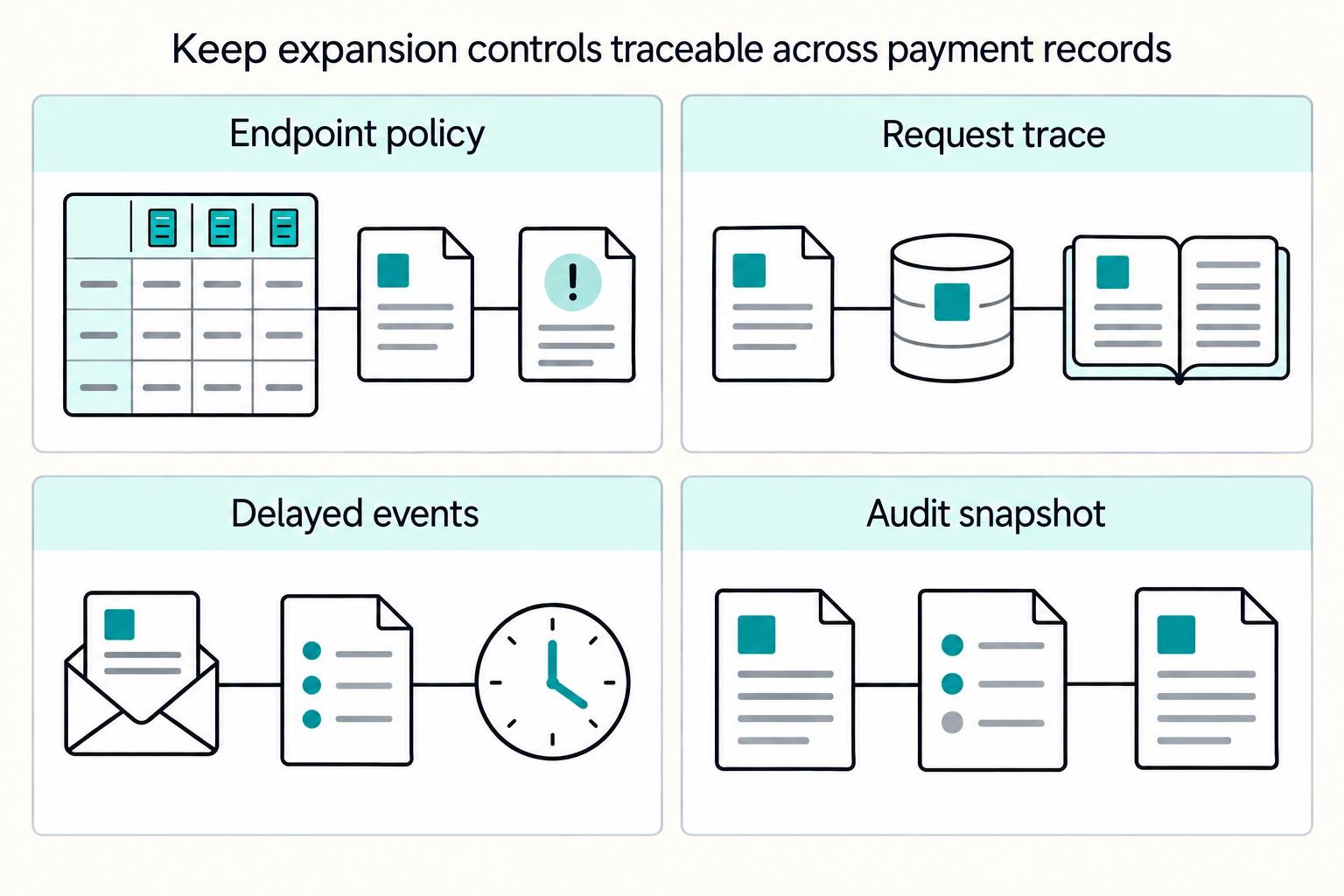
To scale beyond a narrow pilot, make duplicate prevention and traceability product requirements, not support habits. Expansion risk usually shows up during retries, webhook replays, and delayed returns, when teams cannot tie an event to one ledger movement across the Canada and United States entities involved.
Add idempotency to every money-moving write path#
Put an idempotency key on every retryable POST that can move funds, including payment and payout creation. A replay should return the prior result, not create a second movement.
Stripe documents that the first result for a key is stored and reused, with low-level guidance describing safe same-key retries within 24 hours. PayPal also states the duplicate risk when a request ID header is omitted on supported endpoints.
Do not assume one retry standard across providers. Validate idempotency support at the endpoint level, and keep a matrix for each provider and endpoint: support (yes/no), key lifetime if documented, retry behavior, and your fallback behavior when support is missing. Where support is missing, route retries through your own internal dedupe record before a second provider call.
Capture one trace chain from request to ledger#
For every CAD and EFT event on Canadian bank rails, log one complete trace chain that support and finance can follow quickly:
- your internal payment or payout ID
- provider request identifier such as
Request-Id - provider object ID
- balance transaction, or equivalent ledger movement record
- reconciliation export row or payout batch reference
This is the minimum evidence pack for fast, defensible investigations. On Stripe, the balance transaction source links movement records to the originating object, and payout-level reconciliation depends on payout ID. If financial reports are available by CSV and API, automate both so settlement proof is stable, not dashboard-dependent.
Define who owns webhooks, exceptions, and rail incidents#
Assign explicit ownership for webhook ingestion, exception queues, and incident response for delayed or returned transfers. This matters because webhook retry behavior varies by provider and events can arrive late or replayed.
Stripe may retry undelivered webhook events for up to three days. Adyen documents three immediate retries and then queued retries for up to 30 days. Treat every webhook as replayable and potentially delayed.
If your activities are in RPAA scope, this ownership model is also a compliance requirement. Section 17 requires a risk management and incident response framework, regulations require measurable reliability targets and specific role allocation, and Section 18 requires without-delay notification for certain incidents. Operationally, if a delayed ACSS or EFT event arrives after manual intervention, reconcile current state first, then decide whether to ignore, reverse, or escalate.
Gate each expansion with an internal audit snapshot#
Before each new cohort, require an internal audit snapshot that ties rail events to internal ledger totals. This is an internal launch control, not a legal reporting cadence.
Include request counts, successful creations, delayed or returned transfers, payout totals, unreconciled items, and the export used for validation. Keep incident logs and exception decisions that explain mismatches. Payments Canada's recent ACSS updates emphasize tracing and clarify bill-payment error-handling responsibilities, so include trace references in investigations. Retain records in a format that supports the Bank of Canada's five-year retention expectation after active compliance use ends.
For a step-by-step walkthrough, see How to Calculate the All-In Cost of an International Payment.
Handle the mistakes most teams make in Canada expansion#
Once you have an audit snapshot, a common risk is poor sequencing, not a missing feature.
Convert announcements into requirements#
Treat partner announcements as market signal, not implementation guidance. Finix, for example, announced Canada expansion and said U.S. companies can expand without multiple APIs, integrations, or compliance challenges, but that does not prove your readiness. Convert each external claim into a confirmation sheet your team can test with the provider or partner:
- which payment methods and CAD settlement paths are supported for your merchant segment
- whether reconciliation exports and identifiers meet your ledger requirements
- whether your model triggers RPAA PSP registration, including foreign-PSP cases
- whether any membership claim includes actual system participation, since membership does not guarantee system access
If you cannot tie the claim to named contacts, current product docs, and a clear yes or no on compliance scope, do not scope engineering yet.
Roll back Interac Debit if core EFT is still noisy#
If core CAD and EFT flows are not stable, adding Interac Debit can increase operational risk. Interac Debit acceptance requires an acquirer or payment processor, which adds another dependency while you are still fixing reconciliation.
The recovery move may be to reduce scope to core EFT and re-baseline. Payments Canada's EFT scope includes direct deposit, remittance, pre-authorized debit, and online bill payments. For many teams, stabilizing those first before adding local debit can reduce risk once your weekly snapshot shows traceable settlement and auditable exceptions. This sequencing can matter because many business decision-makers report reconciliation as time-consuming.
Rework ownership across legal, tax, and payment design#
Do not separate legal setup from payment design decisions. If you incorporate in Canada, CRA requires a business number and a corporation income tax program account. Separately, your PSP pathway may require RPAA registration to continue providing services, including for foreign PSPs subject to the RPAA, and Payments Canada rules are updated over time with online versions in force.
Use one shared owner matrix across legal, finance, and product with three explicit decisions: who contracts the merchant, who owns CRA account setup, and who confirms the PSP or participation path. If any of these remain TBD, pause rollout, because the issue usually surfaces later as onboarding and operating blocks.
This pairs well with our guide on How to Handle Payment Disputes as a Platform Operator.
Are you actually ready to commit GTM budget#
Commit full GTM budget only when your ownership map and evidence pack are complete. A Canada launch is not ready because a partner announced expansion or sales wants pipeline. It is ready when legal, tax, rail operations, and monitoring each have named owners and tested checkpoints.
Lock the operating prerequisites#
Before paid acquisition or broad sales activation, confirm ownership for the Canadian contracting path, CRA setup, and payment operations. If you need a CRA identifier, verify the exact status of the 9-digit Business Number, who manages its program accounts, and where required records will be kept in Canada. CRA records are generally retained for 6 years, so evidence storage should be decided explicitly.
Write a one page launch thesis#
Write a one-page thesis that can be proven wrong. State the target merchant segment, the merchant value you expect to deliver, and why Canada beats your next market now. If the case depends on local debit demand, CAD settlement, or EFT reliability, say so directly. If demand is mainly cross-border card acceptance, delay rail-heavy work instead of masking that uncertainty.
Block on unresolved external dependencies#
Treat unresolved external dependencies as hard blockers. If you expect to perform retail payment activities and your RPAA PSP status is unresolved, do not commit budget. A PSP must register with the Bank of Canada before performing retail payment activities, and annual reporting for registered PSPs includes a March 31 filing deadline each year. Apply the same standard to infrastructure assumptions: membership includes PSPs, but membership alone does not guarantee payment-system access, and direct ACSS participation requires settlement accounts at the Bank of Canada. A practical red flag is any partner motion that still ends with "contact sales" for core launch details.
Get executive sign off on rollback triggers#
Define rollback triggers before spend starts and get executive sign-off in writing. Unresolved pricing, repeated policy overrides, rising EFT exceptions, or missing Canadian rail monitoring should pause launch. If that memo is not signed before activation, you are not ready for a full market commit.
Conclusion#
Treat Canada as a gated operating launch, not a branding expansion.
- Confirm Canada wins on explicit criteria, not momentum.
Document why Canada beats your next-best market on merchant demand, payment-method fit, expected CAD volume, and the team you can actually staff alongside your US roadmap. If demand is mostly cross-border card acceptance and not Canadian bank-rail usage, waiting can be the better choice. Verify: your approval memo names the target segment, priority payment methods, and staffed owners for compliance and integration. A press release, partner pitch, or competitor announcement is not readiness evidence.
- Lock entity design and ownership before product build.
Decide federal versus provincial or territorial incorporation, then assign ownership for each downstream obligation. Federal incorporation allows business across Canada, but operating in additional jurisdictions can still require extra-provincial or extra-territorial registration. Verify: you have a signed responsibility matrix for merchant contracting, CRA registrations and filings, settlement-risk ownership, and corporate tax handoffs. If you form a Canadian corporation, file a T2 every tax year even with no tax payable. For tax years starting after 2023, required T2 filing is electronic, and non-compliance can trigger a $1,000 penalty.
- Prove core CAD and EFT operations before adding more rail complexity.
Establish reliability first in the flows likely to carry day-to-day load. Payments Canada notes ACSS and USBE support 99 per cent of daily transaction volume and 13 percent of daily transaction value, so CAD settlement, direct deposits, and pre-authorized debit reconciliation should be stable early. Verify: pilot evidence traces each EFT event from request to provider reference to internal ledger posting to reconciliation output, including returns and exceptions. If ledger mapping or refund handling is still unstable, pause cohort expansion and resolve those gaps before broadening rail coverage. For deeper EFT design detail, use this guide on international EFT payments.
- Validate compliance and access assumptions with auditable records.
If your activity is in RPAA scope, Bank of Canada registration is a hard gate. Payments Canada states registered PSPs are eligible to apply for membership and Real-Time Rail participation, but eligibility is not the same as operational access. Verify: keep saved registry checks, partner confirmations on rail coverage, and the policies and records supporting your compliance position. Record retention is part of readiness, including five-year retention once a record is no longer used to demonstrate compliance.
- Scale only after pilot gates pass and unknowns have owners.
Move from pilot to full GTM only when reliability targets are clearly defined and measurable, controls are reviewed at least annually and before material operational changes, and unresolved issues have owners and deadlines. Verify: your launch file includes pilot results, logged exceptions, rollback criteria, and a short open-risk list with named owners. The finish line is evidence that the Canadian launch operates cleanly under scrutiny.
If your Canada go/no-go still depends on coverage and control validation, talk to Gruv before you commit full GTM budget.
Frequently Asked Questions
What should a US payment platform localize first for Canada, legal structure or payment rails?
A common sequence is to localize the control surface first, then sequence rails. Confirm which entity contracts with merchants, who owns CRA registrations and filings, and whether your activity may be in RPAA scope before adding CAD settlement or EFT. After that, many teams prioritize core bank-rail needs and add local debit where merchant demand justifies the added operational load.
Do we need Incorporation in Canada before enabling CAD and Electronic Funds Transfer (EFT)?
Not in every case. CRA provides a non-resident path to register a Business Number and key program accounts, including GST/HST. But for corporations, the GST/HST registration effective date cannot be earlier than the incorporation date, and a non-resident corporation carrying on business in Canada may still need to file a T2 return.
How do Interac and Interac Debit change launch complexity versus standard Canadian bank rails?
Interac Debit changes the operating model, not just branding. Interac describes real-time authorization and a good-funds flow tied to accounts at Canadian financial institutions, while Canada’s retail batch rail, ACSS plus USBE, settles previous-day net balances the next business morning. That difference affects reconciliation timing, exception handling, and merchant expectations.
What does Payments Canada participation mean for a Payment Service Provider (PSP) strategy?
Treat membership as a pathway, not guaranteed access. PSPs defined under the RPAA can be members, but Payments Canada states membership does not by itself guarantee access to payment systems. Actual participation still depends on meeting operational, technical, security, and related requirements.
Can we phase compliance work, or must CRA-related controls be complete before any pilot?
You can phase product scope, but not the controls that determine whether you can operate. If you are in RPAA scope, Bank of Canada registration is required before retail payment activities begin. If you are a FINTRAC reporting entity, you must establish and implement a compliance program. GST/HST treatment can also change once taxable sales exceed the small-supplier threshold of $30,000 over four consecutive calendar quarters.
What minimum evidence should operators require before approving full GTM spend?
Require evidence, not assurances. Practical evidence can include a clear ownership matrix for contracting, CRA, compliance, and rail operations; proof that CAD and EFT events reconcile in test or pilot; and written confirmation of partner access assumptions. When applicable, verify Bank of Canada PSP registry and FINTRAC registry status, but do not treat either registry as an endorsement or licensing signal.
Try a related tool
Researched and edited by the Gruv editorial team. Gruv builds cross-border billing, payouts, and finance-operations software for global businesses.
Sources
Includes 5 external sources outside the trusted-domain allowlist.
- ecfr.gov/current/title-31/subtitle-B/chapter-X/part-1...trusted
- ecfr.gov/current/title-31/subtitle-B/chapter-X/part-1...trusted
- laws-lois.justice.gc.ca/eng/regulations/SOR-2003-346/section-1.htmltrusted
- bankofcanada.ca/2024/10/criteria-for-registering-payment-ser...external
- bankofcanada.ca/core-functions/retail-payments-supervision/i...external
- canada.ca/en/department-finance/programs/financial-sec...external
- canada.ca/en/revenue-agency/services/tax/businesses/to...external
- interac.ca/en/payments/personal/pay-with-interac-debitexternal
Educational content only. Not legal, tax, or financial advice.
Related Posts
How Platforms Choose International EFT Payments Across Borders
If you are choosing a provider for cross-border EFT, start with route evidence, not country-count slides. Cross-border payments are more complex than domestic ones: they are often slower, less transparent, and more expensive. Broad coverage on paper may not reflect performance in your real corridors or exception paths.
What Is a SPAC? How Payment Platforms Can Use Special Purpose Acquisition Companies to Go Public
The core decision is readiness, not structure. Choose the route your team can support under public-company disclosure, governance, and reporting pressure. If your operating claims are not backed by evidence today, a **Special Purpose Acquisition Company (SPAC)** should not be treated as a shortcut.
How Platforms Reconcile Foreign Contractor Payments in QuickBooks Online
This guide is for CTOs, engineering leads, and finance ops owners who need foreign contractor payouts to reconcile cleanly in **QuickBooks Online** (`QBO`). The real question is not just whether you can send money. It is whether each payout maps back to the right vendor, bill, and payment record when Accounts Payable reviews the ledger.