

Quick Answer
Choose the best international moving companies by filtering for written execution proof, not brand visibility. For a digital nomad move, the strongest option is the one that can document route steps, handoff owners, document responsibilities, and escalation contacts for your exact lane. Compare candidates with the same questions, freeze your shortlist once evidence is clear, and keep one backup provider ready if your primary misses a critical checkpoint.
Your move is not a vibe project it is an operations project#
Treat this as an execution decision, not a brand popularity contest. You are not picking from a generic pool of movers. You are testing whether a provider can explain your route, show who owns the risky steps, and put that in writing before you commit.
Start with a simple filter: can they walk your move in plain English for your actual origin and destination, without hiding behind vague "door to door" language? That matters more than badges, marketplace activity, or polished reviews. If you are moving to Spain, for example, a serious conversation should acknowledge the red tape. It should also acknowledge that English is less common in rural areas. A company that cannot talk through those friction points early is telling you something useful.
| Decision gate | What you ask | Acceptable evidence | Pause or remove if |
|---|---|---|---|
| Route fit | "Walk me through my route step by step, from pickup to destination delivery." | A clear verbal walkthrough followed by a written recap after the estimate | They stay generic, skip handoffs, or cannot explain destination-side steps |
| Handoff ownership | "Who owns each transfer point, and when does responsibility change?" | Named roles or teams, plus a simple written responsibility summary | You hear "our partner handles that" with no names, no contacts, and no accountability |
| Documentation owner | "Which documents do you prepare, which do I provide, and who checks completeness?" | A written checklist that separates your tasks from theirs | They blur document ownership or say paperwork gets sorted out later |
| Escalation path | "If a shipment stalls or a document is rejected, who is my escalation contact?" | A named contact or team and a stated escalation path | Support is only a general inbox or call center with no escalation route |
| Crew standards | "Who will handle my goods, and what screening or training standards apply?" | Concrete standards, such as training or checks for movers and subcontractors | They cannot say who will actually show up or how partner crews are vetted |
That table matters more than any "top rated" label. A mover can say its staff undergo training, background checks, and drug screenings. Another can highlight transparency from the first call through billing and follow-up. Those are useful prompts, not proof. Awards and testimonials can support a case, but they do not replace ownership clarity.
Your goal is not to find the loudest option. It is to choose one mover and one backup that can show route fit, ownership clarity, and execution control before your shipment starts. Use this short sprint:
- Prepare your evidence pack
Start with Digital Nomad Pre-Travel Checklist for Long-Stay Moves. Pull together your inventory, target move window, address status, and any documents you already know you will need so estimate calls stay concrete.
- Run three estimate calls
Ask the same questions from the table on each call, then ask for the answers back in writing after the free estimate. If a provider will not summarize process, document ownership, and escalation clearly, do not keep them on the shortlist.
- Check housing readiness before you sign
Use A Guide to Renting an Apartment in Europe as a Foreigner to pressure-test whether your destination address and delivery assumptions are real. Booking movers before your housing is solid can turn a straightforward delivery into storage, delay, or repeated coordination problems.
If you are also sorting destination logistics, read A Guide to the Best International Schools in Barcelona.
Who is this list for and how do you choose in 10 minutes?#
Use this section if your move is cross-border, customs-involved, and coordination-sensitive. Skip it if you are doing a simple local move and only comparing lowest price. If you are balancing work, housing uncertainty, and shipment risk, this section is for you.
Your 10-minute sequence is: shortlist several movers, request estimates, then compare only what each mover will confirm in writing. Before scoring any option, collect four items from each provider: a route plan for your exact origin and destination, named handoff owners, quote inclusions/exclusions, and a document checklist that separates your tasks from theirs, including any needed extras like car shipping.
| Gate | What you ask for | Pass signal | Fail condition (what to do) |
|---|---|---|---|
| Route plan clarity | "Walk my move step by step from pickup to destination delivery, including expected timing." | Written route recap with timing expectations and customs touchpoints | Vague "door to door" language with no route detail (pause and remove if they cannot clarify) |
| Customs experience | "How do you handle customs steps for origin and destination-country processes on this route?" | Clear explanation tied to both sides of the move | Generic answer or one-sided process detail (escalate with follow-up; remove if still unclear) |
| Handoff ownership | "Who takes over at each transfer point?" | Named company/team/contact for each handoff | "A partner handles that" without names or accountability (remove) |
| Quote scope boundaries | "What is included, excluded, and treated as an extra?" | Clear scope boundaries in writing, including optional extras such as car shipping | One total price with no inclusion/exclusion breakdown (pause until scope is documented) |
| Document workflow | "Which documents do I provide, and who checks completeness?" | Checklist that separates your tasks from theirs | Paperwork described as "sorted out later" (remove) |
One caution before you go deeper: ranking and discovery pages are lead sources, not execution proof. Some disclose that they may earn fees from links or have paid relationships with displayed companies, and some state they may not cover all market options. Use them to find candidates, then ignore rank order and decide on written execution evidence.
Related: The Best International SIM Cards and eSIMs for Digital Nomads. If you are comparing international movers and
How do network brands local agents and listing sites actually differ?#
Classify each name before final quotes: if you cannot confirm who markets the service, who contracts with you, who executes each leg, and who handles escalation, do not advance that candidate.
Visibility is not accountability. A network brand, a local office, and a listing page can each help, but they serve different roles. Separate discovery from execution, then compare quotes.
Classify each candidate by role first#
Ask this in one message: "For my exact route, who markets the move, who signs the agreement with me, who handles pickup and each transport leg, and who handles claims or escalation?" If the reply stays at "door to door," treat it as incomplete.
| Candidate type | Who usually markets | Who may contract with you | Who may execute move legs | Main risk if unclear | Proof to request in writing |
|---|---|---|---|---|---|
| Network brand | Brand-level sales and packaging | Confirm exact contracting entity on your quote/agreement | May involve partner handoffs by route | You assume the brand performs every leg | Route-specific handoff chain, named parties per stage, contracting entity, escalation contact |
| Local agent or local office | Local team relationship and communication | Confirm whether they are the contracting party or a local execution partner | Often origin-side tasks like survey, packing, loading, and pickup; confirm destination scope | Strong local support can hide unclear destination ownership | Written split of responsibilities for pickup, packing/loading, customs paperwork coordination, destination delivery, and unpacking if included |
| Listing or review site | Discovery and ranking content | Usually not your mover contract counterparty | Does not execute shipment legs | Ranking is mistaken for route accountability | Disclosure language on placement/coverage, then mover-issued route documents (not platform copy) |
Listing and review pages can still be useful, but use them for discovery and sentiment only. Some disclose that compensation may affect placement, some note they do not include all options, and quote forms may route data to a partner processor.
Match the role to execution risk#
For international moves, delays usually happen at handoffs and paperwork, not in marketing copy. On your route, require written owners for:
| Execution area | What to name in writing |
|---|---|
| Packing and loading | Written owner |
| Freight mode choice | Written owner for sea vs air |
| Customs paperwork and clearance coordination | Written owner |
| Destination delivery and unpacking | Written owner if included |
| Damage or loss escalation | Written owner, including insurance contact path |
If those owners are still fuzzy after one follow-up, remove the candidate.
Keep or remove with one short sequence#
- Tag each option as
network brand,local agent/office, orlisting/review source. - Request a route-specific handoff plan, scope boundaries, and document checklist.
- Drop any option that cannot name responsibility in writing.
- Advance only providers with clear written accountability.
For destination planning context, see A Guide to the Best International Schools in Lisbon.
Quick comparison table before you request quotes#
Use this table as a pre-quote filter, not a winner list. If route proof, contracting entity, handoff owner, claims path, or customs-document ownership is still unresolved after one outreach round, pause selection and keep that option in backup-only status.
Label key: Verified = supported here. Needs confirmation = request it in writing from the mover. Unverified = not supported here, so do not assume it.
| Option | Role in your pre-quote filter | Route proof | Contracting entity | Handoff owner | Claims path | Customs docs owner | Confidence label | Ask this next | Unknowns that keep it backup-only |
|---|---|---|---|---|---|---|---|---|---|
| Allied Van Lines | Provider candidate on your shortlist | Needs confirmation for your exact origin-destination lane | Needs confirmation | Needs confirmation | Needs confirmation | Needs confirmation | Low (execution details unresolved) | "For my exact route, send a written quote naming the contracting entity, each pickup/line-haul/destination handler, the damage or loss claims contact, and who owns customs-related documents and clearance coordination." | Exact lane acceptance, written scope, binding estimate availability |
| Pickens Kane | Provider candidate on your shortlist | Needs confirmation | Needs confirmation | Needs confirmation | Needs confirmation | Needs confirmation | Low (execution details unresolved) | Send the same written request so responses stay like-for-like across providers | Contracting party, handoff chain, written exclusions, customs ownership |
| Stevenson Transfer | Provider candidate on your shortlist | Needs confirmation | Needs confirmation | Needs confirmation | Needs confirmation | Needs confirmation | Low (execution details unresolved) | Send the same written request and ask for the route in plain sequence, not just "door to door" | Lane fit, destination accountability, claims contact, quote structure |
| Chicago Marathon Movers | Provider candidate on your shortlist | Needs confirmation | Needs confirmation | Needs confirmation | Needs confirmation | Needs confirmation | Low (execution details unresolved) | Send the same written request and ask whether the quote covers packing, loading, freight mode, and destination delivery | International lane depth, scope boundaries, paperwork owner |
| MoveAdvisor | Discovery source for finding movers | Verified for discovery only (includes route-style examples like "Chicago to London movers" and advises shortlisting several movers, then contacting them for estimates) | Needs confirmation from chosen mover | Needs confirmation from chosen mover | Needs confirmation from chosen mover | Needs confirmation from chosen mover | Medium for discovery, low for execution proof | Use it to find candidates, then send each mover the same written request above | Which listed mover can prove your exact lane, dates, and document ownership |
| Yelp | Name source only in this working shortlist | Unverified | Needs confirmation from contacted mover | Needs confirmation from contacted mover | Needs confirmation from contacted mover | Needs confirmation from contacted mover | Low for execution proof | If you find a mover here, send the same written request before treating the listing as decision-grade evidence | Whether any reviewed mover can document lane fit, handoffs, claims path, and customs responsibilities |
Use the unknowns column as your stop signal#
Do not fill gaps with brand familiarity or review sentiment. Advance a provider only when the unknowns shrink in writing. If replies stay vague after one follow-up, especially on the contracting entity or customs-document ownership, keep that option backup-only.
Treat roundup rankings as inputs, not proof. The 2026 roundup pages reviewed here do not agree on a single winner, and at least one includes paid-link disclosure.
Before final quotes, ask for a thorough written quote upfront to reduce hidden or surprise fees, and ask whether a binding estimate is available. Claims like "180+ countries," "all seven continents," or "24/7 customer service" can be useful context, but they do not confirm who handles your exact route or customs-related steps.
Shortlist several names, contact each in the same format, and compare like for like before committing. You might also find this useful: The Best Debit Cards for International Travel.
Best international moving options for digital nomads right now#
Treat this as a screening layer, not a winner list. Advance only the option that gives you written route ownership, handoff ownership, claims ownership, and customs-document ownership.
Service operators to screen directly#
| Operator | Useful for | Cannot prove yet | Request next | Advance or hold |
|---|---|---|---|---|
| Allied Van Lines | First-pass operator outreach on your shortlist | Exact lane fit, contracting entity, handoff chain, claims contact, or customs-document owner — confirm directly with the mover | Contracting entity, each route leg owner, claims contact, and customs-document owner | Advance only if ownership is explicit end to end. Otherwise hold. |
| Pickens Kane | Like-for-like quote comparison with other operator candidates | Contract liability, exclusions, escalation contact, or customs-step ownership — confirm directly with the mover | Contracting party, handoff owners by phase, exclusions, and claims contact in one document | Advance if responsibilities are named clearly. Hold if replies stay general. |
| Stevenson Transfer | Additional operator coverage during shortlist screening | Route-specific process depth and destination accountability — confirm directly with the mover | Route sequence in plain steps (not just "door to door"), plus destination-side owner and claims path | Advance if process and owners are step-by-step. Hold if language stays marketing-level. |
| Chicago Marathon Movers | Intake comparison across operator quotes | International scope boundaries, inclusion detail, or paperwork ownership — confirm directly with the mover | What is included (packing, loading, freight mode, destination delivery), what is excluded, and who owns customs-related documents | Advance if scope is itemized with owners. Hold if inclusions remain vague. |
Discovery platforms (not service operators)#
- MoveAdvisor
Useful for: Discovery and shortlist building. Cannot prove yet: Delivery accountability, claims handling, or customs ownership for any mover. Request next (in writing): From each mover you find, request the same route/ownership document set above. Advance or hold: Advance the mover only when written accountability is clear; otherwise hold.
- Yelp
Useful for: Name discovery only. Cannot prove yet: Lane fit, claims ownership, or customs-document ownership. Request next (in writing): Use the same standardized request with any mover sourced there. Advance or hold: Hold until a specific mover provides written ownership and process detail.
A practical benchmark is published process clarity plus written accountability. On its own site, Seven Seas shows a 5-step process, states online documentation is completed before shipment transport, and says shipments to the UAE, Oman, Kuwait, Qatar, Bahrain, and Saudi Arabia are suspended until further notice. Use that level of explicit process and route disclosure as your bar. Keep one primary and one backup, and move a provider to primary only after handoff and claims responsibility are clearly documented in writing. For destination-planning context, use our digital nomad visa index for 50+ countries. If you want a deeper dive, read The Best Co-Working Spaces for Digital Nomads.
What should you verify before signing any mover?#
Before you sign, get scope, ownership, and proof in writing. If any owner or required document is undefined, pause and keep your backup mover active.
Lock the responsibility chain#
Ask for one written responsibility chain that names four parties: contract owner, origin handler, destination handler, and escalation owner. If you hear "a partner handles that," require the partner's name and role in the same written document.
Your non-negotiable checkpoint is the binding estimate: it should state move price and date, and it must be signed by you and the mover. Also require an inventory list that records shipped items and condition before and after handoff, so you have claim evidence if loss or damage is disputed.
Verify your exact lane, not a generic service promise#
Ask for a route-specific handoff map in sequence, including who owns documents at each step and what the fallback path is if a handoff fails or delays occur. Confirm door-to-door transit time as well, not only port-to-port sailing time; they are different, and cheaper routes can include more port calls and slower delivery.
Treat insurance and service promises the same way: written terms only. Do not rely on phrases like "fully covered" or broad marketing language without matching contract or policy documents.
| Check | Ask for | Pass | Stop |
|---|---|---|---|
| Responsibility chain | Named contract, origin, destination, and escalation owners | All four are named in one written chain | Any owner is vague, missing, or verbal-only |
| Scope and timing | Binding estimate, scope breakdown, door-to-door transit time | Price, date, inclusions, and exclusions are explicit | Scope is bundled, incomplete, or only sailing time is provided |
| Documentation | Inventory list, document checklist, owner per step | Condition tracking and document ownership are clear | Checklist is incomplete or document ownership is unclear |
| Claim-evidence alignment | Written proof for each sales claim | Claims match contract terms, insurance terms, or accreditation evidence (for example, FIDI FAIM status) | Claims are not backed by written proof |
Sign only when scope, ownership, and documentation are fully written. If not, walk or hold, and keep your backup mover warm.
For a step-by-step walkthrough, see The Best Disability Insurance Companies for High-Earners.
What timeline prevents avoidable delays on a nomad move?#
Run your move in four gated phases, and anchor each phase to dates you can verify. Use [visa decision or appointment date], [housing access date], and [latest acceptable delivery date] as your timeline drivers, not a generic "move month." Three to six months is a common planning window, but your route and documentation reality should set the schedule. If one anchor is still uncertain, pause execution instead of forcing shipment movement.
International moves add customs paperwork, ocean transport, overseas delivery, and destination partner handoffs. That means delays usually come from unclear ownership or vague scope, not from a lack of effort.
| Phase | What you do | Go or no-go check | Proof to collect |
|---|---|---|---|
| 1. Shortlist freeze | Cut to 3 to 5 options using written criteria for your route, shipment method, destination coverage, and pricing transparency. If ocean freight is in scope, check whether the provider states FMC licensing. | Go when the shortlist is frozen and each option is being judged on the same criteria. No-go if options keep changing or route fit is still not confirmed in writing. | Shortlist sheet, written criteria, provider emails, FMC licensing reference if relevant, written destination partner coverage notes. |
| 2. Quote validation | Review each quote line by line. Confirm inclusions, exclusions, customs-related handling, inventory handling, and full-route timing. | Go when scope is explicit and quote language matches what you intend to buy. No-go if coverage, charges, or timing terms stay vague. | Final quote set, annotated scope notes, inventory documentation, written exclusions, written clarification on fees and service boundaries. |
| 3. Document readiness | Track every required document with owner, due date, and acceptance check. This may include proof of income, health records, background checks, visa files, and shipment paperwork. | Go when every item has an owner and current status. No-go if any required item has no owner or is still on a timeline that can run weeks or months. | Document tracker, submitted-record copies, upload receipts, appointment confirmations, written acknowledgments where available. |
| 4. Shipment release | Confirm pickup, transfer, customs contact, destination partner, delivery contact, and escalation owner before cargo moves. Assign a named owner and fallback contact at each handoff. | Go when accountability is documented at each step. No-go if any handoff owner is missing or entry/housing timing is unresolved. | Booking confirmation, handoff map, contact list, escalation path, insurance terms, destination delivery instructions. |
Treat phases 1 and 2 as your execution cadence: freeze the shortlist, resolve unknowns in writing, and lock contingency owners before shipment release. If a late promise changes scope, route, or ownership, treat it as a change request and re-open the affected gate.
If your move includes pets, children, or a vehicle, add a dedicated risk-buffer phase before shipment release. Extra approvals and handoffs can extend timelines, and weak coordination increases delay risk at international ports. Keep the rule simple: do not move shipment until added approvals, owners, and fallback contacts are fully documented.
This pairs well with our guide on The Best Pet-Friendly Airlines for International Travel.
Make your decision once then execute with discipline#
When two providers meet your gates on the same shipment details, freeze selection. Keep one backup validated to the same standard, and only switch based on written failure triggers.
1. Freeze the shortlist with a decision rule#
Use your scorecard as a stop rule. Once your primary and backup are both validated on the same route, inventory basis, and service level, stop expanding the list unless a predefined trigger is hit.
| Checkpoint | Ask separately |
|---|---|
| Contracting party | Who contracts with you |
| Price changes | What changes price |
| Destination handoff | Who owns destination handoff |
| Inclusions | What is included |
| Exclusions | What is excluded |
| US Dot / MC Number | Collect where relevant |
Ask one criterion at a time so answers stay auditable: who contracts with you, what changes price, who owns destination handoff, what is included, and what is excluded. If you bundle multiple checks into one request, you usually get vague answers that are hard to verify.
Collect concrete checkpoint fields where relevant, including US Dot / MC Number. If you see those fields on a 2026 listing page, treat them as data to collect, not proof that one provider is automatically better.
2. Validate the backup to the same bar before execution#
Your backup is real only if it passes the same gates as your primary before execution starts. That means matching shipment basis, quote scope, exclusions review, and handoff ownership clarity.
Estimate intake paths can differ: traditional quote request, Guided virtual estimate, or DIY virtual estimate. These are intake methods, not guarantees on final price or execution quality. If a provider changes intake method midstream or asks you to accept a new scope without revised documents, pause and require a rewritten document set before pickup is booked.
3. Lock each stage with written proof#
| Lock point | What you are locking | Proof to collect | Switch if |
|---|---|---|---|
| Scope lock | Service level, exclusions, inventory basis, task ownership | Final proposal version, exclusions list, dated inventory, named owner for each open item | Scope changes without a revised written package |
| Pricing terms lock | Included charges, change triggers, estimate method used | Quote version, pricing terms, revision history, note on method (traditional, guided virtual, DIY virtual) | New fees appear without an updated quote |
| Handoff ownership lock | Contracting party, origin contact, destination partner, key handoffs | Names, emails, phone numbers, owner for each overseas step, US Dot / MC Number where applicable | A handoff remains unnamed or changes late |
| Backup activation lock | Exact switch conditions and approver | Written trigger list, backup quote pack, dated approval note | Primary misses a documented trigger |
Choose your primary, document your backup, and execute the checklist end to end. Escalate only on written triggers, not last-minute stress, and do not reopen provider selection once execution starts.
For a related breakdown, see The Best International Bank Accounts for Global Citizens.
Frequently Asked Questions
How do I choose the best international moving company for a digital nomad move?
Compare multiple options on the same inventory, route, and service level, then stop reopening the shortlist. Confirm the written scope, exclusions list, cost and service options, and whether each estimate is based on the same shipment details, since price can change with weight, volume, distance, and other factors. Pause if one candidate will not answer the same quote questions at the same level of detail, because you do not have a fair comparison yet.
What should I verify before signing with an international mover?
Read the Terms and Conditions before you sign, not after pickup is booked. Confirm in writing whether all charges are included in the estimate, whether the mover is licensed for international moves, and what exclusions apply. Pause if licensing status or charge inclusions are unclear.
What is the difference between a mover network brand, a local agent, and a directory listing?
Treat the label as a clue about how you found the provider, not as proof of how your move will be handled. Confirm who issued the proposal, who the contracting party is, who your main contact will be, and who handles destination handoff. Escalate or walk away if responsibility stays unclear after the quote stage.
How should I compare ratings from company websites and review platforms?
Use reviews to build follow-up questions and an open-risk log, not to calculate a fake average. Confirm in writing any repeated concern that affects execution, such as unclear exclusions, unclear customs support, or unclear handoff responsibility. Pause if the company responds with generic “we handle everything” language instead of direct answers tied to your shipment.
What documents and checkpoints should I complete before international shipment?
Keep one tracker with each required document, owner, due date, and acceptance check. Confirm the written scope, exclusions list, items-not-allowed list, customs document owner, and named handoff contacts at origin and destination. Pause if any required item has no owner, no current status, or no proof of submission.
What delay points happen most often in international moves and how do I reduce them?
Contact movers early enough to plan your timeline. Confirm the pickup window, customs contact, destination handoff, fallback contacts, and any open risk that could block release. Pause if you are being sold a fixed timing promise while key dependencies are still unresolved.
How do I build a move plan when destination rules vary by country and city?
Keep one core checklist, then localize it for your destination before packing or booking special items. Confirm the current prohibited-items rules and customs paperwork. Leave any destination-specific requirement pending until you can verify it against current embassy, customs, mover, or local authority records before booking or packing. Pause if the mover’s guidance conflicts with those records.
Try a related tool
Researched and edited by the Gruv editorial team. Gruv builds cross-border billing, payouts, and finance-operations software for global businesses.
Sources
- acquisition.gov/far/part-52trusted
- aqua.kingcounty.gov/council/clerk/code/24-30_Title_21A.pdftrusted
- cio.gov/assets/resources/Cloud%20Operations%20Best%2...trusted
- dot.ca.gov/-/media/dot-media/programs/design/documents/...trusted
- fema.gov/sites/default/files/documents/fema_iappg-1.1...trusted
- ftc.gov/news-events/events/2000/12/mobile-wireless-w...trusted
- irs.gov/pub/irs-prior/p2104--122024.pdftrusted
- legacy.trade.gov/guide_to_exporting.pdftrusted
Educational content only. Not legal, tax, or financial advice.
Related Posts

The 2026 Global Digital Nomad Visa Index for 50+ Countries
Start with legal fit, not lifestyle filters. The practical order is simple: choose a route you can actually document, then decide where you want to live. That single change cuts a lot of wasted comparison work and stops you from falling in love with places that were never a real filing option.
Renting in Europe as a Foreigner on a 90-Day Timeline
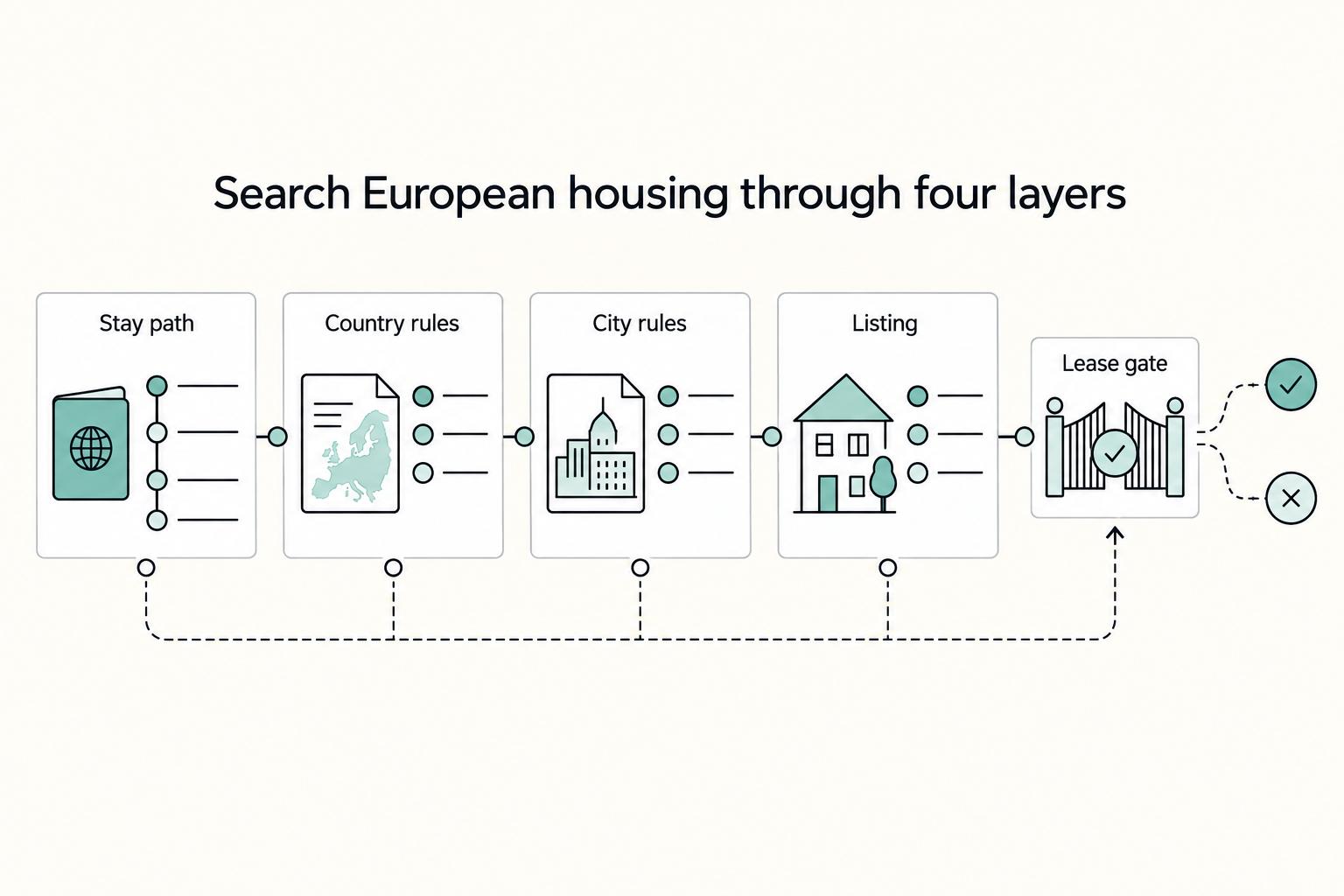
If you're **renting in Europe as a foreigner**, treat the move as a staged long-term housing plan, not a booking sprint. Your first decision is not which listing looks best. It is which city you're targeting, which legal stay track applies there, and when you'll be ready to sign without guessing.

Digital Nomad Pre-Travel Checklist for Long-Stay Moves
Set your departure dates first. Long-term travel planning breaks down when timing stays vague. Vague timing usually turns into rushed paperwork, rushed bookings, or unresolved home obligations.