
Quick Answer
Start by selecting one country you can run cleanly now, then score three to five candidates with the same weighted criteria and explicit friction penalties. Score each country under a feasible entry assumption, and test its actual invoice, settlement, any FX and bank-reconciliation path. Include onward payouts only where your model uses them. Move forward only if your go/no-go threshold is met and pilot checkpoints hold.
Start with the decision you actually need to make#
To choose your first international market, shrink the decision before you scale it. The first question is not, "Where is the biggest opportunity?" It is, "Which single country can we enter with a clear scope and support in month one without creating operational debt?"
Step 1: Set the goal around operability, not headline demand. Your first market should be survivable and teachable. In practice, look for the country where the commercial case is good enough and the operating path is clear enough. Do not default to the country with the biggest TAM slide or the loudest inbound interest. The practical test is whether you can serve customers there without immediately forcing unplanned structural changes.
Write the goal as a one-sentence decision statement. For example: "Pick one country we can launch in with a clear offer, clear ownership, and clear records of what we will validate first." Verification point: if your draft goal includes "largest," "fastest growing," or "most strategic" but says nothing about execution constraints, it is still a growth wish, not a usable operating decision.
Step 2: Define success before you compare any countries. For this kind of decision, success is usually boring in the right way: clear assumptions, explicit tradeoffs, and measurable checks. That matters because it changes what "good" looks like. A market that promises strong demand but creates exception-heavy execution can cost more than it teaches.
Turn that into a short scorecard preface before you build the scorecard itself. List your non-negotiables, your acceptable tradeoffs, and the evidence you will require to say yes. A simple one-page memo is enough if it names the owner, date, assumptions, and what would disqualify a market. Red flag: if stakeholders can each describe success differently, you do not have a market decision yet. You have competing narratives.
Rank markets before making a large entry-mode commitment, but compare each under a feasible entry assumption. If a country requires a local entity or partner, include its cost and constraints in the ranking; revisit the score when that assumption changes.
Keep separate notes for country attractiveness and how you could legally and commercially serve it. Compare the same offering and customer segment across candidates, then document which feasible entry mode each score assumes.
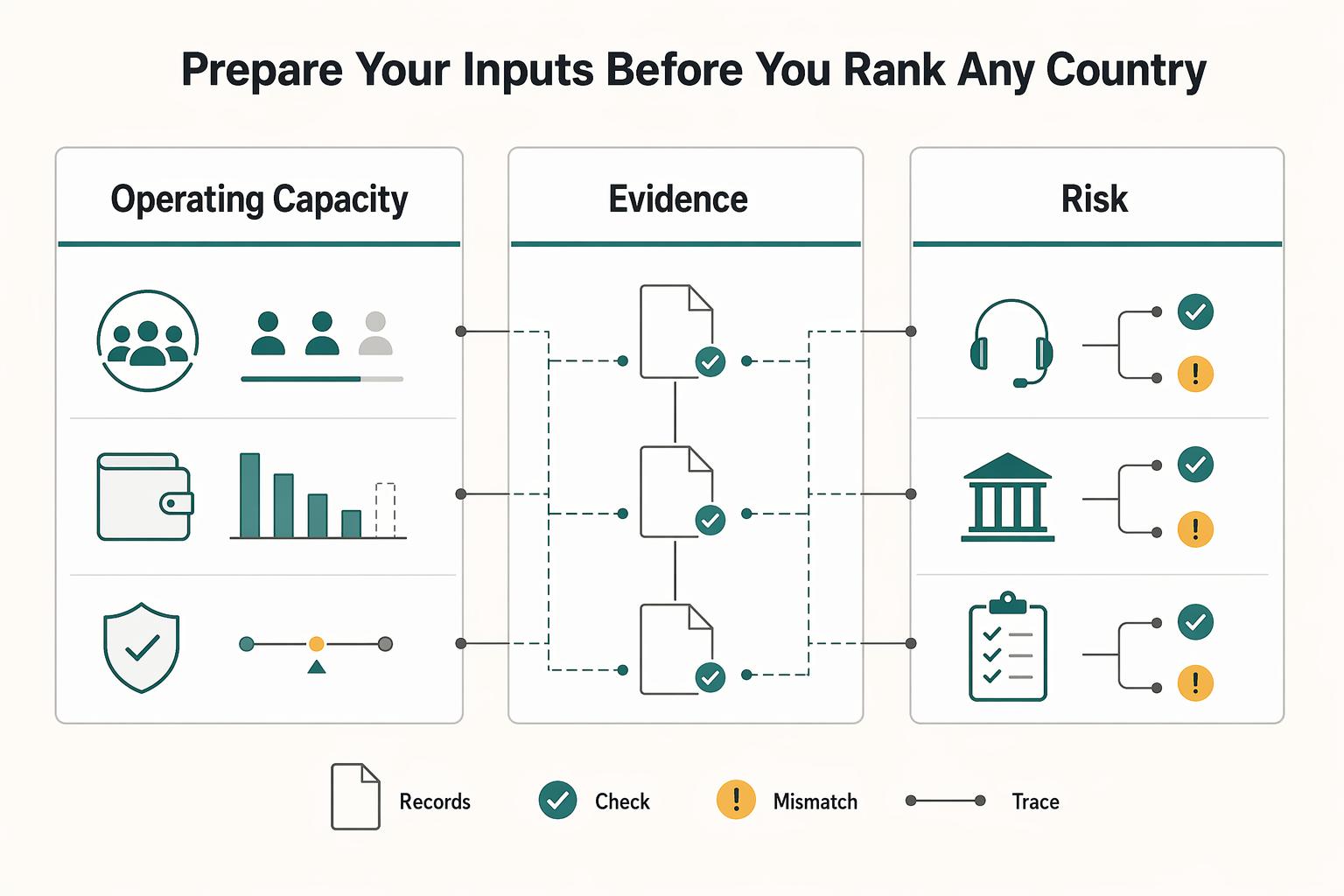
Prepare your inputs before you rank any country#
Start with input quality, not country scoring. A ranking is only as reliable as the assumptions and evidence behind it, so write down your assumptions, assign owners, and attach the evidence before you compare markets.
| Input area | Check | Record |
|---|---|---|
| Operating capacity | Team capacity, cash runway, and compliance tolerance | Owner, date, and current limits |
| Evidence pack | Inbound leads, customer requests by country, support-language constraints, contract terms, tax obligations to review, and payment rail requirements to confirm | Invoice templates, customer terms, payout approval steps, and settlement reports |
| Major rework risk | Invoicing, FX handling, payout controls, and whether a new legal entity is feasible now or only a future option | Record major contract redesign, new language coverage, or entity setup first as friction in the ranking |
Step 1: Run a readiness check on your operating capacity. Review team capacity, cash runway, and compliance tolerance together. The practical question is whether you can support one new country without breaking billing, support, or month-end close. Verification point: document owner, date, and current limits. If support ownership, collections follow-up, or compliance review is unclear, pause ranking.
Step 2: Build an evidence pack before any scoring starts. Collect current demand and operating evidence: inbound leads, customer requests by country, support-language constraints, contract terms, tax obligations to review, and payment rail requirements to confirm. Include the documents you use today, such as invoice templates, customer terms, payout approval steps, and settlement reports. If evidence is stale or based on a single conversation, mark it as weak.
Step 3: Confirm what you can operate without major rework. Check invoicing, FX handling, payout controls, and whether a new legal entity is feasible now or only a future option. If a market depends on major contract redesign, new language coverage, or entity setup first, record that as friction in your ranking.
The U.S. Market Diversification Tool is a useful example of comparing selected export markets with consistent inputs and weights. Its product and trade indicators are a research starting point, not a ready-made SaaS ranking.
Build a shortlist of three to five markets you can realistically serve#
Your goal here is to narrow to a small, evidence-backed set you can realistically serve, then choose one pilot market.
| Shortlist rule | What to log | Decision rule |
|---|---|---|
| Real pull signals | Signal, date, and owner | Base the shortlist on evidence, not momentum |
| Current operating support | Readiness limits, including service capacity and compliance tolerance | Move markets that depend on major new work to a later list |
| Simple scoring | One consistent scorecard | Choose one pilot market with a realistic chance to succeed |
| Exclusion log | Why it was removed, who decided, and what new evidence would justify reopening it | Keep excluded markets from quietly returning without changed facts |
Step 1: Start with real pull signals. Prioritize countries showing actual demand from existing customers, online data, and qualified inbound interest. For each candidate, log the signal, date, and owner so your shortlist is based on evidence, not momentum.
Step 2: Keep only markets your current operation can support. Filter candidates against the readiness limits you documented earlier, including service capacity and compliance tolerance. If a market depends on major new work before launch, move it to a later list instead of forcing it into your first-wave shortlist.
Step 3: Compare remaining options with simple scoring. Use one consistent scorecard so the comparison stays objective and you can choose confidently. You do not need to rank every country; you only need one market with a realistic chance to succeed as your pilot.
Step 4: Keep an exclusion log. For each market you cut, record why it was removed, who decided, and what new evidence would justify reopening it. This keeps excluded markets from quietly returning without changed facts.
Score each candidate market with a compliance-first decision matrix#
Once your shortlist is set, score the same evidence across each market so the decision stays objective and comparable. A decision matrix helps you compare options side by side instead of debating narratives.
Step 1: Build one weighted scorecard across all shortlisted markets. Use the same five criteria for each market: demand quality, compliance burden, payment operations complexity, localization load, and support cost. Set weights before scoring so the model reflects your priorities consistently. Set every criterion in the same direction: 5 is favorable and 1 unfavorable, so lower compliance effort, payment complexity, localization load and support cost score higher. For an illustrative weighting of 40% demand, 20% compliance, 20% payment operations, 10% localization and 10% support, scores 4, 3, 4, 2, 3 produce 3.5 out of 5. Use your own weights and evidence; these numbers are a worksheet example.
| Criterion | What to score | Evidence to attach |
|---|---|---|
| Demand quality | Whether demand is current and repeatable | Dated leads, customer concentration, partner proof |
| Compliance burden | The level of pre-launch compliance effort | Internal compliance notes, counsel input, known blockers |
| Payment operations complexity | How hard it is to invoice, collect, and reconcile | Payment rail notes, billing constraints, finance review |
| Localization load | Changes needed in language, product, contracts, or onboarding | Product gaps, content changes, contract redlines |
| Support cost | Expected service effort after launch | Language needs, coverage hours, training or hiring needs |
Verification point: each score should map to an owner, date, and document.
Step 2: Show exceptional friction separately. Apply a predefined penalty only to a cost or constraint not already captured in a criterion. Count each issue once. Tariffs and customs may matter for goods; use applicable tax, regulatory or local-entity costs for your own offer. Hard legal or commercial disqualifiers remove a market regardless of its score.
Step 3: Define your tie-break rule before reviewing totals. If results are close, apply the pre-set tie-break consistently. A practical tie-break is faster time-to-first-revenue with fewer irreversible commitments.
Step 4: Document a go/no-go threshold. Write the threshold in the same sheet as scores, owner, and decision date, then keep that rule fixed across stakeholders. If a market is reopened later, update evidence first and rescore under the same rules. Require a credible buyer and contribution-margin case as well as operating readiness; payment traceability alone does not prove demand or profitability.
Pressure-test how money and operations will actually work in the top market#
Your top market is only real if money can move cleanly from invoice to bank statement. Before launch, run one realistic transaction end to end and confirm each handoff has an owner, timing, and a traceable record.
Step 1. Map one transaction end to end. Use the intended invoice, collection, provider settlement, any FX conversion and bank receipt. Include onward beneficiary payouts only if your business model has them. Confirm which provider handles each step and its actual timing for the chosen account, currencies and market; local-currency display does not establish local processing.
Step 2. Test failure handling before customers hit it. Test unmatched deposits and the relevant failures for your route: rejected FX quotes if conversion occurs, and payout failures if onward payouts are part of the business. Confirm what operators see, what gets logged, who is alerted and when manual handling starts. Record quote timing and conversion references where FX execution is involved.
Step 3. Confirm launch-gating controls. Check which controls apply to your entity and payment program: KYC, VAT validation, and payout policy controls where supported. Answer three questions before go-live: what must be approved before collection, what must be approved before payouts, and what changes trigger re-review.
Step 4. Compare the operating path before you lock structure.
| Decision point | Employer of record first | Wholly owned subsidiary later |
|---|---|---|
| What you are doing now | Use an EOR for local employment where lawful and suitable; separately establish the selling entity, tax position and payment collection path | Stand up a local entity that can later take on invoicing, banking, and accounting responsibilities |
| What to verify before launch | Which entity invoices, collects funds, and appears in settlement and payout records | Whether the new entity can reproduce payment, FX, payout, and reconciliation trails without breaking reporting continuity |
| Compliance checks | KYC, VAT validation, and payout controls for the entity handling money | KYC, VAT validation, and payout controls for the subsidiary before it handles money |
| Trigger to move | Demand is proven, but you are not ready to migrate money flow | Control, banking, or reporting needs justify migration |
Step 5. Define the minimum audit trail for launch and month-end close. Require a compact evidence pack from one test transaction:
- customer invoice and payment reference
- settlement report with date, currency, and net amount
- FX conversion record or timestamp (if conversion occurred)
- onward payout instruction or bank transfer reference, if applicable
- matching bank statement line
- exception records for the failures relevant to the tested route
If you cannot assemble that pack from a single test flow, the market is not operationally ready yet.
Confirm the entry mode behind the winning score#
Choose the lightest viable entry mode supported by the market evidence. Direct cross-border sales or a partner may be suitable, but verify selling, tax and licensing requirements before assuming remote sales avoid local obligations.
Entry modes trade investment and control differently. Exporting, licensing and local investment are options rather than required stages in a universal sequence. Choose the route your offer, customer and local requirements support.
| Mode | Typical commitment | Use it when | Hard constraint to name before choosing |
|---|---|---|---|
| Direct exporting | Low | You want fast entry with direct customer visibility | Lower local control and local-market knowledge |
| Indirect exporting | Low | You need speed and a local intermediary | Margin and customer ownership can sit with the intermediary |
| Licensing | Low to medium | You can transfer the offer without building a full local operation | Reduced control and potential partner-competition risk |
| Franchising | Medium | You need repeatable local execution through partners | Ongoing quality and brand control risk |
| Joint venture | Medium to high | You need local access and shared investment | Partner governance and conflict risk |
| Greenfield investment | High | You need full control through a wholly owned local setup | High fixed cost and legal complexity before certainty |
| Merger and acquisition | High | You need immediate local presence, assets, or customers | Integration and execution risk after close |
Before committing, write one failure case for the chosen mode and how you would recover. Include partner failure, weak demand or exit costs where relevant; higher investment does not by itself establish a better fit.
Launch a limited pilot with explicit stop or scale checkpoints#
Run a narrow, measurable pilot first, then scale only after it proves it can operate cleanly. Trying to serve everyone too early usually burns runway and muddies what you are actually learning.
| Pilot control | Details | Action |
|---|---|---|
| Scope | One segment, one offer, one channel, and one operating owner | Keep the pilot tight |
| Checkpoint sequence | Legal/compliance pass; paid-demand and contribution-margin thresholds met; receipts reconciled; applicable onward payouts completed; support within capacity | Judge progress in this order |
| Stop conditions | Demand or margin misses; unresolved customs delays for goods; repeated payment or applicable payout exceptions; support above capacity | Define before launch |
| Scaling rule | Change only one lever next: volume, segment, or channel | Scale one variable at a time |
Step 1. Keep the pilot tight. Set one segment, one offer, one channel, and one operating owner. The goal is a simple go-to-market motion you can measure without mixed signals.
Step 2. Check commercial results and operations together. Set paid-demand and contribution-margin thresholds before launch. A pilot passes only when it meets those targets, clears legal requirements, reconciles customer receipts to the bank, completes any applicable onward payouts and stays within support capacity.
Step 3. Prewrite stop conditions before launch. Set a pause or redesign threshold for weak paid demand, margin below plan, repeated payment exceptions and support above capacity. Include customs delays for goods, FX failures where conversion occurs and payout failures where onward payouts are part of the model.
Step 4. Scale one variable at a time. After the pilot meets both commercial and operating thresholds, change one lever next: volume, segment or channel. Keep the other conditions stable so you can assess what changed.
Avoid the mistakes that make first-market expansion expensive#
Most first-market expansion mistakes are expensive for the same reason: teams copy playbooks and commit before they have enough evidence for their own operating reality.
Step 1. Re-rank markets with risk-adjusted weights, not market size alone. If market size or prestige is driving the ranking, rebuild it around execution risk and document the weights. Expansion is a strategic decision, not an experiment, and research is not optional even when a choice feels obvious.
Step 2. Use outside lists as prompts, not decisions. A market list can suggest candidates; your buyer evidence, costs and constraints should determine their scores. Keep the evidence behind your shortlist current and record why each market fits the offer.
Step 3. Match structure to actual obligations. Delay a subsidiary when another lawful, workable selling model fits. An EOR can address employment needs but does not itself establish a legal sales, tax or licensing route.
Step 4. Treat partner-led growth as a test you can audit. Do not assume a Distributor or Agent model creates accountability by default. Confirm ownership, reporting cadence, and exception handling before scaling, so you are measuring real traction instead of partner enthusiasm.
Related: A Guide to International Expansion for SaaS Businesses.
Make the choice and move with controlled risk#
Choose a market under a feasible entry assumption, then confirm that mode before committing. Keep early spending reversible where possible and revisit the ranking if the required structure changes.
- Define success and hard constraints.
Put 3 to 5 success metrics on one page before comparing markets: paid demand, contribution margin, support load and reconciled customer receipts. Add onward payout completion where the model requires it. Set thresholds and list non-negotiable legal or operating blockers beside them.
- Shortlist 3 to 5 markets and document exclusions.
Keep the list narrow enough to pressure-test each option. For every excluded market, log a one-line reason (for example, weak demand evidence, heavy partner dependence, or operating friction you cannot absorb yet). This prevents excluded markets from re-entering without new evidence.
- Score each market with one weighted scorecard and tie-break rules.
Weight practical criteria like compliance burden, payment operations complexity, localization load, support cost, and demand quality. Include marketing, sourcing, and control in the scoring logic so tradeoffs are explicit. If scores are close, favor the option with faster time to first revenue and fewer irreversible commitments.
- Pressure-test payment and reconciliation flows before approval.
Map the applicable invoice, collection, settlement, conversion and bank receipt, then verify a test flow. Where you depend on onward payouts or instant cross-border transfers, confirm that exact provider path is supported.
- Confirm the assumed entry mode before committing.
Treat entry mode as a risk-control tool, not a static choice. Start with the level of commitment your current evidence supports, then deepen only after proof. If you later need tighter control and liability containment, evaluate structures like a wholly owned subsidiary based on results, not assumptions.
- Run a limited pilot with prewritten go/no-go checkpoints.
Keep scope tight: one offer, one segment, one owner. Predefine paid-demand and contribution-margin targets, legal readiness, reconciled receipts and support capacity as pass conditions. Add FX, customs and onward payout checks only where relevant. Set stop conditions for repeated misses before launching.
- Scale one variable at a time after a clean pilot pass.
Change one variable per cycle: volume, segment or channel. Pause and revise the plan if demand or margin misses its target, or operations cannot support growth.
Frequently Asked Questions
How do I choose first international market without overcommitting?
Start with a small written shortlist and compare options against your goals and target market. Keep early steps reversible where possible, and avoid large commitments until you have enough evidence to justify them.
What criteria matter most when ranking first-market options?
The core test is fit: which option best matches your goals and the realities of your target market. If two options look similar, favor the one your team can execute more reliably with fewer hard-to-reverse commitments.
Should I pick the largest market first?
Not automatically. Market size can matter, but it should not outweigh fit with your goals and target market conditions.
How many markets should I shortlist before deciding?
Three to five candidates is a practical starting range for this worksheet. Keep the list small enough to compare evidence consistently; expand it if the first shortlist has no viable option.
What is the lowest-risk way to start international expansion?
There is no universal "lowest-risk" path. A lower-risk start is usually the approach that aligns with your goals, matches your target market, and lets you learn before making deeper commitments.
What are the most common failure signals in the first 90 days?
Watch for weak paid demand, contribution margin below your plan, recurring payment exceptions, unmatched receipts and support load above capacity. Set your own pilot thresholds before launch and investigate repeated misses rather than scaling through them.
When should I move from exporting to a deeper local presence?
Consider deeper local presence when proven demand and the operating or legal requirements justify its costs. Recompare the expected margin, control and exit commitments before switching; good payment operations alone are insufficient.
Try a related tool
Researched and edited by the Gruv editorial team. Gruv builds cross-border billing, payouts, and finance-operations software for global businesses.
Sources
Includes 1 external source outside the trusted-domain allowlist.
Educational content only. Not legal, tax, or financial advice.
Related Posts

Digital Nomad Health Insurance Comparison for Long-Stay Moves
Use focused time now to avoid expensive mistakes later. Start with a practical `digital nomad health insurance comparison`, then map your route in [Gruv's visa planner](/tools/visa-for-digital-nomads) so we anchor policy checks to your real plan before pricing pages pull you off course.

International Expansion for SaaS With a Three-Stage Operating Framework
Begin buyer interviews and desk research while you define the operating basics. Before taking a foreign customer payment, establish the selling entity, signing authority, customer terms, applicable tax treatment, and a usable invoice and refund process. Travel and local hiring need their own country review; they are not prerequisites for every remote market interview.

SaaS Internationalization for Teams That Need Launch Control
**You do not get orderly global growth by translating strings faster. You get it by treating saas internationalization as an operating discipline with named owners, launch gates, and documented stop conditions.** This tends to become true once you move past 1-2 languages or start shipping weekly updates across multiple markets. At that point, localization behaves more like infrastructure: invisible when it works and expensive when you ignore it.