
Quick Answer
Yes - paying vendors late can raise costs and weaken supplier trust quickly. Start by defining on-time performance at the invoice-term level, then monitor aging, approval lag, and settlement confirmation each week. The article shows direct leakage through missed early-payment discounts, late fees, and interest, plus second-order damage when suppliers tighten terms or deprioritize you. In UK B2B cases, statutory interest can be 8% plus the Bank of England base rate, which makes repeat lateness an economic issue, not just an AP nuisance.
Why Paying Vendors on Time Protects Margin and Trust#
Paying vendors on time is not just back-office hygiene. It is an operating decision that affects profitability, supplier trust, and service reliability as complexity grows.
Late payment is not just a finance annoyance. Under the EU late-payment framework adopted on 16 February 2011, late payment in commercial transactions is linked to weaker liquidity and harder financial management. The European Commission has also said it reduces trust and confidence in the market. The cost goes beyond one overdue bill. It can show up as supplier friction and harder cash planning.
This article is for founders, revenue leaders, product teams, and finance operators who need to connect payment operations to unit economics. If you own pricing, expansion, supplier onboarding, or AP, you already carry part of this risk even when payment execution sits elsewhere. Payment reliability is often judged by whether you pay when you said you would.
There is a market-wide signal too. The 2024 Small Business Credit Survey found that roughly 4 of 5 small firms face payment-related challenges. In Europe, 70% of companies said being paid on time would help them pay their own suppliers on time. Your payment behavior does not stop at your ledger. It can influence whether suppliers can pay their own suppliers on time.
The goal is practical. You will get checkpoints for where cash-flow pressure starts, when reputation risk becomes an operating problem, what to automate first, and what to measure weekly. Start with one discipline: define "on time" against actual contract terms, then track aging, approval lag, and settlement confirmation against that date.
One verification detail matters early. Payment timing can depend on whether a billing document is complete and accepted. In US federal prompt-payment rules, timing turns on a "proper invoice," meaning one that contains or is accompanied by substantiating documentation. Even outside that regime, the lesson is useful. Incomplete data can stall approvals and create misses that look like treasury issues but actually start in intake and documentation quality.
Scope matters too. Payment obligations and reporting rules vary by jurisdiction and program. The UK has a statutory payment-practices reporting regime for large businesses. US federal prompt-payment requirements apply within a defined executive-branch vendor context, not every commercial transaction. EU public-authority timing rules include 30 days, and exceptionally 60 days, within that framework. Use this article as an operator guide, then confirm implementation details with legal and compliance owners before you set payment promises or redesign controls. In short, late vendor payment can become a broader operating constraint before it becomes a finance fire drill.
Define the reputation tax before you try to fix it#
If you do not define lateness at the document level, you cannot measure the real cost. Use "reputation tax" as an internal label, not a formal accounting term. It describes the relationship penalty that can build when late payment repeats, such as lower trust and less flexibility in commercial discussions.
Payment behavior is visible to counterparties. UK Small Business Commissioner research reports that 15% of surveyed businesses avoided specific customers based on payment behaviour. That does not mean every supplier will react after one miss, but repeated late settlement can change how counterparties choose to work with you, especially when bargaining power is uneven.
Make timeliness measurable with a Vendor payment timeline, not a vague instruction to process bills quickly. In practice, set a consistent start point for when a payable is accepted into AP, then measure whether payment lands within the agreed term. Keep one distinction clear: long agreed terms are not the same as late payment if those terms are followed. Track both the share paid within agreed terms and the share not paid within agreed terms because of dispute so you can isolate where misses start. Then separate the costs so leakage is visible:
- Direct cost: lost discount for prompt payment, statutory interest, and late-payment recovery charges where applicable. In the UK, statutory interest on late B2B commercial payments is 8% plus the Bank of England base rate, and a fixed recovery charge may also apply.
- Second-order cost: cash-flow pressure and supply-chain strain, including suppliers struggling to meet their own obligations when payments are late. These effects are not universal, but they are material enough to track when they follow overdue payables.
Set ownership early and explicitly. Accounts Payable (AP) owns execution of supplier payments. Finance owns margin and working-capital impact. Product or operations own downstream supplier dependency risk. If no one owns "paid within agreed terms" end to end, fix that before you change tools or policy.
Where late payments quietly destroy margin#
Late payments erode margin through two channels: direct leakage visible on payables, and slower strategic leakage that raises financing friction and weakens cash decisions. Once lateness is defined at the line-item level, map each leak by trigger, time-to-impact, and owner. That helps you fix root causes instead of treating every miss as an AP failure.
| Cost type | Trigger | Lag to impact | Owner remediation |
|---|---|---|---|
| Missed Early payment discount | Payment lands after the discount window on a valid, approved bill | Immediate on that payment | AP + finance: prioritize approved payables with discount terms; remove approval bottlenecks |
| Late fee | Contractual fee after agreed terms are breached | Immediate to next billing cycle | AP: clear overdue queue; procurement/legal: confirm contract exposure |
| Interest charge | Statutory or contractual interest on overdue B2B debt | Immediate; can accrue | AP + finance: stop repeat breaches; legal: confirm jurisdiction-specific rules |
| Rework from disputed payable states | Wrong tax treatment, pricing errors, or quantity mismatches block processing | Immediate labor cost, then delayed settlement | AP + procurement/ops: tighten document-quality controls and dispute ownership |
| Higher funding friction | Repeated weak payment behavior contributes to weaker external credit posture | Slower; often visible at renewal or credit review | Finance + treasury: improve payment reliability; monitor business-credit indicators |
| Lower Working capital flexibility | Cash gets trapped in exceptions, rush payments, and poor sequencing | Can show up within the quarter | Finance: balance DPO goals against overdue exposure and supplier risk |
| Poorer Cash flow visibility | Payables data is fragmented or document states remain unresolved | Can show up as forecast error and quarter-end surprises | Finance + AP: unify payable-status data and close unknown states quickly |
Direct leakage is usually the easiest to prove. Missed discounts, explicit late fees, and interest are measurable margin give-ups, not soft costs. In the UK B2B context, statutory interest can be 8% plus the Bank of England base rate, and fixed recovery sums can be £40 / £70 / £100 depending on debt size. Treat that as UK-specific, not a global default.
The next leak is operational rework. APQC benchmark reporting cited by CFO.com shows invoice-to-payment transmission at 12 / 15 / 24 days (25th percentile / median / 75th percentile; N=2,227), which points to real process variation. When bills stall on tax, pricing, or quantity errors, margin is already leaking through workload and delay before terms are even tested.
Strategic leakage is slower but can be larger. Experian states its business score predicts timely-payment risk and that credit quality affects supplier credit extension and borrowing rates; Equifax's Payment Index similarly tracks average days beyond terms. The practical point is not that one late payment causes a specific score change. It is that persistent lateness can tighten financing and trade-credit conditions.
Visibility multiplies the damage. CFO-level guidance shows usable cash forecasts require integrated data across payables, receivables, payroll, and bank accounts. Unresolved payables states can increase forecast error and force reactive cash moves. Use this as an internal prioritization heuristic, not a universal threshold or guaranteed payback rule. If your measured leakage over your planning horizon appears likely to exceed the expected implementation cost of an Automated bill pay platform, consider moving modernization up the queue.
For a broader look at how payment delays affect platform operations, read Late Payments Epidemic: How Platform Operators Can Fix the Global B2B Payment Delay Crisis.
How trust loss becomes an operating problem#
Trust loss becomes operational when supplier behavior changes around each payable, not just when a relationship ends. You can see slower confirmations, changes to Payment terms, and less tolerance for exceptions that were previously manageable.
| Weekly signal | What to track |
|---|---|
| Supplier escalations | Escalation count and reason code, for example payment-status request, hold warning, terms-change request, service complaint |
| Aged approved payables | Current, 1-30 overdue, 31+ overdue |
| Confirmation lag | Ship-date confirmation, exception response, dispute resolution |
This is a real commercial risk, not a soft signal. In a March 13, 2025 American Express Trendex release (survey of 1,000 U.S. business decision makers), 26% said late or slow payments were a common reason they had stopped working with a buyer or supplier. Once your payment pattern looks persistent, the issue moves from AP hygiene to continuity risk.
A common place it shows up is day-to-day execution. Suppliers may become less flexible on timelines, pricing, or quantity exceptions when payment status is unclear. If you are extending terms to protect Working capital, note the tradeoff: EU Observatory analysis says longer payment terms are associated with longer payment periods in 87% of cases.
From there, the impact can spread through service delivery. Lower trust can mean less discretionary support on urgent requests and manual exceptions. UK government research describes late payment as having trickle-down effects through supply chains. Upstream rigidity can become downstream delivery pressure for your team and customers.
The growth penalty is where this starts to compound. Expansion can depend on supplier confidence in predictable settlement as volume changes. EU reporting says poor payment culture is most frequently associated with weaker investment and growth. Treat stalled launches or slower market expansion as potential payment-culture signals, not only planning issues.
Track those signals weekly by supplier and owner:
- escalation count and reason code, for example payment-status request, hold warning, terms-change request, service complaint
- aged approved payables by bucket: current, 1-30 overdue, 31+ overdue
- confirmation lag for key actions: ship-date confirmation, exception response, dispute resolution
Do not treat that as proof on its own; treat it as an evidence pack. If escalations rise while approved payables age past agreed terms for the same supplier cohort, pull payment history and supplier communications into one record and escalate jointly through AP, finance, and the business owner. That is the point where "reputation" can become measurable execution drag.
For a step-by-step walkthrough, see How to Embed Payments Into Your Gig Platform Without Rebuilding Your Stack.
Decide whether you need a process fix or a platform redesign#
Once supplier escalations and aging payables line up, decide the scope quickly. Fix AP when delays are local. Redesign when delays are systemic across your operating model. If misses are concentrated in one team, one approver, or one scheduling handoff, repair AP first. If the same lateness appears across entities, currencies, or payout rails, treat it as a design problem and move toward a payout architecture with stronger automation and state control.
When it is still an AP problem#
Start inside AP when delay is local and repeatable. Track AP cycle time: days from document receipt to approval and payment scheduling. Reported benchmarks show top-performing teams can do this in 2.8 days or faster, while lower performers take a week or longer.
If one business unit owns most overdue payables, or one approval step keeps breaching SLA, fix that lane before redesigning your stack. Tighten approval ownership, backup approvers, cut-off times, and exception handling for missing coding or documentation. AP performance is cross-functional, so involve the actual blocker if it sits with budget owners or operations.
When local repair is not enough#
Choose redesign when misses spread across legal entities, regions, currencies, and payout methods. That pattern usually means payment states across charges, transfers, payouts, and fees are too fragmented to manage consistently. Multi-currency operations add real complexity: some platforms process in 135+ currencies, and connected accounts may hold and pay out in up to 18 supported currencies. Regional models can also require different merchant-account structures.
At that point, faster approvals alone may not be enough to protect supplier payment terms. You likely need shared controls for payment status, routing, and exception ownership.
| Signal you see | Likely root cause | Better first move |
|---|---|---|
| Overdue payments cluster in one approver or team | Local AP bottleneck | Fix approval ownership, SLAs, and scheduling cutoffs |
| Delays appear across entities, currencies, or rails | Fragmented payout architecture | Redesign around shared status, routing, and reconciliation |
| High dispute or reversal volume | Weak state visibility and control evidence | Fix reconciliation and event tracking before adding rails |
If disputes are high, fix visibility before speed#
If dispute volume is high, fix visibility and reconciliation before you add payout methods. Formal disputes can reverse the original payment immediately and can also pull dispute fees.
Operationally, you should be able to see payout-event history and reconcile each bank payout to the underlying settled batches. If your team cannot match payouts to batches by entity and currency, or cannot produce payout event history, treat that as a control gap before expanding rails.
Also treat deadlines as hard controls: dispute response windows are usually 7 to 21 days, and missing the deadline means automatic loss of the dispute.
A practical trigger for redesign#
Use a practical trigger, not a universal law: if you have named owners and documented SLAs and still miss payment targets across multiple billing cycles, escalate from AP coaching to architecture review. Build one evidence pack for that review:
- approval timestamps
- overdue payables by owner
- payout event logs or webhook receipts
- reconciliation breaks by entity, currency, and rail
If the evidence shows one local choke point, repair AP. If it shows repeated misses across the operating model, redesign before payment lateness becomes a standing tax on supplier trust.
What to measure weekly to catch risk before quarter end#
Review four things together each week: service level, leakage, control health, and cash signals. If you only track aggregate Accounts Payable totals, concentrated supplier risk can stay hidden until quarter end.
Start with a strict on-time definition. APQC defines on-time as payment sent within the payment terms on the invoice. If terms are "2/10, net 30," track both outcomes: discount captured inside the 10-day window, and payment still sent by day 30 when the discount is missed.
| Metric group | What to measure weekly | Why it matters | Verification detail |
|---|---|---|---|
| Service level | On-time payment rate by supplier cohort and Vendor payment timeline bucket | Aggregate AP rates can hide concentrated risk in specific suppliers or terms buckets | Recalculate from source terms, not only a default vendor master field |
| Leakage | Missed Early payment discount value, accrued Late fee or Interest charge, and receipt-to-payment cycle time | Shows where lateness is becoming direct margin loss | Keep full receipt-to-payment cycle time (calendar days) next to approval-only time to isolate where delay entered |
| Control health | Payout failure rate, duplicate-attempt rate prevented by Idempotent retry, unresolved exception aging | Shows whether controls are containing errors or only masking them | Sample failed first attempts and confirm retries reused the same idempotency key |
| Finance signal | Near-term Working capital pressure and forecast error associated with Cash flow visibility gaps | Late payments affect liquidity planning, not just supplier sentiment | Compare forecasted near-term vendor outflows with actual disbursements and explain largest misses |
Break the on-time rate into buckets you can act on#
Track on-time performance by cohort, not just companywide. Split by groups you can operate on, such as supplier criticality, terms structure, entity, or exception-heavy suppliers that repeatedly need manual handling.
Also bucket by payment timeline so overdue risk does not hide inside a flat aggregate rate. If one bucket keeps deteriorating across weekly reviews, treat it as an active operating issue.
Measure leakage in money, not just counts#
Price the leakage weekly. Missed discount value is a direct signal: more efficient AP operations improve discount capture, so repeated misses show processing speed is affecting margin.
Keep late-charge logic jurisdiction-specific. For UK B2B commercial payments, statutory interest can be 8% plus the Bank of England base rate. In the EU Directive context, statutory interest is the reference rate plus at least eight percentage points. Do not collapse market-specific rules into one global assumption.
Watch for control failures that can compound losses#
When payout failures rise, retry volume rises too, and manual intervention may increase. That is where duplicate risk can rise. Stripe defines an idempotency key as the unique key used to recognize retries of the same request, and idempotency is meant to let retries happen safely without duplicate execution.
Operationally, each retry after a failed first attempt should reuse the same key, and logs should prove it. If urgent manual resends bypass the normal path, you lose confidence in whether one payment was sent or multiple payments were sent.
Add the finance view before cash pressure forces reactive decisions#
Working capital is current assets minus current liabilities. Payment delays can complicate liquidity management and degrade planning quality in the following weeks.
Include a weekly forecast-error check for vendor outflows. If misses persist because payment status is unclear, the issue is not only AP reporting. It is a cash-visibility and accountability gap that can surface as working-capital pressure and avoidable exceptions.
For the reporting side, End-to-End Payments Visibility: How CFOs at Platform Companies Track Every Dollar in Real Time covers how finance teams build better payment visibility.
Build control points in payment order of operations#
Once weekly metrics show where delays start, harden each handoff from intake to settlement. The rule is simple: no payout state is final until provider confirmation is posted to the Ledger journal.
| State | Control note |
|---|---|
| Capture | Start with the supplier billing document and capture terms and dispute flags at intake |
| Approval | Keep approval separate from release |
| Release | If one status means both approved and ready to send, control breaks |
| Payout confirmation | Asynchronous Webhook outcomes should drive final state updates |
| Reconciliation to the Ledger journal | A payout is complete only when provider confirmation is posted to the Ledger journal |
Define states before you trust status#
Use a clear five-state chain: capture, approval, release, payout confirmation, and reconciliation to the Ledger journal. It is a practical control design, not a universal legal standard. It also prevents late or duplicate payments from hiding behind vague labels like "processed."
Start with the supplier billing document, capture terms and dispute flags at intake, and keep approval separate from release. If one status means both "approved" and "ready to send," control breaks. Disputed items, missing receipts, or supplier-detail changes should stop at approval or reconciliation.
Use an invoice reconciliation document as the formal record of discrepancies or exceptions. You should be able to show why a bill was held, who cleared it, and when it became release-eligible.
Keep event evidence for every state change#
Treat dashboard labels as summaries, not proof. Final status is often not known immediately after an API request, so asynchronous Webhook outcomes should drive final state updates. Store each state change with its event trail:
- outbound API request ID and timestamp
- idempotency key used for send or retry
- raw webhook payload, receipt time, and processing result
- linked settlement batch or provider payout reference
- resulting Ledger journal entry reference
Webhook receipts are not inherently immutable. If you need immutable evidence, keep raw payloads unchanged, timestamp receipt and processing, and restrict audit-trail edits.
Use idempotent retries and exception queues#
Duplicate prevention depends on retry discipline. Idempotency key controls only work when retries reuse the same key for the same payment attempt. Keep two details explicit:
- keys can be up to
255 characters - some APIs can auto-remove idempotency keys after
24 hours, so internal correlation IDs should persist longer if investigations run past one day
Route unmatched states into an exception queue instead of manual resend workarounds:
- API accepted, but no webhook outcome in the expected window
- webhook arrives for an unknown internal payment record
- provider confirms payout, but Ledger journal posting fails
Treat payout batches as controlled releases#
At scale, control Payout batch behavior, not only single payments. Reconcile included transactions as settlement batches, then run post-batch checks against expected counts and amounts before marking anything final.
Use cut-off times, dual controls where appropriate, and separation of duties between release and review authority. If you rely on Same Day ACH windows, align internal approvals to the published transmission deadlines (10:30 a.m. ET, 2:45 p.m. ET, 4:45 p.m. ET) so lateness is not built into the process.
Make finality a journal rule#
A payout is complete only when provider confirmation is posted to the Ledger journal. API success means request acceptance, not necessarily settled funds or reconciled accounting.
Audit this with end-to-end trace samples: source bill, approval, release, provider event, settlement batch, and Ledger journal. If one link is missing, the payout is not fully controlled. For example, Fedwire describes settlement as immediate, final, and irrevocable, but that finality language should not be generalized to all non-wire rails.
If your checklist is ready, compare it against Gruv Payouts to see where status tracking, idempotent retries, and batch controls can reduce manual risk (where enabled).
Compare automation options without buying promises#
Do not pick on speed alone. If an option moves money faster while making payout state harder to verify in your Ledger journal, it can create finance-operations risk.
Once control points are defined, the real question is which automation keeps approvals explicit, handles asynchronous events cleanly, and leaves enough evidence to explain every held, retried, confirmed, or failed payout.
| Option | Implementation effort | Approval flexibility | Reconciliation depth | API / Webhook quality | Payout status transparency |
|---|---|---|---|---|---|
| Current AP stack | Often the lowest near-term change, but often spread across email, ERP, bank portals, and spreadsheets | Can be flexible, but often depends on people and inboxes instead of enforced routing | Usually weakest unless ERP, bank files, and journals are tightly aligned | Often fragmented; status may sit in portals instead of event feeds | Often poor between release, bank acceptance, and final confirmation |
Point Automated bill pay platform | Often moderate effort; can unify intake, approval routing, payment, and reconciliation | Usually stronger than manual AP because routing is built in | Better if transaction-level exports, reporting, and reconciliation tooling are strong | Varies widely; some expose usable events, others stop at dashboard labels | Better only when statuses and exceptions are explicit, not black-box |
Integrated B2B payments network | Often the highest effort because it affects initiation, event handling, and finance data flows | Can be strong if approval logic remains explicit in your control design | Strong when transaction data, settlement references, and accounting links are accessible by API/export | Critical criterion; asynchronous Webhook eventing and replay capability matter | Can provide high visibility, but only when event status and confirmation states are exposed clearly |
Use an RFP to force tradeoffs into the open#
Use a Payment RFP to keep options comparable. The point is to expose tradeoffs, not just headline speed claims.
Score each provider against the same criteria: invoice-to-payment coverage, approval routing, transaction-level exports, custom reporting, API access for warehouse use, reconciliation tooling, and status visibility. Those are the criteria that determine whether AP automation really covers receiving bills, coding, approval routing, payment, and reconciliation.
What separates workable from risky#
The main split is usually event handling, not feature count. Payment outcomes are asynchronous, so credible integrations need Webhook-driven status handling, not only "processed" labels in a dashboard.
Ask for a live flow: approval, release, provider event receipt, and posting reference into the Ledger journal. Then ask for a delayed or failed event scenario. If they cannot show raw event detail, processing result, and replay or resend handling, you have a control risk.
Event-status tooling is a useful signal. For example, PayPal's webhooks events dashboard supports event status and detail views and resend actions, with date-range filtering in the last 30 days. That should prompt one practical question: where does older event evidence live for investigations?
Failure modes that should disqualify an option#
The most costly failures often come from quiet operational gaps, not dramatic outages. A treasury leader described payments "disappearing into a black box" and issue resolution becoming "a drain on resources for all." That is one cost of weak status transparency. Watch for these red flags:
- Black-box status updates where "paid" is not tied to provider confirmation, settlement reference, or event detail
- Weak exception tooling that shows counts but not enough detail to isolate and resolve unmatched records
- Manual fallbacks that bypass controls and quietly break your
Vendor payment timelinecommitments
This matters at the rail level too. The ACH network runs batch transfers, and Nacha rules explicitly address improper reversals and enforcement, so reversal and exception handling should be treated as core controls.
A simple decision rule for selection#
Choose the option that increases throughput without weakening traceability to the Ledger journal. A point bill-pay tool can be enough when it reliably automates approvals and reconciliation and provides usable event evidence. Move to an integrated network when you need deeper visibility and broader data access, not just a faster demo.
Before signing, require an evidence pack: sample transaction export, event payload example, replay or resend path for failed notifications, settlement or payout reference format, and field mapping to your Ledger journal. If they can show speed but not that evidence, keep evaluating.
Related reading: Same-Day vs Next-Day vs T+2 Payouts and the Real Cost to Your Platform.
Handle cross-border constraints before they become payout delays#
Treat cross-border payout timelines as conditional until compliance gates are mapped. If you cannot show where Know Your Customer (KYC), sanctions screening, and Anti-Money Laundering (AML) reviews can pause, reject, or block a payment, do not publish an aggressive vendor timeline.
Build those gates into your commitment model. A bank's Customer Identification Program is part of its AML compliance program, so payout readiness can depend on completing risk-based identity verification. In sanctions scenarios, a transaction may need to be rejected, and some payments or transfers may need to be blocked. Your "approved in AP" state is not the same as "ready to pay."
For each corridor, document the hold points, the evidence needed to clear each hold, and the owner for the next action.
For inbound cross-border collections, use Virtual Accounts where your provider supports them. They are sub-ledger accounts linked to a physical account, with unique identifiers used for payor identification and reconciliation. That can help when a bill is paid from abroad and you need cleaner matching of inbound funds, rather than relying only on remittance text. Coverage varies by provider, country, and program, so confirm support before you design intake around them.
Avoid split-brain status handling. Accounts Payable (AP), payments ops, and support should work from one status source. Ideally, that is the provider's payout-status feed plus webhook events, so "processing," "failed," "returned," or "canceled" means the same thing across teams. Add an escalation path for held or returned funds with at least:
- current provider status
- likely cause, such as missing KYC details or incorrect destination information
- named owner and reissue decision
Returned payouts are often caused by incorrect recipient data, not only compliance issues. They are typically returned within 2 to 3 business days in some programs, but timing can run longer by country. Compliance implementation is not uniform across markets, so confirm each rollout with your provider and legal or compliance team before locking supplier-facing timelines.
Related: Cross-Border Payments Guide for Platform Operators: Rails Costs Compliance and Speed Compared.
Roll out in 30, 60, and 90 days with audit-ready evidence#
Treat this as a control rollout, not an automation sprint. First make delays visible, then enforce controls, then tie payout evidence to your books so each month leaves a defensible record.
| Phase | Focus | Key actions |
|---|---|---|
| First 30 days | Baseline AP performance and state tracking | Measure cost per invoice, first-time error-free disbursements, and cycle time from receipt to payment transmission; trace each payable through received, routed, approved, rejected, escalated, transmitted, failed, returned, reconciled |
| By 60 days | Approval accountability and batch governance | Implement approval routing that supports approve, reject, reassign, delegate, and escalate; assign owners for exception queues; formalize Payout batch governance with named preparer and approver roles, cut-offs, expected counts and totals, and a post-release variance check |
| By 90 days | Payment evidence linked to accounting | Capture provider status updates via webhook events or payout-status notifications and link them to the related journal record; automate retries with idempotent retry and unique idempotency keys |
The goal is a measurable improvement path where Accounts Payable (AP), payments ops, and finance can show what changed, what failed, and who owns remediation.
First 30 days#
Start by baselining current AP performance with benchmarkable measures: cost per invoice, percentage of disbursements that are first-time error-free, and cycle time from receipt to payment transmission. Keep that cycle-time definition strict so queue time is visible, not hidden.
Instrument state tracking so each payable can be traced across timestamps, for example: received, routed, approved, rejected, escalated, transmitted, failed, returned, reconciled. If you cannot reconstruct state history reliably, SLA targets are still guesswork.
By 60 days#
By day 60, controls should be explicit enough to enforce accountability. Implement approval routing that supports approve, reject, reassign, delegate, and escalate, and assign clear owners for exception queues and remediation.
For higher-risk payouts, apply dual control where your bank, rail, or provider setup supports it. Formalize Payout batch governance with named preparer and approver roles, defined cut-offs, expected counts and totals, and a post-release variance check against actual status outcomes.
By 90 days#
By day 90, close the evidence gap between payment operations and accounting records. Capture provider status updates via webhook events or payout-status notifications and link them to the related journal record so payment reporting is traceable.
Automate retries with idempotent retry and unique idempotency keys to prevent duplicate payout operations. If your retry window can run longer than a provider's idempotency retention window, for example 24 hours, document how duplicates are prevented after key expiry.
The monthly evidence pack#
Produce one monthly evidence pack that finance, ops, and audit can read without translation. Include practical fields such as:
- on-time trend against SLA targets
- leakage trend, such as missed discounts, late fees, or interest charges, if tracked
- control exceptions with owner, age, and remediation status
- top supplier-risk accounts by repeat lateness, disputes, failures, or returns
Support each metric with retained records: bill, approval history, batch approval, status notifications or webhook receipts, journal record reference, and remediation notes. If the package cannot pass a trace test from KPI to transaction evidence, it is a status report, not audit-ready proof.
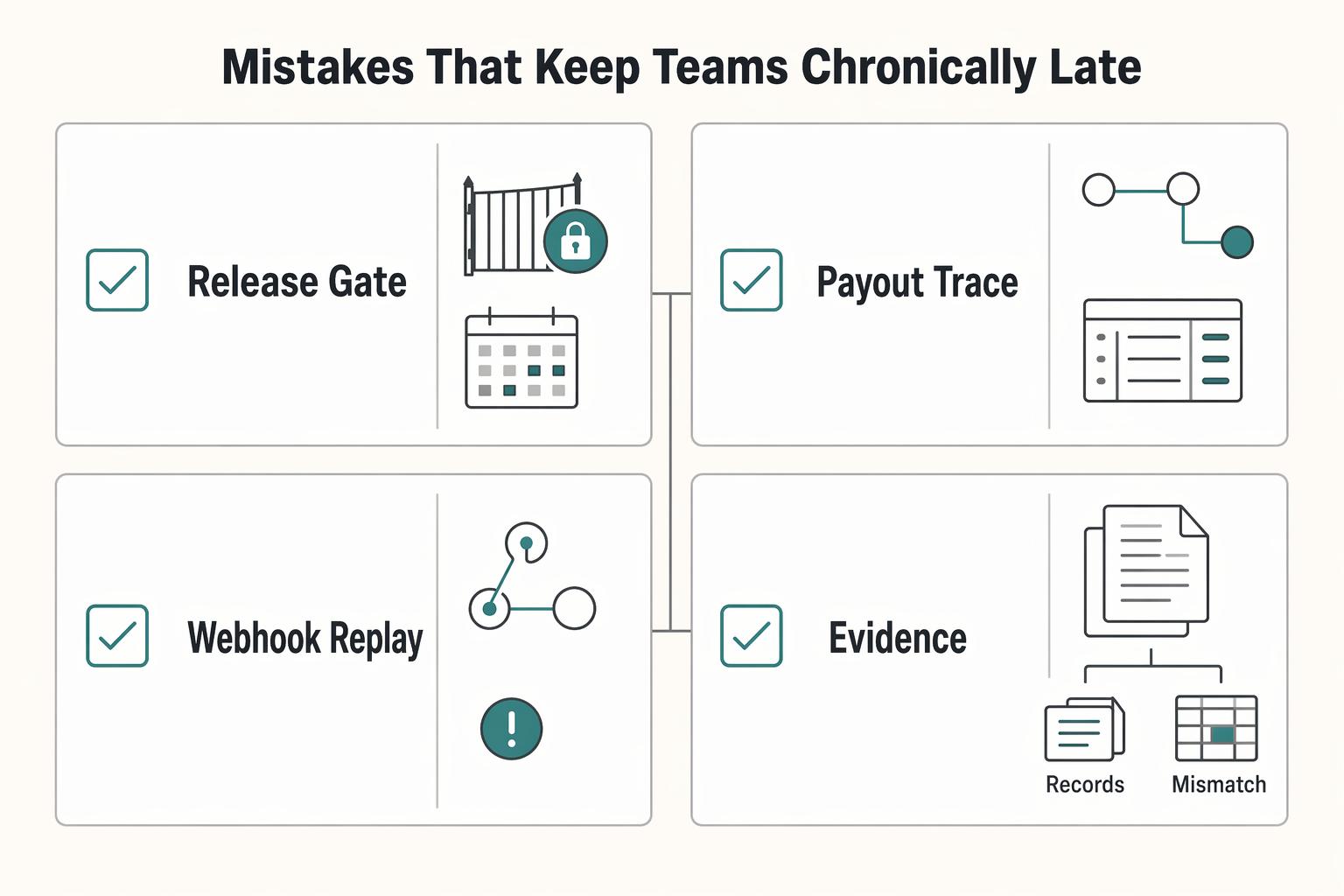
Mistakes that keep teams chronically late#
Chronic lateness is often an operating-design problem, not just one weak AP performer. Ownership gaps, cash-flow pressure, control breaks, and reliability misses can stack up over time.
- Treating payment timing as "finance only." AP performance depends on collaboration across the business, so late approvals upstream can delay payment even when AP is ready. Use approval-and-scheduling cycle time as an early signal: top AP organizations can schedule in 2.8 days or faster, while weaker performers take a week or longer.
- Optimizing payout volume while ignoring cash-flow visibility and ledger traceability. High throughput can mask funding pressure, and cash-flow constraints are a documented driver of late and long payment times. If payouts cannot be traced cleanly from approval through payment status into accounting records, you are carrying close risk even if volumes look strong.
- Buying an automated bill-pay platform before defining control ownership. Automation will not fix unclear approvers, missing exception paths, or weak separation of duties. Keep reconciliation separate from transaction posting, assign owners for rejected, returned, or disputed payments, and require API reliability controls such as idempotency keys and webhook deduplication.
- Ignoring early warning signs. Recurring dispute loops, aging approvals, and repeated "manual urgent" payouts can be control signals, not noise. Administrative errors are a documented late-payment driver (24% overall, 36% among large businesses), so repeated signals should trigger process fixes first.
Conclusion#
Treat vendor payment timeliness as a growth control, not a back-office cleanup task. The practical upside can be lower avoidable payment loss and more predictable execution. The commercial upside is supplier trust. In UK survey data, 15% of businesses said they avoided doing business with specific customers because of payment behavior.
Start with one decision this week: pick the single control point causing most misses and assign one accountable owner. If delays cluster before approval, fix approval ownership. If payments are released but still draw escalations, focus on settlement confirmation, exception handling, and reconciliation.
Use a clear metric, not a vague goal. APQC's definition is practical: an on-time supplier invoice payment is sent within the payment terms on the invoice. That gives you a concrete way to track where misses occur by supplier cohort, due bucket, or approval stage. Then run the minimum operating set:
- measurable timeline targets for approval, release, and confirmation
- exception routing for disputes, returns, and compliance holds
- a traceable evidence trail from payment events to the Ledger journal
- a regular KPI review of aged approvals, unresolved exceptions, and supplier escalations
Do not treat a payment as complete just because someone clicked "pay" or a batch was submitted. Close the loop when provider confirmation arrives, for example through webhook events, matches the expected payment, and is reflected in the Ledger journal entry used for reconciliation.
For retry paths, use idempotency keys where supported so repeated requests do not create duplicate payment objects. For cross-market or regulated payouts, confirm current coverage and constraints before expanding commitments: AML/CFT standards are globally set but implemented by jurisdiction, and FATF monitoring lists are updated three times per year.
Late payment is a controllable operating risk with visible commercial fallout. When ownership, metric definition, exception paths, and Ledger journal evidence are explicit, you can reduce avoidable loss, protect supplier confidence, and keep growth plans from being derailed by payment timing. Before expanding payout promises across markets, use a quick coverage and controls review with your finance and compliance owners.
Frequently Asked Questions
Why does paying vendors on time affect platform reputation more than most teams expect?
Payment behavior can signal business reliability, not just AP efficiency. When delays repeat, the risk can move from friction to relationship loss, including counterparties ending the relationship over payment issues. If supplier escalations and aging payables keep rising together, treat that as a commercial risk signal.
What are the hidden costs of late vendor payments beyond late fees?
Late fees are only part of the cost. EU late-payment law highlights broader damage: weaker liquidity, harder financial management, and pressure on competitiveness and profitability. In the UK B2B context, statutory interest can be 8% plus the Bank of England base rate, but operators often feel the larger impact in cash-planning strain and relationship fallout.
How common are late B2B payments, and what is still unknown in published stats?
Late payment is common, but no single headline number should be treated as universal. Atradius reports that in current US B2B trade, half of invoices are overdue and overdue invoices convert to cash on average 20 days past due. EU reporting also found more than half of companies faced late-payment difficulties in 2024. What remains uncertain is strict comparability across markets, because payment performance varies by country and monitoring gaps still exist.
Does an automated bill pay platform always improve vendor payment outcomes?
No, not by default. Automation can improve outcomes, but only when ownership, approvals, exception handling, and reconciliation are clear and enforced. Adoption data reflects that gap: only 17% of surveyed businesses reported fully automated payments processes, and automation has not yet been fully embraced.
What should a platform team measure weekly to prevent repeat late payments?
There is no universal weekly KPI set in the cited sources. Track control signals weekly, not payout volume alone. Use a short operating view: aging approvals, rejected or returned payments, unresolved exceptions, and supplier escalations tied to payment terms. Then classify each late payment by root cause so the team fixes the process that failed, not just the symptom.
When do late payments become a strategic risk instead of a temporary AP issue?
There is no single universal threshold. The risk often becomes strategic when delays persist across billing cycles, affect critical suppliers, or change counterparty behavior. In EU commercial context, a late payment is one made after the statutory or contractual period. Businesses generally must pay within a maximum of 60 days unless different terms are expressly agreed and fair. If misses continue after ownership and controls are clear, escalate it beyond AP.
Try a related tool
Researched and edited by the Gruv editorial team. Gruv builds cross-border billing, payouts, and finance-operations software for global businesses.
Sources
- acquisition.gov/far/subpart-32.9trusted
- ecfr.gov/current/title-5/chapter-III/subchapter-B/par...trusted
- ecfr.gov/current/title-31/subtitle-B/chapter-V/part-5...trusted
- fdic.gov/risk-management-manual-examination-policies/...trusted
- federalreserve.gov/paymentsystems/fedach_about.htmtrusted
- guides.gaoinnovations.gov/greenbook/2025/appendix-i-requirementstrusted
- ipp.for.fiscal.treasury.gov/onlinehelp/8.0disburserhelp/concepts/dm_con_...trusted
- irs.gov/publications/p583trusted
Educational content only. Not legal, tax, or financial advice.
Related Posts
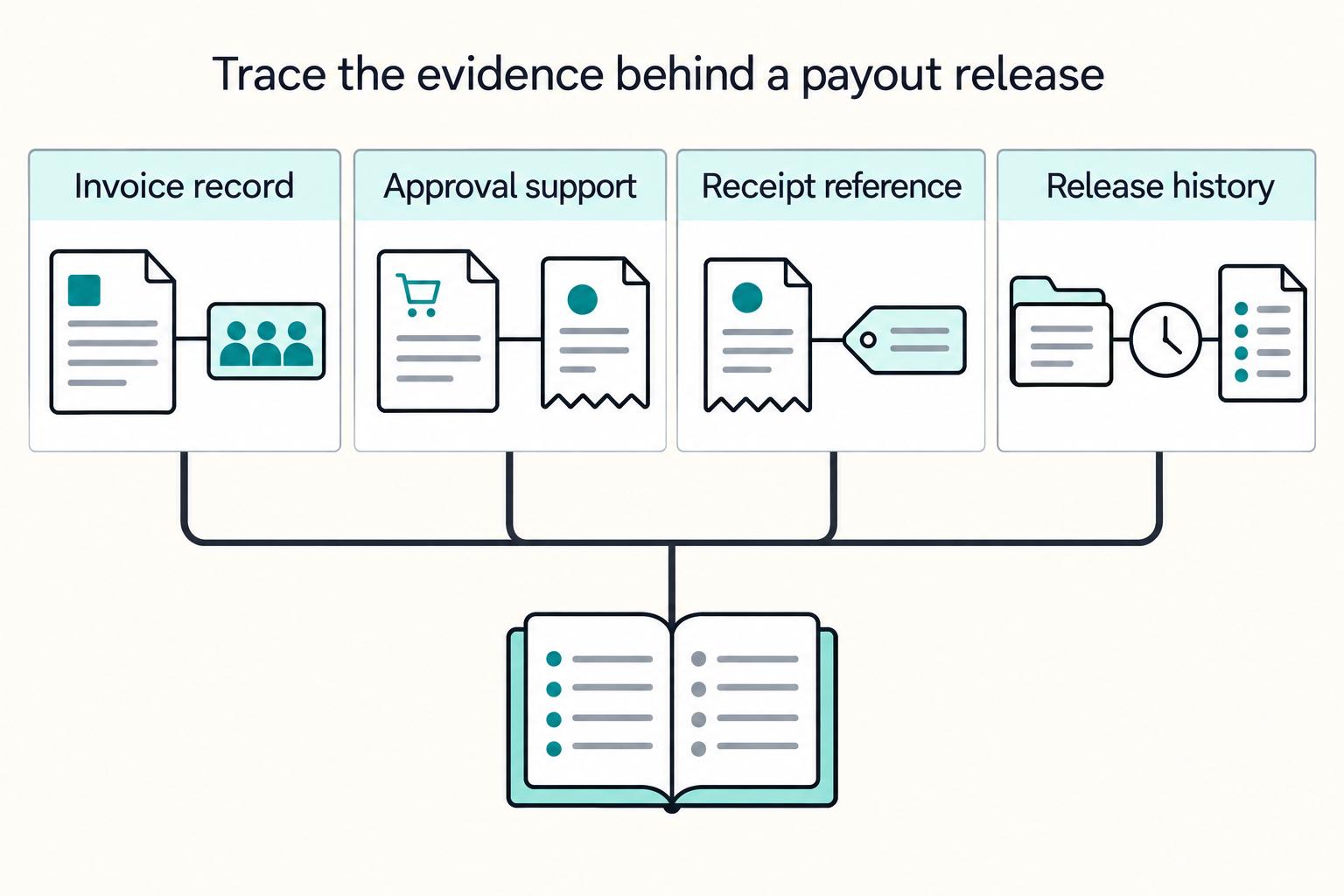
How Platform Operators Triage Late B2B Payments Before Market Entry
Late payments are a market-entry risk for platform operators, not just a collections issue. In B2B and G2B transactions, delayed payment strains liquidity, complicates financial management, and can weaken competitiveness when creditors need outside financing. If you expand before your team can trace where delay starts, you can scale a working-capital problem faster than you fix it.
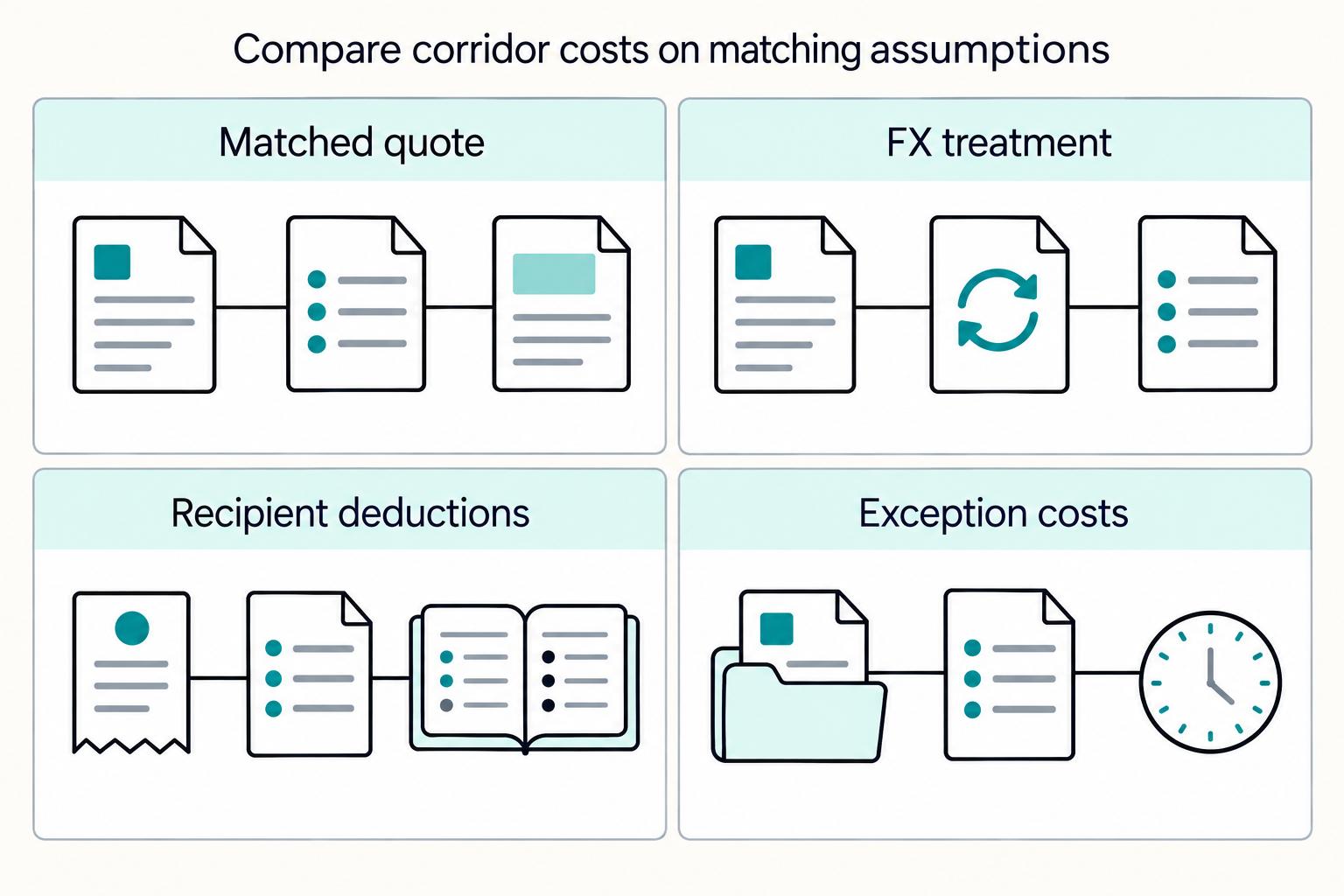
How Platform Operators Choose Cross-Border Payout Rails by Corridor
The hard part is not choosing one "best" rail. It is choosing the right rail for each corridor and payout type, where cost, speed, access, and transparency pull in different directions. For any route, the practical question is simple: for this country pair, payout size, and recipient experience, which path gives you acceptable delivery, controllable cost, and audit-ready evidence?
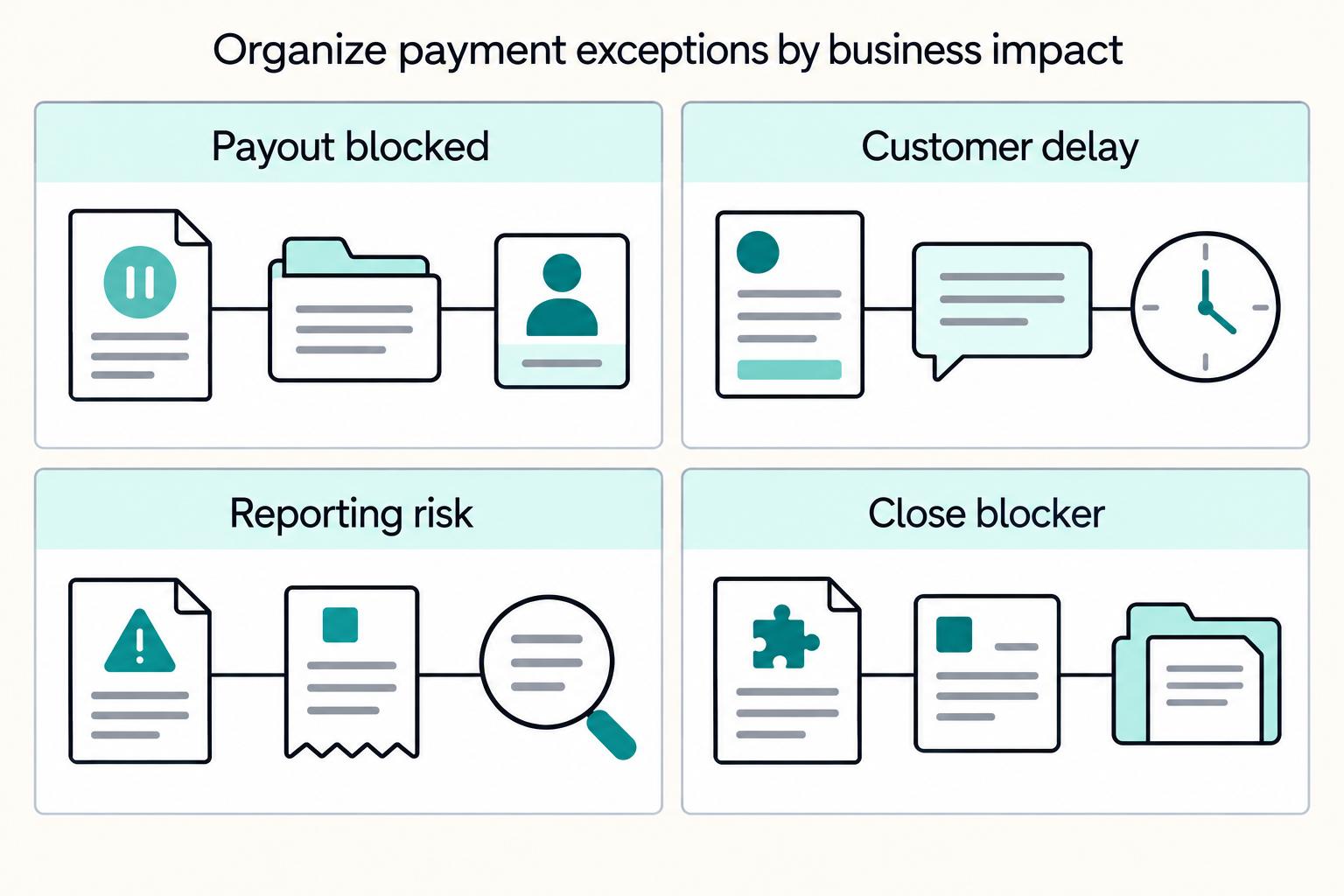
End-to-End Payments Visibility: How CFOs at Platform Companies Track Every Dollar in Real Time
For a Chief Financial Officer, real-time visibility is an operating decision before it is a reporting feature. If teams are not aligned on ownership and proof for each money event, a live dashboard exposes that gap faster. That is broader than a simple payment-status view. Risk can appear at handoffs, especially when a payment event cannot be tied cleanly to bank data and back to ledger records.