
Quick Answer
Start by mapping who is legally responsible for each practitioner and broker payment, then require a finance-trusted record for every handoff before integration work begins. In medical marketplace payouts healthcare decisions, enrollment momentum is not proof of disbursement ownership. Use go/no-go checks for first-premium confirmation, exception routing, and traceability from request to final status; if any path still relies on assumption, stop expansion.
Why healthcare marketplace payouts break expansion plans#
Teams can mis-scope healthcare marketplace payouts when they treat enrollment rails as payout rails. Those are separate decisions. If you cannot name the payer and the record that proves it, expansion risk is already built into the plan.
KFF shows why the confusion is easy to miss. Marketplace enrollment grew from about 11 million to over 24 million people after enhanced premium tax credits were introduced in 2021 and extended through the end of 2025. That signals demand. It does not tell you who pays practitioners, who compensates brokers, or who owns payout liability.
In U.S. exchange flows, this section covers enrollee premiums and tax-credit mechanics. It shows that subsidized enrollee premiums are capped and the federal government covers the remainder as a tax credit. That is useful context for premium flow. It is not proof that the Health Insurance Marketplace directly pays practitioners or brokers.
This article is for founders, payments ops, and finance ops evaluating market-entry constraints, not consumers choosing coverage. The sections that follow focus on the decisions that actually drive launch risk: payout ownership, exception reconciliation, finance evidence, and operational control.
Before you commit product or GTM spend, use documentary checkpoints from authoritative records. FederalRegister.gov is explicitly informational. Legal reliance should be verified against the official Federal Register PDF. For the HHS Marketplace Integrity and Affordability entry, log the official reference tied to 06/25/2025, effective date 2025-08-25, and document number 2025-11606 before policy assumptions turn into requirements.
Related: eCommerce Reseller Payouts: How Marketplace Platforms Pay Third-Party Sellers Compliantly.
How to choose a payout model before building#
Choose the model with the fewest unknowns in payer ownership, not the one that makes enrollment screens fastest to ship. If you cannot name the legal payer and the system of record for each money movement in a Marketplace-related flow, stop before integration work.
| Decision area | Grounded detail | Practical test |
|---|---|---|
| Payout ownership | Map each fund flow to a legal payer, payee, and finance-trusted record. | If ownership still depends on verbal assumptions, you are not ready to build. |
| Compliance burden | Pre-payment can be set amounts per patient, for a set period, and a defined set of services, with possible risk adjustment by patient characteristics and health conditions. | Ask whether the product only passes enrollment and status data or starts to look like it is arranging or controlling healthcare payments. |
| Reconciliation burden | Plans are grouped into 4 metal categories, plus Catastrophic if available, with estimated cost shares from Bronze (60% plan / 40% member) to Platinum (90% plan / 10% member). | Keep a separate, auditable money-movement trail rather than inferred payout logic from premium-side context. |
| Speed to market | Marketplace coverage does not end automatically when Medicare starts; updates can be reported up to 3 months before Medicare starts; the typical Initial Enrollment Period is 7 months. | Whether ops can fence these transitions without redesigning the payout model. |
This shortlist is for teams separating enrollment workflows from payment operations. It is not for consumer enrollment decisions about Open Enrollment, Special Enrollment Periods, Medicare, Medicaid, or CHIP.
- Payout ownership
Map each fund flow to a legal payer, payee, and finance-trusted record. The Health Insurance Marketplace is a coverage channel, not evidence of who disburses practitioner or broker funds. If ownership still depends on verbal assumptions, you are not ready to build.
- Compliance burden
Separate enrollment support from provider payment design. CMS describes pre-payment in some Innovation Center models as set amounts per patient, for a set period, and a defined set of services, with possible risk adjustment by patient characteristics and health conditions. Ask whether your product only passes enrollment and status data or starts to look like it is arranging or controlling healthcare payments.
- Reconciliation burden
Do not treat plan-category data as payout evidence. Marketplace plans are grouped into 4 metal categories, plus Catastrophic if available, with published estimated cost shares from Bronze (60% plan / 40% member) to Platinum (90% plan / 10% member). Your records still need a separate, auditable money-movement trail rather than inferred payout logic from premium-side context.
- Speed to market
Faster launches usually come from narrower scope and fewer ownership assumptions. Keep Marketplace-to-Medicare edge cases out of payout design. Marketplace coverage does not end automatically when Medicare starts, updates can be reported up to 3 months before Medicare starts, and the typical Initial Enrollment Period is 7 months. If Marketplace coverage continues while premium tax credits are used after Medicare starts, those credits may need to be paid back at tax time. The practical test is whether ops can fence these transitions without redesigning the payout model.
For most teams, the first viable model is often the one that leaves payout responsibility with the party that can already prove it in system records.
Related: How to Find a Doctor or Dentist Abroad.
Best payout structures at a glance#
Before you rank options, separate what is actually known from what still has to be defined in contracts. Form 1095-A and Form 8962 support premium tax credit reconciliation, but they do not establish legal payer ownership.
| Structure | Legal payer | Cashflow path | Data artifacts to retain | Main failure surface | Rollout complexity |
|---|---|---|---|---|---|
| 1. Enrollment-only marketplace with insurer payouts | Contract-defined; not established by Form 1095-A or Form 8962. | Platform handles enrollment and status; payout stays off-platform. Commission rates, settlement timing, and claims reimbursement rules are unknown until payer contracts are set. | Form 1095-A; Form 8962 context when premium tax credit is used; contract-defined enrollment handoff records, if used. | Low build scope, but payout traceability and dispute handling can weaken when issuer-side records are delayed or incomplete. | Low |
| 2. Insurer-led payouts with platform reconciliation layer | Contract-defined, still insurer-led in operations design. | Issuer disburses; platform reconciles incoming payout and status data to internal records. Settlement timing is unknown until file cadence is agreed. | Form 1095-A; Form 8962 context; issuer remittance and status files; contract-defined enrollment handoff logs, if used. | Better traceability than enrollment-only, but delayed or missing acknowledgments can create exception backlogs. | Medium |
| 3. Platform-orchestrated payouts through regulated partners | Must be explicitly documented; cannot be inferred from Marketplace or IRS tax artifacts. | Platform or partner initiates payout events after approved records. Commission rates, settlement timing, reimbursement rules, and reversal timing are unknown until partner and payer terms are signed. | Payout event trail and ledger history, plus Form 1095-A and Form 8962 as reconciliation context. | Highest control and observability, but also the broadest failure surface if payer role, approval gates, or exception routing are not defined upfront. | High |
Insurer-led models may reduce launch complexity, but they can also reduce payout traceability and direct exception control. Platform-led models may improve status visibility and handling consistency, but only when payer-of-record ownership and release evidence are fully defined before disbursement.
Before you choose, run two checks. First, confirm whether the Form 1095-A data needed for tax reconciliation is complete, including SLCSP-sensitive fields. Second, if you use enrollment handoff identifiers, treat them as operational joins, not as authoritative payment rules.
Enrollment-only marketplace with insurer payouts#
Choose this model when speed matters most and you can keep enrollment and payment responsibilities cleanly separated. The Marketplace supports enrollment flow, while premium payment and coverage activation sit with the insurer.
| Verification item | What to confirm | Grounded note |
|---|---|---|
| First premium status | Whether the first premium was paid. | No payment means no coverage start. |
| Member account status | The enrolled plan and coverage start timing. | Do not treat enrollment as final status. |
| Plan-issued proof of coverage | Insurance card or other plan-issued proof of coverage. | Keep this as a required go-live verification item. |
The biggest advantage is a simpler operating boundary. In Marketplace coverage, members pay premiums directly to the insurance company, not the Marketplace, and coverage does not start until the first premium is paid. That usually keeps early build and compliance scope tighter because your platform can focus on enrollment progress and status visibility rather than payment orchestration.
The tradeoff shows up after enrollment. Insurer payment processes are not uniform, and users may be routed to the insurer's site to pay, which creates a gap between plan selection and active coverage. If the first premium is missed, coverage can be ended by the insurer, so enrollment should never be treated as final status.
This fits best when your product focuses on discovery, application, or enrollment support and keeps insurer-side payment steps off-platform. In that setup, treat tax forms as tax reconciliation context. Form 1095-A is used to complete Form 8962.
Before go-live, confirm that you can verify three things:
- First premium status, because no payment means no coverage start
- Member account status showing enrolled plan and coverage start timing
- Plan-issued proof of coverage, such as the insurance card
If your product promises fast activation, define a fallback for enrollments around December 15 and January 15 when payment is still pending.
For a step-by-step walkthrough, see How to Build a SaaS Marketplace That Manages Subscriptions and Contractor Payouts.
Insurer-led payouts with platform reconciliation layer#
Choose this when enrollment-only is too thin for finance, but full payout orchestration is still too much control. The goal is not to prove payment from one document. The goal is to build a traceable path from enrollment context to reportable finance status.
Start with a stricter evidence standard. Treat enrollment, insurer-side status, and your internal ledger as separate signals, then reconcile them before you treat any record as reportable. That keeps you from over-trusting a single artifact and makes disputes easier to unwind later.
Use tax forms for context, not payout proof. Form 1095-A is furnished by the Health Insurance Marketplace to enrolled individuals and the IRS, and it comes from the Marketplace, not the IRS. Its role is tax reconciliation: people use 1095-A data to complete Form 8962 and reconcile Premium Tax Credit amounts, including advance payments. Before finance or tax-adjacent use, verify 1095-A accuracy, including SLCSP fields. Healthcare.gov also warns not to file taxes until an accurate 1095-A is available.
When records are delayed, partial, or contradictory, consider holding them for manual review instead of forcing them downstream. Keep a compact evidence pack for each case so reviewers can resolve issues consistently. Also watch for false positives. Healthcare.gov notes that the monthly enrollment premium on 1095-A can differ from premium paid and is not automatically an error.
The cost of this model can be more reconciliation work and a larger exception queue. The benefit is better confidence in reporting and a finance trail that can survive review.
We covered this in detail in Shift-Based Pay for Gig Healthcare Workers and Variable Contractor Payouts.
Platform-orchestrated payouts through regulated partners#
Use this model only when payout control is the real bottleneck. It can give you more operational control over practitioner disbursements without requiring every payment and compliance function to stay in-house. It only works if ownership and approval boundaries are explicit from the start.
The first question is whether insurer files and month-end tie-outs are enough. Healthcare payment operations span multiple payer types, including insurance, government, and individuals. If those inputs are not enough, a partner-led payout layer may help centralize status handling and reconciliation while still keeping insurer and enrollment records in their own lane.
The hard part is rarely the API. Programs are expected to adhere to HIPAA-related requirements, and marketplace onboarding includes provider-credential verification. Before launch, confirm the exact onboarding path, review evidence requirements, and confirm market and route coverage with the partner.
Keep payout proof separate from enrollment and tax context. Use enrollment, insurer, or tax-adjacent records as supporting context, not as proof of payment. Keep payment status records and exception logs clear so mismatches can be resolved quickly.
You also need a plan for mixed healthcare flows. Some marketplace flows are patient-to-provider direct payments, while others involve reimbursements or pre-authorizations that complicate timing and status. Tracking integration issues are a common failure mode, so design ops to resolve mismatches quickly when system records, partner status, and support views diverge.
Make the outsource-versus-in-house decision explicitly. If your priority is standardized operations and long-term scalability, partner-led orchestration can be a fit after you validate fit for your practitioner and market mix. A practical pattern is using Gruv as the payout orchestration layer while keeping insurer-facing records separate.
For a fuller breakdown, read Legal Marketplace Payouts: Trust Accounts and ABA Compliance.
Hybrid model by country and program#
Use a hybrid model when different countries or programs need different payout ownership or regulatory handling. It works best when governance stays centralized and each route is explicit about who pays, what evidence is retained, and which rules apply.
Start by splitting routes by legal payer and evidence ownership. Standardize where you can, but do not force one payout path across every market or program. For each route, define the legal payer, disbursement path, and system of record before you harmonize the product experience.
A key risk is policy drift, especially when ownership and data architecture are fragmented. Run one shared control matrix across teams, and keep it versioned by country or program, legal payer, payout partner, customer promise, retained evidence, and escalation owner so compliance, product, and payout ops work from the same rule set.
For U.S. legal checks, anchor decisions to official Federal Register materials. FederalRegister.gov is useful for discovery, but it states that legal research should be verified against an official edition and notes that the XML display does not provide legal or judicial notice. If you use the Transparency in Coverage entry, record the official references consistently: Document 2020-24591, publication date 11/12/2020, citation 85 FR 72158. For policy decisions, rely on the linked official PDF or official edition.
Allow UX variance if market rules require it, but standardize control evidence. Different routes can have different status experiences, but each route should still produce a consistent minimum evidence set: payout instruction, status history, exception record, ledger outcome, and governing policy reference.
If markets need different legal interpretations or regulated partners, separate money movement by route and accept UX differences. Inconsistent screens are usually manageable; unclear payer ownership is often the bigger failure mode.
Related reading: State Money Transmitter Licenses: Which US States Require a License for Marketplace Payouts.
Agent and broker compensation routing#
Treat agent and broker compensation routing as a control and evidence problem first, not just a payout workflow. If you cannot show the governing document and the rule status behind the routing decision, you should not automate it.
Start with the governing document trail. Before you automate routing logic, make sure you can point to the exact document record your team relied on. In practice, defensibility comes from the retained artifact, not from what an on-screen flow appears to imply.
Use official rule versions in your evidence pack. Do not rely on a FederalRegister.gov XML page by itself for legal interpretation. For the 2026 Notice of Benefit and Payment Parameters entry, store publication date 01/15/2025, document number 2025-00640, citation 90 FR 4424, and the official printed PDF route on govinfo. The XML page is useful for reading, but it remains an unofficial informational resource and should be verified against an official edition.
Keep proposal and final-rule status separate. Label rule status explicitly in your routing decisions. The Regulations.gov record CMS-2024-0311 is marked Proposed Rule. Its comment period is shown as closed (Nov 12, 2024 at 11:59 PM EST), so treat it as proposed-rule context until you verify the final rule source and citation for production use.
If you need one operating standard, use this: no compensation-routing logic goes live until your team can show the governing document, the current official citation, and the rule version status used for the decision.
Evidence pack finance and ops should require#
Build the evidence pack so finance can explain what happened without rebuilding the story from inbox threads. At minimum, for premium tax-credit reconciliation, keep the artifacts that show the enrollment and tax context your team used. If your process also includes payer routing or payout handling, keep internal records for who was treated as payer of record, how status changed, and how reconciliation was closed.
That baseline matters because Marketplace tax reconciliation can move in both directions. If too much APTC was used, it is repaid through taxes. If too little was used, the difference can be claimed as a credit. A pack that only supports the happy path will break as soon as corrected tax data appears.
| Evidence lane | Minimum artifact | What it proves |
|---|---|---|
| Enrollment and tax context | Form 1095-A, Form 8962 context, SLCSP correction status when applicable | The coverage and tax-reconciliation inputs your team used |
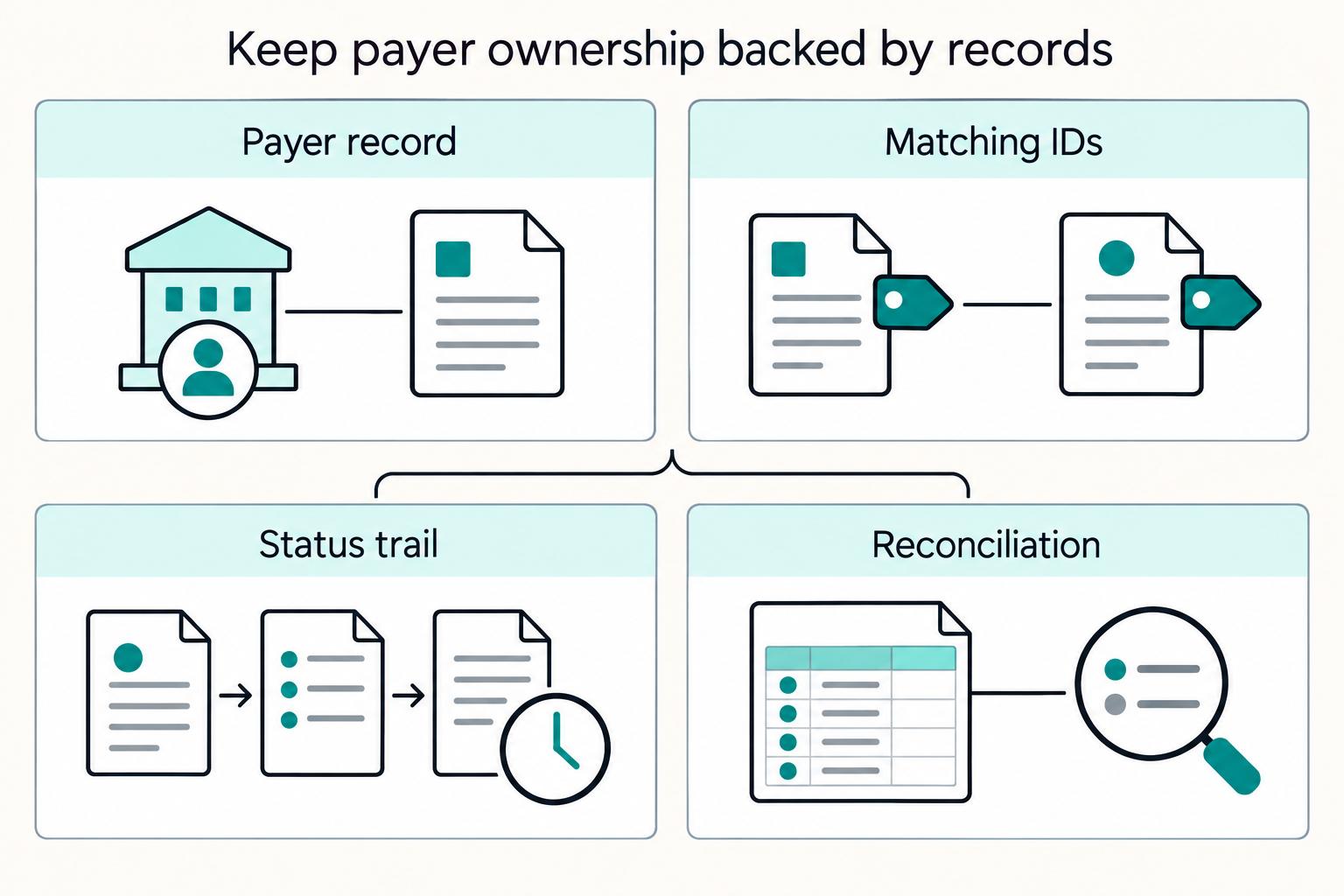
| Payer and matching context (internal control) | Payer-of-record confirmation, plus the enrollment or remittance identifiers your process actually used | Which entity was treated as owing payment and how records were joined |
| Payout and control context (internal control, if applicable) | Status trail and decision/audit artifacts your controls require | What changed, when it changed, and under which internal control decision |
1. Enrollment record first, not just a member snapshot#
Start with the enrollment artifact that anchors the file. In Marketplace-linked flows, that usually means retaining Form 1095-A, since it is needed to complete Form 8962. If decisions are tied to a given coverage year, keep that year's statement context with the internal record it was matched to.
Form 8962 is used to calculate the Premium Tax Credit and reconcile it against APTC, so your pack should preserve enough context to explain downstream variance after tax review. A practical checkpoint is SLCSP on Form 1095-A, because missing or incorrect SLCSP data can affect the tax-credit result.
2. Payer-of-record confirmation should be explicit when your process depends on it#
Do not infer payer ownership from UI screens or partner assumptions. If payer ownership is part of your workflow, keep one retained artifact that states who was treated as payer of record for the flow being reported.
Also retain the matching artifacts your team actually used to join records. If enrollment handoff IDs or remittance identifiers are part of your process, store them with receipt and use context. That lets finance show how records moved from enrollment context to payable context.
3. Status trail and control logs belong in the same packet when payouts are in scope#
If your platform touches payout status, keep a timestamped state trail so pending, failed, reversed, retried, and settled are distinguishable. If compliance checks are part of the flow, keep the related decision artifacts tied to the payee record.
Versioning belongs here too. Form 8962 instructions include 2025 reporting-process changes, so store the tax year and instruction context used when exceptions were reviewed.
4. Reconciliation outputs need clear review checkpoints#
Keep reconciliation outputs that finance can review without reopening every transaction. Daily exception aging, unmatched-item tracking, and month-end tie-outs can be useful operating controls, but they are internal policy choices rather than explicit requirements in the cited IRS/CMS excerpts.
For launch readiness, use a simple gate. Finance should be able to pull one packet and see enrollment and tax context, including Form 1095-A and Form 8962 where relevant, plus any payer/status/tie-out artifacts your internal process requires. If any required piece has to be inferred, the evidence pack is incomplete.
This pairs well with our guide on How Blockchain and Smart Contracts Will Change Marketplace Payouts by 2030.
Red flags that should pause launch#
Pause launch when ownership, legal basis, or traceability still depend on inference instead of retained documents. These are not cleanup items for later. They are indicators that the market is not operationally ready.
| Red flag | What the section says | Launch implication |
|---|---|---|
| Payer ownership cannot be documented | The team cannot name and document who holds payment responsibility for each payout path. | The design is not launch-ready. |
| Product promises unsupported outcomes | Written operating terms do not define the promised outcomes, and status labels shown to users should map to documented terms, not UI wording alone. | Pause. |
| Failed payouts cannot be reconstructed | A failed or reversed payout cannot be reconstructed using retained identifiers and timestamps. | Treat that as a launch blocker. |
| Legal and compliance boundaries are still verbal | Ownership, source validation, and traceability are not document-backed. | Do not launch yet. |
1. You cannot document payer ownership for each payout path#
If your team cannot name and document who holds payment responsibility for each payout path, the design is not launch-ready. This is especially risky in multi-party arrangements.
A related stop signal is relying on FederalRegister.gov XML text without verifying details against the linked official Federal Register PDF on govinfo.gov.
2. Product promises outcomes that your operating terms do not support#
If the product promises outcomes that written operating terms do not define, pause. Status labels shown to users should map to documented terms, not UI wording alone.
3. Ops cannot reconstruct failed payouts end to end#
If a failed or reversed payout cannot be reconstructed using retained identifiers and timestamps, treat that as a launch blocker. This is not only an operations issue. Healthcare payment rails can be exploited for laundering, and scrutiny in health-related payment flows is increasing.
4. Legal and compliance boundaries are still verbal#
If legal and compliance boundaries across parties are still verbal, pause. That risk is higher in an active enforcement environment where CMS has announced concurrent anti-fraud actions, plans to publicly list revoked Medicare billing privileges and rationales, and reported major 2025 enforcement actions. If ownership, source validation, and traceability are not document-backed, do not launch yet.
Go or no-go checkpoints for market expansion#
Go only when your tax-form evidence is traceable end to end. If Form 1095-A intake or Form 8962 reconciliation still depends on manual reconstruction, treat that market as no-go.
1. Ownership map (internal gate)#
Use a single ownership map as an internal launch gate. It should name the Marketplace touchpoints you rely on, the internal system of record for each key event, and the downstream reporting path.
Pressure-test one real case. If your team cannot trace Marketplace coverage context to final reconciliation with retained identifiers and timestamps, expansion is not ready.
2. Evidence pack that survives tax and ops review#
For ACA-related flows, keep Form 1095-A and Form 8962 at the center of your evidence pack. Form 1095-A is Marketplace-issued, includes coverage dates, and Form 8962 is filed with the tax return to reconcile Premium Tax Credit and Advance Premium Tax Credit.
Your records should connect Marketplace coverage details to internal enrollment records and reconciliation reporting. If a 1095-A is missing or incorrect, escalation goes to the Marketplace. If a corrected or voided 1095-A arrives later, be prepared for rework, including possible amended filing. If advance amounts differ from final eligibility, reconciliation can result in repayment or additional credit.
3. Reconciliation should not depend on recurring manual repair#
No-go if your 1095-A/8962 reconciliation process works only after repeated manual data fixes. One-off exceptions happen. Recurring human matching is a control gap that does not scale.
4. Exception handling must be written before rollout#
Before expansion, document how predictable exceptions are held, reviewed, and resolved. Define owners, decision points, customer-facing status behavior, and reprocessing steps so outcomes are reproducible from records, not chat history. Start with the model that minimizes legal ambiguity, then optimize UX and automation after reconciliation is consistently stable.
If your ownership map is clear but implementation details are still open, review how compliance-gated payout flows and status tracking are structured in Gruv Payouts.
The takeaway for founders and operators#
Make the go-or-no-go decision only after payout ownership is clear, then treat unresolved mechanics as launch blockers until they are documented.
- Choose the model by payer clarity first.
A smooth enrollment experience is not enough if your team cannot show who pays, when funds move, and who owns each payout event. If finance, product, and compliance cannot point to a clear payer-of-record path for each flow, do not add deeper payout control yet.
- Treat unresolved mechanics as blockers, not later tasks.
Settlement timing, commissions, claims reimbursement mechanics, and jurisdiction-specific payout constraints should not be assumed to be established, so treat them as open risks until resolved. Regulatory checkpoints are also time-bound: CMS posted a Proposed Rule on Feb 11, 2026, and its comment period ended Mar 13, 2026 at 11:59 PM EDT.
- Require repeatable evidence, not a one-off win.
Health systems may review 100+ vendor pitches per quarter, so your proof has to survive real screening pressure. Build your evidence strategy for repeatability across settings, not just one clean pilot.
- Expand control only after exception handling is routine.
Use the simplest model you can execute reliably now, then expand only after exception paths work repeatedly. A proof point at one academic medical center may not translate to a community hospital, and implementation-caused alert noise can erode trust and consume scarce staff capacity.
The practical rule is intentionally strict: choose the model with the least ownership ambiguity now, keep evidence tight, and scale payout control only after execution is consistently reliable.
If you want a deeper dive, read The Best Way to Pay for Medical Expenses as a US Expat in Europe.
Before launch, confirm market and program fit for your exact payout model with Gruv's team so you can validate coverage and controls early via contact.
Frequently Asked Questions
Does the Health Insurance Marketplace pay providers or brokers directly?
The provided IRS and HealthCare.gov sources do not establish that the Marketplace is a direct payer to providers or brokers. They do state that consumers pay premiums directly to the insurance company, not the Marketplace, and coverage does not start until the first premium is paid. If your internal payout map shows the Marketplace as the disbursement entity, validate that assumption against your agreements and payment records before relying on it.
Who actually pays practitioner commissions in Marketplace-related structures?
There is no general answer to who pays practitioner commissions. Determine payer ownership from your governing agreements and then confirm it against actual payment records. Do not treat Form 1095-A or Form 8962 as proof of commission liability.
Are Advance Premium Tax Credit (APTC) funds paid to consumers or to insurance companies?
APTC exists and Form 8962 is used to reconcile PTC with advance payments. Use APTC as tax-reconciliation context, then verify actual money movement in your payment records.
What documents should finance ops request to reconcile Marketplace-related payment flows?
Start with Form 1095-A and Form 8962 when tax-credit reconciliation is in scope. Include insurer premium payment evidence, especially proof of first-premium payment, because coverage does not start until that payment is made. For timing, last year’s 1095-A may appear in the Marketplace account from mid-January to February 1, and mailed copies should arrive by mid-February.
What is the operational role of Form 1095-A and Form 8962 in payout-adjacent reconciliation?
Form 1095-A provides Marketplace coverage statement context. Form 8962 is used to figure PTC and reconcile it with APTC. Together, they support ACA tax-credit reconciliation, but they do not by themselves prove who owed or sent provider or broker payments.
When should a platform avoid becoming the direct payout orchestrator in healthcare markets?
Use your own legal agreements and payment-operation records to make that determination. IRS also notes its PTC FAQ material is general information and not used to resolve specific cases.
Try a related tool
Researched and edited by the Gruv editorial team. Gruv builds cross-border billing, payouts, and finance-operations software for global businesses.
Sources
- cms.gov/priorities/innovation/key-concepts/capitatio...trusted
- federalregister.gov/documents/2025/06/25/2025-11606/patient-prot...trusted
- federalregister.gov/documents/2025/01/15/2025-00640/patient-prot...trusted
- hcai.ca.gov/visualizations/healthcare-payments-data-hpd-...trusted
- healthcare.gov/medicare/changing-from-marketplace-to-medicaretrusted
- healthcare.gov/quick-guide/one-page-guide-to-the-marketplacetrusted
- irs.gov/affordable-care-act/individuals-and-families...trusted
- irs.gov/affordable-care-act/individuals-and-families...trusted
Educational content only. Not legal, tax, or financial advice.
Related Posts

How US Expats in Europe Can Pay Medical Bills Without Cash-Flow Shock
Your core liability is unverified coverage. If you cannot confirm network access, billing acceptance, and reimbursement limits in writing for your actual residence and travel pattern, you are making care decisions under financial uncertainty. The problem is not only whether a policy mentions overseas care. It is whether the policy can actually function where you live, where you receive care, and how providers expect to be paid.

How Marketplace Platforms Pay Third-Party Sellers Compliantly
Generic marketplace payout advice usually skips the part that breaks in production. Paying many sellers is not just moving money out. It is deciding who gets paid, when they become eligible, what happens when a buyer disputes a payment, and how finance proves every release later. If you are working on **ecommerce reseller payouts marketplace platforms pay third-party sellers**, this guide is for the marketplace operator, not for solo freelancer banking tips.

How to Find a Doctor or Dentist Abroad
**To find a doctor abroad under pressure, run a simple system with clear decision gates, clean documentation, and backup paths.** You are not hunting random listings. You are running a repeatable process you can use for routine care, travel disruptions, and true emergencies.