
Quick Answer
Begin with your filed Form N-400, not generic test prep. For us citizenship test preparation, reconcile travel, address, and employment or school dates on one timeline, then confirm which civics track applies to your filing date before you study. End by practicing interview responses in the same language as your filing and carrying a one-page update list for any post-filing changes.
You have already handled complicated, high-stakes processes. Treat your Application for Naturalization the same way. This is not a test you cram for at the last minute. It is a compliance process that rewards accuracy, consistency, and calm execution.
Set aside generic advice and use a three-phase plan. First, audit your N-400 and the facts behind it. Second, prepare for the English and civics requirements without wasting time on outdated material. Third, rehearse the interview so your answers are clear, accurate, and easy to verify. The goal is not to sound polished. It is to make your case easy to review.
Phase 1: De-Risking Your Foundation (The N-400 Audit)#
Start with the document that drives the whole interview. Your filed Form N-400 needs to be consistent, current, and easy to explain. At the interview, the officer will review your application and background, and that review also functions as the speaking test.
Pull your filed N-400 and build one timeline for the full statutory period. Then verify that your residence, travel, and employment or school dates line up across the form and your records.
Step 1. Confirm your eligibility track#
Audit against the exact track you filed under.
| Requirement | Standard path | Marriage-based path |
|---|---|---|
| Lawful permanent resident period before filing | 5 years | 3 years |
| Physical presence before filing | 30 months out of 5 years | 18 months out of 3 years |
| Residence in filing state or USCIS district before filing | 3 months | 3 months |
| Additional path-specific requirement | None in this comparison | Living in marital union with your U.S. citizen spouse during the 3 years before filing |
Keep two distinctions clear while you review your file:
- Continuous residence means maintaining a U.S. dwelling during the required period.
- Physical presence means the number of days you were physically in the United States.
Do not force your case into a general rule if you filed under a category with reduced periods. Consistency issues often show up where residence, employment or school, and travel overlap, so review all three together instead of one at a time.
Step 2. Reconcile one master timeline#
Build the timeline on one date spine and check each part against it.
| Timeline area | What to check | Key note |
|---|---|---|
| Travel history | List trips exactly as filed and recheck departure and return dates carefully | USCIS counts both departure day and return day as physical-presence days; flag any absence of more than 6 months but less than 1 year, and treat any absence of 1 year or more as a major issue |
| Address history | Read addresses in date order and fix gaps, overlaps, or conflicts with travel dates | If you spent time abroad while maintaining a U.S. dwelling, make sure your timeline shows that clearly |
| Employment or school history | Align each entry to the same date spine | Unexplained gaps or conflicting dates can create risk and follow-up questions; prepare plain-language notes for remote or international work periods |
- Travel history
List trips exactly as filed. Recheck departure and return dates carefully, since USCIS counts both departure day and return day as physical-presence days. Flag any absence of more than 6 months but less than 1 year for a continuity explanation. Treat any absence of 1 year or more as a major issue because it breaks continuous residence for the required period.
- Address history
Read addresses in date order and fix gaps, overlaps, or conflicts with travel dates. If you spent time abroad while maintaining a U.S. dwelling, make sure your timeline shows that clearly.
- Employment or school history
Align each entry to the same date spine. Unexplained gaps or conflicting dates can create risk and follow-up questions. Prepare plain-language notes for remote or international work periods so your explanation stays consistent.
If you change one date, recheck the entries around it in all three sections. A small edit in one part of the form often creates a mismatch somewhere else.
Step 3. Review your filed form the way the interview will#
Now shift from document review to spoken review. Read your N-400 out loud from start to finish. You want simple, consistent answers that match what you filed.
Pay extra attention to entries that may trigger follow-up questions:
- Long trips
- Address changes
- Self-employment or overlapping work
- Marital-status details
- Any answer you were uncertain about when filing
For each flagged item, keep a short support set: the record itself and one clear explanation. If something changed after filing, report the address change if you moved so USCIS can route your A-file to the proper office. If your legal name changed after filing, provide supporting documentation before certificate issuance in the new name. For other factual changes, document them so you can address them clearly during interview review.
By the end of this phase, you should have one clean timeline, one annotated N-400, and a short list of items you may need to explain.
If you want a deeper dive, read our digital nomad visa index for 50+ countries. If your travel history and residency timeline are still messy, use the tax residency tracker to organize dates before your final N-400 consistency check.
Phase 2: Efficient Knowledge Acquisition (The 4-Week Study Sprint)#
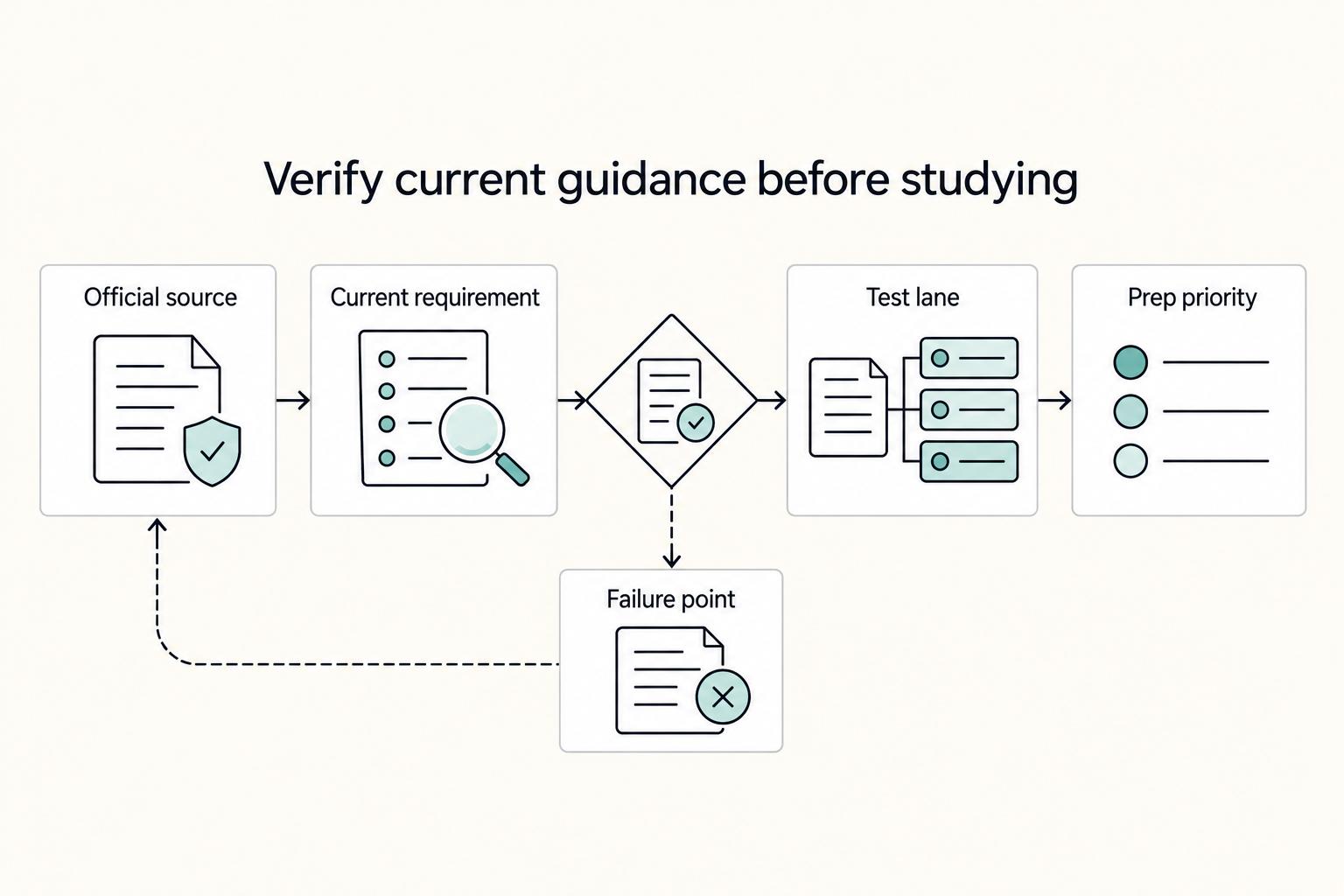
Once your N-400 audit is stable, move to test prep. Start by confirming the current USCIS naturalization test guidance that applies to your case, then study in two lanes: English and civics. This order helps reduce the risk of memorizing material that does not match current guidance.
Step 1. Verify current guidance before you study#
Before you open flashcards or videos, confirm the current official USCIS test guidance. Write this at the top of your notes:
- Version/track check (if applicable): confirm the current version rule directly with USCIS before you study.
- Pass-format check: confirm the current pass format directly with USCIS before you study.
Then use this quick prep map:
| Test lane | What to confirm first | Prep priority | Common failure point | Official USCIS resource to use first |
|---|---|---|---|---|
| English | The current English tasks and format listed in official USCIS guidance for your case | Practice only the listed task types and rehearse clear spoken responses tied to your filed N-400 | Spending time on generic English practice that does not match current USCIS guidance | Current USCIS naturalization test guidance and official study materials |
| Civics | The civics version/track and format listed in current USCIS guidance for your case | Study only the verified version and keep answers retrieval-based | Using mixed or outdated question sets from third-party sources | Current USCIS civics test guidance and official study materials |
Verify first, then study. That step alone prevents a lot of wasted effort.
Step 2. Run a baseline pre-test (Step 13 mindset)#
Do a pre-test before Week 1 so you know where you actually stand. The USCIS citizenship education framework uses pre-testing in Step 13, post-testing in Step 15, and end-of-cycle evaluation in Step 16. Mirror that structure in your own prep.
In one timed session, test civics recall from memory, rehearse your N-400 explanations out loud, and practice the English tasks in the USCIS guidance you verified. When you finish, reduce the results to three short weakness lists only:
- Civics items you missed
- English task types that broke down
- N-400 explanations that were unclear
That keeps your study plan focused on failure points instead of vague effort.
Step 3. Execute the 4-week workflow#
Think of this as a focused sprint, not a guarantee. The daily goal is simple: finish each session with fewer uncertain answers than when you started.
| Week | Focus | Key action | Adjustment |
|---|---|---|---|
| Week 1 | Build structure | Study by category, not random order | Quick self-check: Can you answer aloud without reading? |
| Week 2 | Add spaced repetition | Review older items first, then add limited new items | If you miss the same item twice in one week, pause new items in that category and restudy source wording |
| Week 3 | Increase switching pressure | Alternate English, civics, and N-400 spoken drills in the same session | If switching causes repeated misses, shorten sessions and increase frequency for three days |
| Week 4 | Post-test and patch | Run a full post-test against your Week 1 baseline, then do a short end-of-cycle review | Use the final days for weak items only |
- Week 1: Build structure
Study by category, not random order. Quick self-check: Can you answer aloud without reading?
- Week 2: Add spaced repetition
Review older items first, then add limited new items. Escalation rule: If you miss the same item twice in one week, pause new items in that category and restudy source wording.
- Week 3: Increase switching pressure
Alternate English, civics, and N-400 spoken drills in the same session. Escalation rule: If switching causes repeated misses, shorten sessions and increase frequency for three days.
- Week 4: Post-test and patch (Step 15 and Step 16 mindset)
Run a full post-test against your Week 1 baseline, then do a short end-of-cycle review: what is automatic, what still breaks, and what needs exact-wording cleanup. Use the final days for weak items only.
Step 4. Keep resource hygiene tight#
Your safest source of truth is official USCIS material. For documents, check authenticity signals such as "Official U.S. Government edition."
| Validation check | Requirement |
|---|---|
| Wording and format | Matches current USCIS wording and format |
| Version/track guidance | Matches the USCIS version/track guidance you verified |
| Scoring or exception claims | Does not present unsupported scoring or exception claims as settled facts |
Third-party tools can still help, but only after a quick validation:
- Matches current USCIS wording and format
- Matches the USCIS version/track guidance you verified
- Does not present unsupported scoring or exception claims as settled facts
If a tool mixes versions or states uncertain rules as definitive, drop it. Clean inputs make the rest of your prep easier.
Related: 183-Day Rule Explained: Stop the Tax Myths Before They Cost You.
Phase 3: Prepare for the interview as a verification conversation#
By this point, the work shifts from studying to performance. The interview is mainly a verification conversation. The officer reviews your Form N-400 for accuracy, and your speaking is judged by how you respond to normal interview questions, not by accent or polished wording.
Step 1. Build a practical interview packet#
Bring a packet you can use under pressure. Do not aim for more paper. Aim to retrieve the right document quickly and keep your answers consistent.
- Your filed N-400 (full copy): use it as your source of truth for names, dates, and prior answers
- A one-page update list: corrections or changes since filing, with dates
- Supporting records you relied on: organize them so you can quickly confirm an answer if asked
Use this quality check: if asked, "What document supports that answer?" you can locate it in seconds.
| Common practice question area | What to review in your N-400 and packet |
|---|---|
| Biographic details | Name, address history, contact details, and any corrections you plan to report |
| Travel and residence | Trip dates, longer absences, passports, and the records you used to reconstruct travel history |
| Family and marital history | Current status, prior history if applicable, and records supporting any changes |
| Updates since filing | A short written list of what changed, when it changed, and which document supports it |
Step 2. Rehearse concise, accurate answers#
Brevity helps here. Answer directly first, then add detail only if asked. Practice using the same language as your filed N-400 so you do not create avoidable inconsistencies while trying to explain something clearly.
Step 3. Rehearse clarification and update language#
A good interview answer is not always the longest one. If a question is unclear, ask for it to be repeated or rephrased. Officers may repeat and rephrase questions until they can determine whether you understand English, and responsiveness matters more than dictionary-style definitions.
Use one update format every time: "Since I filed my N-400, this changed," then state the date and the supporting document. That keeps your original filing and your current facts clearly separated. For mock scoring, use the same mechanics: 1 out of 3 reading sentences, 1 out of 3 writing sentences, and 12 out of 20 civics questions.
Step 4. Set a calm contingency workflow#
If a mock interview goes poorly, do not restart everything. Log exactly what failed: N-400 accuracy, spoken responsiveness, reading, writing, or civics. Then verify current USCIS retest rules and write the confirmed timing and process in your notes. The goal is to remove panic and give yourself a clear next step.
You might also find this useful: A Guide to the O-1 Visa for Extraordinary Ability in the US.
Conclusion: You Are Prepared to Succeed#
You are prepared when your plan is consistent, documented, and based on current official USCIS updates.
Before interview day, run one final readiness check:
- Re-read your filed N-400 and confirm your spoken answers align with it.
- Note any post-filing changes in a short, clear format with supporting records.
- Treat fee or process changes as status-sensitive, and verify the latest position on official government pages.
- Use DHS Docket No. USCIS-2021-0010 as a checkpoint for fee-schedule updates, since that item is presented as a proposed rule rather than final policy.
Do one final brief review shortly before your interview, focused on your filed details, your document packet, and the latest official USCIS updates.
For a step-by-step walkthrough, see A Deep Dive into the UK's Statutory Residence Test for Nomads. Once your interview plan is locked, browse Gruv's tools to tighten the rest of your cross-border move checklist.
Frequently Asked Questions
Which civics test version will you take?
Use your N-400 filing date as your first decision rule, then verify the current USCIS process before your interview. USCIS states that filings before Oct. 20, 2025 use the 2008 civics test, and filings on or after that date use the 2025 civics test. Record the USCIS-confirmed cutoff and process in your prep notes before test day. Also check USCIS test updates before the interview because some civics answers can change.
How is the English speaking part judged?
USCIS says speaking and understanding English are evaluated during your eligibility interview on Form N-400. You are being evaluated on whether you can speak and understand basic English during that interview. Practice short, direct answers so your responses stay clear and consistent.
Do you also need to pass reading and writing?
Yes. USCIS states you must read 1 of 3 sentences correctly and write 1 out of 3 sentences correctly. Focus your prep on accuracy under interview conditions so you avoid avoidable errors.
What questions should you expect about your N-400?
Prepare for the interview by reviewing your N-400 line by line, flagging updates, and practicing clear, consistent answers. If your case has complexity or interpretation issues, consider legal guidance before interview day.
What documents should you bring to the interview?
Use current USCIS interview instructions for your case, and keep your records organized and easy to retrieve during the interview.
What happens if you do not pass part of the test?
Verify the current USCIS retest process directly and record the confirmed timing and next steps in your plan. Then identify exactly which component needs work, whether civics, reading, writing, or spoken English, and rebuild that specific area instead of restarting everything.
Are there exemptions or special consideration rules?
Confirm current eligibility directly with USCIS before relying on any exception, and record the rule that applies to your case in your checklist. One grounded USCIS threshold is special civics consideration for applicants age 65+ with 20+ years as a lawful permanent resident. Check eligibility early, and seek legal guidance if your case needs interpretation.
Try a related tool
Researched and edited by the Gruv editorial team. Gruv builds cross-border billing, payouts, and finance-operations software for global businesses.
Sources
- gao.gov/assets/680/678461.pdftrusted
- oig.dhs.gov/sites/default/files/assets/2017-12/OIG-18-23...trusted
- recruitment.chp.ca.gov/html/asg.pdftrusted
- regulations.gov/document/USCIS-2021-0010-0001trusted
- uscis.gov/citizenship/find-study-materials-and-resourc...trusted
- uscis.gov/citizenship/learn-about-citizenship/citizens...trusted
Educational content only. Not legal, tax, or financial advice.
Related Posts

The 2026 Global Digital Nomad Visa Index for 50+ Countries
Start with legal fit, not lifestyle filters. The practical order is simple: choose a route you can actually document, then decide where you want to live. That single change cuts a lot of wasted comparison work and stops you from falling in love with places that were never a real filing option.

183-Day Rule Tax Myths That Trigger Residency Filing Mistakes
If you are a mobile freelancer or consultant, start here: the "183 day rule tax" idea is not a single universal test. It is a shortcut phrase people use for different residency rules that do not ask the same question. If you mix federal and non-federal residency logic, you can create filing risk even when your travel calendar looks clean.
O-1 Visa for Extraordinary Ability in the US for Independent Professionals
If this feels stressful, that is normal. The O-1 is not a one-and-done form. It is a case project: your USCIS criteria strategy, evidence packet, petitioner setup on [Form I-129](https://www.uscis.gov/i-129), and filing sequence, including itinerary details, all need to support the same story.