
Quick Answer
Independent professionals can qualify for an O-1 visa, but they generally need a petitioner such as a U.S. agent or employer rather than filing for themselves. A strong case depends on choosing the right O-1A or O-1B track, building a consistent evidence packet, and making sure the contracts, advisory opinion materials, and itinerary details match the actual U.S. work plan.
Run the O-1 as a case project with one consistent story#
If this feels stressful, that is normal. The O-1 is not a one-and-done form. It is a case project: your USCIS criteria strategy, evidence packet, petitioner setup on Form I-129, and filing sequence, including itinerary details, all need to support the same story.
USCIS is evaluating documented, sustained national or international acclaim. For O-1A, that means a major internationally recognized award or evidence meeting at least three listed criteria. A case weakens when the documentation is incomplete, inconsistent, or mismatched to the petitioner structure.
What this section gives you#
Before you move on, lock in four decisions:
| Decision | Focus | Key detail |
|---|---|---|
| Positioning | Strongest criteria-based narrative you can document now | Do not plan around a future version of your profile |
| Petitioner | Qualifying filing entity | You cannot self-petition |
| Evidence packet | Packet scope set early | Include written contracts, the required advisory opinion or consultation, and records connecting achievements to the U.S. work |
| Sequence and timing | Petition first, then the visa application | Petitions cannot be filed more than 1 year before the actual need for services; premium processing means adjudicative action within 15 business days for most classifications, not guaranteed approval |
If you plan to work across multiple U.S. clients, resolve petitioner and itinerary structure first. Unless an established agent files, each employer generally needs a separate petition, and your itinerary should clearly map dates, actual employers, and locations or services. If you want a deeper dive, read The 2026 Global Digital Nomad Visa Index: 50+ Countries Compared.
Why the O-1 Visa is Your Most Powerful Strategic Asset#
The label matters less than the fit. For many independent professionals, the O-1 vs H-1B choice is case-specific and should be handled as a verification-first decision. H-1B planning, by contrast, sits inside an actively updated registration-rule environment.
Compare the decision, not the label#
| Decision point | O-1 | H-1B | What to verify now |
|---|---|---|---|
| Core planning driver | Case-specific facts and current official requirements. | Registration-selection framework and current rule status affect planning. | Confirm the DHS rule published on 02/02/2024 (89 FR 7456) and the related newer document marked Final rule on 12/18/2024. |
| Flexibility across clients | Do not assume a work structure is acceptable without current official language for your fact pattern. | Depends on current filing structure for your arrangement. | Verify current official language before assuming one setup covers all planned work. |
| Renewal path | Unknown until current official text is verified. | Unknown until current official text is verified. | Check current USCIS and regulatory text before committing to long timelines. |
| Planning certainty | Improves when assumptions are replaced with current, verified text. | Timing and process are also affected by current registration rules. | Use official sources, not summaries alone. |
One checkpoint is non-negotiable: FederalRegister.gov states its XML rendition is informational and does not itself provide legal notice. If you are making business decisions from rule text, verify against the official edition and use the printed PDF record.
The agent model only helps if the paperwork is operationally credible#
If your income comes from multiple engagements, treat any agent-based structure as a verification item, not an assumption. Your contracts and itinerary should align on who the parties are, what services you will provide, and when and where the work happens.
If those documents conflict or stay vague, risk rises. Tighten the first wave of concrete engagements before filing so the record shows actual work, actual counterparties, and a believable timeline.
Stability is about execution, not prestige#
What matters in practice is whether your status plan supports project continuity, client contracting, and relocation timing with fewer surprises. Treat validity and extension mechanics as unknown until you verify current official text, then map confirmed dates to client delivery windows, housing moves, and travel plans.
For long-term options, use a risk-aware sequence: secure the temporary strategy first, preserve your evidence file, then assess permanent pathways using current policy language at that time. If a legal memo relies on a source that now resolves to Page Not Found, treat that as a verification failure and request current authority before relying on it. For related planning issues, see 183-Day Rule Explained: Stop the Tax Myths Before They Cost You.
O-1A vs. O-1B: Choosing the Right "Product Line" for Your Talent#
Choose the track that matches how your work is recognized, not the title on your profile. A strong record can still underperform if it is framed under the wrong O-1 category.
For 2026 planning, verify legal wording in USCIS Policy Manual Volume 2, Part M, current as of February 03, 2026. The USCIS O-1 overview page is useful for orientation, but it shows a last reviewed date of 03/03/2023.
Side by side comparison#
| Decision point | O-1A | O-1B Arts | O-1B Motion Picture and Television |
|---|---|---|---|
| Plain-language fit | Science, education, business, or athletics. | Arts-focused work evaluated for artistic distinction. | Film and TV industry work evaluated for extraordinary achievement in that industry. |
| USCIS definition status | Confirm the current definition in the USCIS Policy Manual. | Confirm the current definition in the USCIS Policy Manual. | Confirm the current definition in the USCIS Policy Manual. |
| Legal framing | Very top-of-field standard. | Distinction standard in the arts. | Very high level of accomplishment in motion picture or television. |
| Recognition frame | Sustained national or international acclaim. | Sustained national or international acclaim. | Demonstrated record of extraordinary achievement. |
| Threshold route | Major internationally recognized award, or at least 3 of 8 documentation forms. | Significant national or international award or nomination, or at least 3 of 6 documentation forms. | Significant national or international prize, award, or nomination, or at least 3 of 6 documentation categories. |
| Common evidence focus | Documentation that supports top-of-field standing and impact in the O-1A domain. | Documentation that supports artistic distinction and recognition in arts work. | Documentation tied to film or TV productions and achievement in that industry. |
| Best-fit profile | Professionals whose strongest record is in science, education, business, or athletics. | Professionals whose strongest record is artistic work. | Professionals whose strongest record is in film, television, streaming productions, or commercials. |
| Boundary issue | Job title alone does not decide category. | Some cases overlap with MPTV. | USCIS states static web materials and self-produced video blogs or social content generally do not fall in MPTV; streaming movies, web series, and commercials can fall within MPTV. |
Meeting an initial threshold is not the same as winning the case. USCIS states that satisfying initial evidentiary criteria does not, by itself, establish eligibility.
The same role can be framed two ways#
The same role can point to different tracks depending on the evidence trail. What the record actually shows determines the track. An O-1A framing centers on business or technical impact and top-of-field recognition in that domain. An O-1B Arts framing centers on artistic distinction and recognition of the creative work itself.
A video editor can be an overlap case too. If the record is tied to film or television productions, O-1B MPTV may be the cleaner fit. If the record is mostly self-produced short social content, USCIS guidance says that generally does not fit MPTV.
How to choose your primary track#
Start with the evidence trail you can support today, not the title that sounds best. That keeps you from forcing a category onto a record that does not fit it cleanly.
- Role narrative: Is your strongest story top-of-field work in O-1A domains, artistic distinction, or MPTV achievement?
- Strongest evidence in hand: Which track already has the clearest documentary record?
- Weakest criteria: Where would you need to stretch or over-explain?
- Petitioner alignment: You cannot self-petition; a separate legal entity, including one you own, may petition. For work with multiple employers, separate petitions are required unless an established agent files. Confirm advisory opinion requirements from the appropriate consulting entity or entities.
Make the decision and start the file#
Once the track is clear, turn it into a working file instead of leaving it as a theory. Build it around documents you already have or can collect now.
- Primary track: Pick the category that matches your strongest current evidence.
- Backup track: Note a secondary framing only if the overlap is real and documentable.
- First documents to collect: petitioner or agent details, evidence of engagements (especially if multiple employers are involved), advisory opinion path, award or nomination records, and documentation that supports your chosen track narrative.
You might also find this useful: The Best Podcast Hosting Platforms for Beginners.
Secure a petitioner when you work across multiple clients#
Your petitioner does not need to be a single full-time employer. If you work across clients, a U.S. agent can be a valid path because USCIS allows agent filings for traditionally self-employed workers and for short-term work with numerous employers.
Filing posture matters, along with whether the evidence matches it. USCIS treats agent roles differently under 8 CFR 214.2(o)(2)(iv)(E). Document requirements depend on whether the agent is functioning as your employer, acting as an authorized representative of employer or employers, or filing in another agent role.
How the U.S. agent model supports multi-client work#
A U.S. agent filing can support multi-client work, but only if the record is specific. USCIS requires evidence tied to planned engagements, not just a general intent to freelance.
If your work happens in more than one location, include an itinerary with dates and locations. USCIS states there are no exceptions for this posture. If the agent is functioning as your employer, include your contractual agreement with the agent, either a written contract or a summary of oral terms. USCIS evaluates the relationship case by case using contract terms and control indicators. It also requires wage-offer evidence even though there is no prevailing wage requirement or fixed wage structure.
| Petitioner option | Control | Operational burden | Documentation complexity | Best fit |
|---|---|---|---|---|
| U.S. agent | Case-by-case in employer-function filings | Varies by filing posture | Additional evidence required under 8 CFR 214.2(o)(2)(iv)(E) | Traditionally self-employed workers and short-term work with numerous employers |
| Direct U.S. employer | Not covered in this section | Not covered in this section | Not covered in this section | Verify current eligibility details separately |
| Founder-owned U.S. entity | Not covered in this section | Not covered in this section | Not covered in this section | Verify current eligibility details separately |
A loose pipeline is not enough here. You need dates, locations, and engagement-level proof before you file. Before filing, prepare:
- Draft your work itinerary with dates and locations for each engagement.
- Gather documentation that matches the agent filing posture, including the agent agreement and contract evidence for employer-function filings.
- Confirm petitioner-role documents, including employer authorization when the agent is acting in place of employer(s).
- Flag attorney review points: exact agent posture, employer-function analysis, and control indicators.
For a step-by-step walkthrough, see The E-2 Treaty Investor Visa: A Path to US Residency for Entrepreneurs.
Deconstructing "Extraordinary": Your Action Plan for Meeting the Criteria#
This section has a source-access problem: the provided 2009/2010 USCIS decision links return "Page Not Found." Treat the criterion notes below as unverified until current official USCIS source text or immigration counsel records confirm the standard.
| Criterion | Verification status | Strong evidence examples | Common weak evidence to avoid | How you package it in your filing |
|---|---|---|---|---|
| Published material | No substantive USCIS standard is available from the provided decision links. | Examples pending confirmation from a working USCIS source. | Assuming an inaccessible source still supports the claim. | Keep the page URL, link title, and a screenshot showing the broken link. |
| High remuneration | No substantive USCIS standard is available from the provided decision links. | Examples pending confirmation from a working USCIS source. | Unsupported threshold statements tied to unavailable sources. | Keep the page URL, link title, and a screenshot showing the broken link. |
| Judging | No substantive USCIS standard is available from the provided decision links. | Examples pending confirmation from a working USCIS source. | Treating unavailable source pages as proof of a standard. | Keep the page URL, link title, and a screenshot showing the broken link. |
| Critical or essential role | No substantive USCIS standard is available from the provided decision links. | Examples pending confirmation from a working USCIS source. | Claiming adjudication tests that are not visible in the source. | Keep the page URL, link title, and a screenshot showing the broken link. |
Four criteria to validate first#
At this stage, these four are checkpoints, not verified standards. If a USCIS link fails, check URL spelling and completeness first, then use the USCIS A-Z Index or Site Map. If the page is still unavailable and you report it to the USCIS webmaster, include the page URL, link title, and a screenshot of the broken link.
| Criterion | Status | Next step |
|---|---|---|
| Published material | Confirm with the relevant authority | Confirm a working USCIS source page before mapping evidence |
| High remuneration | Confirm with the relevant authority | Confirm a working USCIS source page before mapping evidence |
| Judging | Confirm with the relevant authority | Confirm a working USCIS source page before mapping evidence |
| Critical or essential role | Confirm with the relevant authority | Confirm a working USCIS source page before mapping evidence |
For now, all four stay in the same posture, and each needs a working USCIS source page before you map evidence.
Related reading: UAE Golden Visa for Freelancers and the Green Visa Decision Guide.
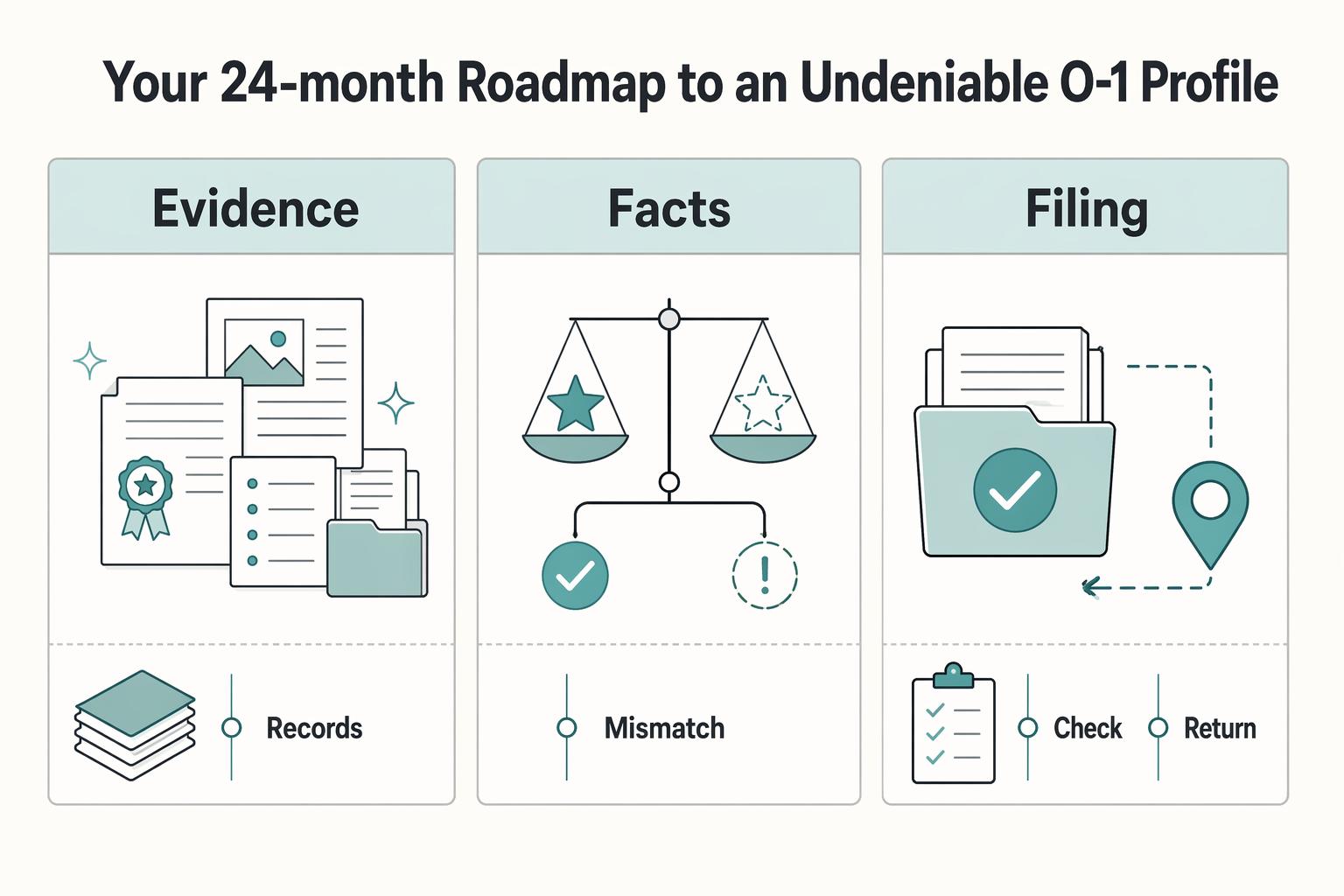
Your 24-Month Roadmap to an Undeniable O-1 Profile#
Treat this as a phased execution plan, not a last-minute filing task. Use 24 months as a planning horizon, not a legal rule. The goal is to show sustained acclaim with extensive documentation and to show that your recent record remains at a comparable level when you file.
| Phase | Primary objective | Actions you take | Evidence produced | Common failure mode |
|---|---|---|---|---|
| Months 1 to 3 | Run a strategic audit and lock category fit | Map your work to evidence you can verify, flag weak or self-authored proof, and draft a category memo for the lane you will use | Evidence map, gap list, category-fit memo, draft evidence index | Choosing a category standard that does not match your actual record |
| Months 4 to 12 | Build documented recognition | Prioritize work that creates independent, third-party records and capture proof as it appears | Publication and credit records, role documentation, project records, compensation records where relevant | Doing strong work without preserving verifiable records |
| Months 1 to 24 | Maintain an evidence vault | Archive full copies, URLs, dates, screenshots or PDFs, contracts, invoices, payment records, and project artifacts by evidence category | Exhibit-ready folders organized by evidence category | Link decay, missing dates, or records that do not tie to your contribution |
| Months 12 to 24 | Confirm readiness before filing prep | Check for comparable recent acclaim, confirm your narrative shows continued work in the same area of ability, and resolve any category-fit ambiguity | Updated readiness memo, recent-record check, category-fit confirmation | Strong historical evidence but weak recent record or unresolved category fit |
Phase 1. Strategic audit#
Start with what a reviewer can verify without relying only on your word. For each evidence item you may rely on, list the exact document, who controls it, and whether it is independently verifiable. If it is informal, self-published, or hard to date, treat it as weak until strengthened.
Lock category fit early. If your work spans arts, screen, and internet-heavy formats, resolve classification risk now and document your logic in a short memo so filing prep does not stall later.
Phase 2. Authority-building sprint#
Build proof, not just visibility. Focus on work that creates third-party records you can preserve: publication pages, credits, invitations, project materials, and letters tied to specific outcomes.
If you include compensation or role-impact evidence, keep signed agreements, invoices, payment confirmations, and dated records that clearly tie to your personal contribution.
Phase 3. Evidence vault discipline#
Keep your archive current while events are fresh. Save the source artifact plus a short note on why it supports your case. The goal is completeness. A common weakness is late reconstruction: broken links, missing context, and undated files gathered too late.
Phase 4. Readiness checks before filing prep#
Readiness work only helps if it improves the filing record. Prioritize relationships and projects that create verifiable records and support the same work narrative you plan to present. Use these checkpoints before final prep:
| Checkpoint | What to confirm | If weak |
|---|---|---|
| Category-fit clarity | Which O-1B standard your record best supports if your work spans arts, screen, and internet-heavy production | Confirm classification before final prep |
| Comparable recent acclaim | Whether recent documented work supports the filing record | Add recent, documented work before you move forward |
| Continued work in the same area | Whether current projects match the area of ability in your case narrative | Tighten scope before filing prep |
If a checkpoint fails, adjust priorities and keep building. That is often faster and safer than filing on a thin record.
Need the full breakdown? Read How to get a 'police clearance certificate' from the FBI for a foreign visa. As you build your evidence vault and relocation timeline, keep your action items in one working checklist: Visa Cheatsheet for Digital Nomads.
Conclusion: Manage the inputs and hand the pack to counsel#
At filing stage, treat this as an execution project: you manage the inputs, and counsel, if engaged, manages legal strategy. You do not need to resolve whether the process feels subjective. You need a clean fact pattern, complete records, and disciplined timing. That changes your approach in three practical ways:
- Your audit becomes a decision file: pick the classification, keep only claims you can prove, and remove weak or unverifiable points.
- Your roadmap becomes a calendar: track what evidence is missing, who can verify each item, and when each document must be collected.
- Your evidence vault becomes a filing pack: store contracts, publications, judging invitations, rosters, payment records, and other dated artifacts so they are review-ready.
| Mindset | Passive applicant | Project owner |
|---|---|---|
| Evidence | Hopes past achievements are enough | Maps each claim to a document and verifier |
| Petitioner | Assumes they can file themselves | Confirms petitioner path early because the worker cannot self-petition |
| Timing | Starts when work appears | Plans backward from service dates and the 1-year advance filing limit |
| Premium processing | Treats it like approval insurance | Knows USCIS action may be approval, RFE, NOID, or denial |
Ownership at handoff is straightforward. Counsel, if engaged, owns classification judgment, legal framing, and filing strategy. The petitioner files Form I-129 on your behalf. You own evidence completeness and factual consistency.
If you are using a U.S. agent or a separate legal entity, confirm that structure early. If it is a multiple-employer agent filing, hand over a complete itinerary with service dates and engagement details. Then confirm current filing operations, including the Form I-129 edition USCIS accepts from April 1, 2026.
- Update your audit and cut any claim you cannot verify with dated evidence.
- Organize your evidence vault by criterion, source, and verifier.
- Confirm your petitioner path: employer, U.S. agent, or separate legal entity.
- Include the written advisory opinion and, for multiple-employer agent filings, a complete itinerary.
- Hand off the full pack to counsel when the documents and story match.
This pairs well with our guide on Can My Foreign Spouse Live with Me in the US on an E-2 Visa?.
If your move plan includes getting paid by clients across borders, review how Gruv handles compliance-gated disbursements and status tracking where supported: Explore Payouts.
Frequently Asked Questions
Can you get this visa as a freelancer or self-employed professional?
Yes, but generally not by filing for yourself. Independent workers usually need a U.S. agent petitioner in qualifying self-employed or numerous-employer scenarios. If the work spans more than one location, include an itinerary with dates and locations, and if the agent is functioning as employer, the contract or oral-agreement summary must state wage and terms.
How do you prove extraordinary ability if you do not have a major award?
If you do not have a major award, build the case around sustained national or international acclaim supported by extensive documentation. For O-1A, the article points to a very top of the field standard, and for O-1B arts it points to distinction. The practical move is to map every claim to verifiable evidence and cut weak, self-authored, or hard-to-verify materials.
What is the first step you should take?
Start with a self-audit before drafting forms. Create one working file that lists each criterion you may use, the exact supporting document, who can verify it, and whether it matches the area of ability you will continue in. If you may use a U.S. agent petitioner, confirm the agent's filing role early because agent-filed petitions have added requirements.
How should you think about O-1 versus H-1B if you are a consultant or independent operator?
For consultants and independent operators, O-1 can be a natural path to evaluate first when the work involves multiple projects or clients because USCIS allows certain agent-filed structures. The article treats H-1B as a verify-first comparison because current rules can change. Before choosing either path, confirm current official requirements for work structure, timing, pay rules, and required documents.
How do you build a strong portfolio?
Treat your portfolio as an evidence file, not a branding deck. Save the source artifact, date, and URL or PDF, then note which criterion it supports. Keep full copies of contracts, invoices, payment confirmations, publication pages, judging invitations, rosters, and project materials that show your personal role.
What should you check before you assume your case is ready?
Check that your evidence is well documented, supports one consistent area of ability, and matches a complete petitioner package. If you are filing through an agent, make sure the filing role, agreement terms, wage terms, and itinerary all align. If your work spans arts and motion picture or television, confirm classification early because mixed cases can be unclear.
Try a related tool
Researched and edited by the Gruv editorial team. Gruv builds cross-border billing, payouts, and finance-operations software for global businesses.
Sources
Educational content only. Not legal, tax, or financial advice.
Related Posts

The 2026 Global Digital Nomad Visa Index for 50+ Countries
Start with legal fit, not lifestyle filters. The practical order is simple: choose a route you can actually document, then decide where you want to live. That single change cuts a lot of wasted comparison work and stops you from falling in love with places that were never a real filing option.

183-Day Rule Tax Myths That Trigger Residency Filing Mistakes
If you are a mobile freelancer or consultant, start here: the "183 day rule tax" idea is not a single universal test. It is a shortcut phrase people use for different residency rules that do not ask the same question. If you mix federal and non-federal residency logic, you can create filing risk even when your travel calendar looks clean.

The Best Podcast Hosting Platforms for Beginners
**Pick podcast hosting like an operator: optimize for control, continuity, and clean workflows, not whatever looks appealing on a pricing page.** Podcast hosting is infrastructure. What you choose at signup sits upstream of your RSS feed, Apple Podcasts listing, analytics, monetization options, and how painful it is to change systems later.