
Quick Answer
Most YouTubers should use the simplest structure that fits their current stage: a sole proprietorship while testing, an LLC when personal exposure becomes real, and an S-Corp only after books, payroll, and operations are ready. Decide before state registration where possible, and weigh liability, tax handling, and ongoing compliance before choosing.
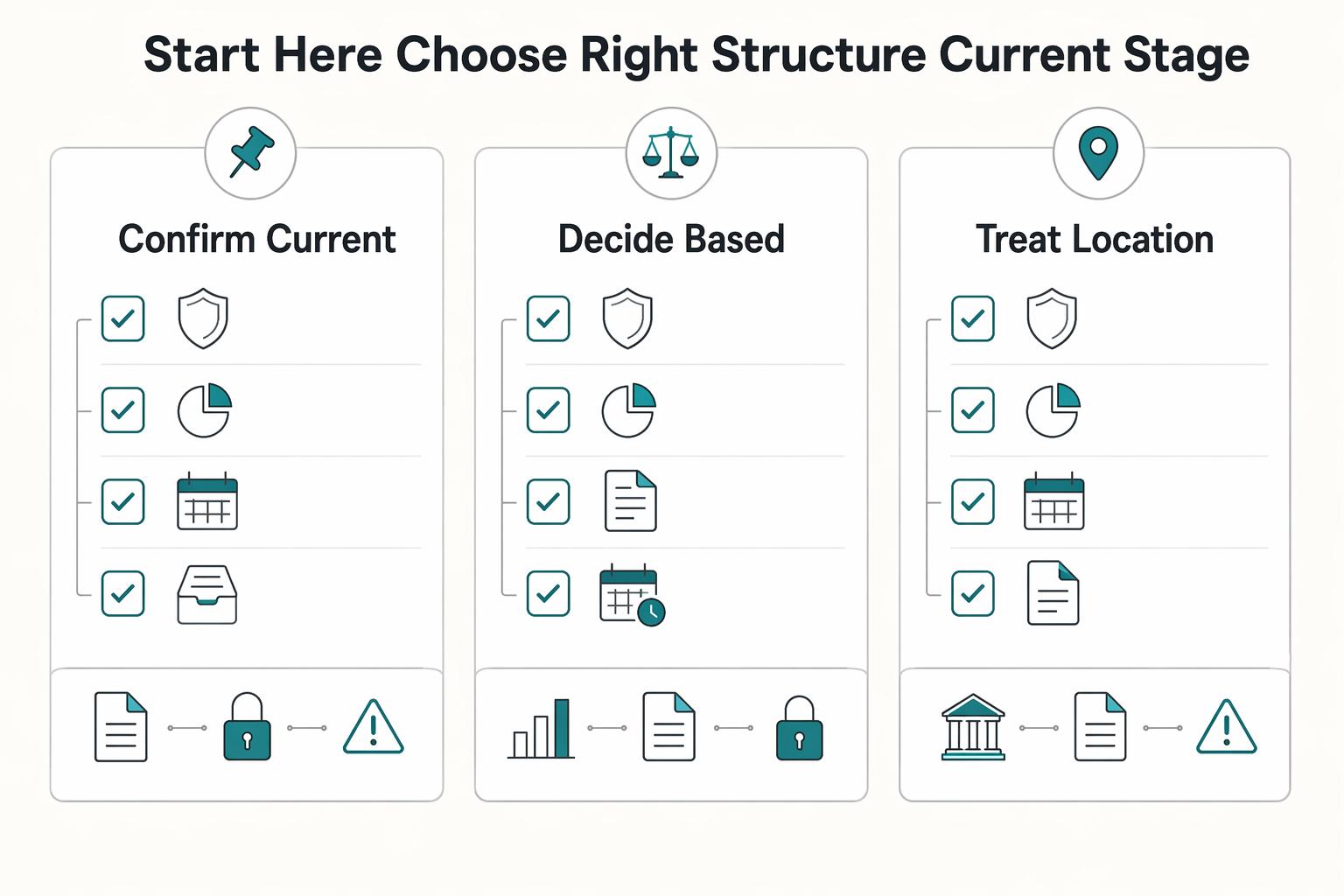
Start here and choose the right structure for your current stage#
Choose the structure that fits where you are now, not the one that sounds most sophisticated. This guide helps you decide between Sole Proprietorship, LLC, and S-Corp. It focuses on the tradeoffs that actually matter: liability exposure, taxes at a high level, and the paperwork and ongoing admin each option requires.
Make this choice before you register with the state. Your structure affects taxes, paperwork, fundraising options, and personal asset exposure. Most businesses will also need a tax ID plus any required licenses or permits.
Use this quick sequence before you file anything:
- Confirm your current status.
If you are doing business activity and have not registered another business type, you are operating as a Sole Proprietorship by default.
- Decide based on the tradeoffs that matter.
At minimum, weigh personal liability exposure, tax impact, and whether you can maintain the paperwork and compliance work that comes with each option.
- Treat location as a real constraint.
These decision rules are directional, not universal. Your location can affect whether and how easily you can change structure later.
A final caution: changing structure later can create tax consequences and even unintended dissolution. Verify local requirements upfront so your first filing is something you can actually maintain.
Gather your inputs before you file anything#
Before you file, put four inputs on one page: your net earnings, your tax-reporting risk exposures, your recordkeeping capacity, and where you operate. That turns structure choice into a decision you can support instead of a guess.
| Input | What to put on one page | Checkpoint |
|---|---|---|
| Net earnings | Income and expense records for the filing period | Estimate net earnings from self-employment from gross business income minus ordinary and necessary business expenses |
| Tax-reporting risk exposures | Income from sales or services, payments reported on any 1099-K, and amounts that may be non-taxable personal transfers | Keep payout reports, invoices, receipts, and related records so you can show what was taxable income versus non-taxable personal transfers |
| Recordkeeping capacity | Whether you can keep complete records throughout the year | You can trace reported income and expenses back to your records without guessing |
| Where you operate | Where you live, where you work, and where you plan to register | Verify state and local filing requirements before you commit |
Calculate net earnings from real records#
Start with your income and expense records for the filing period, then estimate your net earnings from self-employment. For IRS purposes, that means gross business income minus ordinary and necessary business expenses, and it feeds Schedule SE (Form 1040). As a baseline, self-employment tax is 15.3%, and you usually owe it when net earnings are $400 or more.
Use full records, not just platform summaries. Pull payout reports, invoices, bank deposits, receipts, and any Form 1099-K. A missing 1099-K does not make income non-taxable.
List your current risk exposure#
Next, list your tax-reporting exposure in plain language: income from sales or services, payments reported on any 1099-K, and amounts that may be non-taxable personal transfers (such as gifts, reimbursements, or repayments). The point is to see where reporting errors can happen before you file.
Keep an evidence pack for each category with payout reports, invoices, receipts, and related records. If you cannot show what was taxable income versus non-taxable personal transfers, fix that before filing.
Check your admin capacity honestly#
Be honest about whether you can keep complete records throughout the year. Good recordkeeping makes tax filing easier and supports accurate calculations.
Use a simple checkpoint: can you trace reported income and expenses back to your records without guessing?
Confirm where you will actually operate#
Confirm jurisdiction constraints now, not after you file. Capture where you live, where you work, and where you plan to register, then verify state and local filing requirements before you commit. This federal checklist is not all-inclusive, so treat location-specific rules as a separate verification step.
Once you have those four inputs in one place, the comparison gets much clearer.
Compare entity options side by side before you commit#
Decide on paper before you register with the state. Put each option against the same criteria so you are comparing facts, not vibes: liability exposure, tax handling, fundraising fit, and filing or compliance workload.
Compare the core tradeoffs first#
| What to compare | Sole Proprietorship | LLC | S-Corp | C-Corp |
|---|---|---|---|---|
| Liability exposure | No separate business entity; you can be held personally liable for debts and obligations. | Designed to separate personal assets from business liabilities, but only if you maintain real separateness and compliance. | Personal liability exposure differs from a sole proprietorship; verify how corporate protections apply and what formalities are required. | Personal liability exposure differs from a sole proprietorship; verify how corporate protections apply and what formalities are required. |
| Tax handling for the owner | In the cited SBA guidance, the owner is treated as self-employed, not an employee, for Social Security and Medicare tax handling. | In the cited SBA guidance, LLC owners are also treated as self-employed, not employees, for Social Security and Medicare tax handling. | Salary taken as an owner-employee is subject to FICA taxes. | Salary taken as an owner-employee is subject to FICA taxes. |
| Payroll readiness check | Owner pay is not handled like corporate payroll in the cited SBA treatment. | Same cited self-employed treatment for owner pay. | Be ready to handle owner-employee salary correctly. | Be ready to handle owner-employee salary correctly. |
| Tax filing check | Not a corporation. | Verify filing obligations before you file. | Verify corporate filing obligations before election or formation. | Verify corporate filing obligations before formation. |
| Recurring filing check | Verify whether your registration choices create recurring reporting duties. | Verify recurring filing rules before formation. | Verify recurring filing rules before you commit. | Verify recurring filing rules before you commit. |
| Fundraising fit | Harder to raise money; you cannot sell stock, and banks may be more hesitant to lend. | Depends on your goals and setup. | Consider only if the corporate route fits your current plan. | Consider only if the corporate route fits your current plan. |
On paper, this comparison usually makes one or two options fall away.
Read the comparison like an operator#
Read the tradeoffs like an operator. A sole proprietorship is simple, but there is no entity separation. An LLC can improve liability separation, but only if you keep business and personal activity truly separate in practice.
If you are considering the corporate route, treat payroll and formal compliance as real operating work, not a box to check. The SBA distinction between self-employed owners and owner-employee salary treatment is the key checkpoint before you commit.
Match the choice to your actual stage#
Match the choice to your current stage, not a hypothetical future. If corporate-level fundraising is not part of your current plan, weigh paperwork and compliance needs carefully before choosing a corporation.
Before you file, confirm three items in writing for the structure you choose: tax ID needs, licenses or permits, and whether recurring filing requirements apply. Also remember that changing structure later can bring complications, including tax consequences and unintended dissolution.
For a step-by-step walkthrough, see How to Optimize YouTube Videos for Search as a Business Owner.
Use a stage-based decision rule instead of one-time advice#
Do not treat this as a forever decision. Match the structure to your current risk and operating reality. Stay simple when simplicity is the point. Move to an LLC when personal exposure becomes real. Treat S-Corp as a separate review point, not an automatic next step.
Stay with a sole proprietorship when simplicity is the point#
Use a Sole Proprietorship when low-friction setup is the main advantage. It is the simplest form, has no formal creation requirements, and is not a separate taxpaying entity, so income is reported on your personal return.
The checkpoint is straightforward: this path is for 1 owner. Keep the tradeoff explicit. Convenience is high, but liability is unlimited for business debts.
Move to an LLC when exposure becomes the issue#
Move to an LLC when liability protection becomes the real priority. Entity choice is the first step in asset-protection planning, and the source material describes LLCs as offering the most effective protection in most cases.
Frame this stage around exposure, not optics. If you are taking on debts you would not want tied directly to you personally, an LLC should move from a nice-to-have to a serious option.
Review S-Corp separately, not automatically#
Evaluate S-Corp only as a separate review point. A reliable revenue, profit, or timing trigger for an S-Corp election is not established, so skip one-size-fits-all rules.
Treat this stage as case-by-case rather than automatic. Ignore generic internet advice that treats the move as automatic.
Check your stage against the table#
Before you change anything, check your stage against this table and use one simple rule: change structure when it solves a real problem your current setup does not handle well.
| Stage | Trigger signals | Documents to have in hand | Not ready yet signs |
|---|---|---|---|
| Sole Proprietorship | You want the simplest structure and still have 1 owner | Personal tax reporting records | You want liability protection this structure cannot provide |
| Limited Liability Company (LLC) | Personal exposure from business debts is becoming a real concern | Not publicly documented | You cannot point to meaningful exposure, or you assume protection is absolute |
| S Corporation (S-Corp) evaluation | This does not provide a reliable revenue, profit, or timing trigger | Not publicly documented | You are looking for a shortcut trigger or automatic rule |
If your stage points to formalizing now, map your entity decision to how you collect payments and keep traceable records with Gruv for freelancers.
Stay a sole proprietor deliberately while testing channel economics#
A sole proprietorship can be a reasonable testing-stage choice when channel economics are still uneven, but only if you make that choice deliberately. The tradeoff is clear: simpler operations now, but no LLC-style liability protection.
Run the testing stage with discipline#
Operate deliberately from the start. Keep your channel operations clear enough that you can tell when staying a sole proprietorship still fits and when it no longer does.
Use one readiness check: if work and obligations are becoming routine, prepare for an LLC transition before pressure forces the decision.
Accept the exposure for what it is#
Accept the exposure in plain terms. A sole proprietorship does not separate you from the business the way an LLC is designed to separate personal assets from business liabilities.
For creators, that matters when claims escalate, including copyright or defamation-related issues. If you are not comfortable with business and personal exposure staying tied together, that is your signal to move LLC planning forward.
Set your exit trigger before growth forces it#
Set an exit trigger before growth forces the decision. Once work becomes repeatable and agreements become routine, get your LLC formation steps ready instead of waiting for a problem.
Keep the trigger practical: regular activity, recurring obligations, and a clear list of current agreements. Then, if you form the LLC, operate and maintain it as a separate legal entity so the liability protection can do its job.
Move to an LLC when risk and revenue justify the upgrade#
Once your trigger is met, treat the LLC as an operating upgrade, not just a filing. Business structure affects taxes, paperwork, fundraising options, and personal liability risk. Choose your structure before state registration where possible, since changing later can create tax consequences or other complications depending on location.
File the LLC formation documents#
Start with your state LLC filing, often called Articles of Organization. If you do business activities without registering another entity type, you are generally treated as a sole proprietorship.
Filing is the start, not the finish. Some states add post-formation work. For example, New York can require publication in two newspapers for six consecutive weeks and then a Certificate of Publication filing. New Jersey can require a Business Registration form within 60 days.
Request an EIN#
Request an Employer Identification Number (EIN) next. The SBA notes that most businesses also need a tax ID number, and an EIN gives you a business tax identifier for tax and admin workflows.
Open a business bank account#
When you open a business bank account, use the LLC's approved name and formation documents.
Draft the operating agreement#
After formation, draft the operating agreement before operations are fully underway. It records how the LLC is governed and can help protect the company's status. Keep it practical and specific to how the LLC will be run.
Check entity consistency before money starts flowing#
Before money starts flowing through the LLC, check that the LLC name is consistent across key business records and forms.
Consider S-Corp election only after operational readiness is real#
Do not make this election decision until your numbers are clean enough to trust. First establish your baseline, then decide from facts rather than estimates.
Establish your self-employment tax baseline#
Before you compare any election path, confirm what your default tax baseline looks like today. For this self-employment tax context, IRS guidance includes sole proprietors and single-member LLCs that are disregarded for federal income tax purposes.
| Baseline item | Value | Context |
|---|---|---|
| Net self-employment earnings threshold | $400 or more | Self-employment tax usually applies |
| Calculation form | Schedule SE (Form 1040) | Used to calculate self-employment tax |
| Taxes included | Social Security and Medicare taxes only | This is what self-employment tax refers to here |
| Rate | 15.3% | 12.4% Social Security + 2.9% Medicare |
| Share of net earnings generally subject to tax | 92.35% | Of net self-employment earnings |
| 2024 Social Security portion limit | $168,600 | First $168,600 of combined wages, tips, and net earnings |
Keep the IRS baseline mechanics in front of you:
- Self-employment tax usually applies when net self-employment earnings are $400 or more.
- It is calculated on Schedule SE (Form 1040).
- In this context, self-employment tax refers to Social Security and Medicare taxes only.
- The stated rate is 15.3% (12.4% Social Security + 2.9% Medicare).
- Generally, 92.35% of net self-employment earnings is subject to self-employment tax.
- For 2024, the first $168,600 of combined wages, tips, and net earnings is subject to the Social Security portion.
If you cannot clearly calculate your net earnings, you are not ready to evaluate the next layer.
Get your books to decision grade#
Your books should show what the business earned and spent, month by month, without guesswork. Reconcile business account deposits to payout reports, invoices, affiliate statements, and related income records. Match any Form 1099-K to your own books instead of treating the form as the whole picture.
Keep this standard: deposits, payout statements, invoices, and bookkeeping should line up without major unexplained gaps. Also remember that all income is taxable unless the law says otherwise, even if no Form 1099-K is issued.
Use an operator-readiness test#
Use a practical gate. If you cannot produce complete, current records and explain your net earnings from them, delay the election decision.
Readiness should be obvious in day-to-day work:
- You can explain recent revenue, expenses, and owner cash movement from current records.
- Your LLC business account is your real operating account.
- Your bookkeeping is current enough for a tax adviser to review without reconstructing basics.
If those conditions are not true yet, keep LLC operations clean and tighten recordkeeping first. Good records improve filing quality and give you a reliable basis for the decision.
Related reading: How to Write a Pitch Email to a Brand for a Sponsorship.
Build your compliance cadence so structure decisions keep working#
A structure choice only works if recurring compliance work stays clean. In practice, issues show up later through drifting books, missed deadlines, or compensation that no longer matches how the business is set up.
Reconcile the business bank account regularly#
Make routine reconciliation your first control. Reconcile business bank account activity to your books, close your records on a consistent schedule, and flag unusual expenses tied to business operations.
Keep the checkpoint simple. You should be able to explain material transfers, owner cash movement, and unusual items from current records, not memory. If you cannot, fix the records before making new tax or structure decisions.
Review taxes and compensation on a recurring schedule#
Use a recurring review to confirm your setup still fits the way the business is operating. Estimate taxes from year-to-date results, then review whether your compensation approach still matches your entity and records.
If payroll applies, confirm the employment-tax filing process is active and the relevant IRS forms are covered, including Form 940, 941, or 944 when applicable. The goal is consistency between your bank activity, bookkeeping, and compensation method.
Handle required filings and ownership documents deliberately#
Required filings should follow your entity type and state, not a generic checklist. If an Annual Report is required, schedule it early. If your setup requires a separate business return, plan that filing process before year-end.
Review your Operating Agreement when ownership or profit-sharing changes, or when a new member is added. Keep legal documents and books aligned so the structure remains defensible in practice.
Keep one calendar for recurring deadlines#
Use one simple filings and deadlines calendar as your anti-surprise control. Track state filings, if required, tax return obligations, payroll checkpoints if applicable, and license, permit, or tax ID tasks that apply to your setup.
Label every item by entity type and state. Your structure affects taxes, paperwork, and liability exposure, and changing structure later can create tax consequences or other complications. One maintained calendar is safer than relying on memory.
Handle contracts and liability events before they become expensive#
A clean filings calendar alone will not protect you from contract and liability problems. If legal friction keeps repeating, address contracts and operating boundaries before you optimize for taxes.
Put clear terms into creator contracts#
Start with clear documentation from day one. Put ownership, permissions, and payment in writing. Your signed agreement should make it clear what is being delivered, who can use the content and where, and when payment is due.
Before work starts, check that contract and payment terms are consistent across your working documents. When usage rights or payment expectations are unclear, dispute risk can increase.
Know what your entity does and does not protect#
Entity choice affects taxes, paperwork, fundraising options, and personal liability. A sole proprietorship does not separate business and personal assets and liabilities, so personal exposure can follow business debts and obligations.
An LLC can improve liability separation, but that boundary depends on the LLC being properly maintained. If you want that separation to hold in practice, keep contracts, payments, and records aligned with the business entity.
Treat copyright claims as documented incidents#
Requirements vary by jurisdiction, and this guidance does not provide a single universal claim protocol. Set a clear internal process and use it consistently.
That keeps claim handling and communication clearer during a live issue and reduces avoidable confusion.
Use repeated legal friction as a trigger#
As deal volume rises, legal exposure can add up quickly across separate contracts and deliverables. If you are repeatedly fixing unclear terms, ownership confusion, or claim fallout, prioritize legal cleanup first.
Treat structure changes as consequential decisions, especially because changing structure later can involve restrictions, tax consequences, or unintended dissolution in some cases. This decision is not only about taxes; it is also about whether the business can absorb incidents without becoming a personal liability problem.
Account for state friction before finalizing your structure#
Before you file, run a state-and-city preflight. A structure that looks clean in national guidance can become a poor fit once state or city requirements are added.
Check your real jurisdiction stack#
Treat location as part of the structure decision, not cleanup after formation. LLC formation documents are only one piece of setup, so confirm the full checklist on official government sources:
- business structure choice
- business name registration
- tax ID requirements
- relevant permits or licenses
This helps you avoid choosing an LLC or S Corporation path based on an incomplete view of filing and compliance work.
Ignore generic advice that skips local steps#
Be cautious with advice like "just form an LLC" or "just elect S Corp" if it ignores where you actually operate. Validate each requirement where you will register, report, and submit information.
Before you submit sensitive data or payments, confirm the page is official and secure. A .gov domain indicates an official U.S. government organization, and secure sites use HTTPS. If a page is not clearly official and secure, do not enter tax, identity, or payment details.
Build a state-specific preflight checklist#
Before filing LLC formation documents or moving toward an S Corporation election, answer these in writing:
- Which official state or city agency handles each filing step?
- Is your business name available and registered consistently where you will use it?
- Which tax IDs are required for your business activities?
- Which state or city permits or licenses apply to your operations?
- What proof will you keep for each step, such as confirmation pages, receipts, or agency emails?
Use that record as your final checkpoint. Save the exact official government URL, submission receipt, and approval notice for each item. If you cannot produce that evidence pack yet, pause before adding more structure.
Related: How to Structure an LLC for a Freelance Writing Business.
Fix the mistakes that cause most avoidable problems#
Execution drift creates avoidable problems after the original entity choice. If your paperwork, money flow, and filing habits do not line up, fix the operating setup before you add more structure.
| Mistake | Recovery |
|---|---|
| Choosing a structure but continuing to run business activity through personal workflows | Separate day-to-day business and personal activity now, then rebuild clean books from a clear cutoff date |
| Making a tax election before operations are stable | Get bookkeeping and payroll operations stable first, then revisit election timing with your tax advisor |
| Letting notices and filing tasks live across inboxes and memory | Keep one compliance calendar, assign an owner for each task, and store proof in one place |
| Assuming one summary or threshold applies everywhere | Re-check your decision against official legal text and your state source before you act |
Separate operations before cleaning up history#
If current activity is still mixed, a practical first cleanup move is separation. Route new business activity through one consistent process, pick a cutoff date, and then classify older mixed transactions with supporting records.
Your checkpoint is consistency. Contracts, invoices, payout settings, and account records should reflect the same setup going forward.
Treat election timing as a readiness call#
Do not use a tax election as a shortcut for messy records. If bookkeeping and payroll are not stable yet, pause and fix that first. Then re-evaluate timing with your tax advisor once your records are current enough to support a clean decision.
Put filings and notices into one owned system#
Scattered reminders create avoidable misses. Keep one calendar for filings and notices, assign a real owner to each task, and store submission proof where you can retrieve it easily. If you cannot quickly produce the latest filing evidence, tighten the process before you add more complexity.
Verify official legal text before you act#
Before you file, elect, or change payroll handling, verify the rule in official legal text instead of relying on summaries alone. FederalRegister.gov states that legal research users should verify against an official Federal Register edition. Each posted document includes a link to the official PDF on govinfo.gov. It also notes the prototype display is not the official legal edition and does not provide legal or judicial notice.
As one example, the FTC Negative Option Rule entry is a Federal Trade Commission rule document (89 FR 90476; 16 CFR 425) published on 11/15/2024 with an effective date of 2025-01-14. Use the same pattern at the state level by checking your legislature or state code source directly, for example a code navigation page such as the West Virginia Legislature's state-law area. If advisor guidance and official text do not align, pause and resolve the gap first.
Your next-step checklist for this week#
Use this week to lock in a structure you can run cleanly, then build the records that support it.
Write down your current stage#
Decide your current stage in writing before you file anything new. If you do business activity without registering another entity, you are generally operating as a sole proprietorship. That can fit low-risk testing, but it does not create a separate legal entity and can leave you personally liable for business debts and obligations. If you might change structure later, document why, since conversions can involve location-based restrictions and possible tax or dissolution complications.
Build the core setup stack#
Build your core setup stack so your entity and operations match. For an LLC path, that usually includes state registration steps, a tax ID number, and a dedicated business bank account. Also confirm licenses and permits where required, and keep naming consistent across bank records, contracts, invoices, and tax forms. If you are budgeting filing costs, verify your state directly rather than relying on broad estimates.
Set a compliance calendar you will follow#
Set a compliance calendar you will actually follow. Track tax, licensing, permit, and renewal obligations based on the official requirements that apply to your location, then attach the official source, state portal, approval notice, or reminder to each entry so the filing steps are clear when due.
Create a risk file now#
Create a risk file now, before you need it. Keep agreements, invoices, payment records, approval messages, and platform notices together with date-stamped notes. Keep business and personal funds separate in related transactions, since mixing funds can weaken LLC liability protection.
Schedule a 90-day review#
Schedule a 90-day review as an operating checkpoint, not a legal rule. Recheck revenue consistency, risk exposure, document separation, and bookkeeping quality before changing structure again.
Before you file, pressure-test your invoicing, payout, and compliance workflow so your structure choice still works as revenue grows: Talk to Gruv.
Frequently Asked Questions
Do YouTubers need a Limited Liability Company (LLC) to start?
No. If you earn income before forming a separate entity, you are typically operating as a sole proprietorship, which is common early on. The tradeoff is that serious legal disputes can put personal assets at risk.
Can I stay a Sole Proprietorship while I test my channel?
Yes. That can be a reasonable early-stage choice while you test consistency and revenue. Revisit your structure as business activity and risk exposure grow.
When does an S Corporation (S-Corp) election usually make sense for a creator?
Usually later, not at the start. The article treats S-Corp as a tax strategy layer that adds administrative work such as payroll. Wait until operations and records are stable enough to support that complexity.
Is an Employer Identification Number (EIN) required if I already have an LLC?
Do not assume yes. The material does not support a blanket rule that every LLC must get an EIN immediately. Verify the requirement for your specific setup before you act.
What are the first five setup steps after I decide to formalize?
There is no universal, source-backed five-step checklist in the material. For an LLC path, the article supports this sequence: file formation documents, request an EIN, open a business bank account, draft the operating agreement, and check entity consistency across records before money starts flowing.
What ongoing compliance tasks do creators most often miss after forming an LLC?
A common mistake is assuming formation paperwork alone is enough. LLC protection depends on maintaining the entity as separate and compliant in daily operations, keeping business and personal activity clearly separated, and avoiding added S-Corp complexity before core operations are consistent.
Researched and edited by the Gruv editorial team. Gruv builds cross-border billing, payouts, and finance-operations software for global businesses.
Sources
- brooklynworks.brooklaw.edu/cgi/viewcontent.cgitrusted
- congress.gov/crs-product/R46887trusted
- digitalcommons.law.seattleu.edu/cgi/viewcontent.cgitrusted
- federalregister.gov/documents/2024/11/15/2024-25534/negative-opt...trusted
- irs.gov/businesses/small-businesses-self-employed/se...trusted
- irs.gov/newsroom/are-you-making-extra-cash-selling-s...trusted
- pmc.ncbi.nlm.nih.gov/articles/PMC9466341trusted
- rpvca.gov/1707/Land-Movement-Updatestrusted
Educational content only. Not legal, tax, or financial advice.
Related Posts

Sole Proprietorship vs LLC for Global Freelancers in 2026
For most freelancers in 2026, the practical default is still simple: use the simplest structure you can run cleanly, then formalize when risk actually rises. If your work is still in validation mode and the downside is contained, a sole proprietorship is often the practical starting point. When contract exposure, delivery stakes, or dispute risk starts climbing, forming an LLC deserves earlier attention.
How to Structure an LLC for a Freelance Writing Business
Start here when speed and simplicity matter more than entity admin. Keep setup light, focus on winning and serving clients, and use insurance with a clear view of what it can and cannot do.

The Freelance Payment Penalty: A Modeled Audit of Platform Fees, FX Spreads, and Payout Delays
The money rarely disappears through a single, easy-to-spot fee. The real loss is stacked. A marketplace takes its commission, a processor adds a charge for international cards, a bank or payment company converts the currency at a spread, a platform holds the funds before release, and a wire sheds a little to intermediaries on the way in. Each layer looks defensible on its own, but the worker feels the combined result as a smaller deposit and a later payday.