
Quick Answer
Use a free service agreement generator freelancer teams can trust by enforcing controls around it: lock a baseline clause set, require clear Scope of Work and milestone acceptance language, and escalate non-standard forum or liability edits before signature. The article’s core rule is practical: treat drafting tools as input helpers, then validate Governing Law, Jurisdiction, and payment execution against your internal approval path.
Free drafting tools are useful, but only if you control how they are used#
Free drafting tools are useful, but only if you control how they are used. The real risk is not getting a freelancer agreement out quickly. It is letting different teams produce slightly different terms under different legal assumptions until you no longer know what your baseline contract actually is.
The appeal of a free service agreement generator is speed. Some tools claim you can create and sign contracts online in minutes, and some say you can produce a draft in under 5 minutes. That does help, especially when the intake asks for more than party names and dates. A guided flow that prompts for project scope, payment terms, and intellectual property language is a better starting point than a blank document or an old attachment pulled from email.
Still, speed only helps when the intake is controlled. Template-driven drafting can reduce manual copy-paste work and keep outdated or incorrect clauses from slipping in. That is the upside. The failure mode is assuming the tool solved the legal problem when it only solved the formatting problem. A generator can standardize inputs, but it cannot by itself confirm whether the contract fits the governing law, the chosen forum, or the actual risk of the engagement.
That matters most when you are managing repeat freelancer cohorts across markets. Some free tools are clear about their limits. Some say outright that the output is a template, not legal advice, and warn that laws vary by jurisdiction. Some also recommend lawyer review for high-value or legally complex projects before signing. Take those disclaimers seriously.
If your team works in more than one country, or uses different payout, IP, or dispute terms by program, treat the tool as a drafting aid, not a compliance decision. My recommendation is simple: if you need repeatable contracting, standardize the inputs you allow before you worry about the document output. Verify scope, payment terms, governing law, and forum before a draft leaves the business owner. Escalate non-standard edits early, not after signature.
The rest of the article is built for operators making that call. You will get concrete checkpoints for choosing between a guided creator and a static template, a minimum clause set for enforceability, and clear triggers for when legal, finance, or risk should step in. The goal is not to slow freelance contracting down. It is to keep fast drafting from turning into inconsistent obligations you have to unwind later.
For a step-by-step walkthrough, see How to Create a Service Agreement for a SaaS Product.
Define the contract terms before you pick a tool#
Set your core terms first, then choose the drafting format. A Service Agreement Generator uses a guided questionnaire to collect inputs before it generates text, while a Freelance contract template is a static PDF or Word starting point you edit manually. In practice, generators help standardize intake; templates leave more room for variation.
Start with scope clarity, because clause quality cannot fix unclear work. Confirm the Scope of Work, Deliverables, and any Milestones before drafting, especially if your process relies on guided prompts for deliverables, timeline, payment, and revisions. If those inputs are vague, disputes usually move from the contract into email about what "complete" means.
Define the commercial baseline#
Set your payment baseline before drafting begins. Align on invoice timing, milestone billing, and your Deposit position for the relevant freelancer tier, then add optional clauses only where the risk justifies them. If a draft includes Milestones, each milestone should map to a deliverable, a due point, and a payment trigger.
Treat forum choices as scoping data#
Treat Governing Law and Jurisdiction as scoping data, even when a tool marks them as optional. Deciding late increases copy-paste inconsistency across similar engagements. If your team cannot explain the forum choice in a draft, resolve that before it leaves the business owner.
Once these baseline terms are set, tool selection is mostly operational. You might also find this useful: Master Service Agreement for Freelancers in Long-Term Client Engagements.
Compare template downloads and guided creators with operator criteria#
For repeat freelancer contracting, prefer guided creators; for fast one-off, low-complexity work, a vetted template can be enough if final review controls are in place.
| Tool | Confirmed format | Confirmed customization depth | Legal disclaimer clarity | Known unknowns you should verify |
|---|---|---|---|---|
| Wise | Template downloads in Microsoft Word or Google Docs | Editable formats are confirmed; clause-guidance depth is not | Explicit: "this isn't legal advice, and Wise cannot be held responsible for the content of external sites." | Whether optional clauses are standardized, how governing-law/forum choices are handled, and whether version control exists |
| Freelancers Union | Guided creator ("step-by-step contract creator") | Optional clause selection is confirmed | Confirm legal-advice disclaimer before use | Final output format, clause-logic depth, and how forum choices are surfaced in the flow |
| Ruul | Generator with customizable templates | "Customizable templates" is confirmed; deeper feature behavior is not | Confirm legal-advice disclaimer before use | Feature depth, jurisdiction/forum handling, and signup constraints. Platform FAQ mentions account opening, KYC, and payout linking, but does not confirm what is required to use the generator itself |
| ClientManager | In-app contract creation and signing for freelancers/agencies | Build from scratch or reuse saved templates is confirmed | Confirm legal-advice disclaimer before use | Clause-library depth, export flexibility, and how governing-law/forum choices are managed |
Decision rules for operators#
If you manage repeat freelancer cohorts, use generator-style intake to reduce clause drift from ad hoc document edits.
If your team needs quick one-off contracting with low legal complexity, a vetted freelance contract template may be sufficient, but only with a clear final-text review step.
Rollout checks before approval#
| Check | What to confirm |
|---|---|
| Required terms | Tool collects scope, deliverables, payment timing, and forum choices where applicable |
| Optional clauses | Visible during drafting, not only in final output |
| Output | Editable file, in-app draft, or signed record |
| Account setup or verification | Whether it creates procurement or onboarding friction |
Ruul should stay in an explicit "open items" state until you verify feature depth, jurisdiction handling, and generator-access constraints. Wise is clearer on format and disclaimer language; Freelancers Union and ClientManager are clearer on guided or structured creation behavior. Once your drafting format is set, define mandatory clause coverage in How to Structure a White Label Service Agreement for Cross-Border Delivery.
Build the minimum enforceability clause set and the optional risk layer#
Use a two-layer structure: a non-negotiable baseline for every draft, then an optional risk layer based on deal exposure.
Start with the baseline terms that keep the agreement enforceable and operationally clear: Parties, Scope of Work, Deliverables, Milestones, Payment terms, Termination, Governing Law, Jurisdiction, and Dispute Resolution. In the New York City model-contract context, parties, scope, and payment are mandatory, and if payment timing/mechanism is missing, payment defaults to 30 days after completion in that context.
Baseline terms that should survive every draft#
| Term | What it covers |
|---|---|
| Parties | Correct legal names |
| Scope of Work | Service boundaries |
| Deliverables | Observable, testable terms |
| Milestones | Staged work |
| Payment terms | Amount, timing, method, deposit if used |
| Termination | Rights and work-in-progress handling |
| Governing Law | Law that applies in a dispute |
| Jurisdiction | Where the dispute is heard |
| Dispute Resolution | Defined dispute path |
If payments are milestone-based, require written milestone acceptance criteria. A common structure is a review window plus written deficiency notice, so "milestone complete" is not ambiguous.
Optional risk layer (add only where justified)#
- Indemnification clause
- Limitation of Liability
- Late fee clause
- Cancellation fee clause
- Kill fee clause
- Confidential Information clause
- Non-Disclosure Agreement (NDA)
Do not draft these in isolation. Indemnity obligations can be affected by liability caps and governing-law mechanics, so they should be reviewed together. A broad indemnity with no liability cap is a legal-escalation trigger.
Make ownership and status explicit#
Handle Intellectual property rights and Independent contractor status explicitly. If IP is a core deliverable, require ownership-language review before signature and state the transfer trigger clearly, for example on full payment versus another trigger. For contractor status, keep the clause, but do not rely on label-only wording; contract text alone does not establish independent-contractor classification.
Before approving a final draft, confirm three points: milestone acceptance language if staged payments exist, an unambiguous IP transfer trigger, and indemnity reviewed alongside liability limits. Related: A Deep Dive into the US-Israel Tax Treaty for Tech Freelancers.
Account for cross-border legal and tax variance before signature#
Use a free generator as a drafting aid, not as a cross-border legal or tax determination. Review cross-border assumptions before signature, because enforceability and tax treatment can change across markets.
Start with Governing Law and Jurisdiction. Governing Law decides which law applies in a dispute, and the forum selection clause decides where the dispute is heard. If client, contractor, delivery, or payment touch different countries, document why you chose that law and forum before approval.
Add a tax checkpoint when the commercial facts cross borders#
Trigger tax review from deal facts, not contract length.
If EU cross-border B2C activity is involved, confirm your team is using current OSS treatment rather than relying on legacy VAT MOSS labeling. EU materials note the B2C VAT e-commerce rule changes on 1 July 2021, the MOSS-to-OSS extension, and a referenced EUR 10 000 EU-wide threshold. They also distinguish filing cadence: quarterly in Union and non-Union schemes, monthly in the import scheme.
For treaty-sensitive setups, do not rely on IRS treaty tables alone. The IRS states those tables are summaries, and it separately provides full Israel treaty documents. If the tax position depends on treaty treatment, attach a treaty review note before signature.
Match the contract form to the business model#
A domestic freelancer agreement may stay lighter when parties, payment rail, and delivery are in one market. Multi-market seller or creator programs usually need stricter clause and approval controls because contractor profile, payout routing, forum, and tax assumptions can differ by cohort.
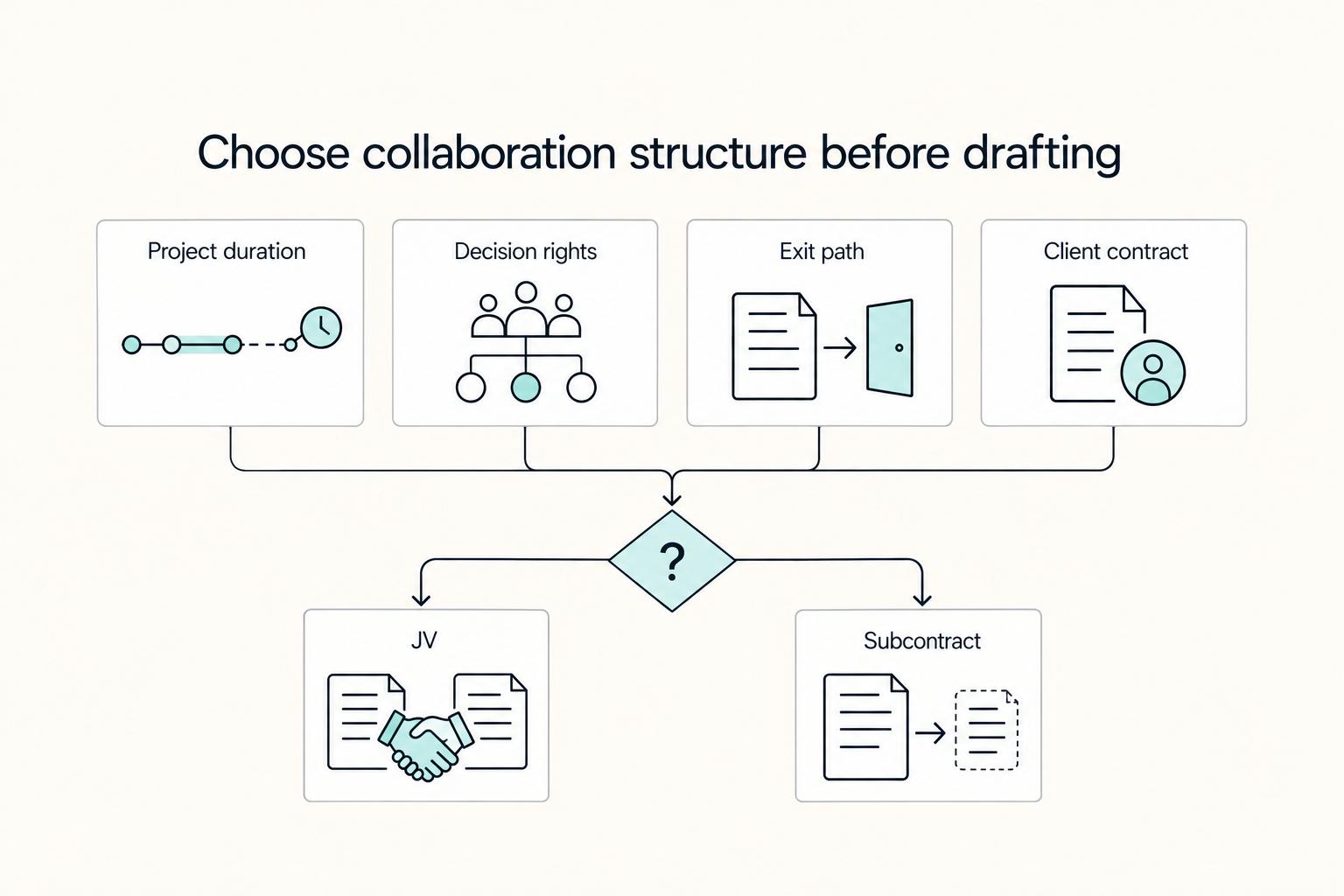
If the economics include shared profits and losses, do not force the deal into a standard freelancer template. That can indicate partnership-style economics, so use a structure that fits the arrangement, such as a Joint Venture Agreement, or escalate for legal review before signature.
For a focused VAT workflow reference, see A Guide to VAT MOSS for UK Freelancers Selling Digital Services to the EU.
Set escalation triggers for legal, finance, and risk review#
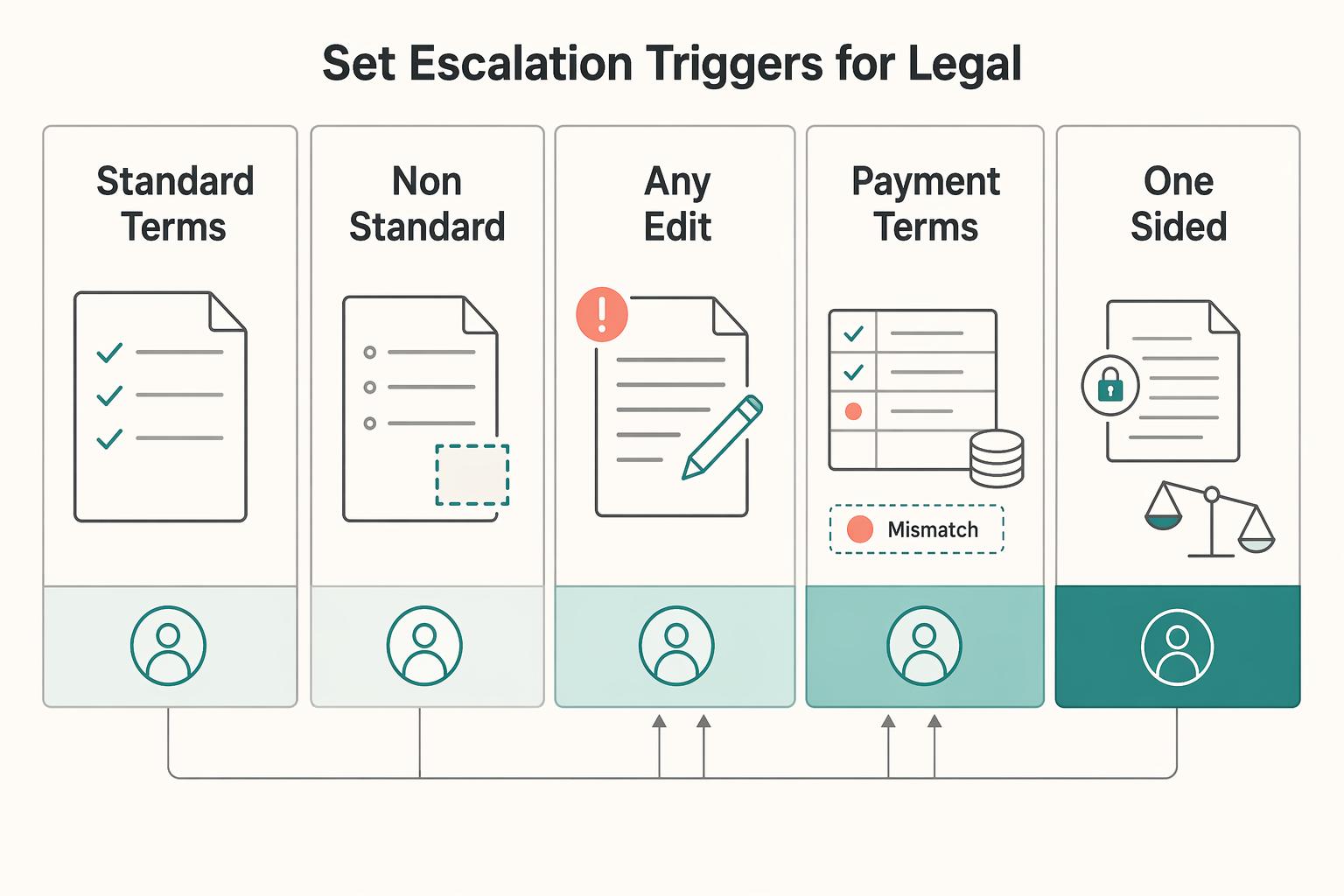
Set escalation rules before negotiation starts so high-risk edits do not get treated like routine redlines. Build a triage matrix that separates standard terms, allowed variations, and true deviations, then assign named approvers for each path.
| Deviation type | Default route | Why it escalates | Evidence to attach |
|---|---|---|---|
| Standard terms or pre-approved fallback language | Auto-approve by contract owner or designated business approver | Low variance from approved language | Final draft, version note, confirmation no non-standard clauses were added |
| Non-standard Indemnification clause or Limitation of Liability | Legal review | These clauses change contractual risk allocation | Redline, clause summary, requested fallback, legal decision, approval date |
| Any edit to Dispute Resolution, Governing Law, or Jurisdiction | Legal review | These terms set governing law and dispute forum | Redline, forum rationale, counterparty request, approver name, approval date |
| Payment terms that change payout execution | Finance review, with legal if language is non-standard | Finance confirms the deal is commercially workable and operationally payable | Payment summary, operations note, exception reason, approver name, approval date |
| One-sided Termination rights or unusual termination economics | Legal review, plus finance when money flow changes | Exit terms can shift legal and commercial risk | Redline, business rationale, concession note, approvals |
Treat two triggers as automatic. First, always escalate edits to Dispute Resolution, Governing Law, or Jurisdiction. Second, escalate payment terms your payout process cannot execute as written, and resolve the mismatch before signature.
Keep deviation approvals auditable. For each exception, retain the redline, approved fallback language, approver name, and approval date. If your playbook changes, log that revision history too. Related reading: A Comparison of Dubai Free Zones for E-commerce Businesses.
Run the send-sign-store sequence with an evidence pack#
Treat send-sign-store as a controlled workflow, not post-signature admin. Freeze the approved clause set before sending, capture every negotiated change, countersign only after required approvals, then lock the signed version and metadata for storage.
A practical sequence is:
- Finalize the approved clause set.
- Send the signature draft.
- Capture all negotiated edits in the redline or change log.
- Countersign after business and legal approvals are complete.
- Lock and store the final agreement and transaction metadata.
What to store in the evidence pack#
Keep one complete pack with the final file:
| Evidence item | Qualifier |
|---|---|
| Final signed contract | Keep with the final file |
| Redline or change log | Keep with the final file |
| Approver names and approval dates | Keep with the final file |
| Jurisdiction rationale | When discussed or changed |
| Clause deviations from baseline terms | Keep with the final file |
| Signature transaction audit report | If available |
This preserves both what was agreed and how exceptions were approved.
Verify operations before storage#
Before filing, confirm contract terms match invoicing and payout setup, especially Milestones and Payment terms. Each payment trigger in the contract should map to a real internal action. If it does not, fix the language before you store it.
Where fixed-price milestone flows apply, keep review timing aligned with payout timing. For example, some fixed-price workflows use a 14-day review window before automatic release.
Catch the common failure modes before they become disputes#
The fastest path to a dispute is a short list of drafting gaps, so pause signing if any of these are missing or unclear:
- Governing Law and Dispute Resolution are both explicit.
- Confidential Information is defined, not implied by adding an NDA label.
- Indemnification language is reviewed for breadth, especially if there is no Limitation of Liability.
- Termination and Deliverables clearly state what is owed, what is accepted, and how payment is handled.
Lock the forum and secrecy terms#
Set Governing Law and Dispute Resolution together in the final draft. Governing law determines which law applies in a dispute, and choice-of-law drafting is used to reduce uncertainty and litigation-cost exposure. Pairing it with a defined dispute path gives both sides a clear route if things break down.
For confidentiality, adding an NDA reference is not enough if Confidential Information is never defined. NDA terms commonly include that definition; without it, parties can end up arguing about scope when disclosure is contested.
Pair risk allocation with payment clarity#
Check the Indemnification clause for scope, not just presence. Language that requires a freelancer to "indemnify, defend and hold harmless" for "any and all claims" can shift risk broadly, and that should be escalated for legal review when no Limitation of Liability is present.
Also treat vague Termination plus vague Deliverables as a stop sign. Ambiguous language can carry more than one meaning, and courts may rely on outside evidence to interpret it. Before filing, confirm each deliverable has a concrete standard or milestone, and that termination terms clearly address payment treatment for accepted versus unfinished work.
This pairs well with our guide on How to Build a One-Page Freelance Service Level Agreement.
Conclusion#
Treat the generator as a drafting input, not an approval. The stronger operating model is simple: use free drafting tools to speed the first draft, then control risk with a fixed clause baseline, clear review rules, and retained records. If a tool labels its output "informational only," take that at face value. It is a starting document, not legal clearance.
Your baseline should stay boring and consistent. A service agreement does its real job when it defines deliverables, payment terms, responsibilities, and the points where the relationship can end. In practice, do not send anything for signature until the core terms are present and readable in one place: scope, deliverables, payment schedule, timeline or milestones, ownership terms where relevant, liability limits, termination, plus Governing Law, Jurisdiction, and Dispute Resolution when the deal needs them. That checkpoint helps prevent avoidable scope and payment disputes later.
Cross-border work is where teams get casual at the wrong moment. Forum and choice of law should be considered carefully and agreed early, especially when the parties are in different places. If those clauses are being edited, or if the project is tied to a specific market, do not treat the draft as routine. Escalate before signature. Some providers explicitly recommend attorney review for specific jurisdictions or complex projects, and that is a sensible threshold, not an overreaction.
Another control worth keeping in place is file discipline. Contract governance is not just about drafting quality. It also includes how contracts are handled, stored, and retained after signature. A practical minimum is to keep the final signed copy in a controlled location and make sure the signer also maintains a copy. If your team cannot quickly produce the signed version and show which governing law and forum were chosen, you do not really have a reliable contract record.
A common failure mode is not that a free tool exists. It is that the draft moves faster than the controls around it. So the final recommendation is straightforward: start with the minimum clause checklist, route high-risk edits to legal or a qualified reviewer, validate any market-specific assumptions early, and document the decision path before anyone signs. That is what turns a quick draft into a contract process you can defend.
Need the full breakdown? Read What is a 'Statement of Work' vs. a 'Master Service Agreement'?.
Frequently Asked Questions
What should a freelancer service agreement always include to be credible?
Include the core terms: the parties, Scope of Work, Deliverables, Milestones, Payment terms, Termination, Governing Law, Jurisdiction, and Dispute Resolution. A freelance contract is most credible when it clearly states what will be done, when it will be accepted, and how payment is earned. Before signature, make sure those items appear in the final draft, not scattered across email.
Generator or template download which is better for repeat contracting?
For repeat contracting, a guided creator can work well because it standardizes inputs like scope, payment, milestones, and optional clauses. A template download can also work if someone reviews every draft against your baseline checklist.
Which clauses reduce payment and scope disputes fastest?
The clauses most likely to reduce payment and scope disputes are Scope of Work, Deliverables, Milestones, Payment terms, and Termination. If payments are milestone-based, put the acceptance criteria in writing inside the agreement or an attached statement of work, not just in chat. A common issue is a contract that says what the freelancer will “help with” but never defines what counts as finished work.
Are free service agreement templates legally valid across countries?
Not automatically. Cross-border enforceability is sensitive to contract language, including Governing Law and Jurisdiction drafting. Some providers say their tools are informational only and not a substitute for legal advice, which is a useful baseline when using any free service agreement generator.
When should I escalate a freelancer agreement to a lawyer?
Escalate when the project is complex, tied to a specific jurisdiction, or involves non-standard edits to Governing Law, Jurisdiction, or Dispute Resolution. Do the same if the contract includes broad language like “indemnify, defend and hold harmless” without a Limitation of Liability.
How do Governing Law and Jurisdiction affect enforcement in cross-border work?
They are not boilerplate in international contracts. Governing Law sets which legal rules apply, and the selected forum sets where a dispute is handled, so both can materially affect enforcement strategy when something goes wrong.
Do I need both Indemnification and Limitation of Liability in the same agreement?
At minimum, review them together. They do different jobs: indemnity can create a broad obligation to cover certain claims, while Limitation of Liability can cap exposure. If a draft has a strong indemnity and no cap, treat that as a legal review trigger rather than accepting it as standard language.
Try a related tool
Researched and edited by the Gruv editorial team. Gruv builds cross-border billing, payouts, and finance-operations software for global businesses.
Sources
Educational content only. Not legal, tax, or financial advice.
Related Posts
How to Structure a Joint Venture Agreement Between Two Freelancers
Treat the **freelance joint venture agreement** as a working document you can use day to day, not a ceremonial signature page. Put it in place before work starts so everyone involved is working from the same written terms.
VAT MOSS and Non-Union OSS for UK Freelancers Selling to the EU
If you sell digital services from the UK to EU customers, treat UK VAT MOSS as historical and [Non-Union OSS](https://vat-one-stop-shop.ec.europa.eu/one-stop-shop_en) as the current route to assess. You cannot use UK VAT MOSS for sales made from 1 January 2021 onwards. For UK sellers who are not established and have no fixed establishment in the EU, the relevant OSS branch is the **Non-Union scheme**.
A Deep Dive into the US-Israel Tax Treaty for Tech Freelancers
The safest way to approach this is simple: treat **income tax** and **social insurance** as separate calculations unless and until you verify a rule that connects them. If you are a **U.S. citizen or resident alien** based in Israel and freelancing, map the fixed obligations first before you chase exemptions or planning moves. These are the terms that most often get mixed together: