
Quick Answer
An MSA sets the legal framework for the client relationship, while an SOW defines the scope, deliverables, timelines, acceptance criteria, and costs for a specific project. Use an SOW alone for a contained one-off if it still covers core protections clearly. Use an MSA plus SOWs when work is likely to repeat, scopes will change, or you want reusable relationship terms across projects.
Start here if you want protection without slowing the deal#
Use the simplest contract structure that still protects both sides and keeps execution clear. The goal is not more paperwork. It is clear expectations, clear delivery rules, and less friction once work starts.
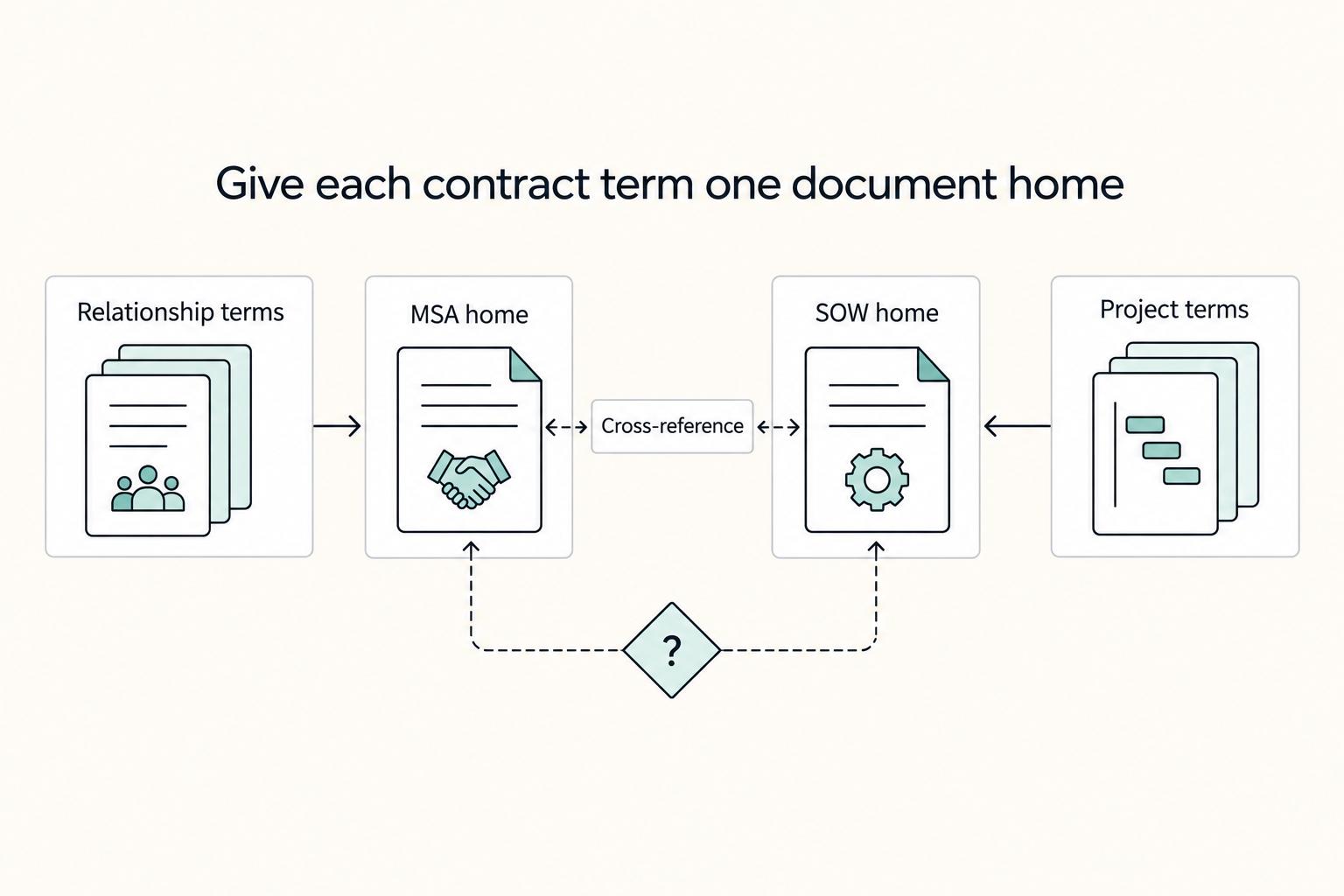
This is why the MSA vs SOW split is practical, not academic. A Master Services Agreement, or MSA, is the overall legal framework for the client relationship. A Statement of Work, or SOW, covers the specific project work. When that split is clean, expectations stay aligned. When it is not, scope blurs, deadlines slip, fees escalate, and trust erodes.
By the end of this guide, you and your team should be able to make three decisions quickly:
- Decide whether a single SOW is enough for the current engagement or whether an MSA plus SOWs is the safer structure.
- Put terms at the right level: relationship-wide terms in the MSA, project-specific terms in the SOW.
- Catch contradictions early so they do not turn into delivery or payment confusion later.
This is practical contract guidance, not jurisdiction-specific legal advice. Use it as a working method, and get local legal advice when your deal turns on country-specific rules or enforcement details.
The operating target is simple: clearer payment terms, clearer project outputs, and smoother contract cycles when new projects come in. An MSA supports repeat work because it usually holds the standard terms that do not change from project to project. Each SOW then carries the execution details that do.
Before you draft, pressure-test the papers against three concrete questions: what work will be done, who will do it, and how much it will cost. If any answer is vague, dispute risk is already rising. On the project side, explicit exclusions in the SOW also help define what the fee does not include.
- 100% scope traceability: you can map each deliverable to one acceptance test.
- 0% pricing ambiguity: your fee logic maps to milestones, hourly terms, or both with no overlap.
- One owner per clause: we assign each clause family to the MSA or the SOW before redlining.
Keep one owner per clause family.
One early red flag: if the client sends its own MSA, do not assume it is neutral. Client paper is often tilted toward client-side risk allocation. We recommend a side-by-side markup before you sign so your team can see where risk moved.
Compare MSA and SOW at a glance before drafting anything#
For repeat client work, a common default is MSA + SOWs. For a contained one-off, SOW-only may work if it still covers core protections and conflict handling clearly.
An MSA is the parent agreement for the service relationship. The SOW sets project-specific responsibilities, outputs, and timelines. Keep that split clean to reduce conflicting terms and dispute risk later.
| Criteria | MSA | SOW | What to watch |
|---|---|---|---|
| Purpose | Sets base relationship terms and conditions | Defines project scope, outputs, responsibilities, and timelines | Keep durable baseline terms in one place and project execution detail in the SOW |
| Lifespan | Often used as the base agreement across related engagements | Usually tied to a specific project or order | If repeat work is likely, a stable base agreement can reduce repeat renegotiation |
| Change frequency | Typically changes less often than project terms | Typically updated per project | Put frequently changing terms where updates are easiest to track |
| Owners | Covers relationship-level legal/commercial terms | Covers project-level delivery/commercial detail | Define who approves each document to avoid ambiguity |
| Negotiation intensity | Initial setup may be more front-loaded | Later SOWs can be narrower when base terms are already set | Plan for more upfront alignment on baseline risk terms |
| What breaks when drafted poorly | Unclear baseline terms can create relationship-level disputes | Unclear project terms can create delivery and billing friction | Poor drafting in either document creates avoidable disputes |
| Payment schedule | Can house base invoicing and payment mechanics | Can add project-specific payment detail | Pick one clear home for detailed schedule language |
| Intellectual property rights | May set baseline ownership and license terms | May add project-specific carve-outs | If the SOW changes the IP position, make override language explicit |
| Confidentiality clause | Can set relationship-wide confidentiality terms | Can reference or tailor confidentiality for the project | If repeated in the SOW, keep wording aligned |
| Warranties | Can set baseline warranty framework | Can add project-specific performance commitments | Keep commitments specific and consistent across both documents |
| Termination provisions | Can set relationship termination framework | Can add project wind-down mechanics | Check for mismatch between termination rights and payment terms |
| Acceptance criteria | Can state the high-level acceptance approach | Can define detailed acceptance tests | Clear sign-off rules reduce billing and delivery disputes |
| Order of precedence clause | Often defines which document controls conflicts | May include named overrides | Do not assume one document controls by default; state it clearly |
| Speed vs protection | Initial setup may take longer | Reuse can reduce repeat renegotiation across later projects | SOW-only can be faster now; MSA + SOW can be faster across repeat work |
| Practical default | Common for recurring or expanding relationships | Common for project-level detail under the parent agreement | For repeat work, MSA + SOW is common; for one-off work, make conflict rules and protections explicit |
A common miss is the Order of precedence clause. If the MSA and SOW both cover the same clause family, such as payment terms, use explicit inheritance or explicit override language. Otherwise, you end up with two sources of truth.
If you want one operator rule, use this: if a term should stay the same across future projects, put it in the MSA. If it changes with the project, put it in the SOW.
You might also find this useful: How to Write a Master Service Agreement (MSA) for Long-Term Client Engagements.
Put relationship-level risk in the MSA#
Keep the MSA reusable. If a term is meant to stay consistent across future projects, it belongs in the MSA so you are not renegotiating the same protections every time.
In practice, the MSA is where relationship-level terms usually live, including payment methods, confidentiality, intellectual property rights, and dispute resolution. Keep each SOW focused on project specifics like deliverables, milestones, timelines, costs, and acceptance criteria.
Apply the same consistency test to other risk clauses. If you want a clause to govern the full relationship, keep it in the MSA and avoid drifting versions across SOWs. If a term is meant to apply across projects, centralize it instead of rewriting it in every project document.
Before you sign, do one conflict check. If both documents touch the same clause family, make the override path explicit with order-of-precedence language. Then sanity-check the MSA for project details such as deliverables, dates, and milestone items. Move those into the SOW so the MSA stays reusable.
For a step-by-step walkthrough, see Structuring the 'Intellectual Property' Clause in a Statement of Work for a Freelance AI/ML Engineer.
Put project execution detail in each SOW#
Treat each SOW as the execution document for a project under the parent MSA. Put project-specific delivery and payment detail there: scope of work, outputs, project phases, milestones, acceptance criteria, service fees, hourly rates if used, invoice timing and triggers, and payment terms.
The same rule applies here: if a term changes by project, put it in the SOW. An MSA can govern multiple SOWs, so keep relationship-level clauses in the MSA and keep each SOW focused on this engagement's execution details.
| Execution item | What to define in the SOW | Red flag |
|---|---|---|
| Scope and outputs | Specific work product for this engagement | Vague project outputs |
| Phases and milestones | Sequence of work and checkpoint events | No clear review or invoice trigger |
| Pricing and invoices | Service fees, hourly rates, allocated hours if relevant, invoice timing/triggers, payment terms | Different payment logic across MSA and SOW |
| Owners and approvals | Named parties or representatives for approvals and sign-off | No explicit sign-off owner |
Define acceptance criteria in objective terms so "done vs not done" is testable. Then map money to those same checkpoints so each milestone has a clear output, approval event, and invoice trigger.
Keep SOW terms aligned with the parent MSA. For example, an MSA may make payment due 30 days after invoice receipt while an SOW says due immediately on receipt. The signed precedence clause determines which controls; resolve that mismatch or expressly authorise the project-specific exception before signing.
Related reading: A Cloud Architect's Guide to Structuring an SOW for a Multi-Cloud Migration Project.
Choose SOW-only or MSA plus SOW with a simple decision tree#
SOW-only can work when the work is truly one project and one document can stay clear. MSA + SOW is often the better fit when the relationship is likely to continue across projects.
| Deal signal | Better fit | Why | What to verify |
|---|---|---|---|
| One defined project with limited follow-on likelihood | SOW-only can work | A SOW is project-specific and can cover that single project's responsibilities, outputs, and timelines | Confirm the document is complete and unambiguous for this one engagement |
| Ongoing relationship, retainer, or likely future phases | MSA + SOW | The MSA sets broad relationship terms, while each SOW handles project-level execution details | Confirm the MSA is the parent agreement and each SOW is issued under it |
| Same client, changing project scopes over time | MSA + SOW | Keeps reusable relationship terms in one place and project detail in each SOW | Check that SOWs do not restate parent terms in conflicting ways |
| You plan to reuse the contract set | MSA + SOW | Clear document roles make reuse easier to manage | State which document controls and how an authorised project-specific override is made |
The key checkpoint is the parent-child link. If you use both documents, make it explicit how SOWs are created and governed under the MSA. A dedicated section for Statements of Work can reduce ambiguity.
A common risk is contradiction between documents. Read the signed precedence clause to determine which term controls; the document title alone does not settle the conflict.
We covered this in detail in A DevOps Engineer’s Statement of Work That Prevents Scope Creep.
Sequence the deal from first call to signature without rework#
A practical sequence is: align commercial scope first, stabilize the MSA baseline terms, draft SOW execution terms to match delivery, run one contradiction pass, then finish signature hygiene. That order reduces redlines and rework.
| Stage | Primary document | Set this now | Verify before moving on |
|---|---|---|---|
| 1. Commercial alignment | Deal notes, SOW outline | Project outputs, phases, service fees | Both sides describe the same work, timing, and pricing |
| 2. Risk rails | Master Services Agreement (MSA) | Core relationship terms and legal baseline | Core relationship terms are stable enough to draft project terms once |
| 3. Execution detail | Statement of Work (SOW) | Milestones, acceptance criteria, payment schedule | Each milestone maps to output, sign-off event, and invoice trigger |
| 4. Contradiction pass | MSA + SOW | Duplicated payment terms, timeline wording, acceptance language | No overlap says different things |
| 5. Signature hygiene | Final execution set | Signatory authority, version control, Effective Date | Signed files are traceable and audit-ready |
Start with commercial clarity before legal redlines#
Set the commercial shape first: what work will be done, in what phases, and for what fees. A concrete package is easier to negotiate and draft than a vague services description. If this step is fuzzy, scope, timeline, fees, and trust are where deals usually break down.
Stabilize the MSA before detailed SOW drafting#
Once scope is real, lock the durable relationship terms in the MSA. The MSA can act as the governing framework for the service relationship, while project execution belongs in the SOW. If ownership or other core terms are still moving, detailed SOW drafting usually gets reworked.
Draft SOW terms around delivery evidence#
Write milestones, acceptance criteria and the payment schedule so they work together. Follow the agreed change-control process for later scope, price or timing changes, and use an amendment when the agreement requires one. A change order can amend commercial terms; its authority and required signatures come from the contract, not its label.
| Element | Use in this section |
|---|---|
| Milestones | Map each milestone to an output, sign-off event, and invoice trigger |
| Acceptance criteria | Define "done vs not done" in objective, testable terms |
| Payment schedule | Make it operate together with milestones and acceptance criteria |
| Change orders | Use the agreed approval and signature process for scope, price and timing changes |
| Amendments | Use when required to change the governing agreement; identify affected terms and authorised signers |
Run one hard consistency pass, then finalize execution controls#
Before you sign, review the MSA and SOW side by side for conflicts in payment, timing, and acceptance wording. Then confirm entity names, signer authority, linkage between the MSA and SOW, version labels, and Effective Date. A clear Effective Date marker supports traceability in later audits.
Before signing, make sure you have one clean execution set: final MSA, final SOW, and any later change orders in a traceable chain.
Prevent contradictions with one precedence rule and one source of truth#
Set one clear tie-breaker and one authoritative draft location before you sign. Do not assume one document wins by default. State what controls if the MSA and SOW conflict, then reduce conflicts by giving each clause family one operative home in your drafting set.
Use precedence to resolve conflicts, not to justify overlap#
Your order-of-precedence language should answer one practical question: if MSA and SOW text conflict, which one governs for that issue? The goal is clarity in the signed set, so teams are not relying on redline history or email threads later.
For delivery execution, treat the SOW as the operational blueprint and working source of truth for scope, outputs, timing, and conditions. Keep milestone approvals explicit by naming who approves milestone completion.
Build a single-home matrix before redlining#
Use a simple ownership matrix: one document holds the operative clause, and the other either stays silent or points back to it.
| Clause family | Operative home (by drafting choice) | Pre-sign check |
|---|---|---|
| Payment schedule | MSA or SOW, chosen on purpose | Invoice triggers, due events, and timing appear in one place only |
| Acceptance criteria | MSA or SOW, chosen on purpose | Project outputs have clear criteria and a named approver |
| Scope change requests | SOW + documented change-order path (if used) | Scope wording and change mechanics do not conflict with MSA text |
| Termination provisions | MSA or SOW, chosen on purpose | Termination terms are stated in one place, or any different SOW term is explicit |
These duplicate zones become high risk because they affect money, completion, and exit. Contradictory wording in those areas can lead to avoidable disputes.
Run an alignment check before signature#
Review the SOW line by line and label each relevant clause as either covered in the MSA or specified in the SOW. If the SOW sets different terms for a clause, state that difference directly and keep it narrow and readable. If the clause is covered in the MSA, avoid restating the same concept with different wording.
Finish with one legal QA pass across the full execution set. Definitions, cross-references, and MSA-SOW linkage should all be consistent. Keep drafts and approvals in one authoritative place with traceable version history so edits and approvals remain auditable.
Handle Governing Law Jurisdiction and Dispute Resolution early in cross-border deals#
Set governing law, jurisdiction, and dispute-resolution language in the Master Services Agreement (MSA) before work begins. In cross-border deals, leaving key relationship terms open increases uncertainty if a dispute arises.
Put relationship-level legal terms in the MSA, and keep SOWs focused on delivery#
Use the MSA as the relationship baseline, and keep each Statement of Work (SOW) centered on the work to be done. Keep relationship-level legal terms consistent across the contract set, and document any intentional exception clearly. This keeps the agreement structure easier to follow before projects start.
Before you sign, do a quick consistency pass:
- Read the MSA sections that set relationship-level legal terms end to end.
- Scan each SOW to confirm it stays focused on the work to be done.
- Flag conflicts between the MSA and any SOW language.
- Resolve conflicts before signing.
Early decision vs. late decision#
| Decision point | Set early in MSA | Left late or scattered across SOWs |
|---|---|---|
| Governing Law | Clearer baseline before work starts | Less clear agreement structure |
| Jurisdiction | Clearer forum expectation | More uncertainty if a dispute appears |
| Dispute resolution clause | One relationship-level process | Higher risk of confusion and disputes |
| Effect on SOWs | SOWs stay focused on delivery | Scope and responsibilities can blur |
Clear structure is practical risk control. When agreements are unclear, scope can blur, deadlines can slip, fees can spiral, and trust can erode.
Keep uncertainty explicit in cross-border cases#
Review cross-border forum terms against the parties, governing law, dispute process and place where a judgment or award would need enforcement. Obtain advice on that country-specific combination before agreeing to a forum that would be impractical for your side.
If forum terms could make enforcement harder for your side, reassess the overall deal package before signing so the contract remains workable in practice.
Protect cash flow with tighter payment and acceptance mechanics#
Protect cash flow by reducing ambiguity. Set baseline Payment terms in the MSA, then use each SOW to map Milestones, invoice events, and approval language to concrete delivery points. This keeps payment conversations anchored to defined terms instead of vague "satisfaction" debates.
The logic is simple: the MSA is the relationship foundation, and the SOW carries execution detail for a specific engagement. Keep that split clear so overlaps are easier to resolve.
| Contract item | Best home | What it should do |
|---|---|---|
| Payment terms | MSA | Set the relationship baseline for invoicing and any late-payment or nonpayment terms included in the agreement |
| Payment schedule | SOW | Define invoice triggers, where applicable, against project events such as milestones, phases, or completion of specific work |
| Acceptance criteria | SOW | Define completion in observable terms so approval is testable |
| Hourly rates or Service fees | SOW | State whether billing is hourly, fixed, or mixed, and align that model to scope |
Make acceptance testable before payment disputes start#
The practical move is to replace soft approval language with clearer, checkable outcomes where possible. Each milestone can point to a defined output, and each output can have sign-off criteria that are verifiable. Before you sign, read each payment trigger and confirm what record would show it was met.
Mirror payment mechanics across MSA and SOW#
Payment terms are not just end-stage admin. They shape deal structure and cash-flow planning. If the MSA includes late-payment consequences or other nonpayment mechanics, the SOW payment schedule should not conflict with them. Do one consistency pass that reads milestone, acceptance, invoice, and nonpayment language together.
Draw clear boundaries for billing model and scope changes#
Payment conflicts can overlap with scope conflicts. If you use Service fees, state what is included and what is not. If you use Hourly rates, identify which work is billed that way and how added work is handled. For mixed projects, assign each workstream to one model so inclusion disputes are less likely later.
| Billing approach | What to clarify |
|---|---|
| Service fees | State what is included and what is not |
| Hourly rates | Identify which work is billed that way and how added work is handled |
| Mixed projects | Assign each workstream to one model |
Keep an evidence pack, not just a signed contract#
Keep practical records that support payment conversations: approval confirmations, change approvals, invoices, and delivery or receipt confirmations. If you use a payment platform, keep records that are easy to trace and review later. Treat this as part of closing readiness, not a cleanup task after work begins.
Spot red flags before signature on Termination Limitation of Liability and Indemnification#
Before you sign, keep document roles clear: the MSA sets the relationship-level legal framework, and the SOW sets project-level execution details. Mixing those roles can create dispute leverage, so keep any SOW override narrow and explicit.
| Clause area | Red flag before signature | Better home | What to verify |
|---|---|---|---|
| Termination | Termination rights are broad, but notice, payment, or wind-down treatment is unclear | MSA, with project wind-down detail in the SOW | How approved in-flight work, accrued fees, and milestones are handled if work stops midstream |
| Indemnification and limitation of liability | Broad indemnity obligations for risks you cannot control, plus carve-outs that may weaken the liability cap | MSA | Read indemnity triggers and carve-outs line by line to see what could become uncapped |
| Warranties | Promises are not tied to defined scope or delivery standards | MSA baseline, with SOW- or SLA-linked standards | Each warranty maps to a stated output, milestone, or sign-off criterion |
| Intellectual property rights | Ownership language is broad or unclear about project outputs versus pre-existing materials | MSA baseline, with SOW identifying project outputs | Confirm transferred rights are clearly tied to the paid-for work |
Termination that only works one way#
Termination language can create leverage when exit mechanics are vague. If convenience termination is allowed, the contract should clearly state how approved work in progress, invoiced amounts, and handoff obligations are handled.
Do a mechanical read across documents: termination clause, SOW milestones, acceptance criteria, and payment terms. If early exit is allowed but treatment of completed or partial work is unclear, fix that gap before signature.
Liability terms that quietly erase the cap#
A headline cap can be misleading if carve-outs are broad enough to bypass it in practice. Read limitation and indemnification together so you can see the actual risk position, not just the cap label.
Vague liability caps and missing IP terms are recurring drafting problems, and poorly drafted MSAs can lead to delayed payments, IP loss, or litigation.
Warranties and IP rights should map to the work, not to wishful thinking#
Warranties are safest when they map to defined delivery or performance standards in your deal documents. Tie each warranty back to the SOW scope, outputs, milestones, and approval criteria.
Apply the same discipline to Intellectual property rights. Attach a detailed SOW for each project and cross-reference it in the MSA so ownership language tracks the actual work. Then confirm the language is clear about what is transferred and what is retained.
Need the full breakdown? Read How to Write a Scope of Work for a Podcast Production Series.
Run this pre-sign checklist before you send the final draft#
Before you sign, run one hard pass to catch anything that can fail later. Keep relationship terms in the MSA, execution terms in the SOW, and make control rules explicit. If any item is unclear, fix it now, because unclear SOW language drives conflict and weak MSA drafting can lead to delayed payments, IP loss, or litigation.
| Checkpoint | What "good" looks like | What to verify |
|---|---|---|
| Clause placement | The Master Services Agreement (MSA) holds reusable relationship terms. The Statement of Work (SOW) holds project execution detail. | Confidentiality, IP, dispute resolution, and baseline payment methods are in the MSA. Scope, deliverables, timelines, milestones, costs, and acceptance criteria are in the SOW. |
| Legal control stack | Conflict control between the MSA and SOW is explicit. | Read the Order of precedence clause and confirm whether the MSA controls by default or whether the SOW has explicit overrides. |
| Delivery to cash | Scope, delivery, and billing terms are aligned. | Trace Scope of work -> Deliverables -> Acceptance criteria -> Billing terms. Confirm out-of-scope work follows the agreed change-order process. |
| Scope-change control | Scope expansion has a documented path. | Confirm revision limits and change-order mechanics. If scope expands after redlines, issue a new SOW or a clean replacement draft. |
| Execution hygiene | The final signature set is traceable and bindable. | Confirm legal entity names, signatory authority, latest version label, effective date, and one final merged document set. |
Practical rule: each clause family should have one home and one control rule. If the SOW repeats relationship-level terms, delete duplicates or state any override explicitly.
Finish with artifact checks: verify the signer can bind the entity, and confirm everyone is signing the same final set, not mixed redlines. A visible version label and an effective date are small details that keep the contract traceable.
This pairs well with our guide on A Guide to the Statement of Work (SOW) for a SaaS Development Project. Before you send the draft, turn your final scope, milestones, and acceptance criteria into a clean working document with the SOW Generator.
Use this structure to close faster and stay protected#
Use SOW-only for a truly narrow, one-off project where one document can cover both project specifics and baseline legal terms. Use MSA + SOW when work is likely to repeat, scope may expand, or risk is high enough that you should not renegotiate core terms on every project.
Keep the split clean: the MSA is the ongoing relationship framework, and each SOW defines project execution details like outputs, milestones, costs, timelines, and acceptance criteria. This parent-child structure makes repeat work easier to run without reopening the full legal stack each time.
| Your situation | Better structure | Why it usually wins |
|---|---|---|
| One defined project, limited scope, low chance of follow-on work | SOW-only | Fewer documents and a leaner setup, if that one document still covers core protections |
| Ongoing relationship or likely repeat phases | MSA + SOW | Set durable relationship terms once, then issue project-specific SOWs |
| Multi-project or higher-risk engagement | MSA + SOW | Cleaner allocation of relationship terms vs project terms across multiple SOWs |
Overlapping terms, vague acceptance and unclear document priority can create disputes. Make precedence explicit and verify that any SOW exception follows the agreed override process.
Use this quick pass before your next negotiation round:
- Keep relationship terms in one home and project execution terms in the SOW.
- Make acceptance criteria objective so approval and payment expectations are clear.
- Confirm any intended SOW override is explicit and aligned with the precedence clause.
- Do not start work before all signatures are complete and traceable.
For repeat enterprise clients, build a reusable MSA baseline, then update the SOW for each project. Allow time to negotiate the first MSA, especially ownership, liability and termination terms; later SOWs can then focus on delivery and commercial details.
If you want a faster first-pass template for new client deals, start from the Freelance Contract Generator and then apply this article's MSA/SOW allocation rules before signing.
- Trace every deliverable to an acceptance check and invoice trigger.
- Resolve duplicated control terms or label authorised exceptions.
- Confirm milestone approvals, fees and payment dates before signature.
- Keep one final execution set with effective date, version and authorised signers.
Frequently Asked Questions
What is the one sentence difference between an MSA and an SOW?
An MSA sets the legal framework for the relationship. An SOW defines the project outputs, timelines, requirements, and costs for a specific project under that framework.
Do freelancers actually need both an MSA and an SOW?
Not always. If the work is a one-off and one document can still cover core protections clearly, an SOW alone may work. If repeat work or multiple projects are likely, using both is usually cleaner.
Which document should be signed first in a new client relationship?
For a long-term relationship, the usual approach is to sign the MSA first. Then execute project-specific SOWs under it. If you use both, make sure the SOW clearly ties back to the parent agreement.
What happens if MSA and SOW terms conflict?
Read the signed order-of-precedence clause to determine which document controls a conflict. The MSA title does not create an automatic priority rule. If one document says payment is due 30 days after invoice receipt and the other says immediately, resolve it or expressly authorise the exception before signing.
Can one MSA govern multiple SOWs over time?
Yes. One MSA can govern multiple SOWs over time, which is a common reason teams use this structure. The tradeoff is that setting up the MSA can be slower upfront.
Which terms should never be duplicated across both documents?
Do not duplicate clause families unless an override is intentional and explicit. Keep broad relationship terms in the MSA and project-specific execution terms in the SOW. If an SOW changes a parent term, label the override clearly and check it against the precedence clause.
When is it reasonable to use only an SOW and skip an MSA?
It is most reasonable when the work is truly one project and one document can stay clear and complete. That SOW still needs to cover core protections and conflict handling clearly. For ongoing or repeat work, an MSA with project-specific SOWs is the more common structure.
Researched and edited by the Gruv editorial team. Gruv builds cross-border billing, payouts, and finance-operations software for global businesses.
Sources
- dgs.ca.gov/-/media/Divisions/PD/PTCS/PAU/FISCAL-Financi...trusted
- ldh.la.gov/assets/csoc/Attachment_3_SOW_42820.pdftrusted
- sbmtd.gov/wp-content/uploads/2025/10/On-Call-AE-Servic...trusted
- sec.gov/Archives/edgar/data/820609/00011931251016002...trusted
- sec.gov/Archives/edgar/data/1336691/0000950130100030...trusted
Educational content only. Not legal, tax, or financial advice.
Related Posts

Germany Freelance Visa Application Path for Freiberufler and Gewerbe
Choose your track before you collect documents. That first decision determines what your file needs to prove and which label should appear everywhere: `Freiberufler` for liberal-profession services, or `Selbständiger/Gewerbetreibender` for business and trade activity.

The Best Digital Nomad Cities in Southeast Asia
Pick the city that can support a normal workweek, not the one that looks best across a dozen tabs. If you want one practical answer from this Southeast Asia shortlist, use these three gates in order and drop any city that fails one.

Master Service Agreement for Freelancers in Long-Term Client Engagements
If you expect repeat work with the same client, set the contract architecture first: one reusable MSA for standing terms, then project documents for each engagement. The point is not just speed. It is making sure your baseline terms are set before they repeat across future projects. Treat each document as a separate layer: