
Quick Answer
Define who contracts with and invoices the end customer, who delivers and who approves changes. Align scope, actual billing triggers, customer-use rights, support, risk and exit in the final packet. Preserve authorized earlier commitments; signed paperwork is a useful control but its absence does not automatically erase an agreement.
Start here and decide what you must protect before you draft#
Before drafting, decide the service boundary, payment risk, rights and customer-contact limits you need to protect. Assign one draft owner and keep unresolved terms visible. A formal signed packet is a useful control, but email, conduct or other communications can also create obligations under the applicable law.
Many negotiation problems start when verbal alignment gets mistaken for contract language.
Step 1. Turn verbal promises into contract text first#
Start with the promises that affect delivery, money, ownership, or end-client communication. If it changes who does the work, what gets delivered, when you invoice, or who speaks to the client, move it from chat into the draft.
| Verbal Promise | Signed Contract Text | Risk If Left Unwritten |
|---|---|---|
| "We only do fulfillment, not client strategy." | Service scope excludes strategy, consulting, and direct end-client advisory work. | Extra work gets pulled in without clear pricing or boundaries. |
| "They handle all end-client communication." | Customer-facing communication stays with the reseller unless the provider is expressly authorized in writing. | Conflicting instructions, blame-shifting, and brand confusion. |
| "Rush changes are billable." | Out-of-scope or expedited requests require written approval and separate fees. | Extra work is treated as included. |
| "Our templates and methods stay ours." | Pre-existing materials, tools, and know-how remain with the original owner, with only the agreed license granted. | Reuse rights become unclear after delivery. |
If someone says a term was already agreed, preserve the actual record and check who had authority to agree it. Reconcile it with the current draft instead of assuming that omission from a signature packet erases the commitment.
Step 2: Assign owners before redlines start#
Set ownership before comments start flying. Use one wording owner for version control, then assign operational decisions to the people who actually own them.
| Role | Responsibility |
|---|---|
| Redline owner | Controls the single active draft, accepts edits, and issues the next version. |
| Delivery owner | Confirms scope, turnaround assumptions, support limits, and handoff points. |
| Finance owner | Confirms pricing logic, invoice triggers, credits, and extra-work approvals. |
| Legal wording owner | Confirms the agreed business decisions are accurately reflected in contract language. |
Keep unresolved points in one decision log, not scattered across email and chat: issue | proposed wording | owner | status | next action. Example: Client revisions cap | "Includes two revision rounds per deliverable" | Delivery owner | Open | Confirm with reseller by Friday. Before you send any draft, every open item should have an owner and a next action.
Step 3: Control versions with comparison, not file locking#
Work from one active draft only. Parallel versions can create silent conflicts and missed edits.
Do not treat Office or Word protection as change control. A locked file can still be made editable. Use document comparison as your baseline control, and compare every returned draft against the last version you sent. That is how you catch quiet but material edits, such as removed approval steps or softened support limits.
Set the commercial boundaries, keep one active draft and reconcile material commitments before signature. Follow any amendment formalities in the actual agreement and applicable law.
Related: What is a 'Certificate of Good Standing' and When Do You Need One?.
Gather your prerequisites and evidence pack#
Build one negotiation packet around one current draft, and do not send it until every file matches that version.
Treat the agreement set as one operating package, not a loose collection of attachments. If the files drift, the negotiation drifts with them.
- Assemble the pre-negotiation packet first.
Use one folder and mark one agreement file as the current draft. Include the files your deal actually uses, for example: agreement draft, active SOW, scope schedule, pricing schedule, and any support annex needed for delivery.
| Document | Purpose | Owner | Must Match Across Files |
|---|---|---|---|
| Agreement draft | Core terms, roles, payment logic, risk terms | Redline owner | Party names, defined terms, schedule titles, version/date |
| Active SOW | Deliverables and timing for this engagement | Delivery owner | Scope wording, milestones, acceptance points |
| Scope schedule | Included work, excluded work, change control | Delivery owner | Service names, revision limits, dependencies |
| Pricing schedule | Fees, billing triggers, extra-work pricing | Finance owner | Currency, billing events, approval requirements |
| Support annex | Support boundaries and escalation path | Delivery owner | Response commitments, contact path, exclusions |
- Standardize labels before commercial bargaining.
Keep the same party labels and schedule names across the agreement, SOW, schedules, and signature blocks. If labels drift between files, pause and align them before you negotiate price or concessions.
- Use a consistent drafting order.
Use one sequence every time, for example: agreement, SOW, scope schedule, pricing schedule, then support annex if needed, so deal logic and operating boundaries stay clear before price discussions.
- Run a strict pre-send gate.
Before sending, confirm all four checks against the current version: defined terms match, party names match, schedule references point to the right documents, and the unresolved-items log matches the same version number. If any item fails, stop and fix the packet first.
- Maintain a minimal evidence log for every major revision.
Track changes beside the draft using: revision | change summary | reason | approver | status. Keep comparison files for major revision cycles so concessions stay traceable.
Use relevant sources for the service and jurisdiction. A government procurement form or unrelated regulation can illustrate document structure without establishing the rules for a private white-label engagement. Record the applicable source and reviewed date where a clause depends on law.
Step 1 define the deal model and party roles in plain language#
Set the operating model before you discuss price. In writing, decide who faces the customer, who delivers the service, and whose brand appears. Put that in the agreement body first, then mirror the same labels in the SOW and schedules so role confusion is less likely to turn into scope, support, or liability conflict later.
Use one set of party labels and repeat them everywhere without variation. If the deal is partner-branded and provider-delivered, say that once in the definitions and carry the same terms through pricing and support language. If customer-contact rights differ between the agreement and annexes, the draft is not ready.
Pick the operating model before pricing#
White labelling describes how the service is presented under another party’s brand. Subcontracting describes a delivery relationship; the two can overlap. Define who contracts with the end customer, who supplies the work, who invoices each party and what the provider may say to the customer.
| Model label | Customer-facing party | Delivery party | Brand-control implication |
|---|---|---|---|
| White label | Partner | Provider | Services are offered under the partner's brand, so brand permissions and customer-contact boundaries should be explicit |
| Subcontracting | The prime supplier contracts with the end customer | Subcontractor supplies the assigned scope | Can be disclosed or white labelled; define visibility and permissions |
| Hybrid (drafting shorthand) | Varies by service or clause | Split or shared | Write each exception clearly so brand and communication boundaries are not implied |
For a hypothetical project, North Studio is the reseller and contracts with the end customer under its brand. Delta Design supplies one five-section landing-page design for $3,000, using copy supplied by North. North owns customer intake and final client messages; Delta owns design production and correction of nonconforming work. Only North’s named delivery lead may approve scope changes. Delta invoices North, not the end customer, and the agreement states whether North owes payment regardless of when its own customer pays.
Run the clause test on every duty#
A clause is not ready just because it sounds complete. Treat it as ready only if it includes all four fields:
- Owner: which party is responsible
- Trigger: what starts the duty
- Deliverable: what must be provided, fixed, sent, or approved
- Communication boundary: who may communicate with the customer, and when
Run this test across onboarding, approvals, revisions, incidents, reporting, invoice inputs, and service changes. If any field is missing, mark the clause not ready and pause pricing on that point.
Before you move on, run one pre-pricing alignment pass across the agreement body, SOW, scope schedule, and support annex. Check terms like customer, client contact, support, escalation, and notice. If the same event assigns communication rights to different parties, resolve that first.
Step 2 lock scope and change control before discussing discounts#
Define the proposed scope before granting a discount. Check existing agreements and approvals as well as the new draft; do not assume work already agreed in email is optional merely because it is absent from a later schedule.
That sequence helps because pricing works best when the service boundary is clear. If the boundary is vague, margin can get traded away before the work is fully defined.
List the documents incorporated into this deal and define precedence when they conflict. An agreement, SOW, pricing schedule and SLA can form one package, but an external example does not incorporate those documents automatically. Identify exact versions and avoid unintended incorporation of mutable web terms.
Set the baseline before you trade margin#
Use a simple gate: no discount until scope is specific enough to bill and defend. Vague detail is where "included" work expands later.
State output, format, assumptions, exclusions and handoff. Include the revision count, support limits and any branded reporting. Reconcile earlier authorized email approvals with that baseline before finalizing it.
Choose the change-pricing path before the first scope-creep request#
Test a price change against actual delivery cost. In the hypothetical project, $1,800 of planned delivery cost against a $3,000 price leaves $1,200 contribution before overhead and tax. A 10% price discount lowers the price to $2,700 and contribution to $900—a 25% contribution reduction. Define future price reviews and scope changes by agreement rather than assuming an inflation clause permits any increase.
| Change-pricing path | When to use | Approval artifact | Billing impact |
|---|---|---|---|
| Fixed-fee change | Added work is defined well enough to price upfront | Documented, mutually approved change order or schedule update | One added line item or milestone amount |
| Time-and-materials change | Request is valid but effort is still uncertain | Documented approval stating rate basis and tracking method | Variable invoice amount based on recorded time or units |
| Re-baseline and replace scope | Change materially alters service shape, volume, or assumptions | Documented replacement SOW or amended schedule set | Future invoices follow the new baseline instead of stacking exceptions |
If a change affects duration, volume, or service detail, ask one lock-in question: what exact term now binds you, and where is the exit or adjustment path?
Keep change requests short enough to use#
Keep the process usable. If the form is too heavy, people will work around it.
A practical minimum field set can be:
- request summary
- reason for the change
- scope impact
- timeline impact
- pricing basis
- named approvers
That is usually enough to connect scope, price, and authority. Each change should be traceable from request to signoff to invoice line. If finance cannot map an invoice line to an approved change document, your control is too loose.
A request for a second page is new scope; fixing a defect in the agreed page is still owed work. For the hypothetical project, a mutually approved $600 second-page change raises the contract total to $3,600 and specifies a later delivery date. Keep the request, authorized approval, revised scope and invoice line linked. A revision cap must not turn an original defect into a paid change.
Step 3 split ownership and licensing rights without ambiguity#
Classify every asset before you draft IP language. In this kind of agreement, ownership disputes often come from treating unlike assets as one broad "work product" block.
Use these categories to describe each component and its rights; one deliverable can contain more than one category:
- Transferred Deliverables: specifically listed items you are assigning.
- Retained Materials: pre-existing methods, templates, know-how, reusable components, and other materials each side keeps.
- Licensed Use: materials one side owns but the other side may use under defined permission.
An asset may contain both transferred and retained components. Describe the components and permissions rather than forcing the whole deliverable into one exclusive category. Ensure the reseller can grant the customer the rights promised upstream.
| Asset category | Who owns it | What the other party may do | Approval needed | What happens at termination |
|---|---|---|---|---|
| Transferred Deliverables | Ownership transfers only for specifically identified items | Use as allowed in the agreement, subject to disclosed prior licensees and third-party embedded rights | State any transfer conditions clearly, including required approvals and timing | State whether transferred ownership continues and that disclosed inherited encumbrances still apply |
| Retained Materials | Original owner keeps ownership | No use unless a license grant allows it | Define what needs approval, who approves, and by when | State whether use ends or any rights survive |
| Licensed Use | Licensor keeps ownership | Use only within the stated purpose, field/channel, users, and term | State approval workflow explicitly; if sublicensing is allowed, require prior written consent when intended | State end-of-use steps clearly, for example stop use and return/delete materials as agreed |
Draft the license line by line#
Do not rely on broad labels like "licensed for use." Check each license grant against this list:
| License element | What to state |
|---|---|
| Purpose | State the exact permitted purpose. |
| Field/channel limits | State any field-of-use boundaries. |
| Exclusivity | Say whether rights are exclusive, non-exclusive, or exclusive only for identified items. |
| Transfer/sublicense | State whether either is banned, allowed, or consent-based; if sublicenses are permitted, require consistency with master terms, keep primary licensee responsibility for sublicensee compliance, and require affiliate sublicense termination when affiliation ends (if applicable). |
| Modification rights | State whether adaptation, localization, combination, or branding changes are allowed. |
| End-of-use obligations | State what must stop and what must be returned or deleted. |
| Territory, users and continuity | Identify end-customer use, permitted sublicenses, embedded components and which rights survive termination. |
Cover edge cases explicitly#
These points are easy to miss and expensive to argue about later:
- Put pre-existing know-how in Retained Materials unless you intentionally transfer it.
- Identify third-party tools/content/components so neither side assumes full proprietary control over embedded material.
- For third-party components, identify them and state any continuing third-party rights in embedded or included IP.
- For new improvements created during delivery, allocate them expressly. Do not rely on unstated defaults.
Run a short alignment check before signature#
Before signature, ask the counterparty to answer these in plain English on the redline or by email:
- Which exact items transfer?
- Which exact items remain with the original owner?
- Which licensed items may be used, for what purpose, in which field/channel, by whom, and for how long?
- Is sublicensing allowed, and does it require prior written consent?
- What exactly must stop, be returned, or deleted at termination?
For a step-by-step walkthrough, see How to Structure a White Label Partnership With Another Agency.
Step 4 assign service quality and support boundaries#
Assign support ownership before launch. If you do not name one customer-facing owner and one backend owner, support responsibility gets fuzzy and disputes follow.
| Support lane | Owner | Trigger | Required response action | Communication channel | Handoff condition |
|---|---|---|---|---|---|
| Customer-facing support | The party you assign to end-customer intake and updates | End-user question, complaint, defect report, or service-access issue | Acknowledge, collect facts, update the customer, and decide if backend support is required | End-customer channel plus internal ticket notes | Handoff when supplier-side diagnosis, fix, or confirmed product change is required |
| Backend support | The party you assign to technical diagnosis, correction, or platform access issues | Escalated ticket from the customer-facing owner | Investigate, report status, confirm fix or limitation, and return a clear next step | Internal support channel unless an approved exception applies | Return when customer messaging, closure, or commercial decision is needed |
In the example, Delta supplies a design file and preview matching the agreed five sections and responsive layouts. North’s delivery lead reviews against those criteria within the agreed five-business-day window, gives one consolidated response and identifies any specific nonconformity. Those example deadlines are negotiated choices. State correction and retest duties separately from new features or subjective changes.
- Conformance standard: what "done" means for that service item.
- Test method: how conformance is checked.
- Acceptance evidence: the record that shows the check passed.
- Rejection path: who can reject, on what stated basis, and what cure or retest follows.
- Document location: where the term sits, such as Order, schedule, or exhibit.
Define whether direct end-customer contact is allowed, who can approve it, and when it is permitted. Then define the exceptions and escalation path in writing so both sides follow the same workflow. State which channel they must use and when the follow-up notice must be logged.
Each time support changes hands, require a ticket-transfer note with: status, next action, current owner, customer-facing message. Before signature, run one verification drill. Pick a single incident, for example end users unable to access the service in the agreed territory, and have both sides map the escalation order separately. If first responder, external communicator, or closure owner does not match, fix the draft before signing.
Route new functionality through an approved change with price and timing. Diagnose the request first: correcting a failure to meet existing criteria remains part of the original obligation.
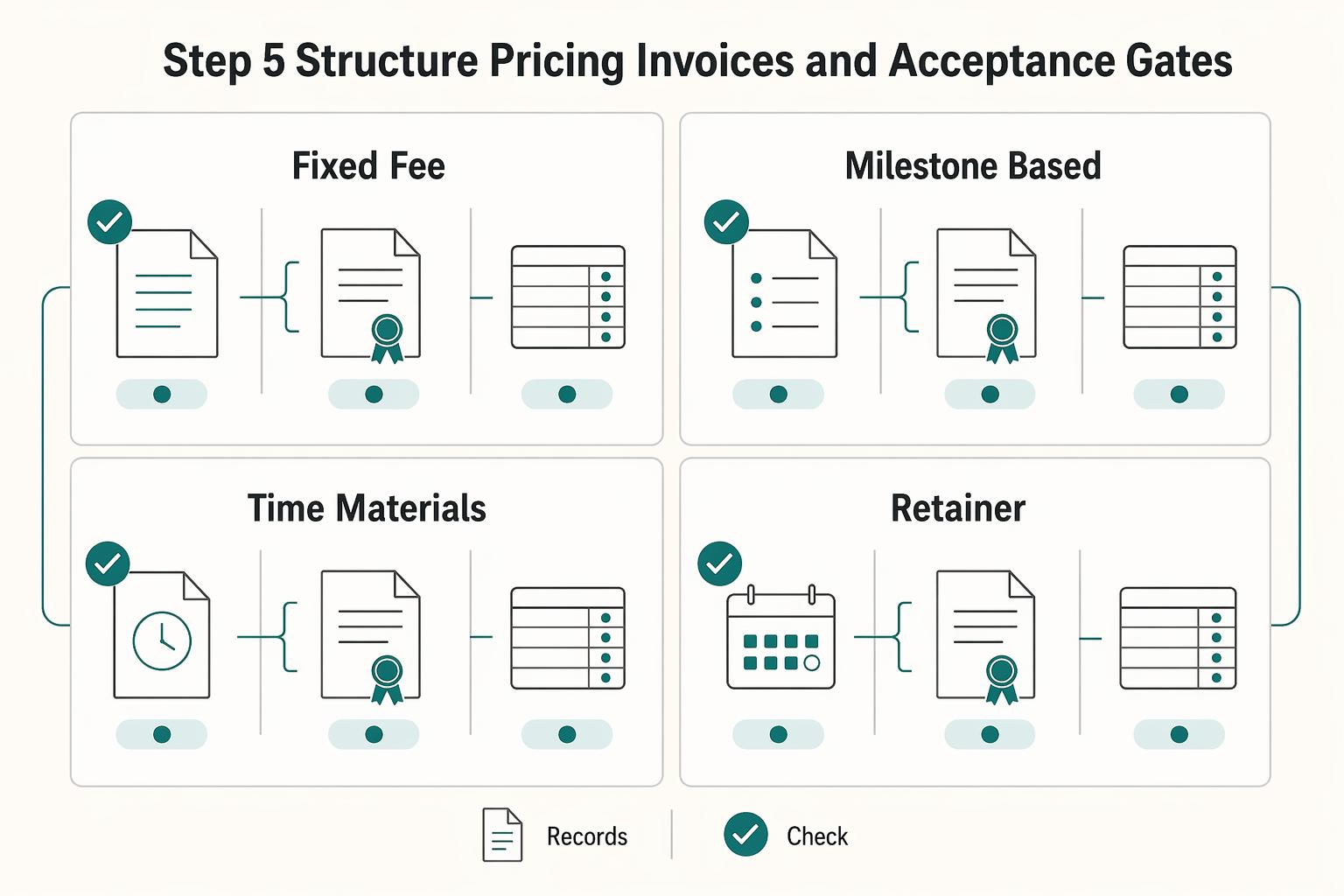
Step 5 structure pricing, invoices, and acceptance gates#
Align invoices with the billing trigger actually agreed. Acceptance may trigger a completion invoice, while a deposit, advance retainer or time-based invoice can be payable before completed output is accepted.
For each chosen billing approach, record the trigger, amount, due date and required evidence. The existing diagram represents traceability across models; its checks do not mean every invoice needs completed-output acceptance.
| Billing model | Actual billing trigger to define | Evidence to align with the invoice | Review question |
|---|---|---|---|
| Fixed fee | Agreed advance or completion event under the fixed price | Agreement and advance terms, or completion/acceptance evidence where required | Does the invoice follow the actual agreed trigger? |
| Milestone-based | Defined stage event; acceptance only where agreed | Stage record and evidence of the agreed advance, time or acceptance trigger | Can the invoice line be traced to the milestone record? |
| Time and materials | What counts as billable time/tasks under signed scope and rates | Time logs, task summary, approval record, signed rate/scope reference | Do billed entries map to approved categories and scope? |
| Retainer | Agreed advance period or service/capacity coverage | Advance period/capacity agreement, or service records where the billing trigger requires them | Do billed services map to documented retainer coverage? |
In the hypothetical project, North owes $1,500 in advance and $1,500 on accepted delivery, both under the agreed due dates. The approved $600 second page is billed with completion, making that invoice $2,100. If $42 processing fees are deducted, $2,058 reaches Delta’s bank; the fee is a separate cost, not $42 of unpaid customer debt unless the agreement shifts it. North’s customer payment does not alter these obligations unless the parties deliberately agreed a contingent-payment clause.
Before each invoice cycle, run a pre-invoice traceability check for each billed line item, such as:
- Agreed scope and approved changes
- Actual billing trigger: advance, time, capacity or accepted milestone
- Amount, currency and due date
- Evidence relevant to that trigger
- Contract version and authorized approver
Trace each billed line to its actual contractual trigger and authentic supporting record. Resolve material discrepancies promptly without letting an internal paperwork check override an invoice deadline or extinguish an amount already due.
Agree changes before undertaking new scope where possible. Preserve authorized existing commitments and distinguish added work from correction or support already owed. Follow the agreement’s change formalities rather than assuming all chat approval is ineffective.
Related reading: How to Structure a Commission-Based Independent Contractor Agreement.
Before you send redlines, turn your scope, acceptance gates, and change-control details into a working draft with the SOW Generator.
Step 6 set risk terms with Limitation of Liability and Indemnification#
Negotiate liability limits and indemnities against the actual risks, insurance and obligations. Direct service remedies, first-party damages and defense of third-party claims do different jobs. Operational control is a useful starting point for allocation, not an automatic legal indemnity.
Make each major risk traceable across the signed agreement set. If one party controls backend delivery and support quality, start service risk there. If the other party controls marketing, brand use, or customer-facing claims, place misuse and deceptive-claim risk there. When customer promises and operating reality diverge, disputes are more likely.
Specify the cap amount or formula, aggregation period, included claims, exclusions and any separate limits. For an indemnity, define claim scope, notice, defense control, settlement consent and exclusions. Check mandatory limits under the governing law; a contract cap does not necessarily bind a regulator or end customer who is not a party.
| Risk scenario | Limitation treatment | Risk allocation to negotiate | Escalation path |
|---|---|---|---|
| Service failure | Route first through the cap structure stated in the Liability Limitation Clause | Delivery party remedies; an indemnity only for defined covered claims | Incident notice -> service review -> clause-based remedy in support terms |
| IP claim | State cap treatment in clause text; do not assume it | Party assigned in the contract to control the relevant technology or supplied materials | Legal notice route -> claim handling contact -> IP defense path in contract |
| Brand misuse | Keep treatment aligned with brand-use and marketing-approval terms | Party controlling branding, advertising, and customer-facing statements | Brand complaint intake -> correction step -> escalation to contract owners |
| Dependency-related issue | Align treatment with dependency disclosures and exclusions | Allocation for disclosed dependencies, not automatic unlimited responsibility | Incident notice -> workaround or suspension path -> dependency clause reference |
Before signing, run this validation checklist against the written text:
- For each scenario, identify the operational owner, applicable remedy or defined indemnity if used, and notice recipient.
- Do the agreement, order form, and schedules use the same escalation and remediation order?
- If a customer complaint starts the claim, is front-line versus backend ownership clearly documented?
- Are cap and uncapped terms finalized for this deal, or clearly marked as placeholders pending legal review?
If either side answers from memory instead of from the contract file, pause and fix the documents first.
Step 7 choose Governing Law, Jurisdiction, and Dispute Resolution for cross-border reality#
Choose governing law, court forum or arbitration procedure before signature. These are separate decisions, and mandatory law can still apply. If arbitration is chosen, state institution/rules, seat, tribunal composition and language, and preserve any needed urgent-relief route.
Sweep every signed document#
Do not assume the main agreement carries the whole answer. Run one clause-alignment sweep across the main agreement, order forms, schedules, and support terms. Unclear dispute wording creates uncertainty and delay, so check alignment from the written text only:
- Governing law is consistent everywhere it appears.
- Forum is consistent, or exceptions are explicitly stated.
- The dispute path matches across documents, including any mediation or arbitration step.
- The precedence clause states which document controls if terms conflict.
One avoidable risk is a clean main agreement and a support addendum that sends disputes to a different forum. That mismatch can stay invisible until a live dispute.
| Route | Trigger | Who initiates | Where it runs | Practical cross-border tradeoff |
|---|---|---|---|---|
| Mediation | Written request under the contract or selected rules | Any party | Place stated in the contract or rules | Can help settlement, but enforceability depends on how the settlement is documented and on applicable treaty coverage |
| Arbitration | Clause-triggered referral to arbitration | Claiming party | Named arbitration seat | Can produce a binding award enforceable through domestic law and treaties such as the 1958 New York Convention, especially when seat and expected enforcement locations are drafted clearly |
| Litigation | Claim filed under the forum clause | Claiming party | Named court/forum | Works when forum drafting is clear, but judgment enforcement still depends on current treaty and jurisdiction coverage |
| Agreed alternative | Contract-defined trigger | Party or role named in the clause | As stated in the clause | Useful for narrower disputes only if the clause defines whether outcomes are binding and what escalation follows |
Draft notice and escalation as an operating sequence: formal notice channel, responsible contact role, response handoff, then precedence if documents conflict. Before signing, run a text-only verification drill. Both sides should trace the same law, forum, notice route, and next escalation step from the contract set alone. If they land in different places, pause and fix the documents.
Step 8 include compliance clauses you can actually operate#
Once law, forum, and dispute route are aligned, make compliance workable. A generic "comply with applicable laws" line is not enough unless the contract also shows who sends notice, who responds, and what happens at termination.
Step 1 scope compliance by actual footprint#
Start with footprint, not a pasted law list. For any Applicable Data Protection Law language in the draft, map the real service flow before you assign duties:
- What data enters service delivery, support, reporting, or handoff?
- Which party handles each part of that flow?
- Where is data accessed, stored, or reviewed?
- Do subcontracting, support escalation, or admin access create cross-border paths?
Complete the data-flow map before processing starts or granting access. Roles follow actual purposes and decisions, not the white-label brand or a label pasted into the agreement.
Where UK GDPR controller–processor rules apply, use a compliant processing contract with instructions, confidentiality, security, assistance, records/audit and end-of-service duties. ICO contract guidance explains the required terms. Subprocessor authorization and applicable international-transfer safeguards are separate checks.
Step 2 separate duties into traceable clauses#
Use dedicated clauses or schedules for regulatory duties, access/audit, records, notices and exit, with cross-references matching your own numbering. Do not copy clause or page numbers from an unrelated sample agreement.
Use one drafting rule: each duty must map to an owner, action, notice route, and termination link.
| Compliance obligation | Trigger event | Owner | Required action | Notice path | Linked clause |
|---|---|---|---|---|---|
| Data-protection scope | Data flow starts or changes | Named party role handling that flow | Confirm scope and update contract schedule if footprint changed | Formal route in Notices | Regulatory Compliance; Termination; Effect of Termination |
| Audit/access response | Customer, regulator, or contract audit request | One response owner + one records owner | Coordinate access and provide contract-defined materials | Contact/method in Notices | Monitoring/Audit/Access Rights; Documentation/Records |
| Records production | Records requested during service or exit | Named records custodian | Produce required records and preserve handoff package | Formal route in Notices | Documentation/Records; Effect of Termination |
| Suspected compliance breach | Internal detection or written allegation | Named incident owner | Investigate, send required notice, and trigger remediation/termination path if applicable | Notices plus any incident route defined in the contract | Regulatory Compliance; Notices; Termination |
Step 3 add conditional inserts only when verified#
Treat anti-bribery and similar frameworks as conditional inserts. Include them only when they are in scope for this deal and you have verified the source text, the exposed party, and the exact clause placement.
Step 4 run one text-only scenario test before signing#
Before signature, test one event from the contract text only, for example a records request or suspected breach. Both sides should independently identify the same first notice sender, response owner, cost owner if assigned, and post-termination records owner.
If the answers differ, pause signing and fix the draft so compliance, Notices, Termination, and Effect of Termination point to one operational path.
Step 9 write Termination terms and an orderly handoff#
Write termination so you can execute it, not debate it. Define triggers, define the cure and notice path, and define who owns each exit task.
Step 1 bucket termination triggers you actually use#
Define contractual cause, cure, convenience and insolvency provisions appropriate to the deal. Mandatory rights or restrictions can apply even when omitted from the packet; review insolvency and suspension wording for the relevant jurisdictions.
| Trigger | Include when | Exclude or narrow when | Drafting note |
|---|---|---|---|
| For cause | The parties want a clear exit for serious contract failure | The parties choose to define cause narrowly | Tie to specific obligations, not general dissatisfaction |
| Uncured breach | The parties want a fix-first path before termination | The agreement routes lower-severity issues to service credits or change control | Match notice and cure mechanics to your Notices clause |
| For convenience | The parties want a no-fault exit option | The agreement reserves capacity, tooling, or third-party commitments | Pair with payment and transition terms that are explicitly stated |
| Insolvency | The parties want explicit insolvency language | Legal review indicates narrower wording is needed | Add jurisdiction-specific wording only after legal verification |
Step 2 write the handoff in execution order#
List offboarding in the order your team will actually perform it:
| Order | Offboarding task |
|---|---|
| 1 | Confirm continuity and handoff access; contain urgent security risks immediately if necessary |
| 2 | Set authorized transition access and cutoff dates under the agreed exit plan |
| 3 | Transfer open tickets, status context, and customer-facing commitments as required. |
| 4 | Return or delete data as required, with permitted legal retention and restricted backup handling documented |
| 5 | Settle final invoices and other payment obligations stated in the contract. |
| 6 | Remove brand names, logos, case studies, and marketing claims where the contract requires takedown. |
Assign one owner per step. If contractors are involved, still name which party remains primarily responsible for delivery and exit.
Step 3 reconcile every signed document before signature#
Treat the master agreement, SOWs, schedules, exhibits, and signed addenda as one package. Add an order-of-precedence rule so conflicts have a defined control path.
Run one clause-alignment check before signature: pick a sample notice date and trace termination across all documents. If support continuity, cutoff rights, or post-termination duties conflict, fix the documents before signing.
Step 4 trade immediate termination rights for concrete terms#
If the other side asks for immediate termination rights, exchange that concession for terms that are explicit in the contract:
- Payment treatment for accrued amounts, deposits and completed or accepted work under the agreed billing triggers
- treatment of committed third-party obligations, if agreed
- a clearly scoped transition-support obligation, with pricing when substantial support is expected
- Mandatory jurisdiction limits and notice requirements reviewed before agreeing exit terms
That keeps exit rights usable without leaving your obligations open-ended.
Common negotiation mistakes and how to recover quickly#
Recover by preserving what was actually agreed, identifying authority and reconciling the commitment in the correct contract record. Do not rewrite history or assume a later form eliminates an earlier binding obligation.
| Mistake | Immediate recovery action | Clause/document to update now |
|---|---|---|
| Scope drift accepted in chat or on a call | Preserve authorized approvals, reconcile added scope and agree the required change record | SOW, acceptance criteria, change order |
| Unverified performance or marketing claims | Hold the claim until evidence and approvals are documented | Master agreement representations, SOW deliverables, approval workflow |
| IP ownership or license assumptions left vague | Split ownership, license scope, territory, and reseller-use limits in signed text | Master agreement IP clause, IP schedule, SOW |
| Support responsibility gaps | Name who owns L1, L2, escalation, and customer communications | SOW, SLA, transition plan |
Step 1 stop scope drift before it becomes a payment dispute#
For new add-ons, ask for the required scope and price approval before undertaking them. If an authorized verbal or email approval already created an obligation, preserve it and reconcile the record under the contract; do not assume a missing updated SOW gives an automatic right to stop.
Update work description, delivery period, standards, price and timing for a genuine added item through the agreed change process. Preserve existing authorized approvals; a valid email approval can be part of the record when the contract and law allow it.
Use one checkpoint: both sides must point to the current SOW version and the exact acceptance trigger for the new item. If that text is missing, alignment is missing.
Step 2 challenge claims you cannot verify#
If a performance or marketing claim is unverified, pause it instead of arguing it live. Use a direct line: "Let's mark that pending substantiation and keep it out of customer-facing copy and contract promises until we have backup."
If the claim must stay, ask for the evidence pack now and attach the approval path to the right artifact. If it is a representation, update the master agreement. If it changes delivery or acceptance, update the SOW.
If your contract is integrated, act like it. Side statements that conflict with signed terms may not control later.
Step 3 fix IP and cross-border assumptions in signed text#
IP and cross-border issues often fail because key limits are implied instead of written. Recover by making each point explicit now: ownership, license scope, territory, reseller or customer-facing use, and subcontractor permissions.
For U.S. copyright ownership transfers, 17 USC 204 generally requires a writing signed by the rights owner or authorized agent. Handing over a file alone does not transfer copyright. Confirm the chain of rights from contributors and third-party material, and do not assume every commissioned deliverable is work made for hire.
For personal data, review actual controller/processor roles and subprocessor authorization. ICO transfer guidance explains that remote access by a separate overseas organization can be a restricted transfer. The brand agreement alone is not a transfer safeguard. For IP complaints, separately define notice, defense and settlement authority.
Step 4 lock unresolved points and run a three-scenario drill#
Before signing, ensure each material commitment is resolved in the final packet or explicitly left open. Preserve records of earlier authorized commitments while resolving conflicts.
Run this short drill before signature and fill placeholders after legal review:
- Missed milestone
Example drill: Delta’s delivery lead reports a missed design deadline to North’s delivery lead through the agreed notice channel. The leads apply the written cure/revised-date process; finance tracks any agreed credit, and the named contract owners handle further escalation.
- IP complaint from end customer
Example drill: North receives a customer IP complaint and forwards it promptly to the agreed legal contact. The contract identifies which party controls defense, any exclusions for customer-supplied materials and who may approve settlement. North handles customer updates; neither team admits liability on behalf of the other without authority.
- Payment dispute over accepted work
Example drill: North disputes the $600 added-page invoice. Finance checks the authorized change approval and the agreed billing trigger, separates any undisputed amount and logs the response deadline. If unresolved, the contract owners use the agreed notice and dispute route; an internal invoice hold does not erase a payment obligation.
If you cannot complete this drill cleanly, do not sign yet.
Need the full breakdown? Read How to Create a Service Level Agreement (SLA) for Your Freelance Services.
Copy and paste this final checklist before you sign#
Check the exact final packet and reconcile all material commitments, including earlier authorized communications. Clear unresolved pricing, scope, rights and remedies before signing, and follow the formalities that actually apply.
Stop signing if any of these are open:
- Scope is loose, incomplete, or not fully listed in the main agreement and
Schedule A (Product/Service List)(or your verified local label). - Pricing, invoice timing, or price-change notice terms are still placeholders or side promises.
- Support ownership is unclear between reseller and provider, or escalation is missing.
- Branding roles, retained provider IP, or use restrictions are not explicit.
Step 1 freeze the exact signature set#
Lock the controlling documents before signature. Usually this is the main agreement, Schedule A, Schedule B (Pricing Terms), and a support annex or Schedule C (Support Terms) if support is separate.
If your deal uses local names such as Annex 1 or Exhibit B, keep the schedule label open until the attached file is confirmed, then use the confirmed label consistently.
Assign one owner per document for final checks:
- Main agreement: legal/redline owner
- Scope schedule: delivery owner
- Pricing schedule: finance owner
- Support annex: support lead
Open the live packet and clear any placeholders, for example [e.g., Net 30 days from invoice], [X days], [12] months, [30/60] days, [X years].
Step 2 map each promise to signed text and one confirmer#
Map each business promise to one place in the signed packet and one person who confirms it is complete.
| Business promise made | Where it must appear in signed docs | Who confirms completion |
|---|---|---|
| Covered services and scope limits | Main agreement scope + Schedule A (or verified local label) | Delivery owner |
| Prices, invoice timing, payment terms, price-change notice | Schedule B + matching payment clause in main agreement | Finance owner |
| Support split, escalation, technical documentation/limited support | Support annex or Schedule C + matching service clause in main agreement | Support lead |
| Branding/marketing role and customer-facing responsibilities | Main agreement + any branding exhibit | Commercial owner |
| Retained provider technology/design/IP ownership and restrictions on reverse-engineering/copying/disclosure | Main agreement IP section + any IP schedule | Legal reviewer |
Step 3 run the cross-document integrity check#
- Keep party labels consistent across the body, schedules, exhibits, and signature blocks, for example Provider/Manufacturer and Reseller/Brand Owner.
- Confirm defined terms and clause references still point to the right sections after redlines.
- Make sure support language matches the operating model. If the reseller is solely responsible for marketing, branding, and customer support, do not leave conflicting customer-support language elsewhere unless that was intentionally negotiated.
- If QA documentation or inspections on reasonable notice were agreed, verify that text appears in the signed support or quality terms.
- If rights or risk expand, confirm the commercial or process trade-off is also written in signed text.
Step 4 copy, paste, and sign only when every box is true#
- I checked the final signature packet, not an older draft.
- The main agreement,
Schedule A,Schedule B, and support annex/Schedule Care attached and correctly labeled. - Local schedule labels were verified, then inserted consistently.
- Scope and covered services are complete in signed text.
- Pricing, invoice timing, and price-change notice are complete with no live placeholders.
- Support ownership, escalation, and customer-facing responsibilities are explicit.
- Branding and marketing responsibilities are explicit.
- Retained provider technology/design/IP ownership is explicit.
- Any needed restriction on reverse-engineering, copying, or disclosure is explicit.
- Liability and termination text is complete, including any intended direct-damages cap lookback, indirect/consequential-damages exclusion, and post-termination stop-sales/stop-marketing obligations.
- Defined terms, clause references, and role labels match across the agreement body, schedules, and exhibits.
If one box is unchecked, pause signature and fix the text first.
You might also find this useful: How to Price a White-Label Service for another Agency.
If you want to confirm operational fit for your cross-border payment and compliance workflow, talk to Gruv.
Frequently Asked Questions
What is a white label service agreement, really?
A white label service agreement lets your customer rebrand and resell your services or deliverables as their own. Treat it as a rebranded delivery model, not a standard services setup. Write roles, branding rights, customer communications, and support boundaries directly into the contract set. Before signing, confirm the role labels match the actual model used in the deal, such as distribution or agency.
Which terms need to be signed before you start work?
Finalize the relevant scope, price, billing triggers, rights, confidentiality, risk and exit terms, with operational approvals and support duties. A signed packet helps clarity. Check whether earlier authorized emails or conduct already created obligations, and follow required formalities for IP transfer or amendments.
How do you split ownership of deliverables from your retained methods?
Write the boundary explicitly so ownership of agreed deliverables does not silently absorb retained methods or materials. Keep ownership language and scope language aligned with what is actually being delivered and rebranded. Before signing, test each split below against your signed text.
Who should support the end customer?
Set an explicit support split: who communicates with end customers, who handles backend delivery, and how priority incidents are handled. Keep that split in the signed documents, not in side conversations. Before signing, run one priority-incident scenario and make both sides name the same owners.
How should you handle indemnity and liability asks?
Do not accept broad risk language by default. Verify that liability and related risk terms align with brand controls, support responsibility, and the actual delivery model. If risk terms expand, ensure matching commercial and operational terms are also written into the signed deal. Before signing, verify those terms appear together in signed text.
What should your cross-border dispute terms say?
Identify governing law, the selected court or arbitration route, notice method and escalation steps. If using arbitration, specify rules/institution, seat and language. Have the applicable jurisdictions and likely enforcement location reviewed before agreeing the route; do not leave the review instruction as a live clause placeholder.
What should happen if the relationship ends?
Specify exit notice, any agreed continuity, access changes, data return or lawful retention, final payments and surviving rights. Keep sufficient authorized access for required handoff before revocation, unless an urgent security need requires containment.
Try a related tool
Researched and edited by the Gruv editorial team. Gruv builds cross-border billing, payouts, and finance-operations software for global businesses.
Sources
Includes 2 external sources outside the trusted-domain allowlist.
Educational content only. Not legal, tax, or financial advice.
Related Posts

Germany Freelance Visa Application Path for Freiberufler and Gewerbe
Choose your track before you collect documents. That first decision determines what your file needs to prove and which label should appear everywhere: `Freiberufler` for liberal-profession services, or `Selbständiger/Gewerbetreibender` for business and trade activity.
When You Need a Certificate of Good Standing and How to Avoid Delays
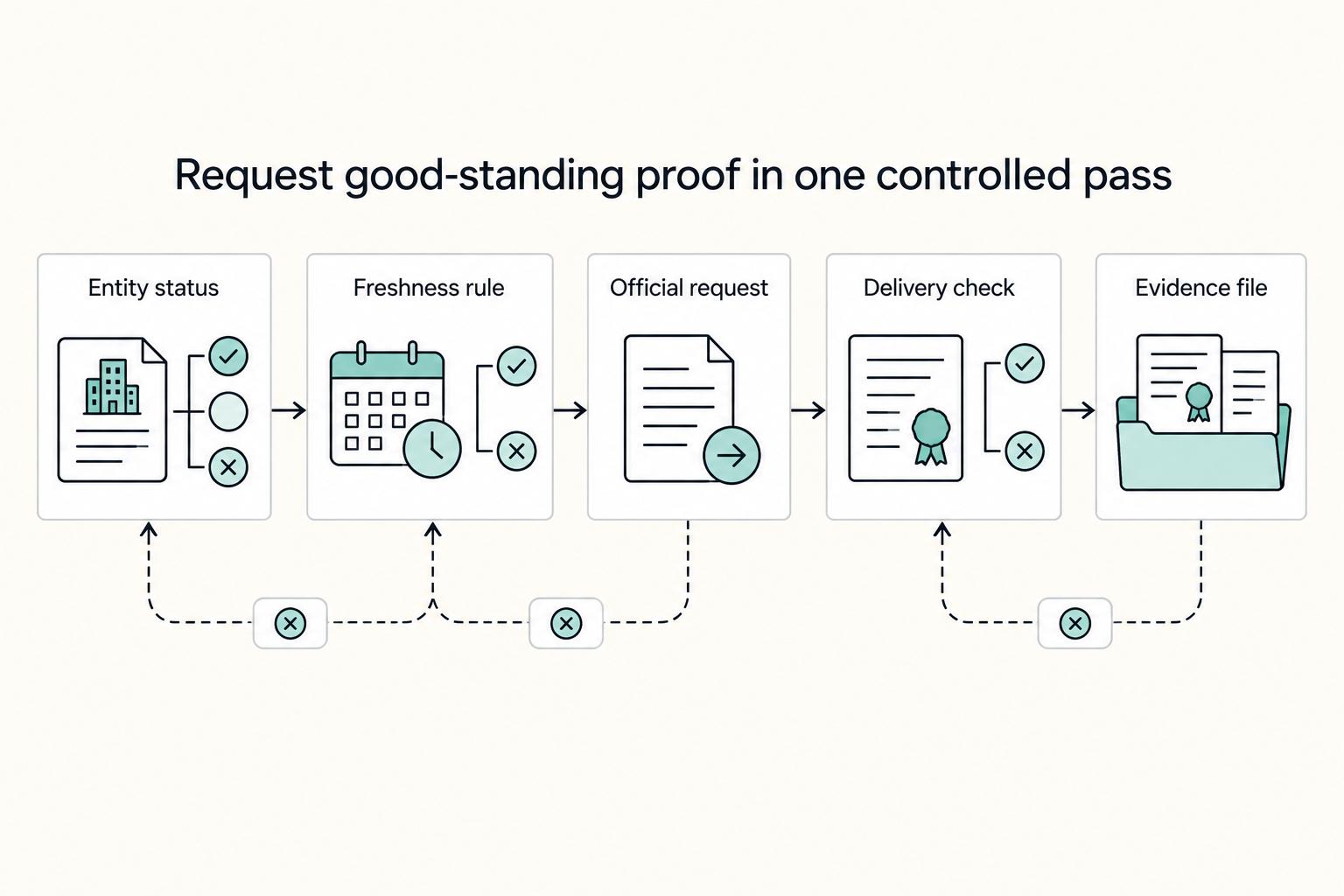
Start with two moves, in this order: confirm your entity status, then request the exact document title your reviewer will accept. That sequence removes the most common avoidable delay and keeps you from paying for the wrong output when the clock is already running.

The Freelance Payment Penalty: A Modeled Audit of Platform Fees, FX Spreads, and Payout Delays
The money rarely disappears through a single, easy-to-spot fee. The real loss is stacked. A marketplace takes its commission, a processor adds a charge for international cards, a bank or payment company converts the currency at a spread, a platform holds the funds before release, and a wire sheds a little to intermediaries on the way in. Each layer looks defensible on its own, but the worker feels the combined result as a smaller deposit and a later payday.