
Quick Answer
Identify who contracts with the client and whether the actual collaboration creates partnership or entity obligations. Agree scope, contributions, approvals and deadlock rules; define collected-funds profit distributions separately from fixed fees. Set IP/data rights, internal and client-facing liability, dispute process, changes and exit in compatible written terms.
Set the operating terms before work starts#
Treat the freelance joint venture agreement as a working document you can use day to day, not a ceremonial signature page. Put it in place before work starts so everyone involved is working from the same written terms.
A joint venture describes collaboration toward a shared business goal. This guide focuses on two freelancers delivering one client project. Agree its endpoint, but assess the actual legal and tax relationship: calling it temporary or independent does not by itself prevent a partnership from arising.
A project agreement does not automatically create a limited liability partnership or shield either freelancer. An internal 70/30 profit split is not a 70/30 ceiling on client claims. Separate the client-facing obligations from rights of recovery between the freelancers, and review the chosen structure under the applicable law.
At minimum, your agreement should clearly cover:
- each party's contributions
- profit-sharing
- decision-making
- duration
- exit strategy
For cross-border work, identify tax/registration responsibilities, the rights needed from each IP owner and the intended enforcement route before commitments are made. Review template terms against the actual parties, project and governing law.
Use the following sections to choose the structure, assign delivery and approval rights, calculate distributions and prepare a workable exit.
Choose the right structure before you draft#
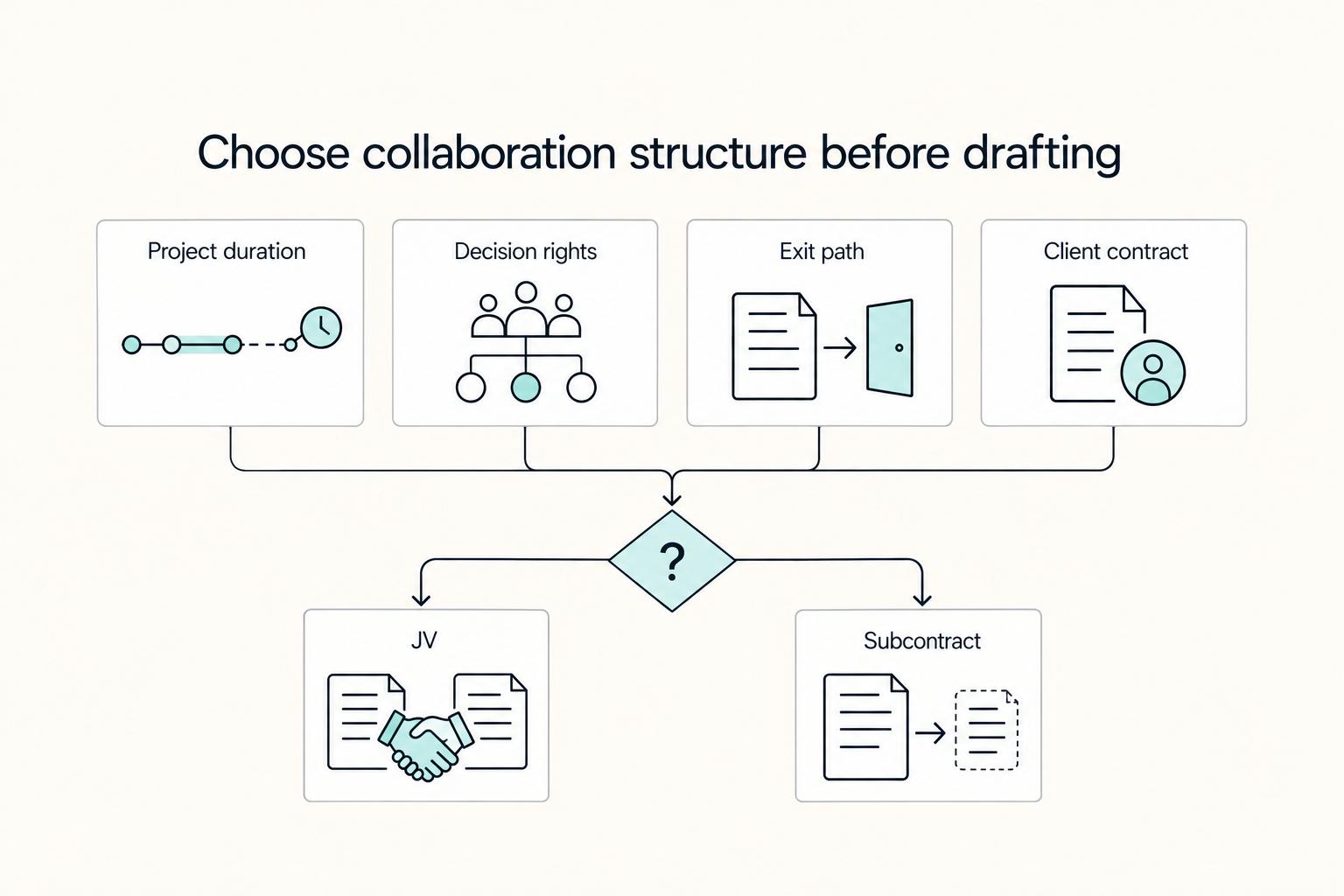
Start with the structure, not the template. That choice should match how long the collaboration is meant to last, how decisions will be made, and what should happen when the project ends. If both freelancers are jointly responsible for a defined project, test a written joint venture agreement early. If one freelancer holds the client contract and the other supports delivery, consider whether subcontracting terms fit that scope.
Classify the deal by its activity, control and endpoint. A defined six-month project can still be a partnership; duration alone does not decide. For example, HMRC’s partnership definition considers carrying on business in common with a view to profit. Record whether both parties contract with the client, one acts as prime contractor or a separate entity will do so.
Choose the legal form before committing to client obligations. Common options are a contractual collaboration between the existing businesses or a separately formed entity, such as a company where appropriate. These are not universal exhaustive categories. A contractual JV can amount to a partnership; forming an entity brings registration, accounting and tax obligations and does not erase personal guarantees or personal wrongdoing. Put the intended arrangement in writing and check the actual consequences.
Use this checklist as a drafting aid, not a universal legal rule.
| What to define | What to state clearly |
|---|---|
| Client relationship | Who holds the client contract, who delivers each workstream, and how responsibilities are allocated |
| Control rights | Who decides day-to-day issues and how tie-breaks are handled |
| Exit plan | How obligations, payments, and shared work are closed out at the end of the project |
Before you draft, lock two points in writing: each party's asset, cash, or IP contribution, and who decides day-to-day issues. If either point is vague, deadlock risk rises fast.
Gather prerequisites and deal inputs#
Gather the intake facts before making a binding delivery or price commitment. You can draft options while facts are open; mark assumptions and obtain both parties’ approval before signature or work starts.
Build a pre-draft packet that turns the opportunity into an Assigned Project, not just a loose concept. Include the client brief, proposed Scope of Work, working timeline, each party's deliverables, and any client terms already in play. Before treating the project as accepted, add one explicit checkpoint: both sides confirm conflicts are cleared. Project acceptance can be conditioned on a conflict check, so this is a pre-signing control, not optional admin.
Confirm the contracting parties and signer authority. Record each person’s legal name and whether they act personally or for an entity, plus who can bind it. Check authority before commitment, rather than treating an email assertion as conclusive. Identify the version/date and effective date of incorporated upstream terms and make them available to both parties.
Agree commercial inputs and dependencies. Estimate costs and revenue, assign day-to-day authority and decide how cancellation, unrecoverable costs and permitted client concessions are handled. Review the actual client contract for liability, IP, data, subcontracting and dispute obligations; do not assume a generic section number or class-action waiver applies. An internal JV agreement cannot amend the client’s rights without the necessary client agreement.
Draft the operating core of the agreement#
Once the commercial inputs are fixed, convert them into operating rules. This is where scope, ownership, and approvals need to become explicit so the project does not run on assumptions.
| Checkpoint | Confirm | Record |
|---|---|---|
| Kickoff | Active scope, timeline, dependencies, and access | Dated writing by email, shared log, or signed project note |
| Midpoint | Completed work, blockers, and whether client feedback changed the brief | Dated writing by email, shared log, or signed project note |
| Pre-delivery signoff | Assigned obligations are complete and quality review is done | Dated writing by email, shared log, or signed project note |
Define scope boundaries first. Write the Scope of Work so a third party can identify the objective, deliverables, client dependencies, and whether the venture is tied to a specific project or a specific time period. Do not rely on broad labels alone. List what is included, what completion looks like, and what is explicitly out of scope. If either party cannot answer "what are we not doing?" in one or two sentences, the scope is still too loose. Use client language carefully instead of pasting it in. Recycled template text can carry terms you did not mean to accept.
Assign work and authority, including shared interfaces. State each party’s deliverables, dependencies, review duties and decision rights. Identify one accountable owner for a handoff, while keeping any required joint approval explicit.
At minimum, define:
- who handles day-to-day client communication
- who approves drafts, revisions, and final delivery
- which decisions require both parties, for example scope, pricing, timeline, or client concessions
- who owns quality control before anything is sent
If both parties can make client commitments but no one has final approval authority, the conflict is built in.
Use written verification checkpoints if they fit your project. Kickoff, midpoint, and pre-delivery signoff can be practical controls when you define them clearly. At kickoff, confirm active scope, timeline, dependencies, and access. At midpoint, confirm completed work, blockers, and whether client feedback changed the brief. Before delivery, confirm assigned obligations are complete and quality review is done. Record each checkpoint in dated writing, whether by email, shared log, or signed project note. Written records are easier to review than verbal approvals if a dispute shows up later.
Set document hierarchy and change control explicitly. If you want the Joint Venture Agreement to govern by default, say so directly, and state that only a signed Change Order can override specified terms. Require each Change Order to identify the project name, effective date, and exact provision changed. This helps avoid the "latest file wins" problem that can show up in email threads and revised proposals. If you use recurring terms such as Scope of Work, Change Order, Effective Date, or Assigned Project, add a short definitions section so each term stays consistent throughout the agreement.
Set payment and cost mechanics that survive real projects#
Agree the money flow before the percentage split. Use one shared reconciliation record even if the client pays two separate invoices. Distinguish profit distributions based on collected funds from fixed service fees, approved reimbursements or other debts that are due under their own terms.
Agree the collection arrangement before debating percentages. Decide who invoices, where client funds land first, and who confirms receipt. Then align the Cost-Sharing Clause and Profit-Sharing Clause to that sequence. Write the order explicitly: client receipt, deductions, then distribution. That helps prevent one person from calculating from gross billings while the other calculates after fees, approved expenses, or disputed amounts.
| Money-flow option | Control | Speed | Auditability | Main failure risk |
|---|---|---|---|---|
| One lead invoices and receives all funds | High for the lead, single owner | Can be faster for the client | Can be strong with one account and one invoice trail | Mistrust if reporting to the other partner is weak |
| Client pays each freelancer directly on separate invoices | Shared control | Can be slower if client processes two vendors | Medium, records are split | Agreed economics can drift in practice |
| Lead invoices client, with service cost and expenses separated in billing and reconciliation | High control, clearer deductions | Moderate | Can be strong when receipts and expense proof are attached to each reconciliation | Delays if expense proof is incomplete or disputed |
If reliability is shaky, the first or third option may work better because one accountable lead can own follow-up and proof of receipt.
Separate service fees and expenses. State the rate or fixed fee, billable activities, approvals and supporting records. Label reimbursable costs and whether any markup is allowed; do not deduct a freelancer’s fee from the pool and then treat it as an unpaid share unless that is the agreed calculation.
For a collected-funds profit distribution, retain the client invoice, receipt status, payment fee/FX detail, approved expense receipts and reconciliation. Cite the actual agreed billing provisions, not a sample section number. Both parties should be able to verify the pool and receive undisputed amounts on the stated timetable; route disputed deductions separately rather than holding every amount indefinitely.
Write late-payment, dispute, and refund mechanics now. In the Joint Venture Contract, define at least four points:
- whether distributions wait for cleared client funds
- who handles late-payment follow-up and who can approve payment extensions
- how partial invoice disputes are handled
- how refunds, credits, or chargebacks are allocated after any distribution
Separate collection risk from amounts already owed. You can agree that profit distributions depend on collected funds, with a reserve for refunds. That does not automatically postpone a fixed service fee or third-party bill. Specify any lawful contingent payment arrangement expressly and plan funding for unconditional obligations. Do not impose new client-payment conditions after work is done.
Assign authority for refunds and concessions, and state actual client invoice due dates, internal reconciliation dates and payout dates separately. Define how a partner disputes a deduction and when undisputed sums are released. A blank “within () days” is not an operable term.
Define currency and payment evidence. Record invoice currency, actual gross receipt, provider fees, conversion date/rate, settled currency and bank amount. Identify the record used for each fact rather than forcing one document to override all others. A client may have paid while funds remain provider-held; avoid duplicate collection. Compare cross-border payout options in Gruv Payouts, checking actual eligibility, fees and currencies.
Specify the reconciliation format, sharing channel, required contents and cadence. A per-invoice reconciliation can show deductions, reimbursements, reserve and each profit share. Give both parties access to the relevant evidence, with restricted handling for personal or banking details.
Worked Example: Reimburse Costs Before Splitting the Pool#
Illustrative terms: the client pays $10,000, the collection fee is $100, and approved third-party project costs total $1,900. A has already paid $1,200 and B $700. Assume no sales tax or FX for this example. Net receipt is $9,900; reimburse A $1,200 and B $700, leaving $8,000. Hold an agreed $1,000 refund reserve, leaving $7,000 to distribute at 70/30: A $4,900 and B $2,100. Total cash paid is A $6,100 and B $2,800, plus $1,000 retained. Reimbursement is not an extra profit share.
If the client later receives an agreed $500 refund funded from the reserve, $500 remains. When the agreed release conditions are met, A receives $350 and B $150. Their final profit distributions are $5,250 and $2,250: 70/30 of $7,500 after costs, fee and refund. This is a contract-defined cash pool, not necessarily taxable profit or a return on unpaid labour. A refund larger than the reserve needs explicit loss-sharing and repayment rules; do not silently deduct unrelated fixed fees.
Give a Two-Person Team a Deadlock Route#
For example, A may approve design execution and B technical execution within the signed brief. Both must approve price, new scope, deadline concessions and refunds above an agreed threshold. If they disagree, record the issue and options, use a stated escalation window, and either retain the approved baseline or invoke a defined exit. Neither may promise the client a change the other must perform before internal authority and any required client approval are settled.
Protect work product and sensitive information#
If IP and confidentiality are fuzzy at the start, they can turn into a mid-project argument. Keep both areas explicit so each freelancer knows what is protected, who owns project work, and what can be shared.
| Topic | What to do | Key note |
|---|---|---|
| Ownership rights | Clarify intellectual property rights and ownership of the work produced during the project | If pre-existing materials are used, define how those materials and project outputs may be used |
| Confidentiality timing | Execute the Confidentiality Clause or NDA before any sensitive information is shared | Define prior-disclosure coverage and standard exclusions explicitly |
| Standard language | Use standard confidentiality language when possible | Check actual scope, permitted disclosures and negotiation needs; no universal processing-time multiplier |
| External sharing | Approve specific material in writing before sharing it outside the collaboration | Save the approval with the project records |
State ownership rights clearly in the Intellectual Property Clause. Clarify intellectual property rights and ownership of the work produced during the project, and put those terms in writing.
Separate background IP, each person’s new work, jointly authored work, third-party assets and client deliverables. Identify the owner and rights granted in each bucket, including source files, reusable components, portfolio use and handoff. In the UK, commissioning work does not generally make the customer its first copyright owner; obtain the agreed rights from every relevant owner. Do not promise a client rights that one freelancer cannot grant.
Agree confidentiality before sharing. Define protected information, permitted project use, recipients, duration and return/deletion. A new NDA does not automatically remedy an earlier disclosure, but the parties can expressly address identified prior disclosures. Distinguish prior lawful knowledge and other exclusions from newly received confidential material. Keep the signed date, share date and material log; preserve disclosures required or protected by law.
Use a reviewed baseline and examine deviations. Standard wording can simplify review, but it is not inherently enforceable or safer. Check exclusions, permitted disclosure, duration and remedies in the actual deal. If client personal data is involved, identify each party’s controller, processor or subprocessor role and the required instructions/contract or other arrangement; an NDA alone is not a data-processing agreement.
Control external sharing. Define routine authorized disclosures to approved collaborators and advisers, with appropriate safeguards. Require recorded approval for sharing outside those permissions, while preserving disclosures required or protected by law. Save the approval and scope with the project records.
Allocate downside with clear liability boundaries#
Because joint venture arrangements can involve shared risks and costs, downside should be decided before the work starts, not after something goes wrong. In a contractual joint venture formed through a written contract, liability boundaries should be explicit and tied to who controls each risk.
Separate internal allocation from external liability. An internal cap governs only the parties and claims it lawfully covers; it cannot unilaterally cap the client’s claim or override partnership liability. Define aggregate/per-claim basis, amount, period and exceptions, coordinating the client contract and insurance. Mandatory limits apply: for example UK law bars excluding negligence liability for death or personal injury.
Define indemnity by trigger and map each trigger to the Contribution Clause. Avoid a generic promise to "hold harmless" without saying what events trigger it. If you include triggers, for example a third-party claim tied to supplied materials or a confidentiality issue tied to one party's handling, connect each one to the person responsible for that part of the work.
Use a simple risk map before signing:
| Risk event | Who controls it under the Contribution Clause | Contract response |
|---|---|---|
| Third-party claim tied to supplied materials | Freelancer who supplied or selected the material | Trigger and scope tied to that conduct |
| Confidentiality breach from one party's handling | Freelancer who received, stored, or disclosed the information | Trigger, scope, and any carve-out stated clearly |
| Assigned task not completed | Freelancer assigned that task | Responsibility and claim handling tied to that assignment |
If you cannot fill in the control column cleanly, the role split is still too vague.
Only include insurance, notice, and cooperation terms you can actually operate. If coverage exists, record it accurately in the agreement or schedule. Do not promise coverage that is not in place. For claim notices, define where notice goes, who receives it, and that notice is sent promptly after awareness. Then set cooperation mechanics: who leads the response, what records must be shared, and whether settlement needs the other party's written consent.
Run a final clause-management check before you sign. Verify clause identity, incorporation, and modification rules so the risk terms do not conflict later. A practical checklist is to confirm the agreement handles:
- Identify each clause and referenced document by name and version/date.
- Make incorporated terms available and state which controls each subject.
- Complete blanks and record permitted amendment methods and approval authority.
Keep the signed version and amendment record together. Written change rules reduce ambiguity, but do not assume conduct or later communications can never affect legal obligations. Review governing-law formalities and use authorized written changes consistently.
Make enforcement choices upfront#
Enforcement works best when the process is clear before a dispute starts. Set dispute terms early so the agreement is usable, not just signed.
Set core dispute terms early, and keep them explicit. A joint venture is usually built for a specific project or defined activity, and things get messy fast when the rules are not agreed upfront. Informal or vague setups can also be interpreted differently once conflict starts.
State both points directly in the Joint Venture Agreement:
- Dispute resolution methods: which methods are available, for example mediation or arbitration
- Final path: what happens if earlier steps do not resolve the dispute
Quick check: can a neutral reader immediately find how a dispute starts, how it moves, and what the final step is?
Use a defined dispute path. Provide business escalation and optional mediation with a time window, then choose arbitration or litigation for the merits. Arbitration needs a seat, rules, scope and appointment mechanism; court terms need a specified forum. Defined court roles for interim relief, challenge or enforcement are not a routine fresh merits trial after arbitration.
For each stage, define:
- how the stage starts
- who must participate
- how long the stage runs
- when either party can move to the next step
Avoid open-ended wording with no time boundary.
Pick the final forum based on your top enforcement priority. Name the final path clearly in the clause so the process is operational when a conflict arises.
| Dispute path | Process clarity | Escalation clarity |
|---|---|---|
| Litigation | Specify courts, jurisdiction and permitted interim action | State any escalation/mediation prerequisites and deadlines |
| Arbitration | Specify seat, rules, scope, appointment and necessary court exceptions | Separate merits determination from award enforcement/challenge |
| Mediation | Define initiation, participants and time window | State when unresolved matters move to the chosen merits forum |
Choose a process proportionate to the likely claim value and parties’ locations. Examine cost, urgent-relief needs and enforcement where assets are held. A foreign arbitration award and a court judgment follow different recognition routes; neither is universally enforceable merely because the contract names a forum.
Make notice mechanics precise enough to survive a real dispute. Procedural misses can derail enforcement even when the underlying claim is strong.
At minimum, specify:
- a written service address for each party
- a defined submission channel for formal notices
- who receives notices
- any language mechanics you want notices and supporting documents to follow
Keep notice details current and store address updates with the signed agreement. For a shared product rather than one client engagement, the software-product JV guide covers that different scope.
Control scope drift during delivery#
Scope drift can become a legal issue if operating controls fail. Treat each material change as a priced, written change request tied to the current Scope of Work.
Anchor every change to the written scope baseline. Define scope before work starts, and keep one clear baseline that shows the agreed deliverables and what is out of scope. When new features or extra requests appear, route them through a documented change process that points to the exact part of the Scope of Work being changed. For each request, state whether it changes deliverables, acceptance criteria, timing, or dependencies. If it does not fit the current project, defer it to a future phase.
Quick check: can a neutral reader find the active scope baseline and latest approved change record without asking either freelancer for context?
Name who approves changes, then connect approval to repricing. The Decision-Making Clause should clearly assign who can approve, reject, or escalate a change request. Then connect that process to pricing terms. Added work may require a fresh proposal and fee negotiation, so the agreement should state which outcome applies when scope or margin changes:
- revise client price
- revise internal split
- revise reimbursable costs
- reject the change and keep original scope
Avoid approving extra work externally before internal repricing is agreed.
Use weekly checkpoints to catch drift early. Weekly checks are a practical control, not a universal legal requirement. Keep each check short and structured. Review delivery status, client feedback, unresolved dependencies, and pending change requests. In your shared tracker, label items as in scope, proposed change, blocked, or complete so scope decisions stay explicit. Keep one evidence set together: current Scope of Work, approved change records, milestone tracker, request log, and written pricing and timeline approvals.
Define failure mode and escalation before misses happen. Set recovery steps that run before formal dispute procedures. Your failure section should identify what counts as a missed milestone, who must notify whom, what written recovery plan is required, and how internal escalation works if issues are not cured. You can also state that non-approved extra work pauses until scope, price, or dependencies are resolved in writing.
Do not assume clear drafting alone prevents payment disputes. If delays and payment resistance appear together, escalate early inside the venture: confirm completed work, freeze extras, reconcile approved changes, and decide whether the issue is operational, commercial, or moving to formal dispute.
Plan exit terms before kickoff#
Exit terms are easiest to write before anyone is under pressure. Make them part of the operating deal from the start so an early stop does not become a second dispute.
Write termination triggers you will actually use. Name the exit conditions and decision process in plain language so both parties know when exit can be invoked. Keep this specific and signed before client work begins. Generic templates can contain errors or unlawful provisions, so do not rely on template language as-is.
Tie termination to unfinished work, money, and post-exit duties. If work stops mid-project, state each participant's obligations, rights, and responsibilities, and keep payment terms explicit since contract terms can provide legal protection in non-payment scenarios. Connect this directly to the Confidentiality Clause and Intellectual Property Clause. If you want confidentiality, IP ownership, or use restrictions to continue after termination, say so explicitly.
Define the handoff. List completed/unfinished work, files, licences, access revocation, data return/deletion and protected retention. Assign the client communication owner, transition work and its cost. An internal exit does not release obligations to the client or other creditors: arrange any needed client consent, replacement or release separately and reconcile receivables, liabilities, reserves and distributions.
Common drafting mistakes and how to recover#
Most failures are predictable. The usual problems are vague scope, unclear payment and decision rules, weak written terms, and exit language that falls apart under pressure. Fix them before the next milestone.
| Mistake | Recovery | Check |
|---|---|---|
| Generic scope language | Rewrite scope into measurable outputs with itemized deliverables, clear boundaries, and revision limits | A neutral reader can see what each person must deliver, what counts as done, and what requires a signed change |
| Unclear ownership of client contract and cash flow | Amend decision and money clauses together before the next invoice cycle | Both freelancers give the same answer to who invoices, who approves changes, which costs are shared, and when money is released |
| Missing signed terms for dispute-prone issues | Patch them in a signed addendum that references the original agreement | The document is signed and clearly states how decisions, money, and exits are handled |
| No workable mid-project exit path | Add termination mechanics plus post-exit duties covering exit triggers, unfinished work handling, ownership, and final reconciliation | Both parties can walk through an early stop and reach the same result on money, ownership, and post-exit obligations |
Mistake: generic scope language. Recovery: rewrite scope into measurable outputs. Repair the Scope of Work and related contribution language with itemized deliverables, clear boundaries, and revision limits. Avoid one-line descriptions that leave room for scope creep. Use this checkpoint: a neutral reader should be able to see what each person must deliver, what counts as done, and what requires a signed change.
Mistake: unclear ownership of client contract and cash flow. Recovery: amend decision and money clauses together before the next invoice cycle. Update the Decision-Making Clause, Cost-Sharing Clause, and Profit-Sharing Clause as one package. State who approves added work, who invoices, which expenses are shared, and when profit is distributed. Use this checkpoint: both freelancers should give the same answer to who invoices, who approves changes, which costs are shared, and when money is released. Keep the signed version and records together.
Mistake: missing signed terms for dispute-prone issues. Recovery: patch them in a signed addendum. Add clear terms for decision-making, financial contributions, and exit strategy, and make sure the addendum references the original agreement. Without a signed agreement, payment disputes can become evidentiary arguments. If there is no clear written agreement, default partnership rules can fill gaps, which is usually not what either party wants. Use this checkpoint: the document is signed and clearly states how decisions, money, and exits are handled.
Mistake: no workable mid-project exit path. Recovery: add termination mechanics plus post-exit duties. Strengthen the Termination clause and related dissolution language so it covers exit triggers, unfinished work handling, ownership, and final reconciliation. Use this checkpoint: both parties can walk through an early stop and reach the same result on money, ownership, and post-exit obligations.
For defined service commitments, use the freelance SLA guide to align response clocks, acceptance and remedies with each person’s delivery role.
Final takeaway and copy-paste checklist#
Lock the operating terms first. Then finalize protection and procedure before signatures.
Confirm the structure choice, then lock the core delivery clauses. Focus on Scope of Work, Contribution Clause, Cost-Sharing Clause, Profit-Sharing Clause, and Decision-Making Clause. Before you move on, make sure both freelancers can give the same plain-English answer to four questions: who invoices, where money lands first, which expenses need proof, and when profit is distributed. If those answers do not match, the draft is not ready.
Review protection terms together. Check confidentiality, IP, caps, indemnity, notices, law/forum and exit against the actual client obligations and mandatory rules. Keep background and third-party assets outside any unintended assignment, and specify the client’s agreed rights. Do not rely on broad confidentiality wording or internal caps to solve data obligations or external liability.
Set a procedural checkpoint before signatures. Use an internal cutoff for unresolved legal or commercial questions, then a separate signing target. Keeping those dates separate helps if timelines move earlier or later than expected.
Use this copy-paste checklist for final signoff:
- Structure selected and both parties agree this is a shared delivery arrangement
- Roles assigned in Scope of Work and Contribution Clause, including client communication and approvals
- Payment flow mapped from invoicing to receipt, expense proof, reconciliation, and distribution
- Risk clauses reviewed together, including liability limits, indemnification, confidentiality, and IP boundaries
- Enforcement forum selected with aligned Governing Law, Jurisdiction, and Dispute Resolution terms
- Change process set for scope or pricing changes
- Exit plan documented in Termination, including handoff and final reconciliation
- Signatures complete only after both parties confirm the final draft is the controlling version
If any box is still unclear, pause and fix it before kickoff. If you want to turn this checklist into a faster first draft your lawyer can redline, start with a structured template in the Freelance Contract Generator.
Frequently Asked Questions
What is a freelance joint venture agreement and how is it different from a standard collaboration contract?
A freelance joint venture agreement records how two professionals collaborate on a shared enterprise, including scope, governance, money, IP and exit. This guide uses a defined client project as its example. The name does not establish separate legal status or prevent a partnership: assess the activity, control, contracts and applicable law. A lighter collaboration or subcontract may suit a different allocation of responsibility.
When should two freelancers use a Joint Venture Agreement instead of a Subcontractor Agreement?
Shared decision-making, economics and delivery responsibility may justify a JV-style agreement. A prime contractor directing a defined supplier workstream may need a subcontract instead. Review the actual relationship and any worker-classification rules separately; calling someone a freelancer or partner does not settle employment status. Compare JV and subcontractor relationships.
Which clauses are mandatory before starting client work on a shared project?
There is no single supported rule that the same clauses are legally mandatory in every jurisdiction. Treat this as risk control: before work starts, get clear written terms on scope and contributions, governance and decision-making, payment flow and sharing mechanics, IP, dispute handling, and exit. If both freelancers cannot quickly explain who does what, who invoices, where funds land, and how a mid-project stop works, the draft is not ready.
How should freelancers split revenue, costs, and late-payment risk in a cross-border project?
Define invoicing, collection evidence, deductible costs, reimbursement, reserve, distribution and any loss-sharing before percentages. Separate profit distributions from fixed fees or bills due independently of collection. For cross-border work, record gross receipt, fees, currencies and actual conversion. State how partial payments, disputed deductions and later refunds change the calculation.
Who owns IP created together for a client under an Intellectual Property Clause?
Do not assume a universal default outcome for jointly created IP in cross-border work. A practical drafting approach is to separate pre-existing IP, jointly created work, and client deliverables, then state what rights transfer or license the client receives. If you cannot tag assets into those buckets up front, disputes can surface later around reuse, portfolio rights, and handoff.
What should be decided first on Governing Law, Jurisdiction, and Dispute Resolution for international collaborations?
Choose governing law and either an arbitration or litigation merits path that works for the parties and likely claims. Give escalation/mediation usable time limits. Specify arbitral seat/rules or court forum, and any urgent-relief/enforcement exceptions. Check recognition where assets are held; arbitration is not normally followed by a fresh court trial on the merits.
Try a related tool
Researched and edited by the Gruv editorial team. Gruv builds cross-border billing, payouts, and finance-operations software for global businesses.
Sources
Includes 4 external sources outside the trusted-domain allowlist.
- beta.dol.gov/policy-regulations/pay-benefits/wages-hours/...trusted
- legislation.gov.uk/ukpga/1977/50/section/2trusted
- uncitral.un.org/en/texts/arbitration/conventions/foreign_arb...trusted
- gov.uk/hmrc-internal-manuals/partnership-manual/pm1...external
- gov.uk/guidance/technical-guidance-for-official-rec...external
- ico.org.uk/for-organisations/uk-gdpr-guidance-and-resou...external
- ico.org.uk/for-organisations/uk-gdpr-guidance-and-resou...external
Educational content only. Not legal, tax, or financial advice.
Related Posts
How to Build a One-Page Freelance Service Level Agreement
A **freelance service level agreement** can document service expectations, but it does not determine worker status or tax treatment on its own.

The Freelance Payment Penalty: A Modeled Audit of Platform Fees, FX Spreads, and Payout Delays
The money rarely disappears through a single, easy-to-spot fee. The real loss is stacked. A marketplace takes its commission, a processor adds a charge for international cards, a bank or payment company converts the currency at a spread, a platform holds the funds before release, and a wire sheds a little to intermediaries on the way in. Each layer looks defensible on its own, but the worker feels the combined result as a smaller deposit and a later payday.

How to Respond to a Subpoena for Business Records
Move fast, but do not produce records on instinct. If you need to **respond to a subpoena for business records**, your immediate job is to control deadlines, preserve records, and make any later production defensible.