
Quick Answer
Identify the service, customer, access limits and billing events, then draft support, data, risk and exit terms that the product can deliver. Use master terms and an order form where useful, adding an SOW for implementation work. Define document precedence, liability and indemnity treatment, actual dispute forum and data export/deletion before signature.
Make the SaaS Agreement Match the Service You Deliver#
A SaaS agreement should define hosted access, commercial limits, payment, support, data responsibilities and what happens when the relationship ends. Make those terms consistent with the actual product and operating capacity.
Identify whether you sell a hosted subscription, implementation services or both. The customer needs to know what it can use, what it pays for, what support is promised and which responsibilities remain with each party.
A SaaS agreement sets the relationship, rights, and obligations between provider and customer. For ongoing work, an MSA can hold the core terms, with deal specifics in the client documents you attach. Keep the terms clear on services, payment, support levels, liability, indemnity, term, suspension or termination, and data responsibilities.
| What you need at signature | Where to anchor it | Why it protects revenue |
|---|---|---|
| Clear service promise | Service description and scope terms | Stops unpaid extras and scope drift |
| Predictable cash flow | Pricing, invoicing, and payment terms | Reduces delay and collection disputes |
| Operable support rules | SLA and response commitments | Prevents expectation fights |
| Defensible downside | Liability, indemnity, term, suspension, termination, and data clauses | Limits loss when problems escalate |
Before You Start#
Preparation item 1: assemble the current scope, pricing, support and data facts, then draft the clauses and mark unresolved decisions.
| Preparation item | Action | Key detail |
|---|---|---|
| 1 | Build a first pass in one focused session | Draft the core clauses above, then mark open issues for review |
| 2 | Rank redlines before you send | Label each clause accept, trade, or reject so you protect payment timing, risk limits, and delivery boundaries under pressure |
| 3 | Prepare fallback scripts | Trade within your framework instead of conceding control; move open-ended custom work into a scoped amendment before work starts |
Preparation item 2: Rank redlines before you send. Label each clause as accept, trade, or reject so you can protect payment timing, risk limits, and delivery boundaries under pressure.
Preparation item 3: Prepare fallback scripts. If a client pushes broad edits, trade within your framework instead of giving up control. For example, if a client asks for open-ended custom work, move that request into a scoped amendment before work starts.
Choose terms for the actual customer type and governing law. A business subscription and a consumer sale can have different mandatory protections. Use Revenue Recognition for SaaS Companies for the separate accounting question; signing or collecting a subscription does not by itself determine revenue recognition.
What should you prepare before drafting your first version?#
Prepare your contract stack, scope boundaries, and legal-review triggers before you draft so the agreement is faster to negotiate and stronger under pressure.
Once you know what you are protecting - revenue, scope, and downside - you need reusable inputs. The goal is simple: stop negotiating your core terms from scratch every time a client sends redlines.
For a recurring subscription, master terms can hold the reusable legal framework and an order form the deal specifics. Add an SOW when implementation or other defined delivery work is included; a simple hosted subscription does not automatically need all three documents.
| Document | What it controls | Verification point |
|---|---|---|
| Master Terms and Conditions | Core legal framework for the agreement | Reusable baseline across deals |
| Order Form | Pricing, billing, term, and commercial specifics | Matches the exact deal you are selling |
| Statement of Work (SOW) | Services, deliverables, timeline, responsibilities, and payment terms | No vague tasks or undefined handoffs |
- Assemble your baseline set.
Collect the documents that actually apply and record their version/date. Incorporate the identified terms into the order and make them available before assent. Define subject-specific precedence so, for example, a negotiated data-processing term is not unintentionally overridden by a generic order-form sentence.
- Define the service boundary.
State what your service includes, what it excludes, where support starts, and where support ends. Clarify access and license rights in the agreement, and spell out what is explicitly excluded. Verification point: a client can read one section and understand what they do and do not get.
- Pre-decide your risk posture.
Write your non-negotiables for Limitation of Liability, Indemnification, and Termination before negotiation starts. Align payment and service commitments early so risk terms and commercial terms do not conflict later. Verification point: you can label likely redlines as accept, trade, or reject in minutes.
- Capture intake facts early.
Record the deal facts and legal flags that can change drafting, including jurisdiction and any required security or compliance terms. If a cross-border client asks for extra legal language, route it immediately instead of letting the draft stall.
- Set your approval workflow.
Name who can approve commercial concessions, who can approve legal edits, and when you escalate to counsel for jurisdiction-specific enforceability checks. Verification point: every reviewer knows their lane before the first redline round.
Step 1 lock scope and access terms before you discuss price#
Lock definitions, access rights, and change control first so the agreement protects margin before pricing pressure starts.
This is where your prep turns into a draft you can actually run. Lock down scope, access, and change control before you talk price. Pricing pressure is where vague scope turns into unpaid work.
- Define the core terms and set the Effective Date.
Define the parties, Effective Date, subscription start, implementation start and service term separately where they differ. Confidentiality may begin before launch; billing may begin on an agreed calendar date or advance trigger. Delivery acceptance is relevant only where the agreed service or SOW requires it.
- Separate access rights from ownership rights.
For hosted SaaS, define the right to access and use the service, including any client components. Separately address ownership/licensing of provider software, customer data, custom deliverables and third-party material. Commissioning custom work does not automatically transfer copyright in every jurisdiction.
| Model | What the client gets | Scope risk to control |
|---|---|---|
| SaaS Agreement | Ongoing access to hosted service | Unclear usage boundaries can expand support and delivery load |
| Software License Agreement | Rights to use software under stated terms | Ambiguity can trigger ownership and reuse disputes |
- Tie usage rights to account structure in the agreement and Order Form.
Write usage and access restrictions in the agreement, then match commercial limits in the signed Order Form. Specify account security duties such as credentials, access codes, and connectivity requirements so daily operations match the legal document. Verification point: operations, billing, and legal language describe the same usage model.
- Add strict SOW change control.
Require the agreed authorized written approval for additional implementation scope and its price/schedule impact. Distinguish an in-scope defect from a new feature: correcting a failure to meet an existing promise follows the agreed remedy rather than becoming a paid change.
- Set Affiliate participation rules only when needed.
If affiliates may use the service, define eligible entities, permitted users, ordering and who owes fees or is responsible for their conduct. An affiliate is not automatically bound merely because you call it one; obtain the required assent or customer undertaking. Any control threshold, such as more than 50% ownership, is a chosen definition to review, not a universal legal test.
Step 2 - Define Billing, Service Levels, Data and Renewal#
Set payment triggers, measurable SLA limits, and renewal rules in the agreement before pricing talks so you keep control when pressure rises.
| Area | What to define | Operator check |
|---|---|---|
| Billing | Actual advance/calendar/usage/milestone event, due date, currency, taxes and fee allocation | Check collection before non-payment notice; cure period is agreed, not a universal ten days |
| SLA | Support clocks, uptime formula, exclusions, credit bands and remedy scope | Distinguish response from resolution and credits from other claims |
| Data | Actual categories and controller/processor/payment responsibilities | Telemetry can be personal data; PCI scope follows actual processing |
| Renewal/exit | Term, consent, notice, price changes, cancellation and export/deletion | Check applicable mandatory rules and usable customer exit |
Once scope and access are locked, move to the commercial engine. Your terms should make it obvious how money moves, what support looks like, and what happens when either side misses a beat.
- Anchor payment mechanics in the Order Form and master terms.
Set price, billing period, invoice event, due date, currency, tax treatment, authorized payer, permitted payment method and fee allocation. Define a non-payment suspension process with notice and cure that fits the agreement and applicable law. A negotiated ten-day cure period is an illustrative choice, not a statutory SaaS default. Check actual collection status before alleging non-payment; a provider-held client payment can be fully collected even while unavailable in your bank.
- Define a measurable Service Level Agreement (SLA).
Specify covered service, measurement period, monitoring source, outage definition, exclusions and remedies. Response time is acknowledgement or initial action, not necessarily resolution time. Name support hours, severity criteria, escalation and whether clocks run outside those hours. If credits are offered, define bands, eligible fee base, claim process, deadline and cap; do not assume an exclusive-remedy clause covers all breaches or overrides mandatory rights. The freelance SLA guide helps organize response commitments.
- Map data duties before security questions escalate.
Identify customer data, usage data and logs, including any personal data in telemetry. Contract labels do not make personal data anonymous or authorize unrestricted reuse. Where a controller uses a processor under UK GDPR, the required contract terms must address processing, instructions, confidentiality, security, subprocessors, assistance, audit and return/deletion. For payment-card data, map actual processing and PCI DSS responsibility; PAN is central, but sensitive authentication data has separate restrictions.
- Control your Renewal Term and price-change fallback.
State initial term, renewal length, notice method/deadline, price-change notice and cancellation route. Give the customer access to the applicable terms before assent and check mandatory rules for the actual jurisdiction/customer type. A renewal price freeze can be traded commercially, but it does not automatically justify broader liability concessions.
Use the SOW generator for a defined implementation package; keep subscription access and recurring billing in the applicable commercial terms.
Worked Availability and Liability Checks#
Illustrative SLA: measure a covered service over a thirty-day month of 43,200 minutes, with a 99.9% availability target and no exclusions in this example. Sixty counted outage minutes gives (43,200 − 60) ÷ 43,200 × 100 = 99.8611%, below the target. If the negotiated credit band for that result is 10% of a $1,000 eligible monthly fee, the credit is $100. Define the actual bands, clock, qualifying outage, exclusions and claim process; these numbers are a drafting example, not an industry-wide remedy. A hosting supplier’s SLA does not automatically become your application SLA.
Illustrative liability clause: an aggregate general cap of fees paid in the twelve months before the event yields $12,000 if the customer paid $1,000 monthly throughout that period, but only $3,000 after three payments if that is the chosen wording. “Paid or payable,” a minimum floor, a different measuring date or a separate cap can change the result. State whether an indemnity is inside that cap and whether credits count toward it; do not add or exclude them by assumption. Some liabilities cannot lawfully be excluded, including UK negligence liability for death or personal injury.
For an exit example, agree a specific export window and supported format, who requests it and whether transition assistance is included or separately priced. Test whether the product can actually provide that export. Distinguish return/deletion of active personal data, protected backups that age out under a stated schedule and records lawfully retained for tax or disputes. Do not promise immediate deletion of every copy if the architecture cannot do it.
Step 3 build the risk core with Limitation of Liability and Indemnification#
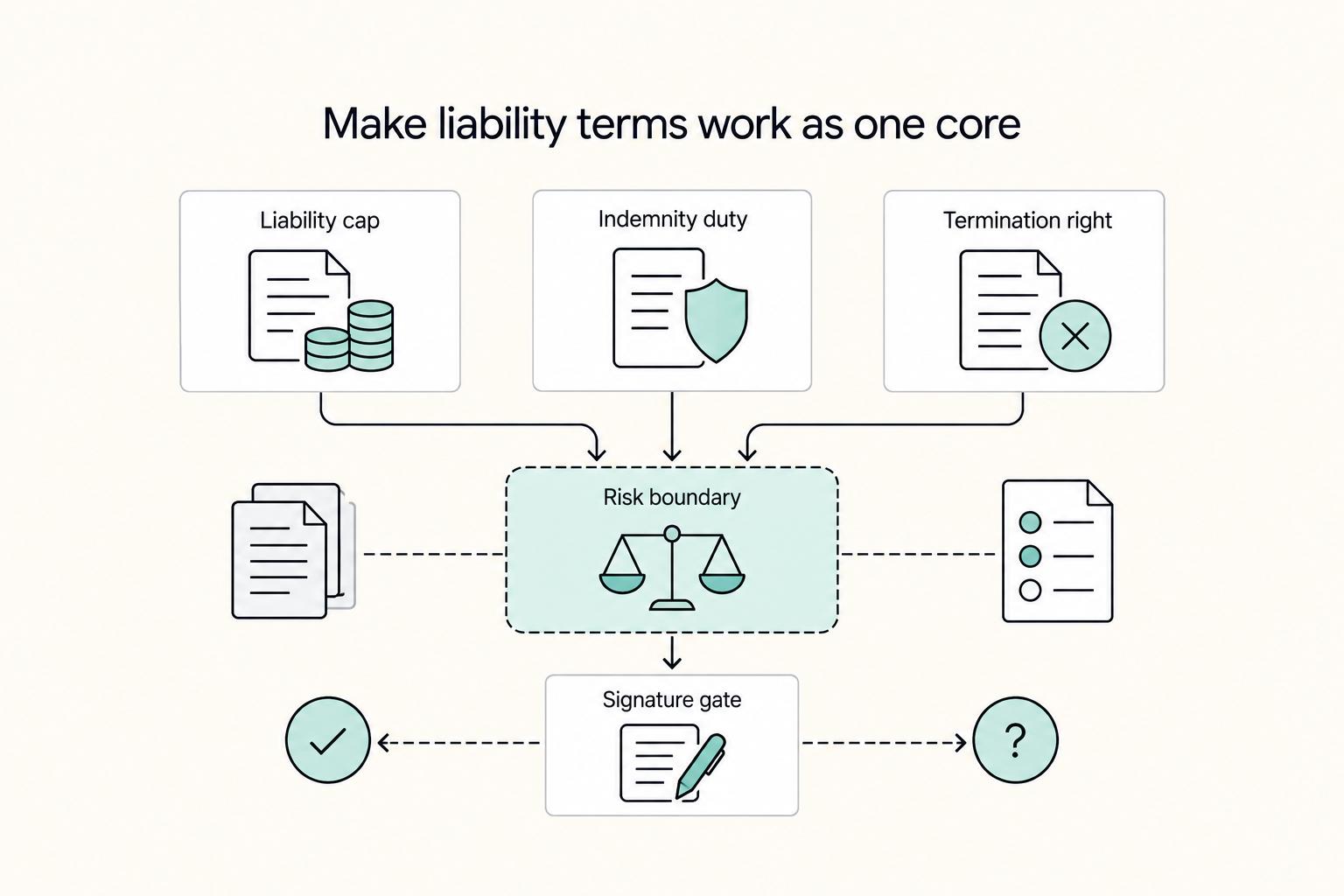
Build a single risk core where liability caps, indemnification duties, and termination rights work together instead of fighting each other.
Commercial terms get you paid. Risk terms keep one bad situation from wiping out months of good work. Draft these as a system, not as isolated clauses.
- Align the risk stack in one place.
A liability clause defines caps, excluded loss categories and exceptions, subject to applicable law. An indemnity allocates specified claims or losses and the related defense duties. State whether each indemnity falls within the general cap, a separate cap or a permissible uncapped category, then check the wording across the documents.
| Clause | What it controls | Operator check |
|---|---|---|
| Liability | General/separate cap bases, aggregation, excluded losses and lawful exceptions | Caps cannot override mandatory non-excludable liability |
| Indemnity | Specified third-party claims or losses, trigger, defense control and settlement consent | State cap treatment and cooperation duties explicitly |
| Termination | Notice/cure, stop date, fees/refunds, export and retention | Ending access does not automatically authorize immediate deletion |
- Define breach pathways before conflict starts.
State notice mechanics, cure structure, and Termination triggers for the breach scenarios your agreement covers. Do not leave these to implied business norms.
- Pair forum terms without ambiguity.
Governing law chooses the substantive law; jurisdiction identifies courts, while an arbitration clause needs its own seat, rules and scope. Coordinate them and identify any court role for interim relief or award enforcement. Do not promise that arbitration is followed by a fresh court trial on the merits.
- Lock confidentiality lifecycle duties.
Define confidential information, permitted disclosures, exclusions, duration and end-of-contract handling. Public, previously known, lawfully received or independently developed information may be excluded with an appropriate proof standard. Set return/deletion and retained backup/legal-record treatment, keeping retained data protected and restricted.
- Flag market-specific review points.
Jurisdictions treat liability limits and related remedies differently, so avoid one-size-fits-all assumptions from a generic software license template. For example, if a new overseas client asks for uncapped liability in your terms of service, pause, escalate, and get jurisdiction-specific guidance before you trade on core risk terms.
Step 4 run a redline framework that protects you and still closes fast#
Run a three-bucket redline system that protects your downside first, then trades value to keep signature speed.
Now you have the pieces. Deals close faster when you stay consistent under pressure, especially when procurement pushes hard and deadlines shrink.
Record the business reason for each position on price, liability, indemnity, renewal and data. Give authorized reviewers an accept/trade/reject playbook with fallback terms; a playbook guides negotiation but does not prove a term is legally enforceable.
| Bucket | Use it when | Your move |
|---|---|---|
| Accept | Edit lowers ambiguity without increasing exposure | Approve quickly and log rationale |
| Trade | Edit increases your risk but client needs movement | Exchange for measurable value |
| Reject | Edit breaks non-negotiables | Decline and offer a prewritten fallback |
- Triage every redline and log the reason.
Classify each edit as accept, trade, or reject against your contract priorities. Keep the log in the same workspace as your master terms and playbook so legal, finance, and delivery are reading one source of truth. Result: fewer ad hoc concessions under deadline pressure.
- Trade on liability with controlled SLA concessions.
A proposed liability change requires review of the actual exposure and insurance, not only a better uptime-credit offer. SLA credits generally address defined availability failures; they do not automatically replace an IP indemnity, data claim or other remedy. Negotiate any narrower scope, separate cap or reporting promise explicitly and check mandatory limits.
- Escalate disputes through a tiered path.
Use proportionate business escalation and, if agreed, mediation with a defined time window. Then choose arbitration or litigation for the merits, with clearly stated exceptions. Specify arbitral seat/rules or court forum and review cross-border enforceability. Courts may have defined roles in interim measures, challenges and enforcement; these are not a routine second merits stage after arbitration.
- Tie renewal and exit concessions to commitment.
When you negotiate Renewal Term language, exchange fee or notice flexibility for clear reciprocal commitments and explicit Termination notice windows. Keep every trade reciprocal and written in the Order Form plus the master terms. Result: predictable renewals, cleaner exits, and fewer surprise lock-ins.
What fails most often and how do you recover without losing the client?#
For each problem, first identify the current obligation and remedy. Use an amendment for an agreed change, the existing defect/incident process for a failure and the contractual notice procedure for a suspension or termination.
Resolve a defect or incident under the existing agreement without requiring the customer to sign away rights as a condition of receiving promised service. Amend scope or commercial terms only when the parties actually agree a change, preserving the original records.
| Failure mode | First recovery move | Verification point |
|---|---|---|
| Additional scope | Agree an SOW/order change before extra implementation | Original in-scope service continues unless a valid suspension ground applies |
| Defect or incident | Run existing remedy/security workflow and document evidence | Do not make promised correction conditional on a new waiver |
| Legal deadlock | Identify actual disputed provision and business effect | Review material data, liability, IP and forum questions as relevant |
| Risk mismatch | Align caps, exceptions, indemnity defense and remedy scopes | Preserve legally required rights |
| Exit | Run agreed notice, export, transition, refund and deletion process | Use specified window/format and protected retention exceptions |
- Re-lock scope immediately.
Issue the revised SOW and any related Order Form updates as one change set, and require signed written approval before anyone starts expanded work. Result: your legal document matches the actual delivery plan.
- Contain security fear with precise definitions.
Map the actual card-data flow, provider responsibilities and incident contacts. Outsourcing payment processing may reduce the merchant’s scope but does not eliminate its responsibilities. Do not store sensitive authentication data after authorization even if encrypted. If a security issue requires protective suspension, use a proportionate scope and lawful contractual basis, notifying affected parties and preserving incident evidence.
For example, a customer requests a new billing integration while the existing hosted service remains within scope. Estimate and approve the additional implementation work before starting it; do not automatically shut down the existing service while the amendment is negotiated. Align support handling with the freelance SLA guide.
- Narrow the legal battlefield.
Identify the disputed provision and its actual business effect. A legal deadlock may involve data, liability, licensing or mandatory rights as well as forum terms; assign the right owner and narrow the open issues without excluding material questions from review.
- Rebalance exposure in one pass.
In your agreement, negotiate Limitation of Liability and indemnity carve-outs together, not separately. Make carve-outs explicit so each party understands where caps apply and where they do not. Result: you avoid hidden uncapped risk and preserve a credible remedy path.
- Run termination like an operations checklist.
Use the agreed notice, cure and termination process. Record the stop date, fees/refunds due, customer-data export window and format, transition assistance and any priced extension. Define when active copies are deleted or returned and when protected backups age out, allowing required legal retention. Revoking service access is not automatically permission to delete data immediately.
Use this copy and paste checklist before you send for signature#
Check five areas before signature: documents, risk/remedies, operating commitments, data handling and approval authority.
| Check | Confirm | Result |
|---|---|---|
| Documents | Actual applicable master terms/order/SOW and referenced versions, with subject-specific precedence | No unintended override or unavailable incorporated document |
| Risk/remedies | Caps, exceptions, indemnity, termination and dispute path fit together | Mandatory rights and claim-specific remedies preserved |
| Operating terms | Billing, support clocks, uptime/credit rules, renewal/cancellation and notices are usable | Owners can calculate and execute promises |
| Data/confidentiality | Roles, processing, personal telemetry, PCI scope, security, export and retention are defined | Labels do not replace actual safeguards |
| Approval | Authorized parties, concessions and unresolved material changes reviewed | Final copies match the agreed terms |
Use this as your final operator pass before you send the package. The goal is consistency across the stack, so the signed contract matches how you actually deliver and bill.
- Confirm document hierarchy and consistency.
Check that your Standard Terms (or master terms), Order Form/Key Terms, and Statement of Work (SOW) describe the same service boundary, pricing logic, and renewal mechanics. Define which document controls if language conflicts, and verify that higher-priority terms override lower-priority terms. Result: your SaaS agreement reads as one coherent system, not three competing drafts.
- Confirm the risk core before commercial sign-off.
Check the cap basis, aggregation and measurement date; distinguish general and separate caps, exclusions and mandatory exceptions. Verify indemnity treatment, termination and forum clauses against that allocation. A signed cap is not necessarily enforceable: for example, UK law bars excluding negligence liability for death or personal injury.
- Confirm execution mechanics in operations terms.
Check support clocks, availability calculation, exclusions, credit bands, claim deadline and remedy scope. Review actual billing events, renewal notices and invoice-dispute process. A dispute window should not silently remove mandatory rights or permit collection of an already paid amount.
- Confirm data boundaries and confidentiality controls.
Define customer data and any permitted analytics purpose, preserving personal-data safeguards. Confirm processing roles, security responsibilities, subprocessor approval, incident notice, assistance, audit and export/deletion. Processor breach notice under UK GDPR is without undue delay to the controller; do not confuse it with the controller’s separate regulator-notification rule. Check additional contractual deadlines against the actual role.
- Send with a controlled call to action.
Invite edits in a structured way, then escalate specialized, complex, or jurisdiction-sensitive points to counsel. If late material terms arrive near signing, pause signature and route the change through a clear amendment path before final approval. Result: you keep deal speed, protect the relationship, and ship a defensible client contract.
Frequently Asked Questions
What is a SaaS service agreement and how is it different from a standard client contract?
A SaaS service agreement governs subscription access to cloud software services. A standard client contract can cover a wider business relationship, including custom services that sit outside the core platform. Use it as the product-access layer, then add separate service-specific terms when the deal includes delivery work.
What is the difference between a Software-as-a-Service (SaaS) Agreement and a Software License Agreement?
Hosted SaaS principally grants access to a service; a software licence can govern copies or components as well. A SaaS agreement may contain licence language without transferring ownership. Its hosted operation makes availability, data processing, access, support and exit important alongside IP rights.
What clauses are mandatory in a freelancer-friendly SaaS Contract?
No single clause set fits every jurisdiction or every deal. In most freelancer SaaS workflows, prioritize service scope, pricing and payment, service levels, limitation of liability, indemnification, and termination terms. If you need to tighten service commitments, use this guide: How to Create a Service Level Agreement (SLA) for Your Freelance Services.
Why do I need both an Order Form and Master Terms and Conditions?
They are useful for separating deal-specific price, term and limits from reusable terms, but not universally required as separate documents. A single well-structured agreement can cover a simple deal. When using several documents, incorporate identified versions and specify precedence, including data-processing and SOW exceptions.
How should I negotiate Renewal Term pricing without killing the deal?
Do not wait until the last minute. Put renewal mechanics and a non-renewal notice path in writing, then keep pricing changes tied to explicit language in the same clause or in the Order Form. If you propose a structure during negotiation, label it as an example and keep it negotiable, not a universal default.
When should I push hardest on Limitation of Liability and Indemnification?
Review the actual claim categories, cap calculation, exceptions, indemnity scope, defense process and insurance before accepting more exposure. SLA credits do not automatically solve an IP or data-liability request. Applicable law may restrict exclusions even if both parties sign.
How do I choose Governing Law, Jurisdiction, and Dispute Resolution for cross-border clients?
Choose the substantive law and the forum/process explicitly. If arbitrating, identify the seat, rules, scope and necessary court exceptions; if litigating, identify the courts and whether jurisdiction is exclusive. Escalation or mediation can precede either route. Review enforceability and practical cost for the actual parties.
Try a related tool
Researched and edited by the Gruv editorial team. Gruv builds cross-border billing, payouts, and finance-operations software for global businesses.
Sources
Includes 6 external sources outside the trusted-domain allowlist.
- legislation.gov.uk/ukpga/1977/50/section/2trusted
- uncitral.un.org/en/texts/arbitration/conventions/foreign_arb...trusted
- cloud.google.com/compute/slaexternal
- gov.uk/guidance/writing-a-fair-contract-for-customersexternal
- gov.uk/guidance/ownership-of-copyright-worksexternal
- ico.org.uk/for-organisations/uk-gdpr-guidance-and-resou...external
- ico.org.uk/for-organisations/uk-gdpr-guidance-and-resou...external
- pcisecuritystandards.org/faqs/does-pci-dss-apply-to-merchants-who-out...external
Educational content only. Not legal, tax, or financial advice.
Related Posts
How to Build a One-Page Freelance Service Level Agreement
A **freelance service level agreement** can document service expectations, but it does not determine worker status or tax treatment on its own.
Revenue Recognition for SaaS Companies Under ASC 606
Under ASC 606, revenue follows the transfer of promised goods or services rather than the date money arrives. A customer prepayment for future service creates a contract liability, commonly called deferred revenue. Cash, billings, receivables and recognized revenue therefore need separate records.

The Freelance Payment Penalty: A Modeled Audit of Platform Fees, FX Spreads, and Payout Delays
The money rarely disappears through a single, easy-to-spot fee. The real loss is stacked. A marketplace takes its commission, a processor adds a charge for international cards, a bank or payment company converts the currency at a spread, a platform holds the funds before release, and a wire sheds a little to intermediaries on the way in. Each layer looks defensible on its own, but the worker feels the combined result as a smaller deposit and a later payday.