
Quick Answer
Yes - in most cases, U.S. tech freelancers in Israel need a two-track plan: handle U.S. self-employment tax and Israeli Bituach Leumi separately, then layer treaty income-tax decisions on top. The core rule is that income-tax treaty relief is different from social-security coordination. Start with fixed obligations, compare FTC against FEIE using current-year rules, and document treaty or disclosure choices such as Form 8833 when relevant. That sequence reduces guesswork and makes the filing path easier to defend.
Your Biggest Fear About Working in Israel is Just a Math Problem. Here's How to Solve It.#
The safest way to approach this is simple: treat income tax and social insurance as separate calculations unless and until you verify a rule that connects them. If you are a U.S. citizen or resident alien based in Israel and freelancing, map the fixed obligations first before you chase exemptions or planning moves. These are the terms that most often get mixed together:
- Tax treaty: an agreement that may reduce or exempt certain income taxes for qualifying people.
- U.S.-Israel tax treaty scope: it covers U.S. federal income taxes and excludes U.S. social security taxes.
- Totalization agreement: a separate bilateral social-security agreement used to coordinate coverage and reduce double social-security taxation.
- Self-employment tax: U.S. Social Security and Medicare tax on self-employment earnings.
- Bituach Leumi (NII): Israel's National Insurance system responsible for social-security coverage and contributions.
That separation is your main risk control. Income-tax treaty relief and social-insurance obligations are not the same question. For U.S. self-employment tax, the IRS rule is generally the same whether you live in the U.S. or abroad. It generally applies when net self-employment earnings are at least $400, and FEIE does not remove it. Once you put the issue in the right buckets, the rest becomes modeling and verification.
Who this applies to#
Use this if all three are true:
- You are a U.S. citizen or U.S. tax resident.
- You are based in Israel.
- You earn income as a freelancer, consultant, or solo operator with cross-border clients.
If you operate through an entity, receive wages, or work under employer-like control, the analysis can change. Classification depends on facts and circumstances, not contract labels alone.
Decision snapshot#
| Question | Why it matters | What to verify next |
|---|---|---|
| Are you analyzing income tax, social insurance, or both? | The treaty can affect income tax, but it does not itself remove U.S. social security taxes. | Split your model into U.S. income tax, U.S. self-employment tax, and Israeli National Insurance. |
| Do you have at least $400 of net self-employment earnings? | That is the IRS threshold where self-employment tax generally applies. | Confirm current-year net profit and filing treatment. |
| Are you clearly self-employed under U.S. and Israeli facts? | Status affects contribution obligations and planning options. | Review control, independence, contracts, invoicing, and registration facts. |
| How does Israel classify your activity for National Insurance? | Local classification affects whether and how Bituach Leumi applies. | Verify the current National Insurance Institute classification criteria for the filing year before modeling contributions. |
| Is there an authoritative social-security agreement rule for your exact case? | Secondary sources can conflict on agreement status. | Verify current SSA and IRS agreement-status guidance before relying on a social-security agreement position. |
In practice, keep one sheet for worldwide income reporting, one line for U.S. self-employment tax, and one line for Bituach Leumi. Support each line with records that prove your status. First quantify the fixed cost. Then choose the planning levers. Then put compliance controls around the result.
Related: The Best Digital Nomad Cities for Tech Hubs.
The Unavoidable 'Cost of Autonomy': Quantifying Your Double Social Security Tax#
If you are pricing freelance work from Israel, model two social-insurance lines on the same income from the start, not one generic tax line. For planning, treat both as potentially applicable unless you have a verified exemption path and the required supporting document.
To keep the math clean, use these definitions:
- Net self-employment income: business income minus business expenses before self-employment tax.
- Social insurance vs. income tax: U.S. self-employment tax is Social Security and Medicare, not income tax; Israeli Bituach Leumi and health insurance are also social-insurance charges.
- Why treaty relief is not enough by itself: the U.S.-Israel treaty is framed as a convention on taxes on income, so income-tax relief does not automatically remove social-insurance obligations.
| Jurisdiction | Social-insurance line to model | Core input to use now | Verify before filing |
|---|---|---|---|
| U.S. | Self-employment tax | 15.3% rate (12.4% + 2.9%), generally applied to 92.35% of net earnings; general trigger at $400+ net earnings | Current-year Schedule SE inputs |
| Israel | National Insurance + health insurance | Current NII income bands and rates (page shows rates as of Jan 01, 2026, including a reduced-rate band at NIS 7,703 monthly) | Current NII rate page and your filing details |
Model the estimate as a range, not a single-point guess:
- Gather inputs: annual U.S. net self-employment income, average monthly Israeli self-employed income, and any status documentation in both systems.
- Run the two lines separately: U.S. self-employment tax using Schedule SE logic, and Israeli National Insurance and health insurance using current NII bands.
- Keep a range, because NII indicates amounts can be reconciled after final tax assessment through an extra payment or a credit.
Use this checkpoint before you go further: if the combined social-insurance cost still fits your margin and pricing, treat it as a predictable cost of working independently. If it materially changes take-home pay, pricing, or entity-structure decisions, escalate to a cross-border tax professional before you lock in your setup.
If you want a deeper dive, read the digital nomad tax guide.
Three Levers to Offset the Fixed Cost: Deductions, VAT, and Structure#
Once you know the fixed cost, the next step depends on what you need most. If you need cash flow now, start with deductions. If your bigger risk is invoicing or VAT mistakes, tighten that next. If the business is changing shape, only then revisit structure.
Lever 1. Tighten deductible expenses for cash flow now#
The fastest way to repair margin is still deductible expenses. For many tech freelancers, that can include software or SaaS, cloud infrastructure, domains and hosting, business-use hardware, relevant training, and workspace costs. In U.S. terms, the standard is whether the expense is "ordinary and necessary" for the business.
| Record element | Article detail |
|---|---|
| Proof | Invoice, receipt, paid bill, or similar source document showing vendor, amount, and date |
| Business purpose | A short note explaining how the expense supported delivery, operations, or business development |
| Category mapping | A consistent expense label in your books that ties to the return entry |
| Audit trail | Payment evidence plus a link to the related client, project, or period |
The common failure mode is not the category. It is weak documentation. The IRS expects supporting documents and expects records to be available for inspection. For each meaningful deduction, keep the four items above together.
Before year-end, review your 10 largest deductions and ask a simple question: would a third party understand each one without extra explanation? If not, fix it now. Mixed-use items such as a laptop, phone, internet, or workspace benefit from clear allocation notes, and travel needs records showing time, place, and business purpose.
Lever 2. Apply VAT rules precisely for risk control and margin protection#
VAT is one of the few areas where precision protects both margin and risk. Israeli VAT applies to services, so freelance service revenue still needs a VAT analysis even when clients are abroad.
| Topic | Rule from article | Implication |
|---|---|---|
| Exempt dealer threshold | Turnover below 122,833 NIS (2026) and activity is eligible | May qualify as an exempt dealer |
| Excluded professions | Some professions are excluded | Must open an authorized dealer file |
| Authorized dealer onboarding | If authorized-dealer status is required, onboarding is tied to Form 821 | Form 821 is part of setup |
| 0% VAT under Article 30(a)(5) | The foreign resident must be outside Israel and have no business or activity in Israel | 0% VAT is not automatic |
| When zero-rating can fail | The service is also rendered to an Israeli resident in Israel | Zero-rating can fail |
Start with registration status. If turnover is below 122,833 NIS (2026) and your activity is eligible, you may qualify as an exempt dealer. Some professions are excluded and must open an authorized dealer file, so revenue alone is not enough. If authorized-dealer status is required, onboarding is tied to Form 821.
Then check whether a foreign-client invoice can be issued at 0% VAT under Article 30(a)(5). This is not automatic. The foreign resident must be outside Israel and have no business or activity in Israel for this rule to fit. Zero-rating can fail if the service is also rendered to an Israeli resident in Israel.
The practical rule is simple: issue at 0% only when your file clearly supports who the contractual customer is, where that customer is located, and who actually receives the service. If those facts are blurry, treat the invoice as a review item and get VAT advice before you issue it.
Lever 3. Revisit entity structure only when the facts justify it#
Entity choice is the slowest lever, and it is also where mistakes get expensive. A Hevra Ba'am can change how compensation and compliance are analyzed across Israel and the U.S., but it is not an automatic fix for U.S. self-employment tax.
| Decision factor | Osek Murshe | Hevra Ba'am |
|---|---|---|
| Administrative burden | Often lower ongoing complexity for a solo operator | Often higher setup and ongoing corporate compliance |
| Legal protection | Confirm exact exposure with Israeli counsel for your fact pattern | Confirm exact exposure with Israeli counsel for your fact pattern |
| Cross-border tax treatment | Often keeps the current self-employed fact pattern unless facts change | Can change how compensation is analyzed; Confirm current treatment with cross-border specialist |
| Payroll implications | May be simpler when there is no salary model | Salary, withholding, and payroll reporting may apply; Confirm current treatment with cross-border specialist |
| Advisor complexity | Often manageable with standard tax or bookkeeping support | Usually needs tighter coordination across accounting, payroll, and cross-border tax |
This is usually where you escalate: when the business has outgrown the current filing setup. Common examples are adding staff, moving toward a highly controlled single-client relationship, or planning a salary model. If worker classification is unclear, the IRS framework looks at behavioral control, financial control, and relationship factors, and a formal determination route exists through Form SS-8.
Choose your next move#
Use the simplest option that actually solves the problem in front of you:
- Stay in your current structure if your main issues are deduction hygiene, VAT-file clarity, or documentation quality.
- Optimize your current setup first if the books are not yet clean and defensible.
- Escalate to entity-structure review if you are considering salary, expecting major growth, or need a company form for commercial reasons.
- Get cross-border advice before relying on structure changes, because saving-clause limits, treaty interaction, and state-level treatment can change the result.
Related: our 2026 guide to long stays in Georgia.
Run Compliance as a Repeatable Routine#
The real risk is usually not one big missed rule. It is letting classification, reporting, and deadlines drift apart until the file stops making sense. You reduce that risk by running compliance as a repeatable routine, not a year-end scramble.
The three controls that usually matter most are contract review, a live U.S. reporting dashboard, and adviser check-ins tied to clear decision triggers.
Pressure-test your contracts before you sign#
Contracts matter, but facts still control the outcome. IRS worker-status analysis looks at behavioral control, financial control, and the relationship of the parties, so your contract language and your day-to-day working pattern need to match.
| Contract point | Include | Red flag |
|---|---|---|
| Independent contractor clause | Use clear language that you are an independent contractor | The client keeps broad rights to direct how, when, and where you work |
| Scope of work | Define deliverables, milestones, and acceptance criteria | Open-ended or permanent role language instead of project or service language |
| Payment terms | State the fee basis, invoice timing, currency, and due dates | Salary-style payments or employee-type benefits |
| Termination | Include a clear exit path for either side | Indefinite lock-in with no practical end point |
| Governing law | Name the governing law and dispute process | Missing or weak terms that make a messy file harder to defend |
| IP and deliverables | Tie IP transfer to defined work product and payment | Language that blurs deliverable-based work into ongoing staff-like duties |
Before a new agreement or renewal, review the six points above against the actual working arrangement.
Keep the evidence in one client folder: signed contract, SOWs, change orders, invoices, and key delivery communications. If the paper says "contractor" but the day-to-day facts look like employee control, treat that as an escalation case. Form SS-8 is available when status is unclear.
Keep a live U.S. compliance dashboard#
Run this monthly so treaty positions, filing work, and reporting obligations stay separate and defensible.
| Control area | Monthly task | Evidence to retain | Escalation trigger |
|---|---|---|---|
| Contracts and classification | QA new or renewed contracts for control, permanency, payment, and benefits language | Signed agreements, SOWs, invoices, delivery communications | Client starts controlling hours, methods, or manager-style approvals |
| Foreign account reporting | Update account list and max balances | Account name and number, institution name and address, account type, max value | Aggregate foreign accounts approach or exceed FBAR threshold |
| Treaty and withholding posture | Log treaty-position decisions and payer withholding-document requests | Filed forms, adviser memo, payer correspondence | You plan to claim treaty relief or reduced withholding |
| Annual filing calendar | Track due dates, extensions, and unpaid tax exposure | Calendar, filing receipts, payment confirmations | You rely on abroad extension while expecting tax due |
Use the same record format for each dashboard item:
FBAR (FinCEN Form 114) What it is: foreign financial account reporting filed outside the tax return workflow. Who it applies to: U.S. persons with qualifying foreign accounts when aggregate value exceeds $10,000 at any time in the year. What records to maintain: account identity, account number, institution name and address, account type, max annual value; retain for 5 years. Threshold/timeline: due April 15 with automatic extension to October 15.
Form 8938 What it is: FATCA asset reporting attached to the tax return; it does not replace FBAR. Who it applies to: specified individuals with foreign financial assets above applicable thresholds. What records to maintain: statements, valuations, ownership records, filed return copy. Threshold/timeline: for taxpayers living outside the U.S., $200,000 / $300,000 (unmarried or MFS) and $400,000 / $600,000 (MFJ). The exact test depends on year-end versus any-time value.
Form 8833 (treaty-based return position disclosure) What it is: disclosure for treaty-based return positions under section 6114. Who it applies to: taxpayers taking a treaty-based return position that requires disclosure. What records to maintain: treaty article analysis, residency support, adviser memo, filed form copy. Threshold/timeline: position-driven, not an asset-balance test. Review Article 16 and saving-clause language before relying on treaty outcomes.
U.S. income tax filing baseline What it is: annual federal return and payment process. Who it applies to: self-employed taxpayers generally file when net self-employment earnings are $400 or more. What records to maintain: books, invoices, deduction support, estimated-tax records, extension confirmations. Threshold/timeline: taxpayers abroad generally receive an automatic 2-month extension (to June 15 for calendar-year filers), but interest still accrues on unpaid tax after the regular due date.
Use your adviser like a decision partner#
Bring decisions, not just documents. Ask focused questions across four tracks:
Entity structure track Ask when your facts still support sole-proprietor treatment versus when a company-structure review is justified, and what payroll or reporting obligations that change adds.
Reporting posture track Ask whether your treaty position needs Form 8833, whether withholding-agent documentation is needed for treaty-rate claims, and whether FBAR and Form 8938 both apply.
Retirement coordination track Ask how retirement planning choices interact across your U.S. and Israeli compliance reality before contributing, and verify current Social Security agreement status before assuming contribution relief.
Cross-border expansion track Ask which additional U.S. information returns are triggered if you add a foreign entity, partnership, or company interest, including possible Form 5471 exposure in corporate cases.
Talk to a professional now if contract terms look employee-like or a client controls your schedule or methods. Also escalate if you plan to rely on treaty relief, a payer requests withholding documentation, you are near foreign-reporting thresholds, or you are expanding into foreign entities.
For a step-by-step walkthrough, see A Deep Dive into the US-Ireland Tax Treaty for Tech Consultants.
Before you lock your filing plan, centralize your day-count and residency evidence so your treaty position is easier to defend with the Tax Residency Tracker.
Make Each Moving Piece Explicit#
The goal is not to make this simple by pretending the hard parts do not exist. The goal is to make each moving piece explicit so you can price it, choose around it, and defend it later.
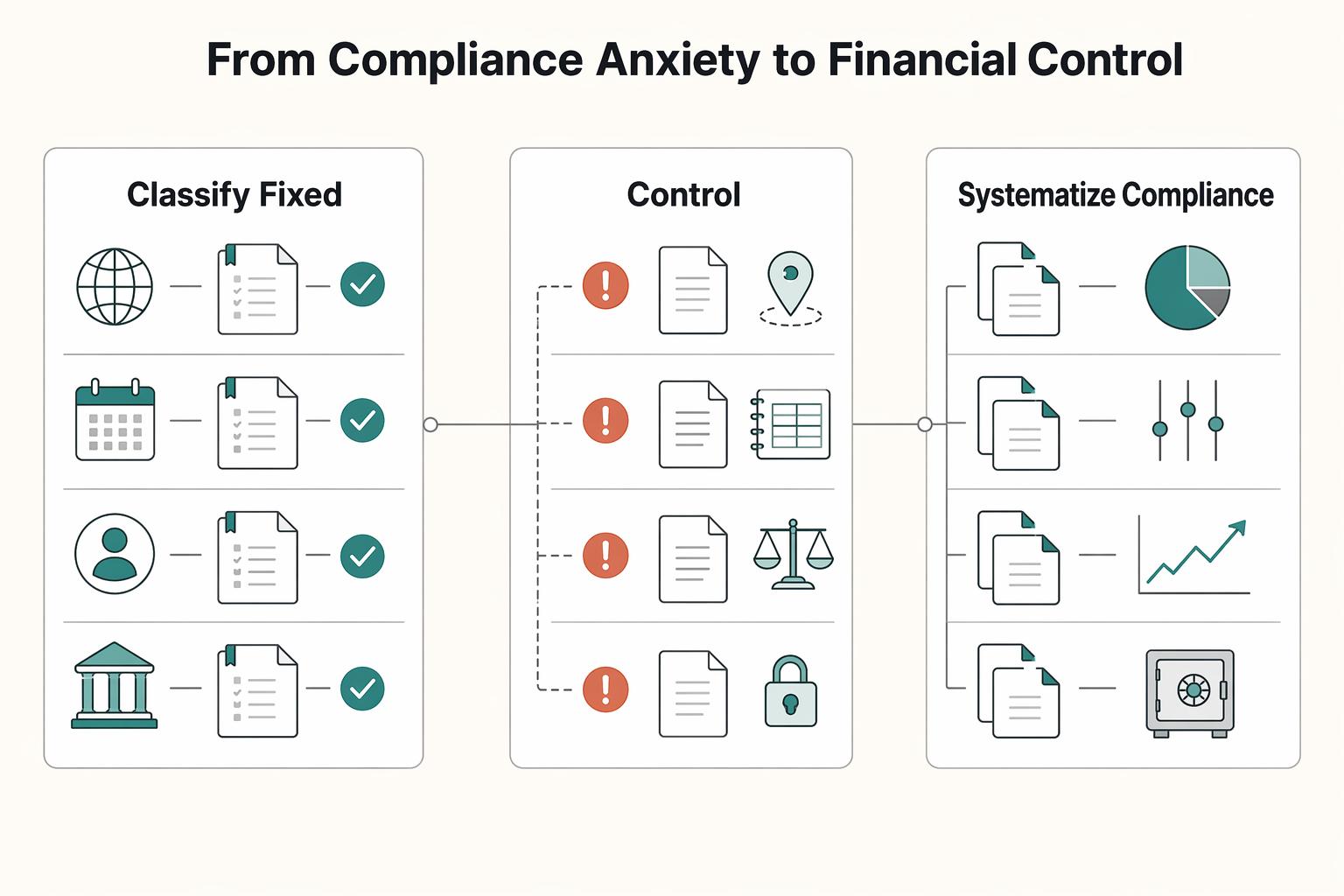
Start by classifying fixed obligations. These are duties that apply even when the answer is unfavorable, including U.S. worldwide-income reporting, estimated-tax rules that generally still apply abroad, U.S. self-employment tax once net earnings reach $400, and FBAR filing when foreign accounts exceed $10,000 in aggregate. Default action: assume these duties apply unless primary guidance clearly supports an exception.
Then optimize the levers you control. These are elective choices that change the outcome only when you meet the legal tests. Examples include modeling Foreign Tax Credit on Form 1116 versus FEIE and confirming whether a treaty-based return position requires Form 8833. Keep the concepts separate: FEIE can reduce income tax, but it does not remove self-employment tax, and you cannot claim FTC on income you excluded. If your result depends on treaty residency, saving-clause limits, or the 330 full days in 12 consecutive months test, escalate instead of guessing.
Finally, systematize execution. A compliance firewall is not vague organization. It is a records-and-controls routine: keep invoices, receipts, canceled checks, foreign-tax payment proof, travel logs, account balances, and withholding or treaty forms together, then reconcile on a regular cadence. Keep records through the normal 3-year assessment window. Use a longer window when your facts create longer exposure, for example up to 6 years for substantial income omission cases.
| Playbook step | Owner | Monthly control check | Escalate to advisor when |
|---|---|---|---|
| Classify fixed obligations | You | Recheck income, estimated-tax exposure, and filing thresholds against current facts | Residency, social-insurance status, or account-reporting facts changed |
| Optimize controllable levers | You with preparer input | Revalidate FTC vs FEIE assumptions and treaty-disclosure requirements | You may file Form 8833, claim treaty-rate withholding with required documentation, or your result depends on treaty characterization |
| Systematize compliance execution | You | Reconcile records, payments, travel days, and account data; close missing support items | Documents conflict, worker classification is unclear, or double taxation appears treaty-inconsistent |
If you do that, the issue stops being a vague fear and becomes what it really is: a set of calculations, documents, and decision points you can manage.
We covered this in detail in A Deep Dive into the US-Japan Tax Treaty for Remote Workers.
If you want a cleaner operating setup for invoicing, getting paid globally, and keeping audit-ready records where supported, review Gruv for Freelancers.
Frequently Asked Questions
Do I have to pay both U.S. and Israeli social-security type charges?
Do not rely on the income-tax treaty to remove social-insurance obligations. A tax treaty addresses income-tax treatment, while a totalization agreement is the separate social-security coordination regime. The U.S.-Israel income-tax treaty text excludes U.S. social security taxes from covered taxes. Verify Israel's current status on the SSA agreement list now, and save the source you used before you file.
How does the treaty reduce double income tax?
Treaty rules can reduce double income tax, but residency for treaty purposes and U.S. filing obligation are different issues. U.S. citizens and residents abroad generally still file, and the Foreign Tax Credit (generally on Form 1116) is often advantageous for reducing double taxation. If you are taking a treaty-based return position that modifies Code treatment, confirm whether Form 8833 is required before you file.
What is my U.S. self-employment tax exposure?
Calculate it using current-year IRS self-employment-tax instructions, not static blog numbers. FEIE can reduce regular income tax, but it does not reduce self-employment tax. Confirm your net self-employment earnings and verify any filing-year threshold or wage-base values before modeling the tax.
Is Bituach Leumi part of the same analysis?
Treat it on the social-insurance track, not the U.S. income-tax track. Finishing your U.S. return does not, by itself, settle your Israeli social-insurance position. If your residency or work status changed during the year, escalate and reconcile both tracks together.
Should I use FEIE or FTC?
Use a simple rule path: start with FTC as the default model, then test FEIE only if your eligibility and facts make it worthwhile. FEIE eligibility can involve the 330-full-days-in-12-consecutive-months physical-presence path, and you cannot claim FTC on income you exclude under FEIE. Before choosing, compile travel records, foreign tax payment evidence, and income-sourcing support so the election is defensible.
Try a related tool
Researched and edited by the Gruv editorial team. Gruv builds cross-border billing, payouts, and finance-operations software for global businesses.
Sources
Educational content only. Not legal, tax, or financial advice.
Related Posts

Digital Nomad Taxes in 2026 With a Defensible Filing Plan
With digital nomad taxes, the first move is not optimization. It is figuring out where you may be taxable, where filings may be required, and what proof supports that position.

Tbilisi Digital Nomad Guide for 2026 Long Stays in Georgia
Start with sequence, not excitement. If your income depends on delivering work on schedule, secure your legal footing, assemble your documents, and keep month one reversible before you optimize comfort.
Best Nomad Cities for Tech With a 90-60-30 Move Plan
The right city is the one you can enter legally, get set up fast, and work from without drama on day one. Everything else is secondary. If your legal path is uncertain, or your first-week setup is still guesswork, that city is not ready yet.