
Quick Answer
Start by classifying each case at intake and assigning one accountable owner before any evidence is chased. For dispute evidence workflows marketplaces teams should run, require a dispute ID, reply-by date, and linked transaction as the first gate, then collect type-specific packs for INR, SNAD, and unauthorized purchase fraud. Move only complete files into review, and keep the final decision explicit: accept loss, defend with a complete template, or route seller payout reversal through approval.
If you want better dispute outcomes, start before a chargeback exists#
If you want better dispute outcomes, start before a chargeback exists. Build a dispute evidence workflow that still holds up when the clock is already running. Do not spend another quarter polishing workflows that look helpful but still leave teams scrambling at filing time.
This article focuses on pre-chargeback preparation for marketplace dispute operations, where finance, ops, and product all have a stake. A dispute starts when an account owner challenges a payment through their bank. A chargeback is the formal reversal request that follows through the issuing bank. There is often an earlier pre-dispute inquiry stage, and it matters because handling it in time can prevent escalation into a formal dispute.
Success here is operational, not cosmetic. The goal is fewer missing artifacts when a case is ready to file and faster chargeback handling because ownership and timing are already defined. If your team is still asking who owns the case, what evidence is required, or whether the provider reference matches the internal transaction after the deadline notice arrives, the problem is not visibility. It is preparation.
The deadline pressure is real. Typical response windows are 7 to 21 days depending on the card network, and if you miss the deadline, you can automatically lose the dispute and forfeit the funds. That gives you the first checkpoint to build into your process. For each dispute type you support, confirm the live deadline, reason code, and defendability rules as soon as the case appears, including at the inquiry stage when available. A common failure mode is waiting to collect evidence until the case is already in review, then discovering the proof chain is incomplete or the filing window is too tight.
What follows stays focused on the part you control before submission: intake, ownership, evidence collection, decision points, and the handoff into filing. It is written for marketplaces where disputes touch multiple teams and downstream money movement, not just a single support queue.
One boundary matters up front. There is no universal evidence standard. Response requirements vary by dispute category, reason-code scheme, and card network. Dispute flow can also differ across schemes and payment methods. Treat every recommendation here as an operating pattern, then verify the exact filing rules and evidence expectations in your provider and network documentation. That is the only credible way to build a process your team can run under pressure.
Define the evidence system before disputes arrive#
Define your operating record before you choose tools. A dispute evidence workflow is the path from case intake to a submission-ready response, with an audit trail so you can reconstruct who did what, when, and why. If you cannot replay a case from intake through finalization, the process is not reliable yet.
| Record or source | Use in the workflow | Boundary |
|---|---|---|
| Ledger | Keep money movement here | Account-organized transaction record |
| Linked dispute record | Keep case ID, owner, timestamps, evidence links, decision notes, and provider deadlines here | Use it to reconstruct who did what, when, and why |
| Payment gateway dashboard | Providers may support both dashboard and API dispute handling | Do not treat it as the truth by itself |
Split your records on purpose. Keep money movement in the ledger (the account-organized transaction record), and keep a linked dispute record for case ID, owner, timestamps, evidence links, decision notes, and provider deadlines. Stable references let finance trace funds, ops assemble artifacts, and reviewers confirm that the case retrieved by dispute ID is the same case being worked.
Do not treat a payment gateway dashboard as the truth by itself. A single source of truth is a data state and operating model, not a UI. Providers may support both dashboard and API dispute handling, but your control is whether every case follows the same intake, ownership, and timestamp rules.
For v1, keep scope narrow and enforceable:
- intake of each new dispute case
- evidence requests and artifact collection
- deadline tracking to the provider reply-by date
- decision logging and documented next action
- handoff into chargeback management for submission and closure
Use one early checkpoint on every case: confirm the dispute ID and reply-by deadline at intake. A common failure mode is collecting narrative without concrete artifacts like refund details, payment processor logs, and merchant account statements, then missing finalization before the deadline.
Related: Chargeback Management for Marketplaces: How to Reduce Disputes and Recover Revenue.
Map dispute types to evidence packs your team can execute#
Run disputes through type-specific evidence packs, not one generic queue. Classify first, assign one owner, and set an internal latest-safe collection point before the provider reply-by deadline so the evidence is complete before filing.
| Dispute type | Required artifacts to request early | Internal owner | Latest safe collection point | Usual decision paths |
|---|---|---|---|---|
| Item not received (INR), often mapped to product not received or 13.1 | Receipt email showing order details, total amount, payment method, and transaction ID; order record; fulfillment or delivery proof if available; customer contact history | Marketplace ops or seller ops, with dispute ops review | Collect at inquiry/retrieval when available; otherwise complete before review starts and before provider reply-by | Accept loss if receipt and fulfillment proof cannot be tied to the disputed payment; contest if the proof chain is complete; consider seller payout reversal when seller nonperformance is confirmed and approvals are in place |
| Not as described (SNAD-like), often mapped to product unacceptable or 13.3 | Order record; listing or service description shown at purchase; fulfillment record; complaint details; refund, replacement, or support history | Support plus seller ops, with disputes lead making the filing call | Complete before review, not on submission day | Accept loss when listing, order, and support records do not support your position; contest when listing, delivery, and remediation records align; reverse seller funds only after review and approval |
| Unauthorized purchase fraud | Authorization details; AVS result; CVV verification; 3D Secure result if used; merchant-side login, device, IP, and event logs; prior account activity | Risk or fraud team | Complete before fraud review and before external submission | Accept loss if core authentication or event data is missing; contest with a compelling evidence template only when evidence is sufficient; escalate immediately on account takeover signals |
| Formal chargeback | Final pack from the underlying category; dispute ID; provider category/reason code; decision note; approval trail; linked payment and ledger references | Chargeback management or finance ops | Lock the pack before submission | Once formal, either accept or defend; if recovering disputed funds from a connected account, route seller payout reversal through the approval path |
Use three operating rules to keep this executable:
- Set your internal checkpoint earlier than the network clock. Typical response windows are 7 to 21 days, and missed deadlines can become automatic losses.
- Trigger escalation on repeat account takeover signals, inconsistent proof chains, or missing merchant-side event logs in fraud cases.
- Keep decisions explicit per case: accept loss, contest, or recover from the seller where your marketplace model allows it. Defend only when the compelling evidence pack is complete.
Store the evidence pack on the dispute record even when you accept loss. That keeps the case reusable for seller accountability, payout-recovery review, and downstream chargeback handling.
You might also find this useful: How to handle a chargeback dispute as a service provider.
Assign ownership so evidence does not stall in queues#
After you map dispute types to evidence packs, assign ownership by task scope and enforce handoffs at decision checkpoints. Disputes often stall when intake, reconciliation, instrumentation, and approval sit with different teams and nobody is clearly accountable as deadlines approach.
| Role | Primary scope | Check before handoff | Typical escalation trigger owner |
|---|---|---|---|
| Ops | Case intake and first evidence request | Intake is complete, a case record exists, and dispute and transaction references are present | Ops lead for missing intake data |
| Finance | Reconciliation and funds-status checks | Ledger match is complete, the amount ties to the transaction, and refund or settlement status is confirmed | Finance lead for amount or reference mismatch |
| Product or technical integrator | Instrumentation, webhooks, event logging, API dependencies | Required event or webhook records are present and linked to the case | Product or integrator owner for missing merchant-side data |
| Risk | Exception approvals and fraud-path review | Exception rationale is recorded, approval is captured, and fraud indicators are reviewed | Risk lead for account-takeover or policy exceptions |
The checkpoint matters more than the org chart. If a case is missing required references or records, it is not ready to move forward.
Who should own each case?#
If multiple teams share ownership, require one named DRI on the case record. That is an internal operating rule, not a network requirement, but it removes queue ambiguity. If no DRI is assigned by your internal checkpoint before the external deadline, escalate to the functional lead before the SLA timer is at risk.
Keep that tied to real response windows: providers often require action within 7 to 21 days depending on the card network, and missing the deadline can mean an automatic loss. In pre-dispute stages, treat the inquiry as a formal checkpoint, since action there can prevent escalation.
How do you make approvals reconstructable?#
Your audit trail should answer four questions from the case record alone: who approved, what was approved, when it was approved, and which evidence set was reviewed. Do not rely on side channels for that history.
Timestamp each approval, record the approver's role, and link the exact artifacts reviewed at that moment. That makes later review possible when a case is reopened, challenged, or audited.
Build enforceable states and deadline logic#
Build your dispute workflow as an internal state machine with hard gates or cases will drift and miss filing windows. A practical model is new, evidence requested, evidence complete, review, submit, closed, reopened, with every transition tied to the response deadline and a named escalation trigger.
Keep this model separate from processor-native statuses. Stripe statuses such as needs_response, under_review, won, and lost should map into your record, but they should not replace your internal controls for evidence completeness, actor permissions, and deadline safety.
Make reopened explicit from the start. Some providers run an inquiry stage before a claim (for example, a 20-day inquiry period), and appeal-like phases such as pre-arbitration and arbitration can follow, so "closed" cannot mean "no further action."
How should state transitions pass or block?#
Treat each transition as an approval gate, not a label change.
- new -> evidence requested: Require dispute ID, transaction reference, disputed amount, provider deadline, and owner. If the deadline timestamp is missing, block contesting and escalate immediately.
- evidence requested -> evidence complete: Require the category-specific evidence pack for the dispute reason. Do not mark complete just because files exist; mark complete only when the required proof chain is present.
- review -> submit: Keep submit permissions narrow by role and stage. Teams can assemble evidence, but only the permitted reviewer should submit. For high-risk unauthorized purchase fraud cases, a manual check is usually the safer gate.
| State | Target tied to SLA timer | Breach action |
|---|---|---|
| New | Start SLA timer at intake | If provider deadline is unknown, block contest path and escalate |
| Evidence requested | Collect artifacts early enough to preserve review time before the external deadline | If key artifacts are still missing at the review buffer, escalate and decide whether to accept loss |
| Review | Complete before the filing cutoff | If compelling evidence is insufficient, switch from defend to accept loss |
| Submit | File within the provider window, often 7 to 21 days depending on card network | If the deadline is missed, close as lost or non-submittable |
| Reopened | Restart review on inquiry escalation, pre-arbitration, or arbitration notice | Escalate if prior approvals or artifacts cannot be reconstructed |
The tradeoff is straightforward: auto-advance can reduce backlog, but it can also move weak evidence packs forward. Use auto-advance only where completion is mechanically verifiable; for unauthorized purchase fraud, manual review is usually safer.
Tie dispute handling to money movement controls#
A dispute is not operationally closed until the money movement is closed. Map each meaningful dispute state to a ledger event and a payout rule so submitted in ops cannot drift from unmatched debits, reserves, or seller balances in finance.
Your case state should trigger journal logic, not just notifications. When a dispute opens, post expected exposure and link it to the original payment reference; when the outcome arrives, clear or confirm that exposure and apply the matching settlement treatment. In Stripe Connect marketplace flows, this is critical because indirect-charge refunds, disputed amounts, and related fees are debited from the platform balance, while seller recovery is a separate action such as a transfer reversal.
How should dispute states map to ledger and payout actions?#
You do not need to freeze every seller for every open case, but you do need explicit rules for when payout execution continues, pauses, or reverses.
| Dispute state or outcome | Ledger action | Payout action | What to verify |
|---|---|---|---|
| Open, evidence incomplete | Record dispute exposure against platform and seller liability view | Optionally pause the related seller payout if liability is unresolved or evidence is missing | Original payment reference, dispute ID, amount, owner, deadline |
| Submitted, awaiting decision | Keep exposure open; do not post final loss yet | Proceed or hold based on your liability policy, not provider status text alone | Submission timestamp and provider reference captured |
| Lost or adverse decision confirmed | Post realized loss and fee, then clear open exposure | If seller is liable, trigger seller payout reversal or transfer reversal approval path | Provider decision matches case record and posted entries |
| Won or funds returned | Reverse temporary loss exposure and post recovery | Release any temporary hold tied to this case | Recovery amount equals provider event amount |
A common failure mode is treating needs_response or under_review as accounting states. Keep your internal record explicit about temporary platform exposure, seller payability, and whether a recovery action is approved.
Why reconcile against provider references instead of screenshots?#
Before period close, require a three-way match between the dispute decision, provider reference, and posted entries. Adyen provides two keys that support this: pspReference for the dispute and originalReference for the disputed payment. Store both dispute-side and payment-side identifiers in your own record so reconciliation survives retries, reopens, and provider-specific payload shapes.
If you use PayPal Multiparty reporting, account for two operational details: the Marketplace Case Reconciliation report is generated by 9:00 AM daily, and amounts are multiplied by 100. Missing that normalization can create false mismatches.
Why treat balances as eventually consistent?#
Treat provider balances as lagging views and your ledger as the source of truth. Stripe documents that webhook processing is asynchronous, and pending funds are not yet available to withdraw or spend, so your reconciliation controls should expect timing lag and reconcile forward when settlement events arrive.
Also account for reserve effects in payout timing. If a connected account goes negative because of a dispute or refund, Stripe can hold a reserve on available balance, which can delay payout execution even after the case decision.
If you want a deeper dive, read Chargebacks in Agentic Commerce: Evidence Liability and Recovery Workflows for Platforms.
Use explicit decision rules for contesting or accepting loss#
After you map the money impact, make the next branch mechanical: accept the loss early or defend it. Adyen's guidance is explicit after a chargeback arrives: accept or defend, and defend only when you have sufficient compelling evidence.
| Case pattern | Preferred path | Condition or note |
|---|---|---|
| SNAD | Contest | Use when you have a full proof chain tied to listing, transaction, and fulfillment, and the compelling evidence template is complete and timely |
| INR | Accept loss early | Use when delivery evidence is incomplete or contradictory |
| Provider triage hint such as 5 dots = 60% versus 1 dot = 5% | Secondary signal only | Use after evidence-pack completeness is confirmed |
| UNAUTHORISED or repeated ATO-like signals | Escalate to fraud specialists | Move out of the normal chargeback queue before the standard team decides accept versus defend |
Use one decision rule: contest only when dispute class, evidence quality, and timing align. If the compelling evidence template is incomplete, accept loss early, close the case cleanly, and shift effort to recovery and prevention. If the template is complete, the evidence is specific to the transaction, and the response window is still open, contest.
When should evidence quality decide the path?#
Evidence quality should decide the path before submission. Build rules around two checks you can verify fast: dispute type and evidence-pack completeness, since evidence strength is a direct outcome factor.
A practical if-then set:
- If the case is SNAD and the amount is meaningful to your business, contest when you have a full proof chain tied to listing, transaction, and fulfillment, and the compelling evidence template is complete and timely.
- If the case is INR and delivery evidence is incomplete or contradictory, accept loss early instead of filing a weak defense.
- If your provider shows a triage hint such as 5 dots = 60% versus 1 dot = 5%, treat it as secondary after evidence-pack completeness is confirmed.
The common failure mode is contesting because a seller insists the buyer is wrong, even when the defense documents do not meet provider requirements. Keep one explicit verification step: verify the reason code matches the template, required fields are complete, artifact links resolve, and the filing window is still open.
When should account takeover leave the normal queue?#
Repeated account takeover patterns should leave the normal chargeback queue. If a dispute is marked UNAUTHORISED, or repeated ATO-like signals appear across accounts, escalate to fraud specialists before the standard team decides accept versus defend.
This avoids isolated case handling when the real issue is broader unauthorized activity. Fraud specialists can connect linked signals that a single-case queue can miss.
What should you review every week?#
Run one weekly exception review with ops, risk, and finance. Review two buckets: preventable losses (defensible cases accepted because evidence was late or incomplete) and false escalations (cases routed to specialists without a real fraud pattern).
Use win/loss monitoring as the feedback loop to refine rules and tighten templates.
Choose tools after the operating model is stable#
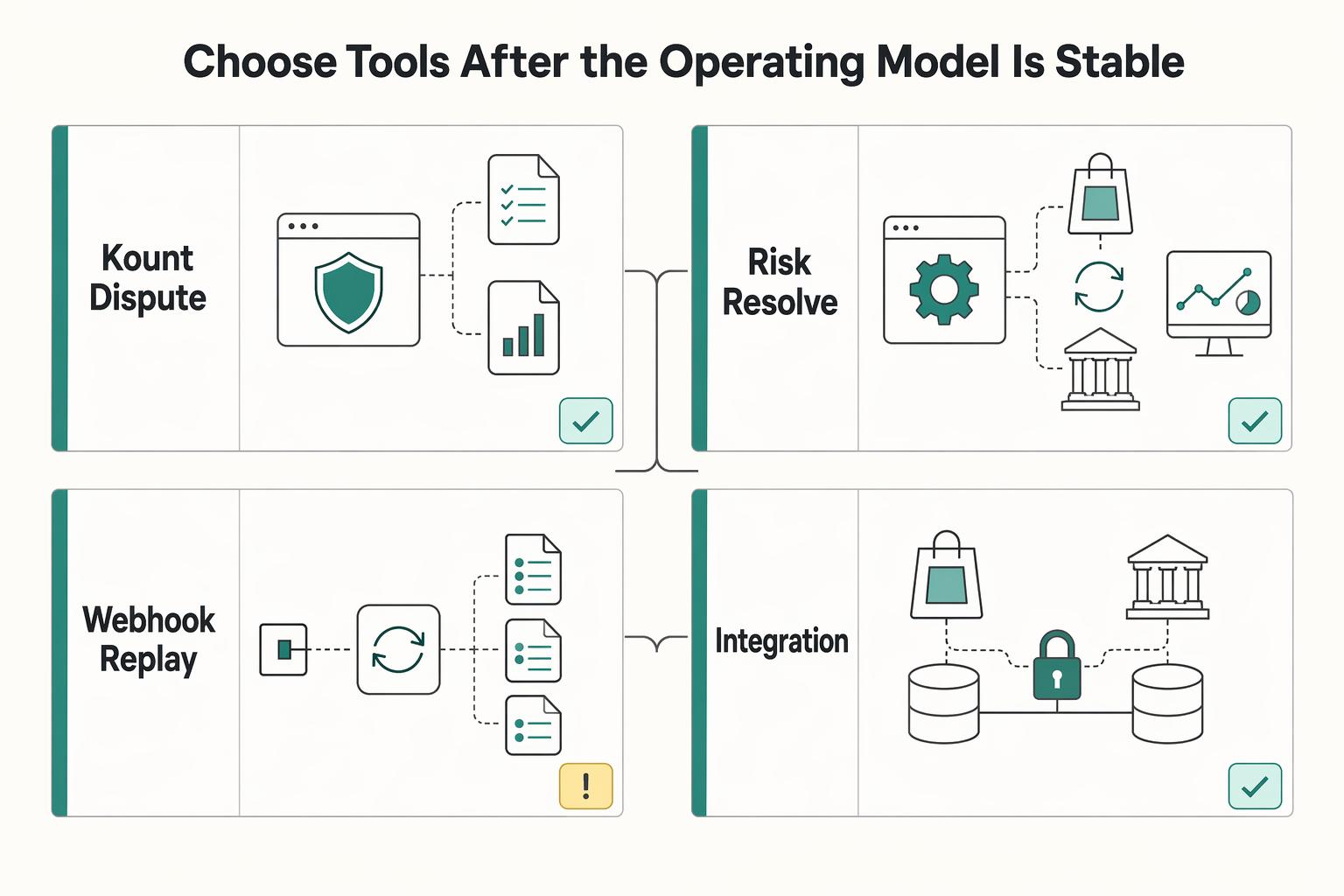
Choose tools only after your ownership, states, and deadlines already work without them. If a tool cannot preserve your case record across Shopify and your payment gateway, it can hide broken decisions instead of fixing them.
| Tool or integration point | What the article says | Validation or constraint |
|---|---|---|
| Kount Dispute Processing | Positioned as a single platform to receive, analyze, and process disputes | Validate it against your ownership and state logic |
| Riskified Dispute Resolve | Presents a Shopify-focused automated workflow with gateway sync and a single source of truth dashboard | The launch was distributed via Business Wire, and the prep-time claim should be tested against your own queue metrics |
| Shopify dispute evidence and disputes/create webhook | Dispute evidence includes dispute linkage and activity logs, and intake can start from the disputes/create webhook | Confirm the sync path preserves internal case IDs, evidence links, and audit trail fields |
| REST and GraphQL Admin API | REST is legacy as of October 1, 2024, and new public apps must use GraphQL Admin API starting April 1, 2025 | Account for the API constraint before calling any tool your source of record |
Kount Dispute Processing and Riskified Dispute Resolve can be useful, but only when they fit your controls. Kount is positioned as a single platform to receive, analyze, and process disputes. Riskified presents a Shopify-focused automated workflow with gateway sync and a "single source of truth" dashboard. Treat both as candidates to validate against your ownership and state logic, not as proof that your process is solved.
Treat launch messaging as directional, not validated performance. The Riskified launch was distributed via Business Wire, so it is vendor communication rather than independent evidence. Its claim of reducing prep time from over 30 minutes to 5 minutes should be tested against your own queue metrics.
Integration checks should be explicit before you treat any tool as your source of record. Shopify dispute evidence includes dispute linkage and activity logs, and intake can start from the disputes/create webhook. Also account for API constraints: REST is legacy as of October 1, 2024, and new public apps must use GraphQL Admin API starting April 1, 2025. Confirm your sync path preserves:
- internal case IDs (for example, IDs stored in Stripe metadata)
- evidence links that still resolve after submission
- audit trail fields for who changed what and when
Conclusion#
The main lesson is simple: stronger chargeback control starts before a case is filed. You get there with clear ownership, enforceable states, and dispute-type evidence packs that connect back to the money record, not with faster submission alone.
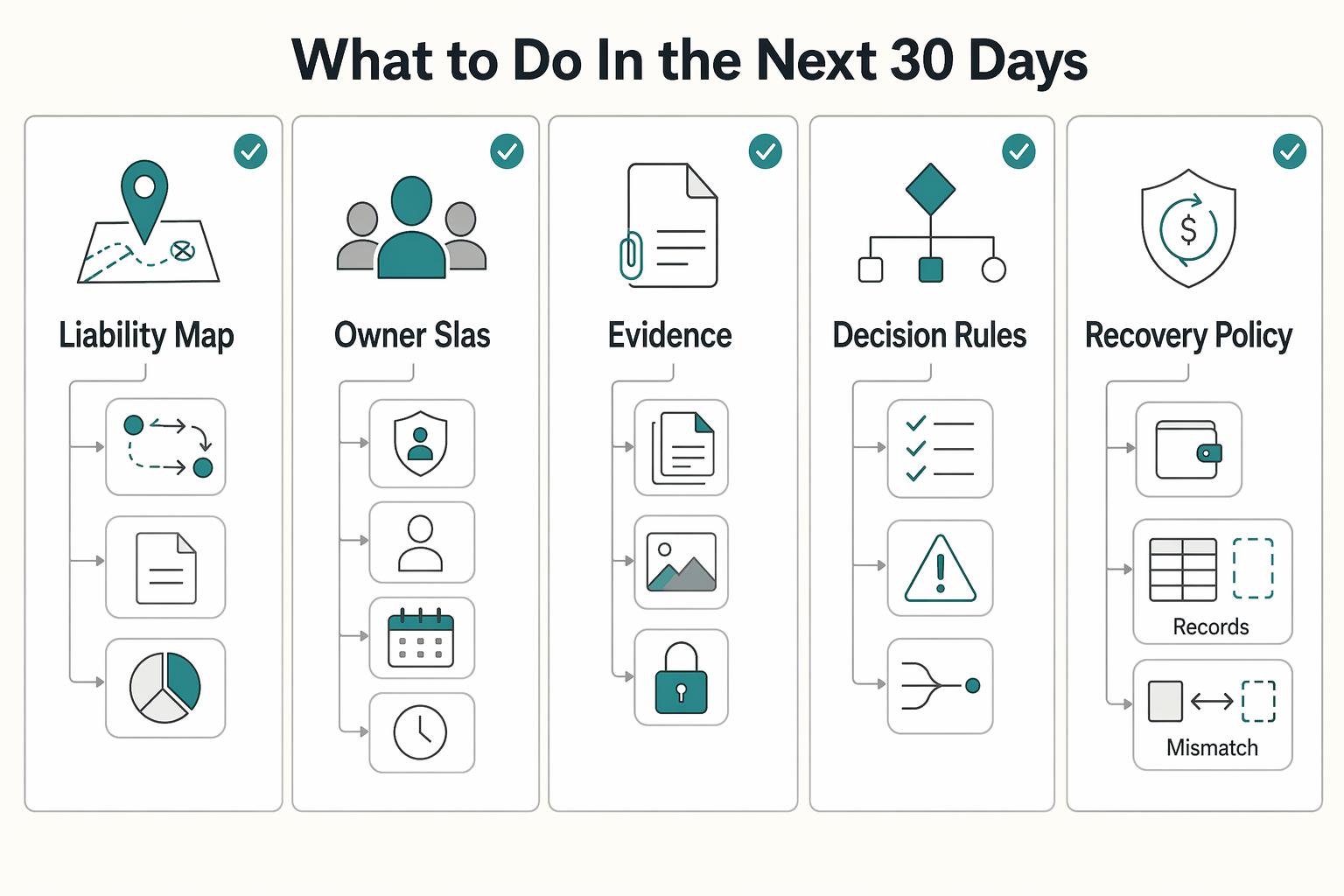
If your team needs a starting point this week, do four things in order:
- Publish dispute-type evidence tables using category-specific packet guidance, so ops and support know what must exist before a case can be contested.
- Assign an explicit owner for each live case and make role boundaries clear across ops, finance, product, and risk.
- Add stage deadlines with breach actions, so cases cannot sit in waiting states without escalation.
- Tie case decisions to your reconciliation checks using the provider fields that matter most: dispute type, amount, status, and any associated evidence or documentation.
That sequence matters because evidence handling is only one part of the lifecycle. A complete flow also needs claim actions and later settlement handling. In practical terms, your case record should show whether you chose to provide evidence, accept the claim, or appeal, then tie that decision to the downstream finance outcome. The verification checkpoint is straightforward: for any closed case, you should be able to match dispute amount, current status, and evidence records to your internal money records and period-close reconciliation.
The common failure mode is trying to automate before those controls exist. Tools can assemble packets and even submit before a dispute deadline, but that does not remove the need to review each case individually. If automation advances a weak file because your acceptance criteria are vague, you have only hidden the problem behind speed. If your evidence table is incomplete or your case owner cannot explain why a claim was accepted versus appealed, pause automation and fix the state rules first.
A practical adoption path is to treat this like a staged rollout, not a big-bang rebuild. Start with v1 controls: intake, evidence requests, decision logging, deadlines, and finance matching. Once those are stable, add automation only where it improves consistency, such as packet assembly for eligible disputes or deadline-triggered submission. Keep one human checkpoint for higher-judgment cases and exceptions, especially where the proof chain is inconsistent or the money movement does not line up cleanly.
That is the real bar for marketplace dispute evidence operations: not a cleaner queue, but a case record that stands up under deadline pressure and still makes sense when finance reviews it later. When your evidence pack, decision path, money record, and reconciliation trail all agree, you are operating from control rather than hope.
Frequently Asked Questions
What is a dispute evidence workflow in a marketplace context?
It is the sequence your team uses to list cases, review dispute details, gather and submit evidence, accept claims when defense is weak, and appeal when it is justified. In a marketplace, that usually means linking buyer facts, seller proof, and payment records into one case record instead of chasing screenshots across teams. A good test is whether you can reconstruct the full transaction and communication timeline in chronological order from one record.
Who should own evidence collection across finance, ops, product, and support?
No single function has to own every case, but ad hoc shared queues can stall cases. Give each dispute a named owner, then split contributions by role based on your operating model: ops can drive intake, finance can confirm amounts and reconciliation facts, product can supply event logs, and support can supply customer communications. If nobody is clearly accountable at intake, deadline windows are easier to miss and duplicate requests are more likely.
What should be in v1 before adding advanced automation?
Start with practical basics: dispute listing, dispute detail retrieval, a claim decision path, and the ability to provide evidence, accept the claim, or appeal. Your first version should also enforce a complete evidence pack definition and store the core case fields, not just attachments. If a tool automates submission before your evidence is complete, that is a failure mode, not a feature.
How do we prevent evidence gaps before a chargeback is filed?
Collect evidence before the contest decision, because some platforms require files to be uploaded before the seller chooses to contest the payment dispute. The simplest prevention rule is to request artifacts as early as the original order and fulfillment steps, then organize them by type such as receipts, communications, policies, and system logs. If you wait until a case is already live, you may discover broken links, missing proof, or data that was never retained.
What causes most dispute delays in cross-team operations?
A common delay is waiting on seller-provided proof or another external artifact, which is why some disputes sit in statuses like WAITING_FOR_SELLER_RESPONSE. Another cause is evidence arriving in the wrong shape: mixed files, no timeline, or no clear mapping between the claim reason and the proof. If your queue has many almost-ready cases, check for missing acceptance criteria at handoff rather than assuming you need more automation.
How do we keep an audit trail that supports reconciliation and settlement reviews?
Keep enough fields to rebuild the case lifecycle, not just the final outcome. At minimum, retain the dispute ID, reason, status, dispute amount, create_time, update_time, and a record of who accessed the case and what they changed over time. For reconciliation and settlement review, verify that those timestamps and status changes line up with the money movement record. If they do not, your dispute record is not reliable enough for post-close review.
Try a related tool
Researched and edited by the Gruv editorial team. Gruv builds cross-border billing, payouts, and finance-operations software for global businesses.
Sources
Includes 2 external sources outside the trusted-domain allowlist.
Educational content only. Not legal, tax, or financial advice.
Related Posts

Chargebacks in Agentic Commerce: Evidence Liability and Recovery Workflows for Platforms
For platform founders, the hard call is no longer just how to stop fraud. You also have to handle disputes where the payment was authorized, but the buyer later says the result was not what they meant to approve. That gap between "authorized" and "wanted" is where much of the new risk sits. It gets wider when an AI agent can browse, compare options, fill carts, and complete purchases on a customer's behalf.
Chargeback Management for Marketplaces and MoR Dispute Recovery
If you are the **Merchant of Record (MoR)** in a marketplace flow, chargebacks are an execution problem. The dispute lands with you. The real question is who reacts, how fast, and with what evidence.
How to Handle a Chargeback Dispute as a Service Provider
Build your defense before the first invoice. Once a dispute starts, you do not get to recreate missing scope definitions, approvals, or policy acknowledgments after the fact.