

Quick Answer
Use a control-first process for certificate of coverage USA social security requests: verify the country pair and worker type, file in the correct lane, and keep proof in one case file. Submit through the SSA channel that fits the case, track the external reference and live status labels, and do not apply foreign-tax exemption treatment until the certificate outcome is complete. If guidance is missing for your fact pattern, mark it unknown and escalate before payroll changes.
Prove coverage before changing payroll treatment#
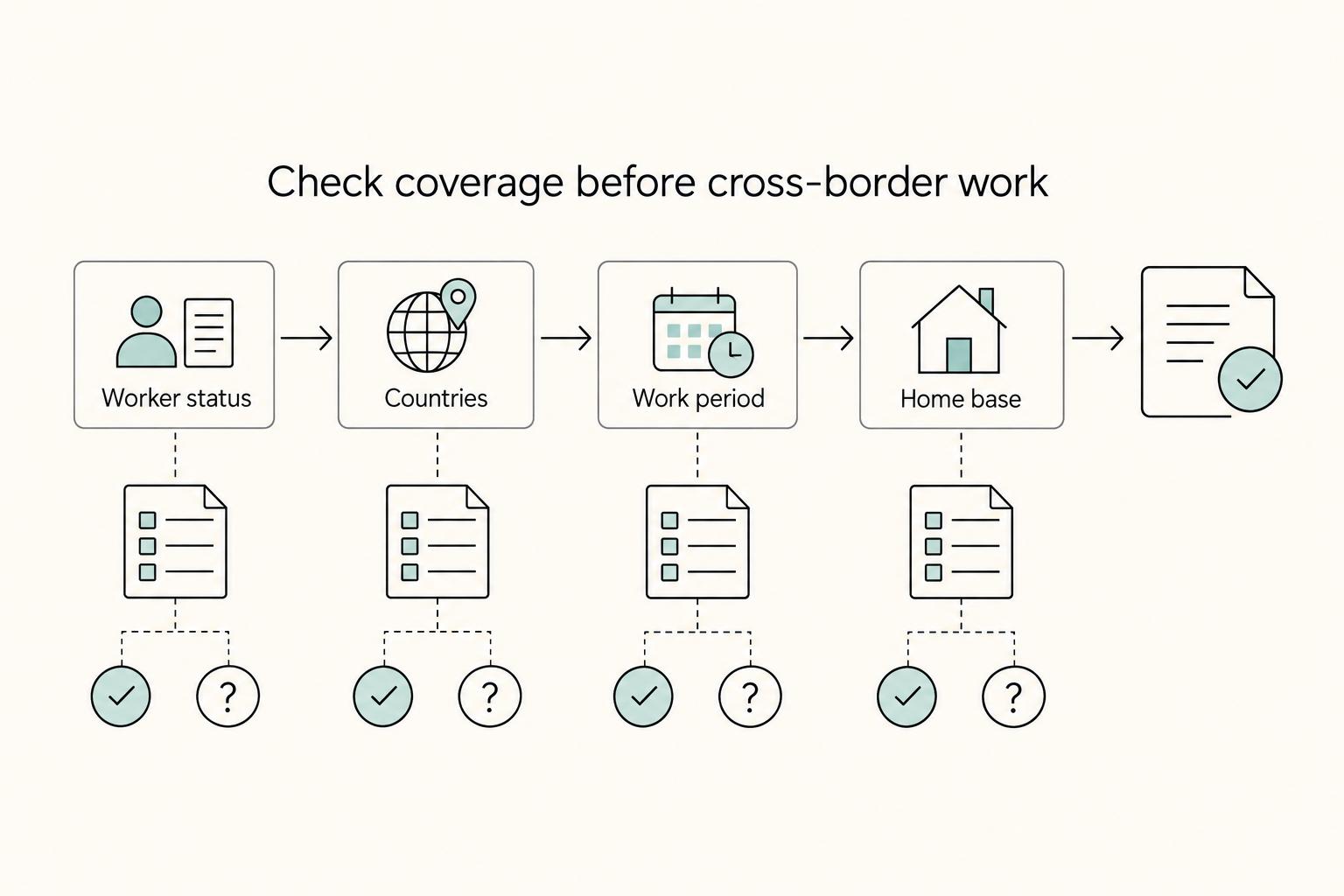
A certificate of coverage USA social security request is usually not a tax theory question. It is a control question: can you prove which country has coverage, who approved that view, and why payroll treatment changed. If you cannot answer those three points quickly, you are carrying dual-tax risk.
This guide is for compliance, legal, finance, and risk owners who need a practical way to handle these requests across markets without building a heavy process around edge cases. The scope is intentionally narrow. We stay with what the Social Security Administration confirms in its international materials, note where the public record is incomplete, and separate facts from assumptions before money moves.
The core SSA rule is straightforward. Under Totalization agreements, coverage is assigned to one country. The employer and employee are exempt from Social Security taxes in the other country. SSA also says these agreements are designed to eliminate dual Social Security taxation. In practice, that means the same earnings should not be taxed into two systems when the agreement applies.
The first place teams get into trouble is scope. SSA describes these as bilateral Social Security agreements with certain foreign countries, not all countries. When an agreement assigns coverage to the United States, SSA issues a U.S. Certificate of Coverage that serves as proof the employee and employer are exempt from paying Social Security taxes to the foreign country. If you cannot confirm that country pair and assignment result first, do not treat the certificate as available by default.
A simple ownership split usually works well. Legal or compliance confirms whether an applicable agreement exists and whether the fact pattern fits the public SSA description. Finance or payroll confirms whether there is exposure to two social security systems on the same earnings. One named operations owner holds the submission record, tracks status, and keeps the evidence file complete.
Your first verification checkpoint is often the country pair itself, because it can stop avoidable filing errors early. A frequent failure mode at this stage is assumption creep. Someone hears "U.S. certificate" and treats it like a blanket exemption across jurisdictions or worker profiles. The public SSA excerpts do not give complete eligibility criteria for every worker type and every market, so this guide calls those unknowns out clearly.
Keep the recordkeeping light but audit ready. At minimum, retain the decision note, the country pair checked, the worker and employer details used, the submission artifact, and the internal approval trail. That is usually enough to show why you filed, why you did not file, or why you escalated instead of guessing.
For a step-by-step walkthrough, see A Guide to Social Security for 'Autónomos' in Spain.
What a Certificate of Coverage actually proves#
A U.S. Certificate of Coverage is limited proof: under a relevant Totalization agreement, coverage is assigned to one country, and the employee and employer are exempt from Social Security taxes in the other country.
| Checkpoint | What to confirm | Grounded note |
|---|---|---|
| Issuer | Who issued the certificate | In the U.S. context, SSA International Programs is the issuing authority |
| Country pair | The exact country pair it covers | If you cannot confirm that country pair and assignment result first, do not treat the certificate as available by default |
| Coverage assignment | Whether coverage is assigned to the U.S. or the foreign system | The certificate serves as proof that the employee and employer are exempt from Social Security taxes in the other country |
That scope is narrow by design. SSA states that agreements assign coverage to just one country, and that "the certificate serves as proof that the employee and employer are exempt from the payment of Social Security taxes to the foreign country." In the U.S. context, SSA International Programs is the issuing authority.
Use it as agreement-specific evidence, not a universal exemption. It is not a blanket pass across every jurisdiction, assignment structure, or worker profile under U.S. Social Security rules. SSA and IRS materials support a narrower conclusion: these agreements are meant to eliminate dual Social Security taxation and must be considered when determining possible U.S. Social Security and Medicare tax exposure.
Before you change payroll treatment, confirm three points:
- who issued the certificate
- the exact country pair it covers
- whether coverage is assigned to the U.S. or the foreign system
A request, draft, or informal confirmation is not enough. The document has decision value only when tied to the right bilateral agreement, the right worker, and the right exemption side.
If you want a deeper dive, read What is a 'Certificate of Coverage' for Social Security Totalization Agreements?.
Decide when to request one and when not#
Request a Certificate of Coverage only when three things are true: the case is cross-border, there is a confirmed U.S. bilateral Social Security agreement for the country pair, and there is credible payroll exposure in both systems. If any one is missing, do not file yet.
IRS guidance says Totalization agreements must be considered when deciding whether someone is subject to U.S. Social Security and Medicare tax or foreign social security taxes. SSA says these agreements assign coverage to one country and exempt employer and employee from Social Security taxes in the other country. That is why agreement fit and dual-tax risk both need to be confirmed before filing.
| Assignment facts | What you verify first | Request now? | Payroll treatment posture |
|---|---|---|---|
| Employee moving between the United States and a country listed by SSA as a concluded agreement country | Confirm the country pair on SSA's agreements overview, including entry-into-force date, and confirm a cross-border pattern that could create exposure in both systems | Usually yes, and early | Do not change exemption treatment until the issued certificate is tied to the correct worker and country pair |
| Self-employed case where agreement text addresses that worker type (for example, SSA's Italy excerpt) | Confirm worker type matches the agreement rule; the Italy excerpt assigns U.S. coverage to self-employed U.S. nationals working in the United States and Italy | Yes, if facts match | Build the file on the worker-type rule, not country name alone |
| Work involving France where you have confirmed only agreement status, not rule fit for this worker and assignment | Confirm status, then escalate for legal or tax review on applicability | Not yet | Do not assume the same result as another agreement country |
| Work involving a country you cannot confirm on SSA's concluded-agreements list | No confirmed agreement basis | No | Keep current payroll treatment and escalate; filing is not the first step |
Use a filing gate#
- Legal or compliance confirms the country pair is covered by a concluded SSA-listed agreement.
- Payroll or finance confirms credible dual Social Security taxation risk on the same earnings.
- The case file records worker type, countries, expected work dates, and why the agreement may apply.
If one gate fails, do not file yet.
France vs. not-confirmed-in-scope#
If a country such as France is confirmed in the U.S. agreement network, that clears only the first gate. You still need applicability review for the specific worker type and assignment facts. If the country is not confirmed on SSA's concluded-agreements list, escalate before filing because there is no confirmed Totalization agreement basis on record.
For a process-oriented related read, see How Autonomos Actually Pay Spanish Social Security Quota in 2026.
Choose request type and submission channel with fewer delays#
Classify the case first, then choose the submission channel. Use a confirmed employer or self-employed lane before intake, and treat unverified internal labels as a hold point.
From the SSA material in scope, two channel facts are clear: employers and self-employed individuals can request certificates online, and employers have traditionally used regular mail and fax. Worker type also matters in agreement materials, including self-employed sections in country pamphlets such as Italy. So decide lane first, then channel.
If your intake uses labels like Employer Certificate, Self Employed Certificate, or Performer Certificate, do not assume every label is SSA-defined. Here, only the employer-versus-self-employed distinction is directly supported.
Start with the online service when the case is ready#
SSA points users to the Online Certificate of Coverage Service at https://opts.ssa.gov/. For a clean employer or self-employed case, use this as your first channel check.
Before you submit, confirm the live form's current required inputs for that case and capture what you verified in the file. SSA confirms online availability, not a full required-field list.
Use fax or mail only with a documented exception#
Fax or mail can still be used, but only when online is not suitable for the case. Record why online was not used, who approved the exception, what was sent, and the SSA destination shown in current instructions.
Avoid routing based only on legacy internal notes. Reconfirm destination details from current SSA guidance before sending.
| Channel | Delay control posture | Data completeness control | Follow-up visibility control |
|---|---|---|---|
| Online Certificate of Coverage Service | Lower avoidable delay when case data is already complete | Validate against current live form requirements before submit | Keep confirmation details and case notes in the file |
| Fax | Useful when online is unsuitable and exception is documented | Use a packet checklist and keep transmission proof | Track via internal logs and retained submission evidence |
| Use when required by case constraints and approved exception | Final pre-send review and full copy retention | Keep mailing proof and a complete copy of the packet |
A common failure mode is choosing channel first and finding later that lane selection or input readiness was wrong. If that happens, stop, correct the case record, and then resubmit.
This pairs well with our guide on Social Media Platform Payments for Creators and Managers.
Build the minimum evidence pack before you submit#
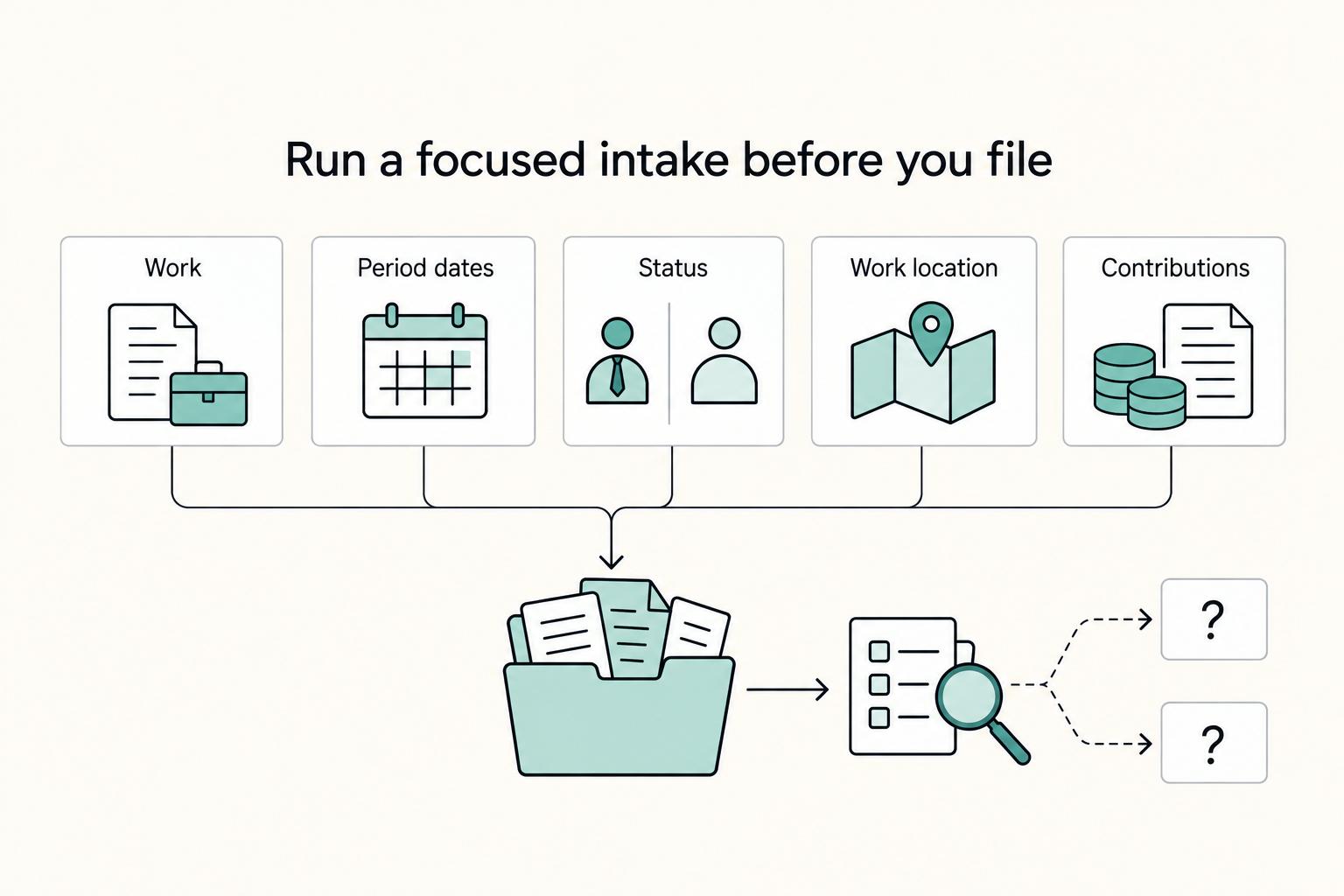
Build one reviewable packet before you submit so the request can be entered once, checked once, and defended later. For a U.S. Certificate of Coverage case, treat your packet as an internal control set, then confirm it against the live SSA request path you will actually use that day.
Because a full mandatory field checklist is not established, do not label your internal template as "SSA-required" unless the live form or current SSA instructions show it.
What to include in your internal minimum packet#
Use a compact set tied to the worker type and country pair already approved:
| Packet item | What to include | Support in file |
|---|---|---|
| Worker identity details | Worker identity details needed for the live request | Keep the source document behind each key field |
| Assignment dates | Assignment dates used for the case | Keep the source document behind each key field |
| Employer details | Employer details for the filing entity | Keep the source document behind each key field |
| Jurisdiction details | Jurisdiction details for the U.S. and relevant agreement country | Keep the source document behind each key field |
| Filing lane | Selected filing lane (employer-filed or self-employed) with a short rationale | Keep the source document behind each key field |
Keep the source document behind each key field so reviewers can verify inputs without reconstructing the case from memory.
Record legal/privacy basis carefully#
In your file notes, log the SSA page consulted, access date, and why it was relevant to the data collected. The grounded SSA material confirms a section titled Authority to collect information for a certificate of coverage on SSA's Totalization Agreements materials.
If your template includes Section 233 of the Social Security Act or a Privacy Act Statement, keep them as internal reference points, not as confirmed claims.
Assign ownership and preserve retrieval-ready records#
SSA does not prescribe your internal two-person model here, but assigning one data-quality owner and one final approver is a practical control to reduce avoidable rework.
Store an audit trail that compliance and finance can retrieve quickly:
- final packet used for filing
- submission proof (portal confirmation, fax record, or mailing proof)
- any SSA acknowledgment artifact
- internal approval log
Related: How to obtain a 'Certificate of Coverage' from the US Social Security Administration.
Track case status and escalate without creating noise#
After you submit, the priority is controlled follow-up: track what the live SSA channel actually shows, wait per current SSA guidance, and keep one internal owner for external contact.
Mirror the live SSA labels#
Use the exact reference and status text shown in the active channel, and avoid internal relabeling. If your online path shows a control/reference number and status labels, copy them verbatim into your tracker. For mail or fax cases, keep stronger proof artifacts because those channels can add handling uncertainty.
| Tracker field | What to record |
|---|---|
| Submission channel | online, mail, or fax |
| External reference | The exact external reference from that channel |
| Current status text | Current status text exactly as shown |
| Last check | Last-check timestamp and checker name |
| Earliest follow-up date | Earliest follow-up date from the current SSA notice or instruction |
| Communication artifacts | All communication artifacts tied to the case |
That set of fields is usually enough for disciplined follow-up without duplicate outreach.
Escalate once, with proof#
Do not send early or duplicate follow-ups. Escalate only after the waiting guidance in the current SSA page, portal message, or acknowledgment you verified for that case, and route outreach through one owner with one concise message.
If the live SSA contact point you verified is certificate@ssa.gov, use it through that single owner. Also avoid relying on archived SSA pages for current contact mechanics, because SSA flags archival material as potentially out of date.
Treat "completed in the channel" and "document received by your team" as separate checkpoints. Keep a short internal hold state for completed-but-not-yet-received cases so you account for delivery lag before reopening with SSA.
Keep every status check, message, attachment, and timestamp in one case log for audit and post-mortem review. Related reading: Freelance Marketer Rates for PPC, SEO, and Social by Channel.
Handle country and worker-type uncertainty before payouts#
If the official International Programs excerpts do not clearly confirm the country pair, worker type, approval criteria, or required fields, treat the case as unknown and do not apply a U.S. Social Security exemption yet.
Treat missing coverage facts as unresolved#
Use only what your captured official excerpt explicitly states. If a required point is not stated, record it as unknown instead of inferring from prior practice, vendor memory, or a different worker profile.
Before any irreversible payout assumption, confirm that your conclusion is supported by the excerpt in hand. If uncertainty remains, pause exemption treatment and route the case to legal/tax review.
Keep adjacent tax reporting in a separate lane#
FBAR, FinCEN, FATCA, Form 8938, and Schedule SE can appear in the same file, but they do not replace a Certificate of Coverage decision.
For Form 8938, the IRS material says it is used to report specified foreign financial assets when the filer exceeds the applicable threshold, and it is attached to the annual income tax return when required. The same material also shows that thresholds vary by filer, with $50,000 as one example for certain U.S. taxpayers, and that some accounts maintained by a U.S. payer are excluded from Form 8938 reporting. Those points do not determine SSA coverage or certificate outcome.
Use a short "known vs unknown" note in the case log:
- confirmed excerpt, capture date, and what it clearly states
- unresolved items labeled
unknown - current payout instruction, including any pause on exemption treatment
- legal/tax owner and next decision date
You might also find this useful: A guide to 'Totalization Agreements' for a US citizen working in France.
Common failure modes that create dual-tax exposure#
Dual-tax exposure usually starts when teams change U.S. Social Security treatment before the coverage decision is fully supportable.
- Worker-type/request-lane mismatch: SSA allows certificate requests for employers and self-employed individuals, so filing in the wrong lane can misalign the case and delay correction until after payroll actions have already started. Confirm the worker type and submission path match before changing contributions.
- Incomplete online submission: SSA accepts online certificate requests, but partial or inconsistent entries can still stall the case. Use a pre-submit check against the live application and keep the submission record.
- Assuming country coverage without verification: IRS says totalization agreements must be considered when deciding Social Security tax treatment, and SSA publishes the countries with concluded agreements. If the country is not confirmed on SSA's list, treat coverage as unresolved.
- Treating
Pendingas approved: The certificate is the proof of exemption from foreign Social Security taxes when U.S. coverage applies. Until the certificate outcome is complete, keep withholding behavior unchanged.
If you want a broader operational comparison, read The Best Security Scanners for Your Web Application.
Turn this into a repeatable control#
Use one owner and one checklist: do not submit until the filing decision is confirmed, the evidence packet is complete, the correct request type is selected, and status tracking is active. Keep the operating rule explicit: no certificate, no exemption assumption.
A practical SSA control has four gates:
- Decision to file: confirm this is a real cross-border Social Security case and document who approved filing.
- Evidence packet complete: complete the request data before submission. SSA states the information requested is mandatory under Totalization agreements.
- Correct certificate type selected: choose the right request type for the case as it appears in the live path (
Performer,Employer, orSelf Employed). - Status tracking active: log submission date and monitor SSA status labels as written:
Received,Pending,Completed.
Before submission, verify the live SSA form is complete, including all required fields. Do not rely on an older intake template if the current form has changed.
Keep boundaries strict for tax treatment decisions. A case marked Pending is not proof that an exemption is approved. A case marked Completed still needs to be matched to the issued document, and if a certificate is issued, mailing can still take up to two weeks.
If your current SSA instructions for the case use a 90 business days waiting window, build that into the checklist before follow-up, then use the confirmed SSA contact path, including certificate@ssa.gov. If your team is not submitting online, record the fallback channel used, whether fax at (410) 966-1861 or a written request route, in the case file.
The practical result is fewer surprises and better audit evidence across compliance, legal, and finance: what was filed, which lane was used, current status, and when escalation is justified.
Frequently Asked Questions
What is a U.S. Certificate of Coverage in plain terms?
It is an SSA-issued document showing that, under an applicable Social Security agreement, the worker’s coverage is assigned to the United States. SSA says the certificate serves as proof that the employee and employer are exempt from paying Social Security taxes to the foreign country when U.S. coverage applies.
How does a Certificate of Coverage prevent dual Social Security taxation?
SSA states that Totalization agreements are meant to eliminate dual Social Security taxation. The mechanism is simple: the agreement assigns coverage to one country and exempts the employer and employee from Social Security taxes in the other country. That is the real value of this case file: it gives documentary proof for the one-country result.
How do you apply through SSA, and when should you use online vs. fax or mail?
SSA says employers and self-employed individuals can request certificates online, and that U.S. employers have traditionally used regular mail and fax. Choose the channel based on current SSA instructions and your case details. The checkpoint is not convenience but fit: confirm the country is one of the certain foreign countries covered by a U.S. bilateral agreement before you pick a channel.
What is mandatory for an electronic application?
The full set of mandatory online fields is not listed here, so do not invent your own requirements from an old template. Validate against the live SSA application at the time of filing and keep an internal record of what you relied on.
What do `Received`, `Pending`, and `Completed` mean in Request Status Search?
This guide does not define those labels, so you should not attach legal meaning beyond what SSA expressly states elsewhere. The conservative rule is straightforward: if the case is not completed and you do not have the certificate, do not treat the foreign exemption as live.
When should a team follow up on a request that seems stalled?
The public material here does not give a universal follow-up threshold. Recheck your submission details, then use the waiting window and contact path confirmed in the current SSA notice, acknowledgment, or live instructions.
What is still unknown from public excerpts, and when should we escalate to specialist counsel?
Three things remain incomplete in the excerpts used here: exact status-label definitions, exact online mandatory fields, and any formal follow-up timing rule that applies across cases. Escalate when country eligibility is unclear or when planned Social Security tax treatment depends on assumptions not confirmed by SSA, especially before a certificate is issued.
Try a related tool
Researched and edited by the Gruv editorial team. Gruv builds cross-border billing, payouts, and finance-operations software for global businesses.
Sources
Educational content only. Not legal, tax, or financial advice.
Related Posts
What is a 'Certificate of Coverage' for Social Security Totalization Agreements?
If you are dealing with **certificate of coverage social security** questions, the goal is simple: document where Social Security coverage belongs before a preventable cross-border compliance problem develops.

How to Get a Certificate of Coverage from the US Social Security Administration
Treat this as a go-or-no-go compliance decision, not routine admin. You are deciding whether your work stays in one social security system or whether you may face social security taxes in both places on the same earnings.
US-France Totalization Agreement for a US Citizen Working in France
If the same work may be exposed to social security taxes in both countries, treat the U.S.-France agreement as a proof-and-process exercise. Start by mapping where the work happened and where contributions were paid. Then secure the Certificate of Coverage if one system should apply, and use the agreement only for the taxes it actually covers.