
Quick Answer
The US-France totalization agreement lets US freelancers and consultants assign social security coverage to one country and avoid paying into both systems on the same earnings. This guide covers how to get a Certificate of Coverage, treat CSG and CRDS separately from covered taxes, and build the documentation trail that supports your exemption position.
The US-France Social Security Agreement: A proof-and-process exercise#
If the same work may be exposed to social security taxes in both countries, treat the U.S.-France agreement as a proof-and-process exercise. Start by mapping where the work happened and where contributions were paid. Then secure the Certificate of Coverage if one system should apply, and use the agreement only for the taxes it actually covers.
That framing matters because most problems do not start with the law in the abstract. They start when the file is messy: payroll coded one way, the return prepared another way, French charges sitting in a broad bucket, and no clear document trail showing why one country should have had coverage. If you want a defensible position, build the file in the same order you would use to explain it to someone else. Show what work was done, where it was done, what status applied during that period, what contributions were actually paid, and what proof supports the exemption you want to claim.
Stage 1: Run a focused intake before you file#
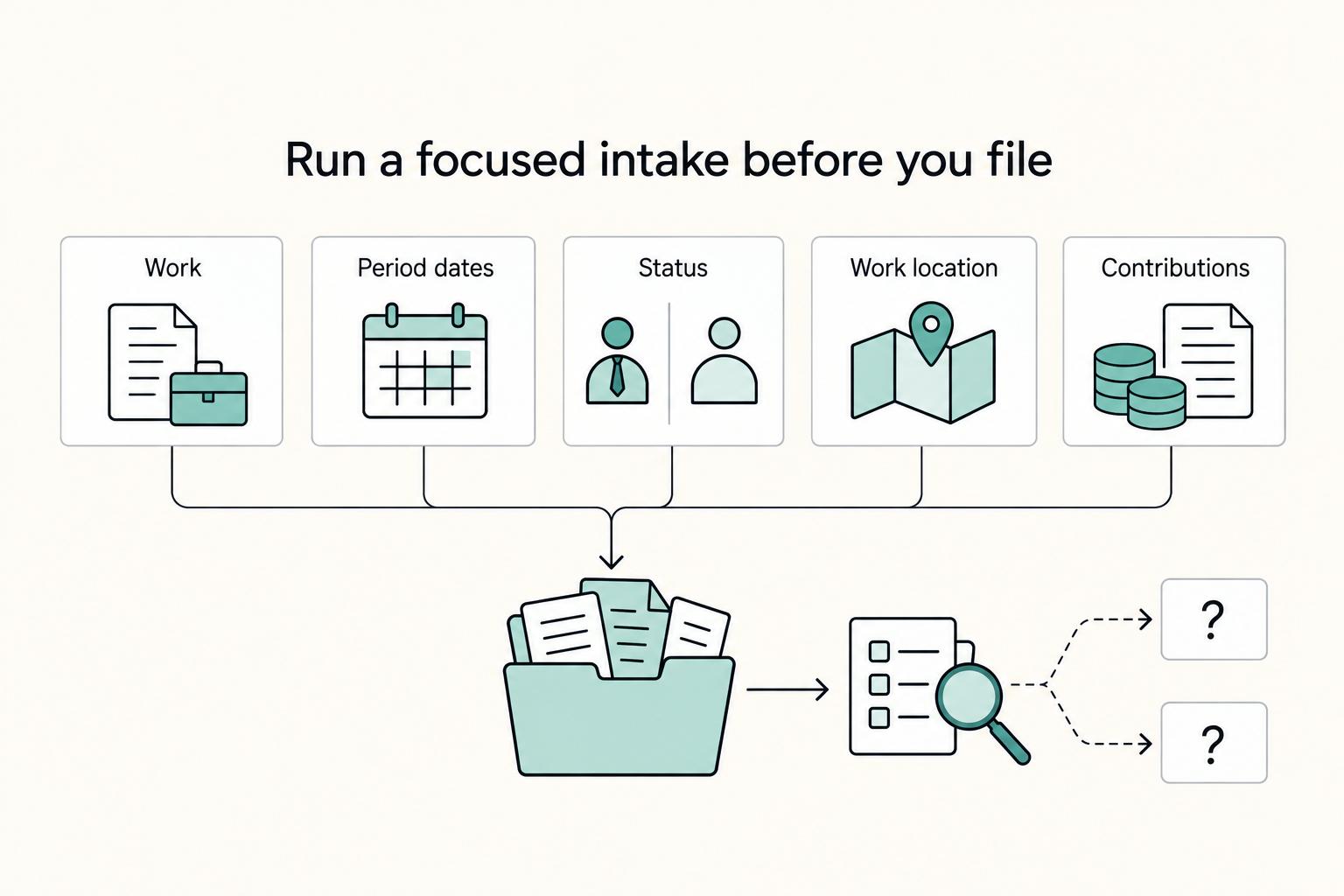
Start with a year-by-year map. For each period, note three things: where you worked, whether you were an employee or self-employed, and which country received social contributions on that income. Pull the records into one folder now: prior returns, payroll records, French contribution notices, invoices, and any employer assignment letters.
| Memo item | What to record |
|---|---|
| Work | What the work was |
| Period dates | When each period began and ended |
| Status | Whether you were acting as an employee or self-employed person during that period |
| Work location | Where the work was physically performed |
| Contributions | Which country collected contributions on that income |
| Proof | What records prove those points |
Do not keep this high level if the facts changed during the year. A clean intake usually works best when you break the year into the periods that actually mattered. If you were an employee for one stretch and self-employed for another, separate those periods. If work location changed, separate those periods too. The agreement analysis is only as good as the timeline underneath it, and broad labels like "worked in France this year" often hide the detail that determines whether a problem exists.
Your first decision is straightforward: do the same earnings appear exposed to social security taxes in both countries? These agreements are meant to prevent that result. If you see French social contributions and U.S. Social Security or Medicare treatment on the same income, flag that year for action.
Focus on the same earnings, not just the same calendar year. A lot of confusion comes from comparing total amounts at the annual level without asking whether the charges relate to the same activity. If one set of contributions ties to employment income and another ties to separate self-employment income, that is a different issue from one stream of earnings being hit twice. Your intake should make that distinction clear before you move on.
Before you file, prepare a short timeline memo that states when the work started, where it was performed, and why you think one country should cover the activity. Keep it with the contribution records and any prior advisor or payroll correspondence so you can support the same position consistently.
That memo does not need to be polished. It just needs to be usable. A practical version answers the questions in a simple sequence:
- what the work was
- when each period began and ended
- whether you were acting as an employee or self-employed person during that period
- where the work was physically performed
- which country collected contributions on that income
- what records prove those points
If you can hand that memo and folder to another reviewer and they can follow the logic without guessing, your intake is doing its job.
Use the intake stage to test for inconsistencies early. Compare the return position, payroll treatment, and contribution notices side by side. If payroll treated the income as subject to U.S. Social Security or Medicare, but you also have French contribution notices on the same work, that is a live issue. If an employer assignment letter suggests one pattern of work but the invoices or work history show another, resolve that before you file. If a prior advisor took a position for an earlier year, decide whether the underlying facts really match the current period rather than assuming the same answer still applies.
A few common failure points are worth catching here:
- mixing employee and self-employed periods into one analysis
- relying on residence instead of work history when the file needs work-location detail
- assuming that paying into one system automatically proves exemption from the other
- treating broad French charges as if they were all covered social security taxes
- trying to explain the position from memory instead of from records
The intake stage is also where you decide whether the record set is strong enough to support the next step. For employees, that often means payroll records and employer materials line up with the work timeline. For self-employed people, that usually means invoices, work history, and contribution records support the same story. If the file is thin, fix that now. It is much easier to request proof, organize records, and reconcile inconsistencies before a filing position hardens. Once that intake is complete, turn the facts into proof.
Stage 2: Secure and use the Certificate of Coverage#
If your intake shows a real risk of paying into both systems on the same earnings, move to the Certificate of Coverage. IRS guidance says you must secure a certificate from your home-country social security agency to claim exemption from U.S. Social Security and Medicare taxes under a totalization agreement. SSA describes the certificate as the proof that one country's coverage applies and the other country's social security taxes are exempt.
| Record to save | Why keep it |
|---|---|
| Copy of what was submitted | Shows what supported the certificate request |
| Confirmation screen | Adds proof that the request was submitted |
| Email acknowledgment | Adds to the submission trail |
| Approval email evidence | Shows approval when available |
| Follow-up correspondence | Helps show prompt action or good-faith use of the procedure |
The certificate is not an optional extra for a file that otherwise looks persuasive. It is the proof that ties the coverage assignment to the exemption claim. Payment records, payroll history, and contribution notices matter, but they do not replace the certificate when the exemption position depends on it. Use this order:
- Decide which country's social security system should apply before claiming an exemption.
- Request the Certificate of Coverage from the relevant social security agency.
- Save confirmations, approval notices, and submission records.
- Use the certificate where needed to support your U.S. exemption position.
That order is worth following exactly. Do not start by claiming exemption and hope the paperwork catches up later. First decide what your facts support. Then request the certificate that matches that position. Then preserve the request trail. Then use the certificate consistently wherever it matters.
Before you submit the request, make sure the support file is ready. At minimum, that means your timeline memo, work history, status as employee or self-employed, and contribution records all point in the same direction. If those pieces do not line up, the certificate request process becomes harder to explain, and even an approved certificate will not cure unrelated inconsistencies elsewhere in the file.
If you file through an online channel, keep approval email evidence when available. SSA notes optional email confirmation for approved certificate requests and also warns that web submissions are not guaranteed confidential, so treat transmission carefully.
In practice, save more than the final approval. Keep a copy of what was submitted, any confirmation screen, any email acknowledgment, and any follow-up correspondence. If you later need to show that you acted promptly or that you used the procedure in good faith, those records help. They also help if the certificate arrives later than expected and you need to explain why the full proof packet was still in progress.
| Filing scenario | Core document set | Where it is used on the U.S. side |
|---|---|---|
| Employee claiming exemption under the agreement | Certificate of Coverage from the home-country agency | Presented to the U.S. employer, per IRS guidance |
| Self-employed person claiming exemption | Certificate of Coverage plus work history and contribution records | Kept as primary support for the exemption position |
| Unable to obtain certificate | Request attempts, agency correspondence, and supporting records | Supports use of the IRS-referenced alternate procedure |
For employees, the key operational question is whether the certificate reached the people who needed it and whether you kept a copy in your own file. Do not assume that because a document was sent once, it will be easy to retrieve later. Keep the certificate with the year's payroll records and the memo explaining the coverage position.
For self-employed people, the file usually has to stand more on its own. Keep the certificate with the work timeline, contribution records, invoices or similar work history records, and any written explanation you would want available if the exemption position is questioned later. The goal is not to build a giant file. It is to build a file that answers the obvious questions in one place.
If you are unable to obtain the certificate, do not leave the record thin. The rule here is still document first, claim second. Keep the request trail, preserve any agency responses, and organize the same underlying records you would have used with the certificate: work history, contribution evidence, and the timeline memo. IRS guidance references an alternate procedure when a certificate cannot be secured, so your fallback record should show that the issue was pursued rather than ignored. A few practical guardrails for this stage:
- do not request the certificate before you have mapped the facts
- do not save only the final approval and discard the submission trail
- do not treat payment into one system as a substitute for certificate proof
- do not let the certificate sit apart from the records that explain the underlying work
- do not use one document pack for one period and assume it explains every other period
For a deeper walkthrough, see What is a 'Certificate of Coverage' for Social Security Totalization Agreements?.
Stage 3: Apply guardrails so you do not over-claim#
With the certificate in place, the last step is making sure you claim only what the agreement actually gives you.
| Item | Agreement treatment | Workpaper label |
|---|---|---|
| Covered social security tax | Addressed by the agreement | Covered social security tax |
| CSG | Not covered by the U.S.-France agreement | CSG |
| CRDS | Not covered by the U.S.-France agreement | CRDS |
| Unclear item | Better to pause than to over-claim | Unclear |
The main guardrail is simple: use the agreement to assign coverage to one country and support exemption from social security taxes in the other. That is its job. Without that assignment, the same earnings can end up exposed to social security taxes in both places.
That means your filing position should stay tightly connected to the specific work and the specific taxes at issue. If the agreement assigns coverage to one country for that activity, then the other country's social security taxes may be exempt for that same activity. If the taxes you are looking at are not the covered social security taxes addressed by the agreement, do not force them into the same analysis.
You also need to separate covered French charges from non-covered ones. IRS guidance states that CSG and CRDS are not social taxes covered by the U.S.-France agreement, and the countries memorialized that point in 2019. IRS also states it will not challenge foreign tax credits for CSG or CRDS on the basis that the agreement applies to those taxes.
This is where over-claiming usually happens. A taxpayer sees French charges connected to work, sees a totalization issue, and treats every line item as if the agreement reaches all of it. The safer approach is to break the file apart. Identify the charges tied to the social security coverage question. Then identify CSG and CRDS separately. Do not let broad labels in payroll summaries, tax workpapers, or advisor emails collapse those categories into one.
| Question | Agreement treatment |
|---|---|
| Which country's social security system applies to the work? | Core function of the agreement |
| Can the other country's social security taxes be exempt once coverage is assigned? | Yes, that is the intended mechanism |
| Are French CSG and CRDS covered social taxes under this agreement? | No |
| Can you skip certificate proof and still claim exemption safely? | No. Certificate evidence is central to the claim |
Use that table as a filing check, not just a concept summary. Before you finalize a position, ask yourself four practical questions:
- Have you identified the work period the agreement analysis applies to?
- Have you matched the exemption claim to certificate proof?
- Have you separated covered social security taxes from CSG and CRDS?
- Would another reviewer be able to see that separation from your file without guessing?
If the answer to any of those questions is no, the file likely needs more work.
A good way to apply this stage is line by line. Review the relevant charges and label them in your workpapers as covered social security tax, CSG, CRDS, or unclear. The "unclear" category matters. It is better to pause on an unclear item than to over-claim. Once everything is labeled, the agreement analysis becomes much more disciplined. You are no longer asking whether France charged something social in a broad sense. You are asking whether a particular charge is one the agreement actually addresses.
Do not stretch the agreement beyond coverage assignment and exemption proof. If the facts are unclear or the records are incomplete, pause and resolve the documentation before taking a position.
That pause can save a lot of trouble. If your file mixes covered social security taxes with CSG or CRDS, if the certificate does not match the period under review, or if the same earnings are not clearly identified, fix the record before you push ahead with a broad claim. The agreement is useful, but only when the proof and scope are handled carefully.
Quick FAQ#
Use these checks to pressure-test your filing position before you rely on the agreement. A good pressure test does two things at once: it checks the legal direction of the claim, and it checks whether your records are strong enough to support that direction. If the answer sounds right in theory but your file cannot prove it, treat that as a warning sign.
Do you need a certificate if you are already paying into France?#
Yes. If you are claiming exemption from U.S. Social Security or Medicare taxes under the agreement, IRS guidance ties that exemption to securing a Certificate of Coverage from your home-country agency. Paying into one system by itself does not replace the proof requirement. Build the certificate into the file from the start rather than treating it as a cleanup item.
What if you cannot get the certificate quickly?#
Do not assume the exemption is automatic. IRS guidance references an alternate procedure when a certificate cannot be secured, so keep a full paper trail of request attempts and agency responses and use that record to support a conservative filing approach. A strong fallback file includes the request itself, any confirmation or acknowledgment, follow-up correspondence, the work timeline, and the contribution records that show why the certificate was requested in the first place.
Are CSG and CRDS handled by the agreement?#
No. IRS guidance says CSG and CRDS are not social taxes covered by the U.S.-France agreement, so review them separately from covered social security taxes when you evaluate your French charges. If a notice or summary groups several French charges together, unpack it before you finalize your analysis. If a workpaper uses a broad label like "French social taxes," rewrite it into the actual categories you are relying on.
When should you escalate?#
Escalate to a cross-border tax professional if your map shows the same earnings may have been taxed for social security in both countries, if you are self-employed and lack a Certificate of Coverage for already filed years, if payroll or advisors cannot clearly explain which country has coverage, or if your analysis mixes covered social security taxes with CSG or CRDS. Those are not edge-case warnings. They are signs that the file may not support a clean do-it-yourself answer. If the earnings overlap is unclear, if the certificate issue affects already filed years, or if the taxes have not been separated correctly, a short review by someone who handles cross-border social security issues can be more efficient than trying to repair the position after the fact.
If self-employment is part of your fact pattern, also review The Self-Employment Tax Trap: How Totalization Agreements Can Save US Expats Thousands.
If you want a deeper dive, read the digital nomad tax guide.
Before you file, centralize your travel, work-location, and documentation trail in the Tax Residency Tracker so your compliance checklist is easier to defend.
If your setup spans multiple countries or non-standard payout flows, contact Gruv to confirm market coverage and compliance-gated workflow support.
Frequently Asked Questions
Do you need a certificate if you are already paying into France?
Yes. If you are claiming exemption from U.S. Social Security or Medicare taxes under the agreement, IRS guidance ties that exemption to securing a Certificate of Coverage from your home-country agency. Paying into one system by itself does not replace the proof requirement. Build the certificate into the file from the start rather than treating it as a cleanup item.
What if you cannot get the certificate quickly?
Do not assume the exemption is automatic. IRS guidance references an alternate procedure when a certificate cannot be secured, so keep a full paper trail of request attempts and agency responses and use that record to support a conservative filing approach. A strong fallback file includes the request itself, any confirmation or acknowledgment, follow-up correspondence, the work timeline, and the contribution records that show why the certificate was requested in the first place.
Are CSG and CRDS handled by the agreement?
No. IRS guidance says CSG and CRDS are not social taxes covered by the U.S.-France agreement, so review them separately from covered social security taxes when you evaluate your French charges. If a notice or summary groups several French charges together, unpack it before you finalize your analysis. If a workpaper uses a broad label like "French social taxes," rewrite it into the actual categories you are relying on.
When should you escalate?
Escalate to a cross-border tax professional if your map shows the same earnings may have been taxed for social security in both countries, if you are self-employed and lack a Certificate of Coverage for already filed years, if payroll or advisors cannot clearly explain which country has coverage, or if your analysis mixes covered social security taxes with CSG or CRDS. Those are not edge-case warnings. They are signs that the file may not support a clean do-it-yourself answer. If the earnings overlap is unclear, if the certificate issue affects already filed years, or if the taxes have not been separated correctly, a short review by someone who handles cross-border social security issues can be more efficient than trying to repair the position after the fact. If self-employment is part of your fact pattern, also review The Self-Employment Tax Trap: How Totalization Agreements Can Save US Expats Thousands. If you want a deeper dive, read The Ultimate Digital Nomad Tax Survival Guide for 2025. Before you file, centralize your travel, work-location, and documentation trail in the Tax Residency Tracker so your compliance checklist is easier to defend. If your setup spans multiple countries or non-standard payout flows, contact Gruv to confirm market coverage and compliance-gated workflow support.
Try a related tool
Researched and edited by the Gruv editorial team. Gruv builds cross-border billing, payouts, and finance-operations software for global businesses.
Sources
Educational content only. Not legal, tax, or financial advice.
Related Posts

Digital Nomad Taxes in 2026 With a Defensible Filing Plan
With digital nomad taxes, the first move is not optimization. It is figuring out where you may be taxable, where filings may be required, and what proof supports that position.
The Self-Employment Tax Trap: How Totalization Agreements Can Save US Expats Thousands
Most US expat freelancers will spend weeks researching income tax in a new country, then spend zero minutes on the one tax that can still follow them even when their US income tax bill is low or zero.
What is a 'Certificate of Coverage' for Social Security Totalization Agreements?
If you are dealing with **certificate of coverage social security** questions, the goal is simple: document where Social Security coverage belongs before a preventable cross-border compliance problem develops.