
Quick Answer
Start by splitting freelance marketer rates into lane-and-channel assumptions instead of using one blended average. Build separate rows for PPC, SEO, and Social Media Marketing, then label each row by source type (for example Upwork or direct), pricing type (Hourly Rates or Project-Based Pricing), and confidence. Use marketplace numbers as directional inputs, not full delivery cost. Before approving expansion assumptions for the United Kingdom, United States, or India, require a cross-check source and a clear scope note so decisions are grounded in comparable evidence.
How Freelance Marketer Rates Vary by Channel#
If you treat freelance marketer rates as one market truth, you will almost certainly make a bad planning call. The useful move is to treat platform listings, editorial rate guides, and specialist benchmarks as different signals that answer different questions.
| Service lane | Rate range |
|---|---|
| SEO consultants | $65 to over $250 |
| PPC consultants | $50 to over $175 |
| Social media strategists | $15 to over $80 |
That matters because pricing in freelancing is not one-size-fits-all. Harvard and BCG describe digital talent platforms as a way for companies to access highly skilled freelancers, but a platform price card is still only one slice of the picture. Wave puts the practical point more plainly: setting freelance rates is one of the hardest parts of the job. Buyers should take that seriously too. If sellers struggle to price consistently, buyers should not expect one blended benchmark to travel cleanly across channels, scopes, and regions.
A simple example shows why broad averages can mislead. Bonsai says its marketing consultant guide is based on thousands of US rates and, importantly, splits them into specialist categories instead of leaving them under one digital marketing label. In that source, SEO consultants are shown at $65 to over $250, PPC consultants at $50 to over $175, and social media strategists at $15 to over $80. You do not need to treat those figures as universal to see the point: PPC, SEO, and social are not priced as the same service, even before geography or buying channel enters the picture.
That tension keeps coming up. Marketplace benchmarks are often used as if they describe the full market, while broader digital marketing guides are treated as if they are directly comparable to marketplace data. They are not automatically interchangeable. Some sources describe hourly rate signals. Others describe project pricing. Some reflect platform listings, while others are guide-based or specialist compilations. If you blend those together too early, your budget starts to look precise while your assumptions are still mixed.
So the goal here is not to hand you one number. It is to give you a way to compare hiring assumptions by service lane first, then by channel, then by confidence. If you are scoping growth work, start with a simple checkpoint: label each input as hourly or project-based, and mark whether it comes from a marketplace, a broader rate guide, or a specialist source. If you skip that step, a common failure mode is importing one average into PPC, SEO, and Social Media Marketing and then planning against a false cost base.
One more guardrail matters from the start: not every rate should be justified only by market sheets. As Behance notes, freelancers also price around the value they can quantify. Even credible benchmarks are only starting points. Your job is to test whether the source type, scope, and confidence level actually fit the decision in front of you. Related: How to Price AI-Assisted Freelance Services.
Define the terms before comparing numbers#
Use two separate lenses first: compare hourly and project pricing independently, and only reconcile them after scope, deliverables, and channel are standardized.
| Tag | Values or example | Section note |
|---|---|---|
| Pricing model | hourly or project-based | Compare hourly and project pricing independently |
| Platform context | platform or off-platform | Keep platform pricing and off-platform pricing separate |
| Service lane | for example, PPC or SEO | Label each input by service lane |
| Scope note | named deliverables | Standardize scope and deliverables before reconciling pricing |
Hourly rates are a billed-time signal, not a full cost model. Indeed presents multiple freelance marketing rate types, and Wave separates hourly pricing from other approaches. An hourly number shows the price of time, but not total hours, included work, or overrun risk.
Project-based pricing is a different model. Wave treats charging per project separately, and fixed-price logic is typically about budget certainty when scope is well defined. This is where implied hourly variance can hide, including in PPC setup work and SEO retainers, if deliverables are not clearly mapped.
Keep platform pricing and off-platform pricing separate in your comparison sheet. Platform pricing is what you observe on marketplace listings; off-platform pricing is direct-client freelance marketing work tied to proposals, scope notes, or retainers.
Before comparing any benchmark rows, tag each one with:
- hourly or project-based
- platform or off-platform
- service lane (for example, PPC or SEO)
- scope note with named deliverables
If you skip that tagging, you create false precision by comparing unlike inputs. For a pricing-model comparison, see The 'Freelancer's Dilemma': Hourly vs. Value-Based Pricing.
What credible sources actually agree on and what they do not#
Across the supplied excerpts, agreement is narrow but useful: rate dispersion is normal, and freelancer experience and scope can materially change price. What these sources do not provide is a normalized PPC vs SEO vs Social Media split or a country-comparable benchmark you can plan from directly.
| Source | What it supports | What it does not support | Planning confidence |
|---|---|---|---|
| Freelancermap (August 13, 2025) | Higher qualifications and more experience are associated with higher hourly rates; communication and negotiation can also affect rates | Lane-normalized benchmarks and cross-country comparability | Directional only |
| Life by Design (published Aug 15 2024, updated October 10, 2025) | You need to scope work before quoting; price and value are distinct concepts | Representative market methodology, lane-normalized benchmarks, and cross-country comparability | Directional only |
The strongest shared signal is mechanism, not a single number: capability, scope, and commercial skill all move pricing. That is why blended "digital marketing" averages can hide real variation before channel or geography is even considered.
Use a quick gate before adding any benchmark to your model:
- pricing model is clear (hourly or project)
- service lane is explicit (or clearly blended)
- date is visible
- method context is present, even briefly
- geography is named
If method context is missing, mark the input directional only and do not use it alone for expansion assumptions. Related reading: Freelance Sales Qualifying That Protects Your Time and Pipeline.
Why marketplace numbers are often lower than broader market guides#
Use marketplace numbers as a different signal, not a direct benchmark for total delivery cost. The material here does not prove that marketplace rates are always lower than broader guides. What it does support is that pricing inputs vary by scope, pricing model, and how buyers interpret the number.
That fits the prior section: when sources mix hourly signals, project pricing, and different service scopes, the numbers will diverge. Reedsy (last updated Feb 12, 2025) says "it can be hard to advise freelance marketers on what exactly they should charge," which reinforces that scope comes before any single rate comparison.
What broader guides usually capture#
Broader guidance often focuses on pricing decisions, not just one posted number. Reedsy frames rate-setting in 5 steps, starting with "Decide on a pricing model," and also advises marketers to "Adjust rates according to each project." Those are not interchangeable with a single visible price signal.
A second caution is perception: a Quora response notes that "the person buying your service will have a completely different view on that number." So even when labels look similar, the same rate can be interpreted differently by freelancers and buyers.
How to use each signal without fooling yourself#
If your priority is fast discovery, marketplace pricing signals are useful for direction. If your priority is planning dependable delivery, treat those numbers as directional and validate them against scoped proposals or broader pricing guidance.
Before you model any number, record:
- the pricing model shown (hourly, project, or unclear)
- the service lane (PPC, SEO, Social Media Marketing, or blended)
- what is included in the work scope
- whether the source is a public listing signal or broader pricing guidance
The common failure mode is using one visible number as if it already includes full ownership and decision support. If you need a companion read on pricing decisions, see Raising Your Rates: How to Do It Without Losing Clients.
Build separate benchmark bands for PPC, SEO, and social before choosing a vertical#
Build separate benchmark bands by lane before you choose a vertical, because one blended assumption will misprice at least one lane. Start with a two-axis grid (PPC / SEO / Social Media Marketing by Upwork / Fiverr / direct) and then add experience tiers.
| Service lane | Upwork / Fiverr role in planning | Direct / off-platform role in planning | Experience tier layer | What the current evidence supports | Confidence |
|---|---|---|---|---|---|
| PPC | Useful for visible pricing signals | Important when ownership is broader than execution | Entry, mid, senior | A January 2, 2026 Google Ads source lists freelance contractor pricing at $25-40 per hour and in-house bands of $50,000-$65,000, $65,000-$85,000, and $85,000-$120,000+ by experience | Medium for tier structure, low for market-wide benchmarking |
| SEO | Collect separately by lane | Needed as a separate planning input | Keep at least an execution vs strategist split | No quantified SEO benchmark is supported in this section's evidence | Low |
| Social Media Marketing | Collect separately by lane | Needed as a separate planning input | Keep at least an execution vs strategist split | No quantified social benchmark is supported in this section's evidence | Low |
PPC is the only lane here with a concrete numeric anchor, and that anchor is narrow to Google Ads context. Use it to draft a PPC band, but do not stretch it into SEO or social benchmarks.
A second failure mode is treating contract shape as interchangeable. The Clicks Geek positioning highlights PPC-focused services with month-to-month flexibility, which is a different pricing signal from deeper ownership models. If you do not label contract shape, your benchmark band can look precise while still hiding scope drift.
Before approving hiring or supply forecasts, require:
- one benchmark source per lane and channel
- one cross-check source from a different source type or pricing model
- an experience-tier label for each number
- a scope note for what the number includes
If that pack is incomplete for SEO or social, keep those lanes as low confidence and do not use PPC data as a proxy. For a step-by-step walkthrough, see Build a Freelance Media Kit That Reduces Client Friction.
Compare United Kingdom, United States, and India with explicit confidence limits#
Treat United Kingdom, United States, and India as hypothesis bands, not pricing truth, until you validate local scope norms and payout feasibility for the exact work you plan to buy.
RemotePass supports using cross-border markets as a research starting point rather than a normalized pricing benchmark: it frames a "Country-by-Country Comparison" for 2025, and the excerpt says cross-border hiring is routine for SMBs and mid-market teams. That justifies comparing countries, but it does not establish lane-specific marketer rates across PPC, SEO, and social.
| Country | Evidence quality for marketer benchmarking | Observed channel bias | Biggest unknowns |
|---|---|---|---|
| United Kingdom | Low from supplied excerpts | Not established | Lane-specific scope norms, strategist vs executor mix, payout feasibility |
| United States | Low from supplied excerpts | Not established | What is bundled into "marketing," reporting ownership, payout feasibility |
| India | Low from supplied excerpts | Not established | Scope and seniority mix, buyer expectations, onboarding and payout friction |
Use geography as a planning range. If your model only works because one country is assumed to be cheaper or premium by default, confidence is still too low to lock GTM.
Buzzcube's framing is a useful guardrail here: its country view is a "2026 Snapshot" and explicitly warns readers not to misread the numbers. Apply the same discipline here: keep method notes, define scope, and avoid country-level conclusions without normalization.
Before you lock GTM, require a local validation pass for any country that drives the plan:
- one lane-specific source for that country
- one cross-check from a different source type
- a written scope note (strategy, reporting, meetings, revisions)
- a payout feasibility check
If any item is missing, keep that country assumption low confidence and out of final margin targets. If all you have is broad cross-border contractor context, use it to prioritize exploration, not commitment.
Use a decision checklist before committing product or GTM resources#
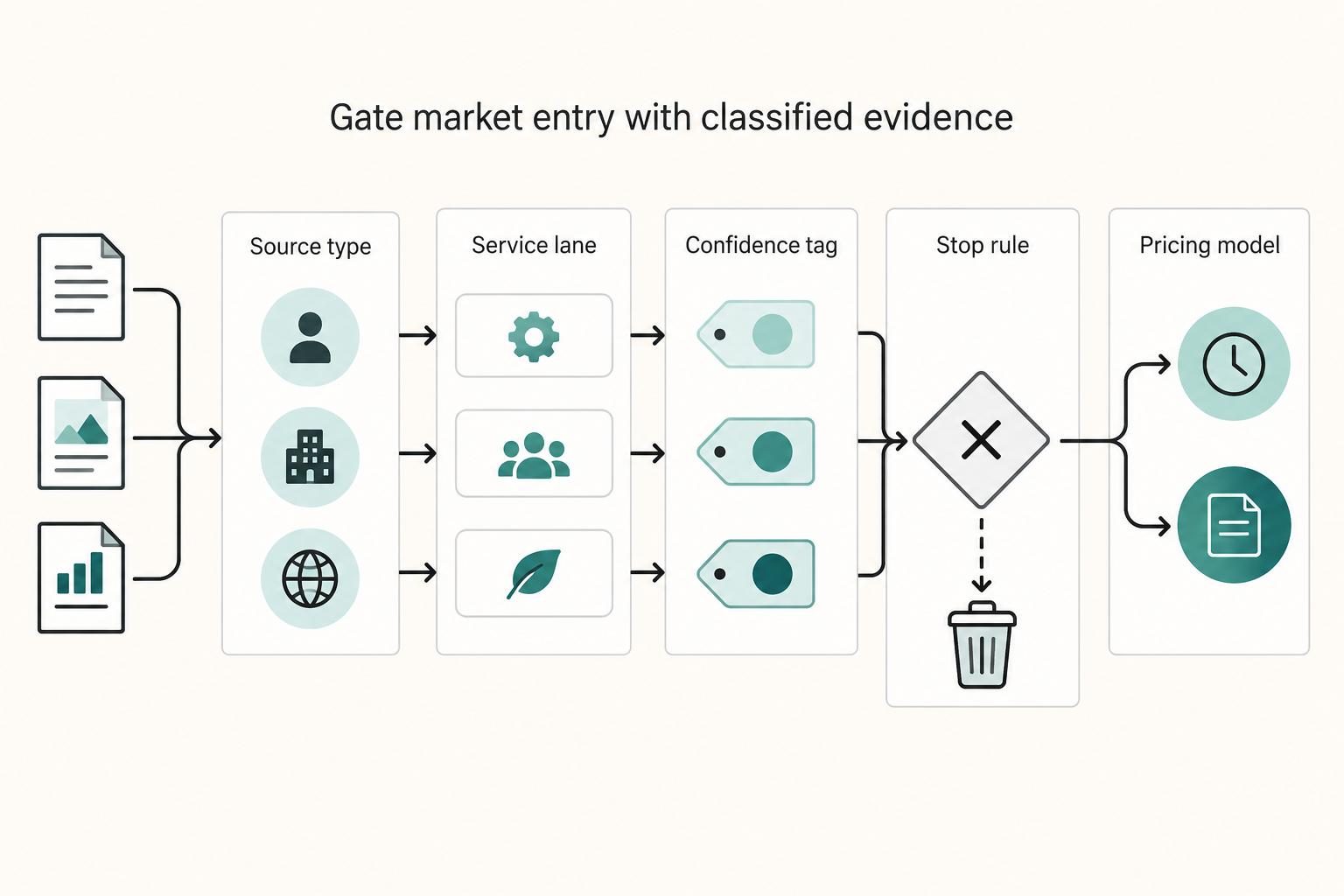
Before you commit product or GTM resources, treat this checklist as a gate: classify each input, map it to a lane, tag confidence, define stop/go rules, and separate pricing models so weak signals do not become operating assumptions.
| Checklist item | What to record | Red flag that should change the decision |
|---|---|---|
| Source type | Label each input as platform (Upwork, Fiverr, Freelancer.com) or broader signal (Indeed, editorial, community like Reddit / r/DigitalMarketing) | One blended average that treats listings, editorial guidance, and community discussion as equivalent evidence |
| Service lane | Map each input to PPC, SEO, or Social Media Marketing | One blended "Digital Marketing" rate used across all lanes |
| Confidence tag | Tag high / medium / low based on method transparency, geo coverage (United Kingdom, United States, India), and recency | Recent date used to mask unclear method or missing geo relevance |
| Stop/go rule | Write the rule that blocks expansion decisions when evidence is weak | No explicit rule, so low-confidence assumptions still drive decisions |
| Pricing model | Separate Hourly Rates from Project-Based Pricing, with scope notes | Fixed-scope quotes compared to hourly benchmarks without implied hours, revisions, or reporting load |
Use confidence tags based on evidence quality, not on how well a number fits your plan. In the supplied material, 42DM frames its insights as internal experience, GTM Strategist appears in newsletter/editorial context, Prose presents a structured playbook format rather than a visible rate-dataset excerpt, and Scribd is preview-style context with AI-enhanced metadata. Those signals can still inform direction, but they should not be treated as high-confidence rate benchmarks.
Set your stop rule before review meetings. A practical default: if lane-level confidence is low in two or more core markets, delay the expansion decision and collect missing evidence.
Then align on pricing-model risk before procurement starts. Keep hourly and project assumptions separate, and document scope so cost comparisons reflect delivery reality.
We covered related operating discipline in Freelance Client Retention: Weekly Systems for Repeat Work and Long-Term Relationships.
Turn benchmark assumptions into payout and compliance readiness checks#
Rate benchmarks are decision-useful only if payout execution is actually workable in the target market. Before you mark a PPC, SEO, or Social Media Marketing lane as ready, confirm your operating model can support traceable disbursements, practical onboarding, and policy-gated checks where enabled.
| Readiness artifact | Minimum details to capture |
|---|---|
| Onboarding requirements | Onboarding requirements used for the payee |
| Payout record | Amount, currency, fee owner, and final status |
| Failed payment reason | Any hold/return/reject reason when a payment fails |
| Reconciliation view | Linking payout status to scope or invoice |
Run one end-to-end payout path before rollout signoff, then keep the result as a readiness artifact. At minimum, capture:
- onboarding requirements used for the payee
- one payout record showing amount, currency, fee owner, and final status
- any hold/return/reject reason when a payment fails
- a reconciliation view linking payout status to scope or invoice
This is where many plans break: attractive Hourly Rates can be offset by payment friction. As Tipalti's payments guidance makes clear, payout design is not one generic transfer choice; it involves payout structures, methods, and tiers that affect operability.
Keep market claims narrow. Jobber notes that earnings vary by specialization, client type, regulatory jurisdiction, and geography. Use rate content as planning input, not as proof that payout and compliance execution are ready.
Conclusion#
Stop looking for one correct market number. The better move is to treat freelance marketer rates as lane-specific assumptions, then test those assumptions by channel, geography, pricing model, and evidence quality before you scale.
That discipline matters because the evidence here is useful, but uneven. A survey of 310 freelance marketers can give you directional signal, yet it still needs a confidence label, especially when the source explicitly says the research is sponsored by the author's book. The Freelancermap guide published August 13, 2025 is more useful for rate-setting mechanics, including the reminder that qualifications, years of experience, and even communication and negotiation can affect hourly pricing. By contrast, a U.S. House hearing dated June 25, 2008 may add background on online advertising, but it is not current standalone evidence for a 2026 rate decision.
The practical question is not "what is the average?" but "what exactly does this number describe, and can I defend using it?" If a benchmark does not disclose its methodology, sample, or pricing type, mark it directional only. If it blends multiple digital marketing services into one broad number, do not carry that blended figure into supply planning. That is how teams end up underpricing one lane, overestimating margin in another, and then reworking GTM assumptions after launch.
Channel separation is usually the highest-value correction. Marketplace listings can reflect visible bidding pressure and fee drag, and one cited guide notes that gig-site fees can reach 20%. That does not make platform numbers useless. It means they describe a different commercial environment from direct-client work, where the price may also cover strategy, reporting, client communication, and revision cycles that are easy to miss on a listing page or profile rate.
A benchmark becomes credible when it survives an operational check. Keep a compact evidence pack for each lane with the source date, country scope, pricing format, method note, and one cross-check source. Then validate payout feasibility before you commit volume. A rate that looks fine in a model can still fail operationally when execution details are missing.
If you need one final decision rule, use confidence tags instead of pretending every source carries the same weight. When confidence is low across two or more core lanes or markets, pause the expansion decision and collect the missing evidence first. That approach is slower for a week and faster for a quarter because it cuts pricing surprises and avoids rollout reversals that were visible in the inputs all along.
Frequently Asked Questions
What is the average freelance marketer rate, and why does the range look so wide?
There is no single grounded average you should trust across freelance marketer rates. The range is wide because sources themselves treat rates as variable by context, and even general guidance notes that freelance pricing is harder to benchmark cleanly than full-time salary bands. A better rule is to ask for one number per lane, pricing model, and source type. If a benchmark does not say whether it reflects Hourly Rates, Project-Based Pricing, or a mixed sample, treat it as directional only.
Why are Upwork and other marketplace rates often lower than broader freelance benchmarks?
You are usually looking at different contexts, not a like-for-like market view. The source guidance does not provide a shared methodology for direct apples-to-apples comparisons across marketplace listings and broader guides. Compare only after confirming pricing type and scope (for example, hourly vs project vs mixed). If that context is missing, treat the difference as directional rather than definitive.
How should I benchmark rates by experience level without overfitting to one source?
Use at least two sources and check what each one is actually describing. Indeed’s guidance, updated December 11, 2025, explicitly frames rate setting around both market comparables and your own value, which is useful, but it still is not a universal grading scale for junior, mid, and senior across every marketing lane. A good checkpoint is to log the source date, audience, pricing type, and whether method context is disclosed. If one source is older editorial context, like Wave’s March 19, 2021 pricing guide, keep it as a secondary cross-check rather than your primary planning anchor.
Can I use one global benchmark for United Kingdom, United States, and India expansion planning?
No. The source guidance does not support country-level parity, so one global benchmark is too blunt for expansion planning across United Kingdom, United States, and India. Use country figures as hypothesis bands until you validate local scope norms and payout feasibility. If one market matters to the launch, do a local validation pass before you lock GTM assumptions.
Should I plan with Hourly Rates or Project-Based Pricing for PPC, SEO, and Social Media Marketing?
Use Hourly Rates when scope is unclear or likely to change. Wise’s definition is straightforward: hourly pricing fits work where the project scope is undefined. Use Project-Based Pricing when deliverables are clear enough to scope and audit. For PPC, SEO, and Social Media Marketing, avoid blending rate types into one benchmark; keep the pricing model explicit before comparing numbers.
What minimum evidence should I require before committing GTM resources to a new market?
Require at least one primary benchmark and one cross-check source, and make sure each source is dated and clear about pricing type. Keep an evidence pack with source date, audience/context, and whether the method is explained. If you cannot compare like-for-like (Hourly Rates vs Project-Based Pricing vs mixed samples), treat the benchmark as directional and delay firm GTM commitments.
Try a related tool
Researched and edited by the Gruv editorial team. Gruv builds cross-border billing, payouts, and finance-operations software for global businesses.
Sources
Includes 4 external sources outside the trusted-domain allowlist.
- govinfo.gov/content/pkg/CHRG-110hhrg42688/html/CHRG-110h...trusted
- grants-neubauercollegium.uchicago.edu/data/virtual-library/Documents/freelancing_g...trusted
- hbs.edu/managing-the-future-of-work/Documents/Buildi...trusted
- oecd.org/content/dam/oecd/en/publications/reports/202...trusted
- almcorp.com/white-label-google-ads-cost-efficiency-scali...external
- behance.net/blog/what-should-i-charge-how-to-justify-you...external
- contra.com/p/2FFF7b3g-a-freelancers-guide-to-digital-ma...external
- creativeladder.org/news/setting-your-hourly-freelance-rate-4-th...external
Educational content only. Not legal, tax, or financial advice.
Related Posts

Raising Your Rates: How to Do It Without Losing Clients
Before finalizing execution decisions, validate wording against guidance from [pon.harvard.edu](https://www.pon.harvard.edu/daily/negotiation-skills-daily/principled-negotiation-focus-interests-create-value/), [law.cornell.edu](https://www.law.cornell.edu/wex/mutual_assent), [hbr.org](https://hbr.org/2021/06/if-youre-going-to-raise-prices-tell-customers-why).

How to Price AI-Assisted Freelance Services
Protect cashflow first, then optimize upside. Late-payment risk rises when scope is unclear, approval ownership is loose, and payment terms are left until late in the process.
The 'Freelancer's Dilemma': Hourly vs. Value-Based Pricing
If you run a business of one, stop asking which pricing model is better in the abstract. Ask which [risk your business is taking on](https://njsba.com/wp-content/uploads/2023/07/WP-Time-vs-Value-Billing-Shifting-the-Risk2.pdf) for this project. The **hourly vs value-based pricing** debate becomes useful only when you frame it that way. Are you buying flexibility because the work is still uncertain, or trading that flexibility for a more predictable fee tied to a defined result?