
Quick Answer
Choose hourly vs value-based pricing by risk allocation, not preference. If scope is moving or success is still hard to verify, bill for time or start with a paid discovery phase. If deliverables are clearly bounded and business impact is defensible, use a fixed or value-led structure with milestone triggers. For mixed engagements, use a hybrid that keeps uncertain work time-based and prices stable components separately.
Ask Which Risk Your Business Takes On for This Project#
If you run a business of one, stop asking which pricing model is better in the abstract. Ask which risk your business is taking on for this project. The hourly vs value-based pricing debate becomes useful only when you frame it that way. Are you buying flexibility because the work is still uncertain, or trading that flexibility for a more predictable fee tied to a defined result?
| Decision point | Hourly billing | Value-based or fixed fee |
|---|---|---|
| Best fit | Unclear scope, changing brief, discovery-heavy work | Defined outcome, clearer success criteria |
| Billing predictability | Lower. Invoice amount moves with hours worked | Higher per project once the fee is set |
| Scope control | Flexible, but easy for work to drift | Needs tighter boundaries up front |
| Client attention | Clients tend to think about hours and time use | Attention can shift more toward results |
| Overrun risk | Client absorbs more of the time overrun cost; you absorb trust friction | More delivery risk can shift to you when the fee and scope are fixed |
Hourly pricing does more than make revenue track your time. It also shapes client behavior. When something you expected to take 10 hours takes 20, the problem stops being just math. It becomes a trust issue, and clients may start scrutinizing meetings, research time, or whether they are being billed for every minute.
Outcome-led pricing changes that conversation, but only if you do the groundwork first. Use this checkpoint: can you quantify and document the customer value well enough to defend it in a proposal? If you cannot clearly state the outcome, the likely business benefit, and the basis for your number, you are not really pricing on value yet.
So use a simple filter before you send any proposal. If scope is unstable, success is still fuzzy, or the client keeps rewriting the brief, charge for time. If scope is defined, value is documentable, and success can be described plainly, a fixed or value-based fee can be the stronger option. The next section turns that into a repeatable diagnostic. If you want a related walkthrough, see Moving From Hourly to Project Rates Without Hurting Cashflow.
The Diagnostic Framework: Which Model Mitigates Risk for Your Business?#
Use this before every proposal: choose the model that protects your cashflow, controls scope, and reduces billing disputes. No model wins by default, so base the decision on project conditions, not preference.
Run three checks in order: scope definition quality, outcome measurability, and client buying behavior. If scope and measurability are weak, do not force value pricing yet.
The three checks that matter#
Start with scope definition quality. Are you being hired to deliver a defined result, or to figure out what the work is? If deliverables and exclusions are still unclear, treat it as uncertain work. Hourly billing is usually safer for true discovery, troubleshooting, or embedded support.
Next, test outcome measurability. Can the client describe the upside in money, speed, certainty, or risk reduction, and can you scope delivery with confidence? If the upside is still hard to define, a fixed/project fee can still fit. But a packaged fixed fee is not automatically value-based pricing.
Then assess client buying behavior. Do they buy outcomes, or do they want labor input tracked line by line? If they need time visibility to feel in control, time-based pricing is often the better fit. If they stay focused on the result and business impact, outcome-led pricing is more likely to hold.
| Variable | What to ask | Strong signal | Recommended path | Main risk if misapplied | Fallback when mixed |
|---|---|---|---|---|---|
| Scope definition quality | Are deliverables, exclusions, and decision points clear now? | Work is still being diagnosed | Hourly | Fixed fee turns into underpriced scope creep | Paid discovery first |
| Outcome measurability | Can the client state the upside in money, speed, certainty, or risk reduction? | Success is hard to verify | Fixed/project or hourly | "Value" price is hard to defend and easier to dispute | Fixed fee for tightly defined deliverables |
| Client buying behavior | Do they buy outcomes or scrutinize labor input? | They want time logs and effort detail | Hourly (or day-rate style time billing) | Outcome-led proposal stalls or creates trust friction | Short fixed phase, then reprice |
| All three are strong | Clear scope, measurable upside, outcome-focused buyer | Low ambiguity, high stakes | Value-based (or fixed fee anchored to outcomes) | Pricing only labor can underprice impact | Fixed fee with clear change-order rules |
The hybrid route for mixed signals#
Most engagements start with mixed signals. Use a phased path based on certainty: hourly for uncertainty, fixed/project for well-scoped deliverables, and value pricing when outcomes are measurable and stakes are high.
Practical rule: if you can define only the next step, sell only the next step. Price discovery or diagnosis first. Reprice to scoped fixed work once scope is clear. Move to value pricing only when both sides can point to measurable outcomes.
This sequence avoids common failure modes. Too much hourly can reward inefficiency, create disputes over hours, and limit scalability. It can also reduce revenue when delivery gets faster.
If uncertainty is real, charge for time. If the work is defined but upside is still fuzzy, use scoped project pricing. If scope is clear, outcomes are measurable, and the client buys results, use value pricing. If signals are mixed, start with a paid first phase and reprice after risk is visible. For a step-by-step walkthrough, see Value-Based Pricing for Creative Services That Protects Cashflow. If you want a quick next step, try the free invoice generator.
How to De-Risk Value-Based Pricing in the Proposal and Contract#
If you want value-based pricing to hold up, your proposal has to work as a risk-control document, not a sales document. Use it to prevent scope creep, payment delays, and disputes about what "done" means by attaching each promise to scope, acceptance criteria, and a payment trigger.
Fill in the five parts#
Use this structure every time. Fill each part in plain language:
| Part | What to include |
|---|---|
| Client context | The client's current situation, the problem to solve, and key assumptions |
| Success definition | The result you are delivering, what evidence the client will review, and any client-side dependencies |
| Offer options | 2-3 clear choices, with each option tied to a specific Scope of Work |
| Scope boundaries | Inclusions, exclusions, client inputs, and timeline dependencies |
| Payment triggers | Each milestone tied to acceptance criteria so completion and invoicing are verifiable |
Define the client's current situation and assumptions, state the result and the evidence the client will review, then tie 2-3 clear choices to a specific Scope of Work. List inclusions, exclusions, client inputs, and timeline dependencies, and make each payment trigger verifiable against acceptance criteria.
When uncertainty is still high, keep billing time-based for discovery or variable inputs. Move to outcome-led pricing only when deliverables are clear enough to scope safely.
Weak language vs strong language#
| Proposal area | Weak language | Strong language | Why the strong version protects you |
|---|---|---|---|
| Scope | "Includes strategy and design support as needed." | "Includes messaging audit, one positioning summary, and homepage wireframe review listed in the Scope of Work." | The fee is tied to named deliverables, not open-ended effort. |
| Exclusions | "Extra work may cost more." | "Copywriting, paid media setup, additional workshops, and new deliverables are excluded unless approved through a written change request." | Gives you a clear path for out-of-scope requests. |
| Approval steps | "Client will review and approve promptly." | "Client approval is required at the draft checkpoint before production starts. Approval delays move the delivery timeline." | Makes review timing a defined dependency. |
| Milestone acceptance criteria | "Milestone 2: first draft delivered." | "Milestone 2 is complete when the first draft and listed deliverables are submitted in the agreed format and reviewed against the milestone acceptance criteria." | Reduces arguments about whether the milestone is complete. |
Guardrails that belong in the contract#
Keep the contract aligned with the proposal, in plain language:
| Guardrail | What to define |
|---|---|
| Change orders | Work outside the agreed Scope of Work starts only after a written change request with updated scope, price, and approval |
| Revisions | Included feedback rounds and what happens when revision requests exceed that scope |
| Ownership transfer | When rights transfer, aligned with payment terms |
| Early termination | What is billable, what is delivered, and what remains due if the project ends early |
You want a clear path for change orders, defined revision limits, an ownership transfer point that matches payment terms, and early termination terms that spell out what remains billable and deliverable.
Before-you-send alignment check#
| Item | What must match |
|---|---|
| Deliverable names | Proposal, contract, and invoice use the same deliverable names and milestone labels |
| Success criteria | Success definition and acceptance criteria match |
| Exclusions | Exclusions in the proposal also appear in the contract/SoW |
| Payment triggers | Payment triggers match how you will invoice |
| Ownership and termination | Ownership and termination terms do not conflict across documents |
This is how you de-risk the pricing choice in practice: make scope, completion, and payment easy to verify. Related: How to Calculate Your Billable Rate as a Freelancer.
The Compliance Layer: How to Invoice for Value Without Creating Headaches#
Your invoice is where value-based pricing either gets approved quickly or turns into delays and disputes. If finance cannot verify what you billed, your cashflow slows down even when the work is good.
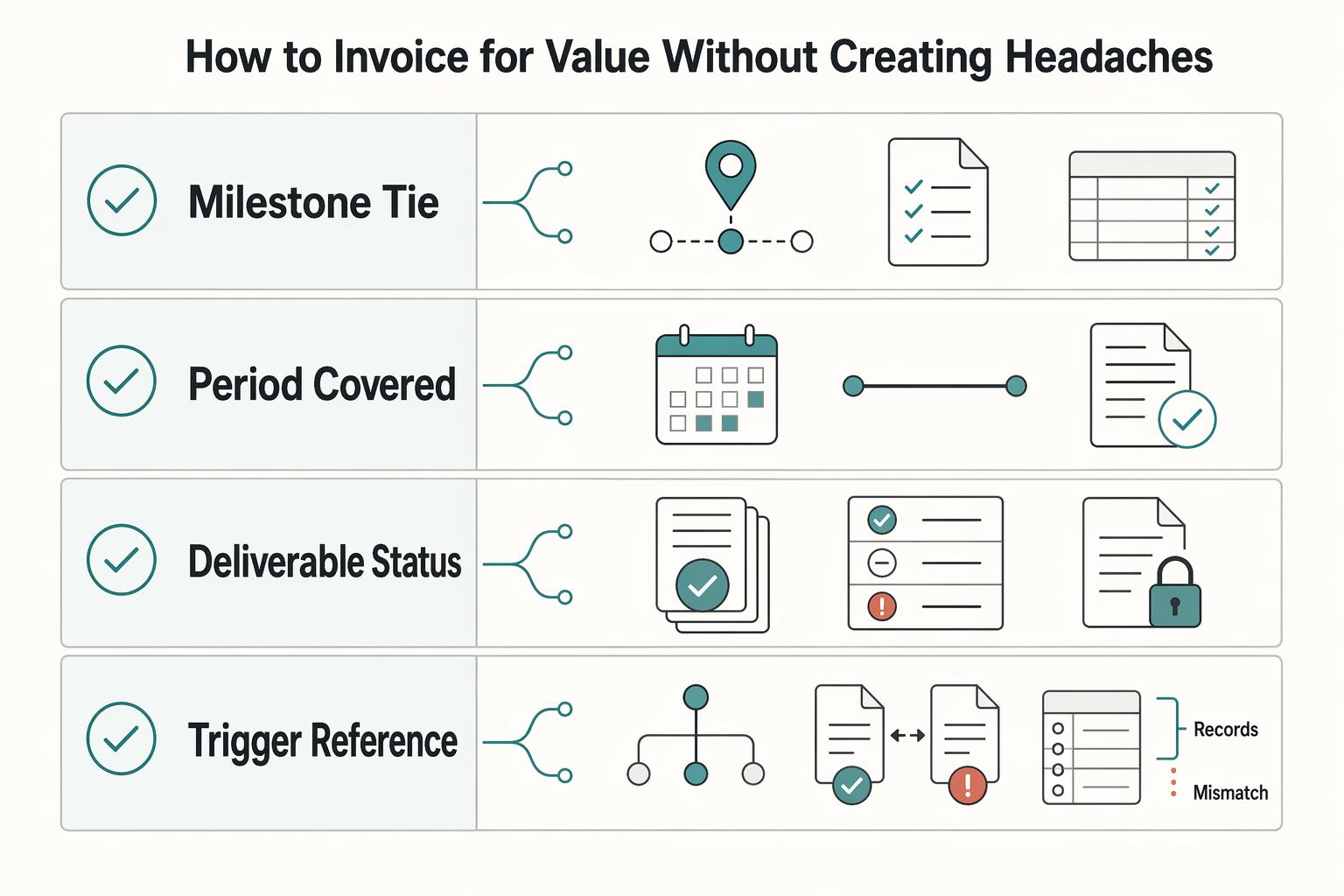
The biggest risk is the translation gap between a strategic promise and an auditable invoice. If your proposal says "improve positioning" but the invoice says "consulting services," you create avoidable friction for the client team and risk for your own records. Use one rule on every project: translate each promise into invoice-ready deliverables, acceptance criteria, and payment triggers already defined in your proposal.
| Billing element | Weak line item | Audit-ready line item | Why the stronger version is easier to approve |
|---|---|---|---|
| Milestone tie | "Brand strategy services" | "Milestone 1 payment: messaging audit and positioning summary delivered per approved Scope of Work" | It ties the charge to a named milestone and an agreed document. |
| Period covered | "Monthly retainer" | "April 2026 strategic advisory retainer covering 2 review calls and 1 decision memo, as listed in the SoW" | It shows the billed period and what was included. |
| Deliverable status | "Project fee, phase 2" | "Phase 2 complete: homepage wireframe review submitted on agreed date, pending acceptance against listed criteria" | It shows whether work is delivered, complete, or awaiting approval. |
| Trigger reference | "50% due now" | "Milestone 2 invoice triggered by draft delivery and client review checkpoint defined in proposal section 4" | It creates a defensible trail instead of an arbitrary-looking amount. |
Before you send it, run one check: can someone who was not on the sales call match each line item to signed scope, a delivery event, and current status? If not, rewrite the invoice. The goal is traceability.
For each invoice cycle, verify this short compliance list:
- Business identifiers: Include the business details your jurisdiction requires for you and, where relevant, your client.
- Tax treatment label: State the tax treatment you are applying only after confirming the current rule for client location and service type.
- Scope reference: Tie each billed amount to a milestone, date range, or deliverable named in the proposal, contract, or statement of work.
- Record-keeping artifacts: Keep the signed proposal, change requests, delivery email, approval note, and final invoice so your audit trail is clear.
If you invoice cross-border and reverse charge may apply, verify before issuing. Confirm the client's current business status and relevant tax ID, then check the service and jurisdiction rules against current official source records. Any required reverse-charge wording stays pending until those checks are complete and should not be used on an invoice before then.
If you cannot translate the work into verifiable line items, do not force a fixed-value milestone invoice yet. Split into a paid discovery phase, or use hourly billing until deliverables, tax treatment, and approval triggers are clear. If you want a deeper dive, read GDPR for Freelancers: A Step-by-Step Compliance Checklist for EU Clients.
Conclusion: Stop Selling Time, Start Selling Certainty#
Your next pricing decision should start with one question: who is carrying the risk? If scope is still moving, charge for time. If the outcome and boundaries are clear, sell a defined result. If only part of the work is stable, use a structured hybrid. That is the real issue behind hourly vs value-based pricing.
| Model | What the client gets | Who carries more risk | What the incentives reward | How growth scales |
|---|---|---|---|---|
| Hourly | Flexible effort as needs change | Client carries more budget risk as time expands | More time logged | Tied closely to tracked hours |
| Fixed or value-led fee | Defined services or a defined result at a set price | You carry more efficiency risk inside the agreed scope | Clear scope discipline | Works best when services are well defined |
| Structured hybrid | A stable core plus a path for changes | Risk is shared more deliberately | Discipline on scope, flexibility on extras | Useful when only part of the engagement is predictable |
The trap is not choosing the middle. The trap is sitting in the middle without structure. If you bill only by time, you can hit the productivity paradox: getting faster lowers your income. If you quote a flat or value-led fee before scope is pinned down, you may absorb extra work. Before you send a proposal, verify that the defined services, exclusions, and any out-of-scope hourly charge are written down. If any result-based component is included, define exactly how success will be measured.
What to do next:
- Match the model to the project profile: unclear scope, clear scope, or mixed.
- Write scope guardrails, especially exclusions and change handling.
- Set billing checkpoints tied to defined scope or deliverables.
- Confirm pricing terms and measurement criteria before work starts.
You do not need a bigger personality to sell certainty. You need a pricing method you can repeat, check, and defend on every deal. We covered this in detail in Value-Based Pricing for Strategic Consultants: A How-To Guide.
Frequently Asked Questions
How do you calculate value for value-based pricing?
Start by documenting impact you can defend: revenue, cost savings, speed, or risk reduction. Build a short value memo with the current state, expected result, time horizon, and confidence notes, then add "Insert verified value calculation example" instead of guessing numbers. Use this when the client can name a real business outcome, not when the benefit is still vague or purely aspirational.
What are the biggest risks of value-based pricing and how do I mitigate them?
A major risk is pricing before enough discovery, then taking on extra work because the scope was never clear. Do discovery first, define scope, and keep a change-order path ready so price changes stay tied to scope changes. This works when outcomes matter more than tracked time and fails when you still cannot describe what done looks like.
How do I switch an existing client from an hourly to a value-based model?
Make the change at a clear project boundary, such as renewal or a new project scope. Show the client the scoped deliverables and expected outcomes so the new price feels easier to evaluate, not harder to justify. This is easiest when priorities are already clear.
What is a hybrid pricing model and when should I use it?
Use hourly for uncertain work, a fixed or project fee for the defined deliverable, and a separate rate or change order for extras. Remember that a fixed fee is not automatically value pricing. It can still be an hourly estimate packaged differently. A hybrid works best when the core outcome is clear but revisions or support may move around.
Is value-based pricing suitable for projects with an unclear scope?
Usually no. When scope is unknown, time-and-materials is the cleaner option, or you can sell a paid discovery phase whose output defines scope before final pricing.
How do I handle requests for additional work on a fixed-price project?
Treat the request as a scope change, not a favor. Restate the original scope, document what changed, and revise the price or timeline before you start. If they push back on price, ask what they want removed from scope instead of discussing discounts alone.
Try a related tool
Researched and edited by the Gruv editorial team. Gruv builds cross-border billing, payouts, and finance-operations software for global businesses.
Sources
Includes 6 external sources outside the trusted-domain allowlist.
- academia.edu/128553268/Show_me_the_money_Bringing_pay_rat...trusted
- govinfo.gov/content/pkg/CHRG-110hhrg35857/html/CHRG-110h...trusted
- acctual.com/insights/hourly-billing-vs-value-based-pricingexternal
- agentik-os.com/blog/pricing-ai-services-value-basedexternal
- altfeeco.com/resources/from-hours-to-outcomes-the-hybrid-...external
- blog.timetracker.in/blog/value-based-billing-vs-time-based-maxim...external
- curalo.io/guides/consultant-pricing-playbookexternal
- forbes.com/sites/ianaltman/2015/10/08/how-to-shift-from...external
Educational content only. Not legal, tax, or financial advice.
Related Posts

GDPR Compliance Checklist for Freelancers Working With EU Clients
Start by separating the decisions you are actually making. For a workable **GDPR setup**, run three distinct tracks and record each one in writing before the first invoice goes out: VAT treatment, GDPR scope and role, and daily privacy operations.
How to Calculate a Freelance Rate You Can Actually Get Paid On
A workable rate is not the neat number a calculator produces. It is the number that still works after you account for real billable capacity, non-client time, scope drift, and the gap between sending an invoice and receiving cleared cash. Start with hourly math even if you do not plan to bill hourly, then turn that number into a quote with clear `payment terms`.

The Freelance Payment Penalty: A Modeled Audit of Platform Fees, FX Spreads, and Payout Delays
The money rarely disappears through a single, easy-to-spot fee. The real loss is stacked. A marketplace takes its commission, a processor adds a charge for international cards, a bank or payment company converts the currency at a spread, a platform holds the funds before release, and a wire sheds a little to intermediaries on the way in. Each layer looks defensible on its own, but the worker feels the combined result as a smaller deposit and a later payday.