
Quick Answer
Start with the narrow definition: a Certificate of Coverage is official proof that a Totalization agreement assigns Social Security coverage to one country for specific work. In U.S.-assigned cases, SSA issues the document and it can support exemption from the other country’s social charges for that covered period. Treat eligibility as fact-dependent, not automatic. Classify worker status first, submit only complete records, and keep your Control Number for tracking and follow-up.
How to document Social Security coverage assignment before a dual-taxation problem develops#
If you are dealing with certificate of coverage social security questions, the goal is simple: document where Social Security coverage belongs before a preventable cross-border compliance problem develops.
Totalization agreements are meant to prevent dual Social Security taxation, and you need to consider them when assessing possible U.S. Social Security and Medicare tax exposure. They are not a blanket pass on every other tax or reporting obligation.
For freelancers and consultants, one common challenge is execution: timing, documentation, and proof. When an agreement assigns coverage to one country, you need records that support that result. If coverage is assigned to the United States, SSA issues a U.S. Certificate of Coverage. Use this sequence early:
- Check whether a relevant agreement exists for your country setup.
- Confirm whether your case is employee or self-employed.
- File through SSA's certificate process, including the online request path for self-employed filers.
- Save the Control Number after submission and use it as your tracking anchor for status and follow-up.
Keep one guardrail in view: a certificate does not replace separate income tax analysis or other compliance filings, and working internationally does not automatically make someone eligible. The U.S. agreement network dates to the late 1970s, but coverage rules still depend on the specific agreement and your facts.
This guide stays narrow on purpose. Make the right call at the right checkpoints, file with complete support, keep the right tracking record, and escalate to a qualified advisor when the facts are uncertain.
What a Certificate of Coverage actually proves#
A Certificate of Coverage is not a general tax waiver. It is official proof that, under a bilateral Totalization agreement, social security coverage is assigned to one country so the other country does not charge social security taxes on the same work. That proof works in both directions:
- If coverage is assigned to the United States, SSA issues the U.S. certificate, and it serves as evidence of exemption from the foreign country's social security taxes for the covered work.
- If coverage is assigned to the agreement country, that country's certificate can serve as proof of exemption from U.S. Social Security coverage and taxes.
For U.S. cases, the key authority is SSA's Office of International Programs, which SSA policy guidance identifies as the issuer of U.S. certificates. Start with SSA International Programs, then verify the specific country agreement before you rely on any exemption.
Keep the scope tight. Totalization agreements address Social Security taxes, Medicare taxes, and retirement, disability, and survivors benefits under Title II on the U.S. side. They do not cover Medicare program benefits or SSI, and they do not eliminate other tax or filing obligations. SSA's agreement-description pages are highlights, not full country manuals. Confirm that the bilateral agreement exists, confirm that your facts fit it, and limit your claim to social security coverage assignment.
If anything is unclear, do not over-claim. Public guidance does not support statements like "a certificate exempts all U.S. tax" or "every country follows the same rule." Even agreement counts can vary by source and date, so stay anchored to the actual agreement and your facts.
Decide if you likely need one before accepting cross-border work#
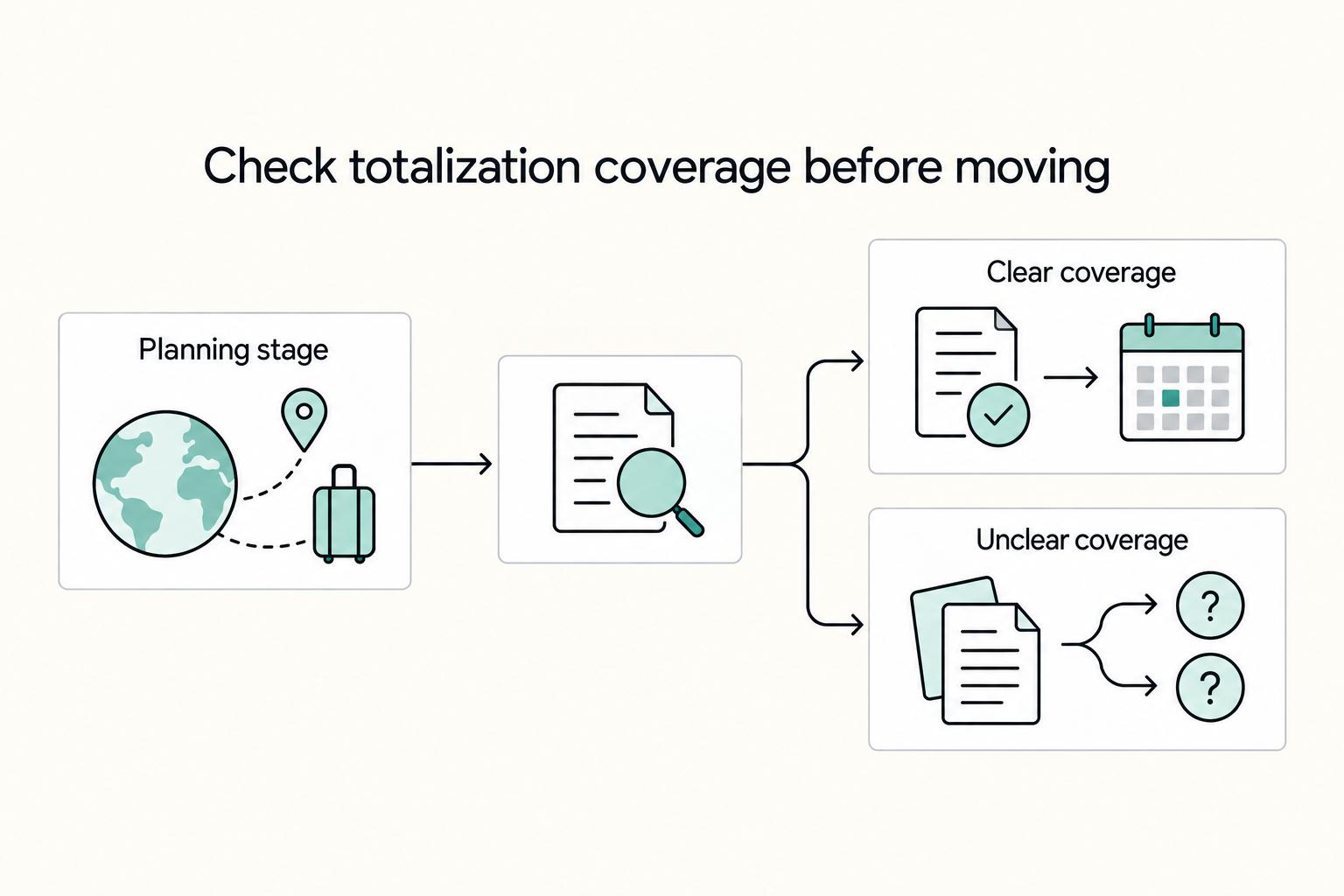
Before you accept cross-border work, assume this needs review unless you can confirm an applicable U.S. Totalization agreement and confirm that your facts fit it. If the work touches two countries and both could expect social security contributions, treat the case as unresolved until you verify coverage assignment.
The reason to decide early is straightforward: dual charges are a real risk. SSA and IRS guidance indicate that without an applicable agreement, employees, employers, and self-employed workers can face social security taxes in both countries. Even when an agreement exists, relief is not automatic because the procedural steps still matter.
Use this two-step screen first#
- Confirm whether the other country is an agreement country under U.S. bilateral Social Security agreements.
- Classify the arrangement correctly: employee assignment or self-employed work.
If either step is unclear, escalate before assuming any exemption. Use the SSA country agreement description itself, not a summary, because country-specific exceptions exist, including special rules noted for Italy.
Match your case to the certificate path#
The filing path has to match the work pattern. If you are sent abroad by the same American-based employer, use the employee certificate request path. IRS guidance says that if an American citizen or resident alien is sent abroad for five years or less to work for the same American-based employer, U.S. Social Security coverage generally continues. The same IRS summary says assignments longer than five years generally shift social security tax to the foreign country.
| Case | Path | Key point |
|---|---|---|
| Sent abroad by the same American-based employer for five years or less | Employee certificate request path | IRS guidance says U.S. Social Security coverage generally continues. |
| Sent abroad by the same American-based employer for longer than five years | Employee certificate request path | IRS guidance says social security tax generally shifts to the foreign country. |
| Self-employed work | Self-employed certificate request path | An applicable agreement is still required, and self-employment abroad does not automatically qualify. |
If you are self-employed, use the self-employed certificate request path. Do not assume self-employment abroad automatically qualifies. You still need an applicable agreement and facts that assign coverage to one country under that agreement.
For filing mechanics, SSA states that only an employer or self-employed worker may use the online request form. If an employee files directly, SSA must verify with the employer.
Hard guardrail before relying on any exemption#
Do not rely on an exemption theory unless you can identify the assignment country of coverage from official agreement materials. Totalization assignment is based on where the worker has greater economic attachment. Residency analysis can also get fact-heavy because "country of permanent residence" depends on where a person has established a home and assumed economic burdens.
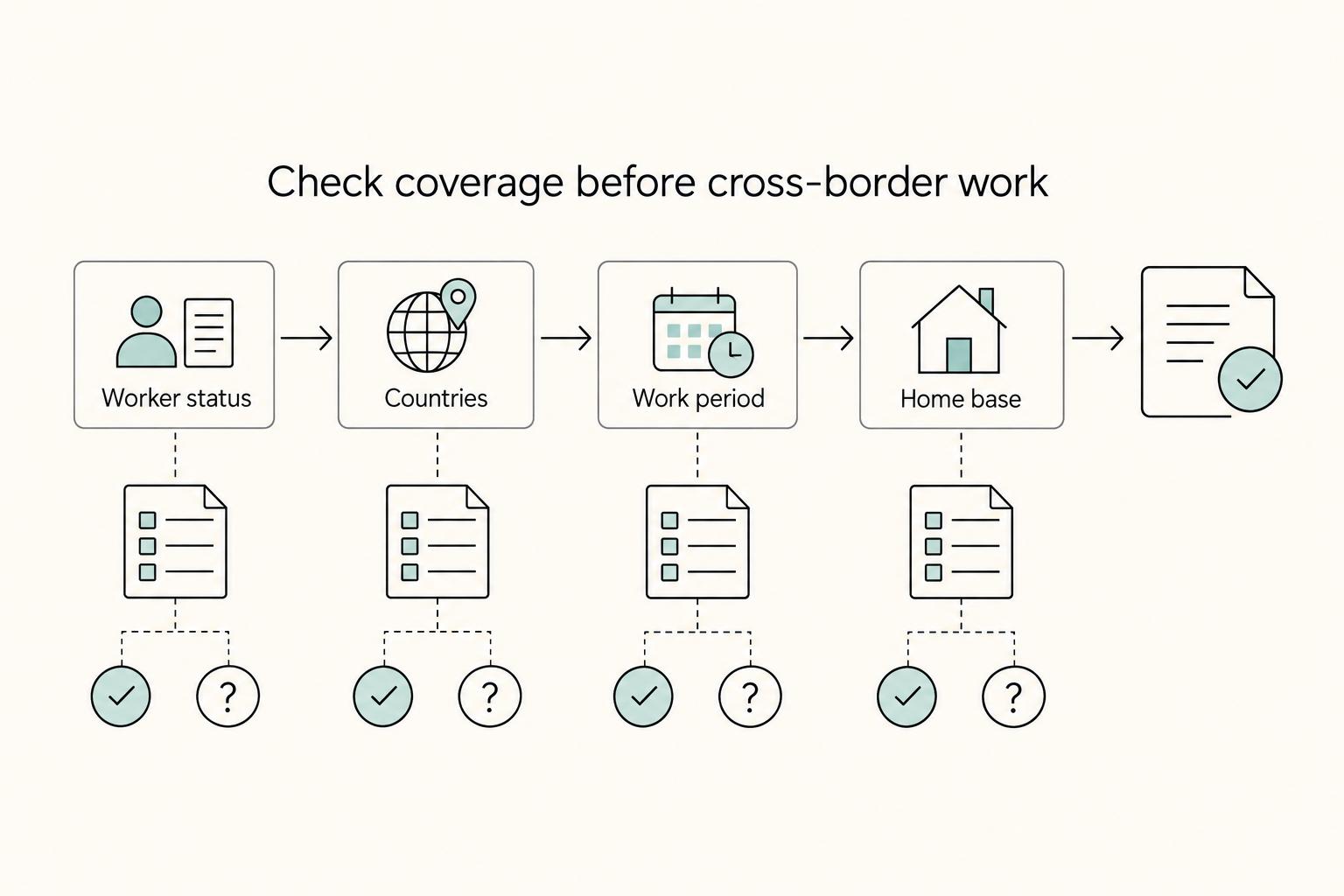
Before you move forward, make sure you can document these points. If that packet is incomplete, the decision is not ready:
- Worker status, employee or self-employed
- Countries involved
- Expected work period
- Where your established home is
Talk to a pro now if any of these apply#
- You cannot clearly determine country of permanent residence.
- The engagement spans multiple non-U.S. countries or includes planned moves.
- Timing may exceed five years or is open-ended.
- Worker classification is unclear for agreement purposes.
- Contribution history is fragmented across countries.
- Agreement language is ambiguous or includes known special-rule complexity.
For a step-by-step walkthrough, see A Guide to Social Security for 'Autónomos' in Spain.
Choose the right certificate type and filing route#
Choose the certificate label and filing route before you submit, because avoidable delays can start at intake. In SSA's Online Certificate of Coverage Service, you will see certificate-type options (such as Performer Certificate, Employer Certificate, and Self Employed Certificate). Treat these as separate lanes, and stop to verify the match if the label is not clear.
Use opts.ssa.gov for the standard online path. SSA presents online filing as faster because it avoids manual rekeying, and the form checks for missing information or keying errors before transmission. If you need a non-web route, SSA also accepts requests by fax at (410) 966-1861 or by mail.
If you file online, use this checkpoint: if required fields are incomplete, do not submit yet. SSA states you cannot transmit until required fields are completed.
Use SSA's exact tool names so navigation stays straightforward: file in Online Certificate of Coverage Service and track progress in Request Status Search. Save your Control Number immediately, because status checks run on that identifier, including labels such as Received, Pending, and Completed. For follow-up timing, SSA asks you to allow 90 business days before checking in. If a certificate is issued after a Completed status, allow up to two weeks for mailing.
Build your document pack before you open the SSA form#
Build the packet before you open the form. That reduces back-and-forth with OEIO if questions come up. SSA's online service can catch keying errors and missing fields before transmission, but your records still need to match.
Pre-submit pack (minimum)#
| Field or fact to prepare | SSA checkpoint | Pre-submit check |
|---|---|---|
| First name | Required for electronic submission; up to 15 characters | Match your official record exactly and keep formatting consistent |
| U.S. Social Security Number | Mandatory field; enter as 000-00-0000 | Confirm from official records before entry |
| Foreign Social Security Number (where applicable) | German, Italian, Norwegian, and Spanish forms: enter if known; up to 15 characters | Include only when applicable and known; do not guess |
| Date of birth | Complete 4-digit year required (for example, 1954) | Confirm year format from source records |
| Date of hire and country of hire | Listed in CoC help topics | Pull from employment or engagement records, not memory |
| Beginning and expected ending assignment dates | Listed in CoC help topics | Use supportable dates, not placeholders |
| U.S. employer name and U.S. address | Company name, street, city, state, ZIP listed in help topics | Copy legal or payroll-matching employer details |
Use this order of operations#
Start with identity data, then lock the assignment facts, then confirm employer details. In practice, that order catches preventable conflicts before they hit the form.
- Gather personal data: first name, date of birth, U.S. SSN, and foreign SSN where applicable.
- Lock assignment facts: date of hire, country of hire, beginning date, expected ending date.
- Confirm employer details: company name and full U.S. address from official records.
- Verify everything against the Certificate of Coverage Request Forms Help Topics.
If the worker files directly, align with the employer before submission. SSA procedures note that OEIO may contact the employer to confirm accuracy when an employee submits the request.
Final review before submit#
Do one strict completeness and consistency check across identity fields, assignment dates, and employer details. Partial or conflicting entries can trigger follow-up with OEIO.
For PII handling, keep access limited, store records in controlled locations, and avoid sending SSNs through loose channels. SSA specifically warns not to send confidential information, such as an SSN, through its Feedback form.
Use a running log for required fields and follow-ups so your CoC process stays organized across client projects with the Tax Residency Tracker.
Submit correctly and avoid avoidable rework#
Submit only when your packet is complete. If a required fact is missing, pause and finish the packet first. The checks on opts.ssa.gov are designed to catch missing fields and keying errors before transmission.
Use the shortest clean-submit path#
SSA's filing point is the Online Certificate of Coverage Service at opts.ssa.gov. Employers and self-employed individuals can file there, and the system validates for missing information and keying issues before submission. SSA also references mail/fax requests through agreement-specific instructions.
- Open opts.ssa.gov only after your full packet is ready.
- Select the request path you already determined.
- Enter identity details exactly as shown in official records. The U.S. Social Security Number is mandatory for electronic submission.
- Enter assignment and employer details from records, and check help topics for agreement-specific instructions.
- Do one consistency pass, then submit only after the site clears validation checks.
Rework risk rises when identity, assignment, or employer details do not match your records.
Save the Control Number immediately#
Save the number shown at submission right away. SSA notes that approval notifications do not include other identifying information, so keep that number for follow-up.
Store it with your request record immediately.
Know where the request goes#
SSA CoC guidance and process instructions list the Office of Earnings and International Operations (OEIO) as the U.S. contact office. The practical rule is simple: if mandatory identity data is incomplete or assignment facts are still unclear, delay filing and complete the packet instead of submitting a weak request.
For help with online CoC forms, SSA lists OEIO assistance at (410) 965-7306, Monday through Friday, 8 a.m. to 3 p.m. Eastern U.S. time.
Track case status and act at the right time#
Once the request is in, treat status tracking as an operating task. Monitor the case and follow up with your Control Number if needed.
That number is the anchor for every check. SSA's electronic approval notice includes limited identifying detail for security reasons, so tying each case to it early keeps follow-up clean.
Read status labels as action signals#
SSA guidance captured here does not provide formal definitions for Request Status Search labels, so use them as action signals rather than legal conclusions:
| Request Status Search label | Practical reading | What you should do |
|---|---|---|
| Received | Treat as not yet final. | Confirm your internal record is complete, store the Control Number with the case file, and recheck status. |
| Pending | Treat as still in progress. | Keep monitoring. Do not refile by default. If it remains unchanged for a reasonable interval, email certificate@ssa.gov and include the Control Number. |
| Completed | Treat as ready for post-approval checks. | Check for the electronic approval notice (if you requested email confirmation), then track delivery of the physical certificate by regular mail. |
Follow up at the right time#
Use a simple timing rule:
- Record the submission date and Control Number.
- Check status periodically.
- If there is no meaningful progress after a reasonable interval, send a concise follow-up to certificate@ssa.gov with the Control Number and your specific question.
Plan for mailing lag after completion#
A Completed status is not the same as having the document in hand. SSA says the physical certificate should arrive by regular mail soon after electronic notification. Leave timeline slack for delivery lag when onboarding, payroll setup, or start dates depend on the paper certificate.
Keep a defensible status log#
Log each check and follow-up in one place: date checked, status seen, who checked, follow-up sent, and next review date. If you contact OEIO at (410) 965-7306, Monday through Friday, 8 a.m. to 3 p.m. Eastern U.S. time, or email certificate@ssa.gov, log that too.
Avoid the mistakes that create compliance risk#
The biggest risk is assuming a Certificate of Coverage is automatic, then trying to fix the support later. The lower-risk approach is to match the request path to your actual work pattern, verify required facts before submission, and only claim a U.S. self-employment tax exemption when you have the support the IRS expects.
The failure modes that cause the most trouble#
Start with the request path. SSA separates employment and self-employment requests, so using the wrong path can create avoidable compliance questions.
Then check data quality. SSA's online service validates for keying errors and missing information before transmission, but that does not confirm that your underlying facts are right. Before filing, confirm the mandatory U.S. Social Security Number field and the assignment timing fields, including Beginning Date of Assignment and Expected Ending Date of Assignment, against your engagement documents.
Next, pressure-test the assignment facts. If you cannot clearly explain which country's coverage applies under the relevant agreement, you are not ready to rely on a certificate outcome. The certificate is proof of Social Security coverage assignment, not a fix for unclear facts. Waiting until payroll setup, foreign registration, or return prep forces decisions while coverage is still unresolved.
Risky assumptions vs. low-risk proof#
| Risky behavior | Low-risk behavior |
|---|---|
| Relying on blog or forum summaries for exemption decisions | Using SSA and IRS guidance as the decision baseline |
| Assuming FEIE removes self-employment tax | Applying IRS guidance that FEIE alone does not remove self-employment tax |
| Skipping Schedule SE support documentation | Getting the required certificate or statement support and attaching it to Form 1040 for each exempt year |
| Treating "likely exempt" as enough | Documenting the exemption position before filing |
If net self-employment earnings are $400 or more, Schedule SE is in scope unless an agreement-based exemption is properly supported. IRS also says that if the foreign country will not issue the certificate, you should request a statement that the income is not covered by the U.S. Social Security system.
Red flags that should pause action#
Pause and clarify before filing or claiming an exemption if any of these are true. If any red flag is present, stop and resolve the fact pattern first, then file from a position you can document:
- You are unsure whether the work is employment or self-employment.
- Your request facts do not match contract terms, assignment dates, or payor setup.
- You cannot identify which country's Social Security coverage applies under the agreement.
- You plan to omit Schedule SE but do not yet have the certificate or required statement support.
- You are relying on FEIE, residency status, or third-party summaries as the main reason not to pay U.S. Social Security tax.
Handle country-level uncertainty without guessing#
If country treatment is unclear, do not file from a "likely exempt" position. Use public SSA and IRS materials to verify your facts first, and escalate when the mapping is not clear.
IRS says totalization agreements must be considered when determining U.S. Social Security and Medicare exposure. Public guidance gives you three core checks: agreement-country coverage, the agreement text, and the Agreement Description summary. If your facts do not line up cleanly across those checks, treat that as an escalation point, not a judgment call.
Where public guidance usually stops helping#
The limits of public guidance show up fastest in complex fact patterns. A common mistake is treating a summary page or brochure as a complete answer. Those summaries may not resolve country-specific treatment or Certificate of Coverage path questions on their own.
A second red flag is certificate uncertainty. IRS notes an alternate procedure when someone cannot obtain a Certificate of Coverage from the home country. If that applies to you, do not improvise a filing or payroll position.
What to prepare before you escalate#
Before calling the SSA Office of International Programs (410-965-7306), prepare a tight fact pack. If you cannot answer these clearly, pause and escalate before relying on an agreement-based exemption:
- countries involved and whether the country appears on the U.S. totalization agreement list
- the specific agreement text and Agreement Description you reviewed
- whether the work is treated as employment or self-employment
- whether the home-country agency can issue a Certificate of Coverage, or whether the alternate procedure is needed
- what documentation you can provide to the U.S. employer for any claimed exemption
Related: The Self-Employment Tax Trap: How Totalization Agreements Can Save US Expats Thousands.
Put CoC into your wider US expat compliance calendar#
Use a Certificate of Coverage to support your social security coverage position under a totalization agreement, not as a shortcut for the rest of your U.S. compliance. It can reduce dual social security taxation risk, but it does not replace Schedule SE, FBAR, or FATCA/Form 8938 analysis.
What it solves and what it does not#
| Filing area | What the CoC can help with | What it does not solve |
|---|---|---|
| Schedule SE (Form 1040) | Supports an agreement-based position that coverage belongs in one country | It is not a blanket exemption. You still have to test whether Schedule SE applies, including the $400 line 4c trigger, and FEIE alone does not remove self-employment tax. |
| FBAR (FinCEN Form 114) | Nothing directly | It does not replace FBAR if foreign accounts exceed $10,000 in aggregate at any time during the year. FBAR is filed with FinCEN, not with the IRS. |
| FATCA | Nothing directly | It does not determine whether FATCA reporting applies to your foreign financial assets. |
| Form 8938 | Nothing directly | It does not replace Form 8938 when required. If required, Form 8938 must be attached to your annual tax return. IRS notes a general $50,000 baseline, with higher thresholds in some cases. |
Rule of thumb: a CoC helps defend social security treatment. It does not replace broader tax return or foreign account reporting compliance.
Sequence the year so you do not mix categories#
The cleanest approach is to separate social security coverage work from the rest of your filing calendar. That keeps you from using a certificate to answer questions it does not answer.
- Confirm social security coverage first. If you rely on a totalization position, secure the required certificate from the applicable social security agency and document the coverage facts before taking an exemption position.
- Run Schedule SE as a separate test. If you have net self-employment earnings, check whether Schedule SE applies, including the $400 line 4c threshold.
- Run FBAR separately. If aggregate foreign account value exceeded $10,000 at any point in the year, file FinCEN Form 114, due April 15 with an automatic extension to October 15.
- Run FATCA/Form 8938 separately. If required, attach Form 8938 to your annual tax return. Do not treat FBAR as a substitute.
- Store records by lane. Keep CoC and agreement support with social security workpapers, and keep FBAR and Form 8938 support in separate files.
Know which agency owns what#
For certificate and coverage assignment questions, use the social security agency specified by the agreement (SSA for U.S.-issued certificates). For U.S. exemption claims under a totalization agreement, secure the certificate from the home-country social security agency and provide it to the U.S. employer. For Schedule SE and Form 8938, work through the IRS. For FBAR, file through FinCEN's BSA E-Filing system. Individuals filing an FBAR directly do not need BSA registration.
The mistake to avoid is simple: "I have a CoC, so I'm done." A CoC can narrow dual social security taxation risk, but other U.S. filing duties still stand on their own forms, thresholds, and deadlines.
Related reading: What Is a Reasonable Salary for an S-Corp Under IRS Rules?.
Keep records audit-ready as your business scales#
Keep one Certificate of Coverage file that another person can review without guesswork. A lightweight setup is enough if it captures the request, identifiers, work dates, and follow-up trail in one place. Use this practical evidence pack from day one:
- submitted request packet, or PDF of submitted fields
- the Control Number from the submission confirmation
- a dated status log showing who checked and what changed
- any correspondence with certificate@ssa.gov
- the final certificate and any delivery record you have
Treat that number as critical. SSA confirmation context is limited for security, so save the confirmation screen immediately and copy the Control Number into your tax folder, task tracker, and client file before closing the browser.
Keep dates consistent across operations. CoC request data includes beginning and ending dates, if known, of employment or self-employment in the other country, so use those fields as an operational cross-check against onboarding notes, contract dates, and request details.
Apply the same discipline to payment records and return support. Tie payment records to the same engagement, country, and work period as the certificate file, especially if Schedule SE review is in scope.
For retention, keep the standards explicit: employers should retain the foreign certificate in office records, and self-employed filers should attach a photocopy of the certificate to the U.S. return each year. IRS guidance is to keep records supporting return items until the limitations period runs out, often 3 years.
If you use Gruv, keep the same artifacts alongside invoice and payout records in a traceable, export-friendly format where supported, so the file still works if tools or advisors change.
Before handoff to your accountant or advisor, confirm the file includes:
- final certificate copy
- original request details, including work-country dates
- the Control Number
- any correspondence with certificate@ssa.gov
- contract or engagement record for that foreign work period
- payment records for the same period
- a note on how the certificate position is reflected on the U.S. return, especially for self-employment tax
Conclusion#
Decide early, submit a complete packet, and track the request like an operating task. Use SSA's process as your baseline. Required fields are mandatory in the online request, and SSA states that incomplete information can prevent an accurate and timely decision. If your dates, identity details, or work facts are not solid yet, pause and finish the packet before you file.
After submission, save your Control Number immediately and use Request Status Search deliberately. Treat Received, Pending, and Completed as process states, not proof of coverage by themselves. Your confirmation point is the issued certificate or SSA decision notice, and SSA notes that mailing can still take up to two weeks after completion.
For follow-up timing, stay disciplined: SSA asks filers to allow 90 business days before following up. If case facts are unclear, escalate instead of guessing; the Office of Earnings and International Operations can help with CoC process questions when needed.
Keep the scope clear. A U.S. Certificate of Coverage is SSA proof that U.S. Social Security coverage applies and that the employer and employee are exempt from foreign Social Security taxes under the agreement. It is not a blanket tax-compliance document.
- Decide early whether your cross-border work needs a certificate.
- Submit only when required facts are complete and consistent.
- Save the Control Number and track status methodically.
- Respect the 90-business-day follow-up window and the possible two-week mailing lag after completion.
- Store the certificate, related notice, and submission record with your broader cross-border compliance documentation.
If you want CoC records and payout operations to stay traceable in one workflow, review how Gruv handles compliance-gated disbursements and status tracking in Payouts.
Frequently Asked Questions
What is a Certificate of Coverage for Social Security?
A U.S. Certificate of Coverage is an SSA document issued when a Social Security agreement assigns coverage of the work to the United States. It serves as proof of exemption from foreign Social Security taxes when U.S. coverage continues under that agreement. It addresses Social Security coverage under the agreement, not every cross-border tax issue.
Who needs a Certificate of Coverage and who usually does not?
You generally need one in cross-border work covered by a Totalization agreement when you need to document which country’s Social Security coverage applies. For employment cases, the employer or the employer's representative should request it. For self-employment cases, the worker or the worker's representative should request it. If there is no applicable bilateral agreement, or no cross-border coverage issue to document, a certificate may not be the relevant tool. If country treatment is unclear, confirm the agreement-specific rules before you assume you need one.
How do I apply through the SSA online service?
SSA says employers and self-employed individuals can request certificates online, and the online form checks for keying errors or missing information before transmission. The U.S. Social Security Number is a mandatory field, so complete required fields before you submit. After submission, save the Control Number immediately because SSA approval notifications are intentionally light on identifying details and are tied to that number.
How long does a Certificate of Coverage request usually take?
Do not assume there is a fixed SSA processing SLA, so do not rely on an exact number of days or weeks. SSA does indicate that online requests can be received several weeks faster than mail. If timing matters, file as early and as completely as possible. Incomplete or inconsistent submissions can create avoidable delays.
What do Received, Pending, and Completed mean in Request Status Search?
Do not treat these labels as proof of coverage by themselves. Do not assume those status terms are defined precisely. Use the final certificate, or an approval notice tied to your Control Number, as your confirmation point. For time-sensitive cases, keep a dated log of status checks.
Can I apply by mail or fax instead of filing online?
Yes. SSA's public Certificate of Coverage page says mail and fax are available through agreement-specific instructions, and it lists OEIO as the contact point. There is an important self-employment nuance here. The public page says self-employed individuals can request online, while POMS says a self-employed person who is not a performer or entertainer must submit by mail or fax. If you are self-employed, verify agreement-specific instructions and contact OEIO if needed at (410) 965-7306, Monday through Friday, 8 a.m. to 3 p.m. Eastern, or fax (410) 966-1861.
What should I do if I cannot complete all required fields yet?
Pause and complete the required information first. The online service validates for missing information and keying errors, and some fields, including the U.S. Social Security Number, are mandatory. Do not guess. Finish the packet, then submit once dates and identifiers are consistent.
Try a related tool
Researched and edited by the Gruv editorial team. Gruv builds cross-border billing, payouts, and finance-operations software for global businesses.
Sources
- irs.gov/individuals/international-taxpayers/totaliza...trusted
- irs.gov/individuals/international-taxpayers/self-emp...trusted
- opts.ssa.gov/strusted
- secure.ssa.gov/poms.nsf/lnx/0302001005trusted
- secure.ssa.gov/poms.nsf/links/0302001190trusted
- ssa.gov/international/totalization_agreements.htmltrusted
- ssa.gov/international/CoC_link.htmltrusted
Educational content only. Not legal, tax, or financial advice.
Related Posts

Digital Nomad Taxes in 2026 With a Defensible Filing Plan
With digital nomad taxes, the first move is not optimization. It is figuring out where you may be taxable, where filings may be required, and what proof supports that position.
The Self-Employment Tax Trap: How Totalization Agreements Can Save US Expats Thousands
Most US expat freelancers will spend weeks researching income tax in a new country, then spend zero minutes on the one tax that can still follow them even when their US income tax bill is low or zero.

The Freelance Payment Penalty: A Modeled Audit of Platform Fees, FX Spreads, and Payout Delays
The money rarely disappears through a single, easy-to-spot fee. The real loss is stacked. A marketplace takes its commission, a processor adds a charge for international cards, a bank or payment company converts the currency at a spread, a platform holds the funds before release, and a wire sheds a little to intermediaries on the way in. Each layer looks defensible on its own, but the worker feels the combined result as a smaller deposit and a later payday.