
Quick Answer
Yes. The best business credit cards for freelancers are the options that keep payments reliable, records clean, and costs predictable when income fluctuates. Build a shortlist, then verify live issuer terms for fees, rewards language, APR, and eligibility before applying. On the current shortlist, Chase Ink Business Preferred, Chase Ink Business Unlimited, and American Express Blue Business Plus are candidates to validate, not automatic winners.
Why freelancers need a risk-first card choice in 2026#
Pick for reliability first. For a freelancer, the right business card is usually the one that keeps recurring bills moving, keeps records clean, and avoids extra costs when income swings from month to month. Rewards still matter, but they sit on top of those basics. They do not replace them.
Freelancers and gig workers can still qualify for a business card, though approval is never guaranteed. Some major roundups note that approval generally depends more on personal credit than on annual revenue or time in business. That context helps, but it does not change the order of operations. Before you spend time on bonuses or category charts, solve three operating problems first: fee drag, expense control, and payment continuity.
Fee drag is easy to underestimate. Some cards charge annual fees and some do not, so set your ceiling before you compare earn rates. Expense control matters because separating business and personal spending usually makes reconciliation cleaner, and cleaner statements often save more time than a small rewards edge. Payment continuity is the quieter risk. If a card is not accepted where you actually pay for software, vendors, or travel, routine expenses get delayed and the most attractive rewards structure stops mattering fast.
The cost of a poor fit rarely shows up as one dramatic mistake on day one. It usually arrives as repeated friction: mixed expenses that take longer to reconcile, benefits you do not really use, or a payment method that fails at the wrong moment. For freelancers, that kind of friction can do more damage than a slightly weaker rewards rate. That is why a risk-first approach works better than a bonus-first approach.
Source quality trips people up too. Comparison pages can help you build a first pass, but many are ad-supported, so use them as discovery tools rather than final truth. Your checkpoint is simple: confirm live issuer terms for fees, rewards language, and approval details on the day you apply. Be careful with threshold math too. Higher earn rates tied to spending limits can look better than they play out when your spending is uneven. The safer order is to lock in acceptance and clean tracking first, then optimize once you have real usage data.
That leads to the next useful move: decide what would disqualify a card before you compare benefits.
Start with your selection criteria and disqualifiers#
Set your filters before you look at rankings. That keeps the search tied to how your business actually runs. The common failure mode is starting with a headline offer or a flashy earn rate, then finding out later that the card is awkward for recurring vendors, month-end bookkeeping, or both. You do not need a complicated scoring model. A simple pass-or-fail screen works better because one operational miss can wipe out the value of a slightly better rewards rate.
| Field | Check |
|---|---|
| Annual fee tolerance | Set your fee ceiling up front, either $0 or paid. If you do not know your ceiling, the reward math turns into guesswork. |
| Rewards fit | Match rewards to your real spend mix, not promo language or categories you rarely use. |
| Acceptance needs | Confirm reliability where you actually pay, including recurring tools, vendors, and travel. |
| Accounting sync | Verify the exports and integrations that matter in your bookkeeping process, including QuickBooks if that is part of your setup. |
| Spending volatility | Check whether the value still holds in both slow and heavy spending months. |
| Travel frequency | Review foreign transaction fee terms directly instead of assuming the travel label tells the whole story. |
| Cashflow risk | Read the APR and borrowing-cost terms before you apply, especially if an intro period could affect how you use the card. |
If you prefer a quick pass-or-fail screen, use the same seven fields below:
- Annual fee tolerance: Decide whether your ceiling is $0 or paid before you compare earn rates.
- Rewards fit: Match rewards to your actual spend mix, not categories you rarely use.
- Acceptance needs: Check reliability where you actually pay, including recurring tools, vendors, and travel.
- Accounting sync: Verify the exports and integrations you need for bookkeeping, including QuickBooks if that is part of your setup.
- Spending volatility: Make sure the value still holds in both slow and heavy spending months.
- Travel frequency: Check foreign transaction fee terms directly instead of relying on the travel label.
- Cashflow risk: Read the APR and borrowing-cost terms before you apply, especially if an intro period could affect how you use the card.
That filter is enough for a solid first pass. You are not trying to predict every detail. You are trying to eliminate cards that create avoidable operating risk.
Then run the disqualifiers. One miss here is often enough to move on, and that saves time.
- Reject cards with weak acceptance for recurring business payments.
- Reject cards with poor transaction tracking for monthly reconciliation.
- Reject cards that only look valuable under spending patterns you do not consistently have.
- Reject cards with eligibility language that does not match your entity type or operating geography.
That may sound strict, but it is practical. Once a card fails on acceptance, tracking, or eligibility, there is usually no good reason to keep debating it. This is where you stop wasting time. A narrower, cleaner shortlist is more useful than a longer one built around reward headlines you may never fully realize.
Finish with a source check. Third-party roundups are useful for comparing features, rewards, fees, and benefits, but issuer pages are still the final record for fees, APR, and eligibility details. If a page is labeled paid placement, do not treat its ranking order as independent proof. Treat Reddit r/smallbusiness as anecdotal signal, not evidence. If you want a related operational read, see Hiring Your First Subcontractor: Legal and Financial Steps.
Once those filters are set, the comparison table becomes more useful because you are reading it through your own operating needs, not a ranking site's priorities.
Quick comparison table for top freelancer card options#
With the filters in place, read the table below as a disciplined shortlist. It separates what this guide supports from what you still need to confirm on the issuer page.
The last column matters. A "Partial" confidence rating means the general positioning is supported here, but live product details still need to be checked before you decide. That caution is deliberate. These products can look more settled than they really are until you reach the current issuer pages.
| Card | Issuer | Best for | Annual fee posture | Rewards style | Accounting fit | Acceptance notes | Key caveat | Confidence in available data |
|---|---|---|---|---|---|---|---|---|
| Chase Ink Business Preferred | Chase, as named in the card title; check issuer page | Freelancers weighing travel value on an initial shortlist | Check issuer page | Travel-oriented; check issuer page | Check issuer docs against your bookkeeping setup | Confirm with the card issuer | Approval can depend on personal credit, not business age or annual revenue | Partial |
| Chase Ink Business Unlimited | Chase, as named in the card title; check issuer page | Freelancers who want simple flat cash back | $0 annual fee; check issuer page | Unlimited 1.5% cash back; check issuer page | Check issuer docs against your bookkeeping setup | Confirm with the card issuer | Ranking order on pages with paid placements is not proof of best fit | Partial |
| American Express Blue Business Plus | American Express, as named in the card title; check issuer page | Freelancers who want points on everyday spend | No annual fee; check issuer page | Double points on purchases up to an annual cap; check issuer page | Check issuer docs against your bookkeeping setup | Confirm with the card issuer | Balance rewards and fees, then validate against issuer terms | Partial |
Two checks keep this shortlist reliable: confirm eligibility and current product terms on issuer pages, and discount ranking bias when a page is marked Paid Placement.
If you want a cleaner first pass, compare one of these pairings:
- Chase-first and travel-leaning: primary Chase Ink Business Preferred, backup Chase Ink Business Unlimited.
- One Chase option plus one AmEx option: primary Chase Ink Business Unlimited, backup American Express Blue Business Plus.
- AmEx included early with a non-AmEx fallback: primary American Express Blue Business Plus, backup Chase Ink Business Unlimited.
Those pairings are not final recommendations. They just give you a practical way to compare one likely primary option against one fallback before you get pulled into too many feature pages. From there, the individual tradeoffs become easier to judge.
Chase Ink Business Preferred best for travel-heavy freelancers#
Keep this on your shortlist only if client travel is a real part of your business. It belongs in the conversation for travel-heavy freelancers, but it is not a blind default.
The support here is directional, not complete. In March 2026, NerdWallet's Chase business-card roundup describes broad Chase options and includes the Ink suite alongside co-branded travel cards. That is enough to justify a travel-oriented look under Chase, but it does not confirm this card's current fee, APR, bonus, or reward details. You still need to verify the issuer page on application day.
If you fly to client sites, pay for recurring tools, and want one business-only card for cleaner reconciliation, the appeal is straightforward. Travel-oriented positioning can make sense if it still matches your actual expense mix and your bookkeeping setup. The risk is paying for premium positioning your monthly spending does not justify. If travel is only occasional, keep the bar high. The label alone is not a reason to pay for a card you may not use to its strengths.
Before you apply, confirm current terms, then pressure-test two practical details. First, check whether the expense categories actually fit your business. Second, confirm that transaction exports still work cleanly for monthly reconciliation, including QuickBooks if that is part of your setup. Sponsored rankings can help you find the card, but they are not proof that it belongs in your wallet.
This is where the risk-first approach helps. A travel card that looks strong on paper can still be a weak operator choice if acceptance is shaky where you spend or if the fee only works in your best months. If those concerns show up early, move on quickly instead of trying to rescue the decision with bonus math.
If travel is not doing most of the work in your decision, the simpler cash back option below is the cleaner control.
Chase Ink Business Unlimited best for simple flat cash back#
If you want the least mental overhead, start here. Chase Ink Business Unlimited is the cleaner benchmark when the job is simple, predictable cash back on everyday business spending.
Current public summaries list a $0 annual fee, unlimited 1.5% cash back, and an intro offer of $750 after $6,000 in purchases in the first 3 months. They also list 0% intro APR on purchases for 12 months, followed by a variable APR range. Treat those details as inputs to verify on the day you apply, not as terms to assume.
The math is straightforward, which is part of the appeal. Run your last 90 days of business spend at 1.5% to estimate the ongoing return. Count the $750 only if you can naturally reach $6,000 in 3 months without pulling spending forward or buying things you would not have bought anyway. If the 0% intro period matters to your cash flow, map the payoff before the variable APR phase begins. That is the difference between using an intro feature intentionally and letting it become expensive later.
This is often the easier recommendation when you do not want to babysit categories or think much about redemption choices. Flat cash back is simpler to value, simpler to track, and easier to compare against your actual statements. For freelancers with mixed or lumpy spending, that simplicity is not just convenient. It makes it easier to tell whether the card is actually doing its job.
The tradeoff is upside. If your business shifts toward regular travel and you reliably redeem travel benefits well, a premium travel card can produce more value. But if your spending stays broad, uneven, or hard to predict, low-complexity cash back is often the more dependable choice. It gives you less to monitor and fewer ways for the expected value to drift away from the real value.
That makes this a useful baseline even if you do not end up choosing it. Compare every more complex option against this simpler outcome. If the extra fee or extra points strategy does not clearly beat it in normal months, not just ideal ones, the simpler card usually wins.
If you like the no-annual-fee structure but would rather earn points than cash back, the AmEx option below is the natural comparison.
American Express Blue Business Plus best for points on everyday spend#
Think of this as the middle ground if you want everyday points without paying for a premium travel setup. Public reviews describe no annual fee and double points on purchases up to an annual cap, which makes the basic case clear even though live terms still need to be confirmed at the issuer page.
That positioning matters more than the label. Some reviews frame the card as useful but limited for travel-heavy use, while others present it as a practical option for small businesses and startups. For a freelancer, the real question is not whether the card sounds versatile. It is whether your regular business expenses are steady enough to benefit from a capped double-points structure. If they are, a no-annual-fee points card can be easy to keep in rotation, even in slower months. If they are not, the cap and acceptance details deserve closer scrutiny.
The appeal is easy to understand. It avoids fee pressure while still offering a points-based setup. That makes it a reasonable option for someone who wants points without turning card strategy into a side project. In that sense, it sits between the simpler cash back choice and the more travel-leaning shortlist option above.
The operational caution is the same as with any freelancer card decision: do not let the rewards format distract you from acceptance and recordkeeping. If key vendors do not take the network, or if you end up keeping a second payment method for too many routine expenses, the practical value drops fast. A points card with friction attached is usually less useful than a cash back card that works everywhere you need it to work.
Before you apply, confirm current terms, check whether key vendors take the card network, and keep a second way to pay ready for must-pay expenses. The clean decision rule is simple: choose it for repeatable everyday earning, then validate the live issuer terms before you commit.
Once you have seen these three profiles side by side, the choice should come down to rules, not brand preference.
Decision rules for annual fee, rewards style, and acceptance risk#
At this point, the card names matter less than the rules you use to choose. A short, disciplined process usually beats a longer shortlist because it forces you to match the card to real spending, real acceptance needs, and realistic approval odds.
Start with your last six months of expenses, not your best month and not a hoped-for month. If spending is broad or variable, flat-rate cash back is usually the cleaner fit. If travel spending is consistent and you reliably redeem travel value, a points-heavy option can be worth the extra complexity. Do not let a one-time offer rescue a card that fails your long-term test.
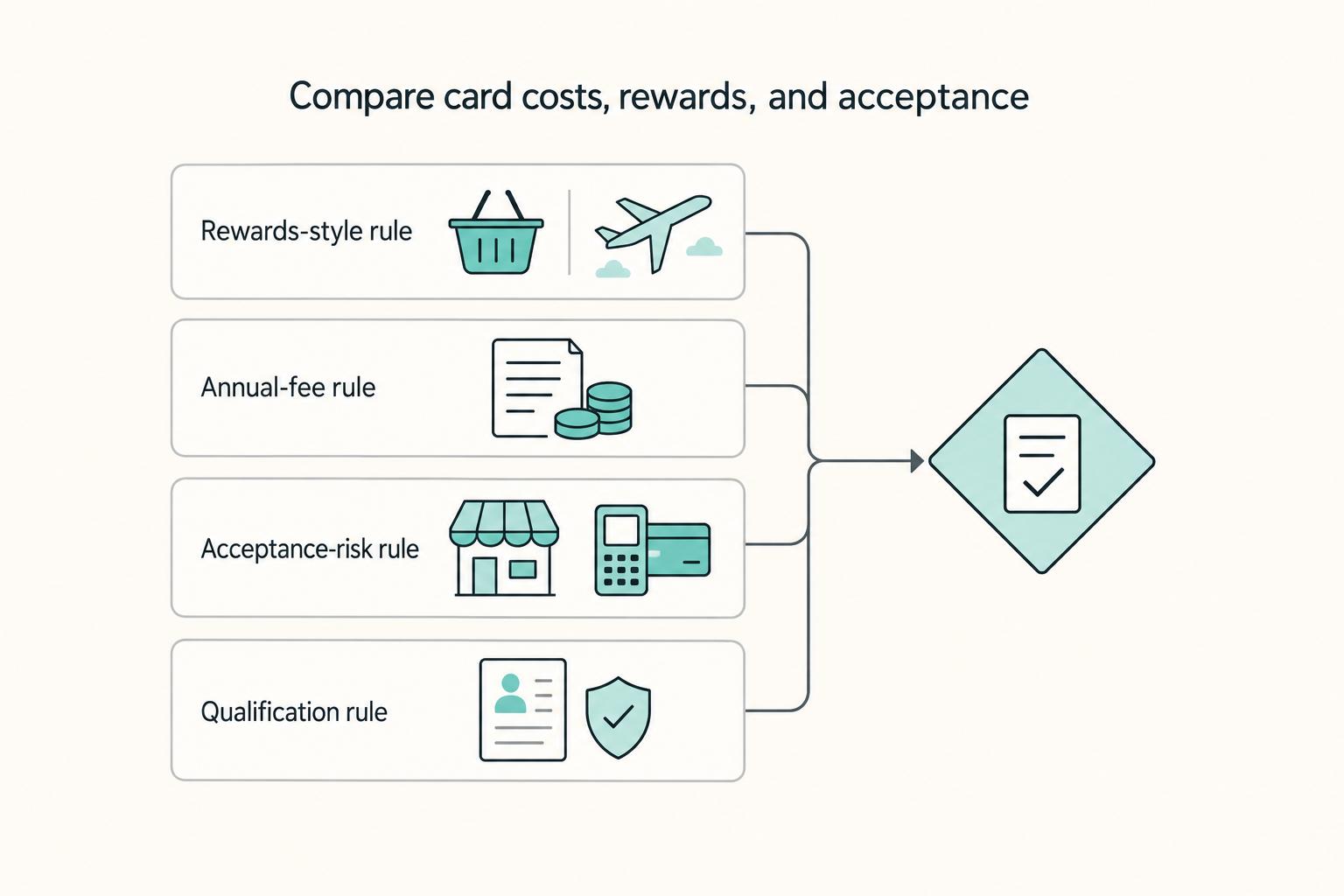
Use the rules below in order, because the earlier ones tend to eliminate more bad fits than the later ones:
- Rewards-style rule: Broad, mixed spending usually favors flat cash back. Consistent travel behavior can justify points.
- Annual-fee rule: If your statements do not clearly offset the fee, start with no-annual-fee options. If you cannot explain the payback in one plain sentence, the fee is probably not earned.
- Acceptance-risk rule: Test critical payments across your actual vendor list and prioritize continuity over small reward differences.
- Qualification rule: Personal credit is still the main approval factor for most business cards, so keep a realistic backup option.
These rules sound simple because they should be. They are meant to force a practical choice, not a theoretical one. A freelancer usually benefits more from a card that works reliably across normal months than from a higher ceiling that only pays off under ideal conditions.
Third-party roundups still have a place, but only as a starting point. Some explicitly note that card details were not reviewed by the issuer, which is a good reminder to confirm terms in the live application flow before deciding. Use rankings to find options, not to outsource judgment.
Then review your choice quarterly. Look at expected rewards, realized rewards, annual fee paid, and any failed or delayed payments. If realized value keeps missing expectations, switch. If value and continuity stay stable, keep the setup. This is also where mixed-month reality shows up. A card that seemed strong when you applied can look very different after several uneven billing cycles.
Once you make the choice, execution matters more than theory. If you want a quick operational next step, try the free invoice generator.
Implementation checklist for a reliable get-paid system#
A solid card choice can still create a mess if the setup around it is loose. A reliable get-paid system needs rules for payment flow, records, cross-border tax tracking, and failure handling before the first deadline hits.
| Area | Action | Details |
|---|---|---|
| Separate collection from spending | Keep payment collection and card spending controls distinct. | Route client payments through dedicated business processes rather than mixed personal activity. |
| Keep a tax-ready evidence pack | Maintain one folder per tax year. | Keep statements, invoices, and payout confirmations so reconciliation and filing support are straightforward. |
| Add cross-border FEIE and FBAR checkpoints | Confirm early whether FEIE tracking and FBAR documentation apply. | For FEIE, remember that eligibility depends on your facts, including tax home and qualification tests, income must still be reported on a U.S. return, and Form 2555 is used to calculate the exclusion. |
| Define payment-failure handling in advance | Write down what happens if a charge is declined, delayed, or not accepted. | Include a backup way to pay and a clear point at which you notify a client or vendor. |
The easiest way to keep this stable is to separate roles. Use the card for spending. Keep your client collection process separate. Keep your tax support files separate too. That separation makes reconciliation cleaner and makes it much easier to troubleshoot when something fails. When records have to be rebuilt later, the cleanup work usually costs more than whatever small rewards edge helped sell the card in the first place.
If you want the same checklist in a sequence you can act on, use this:
- Separate collection from spending: Keep payment collection and card spending controls distinct, and route client payments through dedicated business processes rather than mixed personal activity.
- Keep a tax-ready evidence pack: Maintain one folder per tax year with statements, invoices, and payout confirmations so reconciliation and filing support are straightforward.
- Add cross-border FEIE and FBAR checkpoints: If you work across borders, confirm early whether FEIE tracking and FBAR documentation apply, and keep records throughout the year. For FEIE, remember that eligibility depends on your facts, including tax home and qualification tests, income must still be reported on a U.S. return, and Form 2555 is used to calculate the exclusion.
- Define payment-failure handling in advance: Write down what happens if a charge is declined, delayed, or not accepted. Include a backup way to pay and a clear point at which you notify a client or vendor.
The point of this checklist is not complexity. It is prevention. If a charge fails, a vendor does not accept the card, or tax support files are incomplete, you want the next step to be obvious. That is what keeps a business card from becoming another source of admin drift.
The main red flag is treating nonbinding summaries as if they were final legal or issuer terms. Use summaries to get oriented, then anchor decisions to current issuer and filing requirements. Related: How to Get a Tax ID Number (NIF).
Final recommendation and next step#
Choose the card that survives real use. There is no universal winner, and ranking headlines should carry less weight than your spending pattern, fee tolerance, acceptance needs, and recordkeeping discipline.
As a reference point, NerdWallet's March 2026 roundup says it evaluated close to 70 business credit cards and compares options by features, rewards, and other business-friendly benefits. That is a sensible lens for your own first pass, but it is not a reason to outsource the decision. Use the same lens on your shortlist, then pick the option that fits how your business already spends.
If you want the shortest next step, do this in order: set your fee ceiling, eliminate cards that fail acceptance or tracking needs, confirm current issuer terms, then choose between simple cash back and travel or points using the last six months of spending. Make the pick now, review it after real usage, and adjust from evidence instead of reward headlines.
Frequently Asked Questions
Can freelancers get a business credit card without a traditional W-2?
Many freelancers and gig workers can apply for a business credit card. Approval is generally tied to personal credit rather than annual revenue or years in business, so not having a traditional W-2 does not automatically rule you out. It still does not guarantee approval.
Is a no-annual-fee card better than a premium travel card for most freelancers?
This guide does not establish a blanket winner. Compare your own spending against each card's current fees, rewards structure, and application terms before deciding.
How should I choose between cashback and points if my spend changes month to month?
This section does not provide evidence for a single cashback-vs-points rule. Use your recent spending patterns and current card terms to compare which structure fits better right now.
Which matters more for day-to-day operations, rewards rate or acceptance reliability?
This guide does not establish a universal priority between these factors. Weigh both against your actual payment needs and how you use the card in the business.
What should I check before applying so I avoid a poor-fit card?
Expect the application to ask for personal financial details plus business-related information. Confirm live terms in the issuer application flow on the same day you apply, since final offer conditions are set there.
How do I connect card choice to tax documentation like W-8, W-9, or Form 1099?
This guide does not include detailed W-8, W-9, or Form 1099 documentation guidance. Use card statements for recordkeeping, and confirm filing and documentation requirements with official instructions or a qualified tax advisor.
Watch
Best Business Credit Cards for Freelancers in 2026
Try a related tool
Researched and edited by the Gruv editorial team. Gruv builds cross-border billing, payouts, and finance-operations software for global businesses.
Sources
Includes 5 external sources outside the trusted-domain allowlist.
- bankrate.com/credit-cards/reviews/the-blue-business-plus-...external
- chase.com/personal/credit-cards/education/rewards-bene...external
- nerdwallet.com/business/credit-cards/reviews/amex-blue-busi...external
- thepointsguy.com/credit-cards/why-the-amex-blue-business-plus...external
- thepointsguy.com/credit-cards/ink-business-unlimited-credit-cardexternal
Educational content only. Not legal, tax, or financial advice.
Related Posts

Hiring a Subcontractor for the First Time Without Costly Surprises
**Start with a risk-control sequence, not an ad hoc handoff.** As the Contractor, your goal is simple: deliver cleanly, control scope, and release payment only when the work and file are complete.
How to Get a Tax ID Number (NIF, NIE, TIN) in Europe
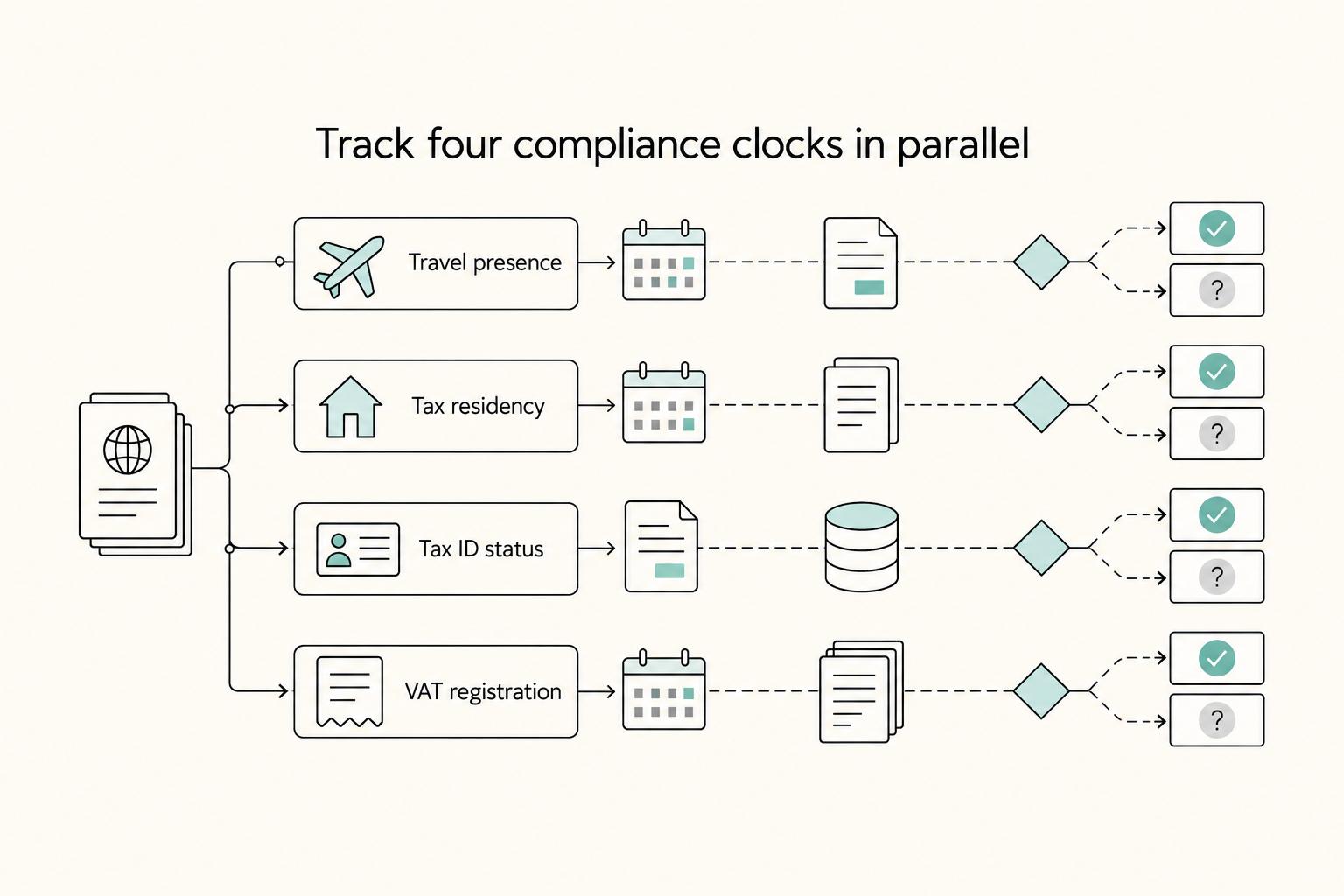
Traditional tax advice is usually backward-looking. Your NIF, NIE, and TIN decisions are forward-looking. You need to know what to apply for, where, and in what sequence before travel, client work, or registrations push you into a harder compliance path.

The Freelance Payment Penalty: A Modeled Audit of Platform Fees, FX Spreads, and Payout Delays
The money rarely disappears through a single, easy-to-spot fee. The real loss is stacked. A marketplace takes its commission, a processor adds a charge for international cards, a bank or payment company converts the currency at a spread, a platform holds the funds before release, and a wire sheds a little to intermediaries on the way in. Each layer looks defensible on its own, but the worker feels the combined result as a smaller deposit and a later payday.