

Quick Answer
Define a bounded assignment, check client permission, screen the provider and agree on scope, price, rights and payment terms before access. Assess worker status from actual facts, request the applicable tax information and run a paid pilot. Pay deposits, authorised hours or milestones when their agreed triggers are met; a missing W-9 can require backup withholding on reportable U.S. payments rather than withholding the entire fee.
Hiring your first subcontractor without legal or payment surprises#
Hiring your first subcontractor works best when you can describe the job, review the result and afford the coordination time. Agree on scope, authority and payment terms before handing over client work, then pay according to those terms.
Vague scope, unclear client permission, missed handoffs and mismatched worker status can turn extra capacity into more management work. Written terms help make decisions visible, but classification depends on the actual relationship. This guide follows the hiring process from deciding what to delegate through a paid pilot, first-month review and payment records.
Who this guide is for#
This guide is for independent professionals moving from solo delivery to a small delivery team. You still own the client relationship and want outside help without losing control of scope, documentation, or payment.
The focus is a small professional-services business, rather than multi-crew construction. The U.S. tax and worker-status examples apply only where those rules govern. Foreign workers, state rules and public-contract flow-downs need their own applicability checks.
What clean delivery requires first#
Before you draft a contract, define the work in a clear Statement of Work (SOW). That first scope checkpoint gives both sides a concrete reference for deadlines, revisions, and acceptance. Then lock in two controls this guide keeps returning to:
- Agree on written scope and terms, client permissions and any insurance or indemnities proportionate to the assignment.
- Record and pay the agreed deposit, time or milestone when its trigger is met.
Before kickoff, confirm the agreed scope, fee, approver, access permissions and terms needed for this assignment. Resolve an issue that prevents authorised work; a missing optional document need not stop unrelated work.
The reusable sequence for growth#
Use the same order each time to reduce legal and payment surprises:
- Define scope and boundaries first.
- Put written terms in place.
- Collect required onboarding and compliance documents before work starts.
- Pay under documented deposit, time or milestone terms.
- Keep records organized from day one.
Use the same folder structure and approval record for repeat assignments, while keeping the packet proportionate to the work.
If you want a deeper dive, read the Department of Labor's independent contractor rule.
Should you hire a subcontractor now#
A repeat delivery bottleneck is a strong reason to hire, but a bounded one-off overflow assignment can also make sense. Check whether you can hand it over clearly and retain enough margin after coordination, review and rework.
Run the checkpoint before you commit#
Use this practical screen before you commit:
| Checkpoint | What to confirm |
|---|---|
| Demand | A repeat bottleneck or a viable bounded overflow assignment |
| Process | You can define the task, review the work, approve payment, and manage the relationship |
| Economics | The work still makes economic sense after coordination overhead is included |
- Confirm the demand. Decide whether this is a one-off overflow task or recurring capacity.
- Prepare the handoff. Define the task, permissions, review method and payment terms.
- Check the economics. Include the provider fee, your coordination time, transaction costs and likely rework.
Suppose a $2,500 client project needs a $1,000 subcontractor fee, four hours of your review time valued at $80 per hour, and $20 in payment costs. That leaves $1,160, or 46.4% of the client price, before other overhead and taxes. Rework or an extra revision reduces that contribution. This budgeting example does not make the supplier payment conditional on your client paying you.
Read the bottleneck correctly#
The right answer depends on the real constraint. If demand is inconsistent, adding delivery capacity can add coordination cost without solving the actual problem. If fulfillment capacity is the issue and your quality bar is already clear, outsourcing can help you deliver more reliably. A common failure mode is bringing someone in while the scope is still blurry. That usually increases coordination load instead of reducing it.
Pick one measurable outcome for the first hire#
Choose one success metric before kickoff, then review accepted work against it. Common choices include:
- Turnaround time for a standard deliverable
- Quality consistency under your Contractor standards
- Revision volume before client approval
Write the expected result into the SOW or scope document so the decision is based on evidence, not impressions. Need the full breakdown? Read How to Manage a Global Team of Freelancers.
Define scope and role boundaries before you post anything#
Give the subcontractor a specific deliverable and define who manages client contact, changes and acceptance. First check whether your client agreement permits subcontracting or requires written consent. Confirm confidentiality, data-access authority and any relevant client flow-downs before sharing materials or credentials.
Think about the assignment in outcomes, not a step-by-step script. A results-focused scope keeps things tight without turning the subcontractor into the person managing your full client relationship.
Use a work order to draw the edge of the job#
Your written scope should make the start and stop points obvious:
Name the deliverable, not the whole engagement.#
Assign a bounded output, not broad ownership like "handle everything."
Describe required results in observable terms.#
Include output, quantity, due date, format, and how quality will be checked.
State exclusions.#
Note what is out of scope unless added in writing, such as strategy, client calls, or extra revision work.
If someone could read the document and still assume they own client messaging or approval decisions, the boundary is too loose.
Split responsibilities before work begins#
Separate lanes keep accountability clear from the start.
| Area | Contractor keeps | Subcontractor handles |
|---|---|---|
| Client communication | Client updates, scope changes, final commitments | Status updates to you unless you approve direct client contact |
| Revisions | Approves revision rounds and scope changes | Completes agreed revisions within scope |
| Sign-off authority | Final acceptance and client delivery | Submits completed work for review |
Define acceptance and rework in plain language#
Delivered and accepted are different milestones. Define objective checks, a review window and how you will communicate a specific defect. Acceptance should not become an open-ended right to postpone payment; deposits, hourly fees and other agreed triggers may fall due before final acceptance.
Include:
- what you check, such as format, required components, deadline, and quality bar
- how you check, such as with a checklist, QA pass, or brief-to-output comparison
- what happens if it fails, including the correction path and when the work is treated as incomplete
- the review deadline, notice of specific defects, correction process and payment treatment for disputed and undisputed amounts
Scope-related disputes are a common source of conflict, so vague acceptance language is expensive.
Add a simple escalation path now#
Decide what happens before the first issue shows up. Cover missed deadlines, quality misses, and handoff failures in the scope document or attached agreement.
Keep it simple:
- what triggers escalation
- who is notified and when
- what corrective step comes next
- when work pauses for written scope clarification
If mediation or arbitration fits the engagement, agree on the process, forum and costs rather than copying a clause without checking its effects. Keep signed versions, scope changes, complaints and acceptance notes together.
Related reading: How to Manage an Offshore Development Team Across Time Zones.
Set your business structure before you delegate risk#
Identify the person or existing business that is hiring the subcontractor and authorised to carry out the client engagement. An LLC is not a prerequisite for subcontracting. Formation may be worth evaluating as your exposure grows, but it does not itself settle worker status, transfer existing contracts or remove every responsibility.
This is an operating control, not a branding choice. Outsourcing can expand capacity, but it also expands risk, and handing off work does not automatically hand off every responsibility.
Pick one contracting party and use it everywhere#
Record both parties clearly: your business is the payer, while the subcontractor is the supplier and payee. Keep each party consistent across the relevant agreement, scope, invoices and records. A change of entity may require consent or an amended contract; do not silently substitute a newly formed LLC.
Use a simple decision rule#
A sole proprietor can hire a subcontractor. Use a bounded scope, agreed terms, timelines and quality standards, and understand the personal exposure associated with that structure.
As you coordinate multiple providers or recurring work, compare the formation, administration, tax and liability implications of an LLC or another available structure. Make that decision around your circumstances rather than pausing every repeat assignment automatically.
If you want a deeper decision check, see When Should a Freelancer Upgrade from Sole Proprietor to an LLC?.
Verify the paper before kickoff#
Before work begins, run one consistency check:
- Your contracting party is consistently identified and authorised to subcontract the client work.
- The supplier and signer are correctly identified in their agreement and invoice.
- Taxpayer and payee information is reconciled with the supplier record; payer and supplier need not have the same name.
That keeps ownership clear and helps prevent avoidable delays and conflict once delivery is underway.
You might also find this useful: How to Delegate Work to a Virtual Assistant.
Prepare the minimum compliance packet before kickoff#
Before kickoff, collect what establishes the work, authority, access and relationship. Begin tax onboarding early enough to handle the first payment correctly. The documents differ for U.S. persons and foreign recipients, and collecting a contractor form does not establish independent-contractor status.
Build the packet in one place#
Keep the agreement, scope, classification assessment and client permissions together. For a U.S. person, request Form W-9 for the tax name and TIN you may need for information reporting. For a foreign person, use the appropriate documentation, such as W-8BEN for an individual or W-8BEN-E for an entity, when applicable; some U.S.-performed personal-service treaty claims use Form 8233.
| Item | Collect by | What to verify |
|---|---|---|
| Agreement and scope | Before agreed work starts | Parties, authority, output, price, review window, payment terms and needed permissions |
| Classification record | Before engagement and when practices change | Applicable tests and actual facts, not just a status clause |
| U.S. Form W-9 | Request early, preferably before first payment | Taxpayer name, TIN and any disregarded-entity relationship; handle required backup withholding if incomplete |
| Foreign-payee documentation | Before payment where required | Applicable W-8 or other form, recipient status and where services occur |
Request tax information early, but do not use a missing W-9 as an automatic reason to withhold the entire amount due. The IRS requester instructions require 24% backup withholding on reportable payments in specified circumstances, including a missing TIN. For example, if a $1,000 gross fee is subject to that withholding, pay $760 net and remit the $240 withheld under the applicable rules. Record the gross amount, withholding and net payment; withholding is not a discount on the fee.
Document classification before work starts#
Do not treat the status clause as the whole classification analysis. The IRS points to three evidence categories: behavioral control, financial control, and relationship of the parties. DOL guidance frames the question around economic dependence versus being in business for oneself.
Your classification note should clearly answer:
- Behavioral control: Who controls methods, schedule, tools, and instructions?
- Financial control: Who bears business risk, provides tools, and has profit-or-loss exposure?
- Relationship of the parties: What do the agreement and the real working arrangement show about permanence, exclusivity, and responsibility?
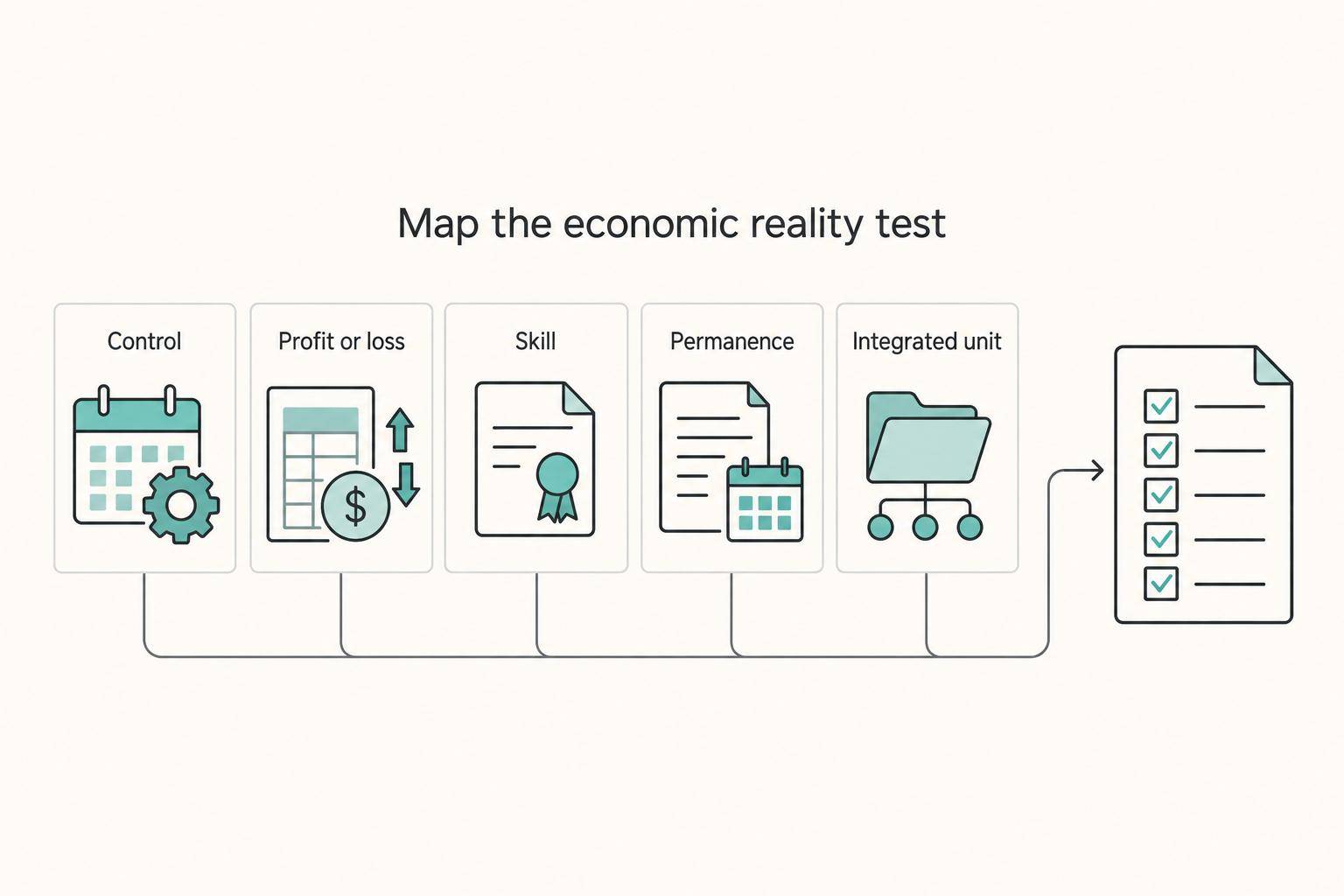
Keep the U.S. tests distinct. The IRS categories concern federal employment taxes. The current FLSA regulation, effective March 11, 2024, uses a totality-of-circumstances economic-reality analysis: profit or loss through managerial skill, investments, permanence, control, whether work is integral to the business, and skill and initiative. Separately, WHD enforcement guidance issued May 1, 2025 directs agency investigators to a different analysis in the covered enforcement matters. DOL announced a proposal on February 26, 2026; a proposal does not amend the regulation. State or other applicable tests can also differ.
If the planned arrangement does not support contractor status under the applicable tests, change the arrangement or engage the worker through a compliant employment setup. Form SS-8 can request an IRS determination for federal employment-tax purposes; it does not decide every labour-law question. Do not hold earned, due pay while waiting for a status decision.
Separate start approval from pay approval#
Use two gates so legal setup and payment approval do not get tangled together.
| Stage | Requirement |
|---|---|
| Before work/access | Agree terms, assess actual status and obtain required permissions |
| Before payment | Identify the contractual payment trigger and amount due |
| Before payment | Reconcile supplier, payee and payment instructions |
| Before payment | Review applicable tax documentation and withholding; do not assume no W-9 means no payment |
| After payment | Link gross, withheld and net amounts to invoice/time/milestone and payment evidence |
Resolve tax and payee questions early so you can pay on time. If a missing TIN calls for withholding, handle withholding and reporting rather than treating the entire invoice as indefinitely blocked.
Keep a verification log you can defend#
A short verification log is enough if it captures what mattered. Track the document, reviewer, review date, issue found, and cleared date, plus any mismatch notes if needed.
That makes the file defensible. You can show what was signed, what was reviewed, and who cleared each item. Watch for a contract-heavy, fact-light file. If the paperwork says "independent contractor" but the real arrangement shows tight control, fixed hours, exclusivity, and low business independence, reassess status before expanding the work.
Screen delivery fit before collecting a full onboarding packet from a selected candidate. Capability and compliance checks answer different questions, and both matter before you grant the access the assignment needs.
Separate capability checks from compliance checks#
Use work samples, references and a focused interview to assess whether a candidate can deliver the assignment. Then confirm the business, payment and permission details of the selected provider. A strong portfolio does not establish worker status or permission to access client data.
Use one short checklist for delivery fit and apply it consistently across candidates. Keep your notes tied to the real work, not portfolio polish.
Verify identity and claimed experience before access#
Ask the candidate to explain their role in a relevant sample and the decisions they made. With permission, check a reference against the claimed responsibility and dates. Similar business names or a polished portfolio are not evidence that this person did the work.
Before granting client access or production credentials, confirm that interview identity, work history claims, and business and payment details are internally consistent. If details conflict or remain unclear, pause and resolve that first.
Keep backup options so one miss does not stall delivery#
For a critical task, keep a viable backup where your budget and market allow it. Track skills, availability and screening status. Before a backup takes over, still obtain the agreement, client approval and access permissions required for that provider; a vendor-list entry is not authorisation.
Use a paid micro-test only as a controlled checkpoint#
A paid micro-test should have a small deliverable, fee or hourly cap, due date, review criteria and payment deadline agreed in advance. Use dummy or authorised materials and limit access. Pay under the agreed terms even if the result shows the candidate is not a good fit for further work.
For example, agree on two draft ad concepts using dummy brand materials, PNG previews and editable source files, at $80 per hour capped at two hours. The maximum authorised fee is $160. Review whether the concepts follow the brief and files are complete; pay authorised time by the agreed deadline and decide separately whether to commission the client project.
Treat the result as decision evidence, not a formality. If execution or consistency is weak at this stage, do not expand scope yet.
Related: The Agency Scaling Blueprint: From Solo Freelancer to Hiring Your First 5 Global Contractors.
Use the freelance contract generator to prepare a draft, then adapt the parties, scope, rights and payment terms to the actual assignment.
Choose pricing and payment controls that protect margin#
Margin usually disappears through a bad price model or weak payment gates. Use fixed-fee when scope and acceptance are clear. Use capped hourly when scope is still moving.
Match price model to scope reality#
The price model has to match the actual work, not the version you hope it will become.
| Situation | Pricing approach | Control |
|---|---|---|
| Defined output | Fixed fee or milestones | Specify deposit, review and payment triggers |
| Uncertain effort | Capped hourly | Approve tasks and cap; review time on an agreed cadence |
| Unclear final output | Bounded paid discovery or scoping phase | Define the phase output before committing to full delivery |
For a defined output, fixed-fee milestones can make pricing and review straightforward. State any deposit, milestone or final-acceptance trigger explicitly, with a review window and correction process. Discovery can also be a separately priced fixed-fee phase if its output is clear. Open-ended revisions or unresolved dependencies need a cap, phase boundary or approved change rather than an unlimited promise.
Hourly pricing can suit uncertain effort. Agree on authorised tasks, rate, cap and review cadence; weekly review is one workable choice. Obtain approval before exceeding the cap. Pay authorised hours according to the contract, even when the work does not yet produce a finished deliverable.
A practical decision rule:
- Use fixed fee for a bounded output with clear price, review and payment terms.
- Use capped hourly for uncertain effort and agree when authorised time is payable.
- If the full scope is unclear, price a bounded discovery phase before the larger assignment.
Match payment evidence to the agreed trigger#
Agree on payment triggers before work starts. Match proof to the trigger: a deposit may need a signed order, hourly billing needs authorised time, and an acceptance milestone needs the specified deliverable and review record. Treat genuine disputes under the contract and applicable law, including paying undisputed amounts when due.
For a U.S. payee, request W-9 information early and reconcile it with the supplier record. A disregarded LLC may put its owner on line 1 and the LLC on line 2, so different tax and contract names can be correct. Foreign payees need the appropriate status and sourcing review; a U.S. client or bank account alone does not make all service income U.S.-source.
Keep the document hierarchy aligned. Public contract templates often use an order of precedence so conflicts are resolved by ranked documents. You can apply the same idea by keeping your agreement, scope document, and payment terms consistent.
Before payout, identify what was ordered, which payment trigger has occurred, how much is due, who receives it and whether withholding applies. An acceptance note answers a milestone question, not every payment question.
Add repeat-hire controls before volume grows#
Most control gaps show up on repeat payments, not the first one. Add three lightweight controls now:
- Set a pre-work approval checkpoint for pricing model, cap or milestone amount, and current scope document version.
- Track payouts by vendor, not only by project. Your Vendor list should show pricing model, latest documents received, total paid to date, and any approved exception.
- Route exceptions, such as early payment, a scope add-on, or over-cap hours, through the same vendor record so decisions stay visible and consistent.
For public or other regulated client work, map the actual flow-down requirements to your vendor packet: required registrations, subcontractor disclosures, certifications, approvals and deadlines. Record which requirement applies and why. These are project-specific obligations, not a universal private-business rule that all paperwork must be complete before any payment.
Choose traceable payout methods#
Payment timing is not universal, so set it in your agreement and scope document. For the payment method, choose traceable electronic rails where possible.
Compare the supported method by destination, fees, currency conversion, cutoff, expected arrival and reconciliation data. ACH is not always faster than every alternative. Checks can be lost or take time to clear; a cash payment needs a receipt and the same tax records as other methods. Save the payment reference so an uncertain status can be checked before retrying.
If Gruv Payouts fits your setup, use it where supported to keep payout operations traceable and easier to review later.
Negotiate contract terms that prevent predictable disputes#
Once pricing and payment controls are set, the next job is to cut down the disputes you can already see coming. Most of them trace back to the same places: scope, status, communication, IP, and exit rights in your Independent contractor agreement.
Use the agreement to settle the work boundary#
Unclear scope is a common dispute trigger, so settle the boundary in writing. Keep the master agreement focused on relationship rules, then attach or reference a scope document that states deliverables, acceptance, delivery format, and revision handling. If no document clearly defines what "done" means, the disagreement usually moves straight to rework and payment.
Use this quick boundary checklist:
- Name the exact deliverable, not just a service category.
- State the handoff format, such as source files, exports, or final approved copy.
- Define who can request changes and when revisions become new scope.
- Set confidentiality duties tied to real risks, including return or deletion of sensitive materials at offboarding.
- Include termination rights and what gets paid if work stops midstream.
If you include termination for convenience, pair it with cleanup terms for in-progress work, approved milestones, and credential access on the termination date.
Keep status language explicit, but do not rely on labels alone#
Include an Independent contractor status clause, but do not treat the label as proof by itself. Written contracts are only one relationship factor. Classification still depends on the full facts, including behavioral control, financial control, and relationship factors, and DOL guidance applies a multifactor economic reality analysis.
Write the clause to match how the work is actually performed, then operate that way in practice. If the relationship becomes long-term, exclusive, and open-ended, treat that as a misclassification red flag and reassess before expanding the engagement. For a deeper breakdown, see Independent Contractor Status: The Most Important Clause for Avoiding Misclassification.
Set communication rules that protect client delivery#
Communication terms need to work like operating rules, not general intentions. Put three items in writing: the approved channel, expected response window, and escalation path for blockers. Avoid broad phrases like "timely communication." Use standards that match your client commitments, and confirm them early in the first assignment.
Match IP terms to the actual output#
Payment does not automatically transfer copyright. Under the U.S. work-made-for-hire rules, employee work within the scope of employment differs from commissioned work: a commissioned work must fall into one of the nine statutory categories and have the required signed written agreement. Calling every freelance deliverable work for hire does not achieve that result.
If the client needs ownership, agree on an effective assignment of the rights you need; a U.S. copyright transfer generally requires a signed writing. Alternatively, define the licence for reuse, edits, sublicensing and client delivery. Carve out preexisting tools, templates and third-party materials, and check that their licences allow the rights you promise the client.
Onboard the first 30 days with checkpoints#
The first 30 days are for verification, not optimism. You are trying to confirm two things early: the work meets your standard, and the documentation holds up in practice before you expand scope.
Start with access, documents, and one tightly defined assignment#
For Day 1 to 3, keep the first assignment narrow and testable. Confirm in writing what "done" means, delivery format, who approves, and where handoff happens.
Confirm the agreed terms and any permissions or certifications needed before this assignment starts. For public-contract work, follow the actual timing requirements before award or access where required. Optional administration can continue alongside authorised work; it does not erase an existing payment obligation.
Check the work product, not just responsiveness#
In Week 1 to 2, review early deliverables against the scope document and track correction patterns. Fast replies do not matter much if handoffs are incomplete, revision notes are missed, or acceptance criteria are not met.
Use a short review after each early delivery:
- Did the deliverable match the exact assignment, including format and completeness?
- Were revisions minor clarifications, or did you need to restate core instructions?
- Did the handoff create extra cleanup, missing-file follow-up, or status confusion?
- Is the same issue repeating after feedback?
Repeated misses after clear feedback usually point to a scope, fit, or capacity problem.
Add compliance screening where the project requires it#
Where public-contract eligibility requirements apply, screen at the required time before award or work, rather than waiting two weeks. For example, FAR 52.209-6 sets disclosure and notification requirements for covered subcontracts, subject to its thresholds and exceptions. Use the actual prime contract and applicable agency requirements, and save dated exclusion-check evidence where needed.
If a required certification cannot be made, obtain the explanation and route it through the prescribed approval process before the affected award or access. A three-year lookback is relevant only where the actual certification asks for it. Do not invent an exception or assume every public-sector engagement uses the same form.
Use weeks 3 and 4 to decide scope, not to hope#
By Week 3 to 4, make a decision based on evidence from delivery quality, revision pattern, handoff reliability, and document status.
- Continue and expand scope when work is acceptable, feedback is absorbed, and the handoff reduces your load.
- Limit scope when the output is usable but still needs close supervision.
- If replacement is needed, follow termination, notice and payment terms, recover authorised materials and revoke access; onboard the replacement before transfer.
If the first month already needs constant rescue, expanding scope usually increases risk instead of fixing it.
For a step-by-step walkthrough, see The Legal Difference Between a 'Joint Venture' and a 'Subcontractor' Relationship.
Sanity checks before first payment#
Check the payment basis, payee, tax treatment and accounting record. Fix discrepancies promptly while observing the payment deadline and applicable withholding rules.
Confirm the file is complete enough to pay.#
Keep the agreement and appropriate tax documentation in the supplier file. Check the W-9 taxpayer name and TIN information for obvious omissions and inconsistencies without forcing a disregarded LLC owner name to equal the contracting entity. Verify payment instructions through a known channel, especially after a bank-detail change. Missing tax information may require withholding rather than withholding the whole payment.
Match the payment to its agreed trigger.#
Match the amount to the agreed trigger: deposit, authorised time, milestone or final acceptance. Record specific corrections and the disputed amount. Follow the contract and applicable payment rules rather than withholding all pay until every revision is complete.
Review classification notes before paying as a contractor.#
Check that classification notes reflect the actual working arrangement and the applicable tests described above. Reassess changes in control or economic dependence; do not try to cure employee status with a contractor label or defer due wages while repairing paperwork.
Make the bookkeeping record tie out cleanly.#
Reconcile payer, supplier, gross amount, withholding, net payment and approval evidence. Keep the agreement, tax information, scope, invoice or time record, review notes and payment reference linked so reporting can be checked later.
Keep tax and audit records clean from day one#
Keep a chain from the order or authorised time through the amount due, tax treatment and payment. A deposit can precede delivery; the records should show why that amount was payable.
Track each payment for Form 1099-NEC review#
For a U.S. independent contractor, request Form W-9 and record the taxpayer name and TIN for applicable reporting. For a foreign provider, document status and where services were performed. Personal-service income is generally sourced where the work occurs, regardless of where the payer or bank is located; mixed-location work needs allocation.
For qualifying business service payments, the IRS FAQ gives a $600 reporting threshold for 2025 and $2,000 for payments made after December 31, 2025. Report any backup withholding even below the threshold. Check exceptions: most corporate recipients are exempt, with specified exceptions such as certain legal-service payments; payment-card and qualifying third-party network transactions fall under 1099-K reporting rather than duplicate 1099-NEC reporting. An ordinary electronic bank transfer is not automatically a third-party network transaction.
Keep one searchable file per Vendor list entry#
Store each vendor file so the full evidence pack is easy to pull up in one place. For each Vendor list entry, keep:
- signed Independent contractor agreement
- applicable tax documentation, stored securely
- scope document
- invoice
- acceptance or approval note
- payment confirmation
- credits, corrections, or revised invoices
The IRS says to keep the completed W-9 for four years. Apply the appropriate retention period to other tax, contract and work records, and restrict access to taxpayer and bank details.
Reconcile monthly so gaps are caught early#
A monthly reconciliation is usually enough to catch problems before year-end. Check your vendor list against accounting records and confirm:
- appropriate tax documentation or a recorded withholding treatment
- reportable payments and recipient/transaction exceptions flagged
- each payment linked to its deposit, time or milestone trigger and payment reference
- corrections, refunds or reversals clearly linked
An hourly fee is not by itself an employee wage. If the actual relationship is employment under the applicable rules, use the required employment and payroll treatment. Employee wages generally belong on Form W-2 rather than Form 1099-NEC.
Maintain a simple audit trail#
Keep a short log that shows inputs, approvals, payouts, and corrections, with links back to source documents. When a payment changes, note what changed and why so each final number stays traceable.
Make your first subcontractor hire repeatable#
Build a sequence you can reuse: define the assignment, screen a candidate, complete the relevant terms and permissions, run a paid pilot, then review whether to expand. Payment records and tax treatment should follow the actual engagement throughout.
1. Scope first. Start with a written scope document before candidate outreach. Define the scope and deliverables in writing, including what completion and approval look like.
If you cannot describe "approved" in plain language, pause and tighten the scope first. Vague scope usually pushes management work back onto you and cancels out the capacity you were trying to add.
2. Complete onboarding for the selected provider. After capability screening, agree on terms, assess worker status and obtain required client, confidentiality and access permissions. Request the applicable U.S. or foreign-payee tax information early, with a plan for withholding or reporting where needed.
Treat completeness as the key control. Document decisions as you go, not later: who approved scope, when documents were signed, what changed, and who accepted delivery.
3. Screen with evidence, not urgency. When you are overloaded, availability can look like fit. Screen for fit against your written scope: work samples, communication quality, revision behavior, and follow-through.
For a first engagement, use a small paid pilot tied to a real assignment. Keep it low risk and easy to review so you can evaluate both output and reliability inside your process.
4. Pay under the agreed terms. Keep proof of the relevant deposit, authorised time or acceptance milestone. Resolve specific disputes promptly and record gross fees, any withholding and net payment.
Use this checklist for your first run:
- Written scope, price, payment and review terms are agreed.
- Required contract and client/access permissions are recorded.
- Applicable tax information is requested and withholding treatment checked.
- The paid pilot is delivered, reviewed and paid under its terms.
- Expansion or replacement is based on the result, with existing obligations resolved.
Complete the setup checks, run the paid pilot and review its result before expanding. A failed pilot can still be payable; the next hiring decision is separate from the fee already earned.
This pairs well with our guide on How to Hire Your First Salesperson.
When your checklist is stable and you need repeatable disbursement controls, review Gruv Payouts.
Frequently Asked Questions
What is the difference between a contractor and a subcontractor?
A contractor is the business your client hires, while a subcontractor is a person or business you hire to furnish supplies or services under that client work. In plain terms, the client relationship sits with you, and the subcontractor supports delivery. The label alone does not settle worker status, so you still need to determine whether the worker is an employee or an independent contractor.
When should I hire my first subcontractor instead of doing the work myself?
There is no universal timing rule, so treat this as a business decision, not a milestone decision. A practical signal is recurring demand with a clear scope and enough margin after subcontractor pay and rework risk. If demand is inconsistent, adding delivery cost too early can create more pressure than relief.
Which documents do I need before a subcontractor starts work?
Agree on the scope, fee, review and payment terms, and record the actual worker-status assessment. Obtain client permission and access or confidentiality commitments where required. Request W-9 information from a U.S. person, or the applicable foreign-payee documentation, early enough to handle payment correctly; tax paperwork does not itself prove contractor status.
How should I set payment terms to avoid disputes and margin leaks?
State the rate or fixed price, any deposit, authorised-hour cap, milestone triggers, review window and payment deadline. Use objective acceptance criteria for acceptance-based milestones, and pay authorised hourly work or agreed deposits under their own triggers. Define change approval and dispute handling before the assignment starts.
Do I need a Form W-9 before paying a subcontractor?
Request Form W-9 early from a U.S. person when you need their taxpayer information for reporting. Foreign persons use appropriate foreign-status documentation instead. If a U.S. payee does not provide a TIN, specified reportable payments require 24% backup withholding; that is not an automatic right to hold the entire fee. The W-9 goes to you, the requester, rather than routinely to the IRS.
What is Form 1099-NEC and when does it apply to subcontractor payments?
Form 1099-NEC reports qualifying nonemployee compensation. The IRS FAQ states a $600 threshold for 2025 and $2,000 for payments after December 31, 2025; backup withholding is reportable at any amount. Check recipient and transaction exceptions, including payment-card and qualifying third-party network transactions handled under Form 1099-K, so you do not duplicate reporting.
Try a related tool
Researched and edited by the Gruv editorial team. Gruv builds cross-border billing, payouts, and finance-operations software for global businesses.
Sources
- acquisition.gov/far/52.209-6trusted
- copyright.gov/circs/circ30.pdftrusted
- copyright.gov/circs/circ12.pdftrusted
- dol.gov/sites/dolgov/files/WHD/fab/fab2025-1.pdftrusted
- dol.gov/agencies/whd/flsa/misclassification/rulemakingtrusted
- ecfr.gov/current/title-29/subtitle-B/chapter-V/subcha...trusted
- irs.gov/businesses/small-businesses-self-employed/in...trusted
- irs.gov/instructions/iw9trusted
Educational content only. Not legal, tax, or financial advice.
Related Posts

Independent Contractor Status for Cross-Border Freelancer Contracts
An independent-contractor clause describes the intended arrangement; it does not decide legal status. Control over working methods matters, but the applicable test can also consider financial independence, permanence, the business relationship and the work’s place in the client’s business. Identify the worker’s location and the relevant tax and labor laws before drafting.

When Should a Freelancer Upgrade from Sole Proprietor to an LLC?
Forming an LLC is usually an operations decision before it is a tax decision. If you are weighing a move from sole proprietor status to an LLC, start with exposure, contract risk, and how money moves through the business. Treat federal tax treatment as a separate choice, and verify it through IRS guidance instead of assumptions.
DOL Independent Contractor Rule in 2026: Proposal and Current Standards
**Status checked 5 October 2026:** DOL’s official page still identifies the February 2026 action as a proposal, and says its comment period **closed on 28 April 2026**. The NPRM, published 27 February under RIN 1235-AA46, proposes replacing the 2024 FLSA interpretation with a modified 2021-style analysis and using the analysis for FMLA and MSPA. A proposal is not a final rule with an effective date.