
Quick Answer
Separate card-present from card-not-present traffic and measure issuer approvals per submitted attempt and completed payments per order. Stripe says online authorization can be 10% lower than in-person in some cases; that is context, not a target uplift. Classify issuer declines before retrying, stop on hard declines, and keep route, retry and final outcome linked to one order. Expand only when fraud and reconciliation guardrails hold.
Treat ML authorization gains as controlled tradeoffs#
Treat AI payment acceptance and ML-based authorization-rate work as a controlled tradeoff, not a guaranteed uplift. This guide is about improving authorization outcomes while keeping fraud control and operational clarity intact.
The business case is simple. Declines can block fraud, but they also reject legitimate payments. When that happens, the impact can go beyond one failed charge: high-value customers may transact less often in the future or move to a competitor.
Online performance is often tougher than in person. Authorization rates for online transactions can be materially lower. One cited benchmark notes they can be 10% lower in some cases, and issuers may apply stricter approval logic online because fraud risk is higher.
That is the core tension for the rest of this article. Every approval-lift move changes risk and operations. Smart routing and related ML decisioning can help, but network declines cannot be eliminated, and decline codes point to different causes that need different responses. If you cannot break outcomes down by decline reason and routing path, it is hard to tell whether a model is improving acceptance or just moving failure around.
Use two rules from the start. First, require explainable checkpoints: what changed, which decline categories moved, and what outcome actually improved. Second, plan for model decay. Data drift can reduce ML performance over time, and less interpretable models are harder to defend when teams ask why a transaction was routed a certain way.
The goal is better issuer approvals and completed payments that you can explain, measure and roll back if fraud or operational outcomes worsen.
Start with one metric language across teams#
Align metric language and ownership before you tune approval performance. If teams do not share definitions, segments, and owners, pause optimization changes until that alignment is in place.
Payment data is often inconsistent across PSPs, acquirers, and payment methods, with different naming conventions, error taxonomies, and levels of completeness. Build a unified data layer, or at minimum a normalized analytics view, so provider performance is measured in one place. Without that baseline, an apparent uplift can reflect a reporting mismatch.
Use the same core labels across teams, then define them in plain language for your own flow: authentication rate, authorization rate, and conversion rate. For each metric, document your numerator, denominator, exclusions, and event source.
Use that unified view as a reliability check. Teams should be able to compare the same payment flow across providers and segments without manual stitching.
A common failure mode is false consensus: one team reports improvement while another cannot verify it or even locate what changed. Treat that as a measurement gap, not a win.
Map the AI acceptance stack before changing production traffic#
Before you change live routing or retry behavior, map the acceptance flow end to end and make every decision traceable. The real control point is not the model itself. It is a clear execution path: where decisions happen, what data feeds them, and how you prove what happened on a single attempt.
Draw the path from request to final action#
Keep the first version to one page and label each decision point clearly:
| Step | What happens |
|---|---|
| 1 | One card payment attempt receives an order and attempt ID |
| 2 | Channel, merchant, amount, credential and permitted risk signals are validated |
| 3 | Eligible acquiring routes and applicable network restrictions are identified |
| 4 | Routing policy or model chooses an eligible path and records its version and reason |
| 5 | Required CNP authentication, such as 3DS, is completed before the first authorization; a soft-decline challenge may precede a permitted retry |
| 6 | Processor and issuer response, including decline code, is attached to the attempt with the authentication and fraud outcome |
| 7 | Retry logic acts only on eligible declines within network and processor limits |
| 8 | Final order outcome and reconciliation references are recorded |
Record those decisions before production changes so a single attempt can be replayed without relying on an opaque model score.
Make routing and retry decisions auditable#
In Gruv, route choices and reattempts should be traceable through API events and webhooks from end to end. Capture enough context to reconstruct the path for one request, including identifiers, timestamps, route decisions, retry linkage, and final action.
Use a simple verification check: hand one request ID to someone outside the implementation team and ask them to trace the complete execution path from request to final action. If they cannot show that call stack, observability is still incomplete. Process events, network flows, or opaque scores alone are not sufficient investigation evidence.
Set stop conditions before any live retry#
Define retry boundaries in writing before launch: which branches are retry-eligible, who owns the rule, max reattempts, and explicit stop conditions. Treat data ingestion and preparation as production input quality control, with validation and transformation before decisioning.
Keep the routing decision tied to the card attempt. A separate payout or bank-transfer flow is outside this issuer authorization path and should have its own controls.
If you want a deeper dive, read Gateway Routing for Platforms: How to Use Multiple Payment Gateways to Maximize Approval Rates.
Route and retry by decline reason not by habit#
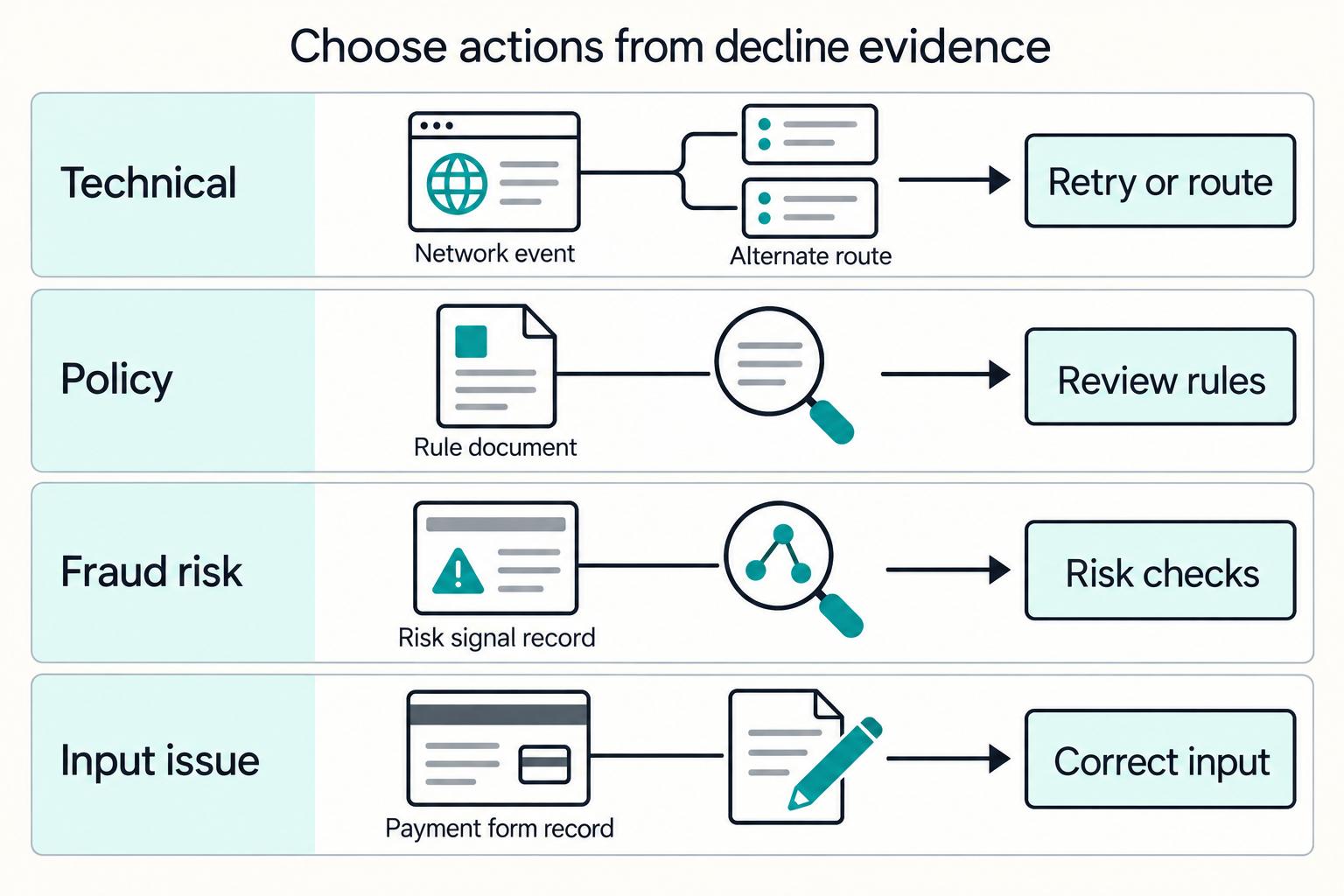
Handle declines by reason first, not by repetition. Classify the failure, then decide whether to retry, reroute, strengthen authentication, or stop. Teams lose approvals when they treat every decline the same.
The useful split is between technical declines, which are often fixable, and policy declines, which are often caused by your own fraud controls. Not every failed payment is fraud, and overly strict controls can create false declines that block legitimate customers.
| Decline class | What it usually suggests | First action to consider | No-go path |
|---|---|---|---|
| Technical decline | Operational issue rather than clear fraud | Consider a controlled retry or reroute when evidence points to a technical cause | Repeating blind retries with no change |
| Policy decline | Internal fraud controls may be blocking legitimate activity | Review risk rules and apply risk-based authentication where your policy allows | Treating it like a network issue and retrying unchanged |
| Elevated fraud risk | Risk signals remain high | Prioritize additional risk checks over automatic retries | Routing to another path just to force approval |
| Customer/input issue | The payment attempt needs corrected input or customer action | Surface the required action; retry after the input changes | Retrying the same request and expecting a different result |
Make retries conditional on real change#
Retries should respond to the decline category and current network rules. Visa distinguishes retryable soft declines from hard declines, such as a lost or stolen card, that should not be reattempted. A new route, corrected input, updated credential or authentication result may improve a permitted retry; repeating the same request blindly can add cost and network penalties.
Optimization is not approval lift in isolation. The Worldpay example is a useful warning. A 2% authorization lift can be offset if 1% of those approvals become chargebacks, or if 0.5% could have been routed at lower cost. Treat those figures as illustrative scenario math, not a benchmark.
Use operating checkpoints, not intuition#
Run regular decline analysis to identify recoverable good failures and separate them from true risk. Then track three metrics together: approval rate, chargeback performance, and fraud-to-sales. Approval rate alone can make a weak retry policy look better than it is.
The operating mindset is simple: recover the right declines, justify why a retry was warranted, and stop paths that create hidden fraud, chargeback, or cost exposure.
Keep channel logic explicit. This section's evidence does not define shared retry rules across CP and CNP. If you run both, keep decision logic explicit by channel and validate outcomes by channel instead of copying one rule set by default.
Need the full breakdown? Read How to Implement Intelligent Payment Retries: Timing Signals and ML-Based Approaches.
Choose architecture and vendor boundaries early#
Choose the architecture that fits your traffic shape first, then evaluate vendors inside that design. If your volume is concentrated in one region with one processor, start with a single-gateway setup and tune your core checkout and risk controls before adding routing complexity. If you run multi-market CNP traffic with multiple acquiring options, prioritize routing control earlier because fee treatment can vary by market.
Start with the architecture that matches your traffic#
| Traffic pattern | First move | Why |
|---|---|---|
| One main region, one main processor | Optimize inside one gateway first | Fewer handoffs and clearer incident triage |
| Multi-market CNP with several acquiring paths | Add orchestration and routing control earlier | Market grouping and fee rules can affect economics |
Use this as a decision rule, not a universal ranking.
Treat vendor claims as test inputs, not proof#
Treat any provider's claimed approval lift as a hypothesis. Compare a defined pilot cohort with a comparable baseline, and log the route mix, issuer response mix, fraud trend, completed orders and total retry attempts.
A routing policy can appear better simply because it received easier traffic. Segment by market, card-present or card-not-present channel, issuer and decline class before attributing a change to ML.
Before launch, capture the contracted acquirer routes, processor retry policy, network rules and fee terms used by the pilot. Record the effective dates in the decision log so later comparisons use the same commercial assumptions.
Make market mapping part of design, not cleanup#
Document which markets, issuers, currencies and acquiring routes each policy can use. Route eligibility, cross-border treatment and fees can change the economics, so compare like-for-like transactions when reviewing the pilot.
Do not assume temporary fee waivers remove all payment costs. Issuer, bank, or FX fees may still apply. Without explicit market mapping, routing choices can create late finance surprises.
Set ownership boundaries before launch (organization-specific). The exact ownership model is not universal, but define clear owners across Product, Engineering, Payments Ops, and Finance before production so routing, risk, and fee changes have explicit approval and rollback paths.
Protect fraud posture while lifting approvals#
Approval lift is only a win if fraud and operations stay controlled. Pair each authorization KPI with guardrails so you do not improve one dashboard while risk, disputes, or manual workload gets worse.
Put a risk guardrail next to every approval target#
When you push approvals up, track fraud loss trend, dispute pressure, and manual review backlog beside the approval metric. That gives you an early warning if a change is shifting cost downstream instead of improving net outcomes.
Blunt fraud controls can create false positives, and false positives block legitimate customers and can cause immediate revenue loss that is hard to recover. The tradeoff is unchanged: too tight declines good customers, too loose allows more bad traffic through.
If approvals improve but fraud loss trend or dispute pressure worsens in the same segment, pause expansion and inspect that cohort before scaling further.
Layer controls instead of widening one rule#
Use layered controls instead of one oversized filter. Treat rule-based checks, machine-learning risk scoring, and account-level signals as separate inputs rather than a single on or off gate.
ML can use observed issuer outcomes and transaction signals to select eligible routes or permitted retries, as Stripe describes for Adaptive Acceptance. Its effectiveness depends on the merchant's own cohort and data quality; no response-time or approval uplift is universal.
Before trusting any score, verify signal quality. Confirm expected inputs are present and consistent, including geolocation, device fingerprinting, and transaction velocity. For logged-in flows with account-takeover risk, behavioral biometrics can be an additional layer.
Keep risk decisions visible. Record whether the attempt passed, failed or entered a fraud review, and preserve the rule or model version that made the decision.
Model governance also needs clear ownership. Faster automated decisions increase exposure when governance, security, or compliance controls lag behind model changes.
Make Gruv traces reviewable by risk and finance#
For Gruv implementations, keep traces auditable from end to end. Requests, provider references, events, and ledger postings should be tied to stable references so risk and finance can verify outcomes.
This trace is what lets teams separate true acceptance gains from control drift and reconcile decisions to posted financial records. If sample transactions cannot be followed cleanly across that chain, keep changes in a controlled pilot until traceability is reliable.
Track proof not promises with a weekly evidence pack#
Treat approval lift as unproven until a weekly evidence pack confirms it. The point is to create one shared record for Product, Payments Ops, Risk, and Finance before you scale routing, retry, or enrichment changes.
That extends the traceability requirement from the last section. When Gruv events, provider responses, webhooks, and ledger postings are tied to stable references, teams can review the same evidence instead of arguing over dashboards.
Start with one KPI sheet everyone can read#
Keep the first page consistent. A practical starting point is to split CNP and CP so results are easier to compare.
| Metric | Guardrail metric | Review cadence | Owner |
|---|---|---|---|
| CNP authentication rate | Dispute pressure | Daily monitor, weekly pack | Risk |
| CNP authorization rate | Fraud loss trend | Daily monitor, weekly pack | Payments Ops |
| CNP conversion rate | Reconciliation deltas | Daily monitor, weekly pack | Product |
| CP cardholder-verification completion | Exception counts | Daily monitor, weekly pack | Risk |
| CP authorization rate | Fraud loss trend | Daily monitor, weekly pack | Payments Ops |
| CP conversion rate | Reconciliation deltas | Daily monitor, weekly pack | Product |
Define a separate numerator and denominator for every row. CNP authentication may mean completion of a 3DS challenge or another online check; CP cardholder verification uses a different flow. Issuer authorization is approved submitted attempts, while completed-order conversion uses orders as its denominator. Keep those channels separate.
Build the pack from traceable transaction evidence#
Your weekly pack can show what changed, where it changed, whether it held, and what shifted elsewhere.
| Evidence item | What to review |
|---|---|
| Issuer response-code distributions | Compare before and after by CNP, CP, and changed segment; confirm counts tie back to deduplicated authorization attempts |
| Acquirer route shares | Separate apparent decisioning gains from traffic mix shifts; if improvement appears on one route only, treat it as contained |
| Retry outcomes | Show first-attempt outcome, retry outcome, final disposition, and stop condition |
| Data enrichment coverage | Confirm expected fields were present and consistent in cohorts where you report improvement |
Add finance-grade artifacts, not just payment metrics. Approval reporting is incomplete until Finance can reconcile it. Include reconciliation deltas, exception counts and the cost of additional routing or retries for the tested card cohort.
Payment changes can move effort downstream. Finance should be able to trace sample transactions from request to provider event to webhook handling to ledger posting and explain differences without manual hunting across tools.
Use a hard checkpoint before you scale#
Scale only when improvement is stable across intended segments, not just visible in aggregate. Roll back or narrow changes when gains are isolated to one cohort or offset by worsening risk or operational guardrails.
The evidence pack should show the same attempt and order population used for the approval claim, fraud guardrails and finance reconciliation.
You might also find this useful: Track Payment Conversion Rates From Invoice to Settled Cash.
Before scaling, turn your evidence pack into an implementation checklist with webhook events, retry controls, and reconciliation fields from the Gruv docs.
Execute the first 90 days in controlled phases#
If you run a 90-day rollout, treat it as a maturity sequence, not a feature sprint. Establish evidence first, pilot in a narrow lane with human gates, expand only after controls hold, then formalize ownership.
| Phase | Primary focus | Control point |
|---|---|---|
| Phase 1 baseline | Make the current workflow observable before you change AI behavior | Track true operating costs from day one, including review and support effort |
| Phase 2 pilot | Start with one narrow segment so results stay interpretable | Humans approve policy, cohort, hard stops and rollback thresholds; approved per-attempt rules execute automatically |
| Phase 3 expansion | Expand only after pilot controls hold across your intended cohort | Avoid combining too many changes at once if it weakens attribution |
| Phase 4 operating handoff | Complete handoff only when each owner has clear responsibilities, escalation paths, and rollback criteria | Publish owner-by-owner checklists tied to the same evidence pack used in earlier phases |
Phase 1 baseline#
Make the current workflow observable before you change AI behavior. Set one shared taxonomy for outcomes and one evidence-pack format that every team can read consistently.
Lock economics at the same time. Track true operating costs from day one, including review and support effort, so you know early whether the model is operationally viable.
Phase 2 pilot#
Start with one narrow segment so results stay interpretable. Human owners approve the model policy, eligible routes, retry limits and rollback thresholds before traffic enters the pilot; per-attempt decisions then execute under those controls.
Review pilot samples and exceptions on a set cadence, and pause the policy when issuer, fraud or reconciliation guardrails breach their agreed thresholds.
Phase 3 expansion#
Expand only after pilot controls hold across your intended cohort. Treat maturity stages as checkpoints, not labels, and avoid combining too many changes at once if it weakens attribution.
This is where teams often create avoidable risk. Confusing maturity stages leads to the wrong tool and architecture choices. Scale in steps you can explain and defend with evidence.
Phase 4 operating handoff#
Complete handoff only when each owner has clear responsibilities, escalation paths, and rollback criteria. Publish owner-by-owner checklists for cross-functional teams, tied to the same evidence pack used in earlier phases.
Your operating goal is straightforward: every change can be traced, reviewed, paused, and resumed with defined proof, not dashboard optimism.
Catch the common failure modes early#
The fastest way to create false confidence is to measure the wrong unit or add checkout friction without verifying that outcomes improve. Set your checks so you can separate real payment improvement from noisy activity before you scale any optimization.
Fix the counting problem first#
Define your unit of analysis and what counts as a positive outcome up front: event, payment attempt, or order. This is not a reporting detail. False-positive problems often start in pipeline decisions, and the wrong unit can make weak performance look strong.
As a control, reconcile checkout telemetry so each authorization attempt is counted once in reporting logic. If you cannot cleanly map events to unique attempts, treat expansion as high risk until that mapping is reliable.
Watch retries for real conversion, not activity. Retry logic should be judged by completed payments, not by higher retry volume alone. Extra checkout steps can increase dropoff, so activity gains alone are not enough.
Review results by cohort and sequence, not only aggregate totals. If retry share rises while completed orders stay flat, tighten guardrails before broadening retry behavior.
Segment routing and EMV 3DS outcomes before you tune#
Aggregate authorization rate can hide differences across routing paths. Break out routing outcomes by lane so underperformance is visible and fixable.
Apply the same discipline to EMV 3DS and fallback design. The tradeoff is security versus customer experience, so test friction points, including mobile flows, and evaluate authentication, approvals, and conversion together. If a fallback path adds steps without a clear outcome benefit, simplify it before scaling.
Keep the 3DS outcome, issuer response and completed order linked before changing fallback behavior.
Confirm country and program variation before scaling#
Do not treat one pilot configuration as globally safe to scale. This section does not establish country-specific or program-specific rules, so treat each new lane as a validation exercise until your own outcomes are clear.
Revalidate authentication before you expand#
Expand only when completed payments improve, not when authentication activity increases. Review authorization rate, issuer responses, decline-code mix, and completed orders together. Use timestamped transaction records over at least a week, because authorization rate alone can hide the tradeoff between blocking fraud and losing legitimate payments.
Stripe says online issuer authorization can be 10% lower than in-person in some cases; your baseline may differ. If CNP authentication activity rises but completed orders stay flat, inspect that lane before widening traffic.
Confirm issuer and processor retry constraints#
Before production traffic, confirm permitted retries with the active card network and processor rules. Visa hard-decline categories such as lost or stolen card are not retry candidates; softer failures require bounded timing, attempt limits and a reason to expect recovery.
Give one owner authority to stop retries when a decline category, attempt count or fraud signal crosses the rule. Keep that decision in the attempt trail.
Validate card-route coverage before expansion#
Confirm that each proposed acquirer route supports the merchant, market, card type and authentication path in the pilot. A route that cannot accept a transaction is not an optimization option.
Require test evidence for issuer response capture, retry linkage, webhook handling and reconciliation on each route before widening traffic.
What to do next#
Start with one narrow Card-not-present (CNP) segment and treat the first rollout as proof, not scale. Expand only after you can show which decline codes moved, what happened to fraud exposure, and whether Finance can reconcile the result.
Start small and assign accountable owners#
Use one controlled segment with enough volume to observe outcomes, but not enough to spread a bad decision quickly. Keep Card-present (CP) and CNP baselines separate from day one, because online authorization can run lower than in person and blended reporting can make movement harder to interpret.
Name one accountable owner in Product, Payments Ops, Engineering, and Finance before routing or retry changes go live. Document who signs off the baseline, who approves changes, who reviews guardrails, and who calls rollback. First checkpoint: every team can point to the same baseline for authorization rate, completed-payment conversion, decline-code mix, and fraud trend.
Build the evidence pack before you widen traffic#
Build the evidence pack before expansion and keep it weekly, segment-split, and decision-ready.
- Authorization rate and completed-payment conversion
- Decline-code distribution, since different decline codes map to different causes
- Retry outcomes for each reattempted decline
- Fraud trend for the same segment
- Reconciliation exceptions or unexplained finance deltas
Pair it with a simple decision table: allow tightly controlled retry when a decline appears recoverable, and define clear stop conditions for suspected fraud or hard failure. Ensure every attempt and retry is tied to one order or customer action so your lift measurement is not distorted by duplicate attempts.
Use vendor claims only to form a test hypothesis. The decision to scale comes from your own issuer approvals, completed orders and risk-adjusted outcome in the pilot cohort.
Scale only when the tradeoff stays healthy#
Scale on net outcomes, not approvals alone. Declines block some fraud and some legitimate payments, and CNP fraud exposure is materially higher than point of sale. Network declines cannot be eliminated completely, so track reduction over time instead of expecting zero declines.
Before broader changes, confirm results stay stable across multiple review cycles and Finance sees a clean downstream picture. Pause expansion if lift is isolated to one cohort while fraud pressure or reconciliation exceptions rise, or if high-value users keep hitting unresolved declines.
If you want implementation support in Gruv#
Keep rollout scope tight and confirm exact market and program coverage before production expansion. The key check is whether support exists for your target segment, payment path, and operating model right now. If coverage is unclear, keep the change in pilot and document open commercial, risk, and finance checks before widening traffic.
Keep the final pilot evidence with the policy version and rollback decision so later route changes can be compared with the same baseline.
When you are ready to move from pilot to production, align on coverage and rollout scope with the Gruv team via contact.
Frequently Asked Questions
What is the difference between authentication rate, authorization rate, and conversion rate in payment acceptance?
They use different events and denominators. For card-not-present traffic, authentication can mean completion of a required 3DS step; card-present cardholder verification is a separate flow. Authorization rate is issuer-approved submitted attempts divided by submitted attempts. Completed-order conversion is completed paid orders divided by eligible orders. Define exclusions and measure each channel separately.
How does AI actually improve authorization rates beyond basic rule-based payment routing?
AI-based monitoring can evaluate transactions in real time, while rule-based setups rely on static thresholds and fixed conditions. In practice, teams use that to improve decisions on which declines to retry, when to avoid retries that are likely to fail, and when to apply acceptance helpers such as network tokens or real-time card account updater. The result only counts if issuer approvals and completed payments improve without adding unacceptable fraud or operational noise.
What causes false declines most often in Card-not-present (CNP) transactions?
A false decline is a legitimate transaction rejected because it was suspected fraud, but not every failed CNP payment is a false decline. Common payment-failure causes can also include insufficient funds or spend limits, incomplete 3DS flows, and gateway downtime or configuration issues. If decline reasons are not tracked clearly, teams can misdiagnose the problem and lose revenue while fixing the wrong failure mode.
What is the practical difference between Smart Routing and Dynamic Retry?
Exact product behavior varies by provider, but at a practical level routing chooses the path for an attempt, while dynamic retry decides whether and when to reattempt after a decline. They address different failure points, so they should be tuned separately. If a decline appears unlikely to recover, repeated retries can add cost and noise rather than lift outcomes.
Does a higher authorization rate always increase fraud risk?
No, and it does not automatically reduce fraud risk either. Treat authorization lift as positive only when fraud outcomes and operational load remain within your guardrails. If gains come mostly from weaker controls or unnecessary retries, the headline improvement can be misleading.
What should a platform team measure weekly to prove authorization gains are real?
Split card-present and card-not-present cohorts. Review issuer-approved attempts, completed paid orders, decline-code mix, route shares and retry outcomes with each metric's denominator. Pair them with fraud, disputes, cost and reconciliation breaks, and trace each attempt to its final order result before calling the lift real.
Try a related tool
Researched and edited by the Gruv editorial team. Gruv builds cross-border billing, payouts, and finance-operations software for global businesses.
Sources
Includes 3 external sources outside the trusted-domain allowlist.
- stripe.com/guides/optimizing-authorization-ratestrusted
- stripe.com/blog/using-ai-optimize-payments-performance-...trusted
- corporate.visa.com/content/dam/VCOM/download/about-visa/visa-ru...external
- corporate.visa.com/en/services/visa-consulting-analytics/insigh...external
- worldpay.com/en/insights/articles/optimization-goes-beyon...external
Educational content only. Not legal, tax, or financial advice.
Related Posts

The Freelance Payment Penalty: A Modeled Audit of Platform Fees, FX Spreads, and Payout Delays
The money rarely disappears through a single, easy-to-spot fee. The real loss is stacked. A marketplace takes its commission, a processor adds a charge for international cards, a bank or payment company converts the currency at a spread, a platform holds the funds before release, and a wire sheds a little to intermediaries on the way in. Each layer looks defensible on its own, but the worker feels the combined result as a smaller deposit and a later payday.

How to Respond to a Subpoena for Business Records
Move fast, but do not produce records on instinct. If you need to **respond to a subpoena for business records**, your immediate job is to control deadlines, preserve records, and make any later production defensible.
A US Expat's Guide to Investing in UCITS ETFs to Avoid PFIC Issues
The real problem is a two-system conflict. U.S. tax treatment can punish the wrong fund choice, while local product-access constraints can block the funds you want to buy in the first place. For **us expat ucits etfs**, the practical question is not "Which product is best?" It is "What can I access, report, and keep doing every year without guessing?" Use this four-part filter before any trade: