
Quick Answer
Use a routing-first review: for a UK company payee, collect Form W-8BEN-E only after confirming beneficial owner status and the requesting withholding agent. Then verify evidence before certification, run section gates in order (Part I, Part III, Part XXV, Part XXX), and pause any file with unresolved treaty or identifier issues. If KYB records, contract entity, and payout profile do not reconcile, escalate before release.
What UK limited companies should review before submitting Form W-8BEN-E#
For a UK limited company acting for its own account, Form W-8BEN-E can be the relevant entity form in some cases. In practice, handle it as a control problem first, not a box-ticking exercise. If you own compliance, legal, or payments operations for UK company payees, your job is to decide whether this is the right document, collect the minimum support behind it, and know when to stop and escalate before a payout goes out.
One boundary matters early. IRS instructions frame Form W-8BEN-E as a document provided to the withholding agent. That sounds basic, but teams still run into onboarding confusion. They collect the form before they confirm who is requesting it, what payment stream it relates to, and whether the requester is acting in a withholding-agent capacity.
This guide stays strict about that line. Where the IRS form and instructions are explicit, we say so plainly. Where teams usually rely on reviewer judgment, payer requirements, or internal policy, we label that as operating practice rather than present it as black-letter IRS instruction. That distinction matters when you are writing review notes, defending a payout approval, or unwinding a withholding issue later.
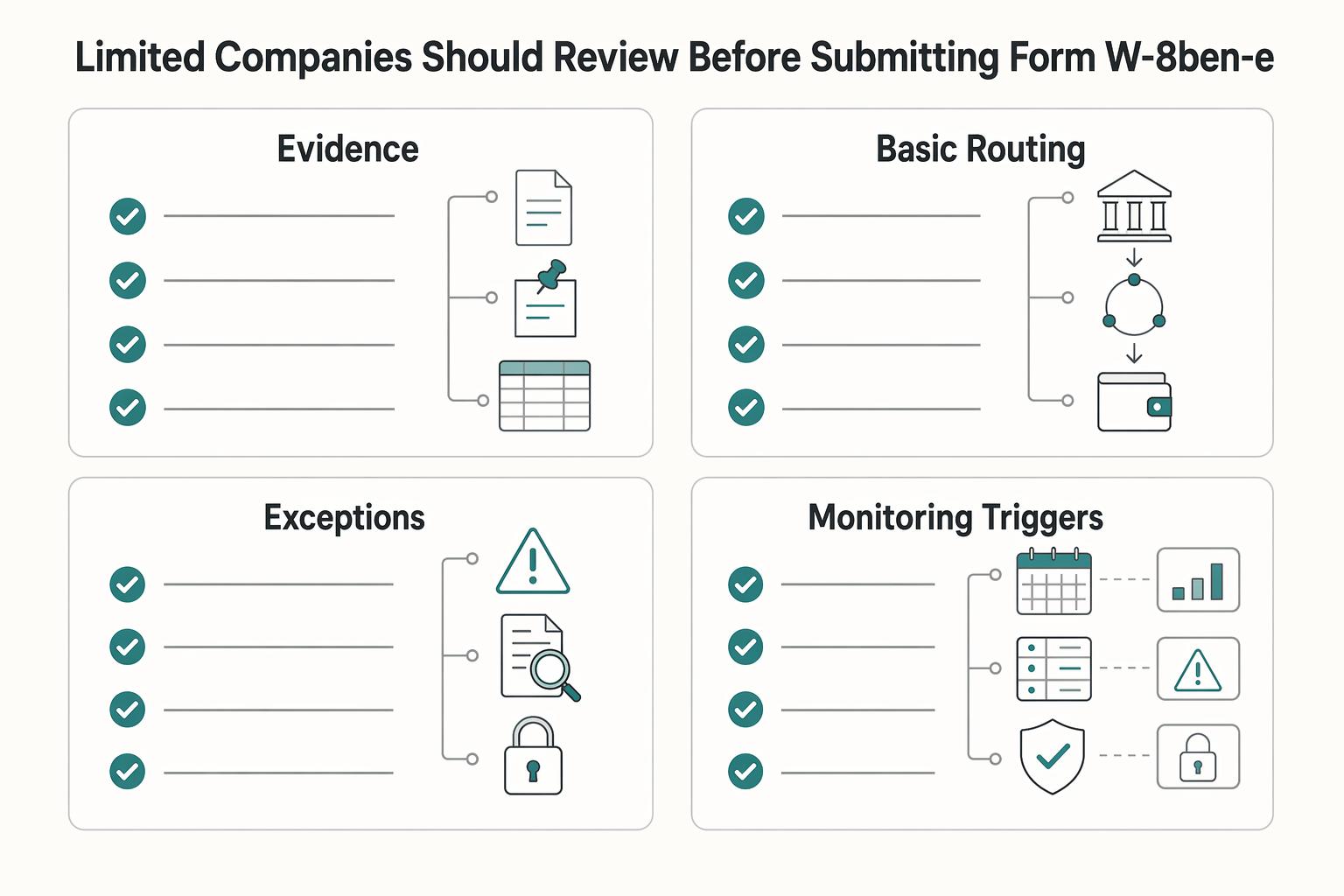
The practical promise is simple. You should leave with a lean review structure that gives your team the right inputs, a repeatable order of checks, and named escalation points. In particular, the focus is on four operator outputs:
- the minimum intake data and evidence you should have before anyone starts Part I
- basic routing checks so you can flag when a different U.S. tax form may be needed and escalate
- acceptance and payout checkpoints that catch mismatches before funds are released
- monitoring triggers for lifecycle events such as change in circumstances and expiration of Form W-8BEN-E
A useful early verification step is to tie the legal entity name in your onboarding or KYB record to the entity named on the tax form request before you ask for certification. If the payer record, contracting entity, and proposed signer do not line up, hold the request instead of letting the file drift into manual exceptions later.
Another red flag is reusing a prior form or a prior treaty assumption without rechecking current facts. That shortcut may save time upfront and create more remediation work when a withholding agent, auditor, or internal reviewer asks what evidence supported the position at the time of payment.
So the aim here is not to overbuild process. It is to give you enough structure to reduce avoidable withholding, documentation, and audit-trail risk while keeping specialist escalation for the cases that actually need it.
For a step-by-step walkthrough, see Setting Up a UK Limited Company for Freelance Work.
Start with form routing so you do not collect the wrong document#
Route the form first, then collect it. For a UK Corporation acting for its own account as a foreign entity, the first-pass route is typically Form W-8BEN-E; if facts suggest an intermediary role or effectively connected income, hold and escalate.
Your routing decision is about what the payee gives the withholding agent or payer (not the IRS). Use a simple first-pass table:
| Counterparty facts at intake | First-pass route | Reviewer action |
|---|---|---|
| Foreign entity, including a UK Corporation, acting for its own account | Form W-8BEN-E | Approve for entity review only if beneficial owner status is supported |
| Foreign individual | Form W-8BEN | Hold W-8BEN-E request and reroute |
| Foreign individual claiming exemption on certain personal-services compensation | Form 8233 | Confirm payment type and exemption claim before acceptance |
| Any person acting as an intermediary | Form W-8IMY | Hold and escalate before collection or payout |
| Foreign individual or entity claiming income is effectively connected with a U.S. trade or business | Do not use Form W-8BEN-E | Hold and escalate for W-8ECI review |
| Payer requests Form W-8EXP, or file facts indicate a special exempt-status lane | Not resolvable from this excerpt set alone | Escalate before collection |
The key checkpoint is beneficial owner status. Part I of Form W-8BEN-E asks for the "name of organization that is the beneficial owner," so require reviewer confirmation before accepting any tax form.
A practical control is to match three records: the legal entity in KYB/onboarding, the contracting party, and the party receiving payment. If those diverge, hold and escalate rather than forcing a form choice.
Your output should be a short form-routing decision log with:
- reviewer name and review date
- form selected or hold status
- evidence used (for example, KYB record, contract entity name, payer request, and payee beneficial-owner statement)
- reason code for approve, hold, or escalate
For a line-by-line walkthrough, see A UK Limited Company's Guide to Filling Out Form W-8BEN-E.
Assemble the minimum evidence pack before anyone touches Part I#
Build the evidence pack first, and hold the file if it cannot support Part I identity fields and payer match. Part I asks for the beneficial owner organization name and country of incorporation or organization, so those records should be verified before certification starts.
Minimum file contents#
| Intake item | What to collect | Pass or hold checkpoint |
|---|---|---|
| Legal entity identity | Legal name from KYB or incorporation record, plus contracting party name and payout profile name | Pass only if names reconcile or any difference is documented. Hold if the file only shows a trading name, nickname, or processor name. |
| Jurisdiction and entity route | Country of incorporation or organization from source records; keep your internal label consistent (for example, England-United Kingdom where your records use it). Include the entity route used earlier, such as Corporation. | Pass only if jurisdiction and route are consistent with the earlier form-routing decision. Hold if facts suggest an individual, intermediary, or effectively connected income path. |
| Tax identifiers | Any Foreign TIN (including a UK Unique Taxpayer Reference when available) and any existing U.S. Taxpayer Identification Number | Pass if identifiers are captured or absence is clearly documented for review. Hold if fields are left blank with no explanation. |
| Payer and authority notes | Payer record, internal policy note, and source notes used for tax logic | Pass only if the file shows what the payer requested and what authority was used. Hold if code or treaty logic is asserted without a source note. |
Keep the packet traceable: if treaty logic may be reviewed later, retain the relevant UK-US Double Tax Treaty source note, and record that the form's section references are to the Internal Revenue Code. The goal here is not to prove treaty eligibility in this step; it is to make later review defensible.
Use a simple intake outcome: complete, incomplete, or escalate. If the file cannot support legal name, jurisdiction, entity route, and payer match, it should not reach certification.
Complete the highest-risk W-8BEN-E sections in a fixed order#
Use a fixed order as an internal control, not as an IRS-mandated sequence: Part I Identification of Beneficial Owner -> Part III Claim of Tax Treaty Benefits -> Part XXV Active NFFE (when used) -> Part XXX Certification.
This sequence helps prevent the most common failure mode: copying a prior form forward without revalidating the current payer, entity facts, and treaty-claim assumptions. Treat each step as a gate before moving to the next.
Work in one direction#
Start with Part I and confirm the core entity and payer facts are stable in your file. Move to Part III only after that gate passes. The IRS instructions navigation includes "Line 14, claim of tax treaty benefits," so keep a clear treaty review note tied to the payer and facts used. Use Part XXV only when your file supports that choice. Validated criteria for selecting Active NFFE are not established, so require reviewer rationale and escalate ambiguous cases. Complete Part XXX last so certification confirms resolved facts rather than patching open issues.
Field-level hold checkpoints#
| Section | What to confirm | Evidence in file | Hold trigger |
|---|---|---|---|
| Part I | Core entity and payer details are consistent across records | Onboarding/KYB records and payer profile | Records conflict or cannot be reconciled |
| Part III | Treaty claim is tied to current payer and documented review basis | Treaty reference note and internal policy note | Claim copied from prior form with no current support |
| Part XXV (if used) | Active NFFE selection is documented as a supported internal determination | Reviewer note with business facts and any uncertainty | Box selected with no rationale or unresolved ambiguity |
| Part XXX | Certification is completed only after prior gates pass | Completed review file and final sign-off record | Open mismatches remain at certification |
A final revalidation check is essential before sign-off: the W-8BEN-E instructions navigation also flags change in circumstances and expiration of Form W-8BEN-E, so prior acceptance should not be treated as proof that current facts still hold. Related: Apple Developer and App Store W-8BEN-E for UK Limited Companies.
Decide treaty claims with explicit escalation triggers#
Treat the treaty claim as a separate go/no-go decision once Part I is stable. If the file cannot clearly support residence, entity status, or claim conditions, hold the form and escalate before payout release.
Use Line 14, claim of tax treaty benefits as the control anchor in your review note. Tie that note to the actual payer or withholding agent and the actual payment context for this form. If the file is relying on a UK-US treaty position, state that position explicitly and record what evidence was checked.
Write the claim as a concrete statement#
Do not accept shorthand like "UK treaty applies." Require a plain-language note that can be reviewed later:
- Treaty benefits are being claimed on Form W-8BEN-E, Line 14.
- The treaty position being relied on is named explicitly (for example, Article 7 Business Profits if that is the filed position).
- The payer or withholding agent is identified and matched to the claim.
- The file evidence supports the entity facts used for the claim, or the file is escalated.
If a file names a treaty article but cannot show supporting entity facts or reviewer reasoning, treat that as unresolved.
Keep uncertainty visible with three review lanes#
| Review lane | What belongs here | Release rule |
|---|---|---|
| Confirmed from IRS form text | What the form/instructions explicitly state (for example, W-8BEN-E is for entities, provided to the withholding agent or payer, and treaty claims are addressed at Line 14) | Can support acceptance when the file matches |
| Supported by secondary UK guidance | UK-side support used in your process, with the source identified in the note | Use only when the source and its applicability are documented |
| Unresolved pending full instructions or specialist review | Gaps or conflicts on treaty conditions, entity status, or payment characterization | Do not release payout until resolved |
Prior acceptance is history, not proof for current facts. Reused language from an older file should trigger a fresh check when payer setup or payment type has changed.
A second escalation trigger is confusion between treaty and effectively connected income handling. The form materials indicate Form W-8ECI is used for effectively connected income claims unless treaty benefits are being claimed, so unresolved classification should not be forced through as "complete."
Handle TIN decisions without guessing#
Treat TIN handling as a separate approval decision, and do not infer requirements that are not established. Form W-8BEN-E includes fields for a U.S. Taxpayer Identification Number and a Foreign TIN, but it does not fully define when each field is mandatory or when a blank is acceptable for every scenario.
| TIN case | What the article says | Reviewer action |
|---|---|---|
| U.S. TIN appears | Match it to the Part I legal entity | Tie the field status to the file evidence |
| Only Foreign TIN appears | Document it without treating it as automatically sufficient | Tie the field status to the file evidence |
| TIN field is blank or not provided | Mark it as blank or not provided | Do not infer requirements the article does not state |
| Secondary guidance references Form SS-4 or Form 8832 | These are possible routes that require validation | Validate current IRS instructions before directing a payee |
| Payer expectations and internal policy conflict | TIN requirements are in conflict | Hold acceptance and escalate instead of forcing incomplete certification |
Use this check before accepting the form:
- Record what is present, not what you assume. Mark each TIN field as completed, blank, or not provided, and tie that to the file evidence. If a U.S. TIN appears, match it to the Part I legal entity. If only a Foreign TIN appears, document that without treating it as automatically sufficient.
- Treat SS-4 and 8832 as possible routes that require validation. Secondary guidance may reference IRS Form SS-4 or Form 8832, but do not treat that as scenario-specific IRS confirmation on its own. Validate current IRS instructions before directing a payee to either form.
- Hold and escalate on conflicts. If payer expectations and internal policy conflict on TIN requirements, hold acceptance and escalate instead of forcing incomplete certification.
For control hygiene, note the instruction version used (for example, Instructions for Form W-8BEN-E (10/2021)) in the reviewer record. The form instructions also cover Change in circumstances and Expiration of Form W-8BEN-E, so reopen TIN review when facts change or the form reaches refresh. For implementation detail, see How to Fill Out Form W-8BEN-E for a Foreign Company.
For a fast workflow check, Try the W-8 form generator.
Build sanity checks for acceptance, payout release, and annual refresh#
A signed form is not the end of review. Use three gates: acceptance, payout release, and refresh/change-event rechecks.
| Gate | What to confirm | Record or action |
|---|---|---|
| Acceptance | Form is complete for your use, consistent with onboarding/KYB, and certified in Part XXX | Hold if key entity details conflict with source records |
| Payout release | Status is approved, open exceptions are cleared, and the form supports the payer relationship | Log the release decision to the exact transaction ID or batch ID |
| Annual refresh or change event | Re-validate entity facts and prior assumptions when a change in circumstances could affect treatment | Treat the annual cycle as a full recheck, not an automatic rollover |
Acceptance gate#
Approve only when the form is complete for your use, consistent with your onboarding/KYB record, and certified in Part XXX Certification under your internal control standard. If key entity details conflict with your source records, hold the form before it reaches an approved state.
Keep signer checks practical and policy-based. Do not assume IRS guidance spells out a detailed signer-authority test, so verify authority using the evidence you already maintain for that payee and escalate when the file is unclear.
Record version context in the reviewer log: Form W-8BEN-E (Rev. October 2021) and, when used, Instructions for Form W-8BEN-E (10/2021).
Payout gate#
Tax-form status should be part of the same gate that releases a transaction or batch. Before payout, confirm status is approved, clear any open exceptions, and log the release decision in an audit trail tied to the exact transaction ID or batch ID.
Confirm routing context too: Form W-8BEN-E is provided to the withholding agent or payer, not sent to the IRS. Your record should show which payer relationship that form supports.
Refresh and change events#
If you run an annual cycle, treat it as a full recheck, not an automatic rollover. Re-validate entity facts and prior assumptions, and reopen review when a change in circumstances could affect treatment.
Where supported, use controls such as masked tax-data views, approval workflows, and exportable audit records. If Gruv is in your stack and those controls are enabled in your program, use them to reduce manual handling and improve cross-market review traceability.
Known facts and unresolved points you must document#
Document two facts as settled, and treat the rest as unresolved until verified. From the IRS form itself, Form W-8BEN-E is for entities (not individuals), and it is given to the withholding agent or payer (not filed with the IRS).
| Topic | Status in this article | Operational note |
|---|---|---|
| Form W-8BEN-E audience | Settled | It is given to the withholding agent or payer, not filed with the IRS |
| Entity versus individual routing | Settled | Form W-8BEN-E is for entities; if the counterparty is an individual, route away from this form to Form W-8BEN, and in some individual compensation cases Form 8233 |
| Intermediary routing | Settled | If the party is acting as an intermediary, route to Form W-8IMY |
| U.S. TIN requirements | Unresolved | This article does not provide complete scenario-by-scenario mandatory TIN and exception logic |
| Publication 515 (for 2010 use) | Historical only | Do not use it as current operational authority |
Record those points in policy notes and in each case file. Your file should show the entity status from onboarding or KYB and the specific payer relationship that received the form. If the counterparty is an individual, route away from this form to Form W-8BEN (and, in some individual compensation cases, Form 8233). If the party is acting as an intermediary, route to Form W-8IMY.
Do not overstate certainty on U.S. TIN requirements. The relevant references here are Form W-8BEN-E (Rev. October 2021) and Instructions for Form W-8BEN-E (10/2021), but they do not provide complete, scenario-by-scenario mandatory TIN and exception logic across all entity and payment profiles.
Keep a standing unknowns register in your policy notes with:
- open question
- affected payment type or payer setup
- source checked
- escalation owner
- interim handling rule
- decision date and outcome
Also mark any use of Publication 515 (for 2010 use) as historical context only, not current operational authority.
Conclusion#
A strong UK company W-8BEN-E process is a control problem first and a form-completion exercise second. If your team cannot show why the form was routed, what evidence supported the certification, and when the U.S. payer or withholding agent received it, you do not have a reliable file even if every box looks filled in.
The practical standard is simple: approve only what the record supports, escalate what is ambiguous, and leave a visible trail for anything still unresolved. The Instructions for Form W-8BEN-E (10/2021) provide useful anchors, not a complete routing blueprint. Those include Who Must Provide Form W-8BEN-E, When to provide Form W-8BEN-E to the withholding agent, Change in circumstances, Expiration of Form W-8BEN-E, and treaty-claim topics such as Line 15, special rates and conditions. Those checkpoints help define when the form belongs in the file, when it should be reassessed, and where claimed reduced rates may need extra scrutiny.
If you want one operating rule to keep, make it this: when the file is unclear on entity status, beneficial owner status, treaty basis, or identifier expectations, treat it as unresolved and escalate for review. An avoidable failure mode is letting timing pressure turn an unknown into an assumption, especially by copying a prior form forward or treating old payer logic as still valid after a change in circumstances. Another avoidable mistake is mixing in unrelated HMRC admin dates. Those dates may matter elsewhere, but they do not determine whether a U.S. withholding document is acceptable.
Your next step should be concrete and modest:
- Put your intake checklist, form-routing logic, and reviewer sanity checks directly into your approval flow.
- Require one verification record for each accepted form: which withholding agent received it, when it was provided, and what evidence supported the key claims.
- Maintain an open-issues log for anything the current record does not fully answer, including identifier questions, treaty support, or section selections that your reviewer cannot defend from the form instructions.
That last point matters more than most teams expect. Unknowns do not become safe just because they are common. For a UK company case, the better discipline is to document the gap, keep it visible, and validate coverage with counsel or current IRS materials where your program rules vary. That is how you reduce rework, avoid weak certifications, and keep payout operations moving without pretending the form says more than it does.
Related reading: How to Fill Out Form W-8BEN for a Foreign Freelancer.
Frequently Asked Questions
Is Form W-8BEN-E the right form for a UK limited company or should we use Form W-8BEN?
The W-8BEN-E versus W-8BEN routing rule for a UK limited company is not established. Confirm entity and beneficial-owner facts, and escalate if the file is unclear rather than guessing.
Do we send Form W-8BEN-E to the Internal Revenue Service or to the U.S. payer or withholding agent?
The instructions are framed around giving Form W-8BEN-E to the withholding agent, including when to provide it.
Which sections matter most in a typical UK company case: Part I, Part III, Part XXV, and Part XXX?
The instructions include Line 14, claim of tax treaty benefits, so treaty-claim review should be handled explicitly. If your team cannot explain why a section was completed a certain way, escalate rather than copy a prior form forward.
What does Active NFFE under FATCA mean in practical review terms for a trading company?
From this grounding set, the practical meaning of Active NFFE is unresolved. The FATCA material provided here is about Form 8938 reporting by certain U.S. taxpayers, not a complete rulebook for entity classification on Form W-8BEN-E. If classification support is unclear, escalate before acceptance.
When can we rely on treaty logic such as Article 7 Business Profits, and when must we escalate?
Treaty claims are an explicit topic in the instructions, but eligibility conditions for Article 7 Business Profits should be verified with the relevant authority. If residence, entity status, or claim basis is unclear, stop and escalate rather than certifying on assumption.
Do we need a U.S. Taxpayer Identification Number, or can Foreign TIN and UK Unique Taxpayer Reference be sufficient in some cases?
This remains scenario-dependent. Confirm with the relevant authority when a U.S. TIN is mandatory and when a Foreign TIN (including a UK Unique Taxpayer Reference) can substitute, then hold the file until that requirement is resolved before finalizing.
Try a related tool
Researched and edited by the Gruv editorial team. Gruv builds cross-border billing, payouts, and finance-operations software for global businesses.
Sources
Includes 2 external sources outside the trusted-domain allowlist.
- irs.gov/instructions/iw8benetrusted
- irs.gov/pub/irs-pdf/fw8bene.pdftrusted
- jct.gov/getattachment/4761ad2d-a31d-4456-b2af-80c044...trusted
- sec.gov/Archives/edgar/data/1067983/0001193125252676...trusted
- taxpayeradvocate.irs.gov/wp-content/uploads/2020/08/08_tas_arc_intro_...trusted
- gov.uk/register-for-self-assessmentexternal
- gov.uk/self-assessment-tax-returns/registeringexternal
Educational content only. Not legal, tax, or financial advice.
Related Posts
How a UK Limited Company Files W-8BEN-E for US Client Payments
How to turn a mandatory compliance document into a practical shield against a 30% withholding tax while keeping payments moving.
Apple W-8BEN-E Decisions for UK Limited Companies in App Store Connect
For most UK teams, the hard part is not discovering that a U.S. tax form exists. It is deciding what a **UK limited company** should actually submit when App Store Connect presents tax questions in a way that is operationally vague. This article takes a narrow, practical path through that problem: how to document decisions, and when to stop and escalate before a tax setup issue turns into a payout or audit issue.
The Best Pension Providers for UK Freelancers
Your pension is not just a retirement pot. If you are comparing pension providers for UK freelancers, start with a simpler point. A pension can reduce tax drag now, compound over time, and keep part of your wealth away from the day-to-day cash risks of self-employment.