
Quick Answer
Start by confirming that a limited company matches your risk and admin tolerance, then register accurate details with Companies House and set up operations immediately after incorporation. In practice, that means separating company and personal finances, notifying HMRC when trading begins, and running a recurring director checklist for records, filings, payroll or dividends, and invoice accuracy. The setup works best when you treat incorporation as the first operational checkpoint, not the finish line.
Decide whether to run your work through a separate company#
You are not just deciding how to file paperwork. You are deciding whether to run your work through a company that is legally separate from you. That choice affects your liability exposure, how credible your business looks, and how ready your operations are as you grow. The real question is whether this structure fits your business now and whether you can run it properly after formation.
This guide follows a simple path:
- Phase 1: Foundation
Decide whether a limited company fits your risk profile, work model, and tolerance for ongoing admin.
- Phase 2: Launch
Register correctly with Companies House and avoid filing mistakes. Online incorporation costs £100 and is usually registered within 24 hours. Postal applications are £124 and usually take 8 to 10 days. You must register before you start trading.
- Phase 3: Operations
Run the company properly after formation. That means meeting HMRC and Companies House obligations, tracking deadlines, and handling director duties that still sit with you. Missing those responsibilities can lead to fines, prosecution, or disqualification.
Early setup risks often show up as small misses. The main ones to watch are privacy exposure, registration-data errors, control-record mistakes, and compliance drift.
- Privacy exposure: most information filed at Companies House is public and searchable worldwide for free.
- Registration-data errors: wrong registered office details can send HMRC letters to the wrong place.
- Control-record mistakes: PSC records need to capture people with significant control, including anyone with more than 25% of shares or voting rights.
- Compliance drift: after becoming active, you must tell HMRC within 3 months for Corporation Tax, and you must file a confirmation statement at least once every year, even when nothing changed.
One baseline rule matters throughout. An accountant can help, but legal responsibility still sits with you as director, including for records, accounts, and required filings. Start with the first question: is a limited company the right fit for your business profile today?
Related: The Best Email Marketing Platforms for Freelancers.
Start with the risk you carry as a sole trader#
Start with the basic tradeoff. As a sole trader, you are personally responsible for the business, including its debts. If that no longer matches your risk tolerance, a company may be worth evaluating, but verify the UK legal and tax effects before you rely on them.
The useful lens here is not "easy now versus formal later." It is "what risk do I carry personally today, and what admin will still exist either way?"
| Decision factor | Sole trader | Company route |
|---|---|---|
| Personal exposure | You are personally responsible for business debts. | Verify the UK liability position and limits before you treat it as protection. |
| Legal separation | No separation is evidenced here between you and the business. | Confirm the exact UK legal effect before you use it in contract or risk planning. |
| Admin burden | Ownership is simpler, but cross-border tax obligations can still apply. | A more formal structure can still leave cross-border compliance in place. |
| Fit signal | You accept personal debt exposure and your setup is still simple. | Risk, buyer requirements, or ownership complexity is increasing and needs a formal structure. |
Verify tax before using it as your reason#
Do not make tax the reason you incorporate until your numbers and status have been checked. Any salary or distribution mix should be treated as unconfirmed until current rules are verified for your case.
Check these points first:
- which current company-tax and distribution rules apply to your case
- whether salary-related payroll contributions would apply
- where you are tax resident and where income is taxed
- your real profit pattern, not a best-case projection
- which current thresholds and filing obligations apply to your case
If you work cross-border, residency can change the outcome. If that is unclear, pause there first and start with Understanding the UK's Statutory Residence Test (SRT).
Admin shows up in the cross-border details#
Australia is a useful stress test. If GST registration is required in Australia, the stated deadline is within 21 days, and one cited turnover trigger is $75,000. In the standard non-resident route, you need an ABN first, then lodge BAS and pay GST monthly or quarterly.
There is also a practical constraint. From outside Australia, electronic lodgment is not available, and you may need an Australian registered tax agent.
The simplified route comes with clear tradeoffs. It can avoid ABN and identity-proof requirements, and you receive an ARN, but you cannot issue tax invoices or claim GST credits. If buyers need tax invoices, or if credits matter to your margin, that can break the setup.
Credibility and future flexibility#
Treat credibility as a buyer-process check, not a branding exercise. Look at recent opportunities and note what buyers asked for before signature: legal entity details, tax details, insurance evidence, bank checks, or authorized sign-off. If those checks are showing up more often, a formal structure may be worth planning for.
Then pressure-test the next 12 months:
- might you add an owner or shareholder
- do you need clearer control and approval rules
- will someone else need authority to sign or manage
- are you ready for the recordkeeping that comes with a formal structure
If several of those are already true, plan before you register. That takes you into the pre-registration work.
If you want a deeper dive, read Sole Proprietorship vs. LLC: The Definitive Guide for Global Freelancers.
Phase 1: The Foundation (Your Pre-Registration Strategy)#
Treat naming as risk control. You want a name you can register, protect, and use consistently across contracts, invoices, and your public presence.
A weak name choice can stop incorporation. It can also trigger a later complaint if it is too similar to an existing company or trade mark, or leave you split between your legal name and online identity.
Run the checks in this order#
Start with Companies House. A private limited company name cannot be the same as an existing registered name. The rules also cover names treated as "same as" and "too like." Check for sensitive words or wording that suggests a government or local-authority connection, because those need permission.
Next, check domain and social handle availability. This is not a legal incorporation requirement, but it is practical risk control if you want one clear market identity. If the legal name is available but your usable web identity is not, fix that before you register.
Then search the UK IPO trade mark database. This is a separate test. The question is not "can I register the company." It is "is the same or a similar UK trade mark already registered?" If the conflict risk is not clear, get professional trade mark advice.
| Check | What it validates | Risk it helps prevent | What to do if there is a conflict |
|---|---|---|---|
| Companies House name check | Whether the proposed name appears available under Companies House naming rules | Rejection at registration, or a later complaint that a name is 'too like' an existing company | Revise the name, test an alternative, or remove restricted wording unless you can obtain permission |
| Domain and handle check | Whether you can use the same identity online | Inconsistent brand identity across legal and digital channels | Adjust the name before registration or reserve the closest viable domain and handle set early |
| UK IPO trade mark search | Whether the same or a similar UK trade mark exists | Trade mark conflict and a potential forced rename after launch | Pause, assess overlap, and get professional trade mark advice where risk is unclear |
Company registration and trade mark protection are different. Companies House registers companies. The Intellectual Property Office registers trade marks. Registering a company name does not automatically protect it under trade mark law, and UK trade mark protection is territorial, covering the UK and Isle of Man only.
Phase 1 readiness#
Before moving to formation, confirm:
- one primary company name selected
- domain and handle alignment checked for your key channels
- Companies House checks completed (
same as,too like, sensitive wording) - UK IPO trade mark conflict check completed
If any item is incomplete, pause and resolve it now. Name changes are usually easier before contracts, invoices, and client records are live.
You might also find this useful: Sole Trader vs. Limited Company: A Guide for UK Freelancers.
Phase 2: The Launch (Clean Filings and Deliberate Disclosure)#
Accuracy matters most in this phase. You want to submit clean formation details, make deliberate disclosure choices, and keep your compliance steps consistent.
A limited company is legally separate from its owners. As a director, you still need to file accounts and tax returns for the company and follow the rules when taking money out of it.
Formation execution#
Use this sequence before you submit anything:
- Pick your filing route.
- Finalize disclosure details, including address and control information.
- Review founding documents and share setup.
- Submit only when all details tell one consistent story.
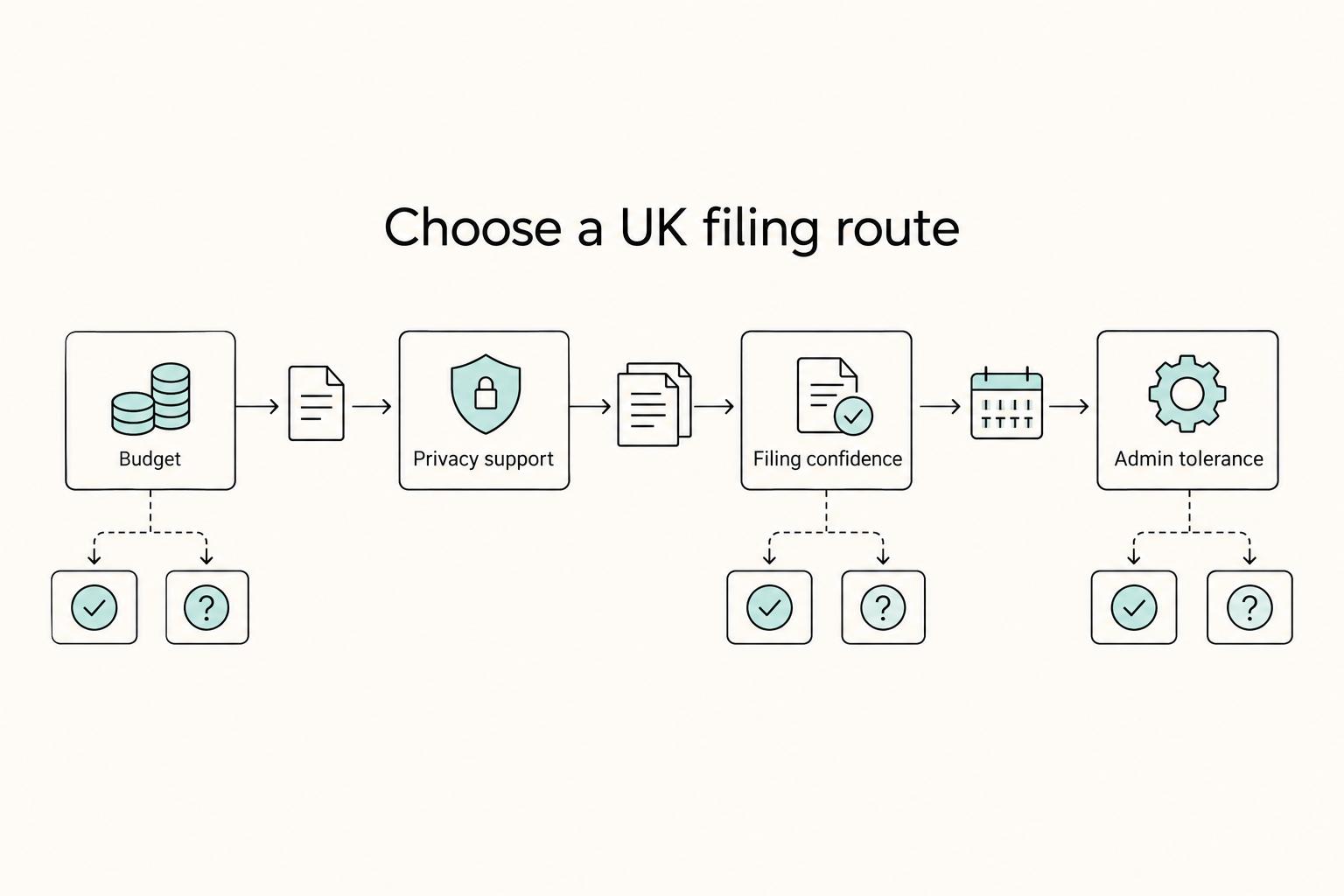
Choose your filing route by scenario#
| Scenario | Direct filing may fit if... | Extra support may fit if... |
|---|---|---|
| Budget | You prefer to handle forms yourself | You want paid help coordinating filings and admin tasks |
| Privacy support | You are comfortable checking current disclosure and visibility rules yourself | You want support organizing address and disclosure decisions before filing |
| Confidence with filings | You can verify each field and supporting detail yourself | You want a second layer of process support before submission |
| Ongoing admin tolerance | You are ready to manage post-setup admin directly | You prefer help setting up a repeatable admin routine |
If ownership or control is not straightforward, pause for legal or tax advice before you file.
Lock disclosure choices before submission#
Sort out disclosure choices before you touch the forms, so your submission stays consistent.
| Item | Key action | Article note |
|---|---|---|
| Registered office | Confirm the address, who receives official mail there, and how notices are escalated. | Public-record effect: verify current visibility rules before submission. |
| Director service address | Confirm the address used for director correspondence and your forwarding process. | Public-record effect: verify current visibility rules before submission. |
| PSC disclosure | Identify who controls the company and verify what details current disclosure rules require. | Public-record effect: verify current disclosure requirements before submission. |
| Evidence pack | Keep copies of submitted details, confirmations, and your decision notes. | Sort out disclosure choices before you touch the forms, so your submission stays consistent. |
If you prefer a pre-submission checklist, cover the same four items:
- Registered office: confirm the address, who receives official mail there, and how notices are escalated. Verify current visibility rules before submission.
- Director service address: confirm the address used for director correspondence and your forwarding process. Verify current visibility rules before submission.
- PSC disclosure: identify who controls the company and verify what details current disclosure rules require.
- Evidence pack: keep copies of submitted details, confirmations, and your decision notes.
Review founding documents before you submit#
Your memorandum, articles, and share setup should match the company you actually intend to run on day one.
- Memorandum: confirm names and core details are consistent across the application.
- Articles: confirm the terms you are adopting are the terms you intend to operate under.
- Share setup: confirm ownership and control reflect your real intent.
If any legal nuance is unclear, stop and verify it with a qualified adviser before filing.
Non-resident banking setup#
Do not rely on generic summaries for non-resident banking. Verify current eligibility and onboarding requirements directly with each provider before you apply.
Keep your company activity wording and documents consistent across your website, invoices, and applications, and keep copies of what you submit.
From day one, keep records such as bank statements and receipts so returns can be completed correctly. If Self Assessment later applies, tell HMRC by 5 October after the relevant tax year, register before first-time filing, keep your UTR ready, reactivate an existing account when required, and pay any tax bill by 31 January. If you cannot use the standard online filing service, including some non-resident cases, use commercial software or other forms.
We covered this in detail in A UK Limited Company's Guide to Filling Out Form W-8BEN-E.
Phase 3: The Operations (Your Day 1 Readiness Plan)#
Once Companies House accepts your filing, control matters more than speed. A clean setup stays clean only if your banking, tax setup, records, and payment process all line up from day one.
Immediate#
Open and start using a business account in the company's name as soon as possible. GOV.UK requires a clear division between company finances and personal finances, and says the simplest way to do that is a business bank account. If onboarding is still in progress, avoid routing client money through your personal account.
Set up bookkeeping before money starts moving. Make sure your invoice template uses the registered company name exactly, and keep the name consistent across your bank setup and accounting records. Keep your incorporation certificate, Company Registration Number, and bank confirmation in one easy-to-find folder.
Your first finance stack choices#
| Decision option | Best for | Tradeoffs | What you need to prepare | When to choose it |
|---|---|---|---|---|
| UK-authorised bank, building society, or credit union business account | You want mainstream banking protection and expect to hold meaningful cash balances | Provider onboarding and checks differ | Incorporation details and identity/business information requested by the provider | Choose this when deposit protection is your top priority. FSCS coverage applies if the firm fails. |
| Payments or e-money business account | You want online payments or multi-currency features | Funds are not directly FSCS-protected. Protection is through safeguarding rules | Company and identity documents, plus a clear business activity description | Choose this when payment features matter more than bank-style protection. |
| Basic bookkeeping software now | You have low transaction volume and want clean records early | You may outgrow it and migrate later | Opening balances, invoice details, expense categories, bank access or CSV exports | Choose this when you are not VAT-registered and want a simple starting point. |
| VAT-capable accounting software now | You expect VAT registration or want fewer system changes later | More setup effort up front | Bank connection, tax settings, invoice template, expense capture process | Choose this when VAT registration is likely, because VAT records and returns must use compatible software. |
| Wait and watch on VAT | You are below the threshold and clients do not require VAT registration | You delay VAT admin, so turnover tracking needs to stay tight | Rolling turnover tracking and a reminder to recheck the live rule | Choose this when turnover is still early stage and your checklist includes a reminder to check the current VAT registration rule. |
| Voluntary VAT registration | You want to reclaim VAT on expenses or need VAT registration commercially | More admin and software discipline from the start | Turnover view, expense profile, and VAT-ready software | Choose this only when the benefit clearly outweighs the extra admin. |
Next#
Tell HMRC when the company starts doing business. You must do this within 3 months of starting your tax accounting period. HMRC treats actions like buying, selling, advertising, renting property, or employing someone as signs you have started. In practice, do not wait for the first paid invoice if trading activity has already begun.
| Task | Deadline | Article note |
|---|---|---|
| Tell HMRC the company has started doing business | Within 3 months of starting your tax accounting period | Do not wait for the first paid invoice if trading activity has already begun. |
| First accounts | 21 months after registration | Track this in your filing calendar before deadlines start stacking up. |
| Annual accounts | 9 months after each financial year end | Build this into your filing calendar. |
| Corporation Tax payment | 9 months and 1 day after the accounting period end | Keep this deadline in your reusable templates and recheck it before each filing cycle. |
| Company Tax Return | 12 months after the accounting period end | Build this into your filing calendar. |
| Confirmation statement | Annual; can be filed up to 14 days after the due date | Companies House will not accept one until all directors have verified their identity. |
Put those dates into your filing calendar now, before deadlines start stacking up. Track first accounts, annual accounts, Corporation Tax payment, the Company Tax Return, and the confirmation statement in one place. Use the same calendar to recheck HMRC timing before each filing cycle.
Before first payment#
Decide how you will pay yourself before money leaves the company account. If you will run salary, set up PAYE so payments and deductions are reported to HMRC on or before each payday. If you will take dividends, keep the supporting records in order so payments are reflected correctly in the books.
Treat your first invoice as a compliance document, not just a billing note. For a limited company, the invoice must show the full registered company name exactly as on the certificate of incorporation. Check this carefully before you send it.
Ongoing#
Run this as a monthly director routine, even if you have an accountant. You can delegate tasks, but legal responsibility for records, accounts, and company performance still sits with you.
| Monthly check | What to do |
|---|---|
| Business account and books | Reconcile your business account to your books and save statements, invoices, and receipts. |
| Record retention | Keep accounting records for 6 years from the end of the financial year they relate to. |
| Payroll reporting | Review payroll entries and confirm PAYE reporting was made on or before payday. |
| VAT monitoring | Recheck whether turnover triggers VAT registration under the current rule. |
| Filing calendar | Review your Companies House and HMRC filing calendar. |
| Invoice name check | Confirm every sales invoice uses the exact registered company name. |
If you prefer a recurring checklist, use the same six items:
- Reconcile your business account to your books and save statements, invoices, and receipts.
- Keep accounting records for 6 years from the end of the financial year they relate to.
- Review payroll entries and confirm PAYE reporting was made on or before payday.
- Recheck whether turnover triggers VAT registration under the current rule.
- Review your Companies House and HMRC filing calendar.
- Confirm every sales invoice uses the exact registered company name.
Two risks deserve close attention. Poor recordkeeping can lead to a £3,000 HMRC fine and possible director disqualification. Missing a confirmation statement can lead to a fine of up to £5,000 and possible strike-off.
For a step-by-step walkthrough, see How to Set Up a Limited Company in Ireland.
As you set up your Day 1 process, use this free invoice generator to issue consistent invoices and keep cleaner records from the start.
Conclusion: Maintain the separation in your day-to-day work#
Forming the company is the start of operations, not the finish line. A limited company is legally separate from you, so your job now is to maintain that separation in day-to-day work.
Use the structure immediately. Keep company activity and records clearly separate from personal admin so filings and returns are easier to complete correctly.
Run your responsibilities on a repeatable cycle:
- Keep records as money moves, including bank statements and receipts.
- Track and complete company accounts and company tax returns.
- Follow the rules when taking money out of the company.
- Check personal tax obligations, including Self Assessment where it applies.
For Self Assessment, keep the key dates in view: file on or after 6 April, tell HMRC by 5 October when required, and pay by 31 January. If you already had a Self Assessment account, confirm whether it needs reactivation before filing to avoid delays.
Use the Phase 3 checklist as your operating routine, and use the FAQ when edge cases come up. That is how you turn incorporation into compliant setup, cleaner operations, and a more durable business foundation.
This pairs well with our guide on A Guide to Incorporating a Private Limited Company in India as a Foreigner.
When you are ready to run client billing and payouts through one workflow as your company grows, explore Gruv for freelancers.
Frequently Asked Questions
Can you be the sole director of a UK company if you do not live in the UK?
Do not assume your residence status alone either blocks setup or guarantees a smooth result. Check current formation requirements and whether your chosen bank or payments provider will onboard you based on your profile. If you also need Self Assessment and you lived abroad as a non-resident, HMRC says some people cannot use its online service and must use commercial software or other forms.
How do you protect your home address from the public record?
Treat address privacy as an upfront filing choice. Before you submit, verify each address field, confirm what your provider says will appear publicly, and make sure required mail can still reach you reliably. Do not assume an address service will keep your home address off the public record in every case.
What are the real annual costs of running a limited company?
Plan for ongoing operations, not just incorporation. Use current quotes for your exact setup, and treat each line item as a pricing checkpoint before launch. | cost area | what it covers | what changes the price | when you may need it | | --- | --- | --- | --- | | Address services | Registered office or mail-handling services, if you do not want to use your own address where permitted | Provider, mail forwarding, scanning, and service level | When privacy or reliable mail handling matters | | Bookkeeping or accounting software | Invoicing, expense capture, bank feeds, and recordkeeping | Feature tier, VAT needs, payroll, and transaction volume | As soon as money starts moving through the company | | Accountant or tax adviser | Accounts, tax returns, payroll support, and advice on edge cases | Complexity, cross-border issues, payroll, VAT, and support level | When you want review, filing help, or tax planning | | Banking or payment provider charges | Account fees, card costs, transfers, and payment processing | Provider type, currencies, volume, and payment features | When you need a business account or client payment rails |
For a higher earner, is a limited company better than being a sole trader?
Not by default. GOV.UK says a limited company is legally separate from its owners and run by directors, while a sole trader is the simplest structure to set up and keep records for. Decide based on your real profit pattern, admin capacity, legal risk, and current tax rules for your case.
How long does a UK limited company setup take?
Do not set expectations from an old headline timeline. Check the current Companies House processing window for incorporation, then add realistic time for onboarding, checks, and first tax-admin tasks. Incorporation is one milestone in the launch, not the whole launch.
Do you really need an accountant?
You do not automatically need one to form a company, but you do need accurate records, and you remain responsible as a director. GOV.UK states directors must follow the rules and file company accounts and tax returns for the company. If payroll, dividends, or cross-border points are unclear, get targeted professional review early.
What ongoing compliance rhythm should you keep as a director?
Keep a regular check of records, cash movement, and upcoming filing tasks, even when someone else prepares returns. HMRC says you need records such as bank statements or receipts so you can complete tax returns correctly. If Self Assessment applies to you personally, remember: register before first online filing, reactivate an old account if needed, file on or after 6 April, tell HMRC by 5 October for the previous year when required, and pay by 31 January.
Try a related tool
Researched and edited by the Gruv editorial team. Gruv builds cross-border billing, payouts, and finance-operations software for global businesses.
Sources
Includes 2 external sources outside the trusted-domain allowlist.
- ato.gov.au/businesses-and-organisations/international-t...trusted
- ato.gov.au/businesses-and-organisations/international-t...trusted
- companieshouse.blog.gov.uk/2019/02/12/choosing-a-company-name-trading-n...trusted
- gov.uk/limited-company-formation/add-corporation-ta...external
- gov.uk/prepare-file-annual-accounts-for-limited-com...external
Educational content only. Not legal, tax, or financial advice.
Related Posts

Sole Proprietorship vs LLC for Global Freelancers in 2026
For most freelancers in 2026, the practical default is still simple: use the simplest structure you can run cleanly, then formalize when risk actually rises. If your work is still in validation mode and the downside is contained, a sole proprietorship is often the practical starting point. When contract exposure, delivery stakes, or dispute risk starts climbing, forming an LLC deserves earlier attention.

Understanding the UK's Statutory Residence Test (SRT)
Treat SRT like ops, not folklore. You want a repeatable workflow you can run monthly so your tax-year answer is boring, documented, and easy to defend.

The Best Email Marketing Platforms for Freelancers
Pick the platform you can still run on a busy Thursday, not the one that looks smartest in a comparison chart. For most freelancers, the decision is not about the longest feature list. It is about whether your email setup stays usable when client work piles up, your list grows, and you need to send without babysitting every step.