
Quick Answer
Pay locum vets and technicians only through a model that clearly assigns who invoices the clinic, who receives funds, who pays the worker, and who issues the contract. Keep veterinarians and RVTs on separate unit economics, define any service charge and conversion fee in writing, and set a traceable settlement and reconciliation process before launch.
What Makes Veterinary Staffing Payments Different#
A veterinary staffing payment model is only defensible if you can clearly say who invoices the clinic, who pays the worker, and who stands behind the contract. If those ownership lines are fuzzy, operational risk can show up from day one, not just commercial risk.
Demand is there. Clinics use locum relief veterinarians, veterinary nurses, and technicians for coverage, and shortages can push teams toward overwork and burnout. Worker interest is there too, with one cited data point showing 44 percent of vets want more flexible working options. So the real question is not whether demand exists. It is whether your payment setup can support that demand without creating avoidable execution risk.
Step 1 Define the first decision correctly#
Start with the gate decision: can you support veterinarian, veterinary nurse, and technician supply with a payment model you can defend across contracts, finance operations, and client conversations? Pressure-test your payment terms, service charges, and any conversion-fee policy against actual operating ownership, not brand positioning. Use three basic questions:
- Who collects from the clinic?
- Who disburses to the worker?
- Who issues the agreement?
If any answer is still "later," pause. In this category, admin setup is part of product viability.
Step 2 Anchor on operating model before revenue model#
There is no one-size-fits-all operating model here. Some relief professionals work as independent contractors and handle their own business matters. Others work through agencies that handle shift arrangements and invoicing.
Resolve that fork early. It changes who owns what, how the process works, and whether the model stays coherent as volume grows.
Step 3 Use compensation signals as stress tests, not formulas#
Treat compensation signals as stress inputs, not universal pricing rules. One source describes relief work as at least 35% higher than full-time pay to offset missing benefits, and last-minute coverage may reach 1.5-2x regular rates. Those figures are not universal across markets or roles, but they are useful for testing whether your model can handle uneven rate pressure.
This guide keeps geography-specific details and expansion unknowns explicit. The result is a practical go or no-go frame. If your model does not pass basic checks on ownership, paperwork, and role-sensitive economics, it is not ready to scale.
Set your decision scope before you model revenue#
Set scope before pricing, or the model will drift. The risk at this stage is losing focus, not missing the perfect rate.
| Decision area | What to document | Pause signal |
|---|---|---|
| Launch context | Why this context comes first, which practice types you want to experience, and how long the scope should hold | If it keeps changing, you may still be in discovery |
| Worker mix | Choose one initial focus: Veterinarian, Nurse, or Technician, and verify eligibility where the work will happen | If eligibility is still unclear, pause pricing design |
| Readiness review | Review assumptions before setting pricing logic | If scope or worker mix keeps shifting, pause and review assumptions |
Step 1 Pick one launch context#
Choose one primary launch context for your first pass, to keep scope discipline.
Write down why this context comes first, which practice types you want to experience, and how long you expect that scope to hold. Revisit that note every month or so. If it keeps changing, you may still be in discovery.
Step 2 Lock the worker mix early#
Decide your first worker focus up front: Veterinarian, Nurse, or Technician. Locum work can include all three, so one role should not stand in for all roles.
Before you model revenue, verify eligibility for that role in the state or country where the work will happen. If that gate is still unclear, pause pricing design.
Step 3 Use a readiness trigger, not a blanket rule#
If your scope or worker mix keeps shifting, treat that as a trigger to pause and review assumptions before you set pricing logic. Keep this as an operating safeguard, not a universal claim that one model always fails. It's meant to catch hidden assumptions before they spread through pricing and payout decisions.
Related reading: IRS Form 1042-S for Platform Operators: How to Report and Withhold on Foreign Contractor Payments.
Build the minimum evidence pack before product scoping#
Before you scope product flows, make the evidence pack reviewable end to end. If any core item is still "to be decided later," pause build and keep this in research.
| Pack | Items to capture | Handling rule |
|---|---|---|
| Contract pack | Artifact list, parties, scenario, handoff point, when each document type applies, and what event changes the relationship | If a reviewer cannot quickly tell which document governs each case, the pack is not ready |
| Finance pack | Hourly-rate model, service-charge model, and failed payout or refund handling | If a value or policy is unknown, mark it as unknown |
| Operations pack | Settlement timing, dispute path, reconciliation ownership, and core intake fields: First Name, Last Name, Email, Phone Number, Job Title, Facility Name, and whether the facility uses temporary/contingent staffing | If ownership or timing is not confirmed, label it unresolved |
Step 1 Assemble the contract pack#
Start with a working contract artifact list rather than final legal language. You are not aiming for final legal polish yet. You are aiming for operational clarity on when each document type applies, what event changes the relationship, and where that change gets recorded.
For each artifact, note the parties, the scenario, and the handoff point to finance or operations. If a reviewer cannot quickly tell which document governs each case, the pack is not ready.
Step 2 Build the finance pack#
List pricing and payout topics as open items: hourly-rate model, service-charge model, and failed payout or refund handling. If a value or policy is unknown, mark it as unknown instead of filling the gap with false precision.
Keep role logic explicit from the start. The January 2023 AAHA trends excerpt frames hiring and retention as a team-usage issue and explicitly calls out "Making Full Use of Credentialed Techs," so do not hide veterinarian and technician assumptions inside one blended model.
Step 3 Prepare the operations pack#
Write down operations questions now: settlement timing, dispute path, and reconciliation ownership across teams. If ownership or timing is not confirmed, label it unresolved. Use a minimum intake record so exceptions can be traced the same way every time. At minimum, anchor records to core fields (First Name, Last Name, Email, Phone Number, Job Title, Facility Name) plus whether the facility uses temporary/contingent staffing.
Step 4 Enforce a hard pause gate#
Use one binary checkpoint before product scoping: all three packs are reviewable, or build stays paused. Treat this like form submission logic: unresolved required items mean "There are some items that require your attention," not "implementation started." Only move forward when the pack is complete enough to be successfully submitted for scoping.
Choose money-flow ownership and lock it in writing#
Once your evidence pack is reviewable, make one hard call: who owns each money step in MVP. Keep ownership explicit in intake and contract language to reduce ambiguous validation issues.
Step 1 Pick one ownership pattern#
Choose one launch pattern you can state clearly in writing. One evidenced example is a direct-seller model where the seller remains the selling party, participating clinics receive commission, and clinics do not take title or possession of products. If you use a different model, define it with the same level of clarity.
Step 2 Map every money event to one party#
Write the ownership map in plain language and attach it to your contract review.
| Money event | Direct-seller example (evidenced) | Your launch model (define explicitly) |
|---|---|---|
| Seller of record | Seller remains the direct seller | Name one party |
| Clinic compensation | Clinic receives commission (calculated to equal margin) | Name one party and method |
| Product title/possession | Clinic does not take title or possession | State yes/no and owner |
| Intake routing signal | Capture whether the facility uses temporary/contingent staffing | Keep this field required |
Use one review check. If a reviewer cannot answer all four rows quickly for each assignment type, ownership is not locked.
Step 3 Remove mixed ownership from MVP#
Do not leave ownership as shared, case by case, or TBD in MVP. Lock the same ownership choice across intake, contract language, and billing records before build.
Include whether a facility uses temporary/contingent staffing in intake so the contract path and money-flow owner stay aligned from the start.
This pairs well with our guide on Build a Staffing Payout Platform That Can Support Weekly Pay.
Price vets and technicians with separate unit economics#
Do not run one blended spread for Veterinarian and Registered Veterinary Technician (RVT) roles. Treat them as separate markets with separate assumptions, then test whether your fee logic still works by role and assignment shape.
Step 1 Split the model by role before you set any Service Charge#
Build two margin trees from day one: one for Veterinarian, one for Registered Veterinary Technician (RVT). Give each its own assumptions for fill effort, support touches, payout exceptions, and conversion exposure.
A useful checkpoint is the ABVMA/ABVTA workforce study, commissioned in 2021 and updated for 2025 with MNP, which reports different role pressure patterns in Alberta:
| Role | 2025 vacancies | Rural vs urban vacancy pattern |
|---|---|---|
| Veterinarians | Over 380 | ~18% rural vs ~12% urban |
| Veterinary technologists | 500 | 22% urban vs 14% rural |
Use this as evidence that role-level modeling matters, not as a direct benchmark for other countries.
Step 2 Test Service Charge by assignment duration inside each role model#
Do not assume one Service Charge behaves the same across short and longer assignments. Run short-duration and longer-duration scenarios for each role. Then check whether contribution still holds when you map real events like intake review, credential checks, schedule changes, dispute handling, and invoice reconciliation. If one scenario only works because another role or duration quietly subsidizes it, treat that as model risk.
Step 3 Model Conversion Fee as a lever, not a default penalty#
Treat Conversion Fee as a decision lever. Test early conversion, late conversion, and no conversion to see when it protects margin and when it adds adoption friction. Keep the trigger language aligned with your Locum Contract and Contract-to-Permanent Conversion terms so the modeled revenue matches what is actually contractable.
Step 4 Set different conversion expectations for RVTs and veterinarians#
Role-specific conversion logic should reflect role-specific market dynamics. The 2025-2035 projection window shows different exit patterns by role, with about 41% of veterinarians projected to leave and over half of veterinary technologists projected to leave. Retirements are the primary exit driver for veterinarians, while attrition is the primary exit driver for veterinary technologists. Use that difference to pressure-test extension, replacement, and conversion scenarios separately instead of carrying one shared assumption across both roles.
Compare pricing models side by side before choosing one#
Put your pricing options in one table and make ownership decisions explicit before launch: who sets rates, who pays whom, what event creates revenue, and how Contract-to-Permanent Conversion is defined.
Step 1 Build one comparison table with decision-critical fields#
Use this as an operating table, not a pitch table.
| Model or market example | How revenue is earned | Rate and payment ownership to verify | Margin predictability | Client sales friction | Reconciliation complexity | Risk of gaming around Contract-to-Permanent Conversion | Evidence status |
|---|---|---|---|---|---|---|---|
Pure markup on Hourly Rate | Service Charge on worked hours | Who sets rate, who invoices clinic, who pays professional | Scenario-dependent | Scenario-dependent | Scenario-dependent | Scenario-dependent | Internal model option; validate in contracts and billing flow |
| Placement-only pricing | Fee tied to hire/conversion event | What counts as a hire, who reports it, notification window | Scenario-dependent | Scenario-dependent | Scenario-dependent | Scenario-dependent | Internal model option; validate in Contract-to-Permanent Conversion terms |
Hybrid pricing with Conversion Fee | Hourly Service Charge plus conversion-linked fee | Hourly billing owner plus conversion trigger/evidence window | Scenario-dependent | Scenario-dependent | Scenario-dependent | Scenario-dependent | Internal model option; validate in contracts, billing, and customer terms |
| Veterinary Locumotion | Published as $10 per month; states "No agency fees. No hourly rate markups. No platform commissions." | Source states practice and professional agree rates directly; practice pays professional directly | A $10 per month subscription price is published; staffing-margin mechanics are not stated in provided material | Pricing-position signal is published; source also notes change takes time and critical mass | Direct pay is stated between practice and professional | Not stated in provided material | Grounded by published wording and price point |
| Oxilia | Unknown from provided material | Unknown | Unknown | Unknown | Unknown | Unknown | No supported fee mechanics in provided material |
| Roo | Unknown from provided material | Unknown | Unknown | Unknown | Unknown | Unknown | No supported fee mechanics in provided material |
| HelpTheVet | Unknown from provided material | Unknown | Unknown | Unknown | Unknown | Unknown | No supported fee mechanics in provided material |
| Veterinary Jobs Marketplace | Fee mechanics not published in provided excerpt | Unknown | Unknown | Excerpt supports a pricing-friction risk: financial conversations can drive client conflict and staff stress | Unknown | Unknown | Excerpt supports friction risk, not pricing structure |
Checkpoint: if a row cannot clearly answer who invoices, who collects, who pays out, and what event creates revenue, the model is still too ambiguous to ship.
Step 2 Choose by operational fit, then test document enforceability#
Choose the model based on the failure mode you can actually manage operationally, then test whether your Locum Contract and Contract-to-Permanent Conversion terms match it exactly. Keep conversion triggers, notification duties, and evidence requirements specific enough to invoice without interpretation gaps.
Step 3 Verify before locking the model#
Before rollout, confirm these points in draft customer and contractor documents:
- the exact event that creates a
Service Charge - the evidence needed to approve worked hours
- the exact definition of a qualifying conversion or hire
- who must notify whom, and by when, for conversion billing to be enforceable
If those points are unclear, finalize terms first and pricing second.
For a step-by-step walkthrough, see Gaming Platform Payments: How to Pay Game Developers Studios and Tournament Players at Scale.
Set settlement cadence and reconciliation controls before launch#
Set your settlement cadence as an internal control before launch, not as an assumed market norm. Define when money becomes payable, what evidence moves each state forward, and how exceptions are handled so each payout decision can be traced to a recorded state.
Step 1 Write the settlement sequence as your internal state chain#
Document one ordered path and treat it as an operating rule. One example is: invoice event -> funds received -> payout eligible -> payout executed -> exception queue -> month-end reconciliation. This sequence is a control choice; do not assume it is a verified industry standard.
Put the chain in both product logic and operating documents. Your contract and billing terms should define the invoice event, and your system of record should capture each downstream state transition. For any live invoice, your team should be able to answer two questions quickly: what state it is in now, and what evidence is required for the next state.
Store explicit evidence fields instead of free-text notes: approved work record, payment confirmation, eligibility check result, payout reference, and exception reason code.
Step 2 Gate payout eligibility with current status checks#
Before moving from funds received to payout eligible, run a current-status check on the entity or payee record you rely on. Standing can change after onboarding.
Kansas shows why this matters. Entities can be forfeited for failing to file annual reports and fees, and a forfeiture notice is not final proof of current standing because reinstatement may occur. If Kansas standing matters to your transaction, check current status in the Business Entity Search Station and store the check date in your counterparty record. If status is unclear, escalate before release. Keep follow-up details in the exception record, including the Business Services Division contact: 785-296-4564.
Use structured identifiers in counterparty records. Arizona's active vendor format shows the pattern with fields such as VENDOR/CUSTOMER CODE, LEGAL NAME, DBA, EBIC NO, and CURRENT VENDOR STATUS.
Keep checks date-stamped. Registry and regulatory materials are time-bound. For example, Kentucky's register includes a submission deadline (noon, March 15, 2025) and includes veterinary-facility renewal and reinstatement entries. That reinforces that one-time onboarding checks are not enough.
Verification point: each payout-eligible record should show legal name match, identifier used, source checked, and date checked.
Step 3 Use Gruv controls only where enabled and proven in your configuration#
Where enabled in your Gruv configuration, use compliance gates, idempotent retry behavior, webhook or event status updates, and ledger-first reconciliation records. Do not assume these controls are active just because they exist in documentation or another environment.
Treat each control as unproven until you test it in your own configuration. Verify replay behavior for retries, verify status updates land on the expected ledger record, and verify exception paths are traceable without manual reconstruction.
Step 4 Define exception ownership and SLA policy before first payout#
Set the owner and SLA policy for common failure modes before launch. Universal owner or SLA targets are not established.
| Failure mode | Immediate handling rule | Owner (set by you) | SLA (set by you) | Evidence pack |
|---|---|---|---|---|
| Late clinic payment | Keep related payouts held or ineligible until receipt is confirmed | Define in operating policy | Define in operating policy | Invoice ID, approval record, collection note |
| Payout return | Pause re-send until payee details are reverified | Define in operating policy | Define in operating policy | Return code, payout reference, updated payee details |
| Unmatched deposit | Route to exception or suspense; do not force-match | Define in operating policy | Define in operating policy | Deposit amount, bank reference, candidate invoices |
| Stale FX quote | Require refresh before release, or keep in exception | Define in operating policy | Define in operating policy | Quote timestamp, rate source, affected payout IDs |
At month-end, reconcile beginning balance, inflows, payouts, returns, adjustments, and open exceptions to the ending balance. No source here defines a universal daily reconciliation threshold for scaling, so set your own explicit scale gate before you expand beyond pilot volume.
Before scaling pilot volume, sanity-check your payout sequence, failure handling, and status visibility against Gruv's operational flow in Payouts.
Gate country expansion with compliance and documentation criteria#
Treat country expansion as a gated approval, not a commercial toggle. Use one internal baseline and require each new country request to show what changes before money moves. If payment or compliance assumptions are not supported with current, domain-relevant evidence, keep that country in research.
Step 1 Anchor one baseline and log only verified country deltas#
Use a single comparison baseline and keep a country change log with core payment and compliance fields. Separate confirmed items from open questions.
The current evidence set is a source-domain mismatch for veterinary payment launch decisions. It includes U.S. hearing records, including Senate Veterans' Affairs metadata dated 07/11/2017 and a Government Publishing Office transcript header dated MAY 24, 2016. That is not enough to approve country launch criteria for veterinary staffing payments.
Verification point: each country file should show decision owner, evidence source, review date, and unresolved items. Blank fields mean no launch approval.
Step 2 Define an internal evidence checklist for launch review#
Set an internal evidence checklist for launch review, and date-stamp each item in the country file. Treat this as an internal operating threshold, not as validated country law from the current evidence set.
Step 3 Mark unknowns explicitly and block launch when they are material#
Do not let assumptions slip through. If material payment or compliance items are unconfirmed, keep the country in research, not launch.
For each open item, record the question, owner, and the evidence required to close it. That creates a clear stop signal before launch moves forward.
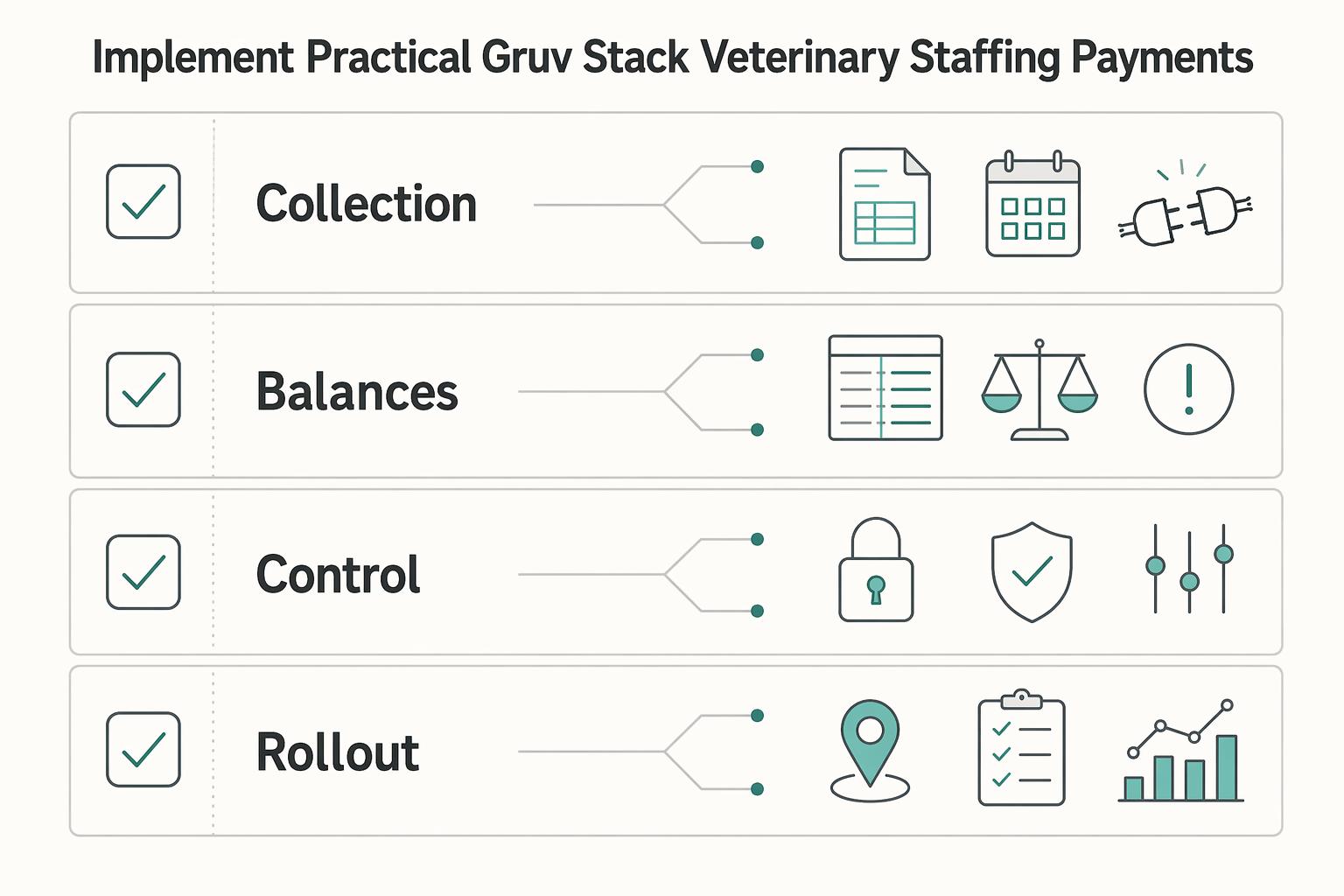
Implement a practical Gruv stack for veterinary staffing payments#
Treat this as a target operating design, not a confirmed feature list. The current evidence does not validate this stack on its own, so convert each layer into a vendor check before moving real money in a pilot.
| Layer | What to verify | Operating note |
|---|---|---|
| Collection | One assignment and one payer record per payment request; if Gruv modules are enabled, verify invoice-link and payment-confirmation flows and server-calculated totals | Manual keying can increase avoidable error risk |
| Balances | Whether the balance view is ledger-derived and whether status updates flow back into ops monitoring | If you cannot reproduce a balance from underlying records, do not use it as a payout decision surface |
| Control gates | What checks can block payout, who can approve balance adjustments, how duplicate payout attempts are prevented, and the audit trail for manual adjustments | Verify idempotent retry controls during the pilot instead of assuming retry safety |
| Rollout | One payer segment and one worker segment first, with end-to-end repeatable reconciliation before expansion | Do not expand until ops can match collection records, posted entries, payment attempts, and exceptions without ad hoc reconstruction |
Step 1 Confirm the collection layer you actually have#
Start by proving that every payment request can be traced to one assignment and one payer record without manual re-entry. If Gruv modules are enabled for your program, verify whether invoice-link and payment-confirmation flows are available, and whether totals are server-calculated from source fields rather than edited at collection time.
That traceability matters in real clinic conditions. The evidence shows teams working across two clinics, handling urgent cases, and balancing diaries, client needs, and clinical priorities. Manual keying can increase avoidable error risk.
Step 2 Build balances from posted records, not dashboard math#
Use balances as a projection of posted money events, not as a standalone profile number. Before rollout, confirm whether your balance view is ledger-derived and whether status updates flow back into ops monitoring.
Keep statuses explicit in pilot operations. Status labels are not interchangeable. If you cannot reproduce a balance from underlying records, do not use it as a payout decision surface.
Step 3 Add control gates before you add volume#
Put controls in front of disbursement. Define in writing what checks can block payout in your program, who can approve balance adjustments, and how duplicate payout attempts are prevented on retries.
Require an audit trail for every manual adjustment, including reason, approver, and linked source record. If idempotent retry controls are available in your setup, verify them during the pilot instead of assuming retry safety.
Step 4 Roll out by segment, then expand#
Roll out one payer segment and one worker segment first, then expand only after reconciliation is repeatable end to end. Expansion should wait until ops can reliably match collection records, posted entries, payment attempts, and exceptions without ad hoc reconstruction.
If you want a cross-vertical comparison at this stage, Payments for Healthcare Staffing Platforms: Compliance and Speed Requirements can be a more relevant reference point than generic recruiting tooling.
If you want a deeper dive, read Nursing Agency Payouts: How Healthcare Staffing Platforms Handle Shift-Based Payments.
Avoid the mistakes that break payment operations in this vertical#
Many failures here come from model assumptions, not code. Keep pricing, contracts, and ledger rules aligned to the veterinary operating model you actually run.
Step 1 Separate recruiting products from money-movement design#
Do not copy recruiting product patterns directly into payout design. The grounded examples show different models. Veterinary Jobs Marketplace publishes job-campaign pricing (USD$240, USD$480, USD$720 for 28-day campaigns). Roo presents both relief coverage and possible full-time hiring, and notes taxes are not taken out for relief veterinarians. Oxilia says it handles fee payments and contract generation. Veterinary Locumotion says employers and professionals deal directly.
Treat those models as operationally distinct. Before launch, define who invoices, who collects, who pays out, and who issues the enforceable contract for each flow.
Verification checkpoint: for each flow, map one signed contract term to one ledger event for invoice ownership, fund receipt, and payout obligation.
Step 2 Split veterinarian and RVT economics on purpose#
Use separate economics for Veterinarians and Registered Veterinary Technicians (RVTs). Market evidence already shows role-specific treatment. Oxilia publishes conversion fees of $8,000 for veterinarians and $4,000 for registered veterinary technicians. It also publishes service-charge tiers by contract duration (25% under 160 hours, 22.5% from 161-420 hours, 20% from 421-800 hours, 17% above 800 hours).
Keep role separation in operations too. AVMA states technicians work under veterinarian supervision and cannot diagnose, prescribe, perform surgery, or do other activities barred by state practice acts. Build separate margin logic, conversion logic, and exception reporting so one role does not hide the economics of the other.
Step 3 Codify conversion triggers in the Locum Contract and billing rules#
If conversion terms are vague, disputes show up after the hiring decision has already been made. Put the trigger in the Locum Contract, then mirror the same trigger in billing rules and invoice review.
A grounded example of structure: Oxilia states conversion after 420 contract hours with role-based conversion fees. Do not assume those exact thresholds apply to your market. Use the same discipline by defining the trigger event, measurement basis, evidence source, and fee outcome in writing.
Verification checkpoint: ops should be able to tell from documents alone whether approved hours, scheduled hours, or elapsed time triggers conversion exposure.
Step 4 Keep Wave for bookkeeping, not as your operating record#
Use Wave as bookkeeping software, not as the core payout operating record. Wave positions itself as double-entry accounting and small-business-friendly bookkeeping, which is useful for finance reporting but does not by itself define assignment-level payout operations.
Keep the platform ledger as the source of truth, then post accounting outputs to Wave as needed. If returns, underpayments, or duplicate disbursement attempts cannot be traced from platform records back to contract terms, approved amounts, and payout status, pause expansion and fix reconciliation first.
Related: IT Staffing Platform Payments: How to Pay Developers and Consultants on Milestone and Retainer.
Make the go-no-go call and use this launch checklist#
Go only when ownership and operating readiness are documented and testable. Eligibility and planning checks should be complete, but payment-model ownership, fee mechanics, and reconciliation standards must also be resolved before launch. If those are unresolved, treat this as a no-go and keep it in research.
Step 1 Lock ownership for each worker flow#
If you plan both Independent Contractor and employed paths, define the operating model for each separately. Document who invoices, who receives funds, who releases payouts, who issues the governing contract, and who handles disputes and exceptions.
Use a simple responsibility matrix plus draft contract language. If ownership on paper does not match finance and support operations, pause launch.
Step 2 Model veterinarians and RVTs separately#
Approve role-specific economics for Veterinarian and RVT instead of one blended model. Keep explicit logic for Service Charge, Hourly Rate, and Conversion Fee by role, with a clear decision owner for changes.
Do not treat missing fee benchmarks as solved. Public amount benchmarks are not established, so unresolved pricing logic is still a launch blocker.
Step 3 Prove your internal reconciliation path before go-live#
Define reconciliation checks as an internal launch bar and test them before go-live. A required reconciliation cadence or standard has not been documented, so confirm your own traceability from payment event to payout eligibility, payout status, and exception state.
If you can confirm payment but cannot confirm whether the professional is payable, paid, or blocked, delay launch until that gap is fixed.
Step 4 Confirm scope, eligibility gates, and review rhythm#
Keep the pilot scope narrow (clinic, hospital, or lab) and document it. Before work starts in any target state or country, verify eligibility and cover logistical prerequisites such as certifications and insurance.
If you are operating across multiple states, document each state explicitly rather than treating it as one generic setup. Revisit goals and launch assumptions every month or so to avoid drift.
Use this checklist before launch:
Segment chosen (clinic/hospital/lab) and documentedRole-specific economics documented (Veterinarian vs RVT)Worker-model ownership documented (invoicing, funds, payouts, contracts, exceptions)Reconciliation checks defined and testableEligibility, certifications, and insurance confirmed for each target state/countryPilot success metrics and stop conditions agreed
If your go/no-go checklist is complete and you need to confirm country and program fit, contact Gruv.
Frequently Asked Questions
How do veterinary staffing platforms usually charge for locum vets versus technicians?
There is no single shared pricing model for both roles. Public examples distinguish relief veterinarians from relief veterinary technicians, and Roo describes dynamic pricing based on market and work type rather than one fixed schedule. Ask each provider to show role-specific pricing logic and contract terms in writing.
Who should pay locum professionals: the clinic directly or the platform?
Either the clinic directly or the platform can pay the locum professional, but ownership should be explicit in a written contract. One model uses an agency to handle shift arrangements and invoicing, while another uses an independent contractor arrangement. Pick one operator of record per flow and define invoicing, payout timing, and dispute handling.
What is a `Conversion Fee`, and when should it apply in a `Locum Contract`?
This guide does not establish a standard conversion fee definition or trigger. If a conversion fee is used, it should be written clearly in the Locum Contract rather than inferred later. Define the trigger event, measurement basis, evidence source, and fee outcome in the contract text.
What usually changes in pricing when contract duration increases?
The public excerpts do not establish one universal duration-pricing rule across platforms. Treat assignment length as a variable you need to confirm in writing for each provider. Ask whether longer contracts change the professional's pay, the clinic charge, or both.
Which payment details are most often missing when evaluating platforms like `Oxilia`, `Roo`, or `HelpTheVet`?
The most common gaps are operational terms such as who invoices, when funds are treated as received, when payout becomes eligible, who handles disputes, and what confirms a worked shift. Roo does provide one concrete timing point by stating payment within two business days after shifts, but that alone does not define full ownership and exception handling. Require written terms for payout timing, cancellations, contract ownership, and any conversion terms.
What is the minimum compliance and reconciliation setup needed before multi-country rollout?
A practical baseline is written contracts for each flow and verification of required registrations and licenses before work begins in a new state or region. Your ledger should tie each assignment to invoice events, funds received, payout eligibility, payout execution, and exceptions. For independent contractor models, confirm insurance posture in advance, including when professionals carry their own cover versus when clinic coverage is confirmed for sporadic locums.
Researched and edited by the Gruv editorial team. Gruv builds cross-border billing, payouts, and finance-operations software for global businesses.
Sources
- apps.legislature.ky.gov/law/kar/registers/51Ky_R_2024-25/10_Apr.pdftrusted
- capitol.tn.gov/Archives/Joint/committees/fiscal-review/arch...trusted
- congress.gov/event/115th-congress/senate-event/LC59064/texttrusted
- congress.gov/114/chrg/CHRG-114shrg21348/CHRG-114shrg21348...trusted
- das.nebraska.gov/materiel/purchasing/6322%20Z1/6322%20Z1%20Sp...trusted
- dlcp.dc.gov/sites/default/files/dc/sites/DLCP/publicatio...trusted
- govinfo.gov/content/pkg/CHRG-114shrg21348/html/CHRG-114s...trusted
- ir.library.louisville.edu/cgi/viewcontent.cgitrusted
Educational content only. Not legal, tax, or financial advice.
Related Posts

The Freelance Payment Penalty: A Modeled Audit of Platform Fees, FX Spreads, and Payout Delays
The money rarely disappears through a single, easy-to-spot fee. The real loss is stacked. A marketplace takes its commission, a processor adds a charge for international cards, a bank or payment company converts the currency at a spread, a platform holds the funds before release, and a wire sheds a little to intermediaries on the way in. Each layer looks defensible on its own, but the worker feels the combined result as a smaller deposit and a later payday.

How to Respond to a Subpoena for Business Records
Move fast, but do not produce records on instinct. If you need to **respond to a subpoena for business records**, your immediate job is to control deadlines, preserve records, and make any later production defensible.

A US Expat's Guide to Investing in UCITS ETFs to Avoid PFIC Issues
The real problem is a two-system conflict. U.S. tax treatment can punish the wrong fund choice, while local product-access constraints can block the funds you want to buy in the first place. For **us expat ucits etfs**, the practical question is not "Which product is best?" It is "What can I access, report, and keep doing every year without guessing?" Use this four-part filter before any trade: