
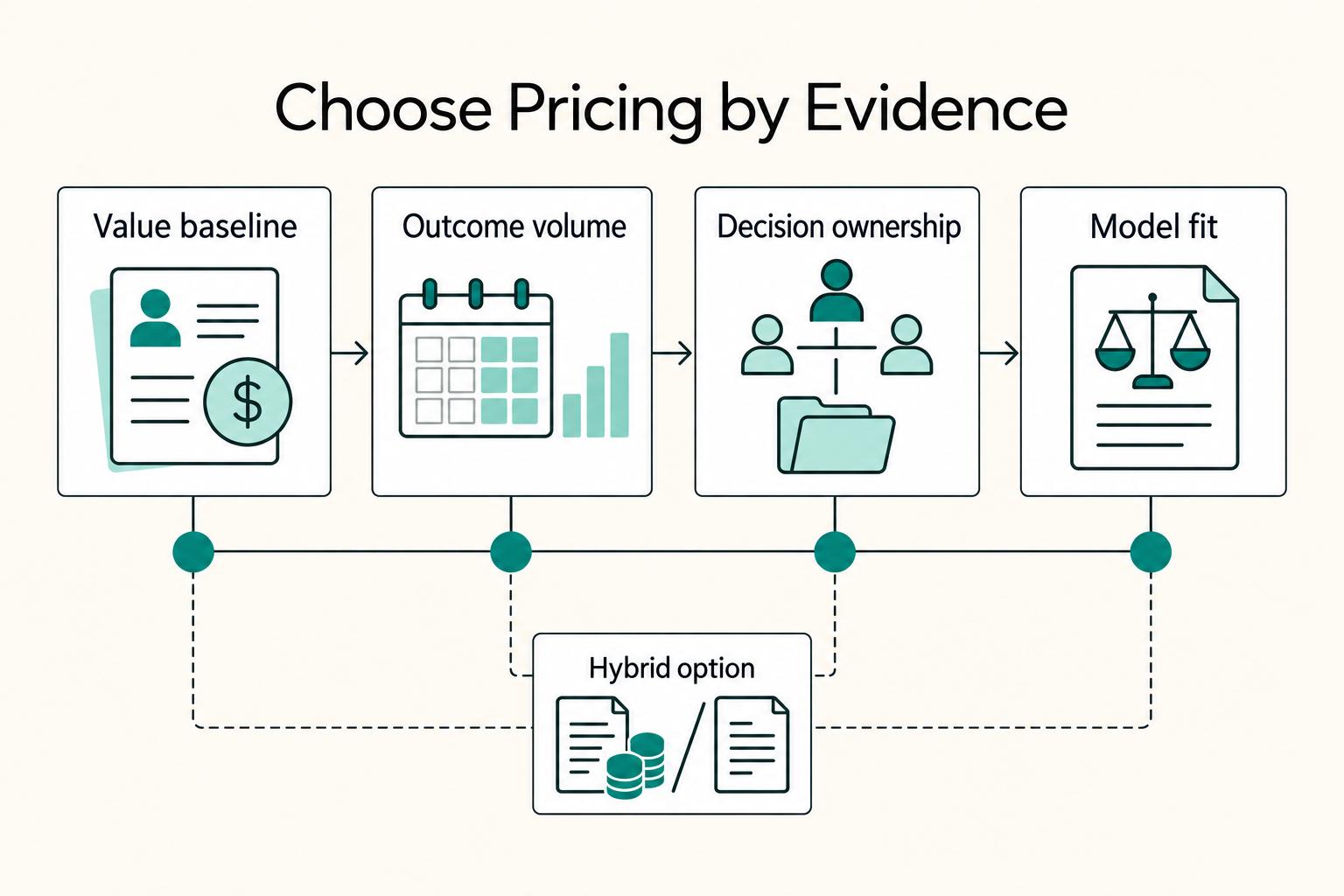
Quick Answer
Estimate the client’s incremental benefit, test willingness to pay and compare your delivery cost and risks before quoting. A fixed fee informed by value is not automatically a success fee. Define scope, acceptance, invoice triggers and approved change terms; use bounded discovery when the evidence is weak.
Tie pricing to a named result and clear checkpoints before kickoff#
Value-based pricing starts with the client’s expected benefit and willingness to pay. It still needs a deliverable, scope and payment agreement you can perform. Use a discovery phase when the benefit or effort is too uncertain to support a defensible quote.
Hourly billing charges for time. Value-based pricing is a way to set the price; it does not automatically make payment contingent on a result. Distinguish a fixed fee justified by expected value from a success fee payable only when an agreed outcome occurs.
For freelance engagements that may use value-based pricing, settle five points early:
- pricing model choice and why it fits current uncertainty
- target outcome and what done means in practice
- delivery expectations and approvers
- invoice and confirmation steps before work starts
- record location for key documents and approvals
Think of this as one chain. Pricing sets assumptions. Scope turns assumptions into commitments. Payment checkpoints verify progress. Records preserve what both sides accepted. If any link is weak, confusion in one stage leaks into the next and usually surfaces when money is due.
Before production starts, run one alignment test in plain language. Ask the client to restate the target outcome, approval owner, and first billing checkpoint in their own words. If their summary does not match yours, fix it before work begins.
Consistency matters. When every engagement starts with the same sequence, weak assumptions surface earlier and are easier to correct. If you are moving away from hourly billing, Moving From Hourly to Project-Based Rates is a useful companion. Related: Raising Your Rates: How to Do It Without Losing Clients.
Define value-based pricing before you price anything#
Value-based pricing uses expected customer value and willingness to pay rather than estimated hours alone. This guide focuses on a fixed project fee informed by that value. A fixed fee can also be set from costs or market comparisons, so billing format and pricing basis are separate choices.
That difference changes incentives. Under hourly billing, faster delivery can reduce revenue even when the client gets a better result. At $50/hour, 20 hours yields $1,000; the same outcome in 2 hours yields $100. When expertise shortens execution, hourly math can reward slower work.
That does not make hourly billing wrong. It means you should be honest about what the model is actually paying for. If the project is mostly uncertain effort, hours may be the cleanest proxy. If the project has a clear business target and your work can materially influence it, a fixed fee tied to expected value can make more sense.
Use “value-anchoring” here to mean explaining the quote against the client’s expected benefit and alternatives. The comparison should be supportable. It is not permission to invent a higher price solely to make your quote look cheaper.
Before you send a proposal, force clarity with a short qualification check:
- ask for a baseline: what is this problem costing now in missed revenue, rework, or wasted time
- confirm the target result is measurable enough to judge progress
- confirm your work can materially influence that result
- decide whether value-linked pricing actually fits this engagement now
A practical way to stay disciplined is a one-page pricing brief. Put baseline assumptions, expected result, known constraints, and approval owner in one place. That is not extra ceremony. It is a simple way to stop the deal from drifting into fuzzy promises once the work starts.
You can also spot risk early with three quick checks. Baseline numbers that change every call, unclear approval ownership, or pressure to guarantee outcomes you do not control all point to the same problem: the price may look precise while the deal is still unstable. Any one of those is enough reason to tighten the structure before you quote.
Keep supporting evidence where pricing decisions actually happen: proposal copy, estimate notes, email recaps, and call summaries. You are not trying to prove certainty. You are showing why the current quote is reasonable under current assumptions.
Projected profit should inform your price, not turn into a promise. A strong quote reflects expected value and known risk while acknowledging that outcomes are never fully under your control.
Decide when value-based pricing is the wrong model#
Do not force pure value pricing onto a project no one can price honestly. Weak baseline data can make a number look precise while hiding major uncertainty.
Start with two grounding questions. What is one new customer worth to this client? What outcome volume is realistic during the engagement window? If answers stay vague, contradictory, or politically sensitive inside the client team, treat the value math as provisional and use a lower-risk structure.
In practice, political uncertainty inside the client team can matter as much as analytical uncertainty. If teams cannot agree on baseline numbers or ownership, your quote becomes a proxy for internal debates you cannot resolve. That is a strong signal to narrow the first phase and protect both sides until decision rights are clear.
Consider a hypothetical acquisition project: 100 additional customers at $2,000 revenue each imply $200,000 gross revenue. At a 30% contribution margin, that is $60,000 before the project fee and other relevant costs. If only half the customers are incremental rather than buyers who would have arrived anyway, attributed contribution is $30,000. A $6,000 fixed fee might be discussed against that estimate, but it is not a standard percentage or a promise of $30,000 profit.
When value estimates are credible, use them to inform the fee. When they are weak but scope is stable, build a fixed quote from estimated effort, costs, and a risk allowance. When both value and effort are unclear, agree a bounded paid discovery phase or capped time-based work before quoting delivery. A fixed fee can use either a value-based or cost-based pricing basis.
Check your delivery floor as well as client value. In the hypothetical example, 40 hours at an $80 loaded hourly cost plus $1,000 of direct expenses total $4,200. A $6,000 fee leaves $1,800 before other costs and overruns. If the work cannot be delivered within that scope, revise the offer even if the client’s expected benefit is high.
That phased approach is usually easier for buyers too. A bounded first phase gives both sides concrete data on approvals, delivery pace, and implementation follow-through before larger outcome-linked pricing enters the deal. It also lets you test whether the client can support the kind of measurement this model needs.
Use one readiness checkpoint before quoting. Ask the client to restate the expected result, name the owner on their side, and confirm the approval path. If that recap is inconsistent, tighten the model before you finalize price.
Pick the pricing model with explicit tradeoffs#
Pick the model you can still defend when assumptions are challenged. Pricing conversations go better when your logic is explicit instead of implied.
| Model | What it prices | Main tradeoff | First checkpoint |
|---|---|---|---|
| Hourly rates | Time spent | Clear link to effort, but can understate impact when results create value beyond hours worked | Confirm whether time is the right proxy for value in this project |
| Cost-plus pricing | Your costs plus a markup | Straightforward from an internal-cost view, but can miss the full value of the outcome to the client | Confirm which costs are included and why the markup is set at that level |
| Value-based pricing | Expected customer benefit and willingness to pay | Requires credible assumptions and a feasible delivery scope | Test the benefit estimate, client alternatives, budget and your cost floor |
No model removes risk. The real choice is where uncertainty sits and how visible that uncertainty is to both sides.
A common failure mode is mispricing in either direction. If you price too low, margin disappears when complexity rises. If you price too high on weak assumptions, trust erodes when outcomes do not track projection. Both problems are easier to prevent when assumptions are named before the quote goes out.
Once you select a model, show your reasoning in sequence: what uncertainty is highest now, which model contains that uncertainty best, and what would justify switching later. That sequence helps clients evaluate the tradeoff without feeling cornered by pricing language.
Do not leave model choice implied. Before you send pricing, confirm four points in writing:
- chosen model and why it fits this stage
- assumptions required for the model to hold
- rationale supporting the number today
- trigger events that require repricing
Write scope terms that stop margin leaks#
Most margin leaks start with vague scope, not bad intent. When scope terms are loose, small requests pile up until the project no longer matches the price.
Tie every scope boundary to a decision point: what is included now, what is deferred, and what needs formal change approval. Also state what happens when client-side dependencies arrive late, so delays do not quietly expand your obligation.
Keep the boundaries close to delivery reality. If acceptance depends on client assets, approvals, or implementation steps, say that in the same place you describe the deliverables. If those dependencies live somewhere else, people miss them and later treat them as surprises.
If you want a deeper dive, see How to Calculate Your Billable Rate as a Freelancer. To turn pricing notes into a reusable client draft, use the Freelance Contract Generator.
Protect cashflow with payment terms before kickoff#
Cashflow problems usually start before the first deliverable goes out. If payment checkpoints are vague at kickoff, approvals and invoices drift later.
Define each payment checkpoint with the deliverable or billing event, authorized reviewer, review deadline, invoice submission route and payment period. State how rejected work is identified and corrected. Acceptance and payment should not depend on an open-ended approval queue.
Use one pre-kickoff clarity check on every project:
- start condition is documented and confirmed
- each handoff maps to a clear checkpoint
- approval owner is named for every checkpoint
- support path is clear before launch
- pause and restart conditions are written in plain language
A common failure mode is starting execution while terms still conflict across channels. That creates avoidable friction once expectations drift. Set one rule and enforce it: no start until the start condition is met, and no next phase until the current checkpoint is complete.
When friction appears, use documented checkpoints instead of memory. Add a short reconciliation step after each checkpoint so delivered output, acceptance record, and next action all use the same stage label. Include invoice confirmation in that same step so finance and delivery stay synchronized.
Confirm approvers before kickoff as well. If the reviewer cannot authorize the next stage, delays are likely. Naming authority early is a practical cashflow control, not just project hygiene.
Sell outcomes without creating legal exposure#
Lead with the business result, but only commit to what you control. You can price around expected value without promising guaranteed revenue.
The cleanest method is to split proposal language into two lanes from the start. Lane one covers controllable outputs: deliverables, revision boundaries, acceptance criteria, and payment checkpoints. Lane two covers expected impact: business results that also depend on client execution and external conditions.
Use that split in every proposal:
- controllable outputs, revision limits, and acceptance criteria
- payment checkpoints, including deposit and deliverable-based billing
- client responsibilities for approvals, assets, and implementation
- external variables such as seasonality and market shifts
- clear language that price reflects expected value, not guaranteed revenue
Used well, value pricing can improve positioning. Lead with expected impact, then connect the fee to clearly defined scope. That keeps the discussion out of pure hourly negotiation, where clients may push down both rate and estimated hours and where faster execution can shrink the billable total.
A simple wording pattern helps when negotiations get tense: we commit to specific deliverables and checkpoints, and we estimate impact based on current assumptions and shared responsibilities. This keeps the offer confident without creating accidental guarantees.
Apply the same split everywhere the deal is documented. Proposal text, estimate details, email recap, and call summary should tell the same story. If assumptions change mid-project, update them in writing and route any scope or price adjustment through the agreed change path.
When a client asks for guarantees, return to measurable checkpoints and shared responsibilities. That keeps the deal concrete and protects the relationship if conditions change. It also gives you a clean handoff into fallback terms, because you can point to the exact assumption, dependency, or acceptance step that moved.
Handle uncertainty with fallback clauses clients accept#
If the deal depends on everything going right, it is not ready. Fallback clauses only help when both sides accept them before anything slips.
| Fallback element | Details |
|---|---|
| fallback pricing path | Define which events trigger repricing or a move to another billing model |
| staged acceptance for milestone billing | Split delivery into checkpoints and define what each checkpoint must include |
| change-approval gate | Require written approval before extra work starts |
| delay response path | If client delays pass the agreed limit, use a documented schedule reset and payment-plan review |
Write for failure paths, not just best-case delivery. Trigger language should be observable so decisions do not depend on reading intent or debating tone.
To keep restarts clean, add a phase gate before work resumes:
- prior checkpoint documented
- invoice and schedule status current
- scope changes approved in writing
If any item is missing, pause the restart. Missing checks turn into scope, payment, or dispute problems faster than most teams expect.
A fallback could allow a schedule reset after a defined client delay, then require a written change agreement for any additional standby fee or expanded scope. State whether work may pause, required notice and restart conditions. A changed forecast alone does not let either side unilaterally rewrite the price.
Keep the clauses short enough to read aloud at kickoff. If you cannot explain a term quickly, simplify it before signature so it can still be used under pressure. Simple terms both sides can apply beat dense terms nobody executes.
Set up cross-border compliance checks before money moves#
In cross-border work, late verification is one of the fastest ways to delay payment. Run compliance checks before money moves, not after delivery is underway.
Treat compliance as a pre-payment gate. Confirm what the payer, platform, or client requires before contract signature, then mirror those requirements in the contract and invoice details. Requirements vary, so the practical answer is explicit documentation.
- Contracting, invoicing and receiving entities are identified, with any authorized separate payer role documented
- core contract and invoice details are collected early and kept consistent
- requested identity or business checks are logged when required
- minimal evidence pack is maintained with contract status, invoice metadata, and approval trail
The checklist only works if someone owns it. Assign who requests each document, who verifies completeness, and where records are stored. Without named owners, compliance steps become last-minute admin that blocks payout.
Verify the contracting, invoicing and receiving roles, then confirm the required account setup and verification steps. An authorized affiliate payer or payment agent may have a different name; document the relationship instead of treating every difference as a defect.
If a required check is still incomplete near payout, pause scheduling and reset dates in writing. That protects expectations on both sides and keeps delivery from outrunning payment readiness.
Keep a short client note with required document status, open items and the next owner. Use consistent legal identifiers and record any legitimate payer or account-name differences so the payment reviewer can resolve them.
When payment timing depends on external verification, reflect that dependency in delivery plans and client communication. Clear dependency notes reduce confusion when schedules shift.
Keep records clean from invoice to payout#
A clean record trail protects you when payment or tax questions appear. You should be able to answer from records, not memory.
Keep the agreement, scoped deliverables, change approvals, invoices, acceptance records and transfer references in one project file. Link each receipt to the invoice it settles and record unresolved differences, separately posted fees and any agreed adjustment.
When exceptions happen, log what changed, why it changed, and who approved the change. The note can be brief, but keep it next to the related record so future reviews have context.
For multiple accounts or payment methods, map each provider reference and bank receipt back to the invoice. Provider and bank identifiers may differ; keep the mapping rather than force one label onto every system.
At project close, archive a dated snapshot of the final record set. That makes later audits and tax preparation faster because you can refer back to the exact state used at handoff.
Frequently Asked Questions
What is value-based pricing for freelancers?
Value-based pricing sets the fee using expected client value and willingness to pay. This guide uses a fixed project fee informed by that value. Payment is due under the agreed billing terms; it is contingent on a business outcome only if the contract expressly creates that condition.
Is value-based pricing always better than hourly billing?
No. Each model solves a different problem and carries a different tradeoff. Hourly billing can be the cleaner choice when effort is still uncertain. Value-linked pricing can better reflect impact when outcomes are measurable and your work can materially influence them.
How do I calculate value-based pricing when projected profit is uncertain?
There is no universal formula that removes uncertainty. Build a defensible quote from the evidence you have, state assumptions clearly, and document what would change the price.
When should I use a cost-based quote or paid discovery instead of value-based pricing?
When expected value is poorly evidenced but scope is stable, use a fixed quote based on estimated effort, costs, and a risk allowance. If effort is also uncertain, start with bounded paid discovery or capped time-based work. Fixed-fee describes the billing format; it can use a value-based or cost-based pricing basis.
What is the difference between value-pricing and value-anchoring?
This article does not rely on a universal technical definition, so keep the distinction practical. Value-pricing is the fee decision. Value-anchoring is how you frame that fee so the client evaluates likely outcomes instead of only time.
How do I move from hourly billing to value-based pricing without hurting cashflow?
Shift in phases instead of all at once. Keep hourly, daily, or weekly terms for high-uncertainty work while you pilot value-linked pricing in engagements with clearer baselines and acceptance paths.
Try a related tool
Researched and edited by the Gruv editorial team. Gruv builds cross-border billing, payouts, and finance-operations software for global businesses.
Sources
Includes 1 external source outside the trusted-domain allowlist.
Educational content only. Not legal, tax, or financial advice.
Related Posts
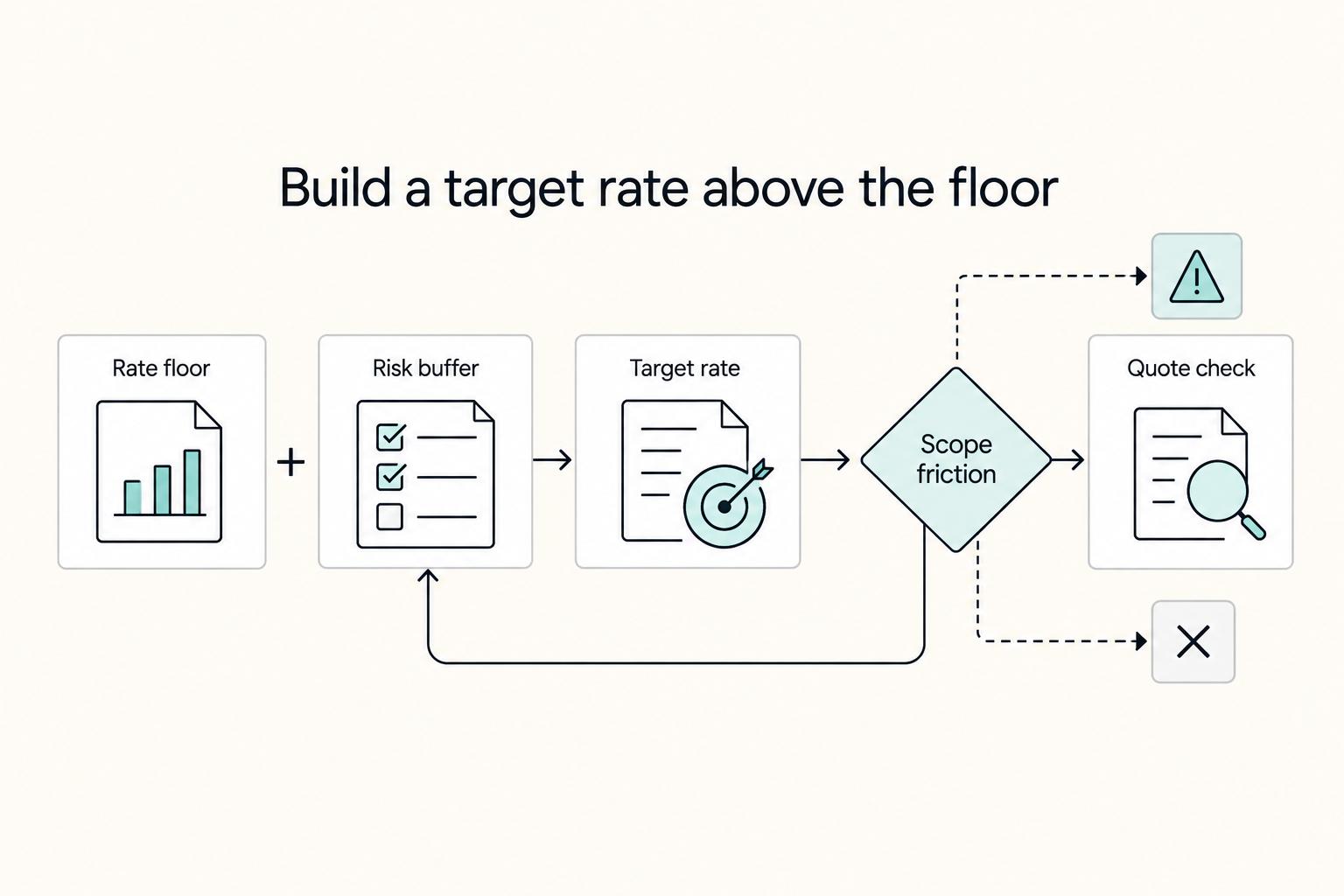
How to Calculate a Freelance Rate You Can Actually Get Paid On
A workable rate is not the neat number a calculator produces. It is the number that still works after you account for real billable capacity, non-client time, scope drift, and the gap between sending an invoice and receiving cleared cash. Start with hourly math even if you do not plan to bill hourly, then turn that number into a quote with clear `payment terms`.

Raising Your Rates: How to Do It Without Losing Clients
A rate change needs a clear proposal, an agreed effective date, and matching billing records. You cannot guarantee retention, but you can help clients assess the change without guessing.
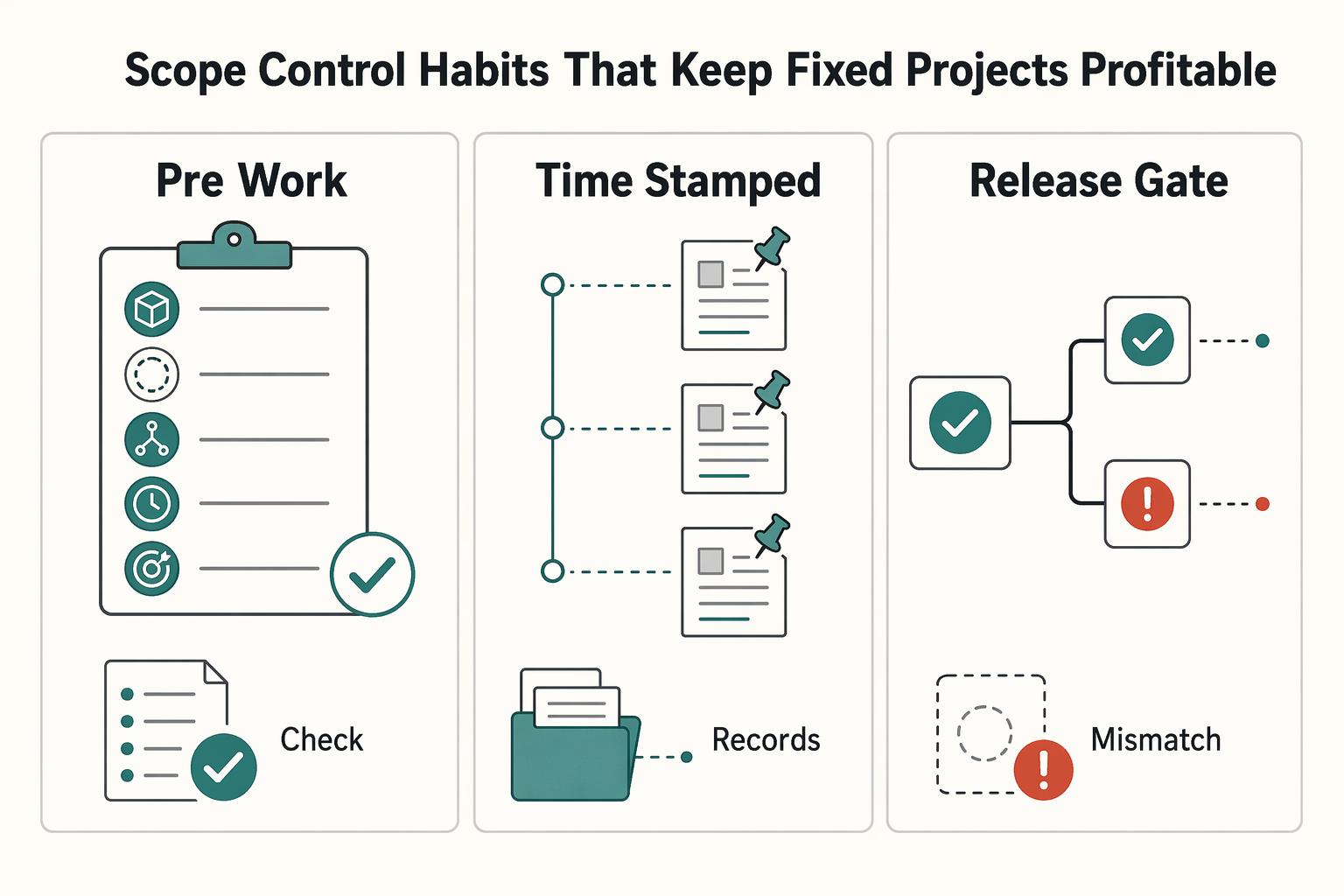
Moving From Hourly to Project Rates Without Hurting Cashflow
The right pricing model matches uncertainty and cashflow risk. It should fit how clearly the work can be defined, approved, and defended, not just what you are used to selling. Hourly billing gives you room to work while requirements are still moving. Fixed project pricing gives the client stronger budget clarity once deliverables are stable enough to pin down.