
Quick Answer
Choose based on economics, not reputation: in toptal vs fiverr vs peopleperhour, use Toptal for higher-screening specialist work, Fiverr for fast packaged tasks, and PeoplePerHour only after live policy checks. The article’s core rule is to verify pricing pages, Terms of Service, escrow flow, and dispute steps before approval, then run a small pilot to test rework and delivery friction before scaling.
Compare platforms by economics, not reputation#
Most comparisons of Toptal, Fiverr, and PeoplePerHour start with reputation, talent labels, or surface pricing. That is usually the wrong place to begin. The real decision is economic design: who absorbs fees, how matching happens, where payment friction sits, and how those mechanics can show up in your margin, delivery speed, and rework cost.
| Reference | Date | Use in decision |
|---|---|---|
| Comparison source readers still find in search | 14 September 2021 | Discount any claim that is not confirmed in current platform docs |
| Buyer-oriented guide | 7 March 2026 | Warns fee structures change frequently and should be verified on official pricing pages |
| Summary dated Dec 31, 2025 | Dec 31, 2025 | Helps classify platform shape; does not replace live Terms or payment documentation |
| Summary dated March 14, 2026 | March 14, 2026 | Helps classify platform shape; does not replace live Terms or payment documentation |
That buyer-side framing matters because many platform guides are written for freelancers, not the team trying to hire. A recent hiring-focused guide makes that distinction clearly: buyers need to understand how platform design changes what they actually pay. If you are a founder, revenue leader, product owner, or finance operator, the useful question is not which brand feels stronger. It is which model still works when procurement, delivery, and finance all touch the same spend line.
You also need to separate headline pricing from total hiring cost. External guides warn that the first number you see may exclude other costs, including fees that are not obvious in the listed rate. That is where teams get caught. A platform can look efficient on the first transaction and still create margin drag through fee pass-through and other non-headline costs as work repeats and scopes expand.
So treat platform choice as a policy and unit economics decision, not just a sourcing decision. Before anyone commits budget, save the current official pricing page, note the date, and pull the live pricing or payments documentation you are relying on. If leadership cannot point to those documents in a review, the comparison is not finished. A summary article can help you shortlist, but it should not be your final evidence pack.
It is also worth calling out evidence quality early. One comparison source readers still find in search was published on 14 September 2021. A more buyer-oriented guide was published on 7 March 2026 and explicitly warns that fee structures change frequently and should always be verified on official pricing pages. That does not make older comparisons useless, but it does mean you should discount any claim that is not confirmed in current platform docs.
The goal here is practical. We will connect marketplace mechanics to unit economics, execution risk, and operational fit so you can defend the choice in a pricing review, a P&L discussion, or a launch plan. If your team has low tolerance for cost ambiguity, start with verification, not brand reputation.
Use the full comparison guide when you need a separate example of ranking options by evidence instead of reputation.
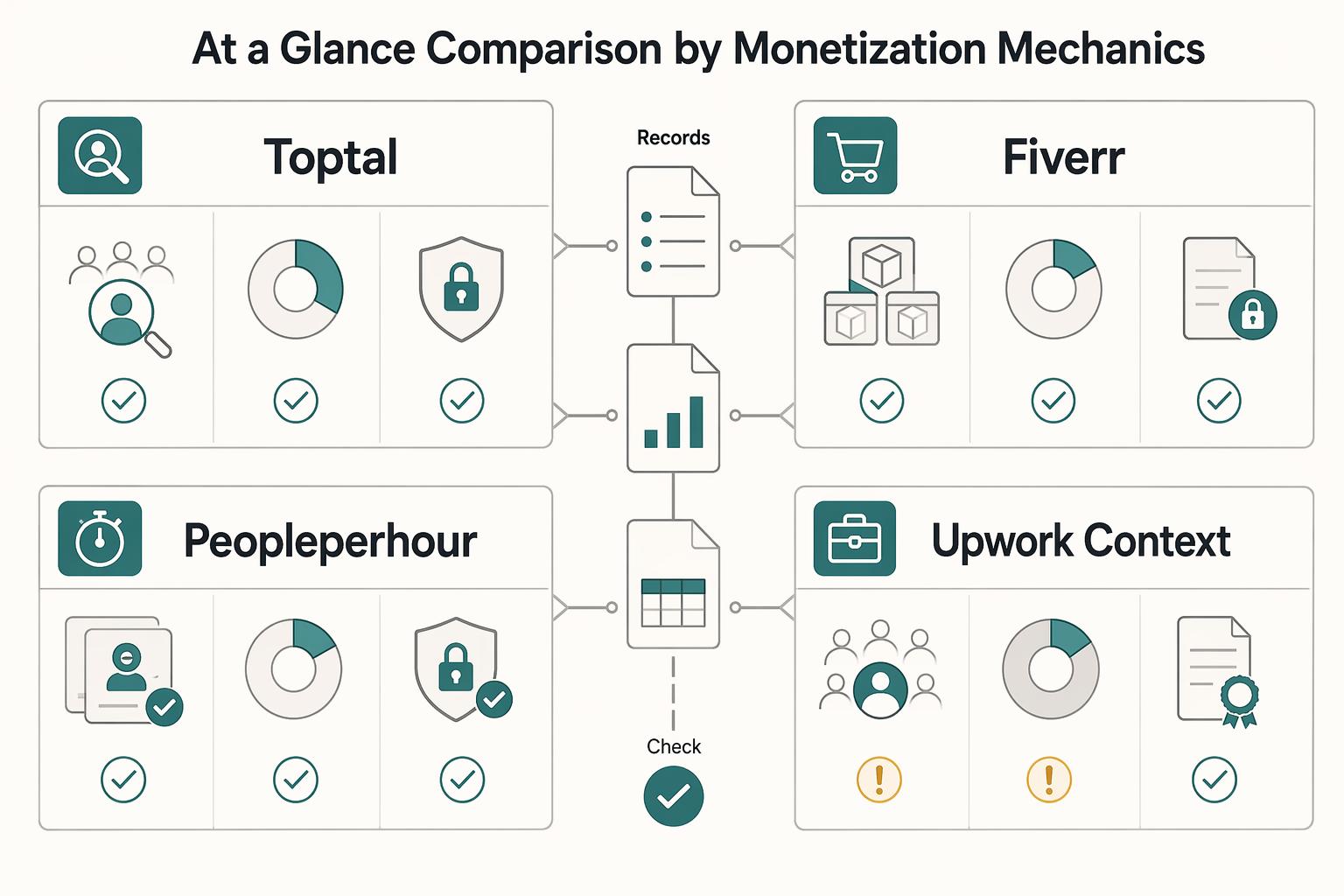
At a glance comparison by monetization mechanics#
The practical split is model mechanics, not brand: Toptal is screening-led, Fiverr is packaged and project-based, and PeoplePerHour remains a verify-before-commit option based on this evidence pack. For decision-making, focus on who filters supply, where fees land, and how payment protection is actually implemented.
| Platform | Model type | Fee payer | Escrow model | Quality filter | Best-fit use case | Known vs unknown |
|---|---|---|---|---|---|---|
| Toptal | Curated marketplace positioned around vetting and exclusivity | Treat as unconfirmed; verify current pricing, Terms, and payment docs | Not confirmed | Screening-led positioning is supported | Specialist work where you want stronger upfront filtering | Known: vetting/exclusivity positioning. Unknown: fee split, payment release flow, dispute path |
| Fiverr | Project-based marketplace with gig-style packaged services and instant-purchase workflows | Fees/commissions are part of platform economics, but payer-side split is not confirmed | Verify Fiverr-specific escrow/release rules directly | More open discovery model | Fast, clearly scoped tasks | Known: packaged project-based model. Unknown: exact fee allocation, escrow details, dispute mechanics |
| PeoplePerHour | Treat as mixed marketplace behavior until live docs are checked | Verify tiered fee behavior in-app | Exact escrow or milestone rules are not confirmed | Screening depth is not established in current evidence | Middle-lane option only after policy verification | Known: summaries here are insufficient for policy-level decisions. Unknown: fee tiers, payment protection rules, filtering depth |
| Upwork (context benchmark only) | Proposal/bidding-driven benchmark for category context, not the core decision in this section | Not assessed here | Not assessed here | Not assessed here | Useful reference if your team is used to proposal workflows | Known: proposal-driven mechanics are a distinct model. Unknown: current platform specifics are outside this section |
Use the table as a filter, not as contract proof. Recent summaries (including pieces dated Dec 31, 2025 and March 14, 2026) help classify platform shape, but they do not replace live Terms or payment documentation for fee responsibility and dispute handling.
Decision rule:
- Toptal: choose when stronger pre-screening is worth the tradeoff.
- Fiverr: choose when packaged buying speed and scoped execution are the priority.
- PeoplePerHour: shortlist only if your team will verify current fee tiers and payment rules first.
- Upwork: use as a proposal-driven benchmark, not a shortcut choice in this comparison.
If leadership has low tolerance for fee ambiguity, do not choose from summaries alone. Verify the current Terms and payment docs first, then decide.
For another marketplace-style vendor screen, see The best 'book cover design' services for indie authors.
How each platform design changes your margin profile#
Your margin risk comes less from headline rate and more from where platform economics show up: total buyer cost, freelancer net pay pressure, and the operational overhead around payment protection and disputes.
Margin shape by marketplace#
Three distinct patterns emerge. Fiverr fits a gig-based, packaged model that can speed transactions and support project-based work. Toptal fits a premium curated model that is quality-oriented but can carry a higher cost fit for buyers. PeoplePerHour requires direct verification before modeling fee behavior or repeat-work economics confidently.
| Platform | Margin pressure tends to show up in | Upside for margin | Common squeeze point | What to verify first |
|---|---|---|---|---|
| Fiverr | Packaged project pricing and service-fee effects on effective hire cost | Faster transaction flow and lower bidding friction | Packaged buying may be less suited to long-term hiring | Current pricing page, freelancer/client fee language, custom-offer and repeat-work terms |
| Toptal | Total buyer cost for curated talent access | Lower sourcing and vetting burden for quality-sensitive work | Higher-cost fit can be hard to justify for lower-stakes work | Client pricing terms, matching/replacement terms, payment docs |
| PeoplePerHour | Unknown until live docs are reviewed | Potential middle-lane option if live terms support repeat work | Margin assumptions are weak without confirmed fee and policy details | Official pricing page, Terms of Service, payment protection and dispute pages |
Use a simple operating rule: model only what is confirmed in live platform documents, and treat unverified fee behavior as downside risk, not planned margin upside.
Escrow helps confidence, but it is not friction-free#
Escrow or similar payment-protection flows can improve confidence, but they can also add process cost through release steps, evidence handling, and dispute workflows. That overhead matters more when scope changes after work starts.
The verification step should be routine and exact: save the official pricing page, Terms of Service, and payment/dispute documentation as dated PDFs before approval. A guide published on 7 March 2026 (noted as current as of early 2026) explicitly warns that fee structures change frequently and should be verified on official pricing pages before contracting.
For repeat work, avoid assuming margin improves automatically. If fee behavior or protection mechanics are not confirmed in current docs, treat that upside as unproven.
For more on platform terms, see Analyzing the Terms of Service for Upwork and Fiverr: What Freelancers Miss.
Quality control and matching depth in practice#
The practical decision is who carries screening risk. If a bad match would create expensive rework, use the platform posture built around screened talent and lower buyer-side vetting; if the task is tightly scoped and easy to judge from samples, open discovery can work, but more quality control stays with you.
Toptal is best treated as the curated, screened option in this comparison. The grounded signal is the pipeline effect of screened talent, not any quantified pass rate. Fiverr and PeoplePerHour are safer to treat as open-discovery environments where your brief quality, sample review, and selection process drive outcomes.
| Platform | Matching posture | Buyer effort | Risk to watch first | What to verify live |
|---|---|---|---|---|
| Toptal | Curated, screened positioning | Lower buyer screening load | Speed/cost tradeoff on simpler work | Current client terms, rematch/replacement language, trial process |
| Fiverr | Open marketplace discovery | Higher buyer-led screening | Quality variance and rework if scope is vague | Portfolio depth, revision rules, custom-offer handling |
| PeoplePerHour | Open marketplace discovery | Higher buyer-led screening | Quality variance until docs are verified | Current Terms, dispute flow, escrow/payment docs |
Use matching model as a risk map, not a winner label. Curated positioning can reduce variance risk; open discovery can reduce speed risk for standardized tasks if your acceptance criteria are clear. For PeoplePerHour, avoid strong assumptions on matching depth until live documentation confirms current behavior.
A simple operator check is to run the same brief across platforms and compare time to first acceptable candidate, number of profiles screened, first-delivery acceptance, and revision rounds. Keep your brief, scoring notes, and rejection reasons so rework risk is measured from your process, not inferred from summaries.
Treat SERP commentary and community threads (including Reddit and r/Freelancers) as directional sentiment, not operational proof. Even recent summaries like Emelia (updated Feb 25, 2026) and Jobbers (published 7 March 2026) still point back to official platform pages because fee, feature, and policy details change. Use secondary commentary to form questions, then verify answers in live terms and support docs before rollout.
For a step-by-step walkthrough, see Choosing Between Subscription and Transaction Fees for Your Revenue Model.
Where competitors are thin and what to verify before rollout#
Before you commit to a platform choice, treat SERP summaries as directional, not policy. The recurring gap in competitor content is evidence quality: forum complaints are sentiment, listicles are broad framing, and unstable source access can leave key details unverified.
| Item | What to verify | Source to check |
|---|---|---|
| Terms of Service | Current governing terms and linked support pages | Current official docs |
| Dispute mechanics | Who can open disputes, what evidence is required, and how funds may be handled | Current official docs |
| Payout timing | Release conditions and any hold or delay language | Current official docs |
| Search visibility rules | Ranking, placement, and profile/review requirements | Current official docs |
A Hacker News thread (Nov 4, 2017, 344 comments) includes a claim about milestone payment reversal, but it is a dated community discussion rather than policy documentation. ServiceList is a dated alternatives roundup (September 17, 2023). Verify current PeoplePerHour policy terms directly on the platform before relying on any of these sources.
Before rollout, verify these items in current official docs for Toptal, Fiverr, and PeoplePerHour:
- Terms of Service: current governing terms and linked support pages
- Dispute mechanics: who can open disputes, what evidence is required, and how funds may be handled
- Payout timing: release conditions and any hold or delay language
- Search visibility rules: ranking, placement, and profile/review requirements
Use a strict evidence checkpoint: if a claim comes only from YouTube or online summaries, mark it unverified until it matches an official page, then save the URL and access date. The common failure mode is approving a clean comparison narrative, then discovering live terms are narrower or more conditional than the summary implied.
When platform choice affects recurring economics, compare it with the finance framing in ARR vs MRR for Your Platform's Fundraising Story.
Scenario recommendations by business type and hiring motion#
Use Toptal when failure cost is highest, use Fiverr when speed of testing matters most, and treat PeoplePerHour as a verify-first middle option rather than an assumed default.
The support for that routing is directional, not absolute. A Fiverr resource positions Toptal as access to the "top 3% of freelance talent" and says that model can fit "large budgets and complex technical needs." That is enough for first-pass routing, but not enough to skip pilot validation on your specific work.
Practical routing rules#
- Use
Toptalfor high-stakes specialist work when you want to reduce buyer-side screening loops and can accept a premium posture. - Use
Fiverrfor fast offer-market tests, smaller scoped outputs, and packaged buying patterns where speed beats perfect variance control. - Keep
PeoplePerHouron the shortlist only if you verify current Terms, payment protection flow, dispute steps, and latest update dates before scaling spend. - For procurement-led teams, run two lanes: premium work on Toptal, volume work on Fiverr or a verified PeoplePerHour setup, then compare blended margin.
Scenario matrix#
| Business type | Choose | Over what | Because |
|---|---|---|---|
| Early-stage startup | Fiverr | Toptal | Fast testing of offer, channel, and positioning usually matters more than deep curation at this stage. |
| Early-stage startup with critical build risk | Toptal | Fiverr | If one specialist miss can delay launch or trigger expensive rework, lower screening burden is worth paying for. |
| SMB agency | PeoplePerHour or Fiverr | Toptal | Mixed project sizes often fit broader marketplace coverage better than a premium-only lane, but repeat-job economics must be tested. |
| Enterprise team | Toptal | Fiverr | When internal sourcing cycles are costly, specialist-focused routing is often easier to justify than lowest entry price. |
| Solo founder | Fiverr | Toptal | Small, concrete deliverables are usually easier to scope and buy in packaged format. |
Hidden cost risk is real, so do not approve rollout from summaries alone. One third-party comparison presents client marketplace fees as both 3-5% and "up to 7.99%" in the same excerpt, which is exactly why official pages must be your decision source.
Use a minimal evidence pack before commit:
- current Terms or pricing URL for each platform
- dispute and payment-protection help URL
- last-updated date on each page
- pilot results from one premium project and one volume project
Decision rule: pick the platform that minimizes your most expensive failure mode, not the one with the cleanest marketing narrative.
For the freelancer-side structure decision behind some hiring models, use How to Choose the Right Business Structure for Your Freelance Business.
Common failure modes that break the business case#
Most business cases break when teams price only the visible fee and ignore operating cost. Treat platform policy, matching model, dispute path, and internal screening labor as part of total cost, and assign one owner to verify current Terms and support docs before scaling spend.
The first mistake is fee-first comparison. Small percentage differences can disappear once you include rework, failed matches, dispute handling, and buyer-side filtering time. In open-marketplace conditions, teams may sort through very large proposal pools, and that screening effort is a real cost if a PM, recruiter, or founder is doing it.
Escrow-style protection is another place teams undercount effort. For fixed-price jobs, funded escrow can reduce payment risk, but you still need time for funding checks, release steps, and dispute handling when scope gets messy. Anecdotes from Reddit, LinkedIn, or Quora can be useful warning signals, but they are not policy truth and should not replace official docs.
| Failure mode | What teams assume | What actually breaks | What to verify |
|---|---|---|---|
| Fee-first comparison | Lowest visible fee wins | Rework, screening time, and failed matches erase savings | Current Terms, pricing page, and who absorbs review time |
| Interchangeable marketplace view | Upwork, Fiverr, and PeoplePerHour work the same | Buyer effort changes by model (curated, packaged, open) | Search flow, proposal volume, scope format, dispute/help docs |
| Social-proof overreach | Reddit/LinkedIn threads reflect current rules | Community posts are anecdotal and may be outdated | Official help URLs and last updated date |
| No policy owner | Terms are stable enough | Silent margin drift as rules/processes change | One accountable owner with a dated evidence file |
A second failure is treating unlike platforms as interchangeable. Fiverr can fit fast, scoped buying; curated models like Toptal shift effort differently; open marketplaces can require more self-screening. If you flatten those differences, the cheapest option on paper can become the most expensive in execution.
Before rollout, save the live Terms URL, dispute or payment-protection URL, and last updated date for each shortlisted platform. If no one owns that file, you do not have a stable business case.
For the trust side of marketplace choice, read The 'Trust Vacuum': Why Freelancers Distrust Platforms like Upwork and Fiverr.
Decision checklist finance and product teams can use this week#
Use a one-page, evidence-backed decision sheet and approve only the platform choice supported by current official policy docs. If costs are close, choose the option with lower execution risk and clearer policy language.
Start with one primary goal, not four: faster fill, higher quality certainty, lower blended cost, or repeatable delivery velocity. Finance and product should agree on that tie-breaker before comparing fees.
Build the one-page sheet#
Put Toptal, Fiverr, and PeoplePerHour on one page so everyone reviews the same inputs.
| Platform | Fee payer and non headline costs | Screening depth to verify | Escrow or payment constraint to verify | Contract flexibility to verify | Evidence attached |
|---|---|---|---|---|---|
| Toptal | Current pricing page, Terms of Service, and any client fees or extras | How matching and approval work in practice | Payment protection, release, and dispute steps | Repeat engagement and scope-change rules | Terms snapshot, dispute summary, risk note |
| Fiverr | Client fees, commissions, payment charges, and extras in official docs | Search, filters, gig scoping, and buyer review burden | Funding, milestone, cancellation, and remediation path | Order changes, milestones, and reuse terms | Terms snapshot, dispute summary, risk note |
| PeoplePerHour | Official pricing and any tiered fee language currently in force | Proposal flow, profile review, and buyer screening load | Escrow flow, release conditions, and dispute path | Ongoing engagement and contract terms | Terms snapshot, dispute summary, risk note |
Do not compare on headline numbers alone. Third-party guides warn that fee structures change and that total cost should include commissions, client fees, payment charges, and extras. A third-party example cites PeoplePerHour fee progression of 20% / 7.5% / 3.5% as spend grows, but treat that as a prompt to verify current platform pricing and Terms of Service, not as current policy.
Require evidence before sign-off#
Require three artifacts per platform before approval:
| Artifact | Must include |
|---|---|
| Terms of Service snapshot | URL and last updated date |
| Dispute/remediation summary | What protections exist if the work is not what you paid for? |
| Internal risk note | Likely failure points, including screening ownership, scope-change handling, and escalation ownership |
Run one operational readiness check before final selection: can finance reconcile invoices, fees, and contractor spend cleanly at month end? If cross-border complexity is high, map the handoff into Gruv flows where supported before the first engagement.
If two options land within your expected margin range, avoid over-optimizing for a small fee gap. Pick the one your team can execute with less ambiguity, fewer exception cases, and clearer policy language.
Conclusion#
The right call in a Toptal, Fiverr, and PeoplePerHour decision is the one that leaves you with the most predictable margin after matching effort, revisions, fee drag, and policy friction. Brand signal matters far less than three things: how talent is found, who effectively absorbs platform costs, and how much operational uncertainty is still sitting in the terms when you approve spend.
That usually leads to a practical split. If rework is expensive and your team cannot absorb heavy screening, paying for tighter curation can make sense. If the work is defined, lower ticket, and speed matters more than selection depth, a packaged marketplace can win even with more quality variance. If you want a middle path, broader supply plus payment protection can be useful, but only if you test repeat-engagement economics before volume ramps.
A good final check is simple: build a one-page approval file for each platform and do not sign off without it. Include the current pricing page URL, the Terms of Service URL, the last updated date, and a short internal note on dispute handling, cancellation language, and what happens when scope expands. Save a PDF or screenshot of what you reviewed on the approval date. That evidence pack prevents a common failure mode where teams argue later from memory, screenshots in Slack, or a listicle that was never policy in the first place.
Be especially careful with fee assumptions copied from comparison content. Recent comparison coverage suggests how fast pricing logic can move. One alternatives comparison published on 21 December 2025 highlighted, in an Upwork context, variable service fees in the 0 to 15% range, client marketplace fees up to 7.99%, and currency conversion markups. That is not proof about Toptal, Fiverr, or PeoplePerHour. It is a warning that fee design can shift, and that your model breaks if you treat old summaries as current contract terms.
If two options come out close on paper, choose the one with clearer official language and lower execution risk, not the one with the prettier headline rate. The cheaper option before delivery can become the expensive one after failed matches, extra revisions, buyer-side vetting time, or payment friction.
One last operator point: if your team will scale cross-border payouts after platform selection, set internal owners early for policy review, reconciliation, and payout operations. The monetization gain from a better marketplace choice can erode quickly if finance is later cleaning up fee mismatches, FX surprises, or poor document capture.
For remote-team reporting decisions that can affect hiring economics, read Choosing the Right SUI Reporting State for Remote Teams.
Frequently Asked Questions
What is the core difference between Toptal, Fiverr, and PeoplePerHour?
The real split is less about branding and more about how much vetting happens before hiring, how much screening work lands on the client, and how payments and disputes are structured in the platform terms. In practice, comparisons often place Toptal, Fiverr, and PeoplePerHour in different positions, but the practical difference for your team comes from each platform’s current vetting flow and terms.
Which platform is usually better for premium specialist work with lower tolerance for quality variance?
If rework is expensive and your team does not want to sort through large proposal volume, prioritize options with stronger upfront vetting and lower buyer-side screening burden. Toptal is often evaluated for that use case, but you should verify the current matching, replacement, and dispute process before committing. Before budget approval, confirm the current language in the Terms of Service, not in review articles.
Which platform is better for fast, lower-ticket execution when speed matters more than curation?
When you need quick execution on clearly defined, lower-ticket tasks, marketplace formats can be a useful first test. Fiverr is commonly part of that comparison, but faster discovery can still come with quality variance, so tighten scope, acceptance criteria, and revision limits before you place an order. If the task is vague or likely to expand midstream, speed can disappear into revisions and cancellations.
How do fee models change freelancer margin versus client total cost?
Look at both sides of the transaction, not just the buyer’s visible price. Some marketplaces create client-side cost through marketplace fees, while others create freelancer-side pressure that can still come back to you as fee pass-through in quoted rates. For this decision, that means your sheet should capture commissions, client fees, payment charges, and any extras shown on the official pricing page on the day you approve spend.
Is escrow always safer, or can it add operational friction and dispute risk?
Escrow can improve payment confidence, but it is not automatically the lower-risk path. Depending on platform rules, milestone funding steps, release conditions, and dispute timing can add operational friction. Verify who can trigger a dispute, what evidence is required, and whether partial releases or milestone amendments are allowed before the first contract starts.
What should I verify in Terms of Service before committing budget to one platform?
Check at minimum: the current pricing page, payment and escrow rules, cancellation or refund language, dispute and remediation steps, and contract change rules for scope expansion. Save the URL and last-updated date in your approval file because pricing and policy details can change frequently. If a claim only appears in a listicle or forum thread, treat it as unverified until the platform’s own Terms of Service confirm it.
Try a related tool
Researched and edited by the Gruv editorial team. Gruv builds cross-border billing, payouts, and finance-operations software for global businesses.
Sources
Includes 4 external sources outside the trusted-domain allowlist.
- cdr.lib.unc.edu/downloads/g158bj51ptrusted
- downloads.regulations.gov/USTR-2024-0002-0266/attachment_4.pdftrusted
- ilo.org/sites/default/files/wcmsp5/groups/public/@dg...trusted
- oecd.org/content/dam/oecd/en/publications/reports/202...trusted
- codegym.cc/groups/posts/597-top-4-freelance-websites-up...external
- ecommerceparadise.com/best-freelance-marketplace-in-2026-top-platf...external
- elementor.com/blog/best-freelance-websitesexternal
- emelia.io/hub/freelance-platformsexternal
Educational content only. Not legal, tax, or financial advice.
Related Posts

How to Compare Freelance Hiring Paths by Trust, Evidence, and Control in 2026
In 2026, **freelance platform trust issues** can surface after work has already started, not just while you are scanning profiles. The real question is simple: when delivery gets messy, can you still prove what was agreed, control who approves payment, and show whether the work met the standard?
What Freelancers Miss in Upwork and Fiverr Terms of Service
Use this manual when a client request touches platform rules and you need a clear call fast. It is built for **upwork fiverr terms of service** decisions where speed matters, but traceability matters more.
The Best Book Cover Design Services for Indie Authors
You do not need another roundup built from provider marketing pages and recycled praise. You need a buying guide that helps you choose the right service model, verify what is actually being sold, and reduce avoidable revision loops when launch week gets tight.