
Quick Answer
Prioritize evaluation and implementation terms, then rank clusters by monetization fit before volume. A practical payment-platform SEO approach is to tie each keyword to a concrete buying motion and a defined product area, score commercial relevance against proof quality, and publish on a 90-day sequence with hard cut lines. Keep only topics that support a real next move such as vendor comparison, rollout planning, or integration validation.
Start with the business decision this SEO strategy must support#
Start with the real decision: this SEO strategy should support monetization outcomes and qualified pipeline, not just increase sessions. In B2B, conversion value matters more than raw volume, so prioritize topics that can bring the right accounts, not just the most clicks.
Anchor SEO to qualified pipeline. Set that standard early. If a topic cannot plausibly support qualified demand, it is not a priority yet. A simple reality check is intent-weighted performance: 500 searches/month at 8% conversion can outperform 5,000 at 0.2%.
Because B2B buying is usually multi-touch, your content should help buyers evaluate over time, not just drive a single visit. If you cannot connect a keyword to evaluation behavior and sales conversations, move it down the list.
Reconcile stakeholder tension before keyword selection. Make the tradeoffs explicit before you build clusters. Different stakeholders may push for visibility, ICP-fit demand, or commercial relevance.
Run a fast alignment pass to confirm which product areas need stronger buyer confidence now, which themes attract evaluators rather than casual researchers, which topics reflect real solution areas rather than vague education, and which account types or offers justify content investment.
If those answers conflict, pause and resolve them. Chasing high-volume terms that do not map to ICP intent is a common B2B failure mode.
Draw a hard boundary around high-intent B2B demand. Keep the scope tight. Focus on searches from business stakeholders evaluating solutions, not broad B2C traffic plays. Favor keywords that signal evaluation behavior, such as comparison, planning, or vendor assessment.
If a term mainly attracts general curiosity with no clear business action, remove it from the core sequence. Educational coverage can come later, but it should not get first priority.
Define the output as a prioritized publishing sequence. The output should be a ranked publishing sequence, not a giant keyword spreadsheet. Prioritize pages that reduce evaluation friction first, then add supporting education.
Before you lock the sequence, require measurable mapping. Each topic should tie to a product area and to trackable signals, at minimum rankings, traffic, and conversions. Check technical debt early too, since unresolved issues can compound and make SEO progress harder to measure.
Prepare the inputs before you pick a single keyword#
Before you touch keyword tools, define your ICP and map buyer intent. In B2B SEO, starting without a clear ICP usually leads to generic top-of-funnel content that may rank but speak to nobody.
Build an ICP truth pack. Create one working folder with your ideal customer profile, core use cases, buying triggers, and decision criteria. For each planned topic, note what is clearly supported, what is conditional, and what still needs validation.
For every planned topic, map each concrete claim to a current internal or public source. If you cannot map it, park the keyword.
Qualify intent before you prioritize terms. Do not stop at raw search volume. Classify terms by intent type and buyer stage, then prioritize bottom-of-funnel queries where decision-makers are evaluating solutions.
Use intent matching as a practical checkpoint: keyword matching alone is not enough, and search engines increasingly rely on behavior and satisfaction signals.
Pressure-test keyword economics early. In B2B, high-intent low-volume terms can outperform higher-volume informational terms. A query with 500 searches/month converting at 8% can beat 5,000 searches/month converting at 0.2%.
If a term does not align with ICP, intent stage, and realistic conversion value, do not build a priority page around it yet.
Set content expectations before drafting. Product or service pages may need substantial depth (often 1,000+ words), so set scope up front rather than backfilling later.
B2B buyers often evaluate across 6-8 touchpoints, so prioritize topics that support later-stage evaluation as well as discovery. If two topics are close, choose the one with clearer purchase intent even at lower volume.
You might also find this useful: How to Build a Payment Compliance Training Program for Your Platform Operations Team.
Define high-intent keyword tiers for payment platform buying stages#
Once your ICP and intent mapping are ready, tier keywords by buyer action, not by volume alone. The practical test is simple: what decision is the searcher trying to move forward?
Classify each keyword by buyer stage, not just topic. Use a JTBD-style intent framework with four working buckets, for example problem-aware, solution-aware, evaluation, and implementation. These are useful labels, not fixed rules, and they help map search behavior to buyer needs across stages.
| Bucket | What the query usually signals | What you should expect next |
|---|---|---|
| Problem-aware | The buyer is diagnosing a pain point | Problem framing, internal alignment |
| Solution-aware | The buyer is comparing approaches | Category comparison, shortlist direction |
| Evaluation | The buyer is validating fit and risk | Vendor review, stakeholder validation |
| Implementation | The buyer is planning rollout | Justification, implementation planning |
A broad term like "payments" is hard to route on its own. A term tied to a clear buyer job is easier to map to a page, proof, and next action. If your team cannot quickly agree on the stage, the keyword may be too vague and may need a clearer modifier.
Prioritize terms that show buying signals. Favor queries that imply a concrete next step, because those are more likely to support qualified pipeline instead of vanity traffic. If a term does not connect to a realistic buyer action, it should not sit in your core backlog.
The common failure mode here is spending months on terms that sound important but do not match how buyers actually search or buy.
Separate category demand from product-tied intent. Keep generic category demand and product-tied intent in separate queues. Broad category terms can support awareness, but they often mix multiple audiences and weaker decision intent.
Product-tied terms should point to a concrete decision area, such as comparing options, validating fit, or planning implementation. That lets you test whether you can answer the query with verified truth and usable proof. Before moving a term into the core queue, define the proof checkpoint you would use in CRM.
Disqualify keywords that cannot map to action. Add one hard rule: if a keyword cannot map to a realistic buying-stage action, move it out of the core backlog and into a watchlist.
The action can be small, but it must be real, such as comparing options, validating fit, or planning implementation. That keeps the plan tied to CRM-relevant outcomes rather than impressions alone.
If you want a deeper dive, read Buy Now Pay Later for B2B Services: How Platforms Offer Flexible Payment Terms.
Map keywords to monetization levers before you map them to pages#
Map each keyword to commercial impact before you map it to a URL. If a term cannot plausibly improve acquisition quality, support your pricing narrative, increase pipeline quality, or reduce implementation uncertainty, deprioritize it even when volume looks strong.
In B2B SEO, that matters because lower-volume terms can still justify the work when deal value is high. It also protects you from traffic-only decisions. Rankings can hold while organic traffic declines (20-40%), and top-page CTR can drop (34.5%) as AI Overviews absorb clicks.
Build a keyword-to-economics table. Create one working table before page assignment. For each keyword cluster, track product surface, acquisition quality, pricing narrative, expansion potential, implementation friction, decision qualifier, evidence owner, AI-visibility checkpoint, and a final Not now decision.
Use simple labels (High/Medium/Low) only when the team can justify each call in one sentence.
| Keyword cluster example | Product surface | Acquisition quality | Pricing narrative it can support | Expansion potential | Implementation friction | Decision qualifier | Not now |
|---|---|---|---|---|---|---|---|
| enterprise billing automation workflow | Core product | High | Fewer manual finance handoffs and clearer operating costs | Cross-team rollout | Medium | Buyer needs implementation owner and proof | No |
| reconciliation API for finance teams | Integration layer | High | Better control and auditability for finance operations | Reporting and forecasting use cases | Medium to high | Buyer needs technical and finance sign-off | No |
| procurement approval process for B2B software | Onboarding and implementation | Medium | Lower rollout risk in complex buying groups | Multi-department adoption | High | Buyer needs governance and security review | No |
| how to accept payments online | Mixed or none | Low | Weak fit for enterprise pricing or implementation confidence | Low | Low | None clear | Yes |
These rows are illustrative. The structure is what matters.
Force every cluster to one product surface. Assign every cluster to one core surface in your taxonomy. If you cannot place it cleanly, it is probably too broad for the core queue.
That guardrail matters in long B2B cycles (84 days vs. 9 in B2C) and large buying groups (11-person committees). Broad terms may rank, but they often fail to move a concrete implementation decision.
Add decision qualifiers where they shape buyer evaluation. Add qualifiers when they change what the buyer is evaluating, then pair each qualifier with a clear owner for validation. This is not a legal claim map; it is a decision-context map.
For each qualified cluster, name who will validate wording and proof before production. If validation ownership is unclear, hold the cluster rather than filling gaps with unvalidated AI-assisted copy.
Apply a hard deprioritization rule. Use one rule: if a keyword can rank but does not support profitability goals, conversion quality, or implementation confidence, move it down the roadmap. In B2B search, qualified traffic can be materially more valuable (reported at 4.4x), so smaller high-fit terms often outperform broader high-volume terms.
Keep a visible Not now column to prevent low-intent B2C drift. Before moving any cluster to page planning, confirm:
- It maps to one product surface and one credible next action.
- It helps a buyer evaluate pricing, implementation effort, or operational trust.
- It includes an AI-visibility checkpoint (for example, AI Share of Voice and citation visibility), not only classic organic metrics.
- A named reviewer can validate qualifier language and supporting proof.
Related: State of Platform Payments: Benchmark Report for B2B Marketplace Operators.
Build a 90-day backlog using explicit scoring and cut lines#
Treat the next 90 days as an allocation exercise, not a publishing exercise. Decide what earns product, compliance, and writing time now, what supports the core push next, and what stays parked until evidence is ready.
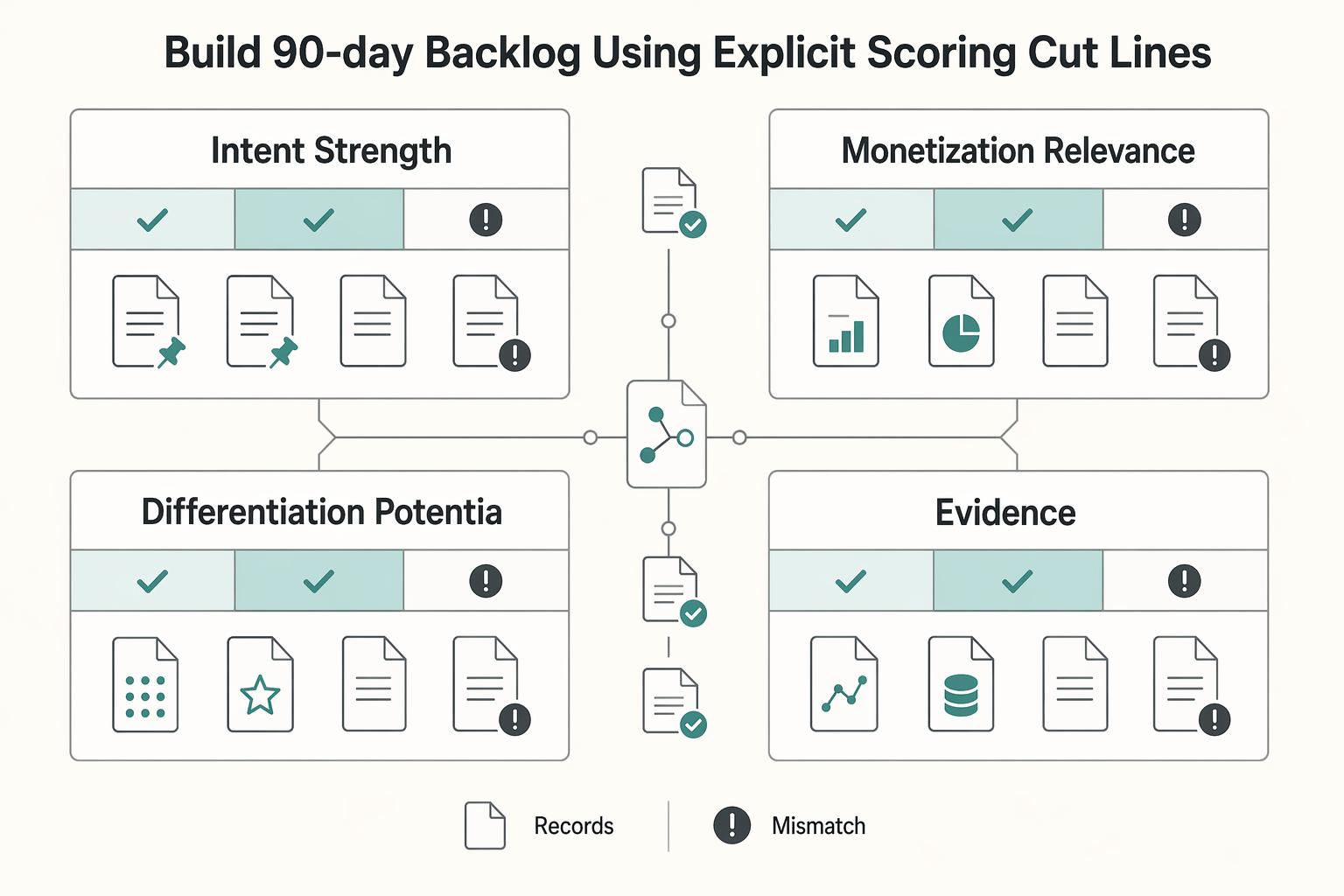
Set the scorecard before scoring starts. Lock the scorecard before you score anything. Use the same dimensions for every keyword cluster: intent strength, monetization relevance, differentiation potential, and evidence readiness. That keeps prioritization tied to revenue-weighted keyword maps, including ICPs, buying stages, and sales messaging, instead of drifting toward search volume alone.
A simple 1-5 scale is enough if you define each score level in writing and apply it consistently.
| Dimension | What a high score means | What you need to verify |
|---|---|---|
| Intent strength | The query signals evaluation or implementation, not casual learning | It maps to a real buying-stage action |
| Monetization relevance | The page can support qualified pipeline, pricing context, or onboarding confidence | It maps to one product surface and one credible next step |
| Differentiation potential | You can provide clearer, more useful coverage than competing pages | You have stronger scope, clarity, or decision support |
| Evidence readiness | Claims can be supported now | A named reviewer and keyword brief exist before drafting |
Every row needs an evidence owner. If ownership is unclear, evidence readiness is not high.
Use Ahrefs as a prioritization system, not just a keyword list. Check competitor pages winning high-intent traffic through Site Explorer, Site Audit, and Content Gap, then decide whether you can credibly outperform them on clarity, proof, or buyer fit.
Weight extractable answer potential, not only ranking potential. Give higher priority to terms that can rank and produce clear answer blocks across AI Overviews and other SERP answer formats. Ranking still matters, but click behavior is tighter. SalesHive cites about 27-28% CTR for the top organic result, fewer than 1% of users beyond page one, and AI Overviews reducing top organic-result clicks by around one-third.
Keep this lightweight. Apply an answer-extraction weight after the four core scores. If a keyword supports a direct definition, concise comparison, or clear implementation answer from verified material, it is usually more resilient.
Checkpoint: can your team write a clean, brief answer from approved source material right now? If not, do not apply the extra weight.
Force three lanes and break ties with stronger proof. After scoring, set cut lines and place every cluster into one lane:
- Must-publish now: strong commercial fit, evidence ready today
- Support content next: reinforces core pages or adjacent demand
- Backlog hold: blocked by missing proof, unclear ownership, or weak differentiation
If two keywords tie, choose the one with clearer, already supported product proof in your existing content or product documentation. Do not move a term into the first lane on reach alone.
Calendar pressure is not a reason to publish. If core claims are still unverified, hold the cluster.
Set kill criteria up front and review every fortnight. Define in advance what triggers continue, revise, merge, or stop decisions for a cluster. Then review on a fortnight cadence so each sprint ends with a decision, not just reporting.
Track live clusters against strategy signals: qualified visibility, extractable answer presence, sales usefulness, and directionally improving acquisition efficiency versus paid channels.
Kill criteria do not need universal thresholds. They do need to be explicit. If a cluster is not gaining useful visibility, is not helping sales conversations, and still lacks verified proof after multiple cycles, stop expanding it and reallocate effort.
Route winning keyword and SERP insights beyond marketing. Feed language, objections, and hooks into SDR and sales work so the backlog supports pipeline, not just publishing volume.
For a step-by-step walkthrough, see How to Build a Payment Reconciliation Dashboard for Your Subscription Platform.
Before you lock your publish-now lane, pressure-test each high-intent cluster against real integration constraints in the Gruv docs.
Choose page types that match buyer intent and SERP reality#
Page type often determines whether a ranking page can actually help a buyer act. In B2B SEO, intent match usually matters more than squeezing one more keyword into a title tag.
Classify the query by decision intent first. Start with the action behind the query, not the phrase. Use a simple split: awareness, consideration, and decision, then map the keyword to that stage and page type.
Bottom-of-funnel terms should usually get priority. The tradeoff is practical: a term with 500 searches per month at 8% conversion can outperform one with 5,000 searches at 0.2%. If you cannot state the next action in one line before you brief the page, the keyword is not ready for a high-priority slot.
Let the current SERP define the page shape. Use page-one results to choose format and depth. If the dominant results are decision-oriented, publishing a broad traffic-first post is unlikely to fix the intent mismatch.
A useful checkpoint is to label the top results by intent and job-to-be-done, then follow the dominant pattern unless you have stronger evidence. This helps avoid a common failure mode: content that ranks but does not speak to the intended B2B buyer.
Build a fast answer layer, then a decision layer. Open with a direct, concise answer so the reader can resolve the core question quickly. Then expand into the detail that supports evaluation and next steps.
For higher-intent terms, keep the deeper section operational and specific to what the reader needs to do next. If you cannot support that depth with approved evidence, hold the page until you can.
Match solution-aware topics to the most credible format. For solution-aware queries, choose the format that most credibly supports a real buying decision. Match the topic to the SERP first, then match depth to decision risk.
When a topic is commercially important, build enough unique substance to support evaluation. In this guidance, service or product pages are often 1,000+ words. If a related explainer already exists, connect it so readers can move from category context to evaluation: Payments Orchestration and Building a Referral-Based Payment Incentive Platform for Viral Growth Through Payouts.
Write content that proves operational credibility#
Operational credibility comes from specificity: show the sequence, the checkpoint, and the failure mode, and tie each claim to approved inputs. If you cannot support those elements, hold the page.
Require operator proof in every brief. Every brief should answer three questions before drafting starts: what happens first, how progress is verified, and what can block or delay the path. Do not draft from keyword plus title alone.
The goal is not extra detail for its own sake. It is approved detail tied to ICP and buyer-journey intent. If you cannot explain the sequence in plain English without guessing, keep the page in backlog hold.
Name the constraints buyers may care about. If operational constraints can affect onboarding timing, required information, or pathing, say that directly. Do not hide behind abstract "compliance" language when a buyer needs to understand what may change next.
Keep wording qualified. Avoid pass-or-fail logic, legal thresholds, or jurisdiction-specific rules unless they are explicitly supported. Use clear qualifiers where needed, including "where supported."
Put caveats next to the claim. Place qualifiers in the same sentence as the capability claim, or immediately after it. That keeps valid but conditional statements from reading like blanket promises.
Removing caveats may make copy feel cleaner, but it weakens trust when support is conditional in practice.
Verify the page like a decision asset. Before publishing, run a final source check against approved inputs and confirm every operational claim is grounded. After publishing, track rankings, traffic, and conversions tied to ROI.
If the page still cannot answer a real implementation question without hand-waving, it is not ready for a decision-stage slot. Generic top-of-funnel content may rank, but it often fails to help the right buyer act.
Publish decision-stage and post-sale content that competitors skip#
Publish pages that help buyers choose, implement, and operate, not just learn category basics. Once rollout risk becomes part of the decision, generic explainers are usually too shallow.
Publish selection pages for Merchant of Record, Payouts, and Virtual Accounts. Prioritize comparison and implementation pages for Merchant of Record (MoR), Payouts, and Virtual Accounts (VBA) that support real vendor evaluation. The useful version of each page is explicit about what gets configured first, what must be verified before go-live, and what can delay rollout.
Use a simple check: can a revenue lead or operations manager use the page to prepare for a real vendor review call? If not, the page is still too generic.
Add post-sale pages that reduce support drag and expansion risk. Post-sale content is often where this strategy starts compounding. Publish pages that help operators run and fix production flows: reconciliation guidance, Payout batches operations pages, and API or webhooks troubleshooting where your docs support it. These pages support retention and expansion because the reader is solving an active implementation problem.
Keep each page operational. Define the checkpoint, what "done" looks like, and what to inspect when outcomes do not match expectations. If a troubleshooting page cannot help someone verify or isolate an issue, it is product copy, not decision-stage support content.
Treat tax and documentation content as reviewed finance content. For W-8, W-9, FEIE, FBAR, and 1099 topics, publish only claims you can support from reviewed inputs, and keep caveats beside the claim. FEIE is the model for that standard.
If you publish FEIE content, state the checkpoint directly. Under the physical presence test, a qualifying person must be physically present in a foreign country or countries for 330 full days in any 12 consecutive months, and those days do not need to be consecutive. A full day is 24 consecutive hours beginning and ending at midnight.
Keep the filing mechanics explicit as well. The exclusion applies only to a qualifying individual with foreign earned income. Excluded income is still reported on a U.S. tax return, and the claim is made on Form 2555 or Form 2555-EZ. If qualification covers only part of the year, adjust the maximum exclusion by qualifying days.
State the failure mode plainly. If 330 full days is not met, the physical presence test is not met unless an adverse-condition waiver applies. Do not present unsupported FBAR triggers, W-8/W-9 workflow rules, or 1099 thresholds and timelines as settled facts.
Link bottom-funnel pages to adjacent depth content. Link high-intent MoR, Payouts, and VBA pages to adjacent depth content so the buying motion can continue without restarting. For example, connect decision pages to Payments Orchestration and BNPL strategy content when those next steps match the reader's implementation path.
A practical check is simple: each high-intent page should route to one or two deeper pages that answer the next decision, not back to generic educational content.
Need the full breakdown? Read Building Authority Content for Technical Payment Platform Buyers.
Engineer extractable answers for AI surfaces without dumbing down the article#
After decision-stage pages are live, make the opening answer easy to extract. Start with a clean definition, then follow it with operator-level detail that helps someone evaluate or implement.
Write a direct answer block under a real question. Place a short answer block directly under the question the page targets. If the page is about Merchant of Record (MoR), open with a tight definition in 2 to 4 sentences before moving into rollout risk, tax handling, or onboarding caveats.
Keep terminology consistent across the heading, intro, and body to avoid label ambiguity. If the H1 says "Payouts," keep "Payouts" in the opening copy instead of switching labels. Apply the same discipline to Virtual Accounts (VBA) and Payout batches.
Add operational depth immediately after the definition. The next section should prove the answer, not restate it. Move straight into setup order, verification checkpoints, and failure modes. If you claim a Payouts flow is operationally useful, show what must be verified before go-live and what to inspect when outcomes do not match expectations.
Definition-first pages are stronger when they immediately show implementation detail: reviewed caveats, supported configuration details, and clear checkpoints a buyer or operator can validate on-page.
Validate each answer block against evidence and measurement. Before publishing, run two checks:
- Evidence check: each sentence in the answer block maps to on-page detail or an explicit caveat.
- Measurement check: the page is trackable in Google Search Console (GSC) and GA4.
For GSC, verify ownership by DNS record, HTML file, or Google Analytics tag, then submit the XML sitemap right away. Use the GSC Performance report for average position and CTR by query. Use GA4 to assess post-click behavior.
Without that measurement layer, optimization decisions are blind, and pages that are never cited in answer engines can become effectively invisible.
Related reading: How to Set Up a Healthy PO System for a Platform: From Requisition to Payment in 5 Steps.
Set team ownership so the strategy survives beyond one quarter#
This strategy stays credible only when each claim has a clear owner and review path. Set ownership before you scale so pages do not drift into generic language or unsupported compliance copy.
| Area | Owner | Responsibility |
|---|---|---|
| Prioritization and backlog control | SEO lead | Prioritization and backlog control |
| Messaging and term consistency | Product marketing | Own messaging and term consistency |
| Tax and compliance language | Payments and compliance SMEs | Verification before publish or refresh |
| FEIE or FBAR sections | Finance and ops | Signoff; verify FEIE details and filing framing; keep FBAR language narrow unless finance confirms the exact workflow |
| Cleanup | One accountable owner | Prune outdated pages, merge duplicates, and retire content that no longer matches product or compliance reality |
Assign decision rights by claim type. Give the SEO lead prioritization and backlog control. Let product marketing own messaging and term consistency. Route tax and compliance language to payments and compliance SMEs for verification before publish or refresh.
Require finance and ops signoff on tax-sensitive content. Any section touching FEIE or FBAR should get finance and ops signoff. For FEIE references, verify the physical presence test details stay precise: 330 full days in 12 consecutive months, with a full day defined as 24 consecutive hours from midnight to midnight. If the 330-day threshold is missed, the physical presence test is not met.
Also verify the filing framing. FEIE is not a replacement for filing a U.S. return reporting income, and FEIE is claimed on Form 2555 or Form 2555-EZ. Keep FBAR language narrow unless finance confirms the exact workflow.
Set a recurring review cadence and document refresh triggers. Use a recurring review cadence and tie refresh checks to documented product or compliance changes your team can verify. If product truth changes, review the page even when rankings look stable.
Make one owner responsible for cleanup. Assign one accountable owner to prune outdated pages, merge duplicates, and retire content that no longer matches product or compliance reality. When two pages answer the same buyer question, consolidate them before authority and review quality split.
Measure pipeline impact and decide what to scale#
Measure this work by business relevance, not aggregate Google traffic alone. A reliable baseline is to track keyword rankings, traffic, and conversions together so SEO performance stays tied to ROI.
Tag each page by buyer stage. Label every URL by its primary buyer stage: awareness, consideration, or decision. This keeps reporting focused and reduces the risk of judging early-stage research pages by decision-stage outcomes.
Report visibility and conversion signals in one view. Review keyword rankings, traffic, and conversion outcomes together in the same report. When these signals are separated, it is harder to tell whether visibility gains are moving buyers forward.
Use regular audits to decide what to scale next. Run recurring content and technical SEO audits, then decide which pages or clusters deserve more investment based on buyer-stage fit, visibility trend, and conversion trend together. Keep this review loop consistent so decisions are based on evidence quality, not traffic volume alone.
Use this copy and paste checklist before publishing#
Use this pre-publish check to protect commercial outcomes, not just rankings. If a page fails any item, stop the publish.
- Map each keyword to a buying stage and one product surface.
Every target term should point to a real buyer action, not just a broad topic. Prioritize commercial or transactional intent, then name the journey stage and the surface the page supports, for example Merchant of Record (MoR), Virtual Accounts (VBA), or Payouts, plus the likely next action, such as compare, validate fit, or assess implementation. If the mapping is unclear, remove it from the core queue.
- Include at least one conversion-relevant checkpoint.
Do not ship copy designed only for high-volume traffic. Add one concrete checkpoint tied to buying intent, such as decision criteria, a clear next step, or a page-level fit test. A reviewer should be able to explain how the draft supports conversion outcomes, not just visits.
- Qualify and review sensitive claims.
For content touching KYC, KYB, AML, VAT validation, or tax-document workflows, keep language bounded and reviewer-checked. Use clear qualifiers where needed, and cut or generalize any statement a reviewer cannot confirm.
- Make answers clear first, then add decision depth.
Start with a clean, direct answer block, then follow with deeper evaluation content on fit, risk, or implementation. Keep one dedicated page per target keyword instead of scattering intent across multiple posts.
- Measure business impact, not sessions alone.
Confirm Google Search Console and Analytics are in place before publish. Search Console covers pre-click performance, and Analytics covers on-site behavior. Your reporting should connect rankings, traffic, and conversions so you can judge pipeline quality, not just volume.
Related reading: Digital Nomad Payment Infrastructure for Platform Teams: How to Build Traceable Cross-Border Payouts.
If your roadmap depends on payout reliability, compliance gating, and operational traceability, align on rollout assumptions early with Gruv.
Frequently Asked Questions
What counts as a high-intent B2B payment keyword in practice?
A high-intent keyword is a query a business buyer uses while actively evaluating solutions, not just learning the basics. In practice, these are usually bottom-of-funnel terms tied to pricing, comparison, or clear product-category evaluation. If a keyword does not point to a realistic next step, it is likely not a core priority.
How many keywords does a payment platform really need to rank for first?
There is no fixed number to hit first. Start with a small set of bottom-of-funnel, high-intent terms in your core product categories, then expand once those pages are performing. A focused list usually beats a broad list built around volume alone.
Which pages should we publish first if we need pipeline impact this quarter?
Publish pages mapped to consideration and decision stages before broad awareness content. Prioritize pages that help buyers evaluate fit and move toward a commercial action. Keep awareness content in the plan, but not as the first bet if pipeline impact is the goal.
How can we tell whether a keyword is commercially valuable before we write?
Check buyer stage, page type, and expected conversion quality before drafting. Volume alone is not enough: a lower-volume term can outperform a higher-volume term if conversion intent is stronger, for example 500 searches/month at 8% vs 5,000 at 0.2%. The same logic applies to pricing-intent queries with low volume versus broad informational terms.
What is the difference between traffic-focused SEO and revenue-focused SEO for payments?
Traffic-focused SEO emphasizes search volume and traffic metrics. Revenue-focused SEO tracks rankings, traffic, and conversions together, then judges performance by revenue quality per converted visitor. It still depends on technical fundamentals like indexing, speed, and mobile optimization to avoid avoidable losses.
Which intent stages usually convert faster in B2B fintech buying cycles?
There is no universal stage that always converts fastest across every platform. The practical default is to prioritize bottom-of-funnel intent first, then validate stage performance with your own data. Use one view of rankings, traffic, and conversions by stage to decide what to scale.
How should SEO, product marketing, and subject-matter experts split ownership?
Ownership varies by organization, so define it explicitly. At minimum, make sure keyword prioritization, measurement, and factual review each have a clear owner before publication.
Try a related tool
Researched and edited by the Gruv editorial team. Gruv builds cross-border billing, payouts, and finance-operations software for global businesses.
Sources
Includes 5 external sources outside the trusted-domain allowlist.
- fincen.gov/report-foreign-bank-and-financial-accountstrusted
- irs.gov/individuals/international-taxpayers/foreign-...trusted
- irs.gov/individuals/international-taxpayers/figuring...trusted
- adrenalead.com/en/blog/activate-an-effective-customer-acqui...external
- almcorp.com/blog/seo-checklistexternal
- directiveconsulting.com/blog/blog-why-seo-is-important-for-b2bexternal
- directiveconsulting.com/blog/the-playbook-behind-top-b2b-seo-and-con...external
- harborseo.ai/how-to-rank-in-perplexityexternal
Educational content only. Not legal, tax, or financial advice.
Related Posts
When Platforms Should Move to Payment Orchestration and Multi-Gateway Routing
Payment orchestration can become a practical priority when payment performance and finance operations start limiting growth, not just checkout delivery. A single PSP can be the right setup for a long time. But once approval paths, provider constraints, or reconciliation workload start affecting outcomes, you need a clearer strategy than adding providers ad hoc.

When BNPL Helps B2B Services Platforms and When It Hurts Margin
Treat BNPL as a unit-economics decision first, not a checkout feature. For B2B services platforms, faster closes may help, but fees, disputes, and risk-management work can wipe out the upside if you do not model them up front.

State of Platform Payments Benchmark Report for B2B Marketplace Expansion
This article translates broad payments narratives into expansion decisions: where a B2B marketplace operator should launch first, what to delay, and what to validate before committing product and GTM budget in 2026.