
Quick Answer
BNM confirms RENTAS+ continuous interbank settlement, with 24/7 near-real-time settlement of completed retail payments. Ordinary MYR services retain separate windows. Platform access depends on admission or a permitted partner-bank route; confirm the actual payout product, funding and beneficiary-credit signals before making an SLA.
What RENTAS Is and When Platform Teams Use It#
Malaysia can be a viable payout market if your plan clears three checks early: how settlement happens, who can participate, and what your team can operate reliably. A headline about "24/7 settlement" is not enough to support a customer-facing payout promise.
The confirmed baseline is straightforward. Bank Negara Malaysia introduced RENTAS, the Real Time Electronic Transfer of Funds and Securities System, as an RTGS system for high-value ringgit interbank funds and scripless securities, replacing SPEEDS in July 1999. BNM also describes settled RENTAS transactions as final and irrevocable. That matters directly for exposure management and reconciliation.
Access depends on admission and membership type. BNM’s current MYR procedures admit more than licensed banks, including qualified payment/clearing entities and institutions admitted for market development. Type VI includes qualified local corporates; its MYR settlement/securities access is for own holdings. This is not open API access for every platform: establish your admission or partner-bank route and the services it permits before submitting funds.
BNM confirmed RENTAS+ on 7 October 2025: continuous interbank settlement, including gross settlement of completed DuitNow transactions transmitted by PayNet. Its 24/7 liquidity facility supports that operating model. The current MYR procedures distinguish near-real-time retail settlement from other MYR service windows; an always-on retail settlement layer does not make every bank payout service always on.
For a go/no-go decision on Malaysia platform payouts that may rely on central-bank RTGS settlement, work through this sequence: who submits, who settles, who credits the beneficiary, and where delays can still happen. Settlement finality does not automatically mean immediate beneficiary credit on every path.
This guide maps the current settlement model to platform operations: access, liquidity, customer promises, exception ownership and reconciliation. Use it to scope a Malaysia entry plan and identify what your partner must confirm before live payouts.
For Thailand, see How Bahtnet Works: Thailand Central Bank Wire Transfer for Platform Operators.
What is confirmed today about RENTAS and RENTAS+#
BNM’s launch announcement confirms the enhancement; its current operational procedures define the service-specific conditions. Use both to distinguish a retail settlement capability from the bank product your platform can actually submit to.
| Point | What is confirmed today about RENTAS and RENTAS+ | How to use it |
|---|---|---|
| RENTAS role | BNM’s established RTGS infrastructure for funds and securities settlement. | Identify whether the partner’s payout service uses ordinary MYR settlement or the retail near-real-time path. |
| Current operating procedures | MYR procedures issued 1 September 2026, with separate service windows and participant controls. | Use the current clauses for your path rather than treating revision-history entries as live requirements. |
| RENTAS+ retail settlement | BNM confirms continuous gross settlement of completed DuitNow customer transactions; near-real-time retail settlement operates 24/7. | Separate customer completion from subsequent interbank settlement and monitor liquidity/queue exceptions. |
Participant connectivity remains a separate design question. Confirm your partner’s channel, service permission, message format and exception handling. A participant’s SWIFT or RENTAS Portal connection does not establish that your platform may submit directly through it.
BNM’s 1999 announcement explains the replacement of SPEEDS by RENTAS. Use that history for context; use the current service rules and partner agreement for launch decisions.
Related: What Is an ABA Routing Number? A Platform Operator's Guide to US Bank Routing.
Where RENTAS ends and DuitNow begins#
Keep these layers separate. RENTAS and RTGS refer to central-bank settlement infrastructure. DuitNow and PayNet describe the retail payment flow and operator layer.
| Term | Role in the stack | What is supported here | Payout design implication |
|---|---|---|---|
| RENTAS | Malaysia's large-value payment system (LVPS) | BNM says RENTAS is Malaysia's only LVPS, operated on an RTGS basis, supporting high-value interbank funds and scripless securities settlement. | Use RENTAS as an infrastructure or settlement concept, not as shorthand for every local payout. |
| RTGS | Settlement method | Transactions are settled individually and in real time. | RTGS explains interbank settlement mechanics, not when recipients can use funds. |
| DuitNow | Retail payment flow | BNM says PayNet transmits completed DuitNow transfers, QR and e-commerce transactions to RENTAS+ for gross settlement. | Do not place later interbank settlement ahead of customer completion on this retail path; map each bank’s actual customer-status signals. |
| PayNet | Scheme/operator layer | BNM names PayNet as Payments Network Malaysia, the operator transmitting completed DuitNow transactions for settlement. | Model PayNet as an operator layer, distinct from central-bank settlement infrastructure. |
A common execution mistake is treating settlement finality as recipient availability. A payout may be settled at the infrastructure layer while the beneficiary account is not yet credited for use.
For ordinary MYR third-party payments, clause 24 sets a RM10,000 minimum, with exceptions for BNM, government/statutory bodies and other specified institutions; own-account payments have no minimum. The third-party guideline also permits sub-RM10,000 transactions by mutual participant arrangement. Do not apply this threshold to every retail payout or use it as proof of platform eligibility.
If your product promise is instant recipient access, validate beneficiary-bank posting behavior in addition to any RENTAS+ or RTGS settlement claims. Confirm how your partner defines and timestamps submission, retail completion, settlement, and account credit, including weekends and off-hours.
Before RENTAS+, BNM says the affected retail payments settled twice daily on a deferred net basis. PayNet now streams completed DuitNow transactions for gross settlement. Historical RPP material can explain the earlier architecture, but your integration should model the current order of customer completion and interbank settlement.
For a step-by-step walkthrough, see Choosing SWIFT or Local Bank Transfers for Cross-Border Platform Payouts.
What 24/7 settlement changes and what it does not change#
Longer or continuous RTGS hours mostly change interbank settlement timing and risk posture. They do not, by themselves, determine end-to-end customer payout outcomes.
For the near-real-time retail settlement path, the wider window changes participant treasury and settlement-risk operations. It does not remove your bank product’s onboarding, screening, approval, repair or submission constraints. Other MYR services retain their own schedules.
Treat settlement as a risk and operations change first#
Treat this first as an operating-model change, not just a speed claim. BIS framing on operating-hour extension focuses on technical readiness, staffing, financial risks, and operational risk. The practical takeaway is simple: infrastructure settlement status and recipient availability are related, but they are not the same checkpoint.
For an ordinary MYR third-party instruction, the current procedures specify a 4 p.m. participant cutoff; a customer cutoff may be earlier, but not before 3 p.m. Near-real-time retail settlement has a separate 24/7 window. Ask which service your partner uses before turning either rule into a customer promise.
Set customer-facing SLAs from proven recipient outcomes#
If your SLA is customer-facing, promise 24/7 disbursement only after you test it across partner banks and corridor scenarios, including weekends and off-hours.
Use timestamped evidence for each partner path:
- payout submitted
- payout accepted
- settlement completed at the infrastructure layer
- beneficiary account credited for use
Set a recipient-availability SLA from verified account credit. For DuitNow’s documented retail flow, customer completion precedes subsequent interbank settlement; for ordinary MYR instructions, bank acceptance alone is not account credit. Keep the clocks and promises specific to the path.
Keep central-bank liquidity context separate from your platform controls#
BNM’s 24/7 liquidity facility supports participant settlement; it is not an unlimited credit line for your platform. Define your partner’s prefunding requirements, liquidity-release authority and response when available funds are insufficient.
Near-real-time retail settlement uses prefunded participant accounts. Insufficient funds can queue interbank settlement. Your monitoring should distinguish that participant queue from the status of the already-completed retail customer transaction.
Related reading: Building a Referral-Based Payment Incentive Platform for Viral Growth Through Payouts.
What to prepare before you commit resources in Malaysia#
Start discovery with the information you have and label gaps in access, operating conditions and exception ownership. Resolve dependencies before committing the affected implementation or customer promise; unrelated discovery and design work can continue with named owners and explicit assumptions.
Step 1: Gather current operating documents while scoping engineering#
Start with named primary documents, not slide summaries. Your minimum pack should include current Bank Negara Malaysia publications plus relevant partner or scheme operating documents where available. For each document, log:
- title
- date
- URL
- whether it is binding or exploratory
- exact paragraph or page supporting each claim
Separate current operational rules from historical or exploratory material. Note the document version and the clause that affects your chosen service, then record partner-specific questions. You can scope alternatives with open questions; permissions and material launch blockers must be resolved before the affected live flow.
Step 2: Define payout scope and customer promise up front#
Draft a proposed scope sheet for commercial discussions. List candidate payout types, the intended customer promise and the likely payment path; label unanswered questions for the partner rather than assuming the route has already been agreed.
For each use case, define:
- who initiates the payout
- whether it is high-value, retail, single, or batch-oriented
- whether your promise is same-day, near-real-time, or submission confirmation only
- which event counts as success for the customer: submitted, settled, or credited
If you want to promise immediate availability, treat beneficiary credit behavior as a separate evidence point from interbank settlement behavior. If off-hours or weekend payouts are in scope, treat that as a test dependency, not a marketing assumption.
Step 3: Build a constraints log and assign owners#
Use a constraints log to stop discovery from drifting. Keep these items open until current evidence proves them:
- eligibility to access relevant rails
- participant-level cutoff behavior
- fee economics
- exception handling ownership
Do not assume direct platform access, bank-specific cutoffs, or ownership for rejects, returns, or delayed credits unless current source material confirms them.
Staff this review across product, IT, compliance, risk, and operations. Longer settlement windows also require concrete operating readiness, including technical and staffing adjustments.
| Artifact | Primary owner | Discovery or implementation checkpoint |
|---|---|---|
| Evidence register | Product owner | Available operating documents recorded; missing confirmations have owners |
| Payout scope sheet | Product owner (with bank partner input) | Proposed use cases state intended promise and candidate rail dependency |
| Constraints log | Treasury or finance ops owner | Every unknown has an owner, target evidence source, and deadline |
| Compliance review note | Compliance owner | Required permissions and review obligations resolved before the affected live payout |
| Launch approval matrix | Product, treasury, compliance leads | Pilot and production approval gates assigned to the responsible leads |
Step 4: Resolve dependencies before the affected implementation#
Keep every material unknown with an owner, target evidence source and closure date. Use that log to sequence work: research and mock integrations can proceed while a partner answer is pending; a production-dependent design should wait for the answer it needs.
Have product, treasury or finance operations and compliance sign off on the live pilot’s scope and controls. Hold the affected live flow if access or a material operating dependency remains unresolved, and continue independent discovery tasks where useful.
Keep a clear split between confirmed service conditions, proposed design choices and open partner questions. That makes it easier to close the right gap before spending on the dependent work.
Step 1 map each payout use case to the actual settlement path#
Map each proposed payout promise to a named path. Begin with candidate routes and label missing operator, settlement, beneficiary-credit or exception details; close material gaps before the dependent implementation and live pilot.
RTGS language and customer completion are not the same thing. Even when a path uses an RTGS layer, the customer experience can still depend on partner submission timing, beneficiary-bank posting, and exception handling.
Build a use-case map that exposes dependencies and gaps#
Use one row per payout use case, and leave blanks where evidence is missing. Blank cells are useful because they show exactly where launch assumptions are still unproven.
| Use case | Initiation channel | Scheme/operator | Settlement layer | Final credit dependency | Failure paths to map now | Evidence to collect |
|---|---|---|---|---|---|---|
| High-value single payout | Platform API or file to partner bank | Partner bank route (named) | RENTAS or RTGS only if partner confirms | Beneficiary-bank posting process confirmed by partner | Reject, delayed credit, return, investigation ownership | Partner operating doc, path confirmation, participant proof, escalation contacts |
| Retail payout to bank account | App, API, or batch | Retail route (named) | Do not assume RENTAS without source-backed mapping | Retail processing plus beneficiary posting | Scheme reject, account reject, delayed credit, unmatched return | Scheme reference, partner service guide, status and return handling |
| Batch payroll or marketplace same-day payout | Scheduled batch to partner | Bank batch service and any scheme dependency | Verify per path; do not infer from infrastructure labels | Batch acceptance, queue or repair flow, beneficiary posting windows | Partial failure, cutoff miss, delayed credit, reconciliation break | Batch windows, repair or resubmission rules, escalation model, holiday handling |
| Off-hours or holiday urgent payout | Ops or API | Partner-defined off-hours path | Confirm the selected bank product’s service window; NRTS retail settlement is separately available 24/7 | Staffing, approvals, beneficiary availability | Queued or held payment, delay, callback responsibility | Current operating note, support-hours confirmation, holiday treatment |
Separate central-bank scope from your operating reality#
Keep one distinction explicit in your mapping: BNM's MYR settlement procedures are scoped to Participants of RENTAS. If your model depends on a partner bank, your operational truth has to be confirmed in partner artifacts for the exact path you plan to run.
Confirm the message format and onboarding requirements that apply now. The current procedures removed the old MT–MX coexistence guideline and readiness/transaction-flow appendices after migration. Ask for current access-channel and tested-message evidence, rather than requesting an obsolete appendix by number.
Stress-test batch timing and exception flows#
For batch-heavy same-day promises, obtain the partner’s batch acceptance, repair and submission windows. A 6 p.m. non-compliance charge in the MYR schedule concerns settlement without BNM approval; it is not the cutoff for all services and does not override the separate 24/7 retail settlement window.
Document and assign owners for these failure states on each core use case:
- rejected transaction
- delayed credit
- unmatched return
- investigation in progress
Also confirm how unexpected banking holiday handling appears in your partner process and in your customer-status messaging.
End Step 1 with a decision on the scoped live path#
Before a core use case enters the live pilot, confirm:
- a verified settlement path
- a verified exception path
- a named owner
- a clear customer-status interpretation for success and failure
If a material core-path dependency remains assumed, hold that live use case and close the gap with partner evidence. Keep alternatives and non-live integration work moving where they do not depend on it.
Step 2 design liquidity and cutoff operations for always-on claims#
Treat this step as an operations truth test. If settlement may be available but your liquidity or approval controls are closed, your service is not always on, and your status messaging needs to say that clearly.
Turn settlement paths into liquidity ownership#
For Malaysia, start with scope. The documented MYR settlement procedures are for participants of RENTAS (Real Time Electronic Transfer of Funds and Securities System). If you rely on a partner bank, your operating baseline is that partner's model for prefunding, repair handling, after-hours liquidity release, and evidence logging.
For each payout type, define:
- normal funding source
- minimum internal buffer policy
- named role allowed to release emergency liquidity off-hours
If no one can approve extra funds on weekends or public holidays, the real policy is queueing, not instant payout.
Use current service notes, holiday treatment and escalation contacts. For messaging, ask your partner for the applicable format, access-channel confirmation and test results; do not require removed MT–MX migration appendices.
Write explicit if-then cutoff behavior#
Predefine status behavior now so operators do not have to improvise under cutoff pressure. If settlement is available but internal approval is closed, queue the payout and show a timestamped queue status instead of a generic "processing" state.
Keep ordinary MYR and near-real-time retail schedules distinct. Confirm how your partner handles each submission window, requests for extensions and late instructions; a 6 p.m. non-compliance-charge reference is not a universal retail cutoff.
Define controls now for common breakpoints:
- platform accepts a batch, but the bank holds or reworks it because of liquidity, approval, or timing conditions
- buffer falls below policy, and urgent submissions must route to manual treasury review
- route is unavailable outside staffed hours, and "instant" promises must be suppressed
- approval is closed, and payouts remain pending without automatic retry
Stress-test weekends and holidays with Malaysia-specific evidence#
Do not import assumptions from other ASEAN markets. Use partner-bank operating evidence together with current RENTAS procedure updates.
The current MYR procedures cover unexpected holidays and service-specific handling. Near-real-time retail settlement operates on weekends and holidays; ordinary MYR instructions have business-hour rules. Confirm which schedule governs your bank product and what happens when a request needs repair or screening.
For weekend and holiday use, obtain the partner’s submission, support, queue and posting behavior for your service. Confirm who communicates when a bank-product request is held, without implying that RENTAS+ retail settlement itself lacks a confirmed continuous window.
Log auditable references for liquidity and retry events#
Always-on claims are only credible if finance can reconcile payout intent, liquidity action, and settlement outcome end to end. At minimum, log:
| Category | Field 1 | Field 2 / note |
|---|---|---|
| Identifiers | internal payout ID | batch ID |
| Bank references | partner submission reference | bank acknowledgment reference |
| Liquidity action | liquidity release approval ID | treasury ticket |
| Retry trail | retry count | retry reason and retry trigger (rule or operator) |
| Timing | Malaysia-time queue time | Malaysia-time final status time |
Run at least one weekend test batch and one holiday-edge scenario, then confirm reconciliation works from approval to bank response to customer-visible status.
For a country-by-country view of payout rails, see Choosing Local Bank Transfer Networks by Country for Platform Payouts.
Step 3 set compliance and control gates before first live payout#
Put a hard control layer in front of submission before you send any live payout. Faster settlement may improve execution, but it should not weaken your KYC, AML, approval, or audit discipline.
Gate eligibility before submission#
Make the first decision binary: eligible to submit, or not eligible to submit yet. Use your own policy stack consistently, including sender and recipient status, program eligibility, required review states, and product restrictions you already enforce in operations.
Do not use "review later" as a live-path workaround. A fast settlement path can still create high-cost errors if a payout moves before compliance decisions are complete.
Before launch, run a controlled dry run through your real decisioning and customer or ops statuses for:
- a payout that passes all checks
- a payout blocked before submission
- a payout routed to manual review
- a payout that reaches an infrastructure-settled state in your workflow but is not yet ready for customer-visible completion
If ops, compliance, and finance cannot explain each outcome the same way, your gate design is still too implicit.
Set approval thresholds and make overrides provable#
Define approval thresholds by your internal risk classes, then make overrides fully traceable. The threshold values are your internal policy choice, so consistency and evidence quality are the real control objective.
For each override, keep a linked record that covers:
- internal payout ID and risk class
- policy or rule version used at decision time
- approver identity and timestamp
- override reason
- submission reference (when sent)
- final operational status
This avoids a common failure mode: an exception gets approved informally, but the approval cannot later be tied back to the payout outcome.
Constrain the first live cohort after permissions and controls are resolved#
Resolve applicable participant permissions, partner responsibilities and screening requirements before the first live payout. A small cohort limits operational exposure; it does not substitute for those permissions or controls.
Limit early traffic to payout types and customer segments you can review end to end, then expand only after exception handling is stable and ownership is clear.
Make controls explainable from intent to customer status#
Design controls so one payout can be explained end to end with consistent IDs, timestamps, and status definitions. This matters most if your internal workflow can show a gap between infrastructure-settled status and customer-visible completion time.
Keep status states explicit. For example, use submitted, infrastructure-settled, pending posting, and under investigation, instead of collapsing everything into "completed." If your teams cannot tell the same transaction story from the same records, keep volume constrained until they can.
Step 4 build integration and reconciliation checks that catch false positives#
At this point, the control objective is simple: a payout is complete only when provider records, your ledger, and your ops status all agree. Do not let any single event stream define success on its own.
Make retries harmless#
Implement idempotency at the payout-intent level, not just per API call. Keep an immutable payout ID and separate submission-attempt records. Reuse the provider’s idempotency key only within its documented retry window; investigate an ambiguous result before issuing a new instruction.
Design handlers to accept out-of-order events, persist them, and apply only valid state transitions for that payout ID. In testing, replay duplicate outbound requests and inbound events and confirm:
- one disbursement instruction
- one ledger movement
- one stable customer-visible status
If your path supports richer structured messaging, use it. ISO 20022 provides richer, well-defined data structures and can be applied across APIs and other technologies for end-to-end consistency. Compared with terse legacy MT formats, that can improve matching quality for duplicate detection and return or reversal handling.
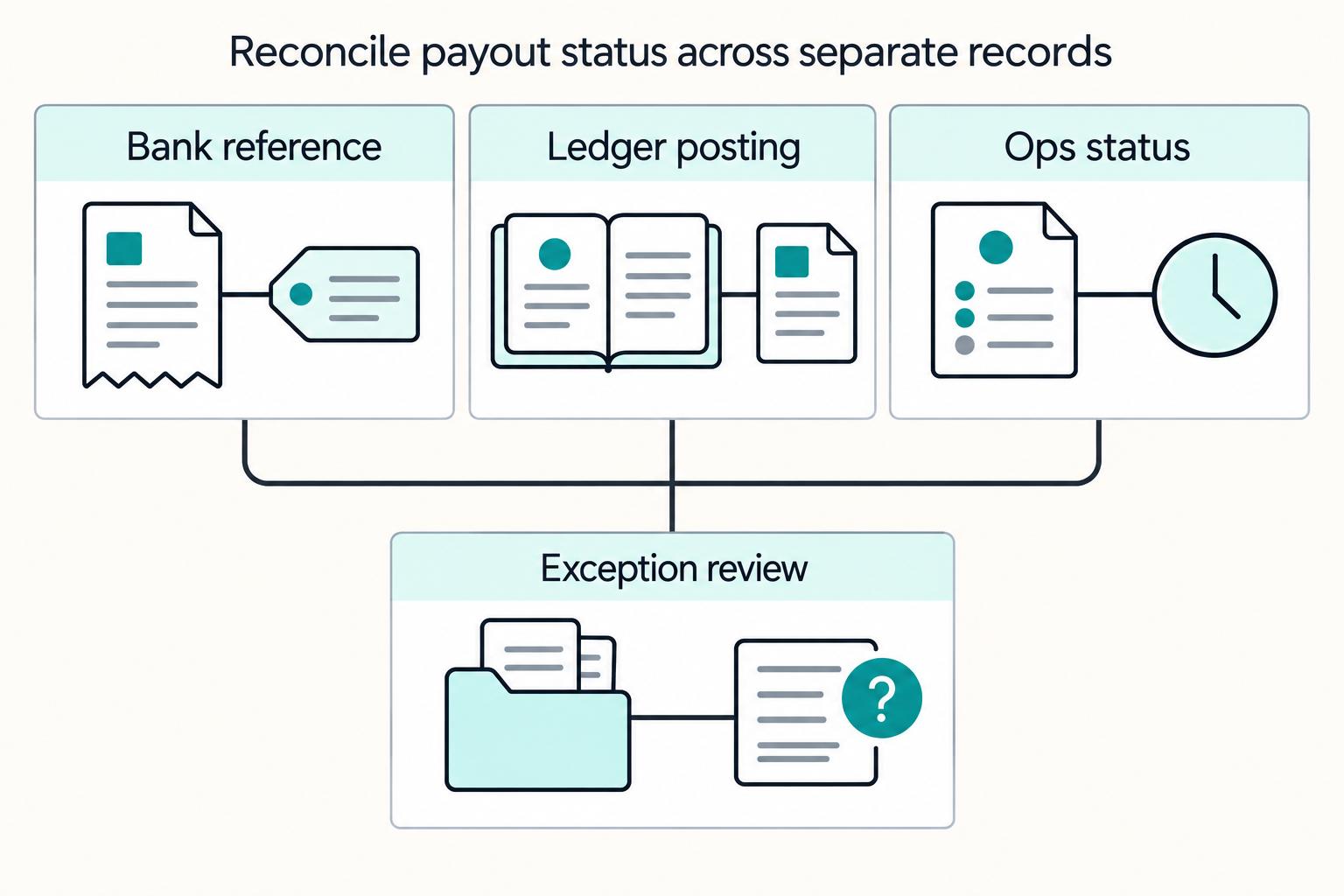
Reconcile three records every day#
Run a strict daily three-way reconciliation across your operational truth sources.
| Record | What must match | Red flag |
|---|---|---|
| Provider or bank reference | Internal payout ID, amount, beneficiary details, latest disposition | Provider shows accepted or settled but internal record is missing or mismatched |
| Internal ledger posting | One valid posting linked to the same payout ID | Duplicate, missing, or unlinked posting |
| Ops or support status surface | Same lifecycle state and reference shown to operators | Ops shows complete while core records remain uncertain |
If any one of the three disagrees at your reconciliation checkpoint, route it to exception review. Model RENTAS-layer settlement separately from retail-network and bank-crediting signals so different layers do not collapse into one "paid" status. A customer-completed retail transaction can still need a separate interbank-settlement investigation.
Add checkpoints for edge cases#
Define evidence requirements before incidents happen. For reversal, return, delayed posting, and partial batch failure, require a linked record set on the same payout ID:
- raw provider payload
- normalized internal event
- ledger effect
- retail-network or bank feedback (if received)
- operator notes for manual decisions
For a bank-product payout whose beneficiary credit is still unconfirmed, keep the customer completion status pending and open a timed investigation. For the documented DuitNow retail path, later interbank settlement monitoring must not reverse an already-confirmed customer completion merely because that settlement is queued.
Keep state definitions narrow#
Use explicit states that prevent false completion:
| State | Definition |
|---|---|
| Submitted | sent outward, no settlement or credit confirmation |
| Settled infrastructure | settlement confirmed at infrastructure layer; beneficiary credit is a separate path-specific signal (acceptance alone is not settlement) |
| Credited beneficiary | recipient credit confirmed by trusted path data |
| Exception investigating | mismatch, return, reversal, delayed posting, or partial failure under review |
That protects SLA integrity. RTGS operating-hours design is framed as a set of operational and risk tradeoffs, so your status model should reflect real process stages instead of compressing them into a single "completed" label.
Common rollout mistakes in Malaysia and how to recover quickly#
A common rollout failure pattern is treating infrastructure signals and secondary reports as proof of customer outcomes.
| Mistake | Recommended action |
|---|---|
| Treating confirmed RENTAS+ retail capability as universal instant bank-product payouts | Use the actual bank path you operate, test that path with live transactions before launch, and keep infrastructure settlement separate from beneficiary credit |
| Using older architecture language without timeline and authority labels | Record publication date and whether each requirement is current, historical or partner-specific |
| Blocking all discovery while partner details are open | Use a proposed scope and owned questions; resolve permissions and material dependencies before the affected implementation and live pilot |
| Showing settlement finality and user completion as the same status | Use distinct states for infrastructure settlement, beneficiary credit confirmed, and exception investigating |
Scope your SLA by the actual bank product. RENTAS+ retail settlement is confirmed, but a platform API or batch product can still impose its own conditions. Test the submitted service before promising instant recipient access.
Publish SLAs by path or partner, and keep infrastructure settlement separate from beneficiary credit in your ops language. Capture timestamps for submission, infrastructure status, and recipient credit confirmation so product, sales, and support all work from the same reality.
Date-tag older architecture assumptions. Do not mix older architecture language into current decisions without timeline and authority labels. If a source is context, label it as context.
Record the source date and role. Older regional architecture material can explain context; BNM’s current procedures define participant conditions, and the partner agreement defines the bank product you use. Record which service each condition applies to.
Assign participant questions without freezing discovery. Access, fees, cutoffs and exception ownership can be open questions during comparison and planning. Resolve the material dependencies before implementing or launching the flow that relies on them.
Record the current artifact, unresolved question, owner and closure date for each dependency. Keep customer SLA commitments on hold where the answer is missing; do not use a narrower pilot to bypass unresolved permissions or screening requirements.
Show finality and completion as different statuses. Settlement finality and user completion are not the same status. Your payout dashboard should show them separately.
Use distinct states for infrastructure settlement, beneficiary credit confirmed, and exception investigating. If infrastructure appears settled but beneficiary credit remains unconfirmed past your bank-path threshold, escalate to manual review before marking the payout complete.
Conclusion and copy-paste launch checklist#
Launch only when your evidence is stronger than your assumptions. For this topic, anchor decisions in the latest Bank Negara Malaysia Operational Procedures for Malaysian Ringgit (MYR) Settlement for RENTAS participants and in your partner's written operating terms.
Step 1. Confirm the evidence base and label unknowns
- Pull the latest Bank Negara Malaysia Operational Procedures for Malaysian Ringgit (MYR) Settlement for RENTAS and date-stamp the version.
- Mark each launch claim as confirmed, reported but unverified, or unknown.
- Separate confirmed 24/7 retail settlement from ordinary MYR service windows, direct-access permission and the partner’s beneficiary-credit behavior.
- Confirm current holiday, cutoff and charge conditions for the selected service, rather than treating old revision-history entries as the operative rule.
Step 2. Map each payout use case to settlement dependencies
- For each payout type, record initiating channel, partner dependency, settlement layer, and exception owner.
- Treat
submitted,settled,credited, andinvestigatingas separate internal operational states. - Assign first-responder ownership for rejects, delayed credits, unmatched returns, and status mismatches.
Step 3. Align controls with the payout SLA you promise
- Define approval and fund-release authority, including outside normal business hours.
- Set customer-facing status rules for queued, held, and exception cases.
- Keep approval overrides auditable and tied to payout intent and final outcome.
- Test applicable ISO 20022 payment fields and partner message handling; use current onboarding requirements.
Step 4. Implement idempotency and three-way reconciliation
- Make payout submission idempotent to prevent duplicate disbursements on retry.
- Reconcile daily across provider references, your internal ledger, and ops or user status surfaces.
- Keep evidence for reversals, returns, delayed posting, and partial batch failures.
- Confirm the message and access-channel requirements that currently apply to your path.
- Obtain partner test results and required access confirmations; do not request removed MT–MX migration appendices.
Step 5. Pilot in Malaysia before broader rollout
- Run a limited live pilot in Malaysia before expansion.
- Include both normal payout flow and exception recovery paths.
- Expand only after reconciliation closes cleanly and exception ownership works in live conditions.
Launch when documents, partner answers, internal controls, and pilot evidence all line up on how funds move and how failures are handled. When your pilot criteria are defined, confirm Malaysia coverage, control requirements, and rollout sequencing with the Gruv team.
Frequently Asked Questions
Is RENTAS the same as DuitNow?
No. RENTAS is central-bank funds/securities settlement infrastructure; DuitNow is a retail payment service. BNM confirms that PayNet sends completed DuitNow transactions to RENTAS+ for subsequent interbank gross settlement. Keep those customer and interbank events distinct.
Did Malaysia move to 24/7 central-bank settlement?
BNM confirmed continuous RENTAS+ interbank settlement in October 2025, and current procedures specify 24/7 near-real-time retail settlement, including weekends and holidays. Other MYR settlement services retain their own windows; your partner’s payout product may have additional submission or review constraints.
How does RTGS reduce payout risk?
Gross settlement reduces interbank exposures compared with waiting for deferred net cycles. BNM identifies that benefit for completed DuitNow retail transactions. It does not remove your platform’s funding, screening, duplicate-payment or bank-product execution risks; validate those separately.
Can a platform directly access RENTAS for payouts?
Membership is not limited to licensed banks, but access requires admission, the appropriate membership type and permitted service scope. Current MYR procedures include qualified payment/clearing entities and market-development institutions, with restrictions by type. Most platforms should establish their approved partner route rather than assume direct access.
Does 24/7 settlement mean 24/7 beneficiary crediting?
They are separate events. In the documented DuitNow retail path, the customer transaction completes before PayNet sends it for interbank settlement. Ordinary bank-product payouts have their own credit and exception conditions. Verify the product’s actual credit signal instead of using a settlement-hour label as proof of recipient availability.
What should I validate first before launch?
Identify the partner service and access permission first, then check its applicable settlement window, funding, screening, repair and beneficiary-credit rules. Use the current BNM MYR procedures alongside the partner agreement; confirm the message format and test results actually required for that route.
Researched and edited by the Gruv editorial team. Gruv builds cross-border billing, payouts, and finance-operations software for global businesses.
Sources
Educational content only. Not legal, tax, or financial advice.
Related Posts

SWIFT vs. Local Bank Transfers: Choose a Cross-Border Payout Route
A platform owes a supplier EUR 5,000. One provider offers local euro delivery; another offers an international bank transfer. The useful comparison is whether the supplier receives the agreed amount in the right account by the promised date, and whether finance can account for the money afterward.

The Freelance Payment Penalty: A Modeled Audit of Platform Fees, FX Spreads, and Payout Delays
The money rarely disappears through a single, easy-to-spot fee. The real loss is stacked. A marketplace takes its commission, a processor adds a charge for international cards, a bank or payment company converts the currency at a spread, a platform holds the funds before release, and a wire sheds a little to intermediaries on the way in. Each layer looks defensible on its own, but the worker feels the combined result as a smaller deposit and a later payday.

How to Respond to a Subpoena for Business Records
Move fast, but do not produce records on instinct. If you need to **respond to a subpoena for business records**, your immediate job is to control deadlines, preserve records, and make any later production defensible.