
Quick Answer
Implement ramp pricing by putting the pricing schedule in the contract documents, not on the plan page. Use the written order document to state each priced period, its fee basis, the Subscription Term, and whether implementation services are included. Treat published plan details as packaging facts only, and leave custom enterprise fees, commitments, and step changes as unknown until quoted and operationally mapped.
Build a Ramp pricing contract you can defend#
For enterprise subscriptions with ramp pricing, start with the contract, not the plan page. If finance, product, and procurement cannot point to the same document set and explain how price changes over time, the deal is not ready to sign.
Anchor the commercial promise in the actual contract documents#
Start with Ramp's contract language. The Platform Agreement is the core legal agreement, paid advanced access is Subscription Services, and the billing period is the Subscription Term.
| Item | Meaning | Use |
|---|---|---|
| Platform Agreement | Core legal agreement | Controlling document |
| Subscription Services | Paid advanced access | Confirm whether implementation services are included when the order document says so |
| Subscription Term | Billing period | State the term for each priced period |
| Written order document | Written acceptance path | Put each period, fee basis, and implementation inclusion in writing |
Put the pricing schedule in the written order document, not in email threads or procurement summaries. Ramp says a company can accept by enabling Subscription Services online or through a written order document, so confirm which acceptance path your deal is using.
If you are using a written order document, spell out each period, its fee basis, and whether implementation services are included. One-time or limited-period implementation services can still be treated as Subscription Services when the order document says so.
A common failure mode is calling something "enterprise pricing" without saying what changes by period. That can create billing disputes.
Separate published pricing facts from negotiated unknowns#
Use the pricing page for packaging facts and stop there. Ramp publicly shows Free at $0/mo/user, Plus at $15/mo/user plus a platform fee based on team size, and save 20% with annual billing language. It shows Enterprise as custom with annual billing and a sales-led flow.
| Item | Status | Detail |
|---|---|---|
| Free | Published packaging fact | $0/mo/user |
| Plus | Published packaging fact | $15/mo/user plus a platform fee based on team size; save 20% with annual billing |
| Enterprise | Published packaging fact | Custom with annual billing and a sales-led flow |
| Exact Enterprise subscription fee | Negotiated unknown | Treat as unknown until quoted |
| Minimum spend | Negotiated unknown | Treat as unknown until quoted |
| Implementation price sheet | Negotiated unknown | Treat as unknown until quoted |
| Standard step-up or step-down schedule | Negotiated unknown | Treat as unknown until quoted |
Treat the core enterprise economics as unknown until quoted: exact Enterprise subscription fee, minimum spend, implementation price sheet, and any standard step-up or step-down schedule. "Custom annual billing" is a packaging signal, not a contract schedule.
Define the problem before negotiations get noisy#
This guide is about putting a Ramp pricing schedule into an Enterprise subscription contract, not comparing vendor plan pages. The goal is practical: decision rules, red flags, and a checklist you can use in live negotiations.
Flag legal review points early. Ramp's Platform Agreement (last updated February 13, 2026) says disputes go to individual arbitration, not class arbitration. It also says some services may require Supplemental Terms for affiliates, third-party providers, or financial institution partners. Those terms may require additional agreements by the company or an affiliate before signature.
Use this as your live-deal checklist:
- Confirm the controlling documents: Platform Agreement plus any written order document.
- Mark each pricing input as either published packaging fact or still custom and unquoted.
- State the Subscription Term for each priced period so the ramp is explicit and billable.
- Verify whether implementation services are included and how they are labeled in the order document.
- Flag arbitration and Supplemental Terms issues before procurement treats pricing as complete.
Do these five things first, and the rest of the contract becomes a pricing problem you can defend rather than a guessing exercise.
For a step-by-step walkthrough, see How to Choose the Right Subscription Pricing Model for Your Platform.
Separate the two meanings of ramp pricing before you design anything#
Get the definition straight before you model: Ramp is the vendor, and a ramp pricing schedule is the contract mechanic that increases price across defined periods. If you blur those two meanings, you will model the wrong deal.
Capture vendor facts first#
Capture the vendor facts and stop there. Ramp's pricing page shows named plans, including Ramp Plus at $15/mo/user + platform fee based on team size, and Ramp Enterprise as Custom with Annual billing. Those are packaging facts, not a contract schedule.
Do not treat "Ramp Enterprise is custom" as permission to stay vague. "Custom" indicates negotiated economics and no public list price; it does not define period count, period pricing, or change triggers.
Define the pricing mechanic separately from the vendor#
Define the pricing mechanic separately from the vendor. In SaaS, ramp pricing generally means a lower initial price that increases over defined periods, with step-ups tied to time, usage growth, or customer milestones. Do not rely on manual handling here; it adds complexity and inefficiency.
Before you draft numbers, ask one verification question: can your quoting and invoicing setup support multiple priced periods in one subscription without manual overrides?
Use one internal definition in the deal file#
Use one internal definition everywhere in the deal file. A Ramp pricing schedule is the pricing table inside one subscription contract that states the applicable price for each defined billing period.
That forces clarity on period boundaries, fee basis, and step-up logic in the order document. If procurement, finance, and legal cannot point to the same pricing table, you are still debating labels, not designing a contract.
If you want a deeper dive, read Tiered Pricing Strategies for Payment Platforms: Basic Pro and Enterprise.
Gather prerequisites and deal inputs before modeling#
Do not model the ramp until the operating inputs and approval path are clear. Missing inputs can make pricing look clean on paper and then break in execution.
Start with operating requirements, not price alone#
Start with operating requirements, then price. Use the commercial and operating context you already know, then pressure-test it against the full procurement path.
Do not stop at supplier selection or contract terms. A workable process runs from requisitions and purchase orders through delivery tracking, invoice processing, and ongoing vendor oversight. If your assumptions do not cover that path, you are not ready to model confidently.
Build one deal-input pack in plain language#
Build one deal-input pack that explains the economics in plain language. Keep the key assumptions and terms in one place so each item can be reviewed in context.
Mark uncertainty directly instead of smoothing it over. If a term is still draft, label it as draft and assign an owner for the next revision.
Confirm purchase-order controls early#
Purchase-order controls and approvals are not a side issue, so confirm them early. The purchase order process exists to request, approve, and track purchases before money is spent, which means missing approvals can become a delivery risk.
Treat approval status that way. Missed approvals can stall urgent purchases, and weak control can leave accounting reconciling budget versus actuals after the fact.
Set one verification checkpoint before heavy negotiation#
Set one verification checkpoint before you do heavy negotiation work. Use it to confirm that assumptions, owners, and approval status are current and that the model can make it through invoicing and reconciliation without guesswork.
This is practical discipline, not ceremony. Clear process design helps reduce unnecessary spend, speed purchasing, and improve visibility into where money goes.
This pairs well with our guide on ASC 606 Revenue Recognition Decisions for Subscription Pricing.
Define the commercial objective and ramp direction#
Pick one commercial objective first, then encode it in contract terms so fee treatment is predictable rather than discretionary. Use that objective to tighten the contract mechanics you can actually enforce:
- State the
Subscription Services,Subscription Fees, andSubscription Termin the order artifact, whether that is an online flow or a written order document. - Specify the billing cadence within that term: monthly unless Ramp offers and you select a different term, such as annual.
- Confirm dependency conditions up front, including account approval and any offer or trial limits that can be suspended or revoked.
- Add clear review triggers tied to payment operations reliability, since delays or errors in getting paid can create direct business risk.
No universal upward-versus-downward ramp rule or default minimum-commitment mechanics is established here, so avoid preset formulas. Document your chosen direction and triggers explicitly in the subscription contract terms.
Choose the price architecture for each contract year#
Use a structure that is easy to quote, order, and bill across the full term. A practical pattern is to keep core terms stable and change only the price elements that need to change by period.
Compare building blocks before combining them#
These are optional building blocks, not mandatory components in every deal.
| Building block | What usually stays fixed | What changes by period | Best fit | Main risk |
|---|---|---|---|---|
| Fixed platform fee | Billing cadence and term framing | Scheduled fee by period, or no change | When a baseline charge helps simplify invoicing | Potential misalignment early if rollout is phased |
| Volume-tier pricing | Tier logic and measurement basis | Tier reached or tier assigned by period | When adoption is expected to change over time | Potential disputes if usage definitions are unclear |
| Time-based discount schedule | Price basis and discount method | Discount or discounted price by contract year | Softer first year with planned later-year changes | Early concessions can outpace realized adoption |
A common multi-year ramp pattern is lower first-year pricing with locked increases later, especially when enterprise implementation is phased.
Lock constants, then map the ramp schedule#
Before you draft the schedule, separate constants from variables.
- Define period boundaries first, for example contract year.
- Freeze constants across the term, for example term structure, billing cadence, product scope, and tier measurement basis.
- Name the primary price variable per period, for example tier or discount.
- Put a period-by-period table in the order terms.
If your stack supports predefined product ramps, use Line Ramps when the schedule is predefined on the product record. Use Group Ramps when configuration happens at quote time for that specific deal. Group Ramps are flexible, but setup-sensitive.
Confirm Ramp Deals for Groups in Quotes and Orders is enabled. Also confirm the enhanced Sales Transaction Line Editor is available, introduced in Winter 26 in the described setup.
Add floor protection with a Minimum commitment clause#
If your commercial policy includes discounts or other early-period concessions, document any minimum commitment terms clearly. State the commitment basis, the period it applies to, and the outcome if performance lands below that floor.
Keep floor language separate from the discount table so finance and billing can apply terms consistently.
Limit moving parts and test failure modes#
Ramp deals already add complexity across quoting, ordering, and lifecycle operations, so keep period-level changes as simple as possible.
Also verify tool constraints before you promise a contract mechanic. In the described setup, uplift as an amount is not supported, so use supported structures such as explicit period prices instead of relying on manual overrides.
Set contract guardrails that protect margin and adoption#
Guardrails work better when each term can be verified from a stable record across billing, finance, and legal.
Pair each term with a proof record#
For every commercial term in the enterprise subscription contract, name the record, owner, and check date that will prove whether it applies. If you cannot name those three items, treat the term as unresolved and simplify it before signature.
A practical pattern is field-based tracking instead of narrative notes. In the TX-RAMP listing format, conditions are tracked with explicit fields: TX-RAMP Certification ID, Certification Status, Certification Path, Certification Expiration Date, and Provisional Certification Expiration Date. Your contract does not need those exact labels, but the same structure of ID, current state, path, and expiry can be a useful checkpoint format.
Use status-plus-date checkpoints for time-based terms#
When a term depends on something changing over time, capture both the current status and the date it can change. Examples from the same listing data include:
- Fundraising Solutions: Provisional SaaS, TX-RAMP Provisional Certification Extension, provisional expiration 1/22/2026.
- 11:11 Cloud: Level 1, IaaS, TX-RAMP Fast Track, certification expiration 5/29/2027.
This helps keep pricing and renewal decisions tied to verifiable checkpoints instead of interpretation.
Make implementation gates observable#
Avoid vague triggers like "integration complete" for any pricing or lifecycle change. Use named records your teams can audit later. Store the supporting artifact at signature time, such as an approved internal memo, export, or screenshot with the check date.
If billing cannot map a gate to a concrete object or amendment path, simplify the clause before signature.
Remove dependency on unstable external references#
Do not leave enforceable terms dependent on links that may move or disappear. One cited source in the research set returned 404 with a warning that the page may be outdated or moved, which is a direct reliability risk.
If a promise matters commercially, put the exact language in the executed agreement or exhibit so legal, finance, and billing can verify it from the same durable record.
Price hidden operating costs so margin does not leak#
Margin is easier to protect when you separate subscription charges from operating costs before approving the final Discount schedule.
Separate subscription items from operational costs#
Use the order document and Ramp Platform Agreement as the billing source of truth. Ramp defines paid Subscription Services as triggering Subscription Fees, which are monthly by default unless another term is selected. It also allows one-time or limited-time implementation services to be treated as Subscription Services when the order document says so.
Before sign-off, split your model into distinct lines:
- recurring subscription fees
- implementation charges
- payment-operation costs
For each non-subscription cost, record who pays it, when it applies, and whether it varies by payment method.
Treat payment methods as explicit cost scenarios#
If the account may use multiple payment methods, model them as separate cost scenarios instead of burying them in the subscription line. You do not need guessed precision here. You need visibility so discount approvals reflect real cost-to-serve risk.
Use two views before approval:
- expected payment method mix
- adverse payment method mix
If the adverse case breaks your margin floor, adjust discount depth or narrow payment-method flexibility in the contract terms.
Verify offer and fee assumptions from live records#
Do not assume promotional or trial economics will hold. Ramp states offer eligibility is discretionary and offers may be suspended or revoked, so tie any "included" or "waived" assumption to current, account-specific documentation.
If your process includes payment-method-specific fees or waiver logic, treat those items as unresolved until a current quote or order-form record confirms them.
Add a final cost-to-serve gate before discount approval#
Run one focused checkpoint right before finance approves the Discount schedule: "cost to serve by payment method." That keeps payment-method uncertainty from silently eroding margin after signature.
Use a simple rule. When payment-method assumptions are still uncertain, hold discount depth until those assumptions are verified in the deal record.
Related: How to price a 'software licensing' agreement.
Map systems and integrations before legal redlines#
Before redlines harden, confirm the deal can be represented cleanly in billing and finance systems. If that path is unclear, pause custom language until operations are mapped.
Confirm the customer's real accounting stack#
Start with the production stack, not assumptions from early calls. Confirm which system they actually close in, plus the AP tool or invoice-intake process around it.
This matters because contract and pricing data are often fragmented. Contracts may sit across CLMs, shared drives, email threads, and supplier portals, while pricing, discount, and usage data can sit across ERP, AP, and analytics systems. You should be able to name where signed terms live, where invoice amounts are configured, and who owns each source.
Sequence operations before custom contract language#
Custom wording should come after the operational path is clear. One workable sequence is to shape the pricing model, confirm billing can represent it, map ERP and AP handoffs, then lock custom wording. Treat that as an execution pattern, not a universal rule.
For an enterprise ramp schedule, contract language should describe invoice behavior your team can run repeatedly. If a period change or discount step cannot be expressed in billing configuration, simplify the commercial design before it becomes negotiated text.
Trace Procure-to-Pay and invoicing handoffs#
Walk the handoff path end to end: signed terms to invoice setup, invoice data to Procure-to-Pay, and required AP fields for matching and approval. This shows where manual work is likely to appear.
Manual AP processes can slow teams, introduce errors, and waste staff time, and manual data entry can become a bottleneck as volume grows. Keep a lightweight evidence pack with:
- a field map for period dates, amounts, discount treatment, billing entity, and invoice description
- a sample invoice view for each planned period
- a named owner for each handoff from contract to billing to ERP/AP
Stop terms finance cannot represent#
Do not carry forward custom terms that have no clean system representation. That is where exceptions can drift into side spreadsheets and invoice execution risk increases.
Before redlines advance, require each commercial term to map to a field, date, or repeatable invoice instruction. Keep this review inside a governed procurement workflow so legal, finance, and procurement are working from the same version of the deal.
Build a quote packet procurement can actually approve#
A quote packet should reduce uncertainty, not hide it. When fixed packaging facts and custom terms are mixed together, approvals can slow down and manual review can expand.
Split known fields from unknown fields#
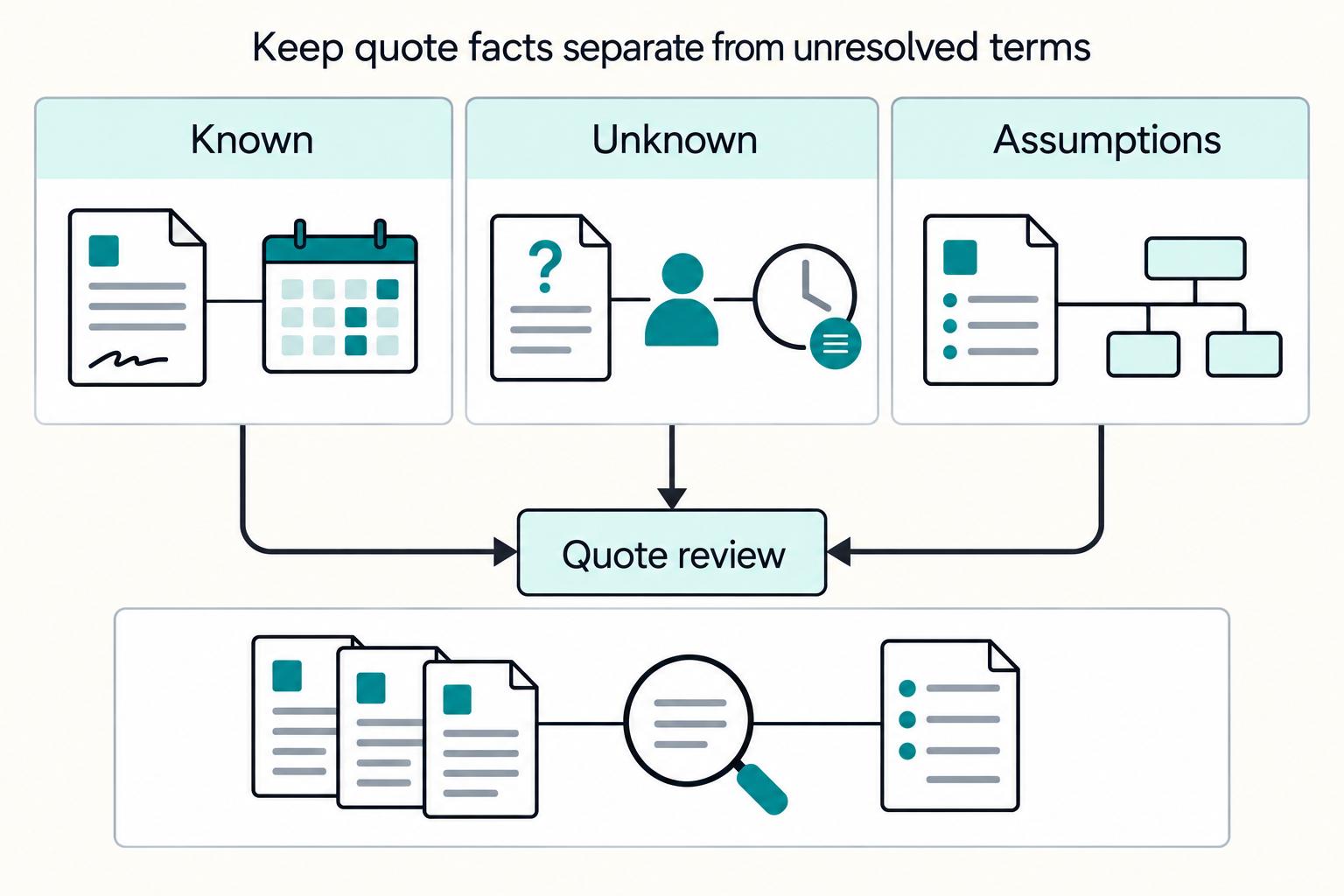
Use three blocks: known, unknown, and assumptions.
| Packet section | What belongs here | What to avoid |
|---|---|---|
| Known | Verifiable packaging facts already set in the quote, for example plan or product variant, billing entity, contract term, agreed invoice cadence | Treating a plan label as if it already defines custom commercial terms |
| Unknown | Quote-only items still being set, for example enterprise terms, discounting, tier-break logic, implementation-dependent scope | Leaving unresolved items without an owner and target resolution date |
| Assumptions | Conditions the quote depends on, for example ERP touchpoints, approval-flow dependencies, rollout scope | Hiding assumptions in side notes or email threads |
If you reference Ramp Plus, keep it to verifiable packaging facts. If you reference Ramp Enterprise, state the commercial and delivery terms directly instead of inferring them from the name.
Add one-page rationales for each pricing lever#
Give each major lever a short rationale page so procurement can review the logic, not just the totals.
For Volume-tier pricing, state the tier metric, what changes when usage shifts, and why that structure fits expected adoption. For the Discount schedule, show which periods change, which variables stay fixed, and the tradeoff between faster adoption and near-term margin. For the Minimum commitment clause, state the floor it protects and the risk it is meant to control if adoption lags.
If a finance reviewer cannot explain each page without reopening the model, the packet is still too opaque.
Surface implementation assumptions early#
List implementation assumptions tied to the real operating stack early, especially when ERP systems are in the approval or invoice path.
Be specific enough to expose expansion risk. Call out billed legal entities, PO-matching field needs, handoff ownership into ERP and AP, and whether early operations rely on manual exchange or direct integration. This is where scope creep needs to be visible before signature.
Clear assumptions matter because procurement and P2P teams are often balancing complexity against limited functionality. If this section is vague, the deal can be treated as an implementation risk even when pricing is sound.
Run a no-unknowns checkpoint before signature#
Before signature, run a three-party checkpoint so procurement, finance, and product confirm no pricing variable is unresolved. Track it in a structured table with columns such as field, status, owner, and date confirmed, and keep separate date fields when status types differ (for example provisional vs final). At minimum, confirm:
| Team | Confirm before signature |
|---|---|
| Procurement | Every custom commercial term is captured as a field, value, or dated assumption |
| Finance | The quote matches billing setup, sample invoice views, and the contract-to-ERP/AP field map |
| Product | Implementation assumptions match what will actually be delivered |
If any pricing variable is still marked "to be determined," pause and resolve it before signing.
Negotiate unknowns when enterprise pricing is custom#
When enterprise pricing is custom, treat every unknown as a contract variable. Before you negotiate details, make the exit-year price explicit.
Use outside benchmarks as directional context only#
If you check third-party benchmark signals, use them as a compass, not a commitment. They can help you pressure-test whether a quote seems broadly in range, but they are not official pricing terms.
Translate those signals into clarification questions tied to deal structure: price, number of licenses, and contract duration. If any of those fields are still unclear, benchmark comparisons are less reliable.
Use a practical negotiation order#
There is no single required sequence, but a practical way to keep negotiations clear is to focus on:
- commitment structure
- ramp shape
- discount mechanics
- support and implementation extras
This keeps the core economics visible first. In a multi-year contract, make sure the final-year number is explicit. In a 3-year deal, that means year three.
Request scenario outputs when the quote is opaque#
If the quote still reads like a black box, ask for scenario-based outputs using your proposed pricing schedule and volume assumptions. Keep term length constant and compare cases such as expected, slower, and faster adoption.
For each case, ask for period-by-period price, the license or volume assumption, and the final-year price. If the vendor will not provide that view, send your own comparison sheet for confirmation. That reduces ambiguity when costs and benefits are otherwise hard to evaluate.
Common implementation mistakes and how to recover#
Implementation failures often come from unclear execution logic, not just a bad quote. If finance cannot model, approve, or audit the deal before signature, the problem is in the design.
Replace plan labels with contract variables#
Treat plan labels as shorthand, not economics. Rewrite the deal in explicit variables: billing periods, what changes by period, discount terms, usage or license assumptions, renewal treatment, and implementation dependencies.
Use a simple check: can finance explain each invoice period without asking what a label "includes"? If not, the contract is still under-defined. That creates room for the same leakage pattern seen in unused licenses, overlapping tools, and auto-renewing subscriptions that keep draining budget.
Simplify stacked incentives before billing inherits the mess#
When one period stacks a tier, a promo, and custom exceptions, execution can break before value is realized. The fix is to simplify the core economics and document any remaining exception separately.
Before redlines close, test whether billing can represent each period cleanly in your real systems. Do not assume tooling will rescue complexity later. Even troubleshooting paths can fail at runtime, and integration gaps or data-quality issues are already enough to stall finance automation work.
Rerun margin with execution assumptions included#
Do not finalize the model until margin is rerun with implementation and control assumptions called out separately from subscription price. If AP automation is in scope, those assumptions should be explicit.
Require finance sign-off on pre-approval controls. A practical checkpoint is fraud review before invoice approval. Ramp reports identifying $5M+ in fraud before invoices were sent for approval. That control discipline matters when many organizations still manage less than two-thirds of total company spend.
Related reading: How to Conduct a Functional Analysis for Transfer Pricing.
Final takeaway and copy-paste checklist#
The deal is ready only when the quote, contract, and billing setup describe the same commercial reality. Separate published facts from negotiated unknowns, then build a ramp pricing schedule your order document, finance team, and invoicing tools can enforce as written.
- Confirm the team is solving for adoption, margin, or risk first.
Pick one primary objective before redlines begin, then align approvals to that objective.
- Lock one contract definition of ramp pricing for all stakeholders.
State exactly what changes by period: price, seat assumptions, discount, billing cadence, and any implementation charges. Keep the same language across your quote, order document, and internal model, and anchor it to the Platform Agreement and the defined "Subscription Term." Subscription Fees are billed monthly unless a different term, such as annual, is offered.
- Finalize pricing variables and any commitment language together.
Treat these as one decision. Ramp also states that some implementation services billed once or for a limited time can still be treated as Subscription Services when specified in an order document, so include those in commitment review.
- Validate billing and ERP feasibility in your actual stack.
Before signature, prove each ramp period can be invoiced and reconciled cleanly, including renewals, true-ups, and any one-time implementation items in scope.
- Recalculate margin with payment-method assumptions.
Model the deal using the payment rails you actually expect, and include that assumed mix in the approval packet.
- Produce a known-vs-unknown quote packet before procurement review.
Include the order document draft, proposed billing cadence, Platform Agreement version checkpoint, for example Last Updated: February 13, 2026, and every unresolved variable. If supporting documentation fails to load or errors, treat it as unverified until the term is confirmed in signed deal documents.
- Resolve all unresolved pricing variables before signature.
Do not sign with blanks on Enterprise price, billable-user logic, billing start date, implementation charges, or non-subscription fees. Confirm legal acceptance of dispute terms, including the requirement for individual arbitration.
If you cannot answer every checkbox from signed documents and tested billing assumptions, pause the deal before signature.
When your checklist is complete and you need implementation-level details for controls, reconciliation, and rollout, start with Gruv docs.
Frequently Asked Questions
What is ramp pricing in enterprise subscriptions?
In this guide, "Subscription Ramp Pricing" appears as a documentation topic, but its mechanic is not defined here. Treat it as contract-specific and state exactly what changes by period, such as pricing, seat assumptions, discounts, and billing timing, in the quote or contract.
Is Ramp Enterprise pricing publicly listed?
No fixed posted amount is shown in the provided pricing excerpt. Enterprise is presented as custom with annual billing, so treat the price as unknown until it appears in the quote and contract.
What published pricing is known for Ramp Free, Ramp Plus, and Ramp Enterprise?
The excerpt shows Free at "$0/mo/user" and Plus at "$15/mo/user." It also says Plus has a platform fee based on team size and advertises 20% savings with annual billing, while Enterprise is custom annual billing rather than a posted dollar amount.
Are there additional transaction fees beyond subscription tiers?
Potentially, yes. When Bill Pay is active, monthly Bill Pay fees are debited from the selected Ramp Plus billing account, and annual Plus plans can still receive monthly statements for seat additions during the term. Budgeting only the base subscription can miss charges that post later.
Should we rely on third-party benchmarks like Vendr to set budget?
Use third-party benchmarks only as directional context. The provided third-party pricing example discloses referral-fee monetization, which shows that external listings are not a vendor commitment. Base budget approval on the vendor quote and contract terms for your actual seat and billing assumptions.
What contract details are still unknown before procurement sign-off?
Common unknowns include the exact Enterprise price, the exact formula behind any Ramp Plus platform fee, which users are billable under your contract setup, and what non-subscription charges may apply. Confirm the billing date in the contract, since first billing is tied to that date and Ramp Plus statement billing dates cannot currently be changed. Resolve these items before procurement sign-off so finance can model invoices and controls.
Researched and edited by the Gruv editorial team. Gruv builds cross-border billing, payouts, and finance-operations software for global businesses.
Sources
Includes 5 external sources outside the trusted-domain allowlist.
Educational content only. Not legal, tax, or financial advice.
Related Posts

The Freelance Payment Penalty: A Modeled Audit of Platform Fees, FX Spreads, and Payout Delays
The money rarely disappears through a single, easy-to-spot fee. The real loss is stacked. A marketplace takes its commission, a processor adds a charge for international cards, a bank or payment company converts the currency at a spread, a platform holds the funds before release, and a wire sheds a little to intermediaries on the way in. Each layer looks defensible on its own, but the worker feels the combined result as a smaller deposit and a later payday.

How to Respond to a Subpoena for Business Records
Move fast, but do not produce records on instinct. If you need to **respond to a subpoena for business records**, your immediate job is to control deadlines, preserve records, and make any later production defensible.

A US Expat's Guide to Investing in UCITS ETFs to Avoid PFIC Issues
The real problem is a two-system conflict. U.S. tax treatment can punish the wrong fund choice, while local product-access constraints can block the funds you want to buy in the first place. For **us expat ucits etfs**, the practical question is not "Which product is best?" It is "What can I access, report, and keep doing every year without guessing?" Use this four-part filter before any trade: