
Quick Answer
Choose a subscription pricing model by matching it to how customers receive value, then proving it survives finance and billing reality. Start with one primary value metric plus a backup, compare two finalists like tiered and usage-based, and test each against MRR behavior, churn risk, and gross margin pressure. Approve only after RevRec treatment, API and webhook flows, and replay safety are validated. Shift to hybrid when heavier cohorts show rising usage without similar revenue lift.
Start With How Customers Use the Product#
Pick the model that matches how customers get value, then pressure-test whether it works for your unit economics and your ability to operate it. If product, finance, and revenue are using different definitions of value, stop there first. Pricing built on split assumptions usually fails later in packaging, forecasting, or billing.
What to clarify first#
Subscription-based pricing means customers pay a recurring fee, usually monthly or annually, to keep access to a product or service. The definition is straightforward. The hard part is choosing the version that fits how value is actually delivered.
Teams can choose across structures from simple recurring billing to usage-based billing and sales-negotiated contracts. Some subscription businesses also monetize through advertising. That flexibility only helps if the model still reflects what customers are buying.
The goal is not just to publish plans on a pricing page. It is to make product behavior, revenue mechanics, and customer expectations line up. That matters because subscription businesses often prioritize MRR and ARR over one-time transactions. A weak pricing choice does not just hurt one deal. It can disrupt renewals, expansion, and forecasting over time.
This guide is for people who approach the same decision from different angles. Founders push for growth. Revenue leaders focus on conversion and expansion. Product teams protect packaging logic. Finance operators need billing and reporting to stay credible. You do not need separate opinions from each function. You need one decision path with shared criteria, one lead value metric, and one backup if the first choice does not hold up.
Use a simple early checkpoint: can your team state the pricing logic in one sentence that everyone would sign off on? "Customers pay for X because X is how they receive value." If that sentence changes depending on whether you ask sales, product, or finance, you are not ready to launch.
The second checkpoint is operational. You should be able to explain how the pricing choice shows up in recurring billing, monthly or annual terms, and any negotiated exceptions without relying on manual reconciliation.
A common failure mode is choosing a model because it sounds familiar or easier to sell, then discovering later that heavy users are underpriced, expansion stalls, or finance cannot trust the revenue picture. Another is forcing a simple plan onto a product whose value clearly scales with consumption. That can look clean at launch but create monetization gaps fast.
Success here is practical. You should leave with a model choice, a launch plan, and clear triggers for when to change course. If a candidate does not hold up on value fit, unit economics, and execution risk, it is not the right choice yet.
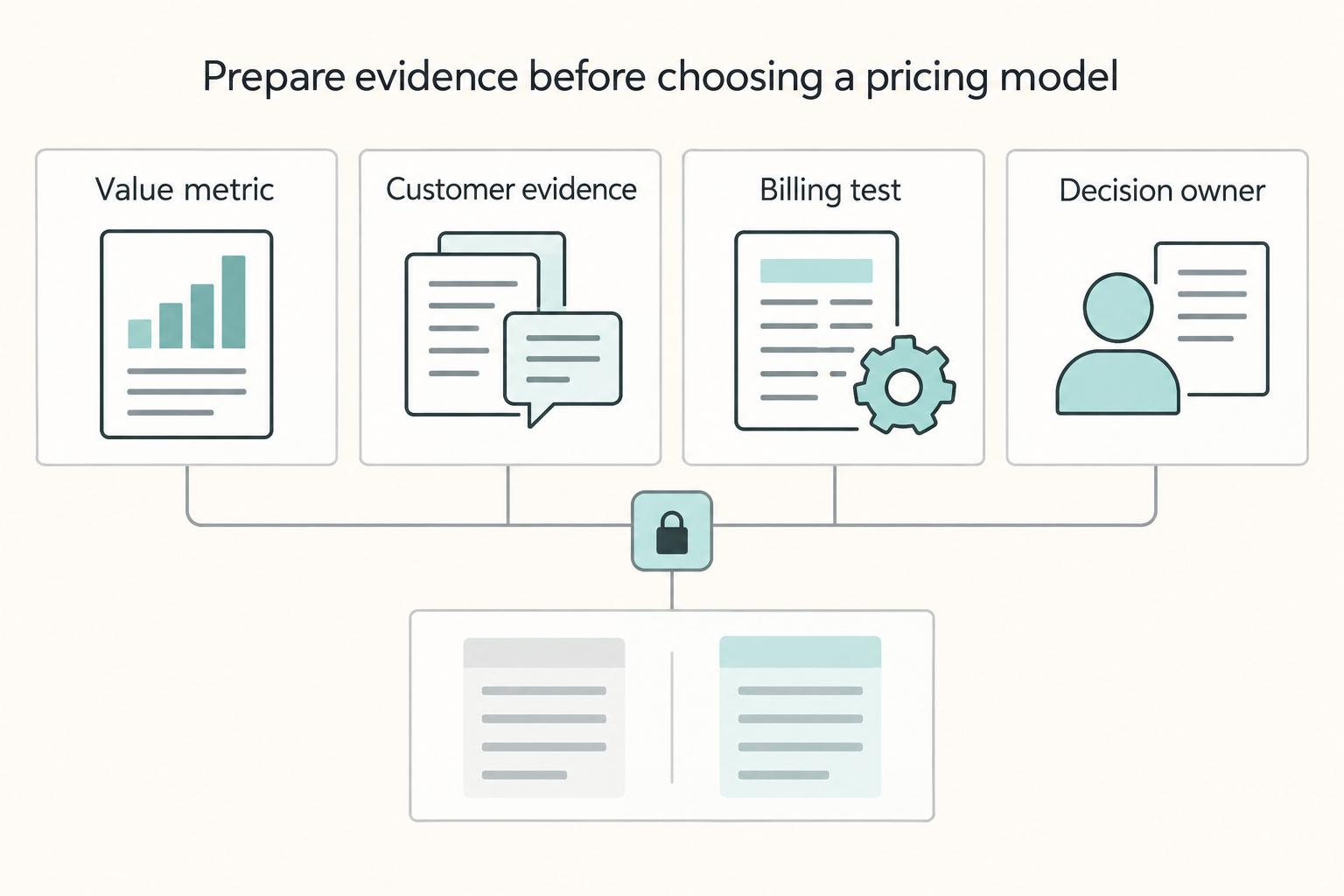
What to prepare before you choose a model#
Choose only after you can show value fit, operating fit, and ownership. Before you compare models, build a compact evidence pack, align on one value metric, and confirm billing can run without manual cleanup.
| Preparation step | What to confirm | Output |
|---|---|---|
| Build a minimum evidence pack | Current billing data, segment-level usage behavior, churn patterns, top renewal objections, and channel context | For each core segment, show what they pay, how they use the product, and why they renew or leave |
| Align on one metric and one backup | One primary value metric candidate and one fallback before packaging starts | One sentence rule with cross-functional signoff |
| Test operational readiness early | API events, webhooks, and finance stack can support the model without manual reconciliation | Validate trigger, billing event, charge outcome, and finance-side visibility |
| Name signoff points | Who approves packaging, billing operations, and Revenue recognition (RevRec) implications | A short approval map |
-
Build a minimum evidence pack. Pull current billing data, segment-level usage behavior, churn patterns, and top renewal objections from sales and success. Keep channel context attached. If some customers buy through third-party billing partners, do not treat those bills as directly comparable to direct billing, because pricing can vary by platform and region. For each core segment, be able to show what they pay, how they use the product, and why they renew or leave.
-
Align product, finance, and revops on one metric and one backup. Set one primary value metric candidate and one fallback before packaging starts. Write the rule in one sentence and get cross-functional signoff on that same sentence. If product defines value by usage while finance expects seat-based recurring billing, the mismatch will surface later in plan design, quoting, or reporting.
-
Test operational readiness early. Confirm your API events, webhooks, and finance stack can support the model without manual reconciliation. Payments operations include repetitive, high-stakes work such as retries, disputes, refunds, and reconciliation, and webhook failures can force your team to piece together context across multiple tools. Validate one end-to-end path now: trigger, billing event, charge outcome, and finance-side visibility.
-
Name signoff points. Decide who approves packaging, billing operations, and Revenue recognition (RevRec) implications. Without clear owners, pricing decisions stall or launch with unresolved exceptions. The output should be a short approval map, not vague consensus.
For a step-by-step walkthrough, see How to Use a 'Cost-Plus' Model for Transfer Pricing.
Match your value metric to the right model candidates#
Match the model to how customer value behaves, not to internal preference. If value rises with measurable consumption, start by testing usage-based pricing. If value is mostly stable month to month, start with flat-rate subscription or per-user pricing.
Define the value metric first#
Write the value metric in one sentence, then classify it as consumption-led or stable-access-led. A value metric should track outcomes customers care about, so your pricing candidate should follow that behavior.
If the metric moves with usage or compute, usage-based pricing is a strong candidate to test. If buyers mostly want predictable access for a known team, flat-rate or seat-based recurring pricing is often easier to budget and buy, especially in enterprise contexts.
Test buyer behavior against procurement reality#
Variable usage is not, by itself, a mandate for pure metering. If usage swings are real but buyers still need budget predictability, test tiered or hybrid candidates alongside pure usage-based pricing.
Keep one tradeoff explicit during selection: usage-driven pricing can improve value alignment, but it can also make spend less predictable for both buyer and seller. There is no single "right" model, so this step is about choosing the best-fit candidates for your context.
Disqualify weak candidates before live testing#
Run a disqualifier pass before you run experiments. For each candidate, ask where it could work against the behavior you want from customers.
For freemium, define what separates serious users from low-intent signups. For per-user pricing, check whether the structure could discourage broader team adoption. Keep the shortlist tight enough that test results stay clear and decisions do not stall.
Compare core subscription models before you commit#
Once you have two finalists, compare them in one table against operating reality, not preference. The better choice is the one that fits buyer behavior and stays understandable on the invoice as accounts grow.
Build the comparison table first#
Use the same evidence pack from the last section: billing data, account-level usage patterns, renewal objections, and notes about budget predictability. If a cell is not supported by observed evidence, mark it unproven.
| Model | Best-fit buyer | Onboarding friction | Expected MRR stability | Gross margin sensitivity | Expansion path | Billing complexity | Main failure mode |
|---|---|---|---|---|---|---|---|
| Freemium model | Large top-of-funnel audience with mixed intent | Low at entry | Lower until paid conversion is consistent | Can tighten if free usage cost outpaces conversion | Convert free users to paid tiers or limits | Moderate | Under-monetized power users |
| Flat-rate subscription | Buyers who want simple recurring access terms | Low | More predictable from fixed recurring fees | Can tighten when usage concentration sits inside one plan | Upsell to higher plans or longer commitments | Low | Under-monetized power users |
| Tiered pricing model | Buyers who want predictable packaging with room to grow | Moderate | Predictable when tier boundaries are clear | Sensitive to tier-limit design | Move accounts up tiers as needs grow | Moderate | Plan confusion |
| Usage-based pricing | Buyers whose value rises with consumption | Moderate | Can vary period to period as usage changes | Sensitive to usage-cost and pricing alignment | Expansion follows higher usage | High | Invoice shock |
| Per-user pricing | Team-based adoption with known user counts | Low to moderate | Predictable while seat counts are steady | Sensitive when value scales without proportional seat growth | Add seats, teams, or commitments | Moderate | Stalled expansion revenue |
| Hybrid pricing model | Varied user base needing predictable access plus value-linked upside | Moderate to high | Balances recurring predictability with variable upside | More controllable when base fee covers standing cost and variable pricing captures heavier use | Expand via committed spend and usage growth | High | Plan confusion or invoice shock if charges feel disconnected |
Recurring-fee models are generally easier to forecast, while models that track actual usage can reflect value more closely but make spend less predictable. Mixed models can work better when one user base includes both low-intensity and high-intensity accounts.
Read the switch triggers before launch#
Move from a single model to hybrid when your metrics show one pricing rule is fitting one cohort but distorting another.
Use these switch triggers:
- usage per account rises while recurring revenue per account stays comparatively flat across heavier cohorts.
- Forecast objections and billing disputes increase as usage variance widens.
- Seat growth stalls while product usage still expands, signaling value is no longer captured well by seats alone.
Do not switch because hybrid sounds more advanced. Switch when the same pattern shows up across billing records, renewal feedback, and expansion outcomes. Related: Subscription Revenue Forecasting: How Platforms Model MRR Growth Churn and Expansion.
Pressure-test economics before launch#
Do not launch a pricing model that only works in a clean forecast. Keep only the option that still holds up when activation slows, discounting increases, and expansion is harder than planned.
Model MRR, CLV, and churn for each finalist#
Build one forecast tab per finalist using the same inputs so the comparison is real. At minimum, model plan mix, billing cadence, Monthly recurring revenue (MRR), churn, and Customer lifetime value (CLV). The goal is not perfect prediction. It is to see how each option changes the shape of subscriber growth, revenue, cash, and unit economics before you make a hard-to-reverse decision.
Use observed behavior from your current accounts, not invented targets. If an expansion assumption does not map to behavior you already see, treat it as speculative. Also run a quick LTV/CAC check: 3:1 is often cited as an ideal benchmark, but use it as a reference point, not proof your model will perform.
Run the downside case before the base case convinces you#
Run the downside first. It exposes weak pricing logic faster than a base case.
Include slower activation, lower seat growth, and heavier discounting in sales-negotiated contracts. Keep assumptions in one shared view so finance, product, and sales evaluate the same scenario set. A practical minimum is base case, downside case, and a sales-reality case with negotiated terms.
Add a finance checkpoint and set a go or no-go rule#
Before launch, confirm with finance that the model still works after support cost, payment cost, and Revenue recognition (RevRec) treatment. Pricing assumptions can look strong in bookings but weaken once recognized revenue timing, service costs, and gross profit are applied.
Keep the approval pack short and explicit:
- assumptions by model
- downside outputs for MRR, churn, CLV, and gross profit
- discounting assumptions for sales-negotiated contracts
- finance sign-off on RevRec treatment and reporting impact
Use a blunt go/no-go rule: if expansion depends on behavior your product does not drive yet, delay that model. Choose the model that matches how customers already buy and expand today.
This pairs well with our guide on How to Handle Multi-Currency Pricing for Your SaaS Product.
Design billing and operations so pricing works in production#
Once the economics work, execution risk shifts to billing operations. If pricing, payment, and accounting states are not tied together, a good model can still fail in production.
Lock the billing sequence and make it auditable#
Define one billing sequence before launch and keep it consistent across standard plans and contract deals. A common pattern is: plan assignment, invoice generation, payment confirmation, then ledger journal posting. The labels matter less than the order. Every team should follow the same sequence.
Your audit check should be direct: each billing record should map to the exact plan version or signed contract terms that created it, and the related accounting entries should map to the same payment outcome. Keep contract ID, billing cadence, renewal terms, and applicable pricing version in the billing record so finance does not rely on side-channel notes.
Make retries and event handling financially harmless#
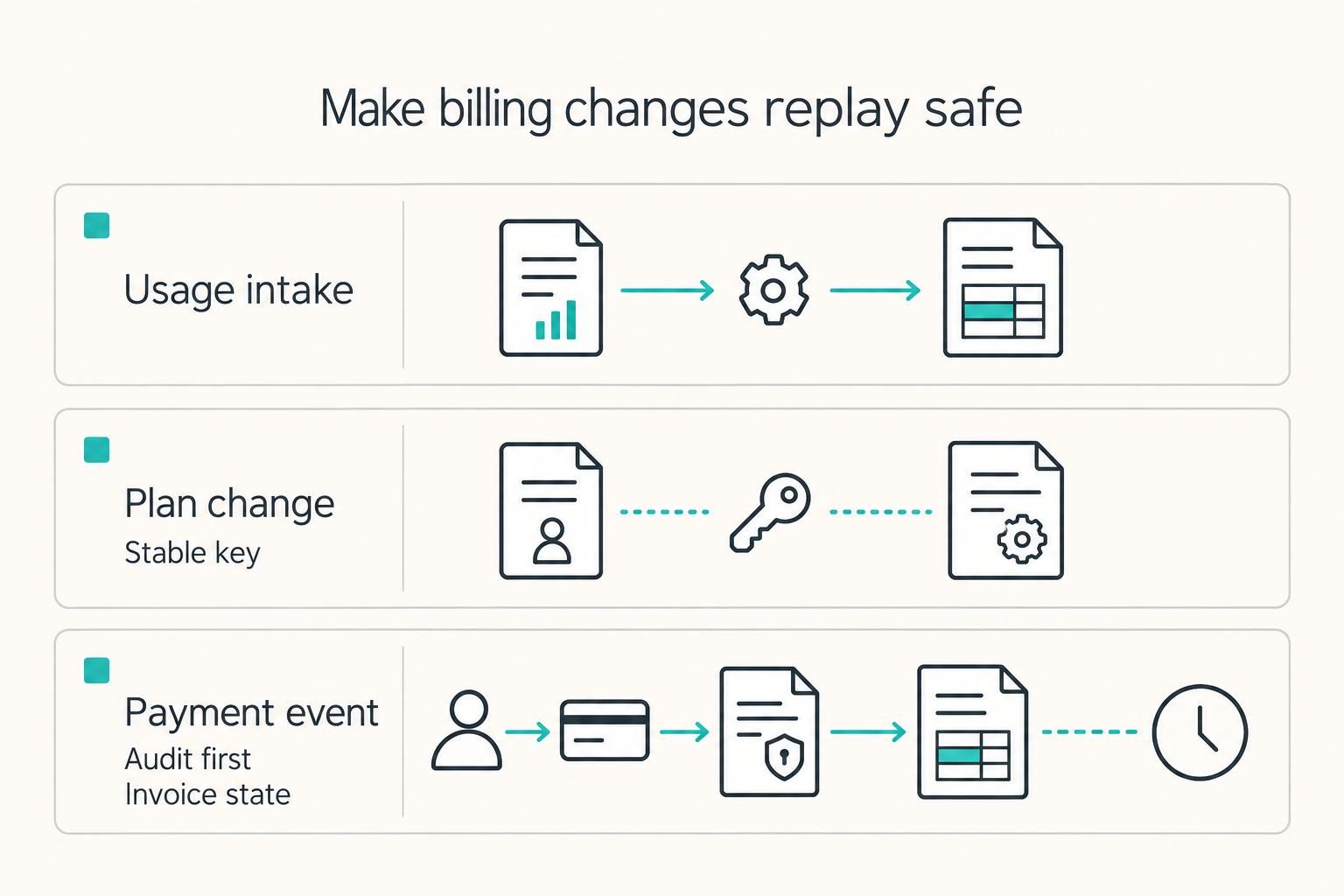
Treat retries and repeated events as normal operating conditions. Define controls so the same billing action cannot create a second charge, credit, payout impact, or accounting impact.
Use a simple staging test before launch: replay the same billing event and confirm the final billing and payment state does not change after the first successful application. This catches the quiet month-end failures that are harder to unwind than obvious outages.
Separate standard plans from contract exceptions#
Keep standard catalog plans and sales-negotiated exceptions on different rails. Standard plans should follow the default billing path. Exceptions should require explicit approval, named non-standard terms, and a clear renewal rule.
| Fee item | Published fee | Notes |
|---|---|---|
| Stripe Standard | 2.9% + 30¢ per successful domestic card transaction | Add-ons: 0.5% for manually entered cards, 1.5% for international cards, and 1% for currency conversion |
| Connect (you handle pricing) | $2 per monthly active account and 0.25% + 25¢ per payout sent | In Connect, if you handle pricing |
| Connect (Stripe handles pricing) | No platform fees | In Connect, if Stripe handles pricing |
| Managed Payments | 3.5% per successful transaction | In addition to standard Stripe processing fees; subscription payments have additional Stripe Billing charges |
Use the published fee structure in your deal review, and route tight-margin exception deals through finance before final sales approval, especially when account activity or payout volume is expected to be high.
You might also find this useful: Choosing Between Subscription and Transaction Fees for Your Revenue Model.
Choose when to move to hybrid pricing#
Move to hybrid pricing when flat plans still win adoption but under-monetize heavy usage. If your highest-consumption customers get much more value than they pay for, that is the signal to test a hybrid pricing model.
- Identify the monetization gap.
Look for a widening gap between product value delivered and value billed under flat-rate tiers. Hybrid pricing combines a fixed recurring fee with additional usage charges, which helps keep a predictable base while allowing revenue to grow with consumption.
This is a common SaaS pattern, not an edge case. Recent commentary describes hybrid and consumption pricing as accelerating in 2025 and 2026, and one cited AI-feature benchmark reports 25% using usage-based pricing and 22% using a hybrid approach. Use that as directional evidence, not a rule.
- Set migration guardrails before announcing changes.
Document who is grandfathered, when existing accounts migrate, and who communicates first. The goal is consistent execution by account, grounded in contract and billing records, so transitions do not drift into one-off exceptions.
Your checkpoint is account-level clarity: for each live customer, the billing record or order form should clearly show legacy plan status, renewal migration timing, or hybrid from day one. For custom contracts, require manual review before applying billing changes.
- Keep billing presentation as simple as possible.
Where your setup allows it, show subscription and usage on a single invoice with separate line items and clear period, metric, and rate details. That can make bills easier to review and explain.
Do not force a single invoice if timing differences would make charges inaccurate. If you need a deeper implementation view, see Hybrid Pricing Models: How to Combine Subscription Fees Plus Usage Charges on a Single Invoice.
- Use the first 2 billing cycles as an initial stress test.
Track exceptions, credit notes, manual adjustments, support tickets, payment disputes, and expansion behavior closely before broad rollout. Treat those cycles as an early checkpoint, not universal proof the transition is complete.
If problems cluster around one metric, segment, or sales promise, pause and fix the meter definition, invoice wording, or migration terms before scaling.
Common pricing mistakes and how to recover#
The biggest pricing misses are often operational: teams optimize the wrong signals, set prices without solid cost logic, or launch before billing is ready.
| Mistake | Risk | Recovery |
|---|---|---|
| Treating top-of-funnel metrics as pricing success | You can miss whether your pricing actually supports margin | Reset your pricing review around paid movement and cost coverage |
| Pricing on intuition or weak cost math | Cost miscalculation and intuition-led pricing can quietly erode profitability | Rebuild your price logic from current cost assumptions and real demand signals, then pressure-test it against market context |
| Launching pricing changes before billing operations are ready | DIY billing engines are a known recurring pitfall | Pause broad rollout until the billing process is clear and repeatable end to end |
Mistake: treating top-of-funnel metrics as pricing success#
If you only track signups or competitor price points, you can miss whether your pricing actually supports margin. A strong pricing strategy should reflect demand, competitive context, and your own costs.
Recovery: reset your pricing review around paid movement and cost coverage, not just volume. If the decision still comes down to gut feel, tighten the model before you scale it.
Mistake: pricing on intuition or weak cost math#
Cost miscalculation and intuition-led pricing are common errors, and both can quietly erode profitability.
Recovery: rebuild your price logic from current cost assumptions and real demand signals, then pressure-test it against market context. The checkpoint is simple: you can explain why this price works for both customers and your unit economics.
Mistake: launching pricing changes before billing operations are ready#
A smooth front-end and back-end billing system is foundational, and DIY billing engines are a known recurring pitfall.
Recovery: pause broad rollout until the billing process is clear and repeatable end to end. Before scaling, confirm finance and support can trace what happened in the billing record without relying on side-channel notes.
Make the decision and document it#
Choose the model you can explain, defend under downside conditions, and run cleanly in billing operations. Then document it so product, finance, and revenue can execute the same decision.
Use this launch checklist in your approval memo:
- Confirm the value metric and backup metric.
Write the primary billing unit in one plain sentence, then name the fallback meter if the first one is noisy. Aim for meter clarity like Make's pricing logic, where each module action counts as one credit.
- Finalize the model choice and disqualifier rationale.
Record the selected model and why key alternatives were rejected. If that rationale is missing, you have not made a durable decision.
- Validate MRR, CLV, churn, and margin scenarios.
Test base and downside cases with real payment-cost assumptions. For example, payment mix can materially change margin: 2.9% + 30¢ card pricing is different from 0.8% ACH Direct Debit (with a $5.00 cap), and extra fees may apply for international cards (+1.5%) and currency conversion (+1%).
- Approve invoicing, RevRec, API/webhook, and idempotency readiness.
Run replay tests for billing and payment events so retries do not create duplicate financial outcomes. Hold launch if finance cannot reconcile bills back to product events and contract terms without manual cleanup.
- Define hybrid switch triggers and the post-launch owner.
If cost-to-serve is volatile, predefine when you will move from a simple recurring charge to a hybrid structure. Assign one owner to review those triggers after launch and confirm whether the current model still fits.
Related reading: Remote.com Pricing for Contractors and the Fees That Change Your Total.
Frequently Asked Questions
What is a subscription pricing model in practical terms for a SaaS platform?
A subscription pricing model is the charging logic that turns product use into recurring revenue and an ongoing customer relationship. In practice, that means you define what triggers a charge, how often you bill, and which value metric sits underneath it, such as seats, API calls, or a flat monthly plan. If finance cannot trace a bill back to a clear pricing rule, the model is not ready.
Which model is usually best for early-stage platforms with uncertain usage patterns?
There is no single best answer for every SaaS company, but early teams usually benefit from simple, transparent pricing first. A tiered pricing model built around an explicit usage metric, such as seats or API calls, often gives customers enough predictability while still leaving room to learn. Your checkpoint is simple: can a new buyer estimate their first bill without a sales call, and can you explain that charge from your product data?
How do I decide between a tiered pricing model and usage-based pricing?
Choose usage-based pricing when customer value rises directly with consumption and you want revenue to track that behavior more closely. Choose tiers when you need simpler, more transparent packaging so expected charges are easier to understand. The red flag is mismatch: if customers consistently struggle to predict costs or pricing no longer reflects how they use the product, the structure likely needs adjustment.
When should I introduce a hybrid pricing model instead of keeping one simple plan?
Move to hybrid pricing when you need both a stable recurring charge and a flexible component tied to usage. That blend can improve fit, but only if billing and accounting can support the added complexity. Before you switch, verify that your bills, contract terms, and revenue treatment can separate fixed and variable charges cleanly.
What are the biggest risks of freemium and flat-rate subscription models?
The clearer documented risk here is with flat-rate subscription: it can improve predictability but weaken alignment to customer value. For freemium, rely on your own conversion and retention data rather than assuming signup volume will become paid growth. If adoption looks healthy but paid outcomes stay weak, revisit packaging and value metrics.
How do pricing changes affect MRR forecasting, RevRec, and contract operations?
Pricing changes do not just change packaging. They can change CAC payback, LTV/CAC, and overall revenue efficiency, and they may change how predictable recurring revenue appears over time. They also raise revenue recognition considerations under ASC 606, especially when you add variable charges or negotiated contracts. A practical review pack should include updated plan rules, contract language, billing examples, and clear records of exceptions.
Try a related tool
Researched and edited by the Gruv editorial team. Gruv builds cross-border billing, payouts, and finance-operations software for global businesses.
Sources
Includes 2 external sources outside the trusted-domain allowlist.
- en.wikipedia.org/wiki/Subscription_business_modeltrusted
- scholarworks.umt.edu/cgi/viewcontent.cgitrusted
- sec.gov/Archives/edgar/data/1609711/0001609711260000...trusted
- stripe.com/resources/more/subscription-pricing-models-a...trusted
- stripe.com/pricingtrusted
- support.stripe.com/questions/managed-payments-pricingtrusted
- dealhub.io/glossary/subscription-based-pricingexternal
- dealhub.io/glossary/hybrid-pricingexternal
Educational content only. Not legal, tax, or financial advice.
Related Posts
Hybrid Pricing Models for One Subscription and Usage Invoice
Treat this as a billing and operations project, not just a pricing exercise. A hybrid pricing model can be commercially strong. The real test is whether you can put a recurring subscription fee and usage-based charges on a single invoice without forcing Finance to stitch things together at month-end.
How to Price a Software Licensing Agreement
The real cost of software is not the headline price. The license and pricing model shape your cashflow, your day-to-day workload, and how hard it is to change course later. If you focus only on sticker price, you miss the tradeoffs that matter.
Subscription Revenue Forecasting for Platform Teams Modeling MRR Churn and Expansion
A usable forecast starts with shared definitions, not sharper formulas. If finance, ops, and product define MRR, Expansion MRR, or churn differently, the model can look precise and still fail the first serious review.