
Quick Answer
Start with a conservative go or no-go model before you create an audiobook: if the downside case fails, wait. Then hire to your bottleneck with a weighted manuscript audition, lock ownership and revision boundaries in writing, and choose distribution by exit flexibility rather than headline payout. Before launch, set a monthly close routine that ties platform statements to your ledger and bank deposits, and keep a proof folder with rights, approvals, and delivery records.
Producing an audiobook is not a creative side project. It is a business decision. You are committing money, time, and intellectual property rights to a format that can generate royalties and shape your professional brand for years. The rule is simple: move ahead only if the conservative case works, the rights are clear, and you can manage the asset after launch. This guide walks through that decision in four management layers, each with its own job.
Part 1: Build the Business Case Before You Commit#
Do not produce an audiobook unless the conservative case still holds after one ugly surprise: slower sales, extra revisions, or more of your time than planned. If the downside would strain cash you need elsewhere, the answer is no, at least for now.
Before you start: verify live platform terms before you model anything. Keep explicit fields in your worksheet for items that change often: current royalty basis, exclusivity terms, reporting cadence, and market signals.
Step 1. Build a three-case worksheet. Use one formula across all three cases: expected royalties + business value created - total project cost. The parts you control are scope, narrator choice, production method, launch timing, and how much of your own time you will spend managing it. The risky parts are your assumptions, so label them clearly instead of hiding them in the model.
For each case, write down:
- Inputs you control: format choice, distribution path, launch assets, revision allowance, your budget cap
- Assumptions to verify: current platform payout terms, current market signal, expected conversion from your audience, and your production-effort estimate
- Pass/fail checkpoint: your conservative case must clear your minimum acceptable return without relying on optimistic sales or unpaid labor
Step 2. Separate visible costs from hidden operating costs. Avoid pricing only the narrator quote. Visible costs can include narration, editing, mastering, cover or sample updates, and upload preparation. Hidden costs can include your management time, pickup rounds, file review, distribution admin, and contingency for fixes after approval.
If you plan to self-narrate or use virtual voice narration, treat that as a cost choice too, not a shortcut. Some storefronts explicitly flag virtual voice narration on the listing, so your model should account for potential brand or conversion effects when that label is visible to buyers.
Step 3. Choose the payment path by risk first, upside second.
| Option | Upfront cash burden | Break-even risk | Control over royalties | Lock-in exposure | Best-fit scenario |
|---|---|---|---|---|---|
| Upfront-fee path (verify current platform terms) | Highest | Highest early cash risk | Highest | Lowest, if terms stay flexible | You have cash and want cleaner long-term economics |
| Royalty-split path (verify current platform terms) | Lowest | Lower cash risk, slower recovery | Shared | Higher if term length or exclusivity applies | You need to protect cash more than upside |
| Hybrid path (verify current platform terms) | Medium | Shared risk | Shared | Medium | You want some cash protection without fully giving up future income |
Red flag: if the path that looks best only works when sales beat your base case, it is not your best path.
Step 4. Set a monthly finance cadence before launch. Decide now how you will monitor the project once it is live. Track monthly revenue, unit activity, refunds or adjustments if shown, ad or promo spend, and non-cash signals that matter to you, such as reviews, inbound speaking requests, or client leads. Treat each channel statement as the baseline record for that channel and put the current reporting cadence for each platform on your calendar. At launch, capture a storefront snapshot you can compare later: displayed price, rating count, and listing labels.
Write down your trigger for a strategy change now, before launch emotion gets involved. If actuals miss the floor you set in your conservative case, stop adding spend and reassess distribution, pricing, or format.
Step 5. Prepare a pre-hiring evidence pack. Before you contact talent or approve a sample, assemble your final manuscript, rights confirmation, planned distribution assumptions, payment-path choice, timeline, and a simple budget sheet with contingency. If your pricing logic is still loose, tighten that first with Value-Based Pricing: A Freelancer's Guide. This is the minimum file set that keeps the next stage from turning into expensive guesswork.
If you want a deeper dive, read How to Write a Book to Establish Your Freelance Expertise.
Part 2: The Executive Producer Mindset - Assembling Your A-Team#
In this phase, staff around your biggest bottleneck so you do not create rework later. Choose the model by constraint, not identity. If your constraint is time, offload coordination; if it is quality control, keep tighter approvals; if it is cash runway, plan for more of your own operating time.
Step 1: Pick the staffing model by bottleneck#
Use this table to decide, then commit to one path before auditions start.
| Staffing option | Control | Time burden on you | QA responsibility | Revision exposure | Cash-flow risk |
|---|---|---|---|---|---|
| Author narrated | Highest | Highest | Mostly yours | Highest if first takes miss | Lower visible spend; hidden labor risk. Benchmark with current quotes before deciding |
| Narrator led | High on direction, lower on execution | Medium | Shared unless assigned clearly | Medium if brief is loose | Mixed. Benchmark with current quotes before deciding |
| Producer led | Lower day-to-day, higher through approval gates | Lowest | Must be assigned in writing | Lower when scope is locked early | Higher visible spend. Benchmark with current quotes before deciding |
Some producers can come across as money-first rather than art-first, so screen for both: budget discipline and tone sensitivity.
Step 2: Run a weighted manuscript audition#
Use one excerpt from your actual manuscript and score every candidate against the same brief. Treat this as a hiring checkpoint, not a demo showcase.
| Criterion | Weight |
|---|---|
| Voice fit and tone range | 30 |
| Direction responsiveness after one redirect | 25 |
| Terminology and name accuracy | 20 |
| Pacing and clarity across tone shifts | 15 |
| Communication discipline and deadline realism | 10 |
Your brief should include straight narration, one tonal shift, and difficult terms or names. Then require one revision round based on your direction. That second pass tells you more about pickup risk than a polished first read. If a platform sets audition-length rules, verify the current guidance and follow it.
Step 3: Lock ownership before full recording#
Do not start recording at scale until ownership is explicit. Name who approves performance, who handles pickups, who signs off QA, and who owns pronunciation updates.
Then define risk controls in plain language:
- Revision boundary: what counts as correction vs creative change
- Communication protocol: where decisions and feedback are recorded
- Timeline change handling: who can approve schedule shifts
- Final QA gate: one pre-submit check by the same owners above, with current delivery specs and platform limits verified in writing
Even prepared teams can hit difficult conversations, so keep these controls written and visible.
Related: How to monetize a YouTube channel.
Part 3: Protect Control of Rights, Contracts, and Master Files#
Once your team is set, your job is to protect control before momentum takes over. Pause the process anywhere you cannot prove rights, explain your exit path, or trace who approved what.
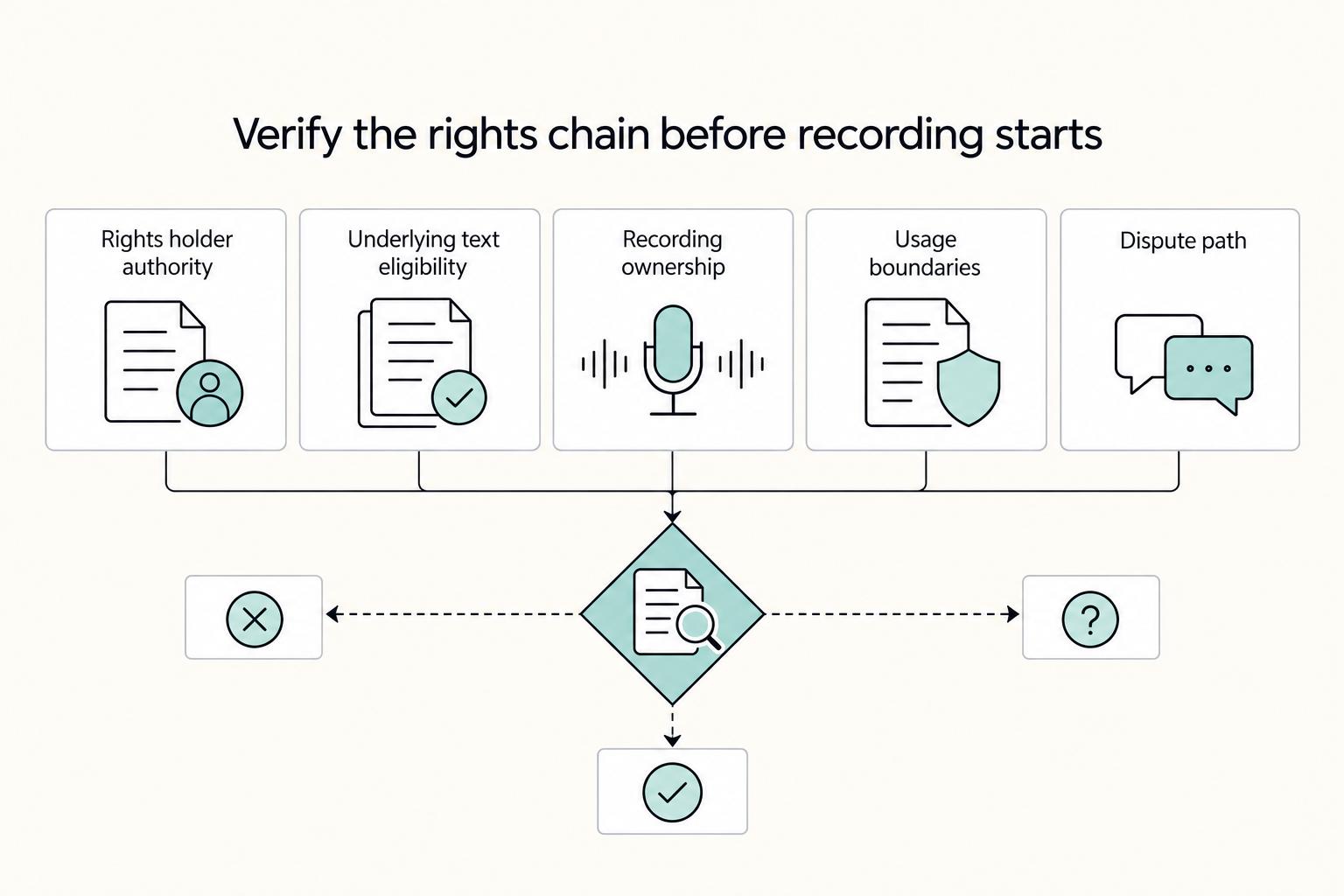
Step 1: Verify the rights chain before recording starts#
Treat this as a go or no-go gate. Do not sign or record at scale until each line has a named owner and proof on file.
| Verification item | Confirm before signing | Evidence for the proof folder |
|---|---|---|
| Rights holder authority | Who controls audio rights for the underlying text, and who can approve production and distribution decisions | Signed rights memo naming rights holder and authorized signer |
| Underlying text eligibility | Whether the source book is eligible for your chosen distribution route under current platform requirements | Screenshot or link record of eligibility check |
| Recording ownership | Who owns final masters, raw sessions, pickups, and related production files | Signed agreement with ownership terms by file category |
| Usage boundaries | Where distribution is allowed, and whether demo/portfolio use or excerpt reuse is allowed | Signed usage clause and any approved excerpt list |
| Dispute path | What happens if rights are challenged, work stops, or termination happens before delivery | Signed notice/dispute clause with named contact and response window |
Use one checkpoint question: if someone asked tomorrow who had authority and what they were allowed to do, could you prove it from documents alone?
Step 2: Make the contract explicit before anyone records at scale#
Before anyone records at scale, put the operational terms in writing so approvals and ownership are not left to interpretation.
| Contract area | What to define |
|---|---|
| Parties | Each party and the signer for each party |
| Approvals | Who approves performance, pickups, and final delivery |
| Ownership | Ownership for each asset category after the agreed trigger |
| Revisions | Corrections versus creative revisions |
| Usage | Allowed usage, including samples, demos, and portfolio excerpts |
| Work stoppage and disputes | What happens if work stops, delivery is rejected, or a dispute begins |
Keep these in your proof folder: signed agreement, rights memo, final brief, approval trail, invoices, delivery manifest, and version log.
Step 3: Choose distribution for control and exit flexibility, not headline payout#
Compare options by off-ramp clarity first, then economics. Verify each point before you upload.
| Distribution option | Control checks to verify | Exit-flexibility checks to verify |
|---|---|---|
| Option A | Verify current exclusivity terms and territory scope | Verify current removal workflow and rights-reversion process |
| Option B | Verify current exclusivity terms and territory scope | Verify current renewal or continuation rules and removal workflow |
| Option C | Verify current exclusivity terms and territory scope | Verify current rights-reversion and renewal or continuation rules |
If you choose tighter channel concentration, document that tradeoff in plain language before launch so the constraint is intentional, not a surprise.
Step 4: Set a master-file handover standard before release#
Treat handover as an asset transfer, not an upload task.
| Area | Requirement |
|---|---|
| Required deliverables | Final masters, raw sessions (if agreed), pickups, room tone, credits, release-package cover assets, delivery manifest, version log |
| Version conventions | Use consistent names (for example, BookTitle_Ch03_Master_v03_2026-03-25) so edits are traceable |
| Access permissions | Limit edit rights, keep approved versions read-only |
| Integrity checks | Verify transferred files match approved files at handover |
| Retention policy | Write a simple policy you can maintain and store it with the masters and proof folder |
Close your risk register before release with four controls: signed rights memo (unclear rights), verified exit summary (lock-in surprises), complete manifest (incomplete handover), and version-plus-approval trail (untraceable edits). If one control is missing, fix it before launch.
For a step-by-step walkthrough, see How to claim copyright for your self-published book.
Part 4: The Financial Controller Mindset - Managing Your Revenue#
Run revenue as a monthly control routine, not as a deposit-checking habit. Your goal is simple: keep a repeatable record of what came in, how you classified it, and what still needs follow-up, while keeping owner pay separate from book revenue.
Step 1 Choose your intake setup before the first payout#
Pick the setup you can still run cleanly when titles and payment streams increase. If everything lands in one undifferentiated pool, reporting gets reactive fast.
| Setup option | Auditability | Reporting clarity | Admin load | Scale readiness | Best fit | What to verify |
|---|---|---|---|---|---|---|
| Single business account | Fair if you keep disciplined records | Fair | Low | Limited | Early stage, low volume | Verify current account policy for royalty deposits and transfers |
| Dedicated royalty sub-account | Stronger separation | Strong | Medium | Better for multi-title tracking | You want cleaner payout separation | Verify current bank policy for sub-accounts and transfer timing |
| Ledger-only separation with one bank account | Depends on update discipline | Strong if maintained consistently | Low to medium | Moderate | You prefer fewer accounts and tighter bookkeeping controls | Verify current bookkeeping policy and classification rules |
Step 2 Reconcile monthly in one fixed order#
Use one internal source-of-truth order every month: platform statement, then internal ledger, then bank deposit. Keep that sequence stable so your close is comparable month to month.
Track entries in clear buckets: title-level income, platform deductions, withholding shown on statements, transfer/FX variance, production cost recovery treatment, and owner pay in a separate category. Your monthly pass/fail check is practical: can you explain the statement amount, ledger amount, and deposit trail without guesswork?
If numbers do not line up, log an exception before closing:
- label the issue as
refund,chargeback,transfer variance,timing difference, orunknown - attach supporting records (statement, deposit record, ledger snapshot)
- leave the item open until resolved instead of forcing a match through owner pay
Step 3 Split year-end bookkeeping from tax prep#
Close your books first, then hand off for tax preparation. This keeps unresolved items visible and makes adviser review faster.
Use this handoff checklist:
- year-end ledger export
- monthly platform statements and bank deposit records
- title list with release dates
- notes on production cost recovery treatment
- withholding summary by source shown on statements
- owner-pay summary kept separate from revenue
- unresolved exception log
- Current filing requirements confirmed with your adviser
For international royalties, run one final checklist before filing: verify withholding treatment, confirm source characterization, and archive the records behind your decision. That record set protects you if questions come up later.
You might also find this useful: How to Get an ISBN for Your Self-Published Book.
Frequently Asked Questions
How long does it usually take to create an audiobook for a self-published title?
The timeline depends on manuscript length, narrator availability, revision rounds, and platform review time. Plan it in phases: audition and contracting, recording and pickups, quality checks, upload, and monthly post-launch review.
Should I self-narrate or hire a professional narrator?
Choose based on your main bottleneck. Self-narration can reduce upfront cash but usually increases your time and QA burden. Hiring a narrator or producer can improve throughput when your schedule is the constraint.
What documents should be signed before full recording starts?
Before recording at scale, define rights authority, approval owners, ownership of masters and raw files, usage boundaries, and a dispute process. Keeping these controls signed and centralized reduces costly rework later.
How can I reduce royalty surprises after launch?
Use one fixed monthly close order: platform statement, internal ledger, then bank deposit. Track unresolved differences in an exception log instead of forcing entries, so your records stay auditable.
Try a related tool
Researched and edited by the Gruv editorial team. Gruv builds cross-border billing, payouts, and finance-operations software for global businesses.
Sources
- berkeleyca.gov/sites/default/files/documents/2022-05-31%20I...trusted
- copyright.gov/1201/2024/2024_Section_1201_Registers_Recomm...trusted
- cs.princeton.edu/courses/archive/spring18/cos226/assignments/...trusted
- huttotx.gov/m/newsflashtrusted
- maricopa.gov/m/newsflashtrusted
- sandiego.gov/sites/default/files/2026-02/10090131-25-d.pdftrusted
- scottsdaleaz.gov/docs/default-source/scottsdaleaz/scottsdale-...trusted
- snap.berkeley.edu/project/10053261trusted
Educational content only. Not legal, tax, or financial advice.
Related Posts
Value-Based Pricing for Freelancers Under Real Payment Risk
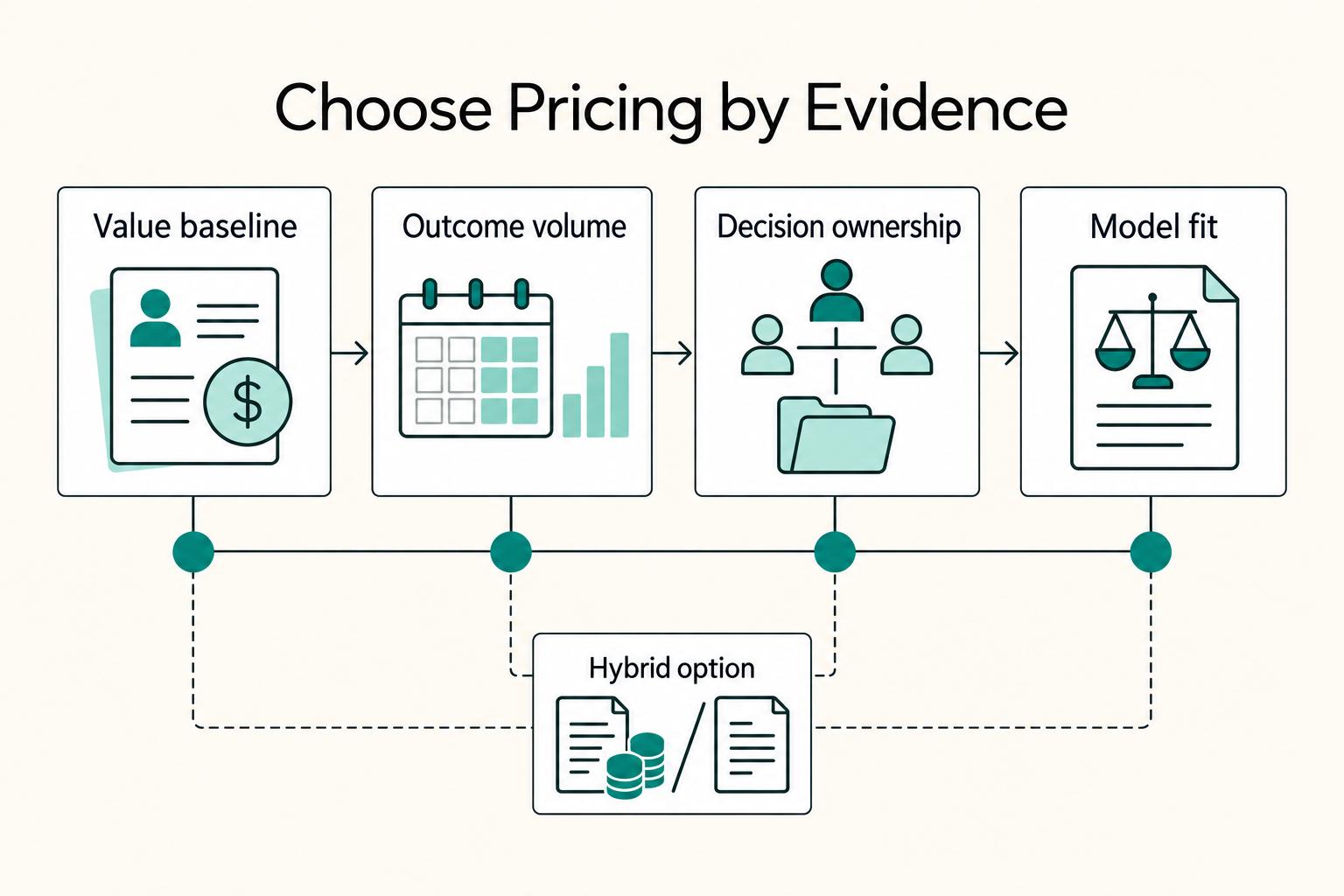
Value-based pricing works when you and the client can name the business result before kickoff and agree on how progress will be judged. If that link is weak, use a tighter model first. This is not about defending one pricing philosophy over another. It is about avoiding surprises by keeping pricing, scope, delivery, and payment aligned from day one.

How to Write a Book as a Freelancer Without Scope Drift
The book needs a defined job and a defined boundary before you draft. In this cycle, give it one job: either support your client book services, or strengthen your own authority book so your niche, offer, and sales conversations become clearer.
How to Monetize a YouTube Channel for Reliable Cashflow
You are not just a content creator. You are running a business of one. That shift matters because most guides stop at feature checklists. They show you how to switch revenue on, but not how to build something resilient, compliant, and easier to manage over time.