
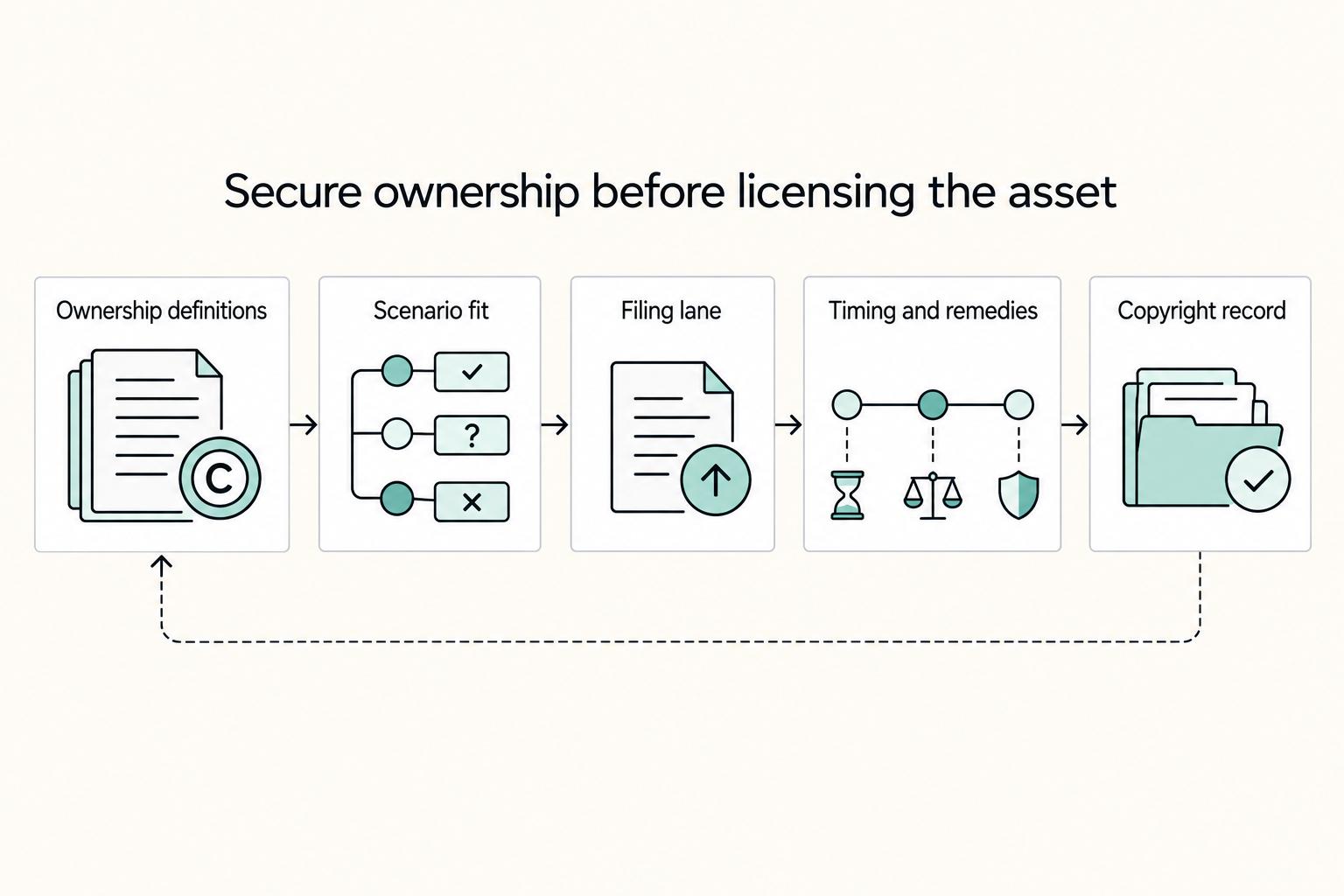
Quick Answer
Yes - register your manuscript with the U.S. Copyright Office if you want enforceable control beyond automatic protection. For a U.S. work, registration or preregistration is generally tied to bringing an infringement claim, and timing can affect available remedies. Before filing, organize contributor agreements, ownership transfers, and publication status, then select the correct path in the Registration Portal and eCO. Keep your submission record and deposit copy for disputes and licensing diligence.
What to Confirm Before You Start Stage 1#
One of the easiest mistakes to avoid is choosing the wrong registration path and creating unnecessary rework.
Before you start. This guide is for self-published professionals who want a book that is documented and ready for registration. It helps you make cleaner filing and recordkeeping decisions, especially when collaborators were involved. It does not replace individual legal advice for active ownership disputes or unclear contract language.
Define roles before you file. Get your labels straight before you touch the application. Consistent naming keeps your filing and records aligned.
Use these as working labels for this guide, not definitive legal determinations:
- Author: the person you list as having created the text in your records.
- Copyright claimant: the person or entity you plan to name in the registration.
- Publisher account: the platform or imprint account used to distribute the book.
- Rights chain: the records showing how rights did or did not move between people or entities.
Keep those roles separate in your documents so your filing choices stay consistent.
Match your current state to the next action. Use the table below before you start Stage 1. If key contributor documents are missing, fix that first.
| Your current state | Immediate action before Stage 1 |
|---|---|
| Sole author | Gather dated drafts and your final manuscript, then confirm the exact legal name you want on the claim. |
| Co-author | Confirm who contributed what, who will be named, and whether both parties have matching records. |
| Work-for-hire contribution involved | Pull the signed agreement and review the wording before filing; if terms are unclear, get legal advice. |
| Contractors or ghostwriters used | Locate contracts, invoices, and delivery files so you can trace who created what. |
Confirm the filing lane. When you are ready to file, start in the U.S. Copyright Office Registration Portal, then log in to the Electronic Copyright Office (eCO) Registration System. If you are registering multiple unpublished works together, use the Group of Unpublished Works application, which allows up to 10 unpublished works on one application. Do not use the Standard Application for a collection of unpublished works. If you submit 2 or more works there, the Office may register only 1 work, remove the others, and require resubmission on the proper form.
Before moving to Stage 1, confirm all four are true:
- ownership records gathered
- contributor agreements located
- publication status clarified
- registration path selected
If all four are true, move on. For related reading, see How to Copyright Your Creative Work as a Freelancer.
Stage 1: SECURE Your Asset - Building an Irrefutable Foundation of Ownership#
Copyright attaches automatically when your manuscript is fixed, but that alone is often not enough once enforcement risk shows up. For a U.S. work, you generally cannot file an infringement suit until preregistration or registration has been made. Delay can weaken your practical enforcement position rather than erase ownership.
Step 1. Lock the ownership definitions before filing#
Use these terms consistently in this filing:
| Term | Meaning |
|---|---|
| Author | The creator of original expression, except where valid work-made-for-hire rules apply. |
| Copyright claimant | The person or entity named as owner in the application. A non-author claimant must own all rights in the claimed authorship. |
| Registration | For filing purposes, your submission is complete when the Office receives the required elements in proper form: application, nonrefundable fee, and nonreturnable deposit. |
| Chain of title | The records showing how ownership moved from author to claimant, including signed transfer writing where required, or operation of law. |
Keep account names, pen names, imprint names, and legal ownership records separate. If the claimant naming and transfer records do not match, fix that before you file.
Step 2. Match your scenario to the pre-filing document pack#
The right document pack depends on who created what and whether rights ever moved. If that is still fuzzy, do not file yet.
| Ownership scenario | Likely claimant | Pre-filing documents |
|---|---|---|
| Solo author, no collaborators | Author | Dated drafts, final manuscript, publication-status note, exact legal name for claim |
| Co-authors created a joint work | Co-authors, unless later transfer | Contribution record, written ownership agreement, final manuscript, any later assignment |
| Contractor or ghostwriter contributed text | Contract-dependent | Signed agreement, assignment or work-made-for-hire terms if used, delivery files/emails, contribution trace |
| Entity-owned rights (for example, LLC) | Entity, only if it owns all rights | Signed transfer or valid work-made-for-hire basis, correct legal entity records, transfer statement support |
If documents are incomplete, pause. Joint authors are coowners unless rights were later moved, and work made for hire depends on statutory conditions and, for commissioned works, a signed writing when that path applies. This is where the distinction in work for hire and assignment of rights matters.
Step 3. File in the correct lane and run an error-prevention check#
Use the U.S. Copyright Office registration system (Registration Portal/eCO). If you are registering multiple unpublished works together, use the Group of Unpublished Works path, up to 10 unpublished works. Do not use the Standard Application for an unpublished collection.
Common delay drivers include the wrong claimant, a missing or unclear transfer statement when the claimant is not the author, the wrong application type for the work set, inaccurate application facts, and treating preregistration as a substitute for registration.
Before you submit, verify these points:
- Claimant name matches your ownership documents.
- Transfer writing is signed where required.
- Application type matches publication and grouping rules.
- Application facts match your manuscript and records.
- All required registration elements are ready in proper form.
Step 4. Treat timing and remedies as verification-gated#
Timing can change what is available to you, so verify it before you rely on it. Check the current rules tied to registration before infringement begins or within 3 months after first publication. Also check the within-five-years publication window tied to prima facie evidentiary treatment.
Do not rely on stale dollar figures for statutory damages or attorney's fees. Confirm current thresholds in current statute and Copyright Office guidance before making enforcement-value decisions.
Step 5. Build a clean copyright page (optional but useful)#
A copyright page is optional, but it helps keep your ownership story consistent. For works first published on or after March 1, 1989, notice is optional, not required. Notice can still be useful, but it does not replace registration. You do not need any copyright-page element to own copyright. If you use one, it can include a notice line, rights-reservation language, a permissions contact, an ISBN, and imprint or publisher details.
A simple copyright page can identify the first-publication year and the copyright owner's legal name.
All rights reserved.
It can also list a permissions contact, ISBN if assigned, and imprint or publishing entity if applicable.
Before you publish or submit, run one last check. Make sure the year matches first publication, the owner name matches claimant and ownership records, and the imprint or entity naming does not conflict with your chain of title.
Stage 2: FORTIFY Your Defenses - Establishing a Global Shield#
Once your ownership file is clean, the next decision is where to enforce first. For cross-border disputes, Berne gives you a baseline, but enforcement still runs through local rules.
Step 1. Apply the Berne rule correctly before you escalate#
Berne gives your book national treatment in member countries. Your work should get the same protection local law gives domestic authors, and protection is not conditioned on formalities. Berne was adopted in 1886 and currently lists 182 members.
What Berne does not give you is one worldwide copyright or one universal enforcement process. Protection and remedies still follow the law of the country where protection is claimed. That means local platform policy and local procedure still control outcomes, and local counsel may still be needed. Before you act, identify the exact country and the exact platform or host where the infringing copy is live.
Step 2. Choose where to act first#
Start with the channel that can remove access fastest, then escalate based on the facts.
| Situation you can confirm | First move | Escalate when |
|---|---|---|
| Infringing listing/upload is live on a marketplace or platform | File the platform IP complaint first | The platform rejects, ignores, or requires additional legal process |
| Content is on YouTube | Use YouTube's copyright removal request, which you or an authorized representative can submit | Repeat uploads continue or identity/privacy concerns require counsel handling |
| Listing is on Amazon | Use Amazon's Report Infringement form, as rights owner or agent | Seller behavior persists across listings/accounts |
| Site is behind Cloudflare | Send the complaint, then pursue the actual host or site operator because Cloudflare does not directly remove content | Host or operator is unclear or nonresponsive |
| Cross-border harm is material and ongoing | Prepare counsel escalation in the country where protection is being claimed | Platform and host routes fail or court-level remedies are needed |
Step 3. Separate strong claims from weak claims#
Not every unfair use is a strong copyright claim. Lead with copied expression, not with frustration. Use the comparison below to sort copyright issues from lookalike complaints.
| Protected element | Commonly misclassified element | Recommended action |
|---|---|---|
| Your specific text, passages, and expressive wording | The underlying idea, method, process, or concept | Gather evidence, then use a takedown route if copied expression is identifiable; escalate to counsel for substantial copying |
| Your copyrighted expression in the work | Underlying systems, principles, or discoveries | Compare side by side; escalate only when copying of expression is clear |
| Your copyrighted work | Titles, names, slogans, or other short phrases | Monitor; do not lead with a copyright claim on title-only disputes; escalate for counsel review if the issue is source identification |
Step 4. Use the right enforcement entity at the right time#
Match the enforcement route to where the infringement actually lives. Use marketplace notice systems when the infringement is on-platform. Use hosting-provider escalation when the content is on an independent site. Use customs recordation when physical infringing copies are crossing U.S. borders and you have a federally registered right recorded with CBP. Use local courts when platform or host actions are not enough and jurisdiction-specific remedies are required.
| Enforcement route | Use it when |
|---|---|
| Marketplace notice systems | The infringement is on-platform. |
| Hosting-provider escalation | The content is on an independent site. |
| Customs recordation | Physical infringing copies are crossing U.S. borders and you have a federally registered right recorded with CBP. |
| Local courts | Platform or host actions are not enough and jurisdiction-specific remedies are required. |
For U.S. paths, keep two process checks in your file: chain-of-title transfers should be in writing and signed, and civil infringement suits for U.S. works generally require preregistration or registration first.
Step 5. Run a defensive operations checklist#
Before you notify anyone, preserve the record. A weak evidence file can undercut an otherwise strong claim.
- Preserve evidence before alerting the infringer.
- Document chain of title, including signed transfer records where rights moved.
- Prepare a platform notice packet with exact locator details and rightsholder or agent signature.
- Route first to marketplace notice systems for on-platform infringement.
- Route to hosting escalation for independent-site infringement.
- Consider CBP e-Recordation for U.S. border enforcement of recorded registered rights.
- Current jurisdiction-specific requirement pending official, legal, or adviser verification.
You might also find this useful: How to get an 'ISBN' for your self-published book.
Stage 3: LEVERAGE Your Rights - Transforming Your Book into a Scalable Business#
Once defense is in place, treat commercialization as a scope problem first and a pricing problem second. A clear rights map helps keep each deal tied to a specific use instead of a broad grant that may be difficult to unwind later. Because deal structures vary, use this section as a working checklist rather than a legal template.
Step 1. Build a rights-commercialization map before you discuss price#
Use this as an illustrative deal map, then narrow or expand only with clear language.
| Rights path | Example buyer type | Example deal format to evaluate | First risk check |
|---|---|---|---|
| Audio | Audio producer or publisher | License or production agreement | Define who controls final masters and distribution files |
| Translation | Regional publisher or partner | Language-limited license | Confirm which language rights are already licensed vs. available |
| Adaptation | Producer, studio, or network | Option, adaptation license, or purchase deal | Define what source material is included and excluded |
| Digital | Platform, app, or education partner | Format-limited digital license | Keep standard digital use separate from AI-training requests |
| Merchandising | Brand or product partner | Category-limited merchandise license | Confirm third-party art/content permissions are documented |
If a request starts with "all media" or "all digital rights," pause and force scope clarity before you move to money terms.
Step 2. Set your licensing checklist before negotiations#
Do not improvise core deal terms on the first call. Document your position on each variable before negotiations, and confirm final terms in contract language.
| Variable | Decision points to document internally | What to confirm before signing |
|---|---|---|
| Exclusivity | Whether exclusivity is necessary for this deal | Performance or release obligations if exclusivity is granted |
| Territory | Territories needed for actual distribution | Exact countries/regions listed in contract language |
| Language | Named languages and localized variants in scope | Whether dialect/localized editions are included |
| Format/use | Named formats and uses in scope | How new uses are handled in contract language |
| Term | Initial term, renewals, and end/reversion mechanics | Start/end dates, renewals, notice windows |
| Sublicensing | Whether sublicensing is allowed and under what limits | Downstream visibility and reporting obligations |
Step 3. Prepare a clean diligence file before outreach#
To reduce avoidable delays, prepare one file before outreach with:
| Diligence file item | Include |
|---|---|
| Chain-of-title proof | Signed transfer documents where rights moved. |
| Contributor agreements | Editing, design, illustration, narration, co-author, or ghostwriting work. |
| Registration records | Related filing documentation. |
| Permissions | Permissions for third-party content used in the book. |
| Rights status sheet | A one-page rights status sheet: retained, licensed, expired, or pending. |
If a prospective partner asks for backup, you should be able to send it without rebuilding your file from scratch.
Step 4. Separate financial terms from control terms#
Keep payment and control on separate tracks. In practice, that helps you avoid accepting a workable price in exchange for unclear control terms.
- Financial track: royalty vs. flat fee, minimums, payment timing, reporting cycle, currency/withholding, and triggers.
- Control track: approvals, audit rights, and reversion terms.
- Benchmark track: confirm current market rates from industry sources before negotiating.
If transparency, audit, or reversion terms are unclear, flag the deal for legal review.
Step 5. Handle AI-training rights as a separate lane#
Do not fold AI-training language into routine digital terms. The U.S. Copyright Office's May 2025 Part 3 pre-publication report addresses the use of copyrighted works in generative AI development. It includes a dedicated "Licensing for AI Training" section and discusses approaches such as voluntary licensing, compulsory licensing, and extended collective licensing. It also notes dozens of pending U.S. lawsuits focused on fair use and flags issues like lost licensing opportunities. The Office says a final version is expected soon without substantive analytical changes, so keep this lane explicit and review terms with current counsel before grant.
Step 6. Operate your rights portfolio like an asset ledger. Once deals start moving, tracking matters as much as drafting. Track each right across each work as retained, licensed, expired, reverted, or under negotiation. Maintain a calendar for payment and reporting dates, renewal windows, option deadlines, and notice periods. For inbound requests, use the same intake script every time: exact right requested, territory, language, format/use, exclusivity, term, sublicensing, and payment model.
For a step-by-step walkthrough, see Launch Strategies for a Self-Published Book That Drive Client Work. Before you negotiate licensing or derivative-rights deals, create a clear first draft of your commercial terms with the freelance contract generator.
Complete Registration, Keep Evidence, and Prepare Rights Documentation#
The shift from author to CEO is mostly operational. Registration helps turn authorship into business control you can prove, enforce, and license. Protection starts when your work is fixed in a tangible medium. For U.S. works, registration is tied to bringing an infringement claim in federal court or, for eligible disputes, before the Copyright Claims Board, and timing affects access to statutory damages and attorney's fees.
Step 1. Secure your ownership position. Start with the submission itself. Complete the registration package correctly: application, filing fee, and deposit copy. Your checkpoint is simple. You should be able to produce the submission record and the exact deposited version. If the work was distributed to the public by selling, renting, leasing, or lending, you should also be able to support the first-publication date.
Chain-of-title gaps can undermine enforcement and licensing. If a coauthor, illustrator, ghostwriter, or contractor contributed protectable material, do not assume ownership is clear. Transfers and exclusive rights deals must be in writing and signed, so clean this up before enforcement or licensing.
Step 2. Fortify your dispute readiness. Registration helps, but disputed facts are won or lost on records. Keep dated drafts, publication records, contributor agreements, platform launch records, and signed rights transfers in one file. If you registered before infringement or within three months after first publication, you preserve stronger remedy options.
For cross-border issues, treat the Berne Convention as a baseline, not a guarantee. It sets core principles across a broad treaty network, but enforcement still depends on local procedure, proof, and forum choice. If the dispute is jurisdiction-specific or commercially significant, involve qualified counsel early.
Step 3. Use your rights commercially. When ownership and timing are clean, you can license from a stronger position. In most deals, the key controls are the rights to reproduce the work and prepare derivative works. That is where audiobooks, translations, adaptations, and exclusive format deals usually sit.
If you grant an assignment or exclusive license, get it signed and consider recordation with the Copyright Office. Recordation is voluntary, but it can improve priority and notice if transfers later conflict.
| CEO move | Why it matters | Immediate next step |
|---|---|---|
| Secure | Creates a public ownership record and supports enforcement posture | Complete the full registration submission and retain the deposited version |
| Fortify | Reduces timing and proof gaps when facts are contested | Build one evidence file with drafts, publication proof, and signed contributor documents |
| Leverage | Makes licensing and partner due diligence cleaner | Prepare a rights packet with registration proof, chain of title, and signed deal documents |
Complete the registration workflow, retain ownership evidence, and prepare rights documentation before licensing or distribution talks. If facts are disputed, or a deal changes ownership or exclusivity, shift from self-help to counsel.
We covered this in detail in How to Create an Audiobook for Your Self-Published Work. If you are turning book rights into cross-border income, see how to run compliant, traceable disbursements with Gruv Payouts.
Frequently Asked Questions
Do I need to register my self-published book?
The U.S. Copyright Office FAQ treats automatic protection and registration as different questions. Use that distinction in practice. If your risk profile is unclear, review the registration question directly before deciding how to proceed. At minimum, keep ownership records organized.
What should I verify before I file?
Start with official U.S. Copyright Office resources, including Online Registration Help, rather than third-party summaries. Verify the current filing details that apply to your situation before you submit. Confirm contributor paperwork is signed and consistent.
Is a "poor man's copyright" enough?
Treat this as a misconception risk and verify the official FAQ guidance directly before relying on it. Keep your supporting records organized in case questions arise.
Does U.S. registration protect me internationally?
Treat cross-border protection as a separate international-scope question, not an automatic extension of a U.S. filing. If infringement crosses borders, verify country-specific requirements before acting.
When should I get counsel involved?
Consider counsel when ownership is disputed, contributor status is unclear, or infringement facts are contested. If facts are uncertain, tighten documentation before taking enforcement steps.
What is the difference between copyright and other IP lanes?
Use this as issue-routing, not as a substitute for legal advice. The U.S. Copyright Office FAQ distinguishes copyright from trademark, patent, and trade secret, so route the question to the matching lane and verify details in the right official guidance. | IP lane | Use it when your main issue appears to involve | Why it matters | Next check | |---|---|---|---| | Copyright | A copyright-specific question from your publishing workflow | Keeps your next step in the right process | Check the Copyright Office FAQ and registration help resources | | Trademark | A trademark-specific question | Avoids mixing different IP processes | Check trademark-specific guidance | | Patent | A patent-specific question | Prevents routing a non-copyright issue through the wrong channel | Check patent-specific guidance | | Trade secret | A trade-secret-specific question | Keeps confidentiality issues in the correct lane | Check trade-secret-specific guidance |
Try a related tool
Researched and edited by the Gruv editorial team. Gruv builds cross-border billing, payouts, and finance-operations software for global businesses.
Sources
Educational content only. Not legal, tax, or financial advice.
Related Posts

Work for Hire vs Assignment of Rights for Freelancers
A freelance agreement is not just about price and scope. It decides who controls the rights in the work. If the ownership language is loose, rights can move earlier than you expect, cutting down your control once the work is delivered or used.

Germany Freelance Visa Application Path for Freiberufler and Gewerbe
Choose your track before you collect documents. That first decision determines what your file needs to prove and which label should appear everywhere: `Freiberufler` for liberal-profession services, or `Selbständiger/Gewerbetreibender` for business and trade activity.

How to Copyright Your Creative Work as a Freelancer
Move faster by settling who owns what before signing and keeping the contract, deliverables, and project record aligned from kickoff through filing. Deals usually slow down when those pieces drift apart, not because the legal question is unusually hard.