
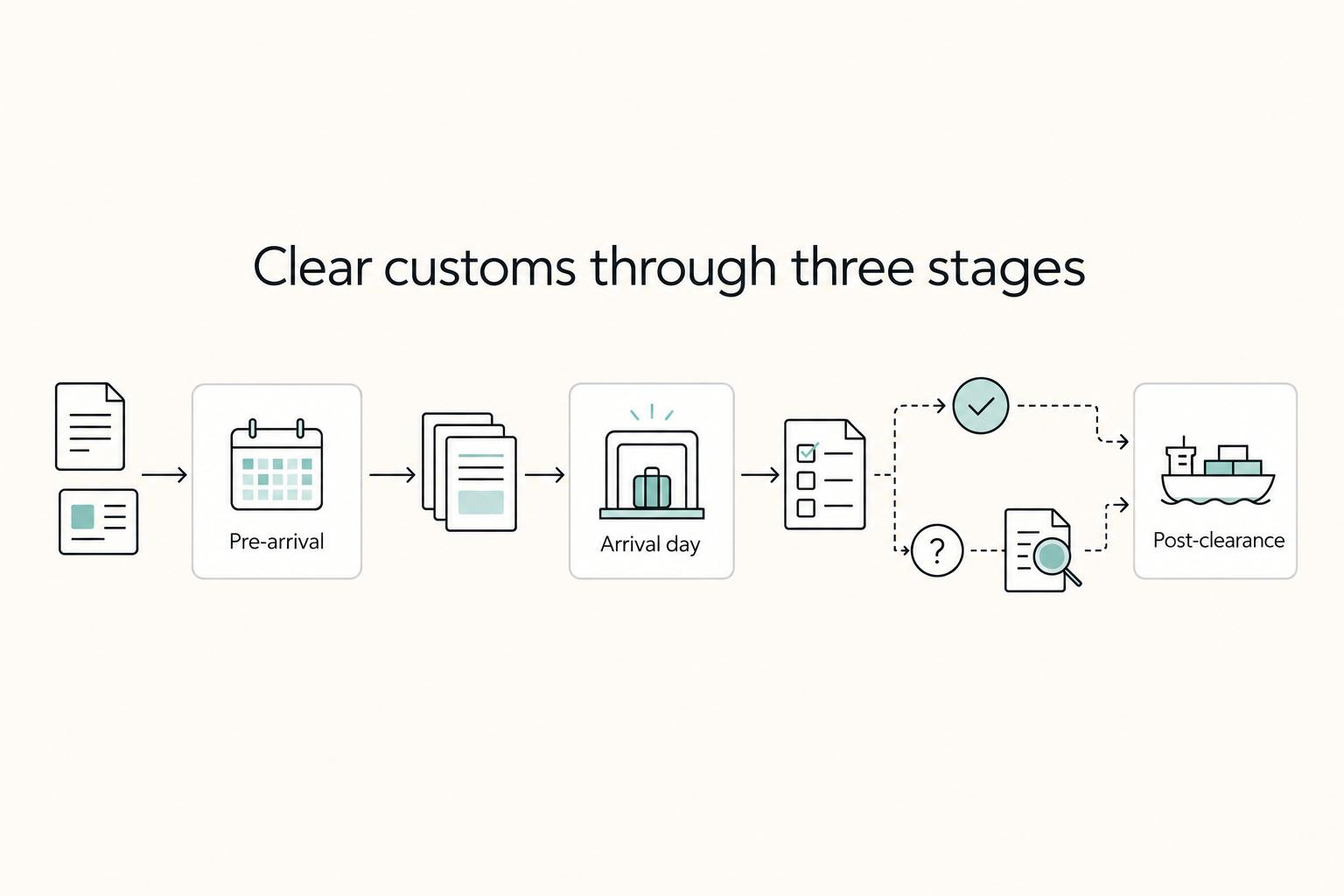
Quick Answer
To clear in and out of countries on a sailboat, verify each destination's official entry rules before departure, submit required pre-arrival forms on time, and carry organized vessel and crew documents. On arrival, follow the exact reporting sequence, keep a first-inspection packet ready, and do not go ashore before clearance where prohibited. After clearance, confirm permit details and save all records for the next port.
Treat clearing customs by sailboat as a repeatable process#
Treat clearing customs by sailboat as a repeatable process. Prepare your evidence before departure, present it in the right order on arrival, and leave each country with records the next port can verify.
Step 1. Prepare before departure#
Start with the destination's official channels: customs, immigration, biosecurity or agriculture, and the port authority. Do not assume one timeline or one document set works everywhere.
| Jurisdiction | Pre-arrival step | Timing |
|---|---|---|
| Australia | Report in writing before entering Australian territory | from 90 days to no less than 12 hours before arrival |
| New Zealand | Small-craft arrival form (NZCS 340) | not less than 48 hours before ETA |
| UK | Pleasure-craft reporting | within 24 hours and up to 2 hours before arrival or departure |
Australia requires non-commercial vessel operators, including yachts, to report in writing before entering Australian territory, with notice from 90 days to no less than 12 hours before arrival. New Zealand's small-craft arrival form (NZCS 340) must be provided not less than 48 hours before ETA. UK pleasure-craft reporting is submitted within 24 hours and up to 2 hours before arrival or departure. Verify your route-specific requirements before you cast off.
That verification step is where a lot of avoidable trouble starts. Do not rely on memory from a prior season, a marina rumor, or a screenshot from a forum thread. Use the official source for the exact port, route, and vessel context for this trip. Then save the page, email, or confirmation number in the same trip folder as your other clearance materials. If your ETA shifts, your crew changes, or you decide to enter at a different port of entry, re-check the filing you already made. Do not assume the first submission still fits the trip.
Then build two clean document packs as your baseline:
- Vessel Dossier: vessel registration, ownership papers, radio or communications licenses where applicable, insurance, and pre-arrival confirmations or reference numbers.
- Crew Dossier: passport or travel document details for everyone onboard, visas or entry permissions where required, and a crew list that matches those identity documents exactly.
Keep these packs usable, not just complete. Someone other than you should be able to open the folder and understand the trip quickly. They should see what vessel is arriving, who is onboard, where you last cleared out, what you already submitted, and what still has to happen on arrival. Put current documents first, remove old duplicates that invite confusion, and make sure the spelling, numbering, and sequence are consistent across forms. A clean packet reduces the odds that an officer has to stop and reconcile conflicting versions of the same information. If your route includes multiple border crossings, use the same packet structure described in A Guide to Sailing Around the World as a Digital Nomad.
Many avoidable problems at this stage come from timing and mismatch: late pre-arrival forms, crew-list errors, or choosing the wrong entry port based on outdated unofficial advice. Before departure, confirm that names, passport numbers, vessel identifiers, and ETA match across all forms. Also check those details against what is physically onboard. A form may list one passport number, while the actual passport in the folder shows another. Or the crew list may still include someone who left the boat two ports ago. Those are small clerical errors to you, but on arrival they can look like uncertainty about who or what is crossing the border.
| Phase | Objective | Documents used | Common failure points |
|---|---|---|---|
| Pre-arrival | Secure lawful entry and reduce avoidable delays | Vessel Dossier, Crew Dossier, pre-arrival submissions, confirmation numbers | Missed deadlines, wrong entry port, crew-list mismatches, outdated unofficial guidance |
| Arrival day | Complete lawful first contact and inspection | Captain's Briefcase, last port clearance, passports, arrival approvals | Going ashore before clearance, delayed reporting where immediate reporting is required, disorganized papers |
| Post-clearance | Protect legal status during stay and at departure | Cruising permit or entry papers, receipts, Digital Shoebox | Not checking permit dates, losing stamped paperwork, missing exit notice or departure-clearance steps |
Step 2. Execute arrival day in the right sequence#
Arrival day is execution, not improvisation. Follow the destination's official sequence.
| Jurisdiction | Arrival-day rule | Condition |
|---|---|---|
| US | Report arrival to CBP immediately | small pleasure vessels arriving from foreign ports |
| Australia | Display the yellow Q flag and proceed directly to an appointed boarding station | do not go ashore before clearance |
| UK | Fly the Q flag | as soon as you enter UK waters (12-mile limit) |
In the US, small pleasure vessels arriving from foreign ports must report arrival to CBP immediately. In Australia, you must display the yellow Q flag, proceed directly to an appointed boarding station, and not go ashore before clearance. In the UK pleasure-craft context, the Q flag must be flown as soon as you enter UK waters (12-mile limit). Verify which rule applies to your vessel type and route before departure.
Carry a Captain's Briefcase as your first-inspection packet. Put your last overseas port clearance first. New Zealand explicitly expects this document to be ready for inspection on arrival. Then place passports, the crew list, vessel papers, and pre-arrival confirmations behind it.
That order helps because it mirrors the first questions officers may need answered. Where did you come from? Who is aboard? What vessel is this? What have you already filed? If those answers sit in one packet in that order, first contact stays controlled. If they are spread across phones, email inboxes, lockers, and old folders, the inspection slows down while everyone reconstructs basic facts that should have been available from the start.
A common failure mode is making officers reconstruct your trip from scattered paperwork. Before entering territorial waters, make sure one person can handle the boat while another can produce any arrival document quickly. If you sail as a couple or small crew, assign the roles out loud before landfall. One person navigates, answers helm needs, and follows harbor instructions. The other handles the briefcase, keeps passports together, and is ready to present the packet in the sequence you already prepared. That simple division prevents the usual scramble of opening lockers, searching inboxes, and answering questions from memory while also trying to dock.
It also helps to treat arrival as a scripted event. Do not send different crew members forward with different versions of the voyage story. Use the same factual sequence that appears in your paperwork: last port, date of departure, people aboard, current ETA, and intended process for clearance. If an officer asks a narrow question, answer that question cleanly and stop there. Precision reads better than over-explaining.
If asked about remote work, keep your answer narrow and factual: "I work remotely for clients outside this country. I am not taking local employment. I am here on visitor status and checked current rules." Then answer only what is asked next. That matters because the rules vary. New Zealand allows remote work for overseas clients on visitor visas applied for on or after 27 January 2025, but excludes work for New Zealand employers. UK visitor rules are stricter, including limits on working for a UK company or as self-employed except specific permitted cases.
The point is not to turn a border interview into a seminar about your business model. Present the facts that match your status and let the officer lead the next question. Volunteering extra detail that is unrelated to the entry decision can widen the discussion without helping your case. A short, consistent answer tied to current rules is usually stronger than a long defensive one.
Step 3. Audit your status as soon as you clear#
Do not walk away from the counter or dock office until you have checked what was actually issued. Confirm the vessel stay period, each crew member's status, any movement limits, and the departure procedure. New Zealand's structure of before arrival, while in-country, and when leaving is a useful operating model even when the local forms differ.
Read the paperwork while the issuing office is still in front of you. This is the easiest moment to catch an incorrect name spelling, passport number, vessel identifier, or date. If an officer verbally tells you one thing but the paper, email, or permit appears to say something else, ask for clarification immediately rather than planning to sort it out later. Small administrative errors compound quickly once you have left the office, changed marinas, or started moving again.
Then build your Digital Shoebox immediately. Capture every stamped page, receipt, permit, and note, and store them in cloud sync plus one offline copy. Save files in a way that helps the next clearance, not just the current leg: document type first, then country, then date or leg. Retrieval under pressure is what counts. When the next country asks for proof of where you last cleared out, you should be able to find the right file in seconds. You should not be scrolling through mixed photos of charts, marina receipts, and provisioning lists.
The Digital Shoebox does not replace the original paperwork. Keep originals dry, grouped, and accessible for the next inspection, because border processes can still depend on the underlying paper, stamp, or official printout. Think of the digital copy as your backup, your archive, and your handoff tool when a later officer asks for evidence of a prior step. Before the next leg, use this departure handoff checklist:
- Confirm whether the current country issues or expects a departure clearance (
zarpe), and where and when to obtain it. - Check vessel and crew permit expiry dates and set reminders before deadlines.
- Save entry papers, receipts, and last port clearance in at least two locations.
- Pull the next destination's official customs, immigration, and biosecurity reporting requirements before departure.
One reason this checklist matters is that border compliance carries across legs. The next country may not care only about your current paperwork. It may also care whether the prior country's exit and your voyage history make sense together. A clean departure record makes your next arrival simpler.
If you want a deeper dive, read The 2026 Global Digital Nomad Visa Index for 50+ Countries. Before you lock your pre-arrival checklist, compare crew passport scenarios in the Digital Nomad Visa Cheatsheet.
Conclusion: Use the same checked process at every landfall#
The practical shift is simple: stop treating each landfall as a fresh puzzle. Crossings get easier when your process is repeatable, documented, and checked against the destination's current rules.
Step 1. Verify before departure#
Use the same internal packet structure for every leg (these are your own working labels):
| Packet | Included items |
|---|---|
| Vessel Dossier | vessel registration, ownership papers, radio or communications licenses where applicable, insurance, and last-port papers, including a zarpe if your departure country issued one |
| Crew Dossier | passports for everyone aboard, any visas that apply, and a crew list that matches those identity documents exactly |
| Clearance Protocol | the destination's live reporting channel and timing |
| Digital Shoebox | where you will store emails, reference numbers, permits, and receipts as they arrive |
Before you cast off, confirm that names, passport numbers, vessel identifiers, and itinerary details match across documents. Then verify the destination-specific requirements. That includes immediate U.S. arrival reporting to CBP, Canada's route- and profile-dependent rules, Australia's written pre-arrival reporting plus valid passport and visa credentials onboard, and New Zealand's NZTD requirement for each passenger, including children and babies.
The goal is not to memorize every country's system. Use the same internal workflow every time: check the official rule, build the packet, verify the details match, and save proof that you completed the pre-arrival step.
Step 2. Confirm at check-in#
At arrival, follow the local process exactly. In Canada, at a telephone reporting site, only the operator may leave to call the CBSA Telephone Reporting Centre, and everyone else stays onboard until authorized. In Australia, display the Q-flag, proceed directly to the approved boarding station, and do not go ashore before clearance.
Use one decision checkpoint: do not treat a call, app submission, or stop as completed entry unless you have the actual authorization to proceed. That checkpoint helps prevent a practical cruising-compliance mistake: confusing initiation of the process with completion of the process.
- Assign one person to vessel control and one person to document handling before landfall.
- Keep one active checklist open for the current country's sequence so the crew does not skip steps.
- If your route or stay logic changes, update your trip assumptions in your Visa planner before the next leg.
Step 3. Archive after clearance#
Right after clearance, save your proof while it is still easy to retrieve. Keep decision emails, for example from CBP ROAM, NZTD reference emails, and any stamped papers, receipts, or local permits you receive in your Digital Shoebox. If your folder hygiene is weak, use this setup from What Is a Digital Shoebox and How to Organize It for Tax Time.
If you are departing the U.S. for a foreign port, confirm whether CBP Form 1300 applies under current rules. Then make this your standard process and re-check reporting, document, and landing rules before every new landfall. The less you improvise, the less border control feels like a gamble. It starts to feel like what it should be: a managed operating procedure.
Frequently Asked Questions
What documents are required to clear customs on a sailboat?
For U.S. arrival, the confirmed requirement is procedural first: report to CBP immediately, with that report tracked in the Pleasure Boat Reporting System, then complete in-person processing at a U.S. port of entry. This guide does not publish a fixed U.S. document checklist, so confirm any additional paperwork with official CBP guidance before arrival.
What is the purpose of the yellow Q flag on a boat?
In this U.S.-specific workflow, treat the Q flag as unconfirmed because it isn't clearly established as a requirement for U.S. pleasure-boat entry. Verify any flag requirement through official U.S. instructions before departure.
How much does it cost to clear in?
Specific clearance fee amounts aren't settled here. Confirm current charges through official channels for your actual port of entry before you rely on a budget.
Do you need a visa to arrive by sailboat?
Visa eligibility outcomes vary by nationality and trip purpose and aren't settled in the general case. What is clear is that lawful entry must be applied for in person to a CBP officer at a U.S. port of entry. Verify each traveler's status requirements through official U.S. immigration guidance before departure.
What is a Port Clearance Certificate, or Zarpe, and why does it matter?
For this U.S.-specific process, the CBP excerpt does not state that a Zarpe is required for arrival. It does not replace immediate CBP reporting and in-person lawful-entry processing. If your last port issued one, keep it organized, but confirm U.S. requirements directly with official guidance.
Try a related tool
Researched and edited by the Gruv editorial team. Gruv builds cross-border billing, payouts, and finance-operations software for global businesses.
Sources
- abf.gov.au/entering-and-leaving-australia/entering-and-...trusted
- appropriations.house.gov/sites/evo-subsites/republicans-appropriation...trusted
- bahamas.gov.bs/index.php/service/inward-declaration-and-app...trusted
- cbp.gov/travel/pleasure-boats-private-flyers/pleasur...trusted
- cbp.gov/travel/pleasure-boats/pleasure-boat-overview...trusted
- cbsa-asfc.gc.ca/travel-voyage/pb-pp-eng.htmltrusted
- congress.gov/committee-report/116th-congress/house-report...trusted
- customs.govt.nz/travel-to-and-from-new-zealand/travel-to-and...trusted
Educational content only. Not legal, tax, or financial advice.
Related Posts

The 2026 Global Digital Nomad Visa Index for 50+ Countries
Start with legal fit, not lifestyle filters. The practical order is simple: choose a route you can actually document, then decide where you want to live. That single change cuts a lot of wasted comparison work and stops you from falling in love with places that were never a real filing option.
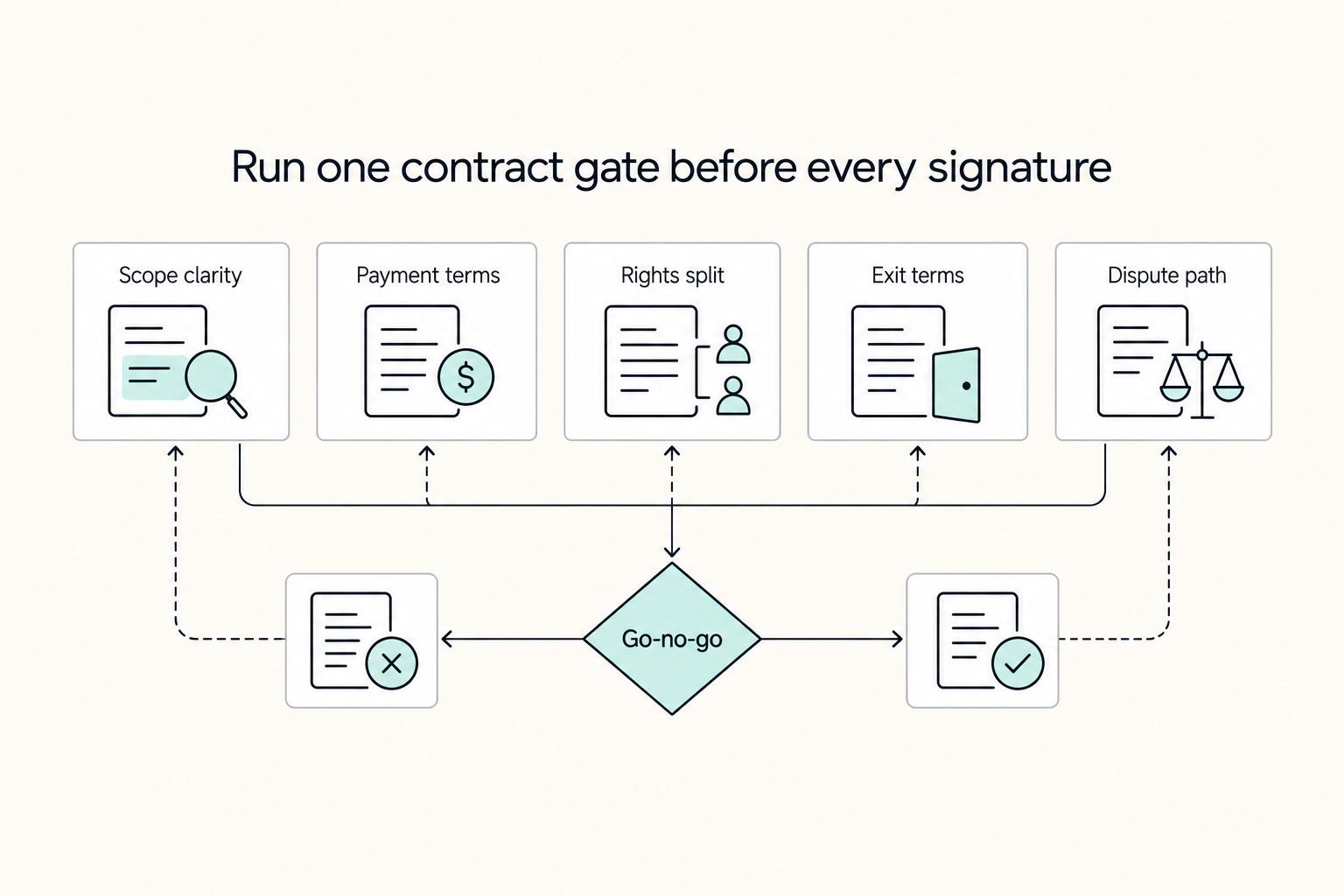
10 Freelance Contract Red Flags That Scream 'Run Away'
Use this as a fast decision screen, not a legal theory exercise: sign the Freelance Contract, send a Contract Redline, or walk away.
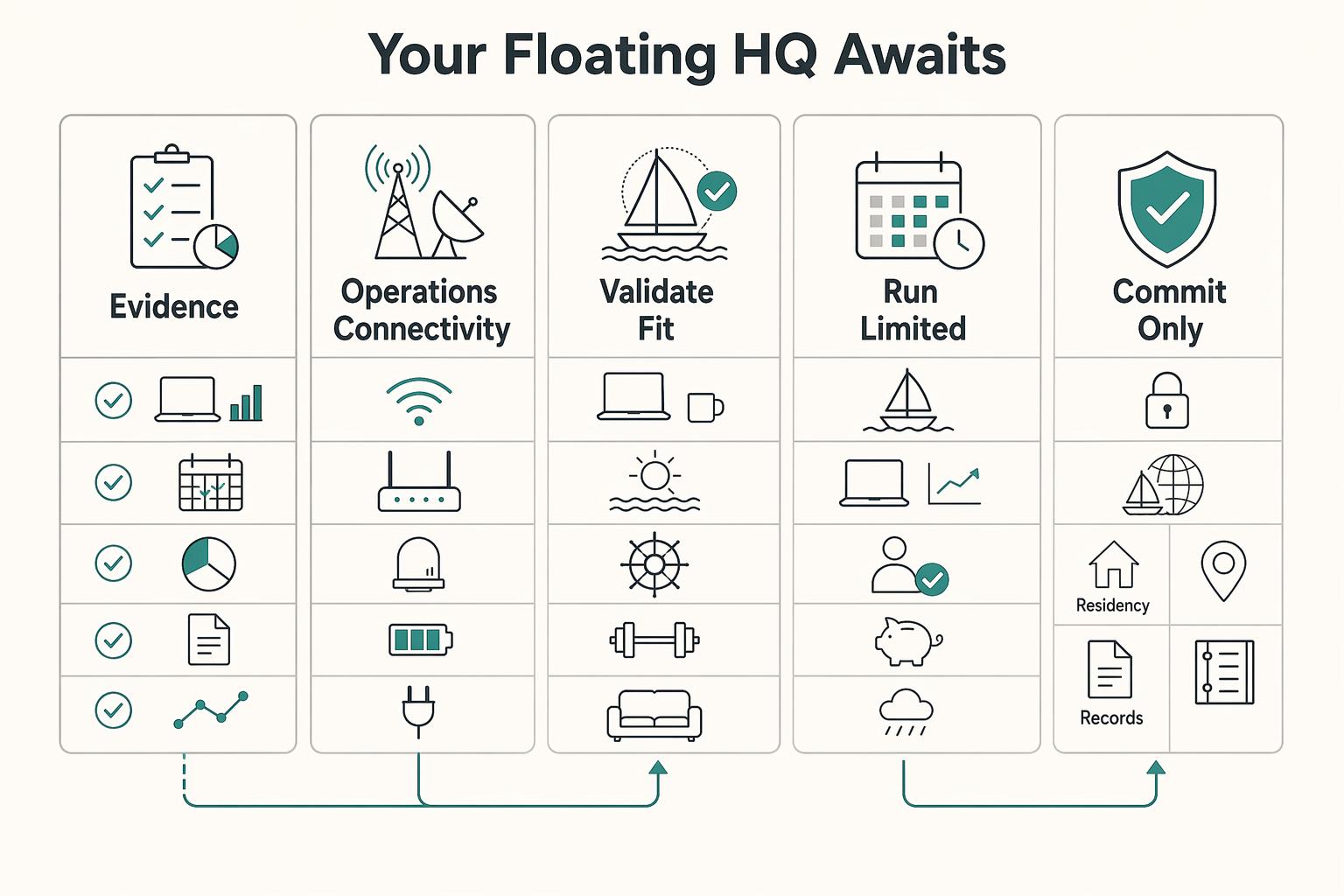
Sailing Around the World as a Digital Nomad Without Breaking Your Workflow
A floating HQ may make sense only if you treat it as an operating change, not a reward for wanting more freedom. You are not just changing where you work. You are taking on more of the continuity burden yourself, with more autonomy on one side and more logistics and disruption exposure on the other.