
Quick Answer
Yes: to get paid eBay cross-border seller payouts reliably, treat setup as market-specific and verify it in your own account before launch. The article recommends using eBay Payments Terms of Use as the baseline, then confirming live Seller Hub and Payments tab evidence for destination options, payout schedule behavior, and status movement from Processing funds to Available for payout. It also advises keeping Payoneer and other third-party claims in a separate “verify before launch” bucket until account proof exists.
Treat this as a source-quality problem first#
Treat this as a source-quality problem first. Before you treat cross-border payouts as a growth lever, separate what eBay confirms today from what third parties, forum posts, or older advice suggest.
- Set the source hierarchy first.
That means payout mechanics, payment processing times, currency handling, and any market-specific limits should come from primary platform documentation and in-product guidance first, not from a partner blog, a Reddit thread, or old merchant memory. Where a claim comes from Payoneer, community posts, or legacy commentary, treat it as context and mark it for validation before launch.
- Define the operating scope before you compare markets.
The focus here is not broad marketplace strategy. It is the narrower question founders and operators need answered before they commit engineering, treasury, or go-to-market effort: which payout rail is available, how long funds may take to move, where currency conversion risk sits, and what can break during rollout. Those are operational questions with direct effects on working capital, seller experience, reconciliation effort, and support load.
- Use an evidence standard that rejects stale or unofficial shortcuts.
That standard matters because payment information ages badly. One source in this area is an eBay Form 10-K for the fiscal year ended December 31, 2013. It is useful as historical context, but not as proof of how current payouts work. Another example makes the same principle even clearer: FederalRegister.gov states that its prototype text is "not an official legal edition" and says researchers should verify against an official edition. The practical rule is similar here. If a source is unofficial, old, or one step removed from the platform, do not use it as the basis for launch decisions.
A good checkpoint before you trust any payout claim is simple: capture the exact source URL, note the access date, and record whether the detail appears in primary platform documentation or only in third-party material. A common failure mode is treating a partner explanation or a forum answer as if it were a platform rule, then discovering at rollout that account- or country-level details are different.
This article follows that rule. It separates confirmed mechanics from claims that still need account-level validation, so your decisions rest on operating facts rather than inherited marketplace lore. Related reading: How Platform Operators Choose Cross-Border Payout Rails by Corridor.
What is confirmed today and what still needs validation#
Step 1: Start from what eBay's payments terms officially confirm#
Start with what is officially confirmed: anchor your baseline to eBay's Payments Terms of Use, not remembered payout behavior. The terms show December 4, 2024 as an effective date for some sellers and February 4, 2025 for all other sellers. They also confirm payment services are provided by the applicable eBay Payment Entities, and that international sales may involve one or more eBay Payment Entities.
For each target market, save the exact terms URL, log the applicable effective date, and note whether your seller cohort is under that same terms set.
Step 2: Treat core payout mechanics as unconfirmed until you verify them#
Treat core payout mechanics as unconfirmed until you verify them in current eBay Help or your own account. Payouts to a linked checking account or debit card, visibility in Seller Hub and the Payments tab, and status movement from Processing funds to Available for payout should each be confirmed directly in your account before launch.
That is where rollout errors happen: teams copy partner posts, Reddit answers, or legacy fee explainers into launch docs and then discover different options, timing, or holds in production.
Step 3: Keep an unknowns register by market before committing scope#
Before you commit engineering or treasury scope, keep an unknowns register by market. Keep Payoneer positioning, community anecdotes, and non-official fee narratives in a separate "verify before launch" bucket.
| Item to resolve | Verification status | What you need to verify |
|---|---|---|
| Country eligibility | Not confirmed | Current eBay Help plus account onboarding for each target country |
| Payouts on demand access | Not confirmed | Account-level availability by market |
| Express payouts access | Not confirmed | Account-level availability by market |
| Payout schedule constraints and fees | Not confirmed | In-product settings and current fee disclosures |
Example: Payoneer says sellers can transfer to local bank accounts in over 190 countries and territories, but that is a Payoneer marketing claim, not official eBay policy. Related: How to Get Paid on Etsy as an International Seller: Fees Currency and Tax Guide.
Prepare the market entry evidence pack before you build#
Treat the unknowns register as a launch gate: if a market cannot produce current, dated account evidence, it is not ready for build, treasury setup, or launch planning.
| Market file item | What to capture | Gate |
|---|---|---|
| Market file | One market file per country and selling entity, with the exact eBay Help URL, the account/site checked, and the terms effective date | Keep open questions explicit and mark them unconfirmed until you have account evidence |
| Verification record | A live URL and a dated screenshot for every row | A community page can help you find eBay Help, but it is not payout evidence on its own |
| In-account proof | Relevant account settings and payment-status screens exactly as shown in the live account; name files with country, entity, account, capture date, and owner | If someone says it should be the same as another market, capture evidence instead of skipping it |
| Treasury inputs | Seller currency preference, buyer currency exposure, local bank account coverage, and whether debit card fallback is visible or still unconfirmed | If key fields are blank, keep that market in pending status |
| Acceptance criteria | Payout timing options, hold behavior, and payout-failure handling, with a source column tied to eBay Help, account screenshots, or support-case records | No market should move forward until these items are documented from current evidence |
| Technical evidence | Filter by SKU first, then attach the exact warning or error text to the market file | Warnings do not prevent listing add/revise actions; errors can block new listings or revisions |
Step 1: Define one market file per country and selling entity. Do not roll multiple markets into one assumption sheet. Track each country-entity pair separately, including the exact eBay Help URL, the account/site checked, and the terms effective date captured earlier. Keep open questions explicit, and mark them as unconfirmed until you have account evidence.
Your verification checkpoint is simple: every row needs a live URL and a dated screenshot. A community page can help you find eBay Help, but it is not payout evidence on its own.
Step 2: Capture in-account proof for each planned market. Save screenshots of the relevant account settings and payment-status screens exactly as shown in the live account. Name files with country, entity, account, capture date, and owner so finance, support, and ops can trace the same record later.
If someone says "it should be the same as another market," treat that as a prompt to capture evidence, not a reason to skip it.
Step 3: Add treasury inputs before engineering starts. In the same sheet, track seller currency preference, buyer currency exposure, local bank account coverage, and whether debit card fallback is visible or still unconfirmed. The goal is not to finalize FX policy here. The goal is to surface soft assumptions before build starts.
If key fields are blank, keep that market in pending status.
Step 4: Set acceptance criteria and log exceptions. No market should move forward until payout timing options, hold behavior, and payout-failure handling are documented from current evidence. If an item is still unknown, record it as unknown. Keep a source column so each point is tied to eBay Help, account screenshots, or support-case records.
If rollout includes listing or onboarding integrations, keep technical evidence too. The Maropost process-log guide (last updated Dec 10, 2025) distinguishes non-blocking warnings from blocking errors: warnings do not prevent listing add/revise actions, while errors can block new listings or revisions. Practical checkpoint: filter by SKU first, then attach the exact warning or error text to the market file.
If the seller model includes remote operators or marketplace teams, Digital Nomad Payment Infrastructure can frame traceable payout evidence across borders.
Compare payout route options and choose your default rail#
Choose one default payout rail first, then approve exceptions market by market. Treat direct settlement from eBay as context from third-party material and treat any Payoneer-connected path as unconfirmed until you validate it in your own account.
Step 1: Use a comparison screen, not a policy sheet#
A third-party guide describes managed payments as buyers paying on eBay and sellers receiving payment directly from eBay. Use that as context only, then confirm current behavior in eBay Help plus your live Seller Hub and Payments tab for each country and entity.
| Decision point | Direct settlement from eBay | Payoneer-connected flow | Required handling |
|---|---|---|---|
| Control and ownership | Cleaner as a single baseline if destination options are visible in account. | Keep as an exception path unless proven for that market. | Validate in account before rollout. |
| Visibility | Easier when payout evidence stays close to marketplace records. | Can split evidence across marketplace and another provider view. | Run a pilot payout and verify traceability. |
| Reconciliation effort | Lower when finance can reconcile from Payments tab plus bank record. | Higher if matching requires cross-system mapping. | Do not set as default until reconciliation is proven. |
| Local bank reach and seller currency handling | Use only where required coverage is visible in account. | Test only where a market need exists and support is visible in account. | Do not infer support from marketing pages. |
| Destination and speed caveats | Checking account vs debit card, Payouts on demand, and Express payouts are not confirmed. | Same. | Mark all as "validate in account before rollout." |
| Country exceptions | Expect country and entity differences. | Expect country and entity differences. | Keep separate decisions per country-entity pair. |
Practical gate: approve a rail only after you have dated screenshots of destination options and one pilot payout record attached to the market file.
Step 2: Set a hard exception rule#
If simpler operations is the goal, keep one default rail wherever it works. The risk in running two rails is not just route choice; it is split evidence, exception handling, and slower month-end close when settlement behavior differs by market.
Use an alternative route only when your market evidence pack shows a specific country-entity need. Approve that exception per market, not as a forward-looking blanket option.
Step 3: Validate edge options before launch#
Do not leave edge checks until after a payout failure. Checking account vs debit card destination, Payouts on demand, Express payouts, and country-level method differences are all unconfirmed until validated in your account, so each must stay tagged "validate in account before rollout."
For each launch market, keep three artifacts together: the exact eBay Help URL reviewed, a live Seller Hub or Payments tab screenshot showing destination choices, and one pilot payout record finance can reconcile. Without all three, the route is still a hypothesis.
Use How to Get Paid on Amazon Marketplace as a comparison point when deciding which marketplace payout assumptions need account-level proof.
Model payout timing and working capital risk#
Do not approve a market on assumed payout speed. After you choose a default rail, map elapsed time from payment confirmation to Available for payout, then from that status to settlement in your destination account, and track payout holds as a separate cashflow branch.
Step 1 Anchor the map to eBay terms, then prove timing in your account#
Use eBay's Payments Terms of Use as the governing baseline, and treat third-party timing claims as context only. The terms confirm effective dates of April 24, 2025 (newly accepting sellers) and June 24, 2025 (all other sellers), and note that sellers with international sales may receive services from one or more eBay Payment Entities. No official processing-duration SLA is published in the terms; verify timing in your own account.
Because no SLA is provided here, build your timing map from live tests in Seller Hub and the Payments tab. For each pilot transaction, record: payment confirmation, first status visible in eBay, status change to Available for payout, and final settlement in the destination account. Add an exception field for holds, failed payouts, or manual review notes.
Step 2 Convert timing into three cashflow scenarios#
Model three cases from controlled test transactions, not just the cleanest path. A third-party financing article updated January 18, 2026 says delays can run from days to weeks and strain restocking cashflow; use that as external stress-test input, not eBay-confirmed policy.
| Scenario | What to model | Finance check |
|---|---|---|
| Baseline case | Normal path: payment confirmation -> Available for payout -> settlement | Can core spend continue without extra funding? |
| Hold case | Same path, with holds handled as a separate branch | How long can operations run if funds do not move on schedule? |
| Payout failure case | Expected settlement does not arrive in the destination account | Who escalates, what evidence is attached, and what spend freezes automatically? |
Step 3 Set thresholds before expansion#
Set a clear tolerance rule before scaling. If timing variance exceeds your restock window, refund-risk tolerance, or cash-concentration limit, reduce launch scope or delay entry until controls improve. If repeated tests for the same country and entity show unexplained variance, keep that market in pilot.
Step 4 Add a finance-verifiable checkpoint per test#
For each test transaction, capture Seller Hub and Payments-tab evidence at each visible status change, then attach destination-account settlement proof. Label files with market, entity, order ID, payout date, and destination type so finance can verify timelines without reconstructing history later.
Keep the release gate strict: no market moves past pilot until finance and ops agree on the observed baseline path, hold path, and payout-failure response. For a step-by-step walkthrough, see How Platforms Reduce Cross-Border Payout Costs.
Set currency conversion rules and reconciliation controls#
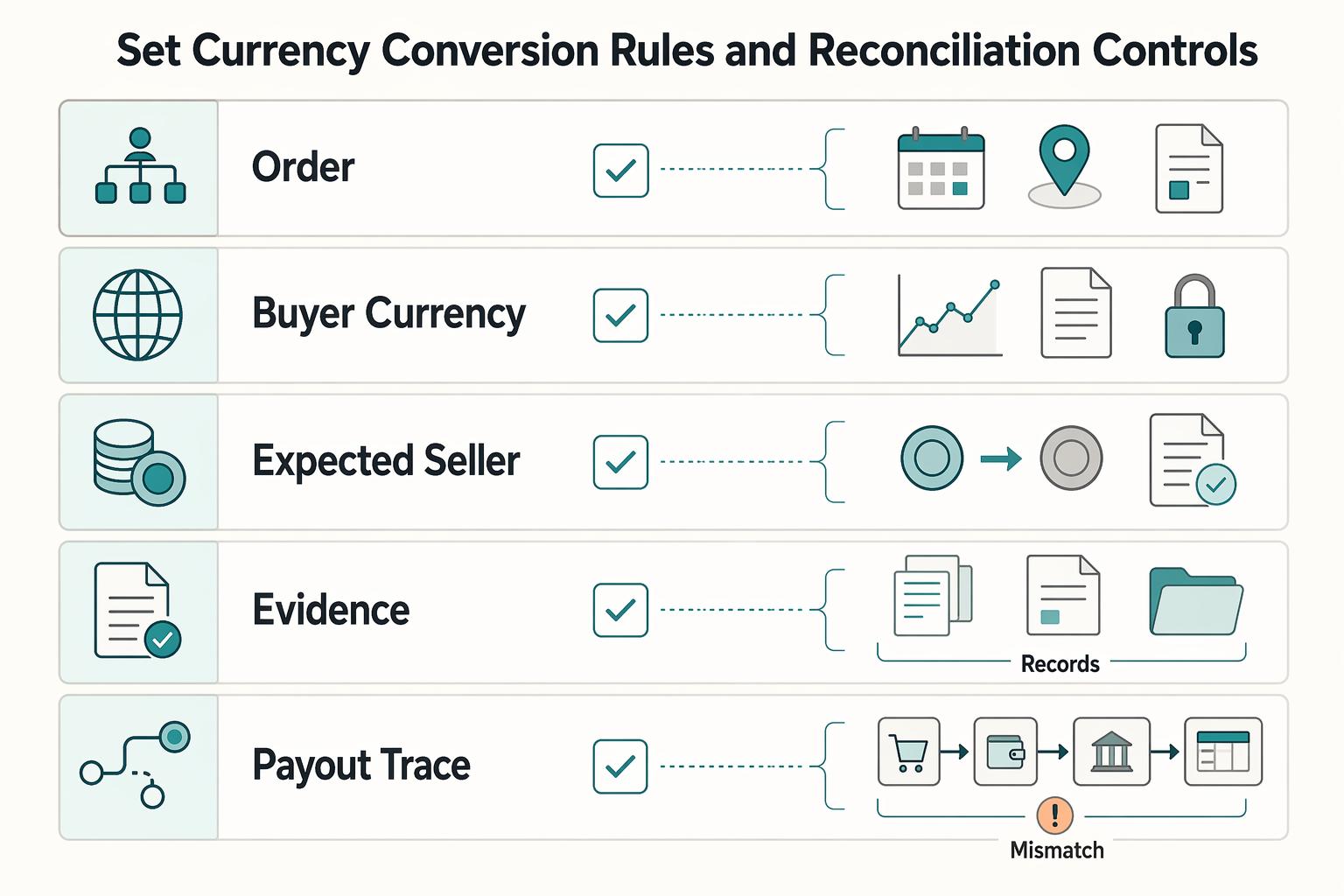
Set FX ownership and reconciliation rules before launch, or payout variances will turn into disputes later. You need one decision owner for conversion and one traceable path from eBay payout status to ledger posting.
| Evidence item | Detail |
|---|---|
| Order ID | Use as your main matching key |
| Buyer currency | Capture in the minimum evidence pack per reconciled payout |
| Expected seller currency | Capture in the minimum evidence pack per reconciled payout |
| eBay payout status evidence | Save evidence from Seller Hub or the Payments tab |
| Destination route and settlement proof | Capture in the minimum evidence pack per reconciled payout |
| Fees or deductions | Capture separately |
| Ledger entry ID and posting date | Capture in the minimum evidence pack per reconciled payout |
Step 1: Define who owns currency conversion and when you recognize it. Name who decides buyer-currency, seller-currency, and destination-currency handling, and who approves exceptions when received amounts differ from expected amounts. Also define the exact checkpoint where you treat conversion as happening in your flow. A third-party article dated 2025-01-03 notes that settlement can involve currency conversion and exchange-rate loss risk; use that as risk input, not as official eBay policy.
A practical launch rule: if finance cannot clearly explain the currency path and variance, do not approve that payout option for that market.
Step 2: Build a three-point reconciliation sequence and anchor it to Order ID. Use the same sequence every time:
- Confirm payout status in eBay, including movement to Available for payout.
- Match settlement to the destination route used.
- Post the net movement to your internal ledger with the same matching key and evidence.
Use Order ID as your main matching key. A reconciliation guide published March 30, 2026 also recommends weekly reconciliation and explicit fee tracking.
Minimum evidence pack per reconciled payout:
- Order ID
- Buyer currency
- Expected seller currency
- eBay payout status evidence from Seller Hub or the Payments tab
- Destination route and settlement proof
- Fees or deductions captured separately
- Ledger entry ID and posting date
Step 3: Constrain payout options when FX visibility is weak. If the conversion path, received currency, or fee visibility is weak, reduce payout-route complexity until reporting improves. A reconciliation guide warns poor reconciliation can cost 2-3% of sales through hidden fees and mismatches; treat that figure as third-party, but the control implication is clear.
Step 4: Document mismatch handling before exceptions occur. Define escalation ownership now: first evidence review in payments ops, then finance/treasury for FX assessment and ledger correction. For each mismatch, capture order detail, payout-status evidence, settlement proof, expected vs. received amounts by currency, and fee/conversion notes. If the mismatch cannot be explained from records, pause expansion of that payout route in that market until the reporting gap is closed.
For rail selection, Choosing SWIFT or Local Bank Transfers outlines the tradeoff between speed, fees, and reconciliation evidence.
Execute rollout in a strict order#
Roll out market by market, and do not expand until one baseline payout route is clearly visible and reconciling in that market.
Step 1: Configure the baseline destination first. Set one payout destination in Seller Hub, set the payout schedule you plan to run, and confirm both are visible in the Payments tab. Treat this as launch evidence, not admin cleanup: capture screenshots with user, date, and market. Use account visibility as the gate before any test volume.
Step 2: Run controlled pilots and track the full status path. Run a small pilot per market on the baseline route and log each order from Processing funds to Available for payout to settled at the destination. Keep Order ID as the anchor and record platform and destination timestamps. Avoid mixed pilots across multiple markets, destinations, or schedule assumptions, or you lose causal clarity when something breaks.
Step 3: Validate optional modes only after baseline stability. Test Payouts on demand or Express payouts only after baseline behavior is stable, and only where your account shows availability. Do not assume eligibility or timing from third-party material. Keep these modes out of launch scope if reporting, fee visibility, or reconciliation is weaker than the baseline.
Step 4: Lock rollout gates before scale-up. Do not scale a market until country eligibility is confirmed, payout-failure handling is documented, and finance has reviewed reconciliation outputs. If you need a companion compliance track, run it in parallel with Cross-Border Compliance Checklist for Platform Payouts: Licenses Registrations and Reporting by Country. If failures are untraceable or reconciliation still depends on guesswork, keep the market at pilot.
When invoice evidence is part of the payout file, Cross-Border E-Invoicing Controls gives the parallel control checklist.
Avoid common payout mistakes and recover fast#
Most payout failures start when teams treat cross-border rollout assumptions as global defaults. Keep controls market-specific, current, and tied to evidence you can re-check quickly.
| Mistake | Recover fast |
|---|---|
| Treating all markets as one Managed Payments setup | Run country eligibility checks market by market before launch, keep evidence together for each country, and pause that market if the market-level setup and your reference checks are not aligned |
| Using PayPal-era narratives as if they were current eBay payout rules | Treat eBay's June 29, 2015 separation context and PayPal fee pages as background only, and require in-account confirmation for each payout route before finance relies on fee assumptions |
| Ignoring hold scenarios in launch cashflow planning | Add hold scenarios to your cash model before launch, assign an owner, and log the order, status timestamps, and last visible account state |
| Splitting payout evidence across teams | Maintain one dated payout decision log that links your reference checks, account settings, and pilot outcomes |
Mistake 1: Treating all markets as one Managed Payments setup. Recover fast: Run country eligibility checks market by market before launch, and keep evidence together for each country. If the market-level setup and your reference checks are not aligned, pause that market.
Mistake 2: Using PayPal-era narratives as if they were current eBay payout rules. Recover fast: Treat eBay's June 29, 2015 separation context and PayPal fee pages as background only, not proof of current eBay payout fees or routes. Even with PayPal pages updated on February 19, 2026 and February 9, 2026, require in-account confirmation for each payout route before finance relies on fee assumptions.
Mistake 3: Ignoring hold scenarios in launch cashflow planning. Recover fast: Add hold scenarios to your cash model before launch, assign an owner, and define what evidence they must collect if funds stop moving. At minimum, log the order, status timestamps, and last visible account state.
Mistake 4: Splitting payout evidence across teams. Recover fast: Maintain one dated payout decision log that links your reference checks, account settings, and pilot outcomes. A single log shortens investigation time when a payout status or fee treatment is questioned.
If a rule does not affect eBay payout eligibility, fee treatment, timing, or reconciliation, keep it out of the payout decision log.
Final checklist before committing resources#
Treat this as a hard stop/go gate: if any item lacks current account evidence, pause launch.
- Confirm current guidance in official eBay Help for each target market, and record any market-specific unknowns.
- Capture dated proof from Seller Hub and the Payments tab for each country and selling entity, including the payout destinations and schedule options visible in that account.
- Set one default payout route, and document clear exception rules before anyone uses alternatives.
- Run a pilot transaction in each launch market and log the full status path shown in account so timing, holds, and settlement handling are evidence-based.
- Assign owners for payout timing review, reconciliation, and payout-failure escalation, and keep one shared decision log across finance, ops, and compliance.
If eligibility, destination options, timing, or reconciliation still depend on assumptions, do not launch that market yet.
Frequently Asked Questions
How do cross-border sellers get paid on eBay today?
Treat payout setup as account-specific and country-specific, not one global rule. eBay’s export materials confirm cross-border selling exists across more than 190 markets, and the India export page lists a payment element as payment gateway (Payoneer), but that does not prove the same route applies to every seller or market. Open the live payout setup for the target account and save the visible configuration before launch.
How long does it usually take for funds to move from Processing funds to Available for payout?
This guide does not establish an official fixed timing, so do not build treasury forecasts around a guessed number. Instead, run a pilot order in each launch market, log the timestamp when funds first show as Processing funds, then log when they become Available for payout. If that variance is wider than your cash tolerance, delay scale until you have enough real account data.
Can payouts go to both a checking account and a debit card?
Do not assume both destinations are available without verifying in your account. Verify what the account actually offers in the payout setup screen, then capture the selection state and any eligibility notes. A common failure mode is finance documenting a destination option that ops never confirmed in account.
When should a seller use Payoneer instead of direct eBay payout routes?
Use Payoneer only when your country and account setup explicitly support it and you have a reason to prefer that path, such as local withdrawal handling or country-specific onboarding. The strongest source-backed reference here is narrow: the eBay Export India page includes payment gateway (Payoneer) as part of its cross-border setup. Do not generalize that into a universal rule for all sellers.
Who handles currency conversion between buyer currency and seller currency?
This guide does not confirm a single official conversion rule or owner across all payout paths. If you sell across borders, assign one finance owner to reconcile the buyer-side order value, the payout-side received amount, and any currency difference visible in your account records. If that visibility is weak, restrict rollout until you can document where conversion happened and who reported it.
What should operators do first when a payout fails or is placed on hold?
Start with evidence capture, not escalation by memory. Pull the order ID, payout status, timestamps, current payout setup/status screens, and the market-specific help page you relied on when launching. The red flag is a team that can describe the problem but cannot produce the exact account state that proves whether this is a hold, a setup issue, or a country eligibility miss.
Try a related tool
Researched and edited by the Gruv editorial team. Gruv builds cross-border billing, payouts, and finance-operations software for global businesses.
Sources
- azag.gov/sites/default/files/2026-02/AG23-0009-006%20...trusted
- digitalcommons.pepperdine.edu/context/etd/article/2464/viewcontent/Llamas_...trusted
- federalregister.gov/documents/2023/07/31/2023-15581/trade-regula...trusted
- fjc.gov/sites/default/files/materials/08/Trade%20Sec...trusted
- ftc.gov/system/files/ftc_gov/pdf/1910134amazonecomme...trusted
- legacy.trade.gov/guide_to_exporting.pdftrusted
- sec.gov/Archives/edgar/data/1065088/0001065088260000...trusted
- sec.gov/Archives/edgar/data/1065088/0001065088140000...trusted
Educational content only. Not legal, tax, or financial advice.
Related Posts
How International Sellers Should Choose Amazon Marketplace Payout Paths
People often treat international Amazon seller payouts like a settings page. That's the wrong starting point. Your payout setup is an operating choice that shapes who controls FX, how quickly you can launch, and where issues show up after you go live.
How to Evaluate Etsy International Seller Payouts Before Market Launch
Treat **Etsy international seller payouts** as a market-by-market screening exercise, not a generic marketplace capability. The real question is straightforward: can this seller entity in this market onboard, get paid, and protect margin under the payout and currency conditions that apply?
Country-by-Country Launch Rules for Platform Payout Compliance
Treat each new payout country as a go or no-go decision. It may be blocked by law, blocked by operations, or cleared only with conditions. This guide helps compliance, legal, finance, and risk teams make that call early, assign ownership, and keep an evidence trail that holds up later.