
Quick Answer
Yes: treat merchant category codes mcc freelancers as an operating control, not a setup field. Assign MCCs from documented primary business activity, verify results with your processor before automating a cohort, and keep a compact audit trail for each decision. The article’s practical standard is evidence plus checkpoints: record the exact reference used, who approved it, and whether early production behavior matches expected routing, reporting, and policy outcomes.
Why MCCs Matter for Freelancers#
For freelancer platforms, MCC assignment is an operating decision, not a setup detail. If your platform onboards freelancers, contractors, or creators, the classification choice you make early can affect reporting and other payment outcomes later. The goal here is practical: classify merchants by what they actually sell, then keep those decisions accurate as your catalog, geographies, and payment partners expand.
A Merchant Category Code, or MCC, is a four-digit number that classifies the type of goods or services a business offers. That sounds administrative until you see where it shows up. These codes can influence interchange fees, tax reporting obligations, and card rewards treatment, which is why payments teams care long before a dispute or partner review forces the issue.
This guide is not a generic code directory for freelancers. It is for platform founders, product owners, payments ops, finance, and engineering teams that need to make repeatable classification choices in live payment flows. In practice, you are rarely choosing from a neat list once and moving on. You are requesting a designation from your payments processor, and that request has to hold up against real merchant behavior, not just a form answer.
One risk to keep in view from the start is variation across card networks. Even when the business looks similar, Visa and Mastercard may not categorize it in exactly the same way, and some card networks maintain their own MCC variations. A code that looks reasonable in one context can still create downstream surprises if you treat it as universal. A good early checkpoint is simple: verify the assigned code with your processor and note any brand-specific differences before you automate it for an entire cohort.
One failure mode is overgeneralization. Platforms can group unlike freelancer businesses into one bucket because it keeps onboarding simple for a while. Then volumes grow, new services appear, or a partner asks why two very different merchant types were classified the same way. At that point, the cleanup is rarely cosmetic. It can affect reporting consistency, partner conversations, and how confidently your team can defend prior decisions.
So the goal is not to pick the perfect code once. It is to build a method your team can actually run. Classify from real business activity, verify with the processor that controls the designation, document why the choice was made, and revisit it when the business mix changes. If you do that, MCCs become a useful control layer instead of a source of avoidable noise.
Related: A Guide to VAT MOSS for UK Freelancers Selling Digital Services to the EU.
MCCs are business classification controls, not admin labels#
An MCC is not a clerical field. It is a control decision. A Merchant Category Code (MCC) is a 4-digit business-activity classification tied to ISO 18245:2023, which defines MCC code values; ISO sets the classification standard but does not mandate MCC use in every context.
This matters operationally because networks and processors use MCCs for transaction processing, reporting, and compliance classification. Visa explicitly warns that incorrect MCC assignment can cause declines, reporting inaccuracies, and compliance issues, and Mastercard requires acquirers to submit a valid, accurate MCC recognized by Mastercard.
Treat assignment as governed work, not a one-and-done step. Keep one internal source of truth built from current network and processor MCC reference documentation, and do not assume mappings are identical across every brand or processor environment.
Use a simple verification checkpoint for every assigned MCC:
- exact reference document used
- reference date or version
- short rationale tied to the merchant's actual business activity
When merchant activity or reference documentation changes, review the assignment instead of carrying forward a stale code.
Related: A Guide to the Qualified Business Income (QBI) Deduction for Freelancers.
Why freelancer platforms get MCC assignment wrong#
Freelancer platforms get MCC assignment wrong when they force unlike businesses into one merchant profile and treat coding as a one-time onboarding field. Because one MCC is assigned at the merchant level and then applied across transactions, that shortcut can misclassify the business from day one.
Overgeneralizing mixed cohorts#
Sellers that look similar in signup flow can still have different primary activities. MCC assignment is typically based on the activity that makes up most of the business, so a single default code across a broad cohort usually hides real differences instead of simplifying operations. If onboarding data does not clearly capture majority activity, the assignment is hard to defend later.
Leaving payments and compliance out of the decision#
Product teams often pick a default code without a formal approval path. That creates risk, because businesses cannot directly choose their MCC and payment stakeholders use MCCs to categorize, track, and restrict transactions. Treat assignment as a cross-functional control decision, not a product-only field.
Skipping evidence and re-review#
Many teams can state the live code but not the evidence behind it. Since MCCs describe the merchant rather than each item purchased, keep a short rationale tied to merchant-level activity, not a single transaction example. Recheck assignments when service mix changes, because old classifications can drift out of step with current activity.
Related: A Comparison of Dubai Free Zones for E-commerce Businesses.
Build an MCC decision map for contractor and creator cohorts#
The fix is a written MCC decision map: define how cohorts are classified, who signs off, and when a case must be escalated instead of auto-assigned.
Use cohorts as the unit of decision, not a free-text onboarding answer. Build a matrix around inputs you already collect and can review consistently: primary service, payment behavior, and the merchant's main business model. Then map each cohort to your internal candidate MCC families, for example Contracted Services MCCs, Business Services MCCs, and Professional Services and Membership Organizations MCCs.
Build the matrix around evidence, not labels#
For each cohort, capture:
- internal cohort name
- primary revenue-driving service
- payment behavior notes relevant to classification
- candidate MCC family
- reviewer and approval date
- alternatives considered and why they were rejected
If a freelancer has mixed activities, classify by the primary revenue-driving activity and document why adjacent families were not selected. That documentation is what makes the decision defensible later.
Use a comparison table approvers can sign#
Make the approval path explicit:
| Candidate MCC family | Fit criteria | Likely risk flags | Owner sign-off |
|---|---|---|---|
| Contracted Services MCCs | Merchant mainly sells contracted or task-based client work | Broad service mix, frequent work-type changes, vague onboarding language | Product proposes, ops reviews, compliance approves exceptions |
| Business Services MCCs | Merchant mainly provides operational or administrative business support | Catch-all use, overlap with advisory work, weak majority-activity evidence | Product proposes, ops confirms evidence, compliance reviews ambiguous cases |
| Professional Services and Membership Organizations MCCs | Merchant mainly provides specialized advisory or professional services | Overlap with execution work, unsupported scope claims, unclear boundaries | Product proposes, ops challenges fit, compliance signs off edge cases |
The point is not the labels alone. It is making the approval path across product, ops, and compliance explicit before go-live.
Give ambiguous merchants an exceptions lane#
Do not force unclear cases into a default bucket. Define exception triggers such as mixed activities with no clear majority, conflicting onboarding evidence, or a cohort your matrix does not yet cover. Route these cases to manual review with a short rationale note.
For each exception, keep a compact evidence pack: onboarding inputs, chosen cohort, rationale, rejected alternatives, and the reference documentation version used at the time. If the primary revenue-driving activity is unclear, escalate before approval and document the reason.
For a step-by-step walkthrough, see Merchant of Record for Platforms and the Ownership Decisions That Matter. Want a quick next step? Try the free invoice generator.
Validate MCC assignments before you scale onboarding#
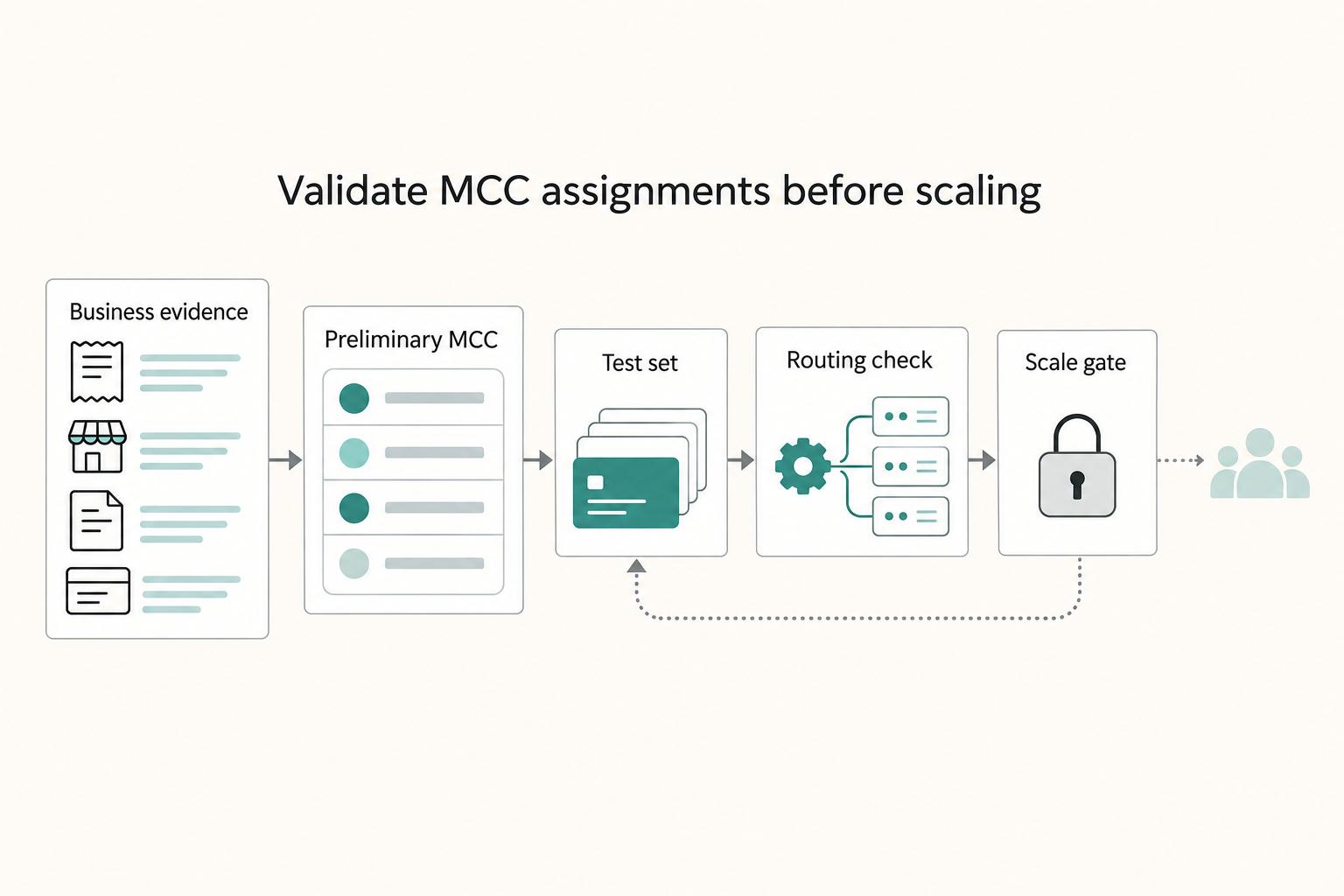
Validate each cohort before you automate at volume: treat an MCC as provisional until real behavior matches your expected outcomes. A 4-digit code that looks right on paper can still create avoidable issues if the assignment does not hold up in practice.
Use a repeatable internal sequence every time: collect business-activity evidence during merchant onboarding, assign a preliminary MCC, run a small test set, and confirm the transaction is tagged and routed the way you expect. This matters because MCCs can influence approvals, processing fees, rewards eligibility, and compliance checks.
Validate in order, not by guesswork#
A common failure pattern is assigning a code, shipping it, and discovering problems only after merchants are live. When assignments are off, you can see higher costs, declined payments, or compliance friction.
| Stage | What to confirm |
|---|---|
| Before assignment | Onboarding evidence supports the selected MCC |
| During testing | Tagging and routing behavior in your environment |
| In early production | A small live sample shows expected approval outcomes, reporting consistency, and policy behavior before scaling automation |
If results do not match expectations, pause and review the evidence, selected code, and observed processor or reporting outputs.
Write down the checkpoints that count#
Keep the verification standard short and explicit. For each cohort, define what "looks right" in sandbox and early production, then require the same minimum evidence pack each time:
- onboarding fields used to support the assignment
- a short rationale for why the MCC fits the primary business activity
- reviewer approval with name and date
- the exact MCC reference documentation used (with version or retrieval date)
Without that record, later reviews become opinion-driven instead of evidence-based.
Add a rollback path before volume arrives#
Set a stop rule before launch. If routing, reporting treatment, or policy outcomes are inconsistent for a cohort, pause automated assignment for that cohort and route new cases to manual review until the gap is resolved.
Keep MCC governance aligned across networks and processors#
Treat MCC governance as an ongoing control, not a one-time onboarding decision. MCCs are standardized by ISO and recognized by major card networks, but your operating outcomes still depend on what you have actually validated in each network and processor environment.
In practice, that matters because MCC selection can influence interchange-related costs, fraud monitoring, and service availability. In the US, interchange is set by card networks, and amounts vary by card type and processing method, so your records should capture confirmed behavior, not assumptions.
Build a register that records evidence, not assumptions#
Keep a living variance register that is simple to maintain and specific enough to audit. For each network or processor environment, log the reference used, retrieval date, affected cohorts, mapping note, and status (confirmed, under review, or unconfirmed).
| Environment | Record at minimum | Verification checkpoint |
|---|---|---|
| Visa | Reference used, retrieval date, cohort mapping note, open issues | Confirm test or early production results match expected routing, reporting, and policy treatment |
| Mastercard | Reference used, retrieval date, cohort mapping note, open issues | Confirm the same cohort behaves as expected in the Mastercard path you support |
| TSYS or other processor environment | Processor reference used, environment note, coverage note, caveats | Confirm support in the processor setup and market you plan to enable |
Use a fixed review cadence and open reclassification work quickly#
Set a fixed review cadence. Quarterly is a common operating choice once multiple cohorts are live. When guidance changes, run an impact check against your current cohort map, identify affected merchants, and open explicit reclassification tasks tied to those cohort entries.
Assign one owner to keep records current#
Assign one accountable owner for payment brand abbreviations, mapping notes, and the change log so documentation does not drift. If coverage is not yet confirmed for a processor path or market, mark it clearly as limited or caveated before enabling new corridors.
Related: UAE Golden Visa for Freelancers and the Green Visa Decision Guide.
Use policy gates to control risk, not to patch bad classification#
Keep classification and policy as two separate decisions: classification states what the merchant does, and policy states what risk treatment you apply.
Document them separately so reviewers can see both decisions without reinterpreting one as the other. If a cohort keeps landing in Restricted and teams are adding one-off overrides, stop and re-check the classification evidence and cohort definition before adding more exceptions.
Use external labeling schemes carefully. An internal control pattern like (Allowable, Restricted, Prohibited) can still be useful, but do not import outside frameworks or quotes unless you can support them. Keep the rationale in your own governance log.
Related reading: How to Choose a Merchant of Record Partner for Platform Teams.
Implement the operating layer in product, ops, and engineering#
Make the operating layer explicit in your system: classification, policy, and evidence should be easy to trace without rebuilding the decision from scratch. If you cannot show which MCC was assigned, what evidence supported it, who approved it, and what changed later, the control will not stay reliable as volume grows.
Product and reviewer UX#
Start at onboarding and capture classification evidence once so other teams can reuse it. Collect the merchant's primary activity, material secondary activity, payment flow on your platform, a short activity summary, and the supporting evidence used in review.
Design the reviewer view so teams do not retype the same rationale into multiple tools. Show the proposed code, evidence used, rejected alternatives, reviewer, and the documentation version used for the decision in one place. Use structured fields for the core decision, then reserve short free text for edge cases.
Engineering controls for traceability#
Treat MCC assignment as a controlled state change with a full history. Record at least merchant ID, prior code, updated code, reason, actor, timestamp, and whether the change was automated or manual, tied to the evidence record.
The broader point is auditability. If policy controls are traceable, classification changes should be too. Keep classification data equally reviewable so reclassification decisions do not disappear into ad hoc tickets or one-off messages.
When possible, parse onboarding inputs into stable attributes instead of relying on one long text field. That makes updates easier when a freelancer's activity mix changes.
Ops review and launch discipline#
Run a regular cross-functional exception review for payments ops, finance, and compliance using one shared view. Review declines, routing anomalies, manual overrides, reporting outputs, and investigation queues by cohort; if the same cohort repeatedly breaks expected behavior, reopen classification instead of normalizing overrides.
Before launching a new geography or freelancer vertical, use a short sign-off checklist:
- confirm network mapping readiness for the networks you support
- run routing tests on representative merchants in that cohort
- verify reporting outputs and investigation queues match expected classification behavior
- confirm approvals across product, payments ops, compliance, and engineering
- document any support limits before enabling self-serve onboarding
Watch for drift: if transaction analytics reports, support tickets, or investigation queues contradict assigned cohorts, pause the affected automation and fix the mapping logic first.
Related: How to Structure a Joint Venture Agreement Between Two Freelancers.
Conclusion#
The practical takeaway is simple: treat MCC assignment as an operating control, not a setup checkbox. These four-digit codes shape how payment partners understand the business, and that can affect fees, fraud treatment, and risk assessment. If your platform supports mixed freelancer activity, classify against the service that makes up the majority of the business, then keep the evidence that proves why that choice won.
What separates clean implementations from painful ones is not a smarter guess. It is discipline. You want a decision map for your main freelancer cohorts, an evidence pack for every assignment, and a clear owner for updates when merchant behavior changes. The evidence pack should stay compact and defensible: onboarding fields, business activity description, website or portfolio review, reviewer identity, approval timestamp, and the exact Visa, Mastercard, or processor documentation version used at the time.
The first verification checkpoint comes early, before you scale a cohort or open a new geography. Confirm that the assigned code produces the expected processing outcomes and policy treatment in your actual processor environment, not just in an internal spreadsheet. If those outputs do not line up, stop automated assignment for that cohort and review manually. Repeated overrides or unexplained fee pressure are not background noise. They are usually signs that the classification story is off.
There is also a governance point worth keeping in view. Networks generally standardize MCCs, but you should not assume a code behaves identically across every processor or market. That is why a living change log matters. When your team adds a new service vertical, updates onboarding questions, or sees a merchant shift into different work, recheck the assignment instead of letting the original code ride forever. The common failure mode is drift: the business changes, the code does not, and the review only happens after a partner challenge or production anomaly.
So the next move is not more theory. Put the operating layer in place before your next onboarding push or geography expansion. Build the decision map, require the evidence pack, and set a documented review rhythm your team will actually follow, with event-triggered checks when business activity changes. Teams that manage MCCs this way can spend less time untangling processing surprises and avoidable review escalations later.
Frequently Asked Questions
What is an MCC and why does it matter for freelancer platforms?
A Merchant Category Code is a four-digit code that classifies a business by its primary goods or services. It matters because MCC designation can influence transaction economics and risk treatment. For a freelancer platform, it is not just a setup field. It is a control that affects how your merchants are understood downstream.
How do we choose an MCC when a freelancer offers multiple services?
Use the activity that makes up most of the business, not the most interesting edge case. If a creator does both design and consulting, classify against the primary revenue-driving service and document why the secondary activity did not control the decision. The checkpoint is simple: a reviewer should be able to point to onboarding answers, website or portfolio evidence, and the rationale for rejecting nearby alternatives.
Can one MCC work across Visa, Mastercard, and every processor?
Not reliably. MCC treatment is generally standardized across major card networks, but you should not assume one code behaves identically across every network, processor, and market. Verify your chosen code against the current reference documentation for the networks and processor environment you actually use before you scale that cohort.
What breaks first when an MCC is wrong in production?
You usually see mismatch symptoms before you get a clean root cause. Transaction economics may not line up with what the business expected, and fraud monitoring or review intensity can feel off. Those are common signs that the classification may not match the merchant’s actual business activity.
How often should we review MCC assignments for existing merchants?
Do not assume a universal mandated cadence applies. Set one that matches your change rate and partner expectations. At minimum, review when a merchant materially changes services, when a cohort starts generating exception traffic, or when network or processor guidance changes.
Should risk controls use separate rules from MCC classification?
A practical approach is to keep them separate. Classification should describe what the merchant does, while risk rules decide what you allow, restrict, or escalate. If a cohort keeps triggering tighter treatment, do not patch that by bending the code choice. Recheck the activity evidence first, then tune the policy layer separately.
What evidence should we keep to defend MCC decisions during partner reviews?
Keep a compact evidence pack for every assignment: onboarding fields, business activity description, website or portfolio review, reviewer identity, approval timestamp, and the exact documentation version used to support the code. If you land on a catch-all like 7399 for business services or 8999 for professional services, note why a more specific option was not used. The failure mode to avoid is free text with no source trail. Once a partner challenges the assignment, you need more than memory to defend it.
Try a related tool
Researched and edited by the Gruv editorial team. Gruv builds cross-border billing, payouts, and finance-operations software for global businesses.
Sources
Includes 4 external sources outside the trusted-domain allowlist.
- irs.gov/irb/2004-31_IRBtrusted
- irs.gov/irm/part21/irm_21-006-003rtrusted
- pmc.ncbi.nlm.nih.gov/articles/PMC10553323trusted
- treasurer.nebraska.gov/tm/documents/credit-and-debit-processing/Mer...trusted
- iso.org/standard/79450.htmlexternal
- nerdwallet.com/credit-cards/learn/credit-cards-merchant-cat...external
- support.visaacceptance.com/knowledgebase/knowledgearticleexternal
- zintego.com/blog/importance-of-merchant-category-codes-m...external
Educational content only. Not legal, tax, or financial advice.
Related Posts
How to Structure a Joint Venture Agreement Between Two Freelancers
Treat the **freelance joint venture agreement** as a working document you can use day to day, not a ceremonial signature page. Put it in place before work starts so everyone involved is working from the same written terms.
A Comparison of Dubai Free Zones for E-commerce Businesses
When you compare **dubai free zones for e-commerce**, start with operating risk, not branding. The real question is whether the setup will support bank account onboarding, satisfy your payment processor's verification demands, keep total setup cost clear, and still hold up as the business gets more complex.
VAT MOSS and Non-Union OSS for UK Freelancers Selling to the EU
If you sell digital services from the UK to EU customers, treat UK VAT MOSS as historical and [Non-Union OSS](https://vat-one-stop-shop.ec.europa.eu/one-stop-shop_en) as the current route to assess. You cannot use UK VAT MOSS for sales made from 1 January 2021 onwards. For UK sellers who are not established and have no fixed establishment in the EU, the relevant OSS branch is the **Non-Union scheme**.