
Quick Answer
Yes, disability insurance for freelancers can protect income when billable work stops, but the policy only works if you size it from fixed expenses and verify contract terms before buying. Start by setting a minimum monthly coverage target, then choose an Elimination Period and Benefit Period your reserves can realistically support. Before you decide, check occupation wording, exclusions, and required underwriting documents like proof of self-employment and tax returns.
Start With the Real Risk Freelancers Face#
When your work stops, revenue can drop fast. The real job is not finding the cheapest quote. It is building an income-continuity plan that still works when billable hours disappear.
For self-employed professionals, income is tied directly to the ability to work. That creates a cash problem that tends to compound. Outstanding invoices may stall, new work can pause, and recurring obligations still arrive on schedule. The first useful question is not what premium feels manageable. It is how long you can carry fixed costs if billable work falls to zero, and what kind of protection actually closes that gap.
At the start, keep the scope narrow so you do not waste time on side issues. Focus on decisions you control now: the contract tradeoffs, the documents you will need, and how carefully you verify rule summaries before relying on them. In that context, Individual disability insurance is often the main path for independent earners because self-employed people usually have to set it up on their own.
Use this baseline checklist before you compare plans:
- Define your interruption threshold in days, not feelings. Mark the point where missed work starts turning into unpaid obligations.
- Separate quote shopping from continuity planning. Price matters after you define the cash gap.
- Keep an evidence pack for legal or regulatory text, including the exact rule title and publication date.
- If a document appears on FederalRegister.gov, confirm the official edition before you treat the wording as final.
Two published 2024 federal rules relevant here are "Employee or Independent Contractor Classification Under the Fair Labor Standards Act" dated 01/10/2024, and "Short-Term, Limited-Duration Insurance and Independent, Noncoordinated Excepted Benefits Coverage" dated 04/03/2024. The practical red flag is treating a prototype page as the legal endpoint. If you skip official verification, your planning choices can end up resting on informational text rather than authoritative text.
Keep one cost reality in view early. Some commercial guidance puts disability insurance around 1% to 4% of annual income. That is a planning range, not a promise across every occupation, insurer, or jurisdiction. It helps you set a rough budget frame, nothing more.
Once you know the size of the problem, the next step is to lock down the terms. A low premium on the wrong structure is still the wrong solution.
Build the Mental Model Before You Compare Policies#
Own the definitions before you compare prices. If you do not, it is easy to line up products with similar labels that solve very different problems.
Start with ownership. Individual disability insurance is coverage you buy and own directly. Group disability insurance is usually tied to an employer plan and often comes with more limited choices. For freelancers, that ownership point often matters more than the first premium number because the policy is not anchored to an employer relationship.
Then separate duration from marketing shorthand. Short-term disability insurance is meant for near-term interruptions. In the material summarized here, it is commonly described as lasting around 3 to 6 months. Long-term disability insurance is meant for extended conditions and can continue for years. The catch is that comparisons do not always use the short-term label consistently, which is why the stated benefit period matters more than the label alone.
Next, reset payout expectations. A Monthly disability benefit is income replacement, not full business revenue replacement. Here, short-term policies are often described as replacing about 60% to 70% of income, while long-term policies often replace about 40% to 60%. Those ranges are useful guardrails for planning, but they are not guarantees.
| Decision point | What to check | Why it matters |
|---|---|---|
| Ownership | Individual vs. group structure | Shows whether coverage stands on its own or is tied to an employer plan |
| Duration type | Short-term vs. long-term fit | Helps prevent a protection gap after the first stretch of an interruption |
| Benefit level | Monthly benefit as partial replacement | Keeps your budget grounded in what the policy may actually pay |
| Qualification path | Whether options like GSI are available, and what underwriting requires | Affects eligibility and the amount of application friction |
| Cost context | Typical premium range in these sources, about 1% to 4% of annual income | Sets budget guardrails without overselling what any one quote will cost |
A common mistake is comparing premium first and contract mechanics later. Two quotes can look close on price and still behave very differently when work stops. Set the terms first, then score each quote against the same checklist.
That gives you a solid foundation for the next decision: defining the minimum benefit you actually need from your real monthly cash obligations.
Set Your Minimum Coverage Floor From Cashflow, Not Guesswork#
Your minimum coverage floor should come from bills that will not wait. Start with required monthly outflows, then test whether any quote can support them. A validated freelancer-specific sizing formula is not offered here, so use this as a planning method, not a fixed rule.
The floor is not your ideal budget. It is the minimum monthly number that keeps required obligations current if work pauses. List only the expenses that must keep getting paid, total them into one figure, and use that amount to evaluate your target Monthly disability benefit and Income replacement benefit. That is much more useful than starting with whatever premium feels comfortable, because a low premium does not help if the benefit misses your minimum number.
This is where discipline matters. If an expense can pause without creating a second problem, leave it out. Continuity is what matters, not recreating a normal month. Keeping the list tight also makes your target easier to defend when you compare it against quoted benefits.
One practical way to handle this is to put the floor on a single page with each item, its due date, and a short note on what happens if it is missed. That turns a vague monthly total into an operating document. It also helps you see which obligations hit first during a disruption and which ones can move without creating a second cash problem. When you later compare that page to the waiting period, the timing becomes much easier to judge.
After that, stress-test the floor against the way your income actually behaves. Run it through a normal collections month, a slower-pay month, and a month with reduced client work. If the floor fails in more than one scenario, that tells you something important. Either fixed obligations need to come down, or the coverage target needs to go up before you spend time optimizing for price.
Keep the sizing logic separate from product labels. Product structure changes how protection is delivered, but the floor still comes from what has to be paid each month. Once that number is clear, you can decide how much of the early gap you are willing to carry yourself and how much you want the policy to absorb.
That brings you to the first major contract tradeoff: how long you wait for benefits, and how long those benefits last once they begin.
Choose Waiting Time and Duration With a Clear Tradeoff#
This is where your reserves and the policy design meet. Make the decision in sequence: first make sure you can survive the gap before benefits start, then decide how long support needs to last if recovery takes longer than you hope.
The core tradeoff is simple. A shorter Elimination Period can come with a higher premium, while a longer wait can reduce premium because you are carrying more of the early risk yourself. That pattern is common, not automatic, so confirm the exact terms in the contract rather than assuming different policies price it the same way.
| Your current position | Elimination Period direction | Benefit Period direction | Why this pairing works |
|---|---|---|---|
| Emergency savings cover only a brief interruption | Shorter | Moderate to longer | Reduces the chance of running out of cash before benefits begin |
| Savings are stable and can absorb a longer interruption | Longer | Longer | Lets you self-fund more of the wait so you can put budget into longer protection |
| Cashflow is uneven | Shorter | Longer if affordable | Helps cover both delayed income and longer work interruptions |
Set your Benefit Period using realistic recovery risk, not a best-case plan. Benefits continue for a defined period, or until a recovery, retirement, or age-based condition in the policy terms is met. If your reserves only solve the first few weeks, a bargain premium paired with a long wait can create its own emergency. If your savings are steadier, you may prefer to absorb more of the initial period and preserve more protection for a longer interruption.
It also helps to map the waiting period against the way money actually lands in the business. A disruption can still leave some trailing receivables from work already done, but that does not mean later weeks will be funded. Looking at the handoff from remaining invoices to reserves often shows whether a longer wait is realistic or just optimistic.
In practice, this is where people talk themselves into a bad fit. They focus on lowering premium without checking whether they can actually carry the wait. If the waiting period runs longer than your usable reserves, you have not really bought continuity. You have bought partial help that arrives after the damage starts.
Before you sign, verify three details in writing:
- The exact Elimination Period trigger and when the waiting clock starts.
- What ends the Benefit Period under the policy language.
- Whether your expected Monthly disability benefit can cover essentials during a claim.
Once the timing works on paper, shift your attention to the wording that decides whether a claim fits the policy in the first place.
Compare Policy Language That Decides Claim Outcomes#
The contract language decides the claim, so give it more attention than the premium. A policy that looks affordable can still fail at the exact moment you need it if the wording is narrower than you assumed.
Compare these four items side by side in every quote: Occupation definition, Claim approval criteria, each Policy exclusion, and each Disability insurance rider. If the carrier will not provide clear contract wording before you choose, pause and ask for it in writing. That step protects you from making a long-term decision off a summary that leaves the hard parts vague.
| What to compare | What to confirm in writing | Why it matters |
|---|---|---|
| Occupation definition | How your work is classified, including any-occupation versus own-occupation wording if shown, and when you are considered unable to work | Wording can widen or narrow claim eligibility |
| Claim approval criteria | What must be shown for approval and continued payment | Vague standards create avoidable uncertainty |
| Policy exclusion | What is explicitly not covered | One relevant exclusion can remove expected protection |
| Disability insurance rider | Trigger, added cost, and exact coverage change | Some riders fix real gaps, while others mostly add cost |
Read those four items together, not one at a time. An occupation definition that looks workable can still be undercut by a claim standard that is harder to satisfy than you expected. A rider can look attractive until you see the trigger language. An exclusion that seems minor can wipe out the scenario you were most worried about. The point of the side-by-side review is to see how the pieces behave as a contract, not as separate selling points.
A useful review habit is to mark any term that depends on interpretation and ask how it would be applied to your actual work pattern. Freelancers often do not have a single uniform workday or a single client type. If the quote materials simplify that reality, make sure the contract language still matches how your work is really performed rather than how a brochure summarizes it.
After the language review, use product type as a second filter. Labels vary, and some comparisons frame Short-term disability insurance as covering benefits up to two years, while Long-term disability insurance can continue for several years. If your main risk is a long interruption, a lower premium with short duration can still leave a meaningful gap.
For Individual disability insurance, published ranges are best treated as directional. You may see estimates such as income replacement around 55% to 65% and cost around 1% to 4% of income. Those figures only become useful after you check the occupation definition, exclusions, approval standard, and how your actual work would be evaluated at claim time.
A simple discipline helps here. Keep a one-page comparison sheet with those four contract fields, plus the policy document name and version date for each quote. It is also worth listing the waiting time and benefit duration on the same page so the big tradeoffs stay visible. That keeps the decision tied to contract terms instead of brochure language or premium alone.
Once you know which contracts are still credible after this pass, the next bottleneck is usually not price. It is whether your records are ready for underwriting.
Prepare an Underwriting Packet Before You Apply#
Treat Underwriting as an evidence review and build your file before you ask for final quotes. A clean income record at the start usually creates a smoother process than trying to explain missing or inconsistent documents after questions start coming in.
Build a core packet first, then tailor it to each insurer:
- Proof of self-employment
- Recent Tax returns
- Schedule SE where applicable
- If you are a sole proprietor, matching-year Schedule C records for business income and expenses
The practical goal is consistency. Keep names, tax years, and file labels aligned so the record trail is easy to follow. One useful setup is a folder for each tax year plus an index showing each file and what it supports. That makes it easier to trace how income was reported if an underwriter asks for clarification. It also helps you catch small mismatches before someone else does.
Those small mismatches matter more than people expect. If names, dates, or records do not line up, a straightforward file can start to look unreliable. That usually leads to avoidable back-and-forth, slower review, and more manual cleanup than the case actually deserves.
Before you submit anything, open each file and check that it is complete, readable, and labeled in a way that matches the year and document type. An accurate packet that is hard to handle can still slow review. The cleaner your file structure is at the start, the easier it is to answer follow-up questions without rebuilding the packet under deadline.
Use IRS details as accuracy checks, not as insurer rules. IRS guidance says Schedule SE is used to figure self-employment tax on net self-employment earnings, and IRS FAQ language references using Schedule SE when net self-employment earnings from all businesses are $400 or more. That is a tax filing point, not a disability policy eligibility test.
Add one more verification checkpoint before you submit anything. Ask each insurer for a written list of any additional underwriting documents they need and whether they want full returns, transcripts, or both. Save the request and response with date stamps, and confirm that you are using the correct tax-year forms and instructions. That step sounds small, but it keeps you from guessing your way into delays.
Once the paperwork is organized, fold the coverage decision into the same monthly habits that already keep cash moving. That is how the policy becomes part of your operations instead of a disconnected line item.
Fit Disability Coverage Into Your Get-Paid Operating System#
A policy works best when it sits inside the same cash routine as invoicing, reserves, and payout monitoring. On its own, coverage does not fix weak collections or a reserve level that cannot carry the waiting period.
That is why a simple monthly review matters. It's not more admin. It's about making sure your current setup still matches the way money actually moves through the business.
Use a short review with four checks:
- Compare expected client inflows with what actually cleared.
- Check whether reserves still cover core obligations during an income disruption.
- Review whether your current coverage setup still aligns with essential spending.
- Record one action: keep current settings, increase reserves, or review policy choices.
The value is in the decision, not the form. If the result is "leave everything as is," that is fine as long as you can say why. If collections have slowed or reserve coverage has thinned, you have an early warning before a disruption turns into a scramble.
Keep records you can verify later. Save invoice and payout timelines, and add short notes on unusual collection gaps so trend changes show up early instead of only when cash gets tight. That record also helps you judge whether your chosen waiting period still matches reality.
When you document your work, use current occupational naming. The U.S. Department of Labor notes that the Dictionary of Occupational Titles was last updated in 1991 and replaced by O*NET, so keep one current standard consistent across internal records and documents you share with an insurer. It is a small step, but useful. If your internal records describe your work one way and your policy paperwork describes it another, you are creating avoidable confusion.
Also keep disability planning separate from unrelated program rules. Minnesota Angel Tax Credit criteria, including 51% Minnesota tests and a fewer-than-25-employee limit, are tax-credit conditions. They are not disability policy standards. The broader point is simple: do not import outside rules into coverage decisions unless they clearly belong there.
That separation matters even more once work crosses borders, because policy questions and tax-reporting questions get mixed together very easily.
Handle Cross-Border and Tax Rules Without Guessing#
If you work across borders, split the analysis into two tracks from the start. Keep policy terms on one track and tax reporting on another, then verify each one with the right documents.
This is one of the easiest places to make a category mistake. A cross-border question can sound like one issue when it is really several. Private policy language, government benefit program rules, and tax reporting do not follow the same logic, and they should not be treated as if they do.
For tax reporting, anchor your view to guidance you can document. Form 8938 is used to report specified foreign financial assets, and certain U.S. taxpayers may need to file when aggregate value exceeds $50,000. Higher thresholds can apply for joint filers or taxpayers living abroad. Form 8938 is attached to the income tax return, and if no income tax return is required for the year, Form 8938 is not required.
Use this checklist before you rely on any cross-border conclusion:
- List each track separately: private disability policy terms, government benefit programs, Form 8938/FATCA, and any FBAR/FinCEN items that need review.
- Record the filing year and taxpayer status used for each conclusion.
- Confirm open requirements with a licensed cross-border tax advisor and keep written responses with dates.
- Mark every unverified assumption as a red flag until it is confirmed.
That approach prevents one answer from doing work it cannot do. A tax filing rule does not answer a policy question, and a policy summary does not settle a reporting obligation. Keep the tracks separate, keep the documents with the conclusion, and the remaining coverage decisions become much easier to manage.
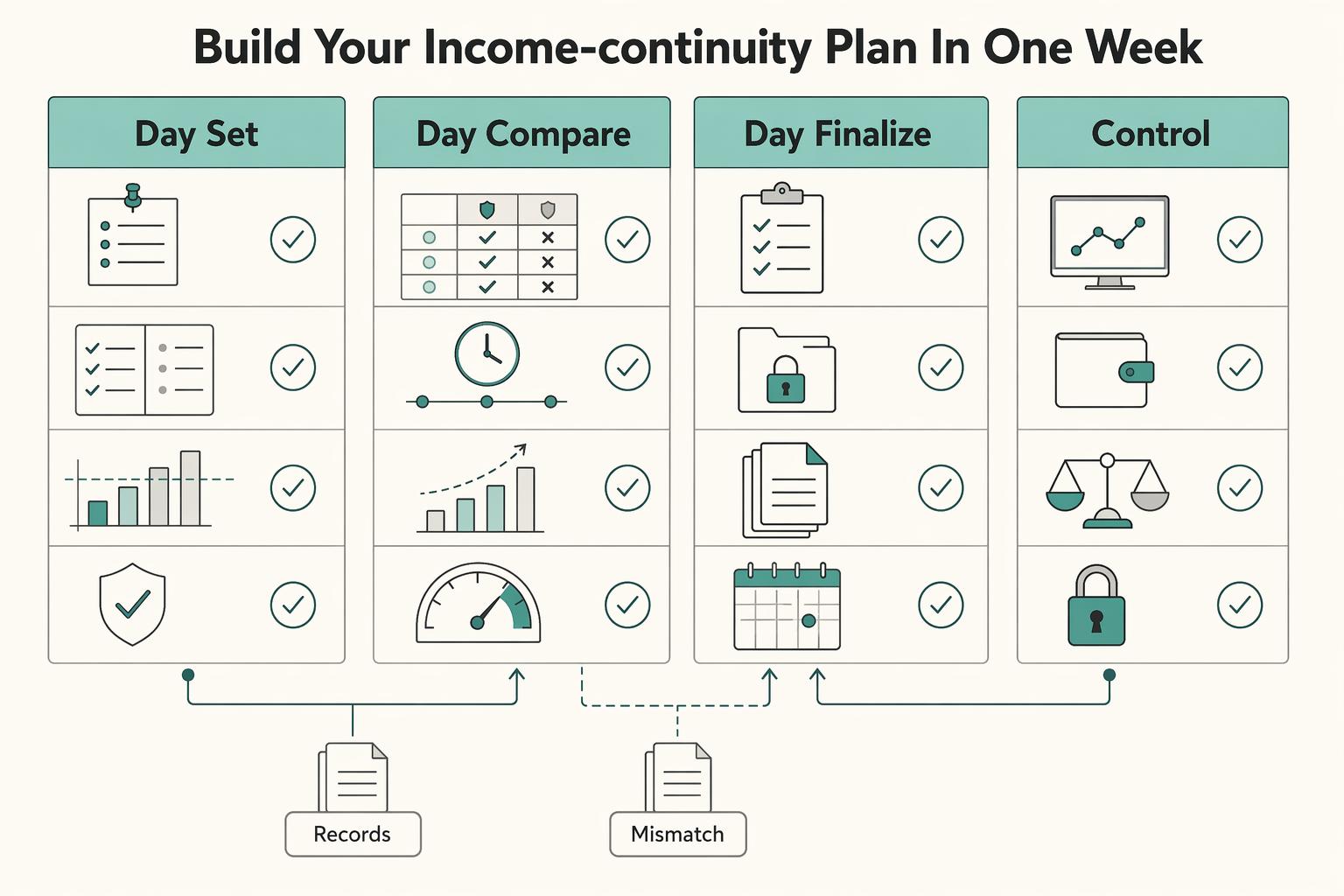
Build Your Income-Continuity Plan in One Week#
The fastest useful version of this process is a focused one-week sprint. By day seven, you should know your minimum monthly floor, the waiting time and duration that fit your reserves, which quotes are still worth considering, and what documents you need to apply.
- Day 1 and 2: Set your floor and target monthly benefit.
List non-negotiable monthly obligations first, then separate variable spending. Use that floor to set a target Monthly disability benefit, keeping in mind that many contracts frame benefits as a percentage of average monthly income rather than full revenue replacement. Stress-test the number so essentials still hold during an income interruption.
A simple checkpoint helps here: if you cannot explain why each item belongs in the floor, the list is probably too broad. Tightening it early makes later quote review faster because you already know the minimum result a policy has to deliver.
- Day 3 and 4: Compare claim language before price.
Build a side-by-side view with Occupation definition, Policy exclusion, and Claim approval criteria as the primary fields, then evaluate premium. Include both private coverage and any government-based options you may qualify for so the comparison is complete. If disability evaluation language is unclear, ask for written clarification before you move ahead.
Do not rely on memory for this step. Put each quote on the same worksheet so differences in wording, waiting time, and duration stay visible at the same time. That reduces the chance of choosing the cheapest option simply because it was easiest to recall.
- Day 5: Finalize your underwriting packet.
Treat Underwriting as an evidence review built on past income documentation. Start with Proof of self-employment and Tax returns, then organize records so income history is easy to verify across periods. Ask each insurer for its checklist in writing and match your packet to that list before submission.
- Day 6 and 7: Connect coverage to daily cash controls.
Align your target benefit with invoicing cadence, reserve levels, and payout timing so the plan works operationally, not just on paper. If reserves only cover a short gap, tighten collections follow-up and increase the near-term cash buffer while coverage is being finalized. Protection is strongest when claims timing, receivables, and reserves are managed together.
That one-week plan will not answer every edge case, but it will replace guesswork with a documented short list and a workable application file.
If you want a quick next step, Try the free invoice generator, or Talk to Gruv if you need help validating country or program fit.
Frequently Asked Questions
Can freelancers qualify for disability insurance if they do not have employer benefits?
Yes. Self-employed workers can buy private coverage, and employer-sponsored Group disability insurance is not the only path. In California, the Disability Insurance Elective Coverage program is an additional option for eligible self-employed groups that do not pay into SDI. It requires at least six months of participation before applying for DI or PFL benefits.
How much income does a typical disability policy replace for self-employed workers?
There is no single universal percentage. One cited long-term range is 50% to 70%, while another source cites 60% to 80%, so treat these as directional ranges, not guarantees. The practical check is whether the projected benefit covers your fixed essentials during a real interruption.
What is an Elimination Period, and how should I pick one?
It is the waiting time before benefits begin. One source gives a common example range of 30 to 90 days, but exact options depend on the policy. Pick a wait period your reserves can carry without forcing debt or missed core bills.
How do Short-term disability insurance and Long-term disability insurance differ in practical use?
Short-term disability insurance is designed for near-term interruptions and is often described as lasting up to six months. Long-term disability insurance is built for longer interruptions. It may continue for years or even through retirement, depending on contract terms. If your risk includes a prolonged recovery, duration usually matters more than a lower entry price.
What documents should freelancers prepare before Underwriting starts?
Prepare to provide clear income and work details, and expect requirements to vary by insurer. Do not assume every carrier wants the same forms or the same level of detail. Ask each insurer for its underwriting checklist in writing before submission, then match your packet to that list.
What should I compare across quotes besides premium price?
Compare the disability definition first, especially any-occupation versus own-occupation wording, because that can change claim outcomes. Then compare waiting time, benefit duration, and expected replacement range under each option. The strongest quote is the one whose definitions and timing match your actual work and cashflow risk.
Try a related tool
Researched and edited by the Gruv editorial team. Gruv builds cross-border billing, payouts, and finance-operations software for global businesses.
Sources
- edd.ca.gov/en/payroll_taxes/Disability_Insurance_Electi...trusted
- federalregister.gov/documents/2024/04/03/2024-06551/short-term-l...trusted
- irs.gov/businesses/corporations/do-i-need-to-file-fo...trusted
- irs.gov/businesses/small-businesses-self-employed/se...trusted
- ssa.gov/budget/assets/materials/2021/2021LAE.pdftrusted
Educational content only. Not legal, tax, or financial advice.
Related Posts

The Freelance Payment Penalty: A Modeled Audit of Platform Fees, FX Spreads, and Payout Delays
The money rarely disappears through a single, easy-to-spot fee. The real loss is stacked. A marketplace takes its commission, a processor adds a charge for international cards, a bank or payment company converts the currency at a spread, a platform holds the funds before release, and a wire sheds a little to intermediaries on the way in. Each layer looks defensible on its own, but the worker feels the combined result as a smaller deposit and a later payday.

How to Respond to a Subpoena for Business Records
Move fast, but do not produce records on instinct. If you need to **respond to a subpoena for business records**, your immediate job is to control deadlines, preserve records, and make any later production defensible.
A US Expat's Guide to Investing in UCITS ETFs to Avoid PFIC Issues
The real problem is a two-system conflict. U.S. tax treatment can punish the wrong fund choice, while local product-access constraints can block the funds you want to buy in the first place. For **us expat ucits etfs**, the practical question is not "Which product is best?" It is "What can I access, report, and keep doing every year without guessing?" Use this four-part filter before any trade: