

Quick Answer
Start with residency, not paperwork. For canada tax self employed situations, the article’s core sequence is to confirm resident or non-resident facts, classify income correctly, complete Form T2125 with evidence, and then carry totals into the return. Keep a one-page status memo, separate business and employment records, and verify every reported number against source documents. If cross-border facts or treaty treatment are unclear, stop and get professional review before filing.
Residency first, forms second#
Your first tax decision is not which form to open. It is your residency position. If that call is wrong, everything after it can go off course, especially if you moved, worked across borders, or changed where you lived during the year.
This guide is for unincorporated self-employed people, including sole proprietors and eligible partnership cases. It is not for corporations or trusts. The practical path is simple: calculate your business results first, support them with records, then carry those figures through Form T2125 (Statement of Business or Professional Activities) into your income tax return.
That order matters because each later step depends on the one before it. It gives you a clean thread from records to return instead of bouncing around between forms.
- Confirm residency facts.
- Separate business and employment records.
- Complete Form T2125 with supportable numbers.
- Transfer the results into your income tax return.
Before you draft anything, create a one-page residency memo. Record where you lived at year-end (December 31), whether you became or ceased to be a resident during 2025, and any entry or departure date you may need to report. If you were self-employed in 2025, also note the provinces or territories where your business had permanent establishments.
Build your evidence pack early, not during filing week. Keep invoices, expense support, payment and bank records, any slips issued to you, and draft calculation notes together. A simple verification rule works well here: every number you plan to report should map quickly to a source document.
The most expensive early mistake is starting forms while residency facts are still unclear. If your case includes cross-border movement, a mid-year entry or departure, or real uncertainty about resident versus non-resident treatment, stop and get a professional review before you file.
Decide your tax status before you touch any forms#
Get residency right first. CRA uses residence information to calculate taxes and credits, so a weak status call can push errors into everything that follows.
In plain language, tax residency is your filing position for the year, and resident versus non-resident treatment can change what you need to report. If the facts are straightforward, document them and continue. If they are not, do not try to solve the problem by filling in forms and hoping the details sort themselves out.
A practical first pass looks like this:
- If your residency facts are clear, continue with the resident filing path.
- If you worked across countries, changed your living base mid-year, or cannot clearly explain your status, treat residency as uncertain and pause before submission.
Then record the key facts in the same memo you keep with the return:
- Confirm the province or territory where you lived, or were considered a factual resident, on December 31, 2025.
- Confirm whether you became or ceased to be a resident during 2025, and record the exact entry or departure date if applicable.
- If you were self-employed in 2025, note the provinces or territories where your business had permanent establishments.
Keep residency separate from business classification. For income tax, business treatment turns on a profit-seeking activity supported by facts. GST/HST can include activities whether or not they are carried on for profit, so do not assume one answer settles the other.
Store the memo with your return records and date it. Include the facts you relied on, your assumptions, any open questions, and the support behind each statement. This keeps your year-end residence, entry or departure dates, and permanent establishment notes in one place instead of scattered across emails and drafts. If CRA asks later, you want an auditable position, not a reconstruction from memory.
Once status is settled, the next job gets much simpler: classify each dollar into the right income bucket before you total anything.
Separate business income from employment income with zero ambiguity#
Do the classification work before you total anything. Business income and employment income are different buckets, and mixing them creates errors that are usually harder to clean up later than people expect.
| Source type | Description | Handling note |
|---|---|---|
| Business activity | Money earned from a profit-seeking activity, such as a profession, trade, manufacture, or other business activity | Confirm each business amount has support tied to a profit-seeking activity |
| Employer pay | Wages or salary from an employer | Keep wages and salary separate from business amounts |
| Reimbursement | Amount received as a reimbursement | Personal reimbursements can look like revenue because they hit the same bank account |
| Other or unclear | Amount that is other or unclear | Move unclear items to a review bucket and resolve them before filing |
Use one bright line. Business income is money earned from a profit-seeking activity, such as a profession, trade, manufacture, or other business activity. Employment income is wages or salary from an employer. If you cannot explain in one clear sentence why an amount belongs in business income, treat it as unresolved until you can.
Before you draft the return, run a classification pass across the full year:
- Label each inflow by source type: business activity, employer pay, reimbursement, or other.
- Confirm each business amount has support tied to a profit-seeking activity.
- Keep wages and salary separate from business amounts.
- Move unclear items to a review bucket and resolve them before filing.
In practice, trouble often starts with ordinary account feeds. Personal reimbursements can look like revenue because they hit the same bank account. An employment relationship can get recorded as contract income because the payment arrived outside payroll. If you use one account for more than one kind of payment, this pass matters even more. That is not just a bookkeeping nuisance. Incorrect classification can distort the rest of the return and may have serious legal consequences.
Before you move on, do one final check: each business total should trace to support, and all income should be included when you calculate income for tax purposes. Once those buckets are clean, the filing sequence becomes much more mechanical.
Build your filing sequence in the right order#
Process breaks cause more filing trouble than arithmetic. A fixed sequence keeps omissions and double counting visible before you submit anything.
Keep the order simple. Finalize your records first, complete the return forms second, then run a final consistency check before filing. For an unincorporated self-employed filer, that means calculating business results with support, carrying them through Form T2125, and only then finalizing the rest of the return.
Treat this as a control step, not paperwork for its own sake. CRA says you must include all income when you calculate tax, so your process should make missing income hard to overlook and duplicate entries easy to spot. This guidance is for self-employed situations. If you are incorporated, use corporations guidance instead.
Keep one filing pack for the full cycle: draft return, final return, workpapers, and short notes for judgment calls. Date each version, keep prior copies, and add a one-line note whenever a number changes. That small habit pays off later when you need to explain a revision to yourself or to an adviser. You are creating a file another person could follow without guessing.
Before filing, run a quick tie-out you can explain in plain language:
- Confirm each income total maps to source records.
- Confirm slip or statement amounts are reflected once, not twice.
- Confirm return totals match your approved workpapers.
- Stop if any total cannot be explained clearly with matching support.
The common failure mode is filing with unresolved gaps because the form is technically complete. If income is missed and a later omission rule is triggered, CRA may apply a 10% penalty to the unreported amount.
Once the core return is in order, step back and map the other tax tracks separately. That is where surprises usually show up.
If your work setup is mobile, the Vancouver digital nomad guide gives broader context.
Map taxes beyond income tax so nothing surprises you#
Do not let the income tax return hide the other decisions. CPP, EI, and sales tax need their own review, even when the income numbers are settled.
A short obligations map is usually enough to keep this manageable. The point is not to answer every edge case from memory. It is to force a clear decision on each track and write down the basis for it. Keep this map in the filing pack, not in your head.
| Track | What to do |
|---|---|
| Income tax | Complete your core filing workflow. |
| CPP | Decide whether obligations apply, and verify against current official material before relying on version-specific or archived text. |
| EI | Treat as conditional, not automatic. |
| Sales tax (GST/HST/PST) | Run a separate review based on your service model and where clients and work activity are located. |
Then close the loop with a simple status check:
- Mark each track as
confirmed,not applicable, orneeds review. - Add one written basis for each
confirmedornot applicabledecision. - Escalate anything still marked
needs reviewbefore filing.
This matters most when your services, clients, or work locations span provinces or countries. In those cases, keep sales-tax analysis in a dedicated note instead of treating it as an end-of-process add-on. Your income tax numbers can be right and you can still miss a separate obligation because no one treated it as a separate decision.
That same discipline matters even more in cross-border cases, where residency and treaty positions have to be settled before the return goes out.
Handle non-resident and treaty exposure before filing locks in#
Cross-border cases should be slowed down, not rushed. Your residency position and any treaty position need to be decided before filing because those choices can change the result entirely.
Start with two tracks and keep them separate from the beginning:
- Canadian residency ties, for example home, spouse or partner, and dependents.
- Tax exposure in the other country.
That two-track view sounds basic, but it prevents a common mistake: collapsing everything into one story too early. A resident with foreign clients and a non-resident with Canadian-source income can end up on very different filing paths. If you merge those situations at the start, the return becomes much harder to defend.
For Canada-to-U.S. moves, there is also a timing layer. U.S. income tax residence can be triggered by green card status or by meeting the substantial presence test (183 weighted days over three years). That is why a vague "I was mostly living here" description is not enough. You need dates, location facts, and a narrative you can support.
Write your treaty rationale before submission, not after a later challenge. A short memo is enough if it covers the core points:
- Residency conclusion and supporting facts.
- Income streams by country and sourcing rationale.
- Treaty article or election you think applies, with assumptions.
- Open questions that still need review.
Add one guardrail to that memo: treaty positions may reduce overlap, but they do not automatically eliminate tax in both countries. That sentence keeps expectations realistic and stops the filing position from getting ahead of the facts. It also makes the file easier to review if you decide to get advice later.
For Canada-to-U.S. movers, also flag timing risk. Some U.S. exposure can begin before U.S. income tax residence, and departure-tax analysis can involve deemed disposition at fair market value on many worldwide assets when non-resident status begins, with specific exceptions. You do not need every answer on day one, but you do need to identify the issues before the return locks in.
Use a simple decision rule here: if treaty interpretation changes whether income is taxed in one country or two, get professional review before filing. That review is usually easier than rebuilding the position later.
For deeper context, read How to Legally Avoid Double Taxation: A Freelancer's Guide to Tax Treaties.
If your plans also involve living and working in Canada, Canada's Digital Nomad Stream: How to Live and Work in Canada covers the broader picture.
Once cross-border positions are settled, documentation becomes your best protection.
Keep an audit-ready evidence pack that reduces stress later#
Good records do more than satisfy an audit request. They shorten prep time, cut second-guessing, and make later questions much easier to answer.
Think of an audit-ready file as a traceability system: each filed number should be easy to follow back to its support without a scavenger hunt through emails, platforms, and bank feeds.
Keep one yearly folder with:
- Income support, such as invoices and payment confirmations.
- Expense support and brief business-purpose notes where needed.
- Filed return and workpaper copies.
- Reconciliation records that tie booked amounts to bank or payment-platform activity.
For cross-border payments, retain exports with the fields that make matching possible later: transaction date, amount, account or customer identifiers, and transaction reference information. Use a consistent naming pattern that works with exact-keyword and wildcard searches, since names, addresses, and memo text can vary across records. In practice, better naming makes it much faster to answer a follow-up without rebuilding the whole file.
Do not rely only on dashboard views. Message formats in primary transfer systems are relatively standardized, but internal database formats can differ by institution and may be harder to interpret without provider help. Keep the raw exports used in your reconciliation, not just screenshots or a platform summary. If you need to rebuild the tie-out later, you want the underlying file that supported the numbers you reported.
A thin file rarely feels risky on filing day. It feels risky when you have to explain it later. The standard is simple: if a number made it onto the return, you should be able to show where it came from and how it was checked. That is what reduces stress later.
Common mistakes that create penalties and rework#
Most penalties and rework come from a short list of preventable misses: underreported income, incorrect residency fields, skipped non-income checks, and filing without a defensible evidence trail.
| Issue | What to verify | Detail |
|---|---|---|
| Underreported income | Every deposit stream maps to support; no orphan amounts | If income is missed and a later omission rule is triggered, CRA may apply a 10% penalty to the unreported amount |
| Residency fields | Province or territory entries and any entry or departure date match your status memo | Also confirm the provinces or territories where your business had permanent establishments if self-employed |
| Non-income obligations | CPP and GST/HST/PST decisions are recorded with assumptions | A common GST/HST review trigger in freelancer guidance is over $30,000 per year in self-employed business income |
| Deadlines | Track filing and payment separately | For the 2024 self-employed cycle, filing was due June 15, 2025 (accepted June 16, 2025), while any balance owing was due April 30, 2025 |
Underreporting usually does not start with a dramatic oversight. It starts in routine records: platform payouts not posted, deposits with no matching invoice, or side income treated as informal. Self-employment income must be reported, so clear any unresolved amount before you approve final totals. If you feel tempted to leave a small deposit for later, that usually means the records are not ready.
Residency errors create rework fast because they affect basic return fields. If your status changed during the year, the return requires an entry or departure date. It also requires your province or territory of residence at year-end and, if self-employed, the provinces or territories where your business had permanent establishments. If those fields are unclear, go back to the status memo and confirm them before filing.
A third miss is ignoring non-income obligations because net income looks finished. Review CPP and GST/HST/PST decisions separately and document your assumptions. A common GST/HST review trigger in freelancer guidance is over $30,000 per year in self-employed business income. Even when the answer is not applicable, write down why.
Deadlines trip people up for a different reason: filing and payment do not always move together. For the 2024 self-employed cycle, filing was due June 15, 2025 (accepted June 16, 2025), while any balance owing was due April 30, 2025. The practical lesson is not to let the later filing date hide the earlier payment date. Most of the pain comes from having to reopen a file you thought was closed.
Use this pre-filing check:
- Income completeness: every deposit stream maps to support; no orphan amounts.
- Residency fields: province or territory entries and any entry/departure date match your status memo.
- Non-income checks: CPP and GST/HST/PST decisions are recorded with assumptions.
- Deadline logic: filing and payment deadlines are tracked separately.
Red flag: if you can submit but cannot explain each major number quickly, do not file yet. Pause, fix the record trail, and only then move forward.
Conclusion#
At the end, the safest filing standard is simple. It is clear classification, solid records, and a return that is internally consistent from workpapers to submission. The goal is not perfect paperwork. It is a return you can explain.
Keep the final pass focused on what can actually be defended. Your business-income support should be complete before you file, and every major total should map quickly to records. That includes mixed personal and business costs where only the business portion is claimable. Those expenses often look reasonable in total but fall apart later because the receipt trail, notes, or allocation logic are thin.
Treat legal interpretation carefully at the finish line. CRA guides are informational and do not replace legislation. A non-incorporated self-employed person still needs to file an individual return each year and report income as business or professional income. If your facts include cross-border income or U.S. ties, filing risk can rise even when U.S. tax is not immediately payable.
A clean close is straightforward: status memo complete, records supporting each income and expense decision, other tax tracks reviewed, and a return package that ties from workpapers to submission without gaps.
Final decision rule: if your case includes cross-border or multi-jurisdiction exposure, escalate early and file once with confidence. If the facts are straightforward and the evidence is complete, submit, keep the full pack, and be ready in case CRA asks follow-up questions.
Frequently Asked Questions
Who is considered self-employed in Canada for tax purposes?
This includes sole proprietorships, partnerships, and self-employed people, including commission earners. Income from a service business is business income. Business income is separate from employment income, such as wages or salaries from an employer. If you are incorporated, this guidance does not apply in the same way.
What forms do self-employed people usually file in Canada?
You still file an income tax and benefit return and include all income in your calculation. In the specific childcare scenario described by CRA, earnings are reported as "Other employment income" on line 10400.
What is the difference between Form T2125 and T1 General?
This section does not provide supported detail on T2125 versus T1 General differences. Keep current CRA form guidance as your final check.
Which taxes can apply beyond income tax, including CPP, EI, and GST/HST/PST?
This section does not provide supported CPP, EI, or GST/HST/PST requirements or thresholds. Review current CRA guidance for your specific facts.
What happens if I fail to report all self-employed income to the CRA?
CRA expects all income to be reported. After a first omission, unreported income may trigger a 10% penalty on the amount not reported.
When should a self-employed non-resident use tax treaties to reduce double taxation risk?
This section does not include supported treaty mechanics for non-residents or double-taxation relief. Use current CRA treaty guidance or professional review for that analysis.
When is it worth hiring a tax professional instead of filing on my own?
Get help when you are unsure whether income should be treated as business income or employment income, or when reporting treatment is unclear. This can include childcare situations where CRA treatment differs by facts (for example, line 10400 treatment versus self-employment daycare income).
Try a related tool
Researched and edited by the Gruv editorial team. Gruv builds cross-border billing, payouts, and finance-operations software for global businesses.
Sources
Includes 4 external sources outside the trusted-domain allowlist.
- irs.gov/irm/part4/irm_04-063-003rtrusted
- canada.ca/en/revenue-agency/services/tax/businesses/sm...external
- canada.ca/en/revenue-agency/services/tax/businesses/sm...external
- cookco.ca/tax-questions-frequently-asked-by-the-self-e...external
- rbcroyalbank.com/en-ca/my-money-matters/business/right-sized-...external
Educational content only. Not legal, tax, or financial advice.
Related Posts
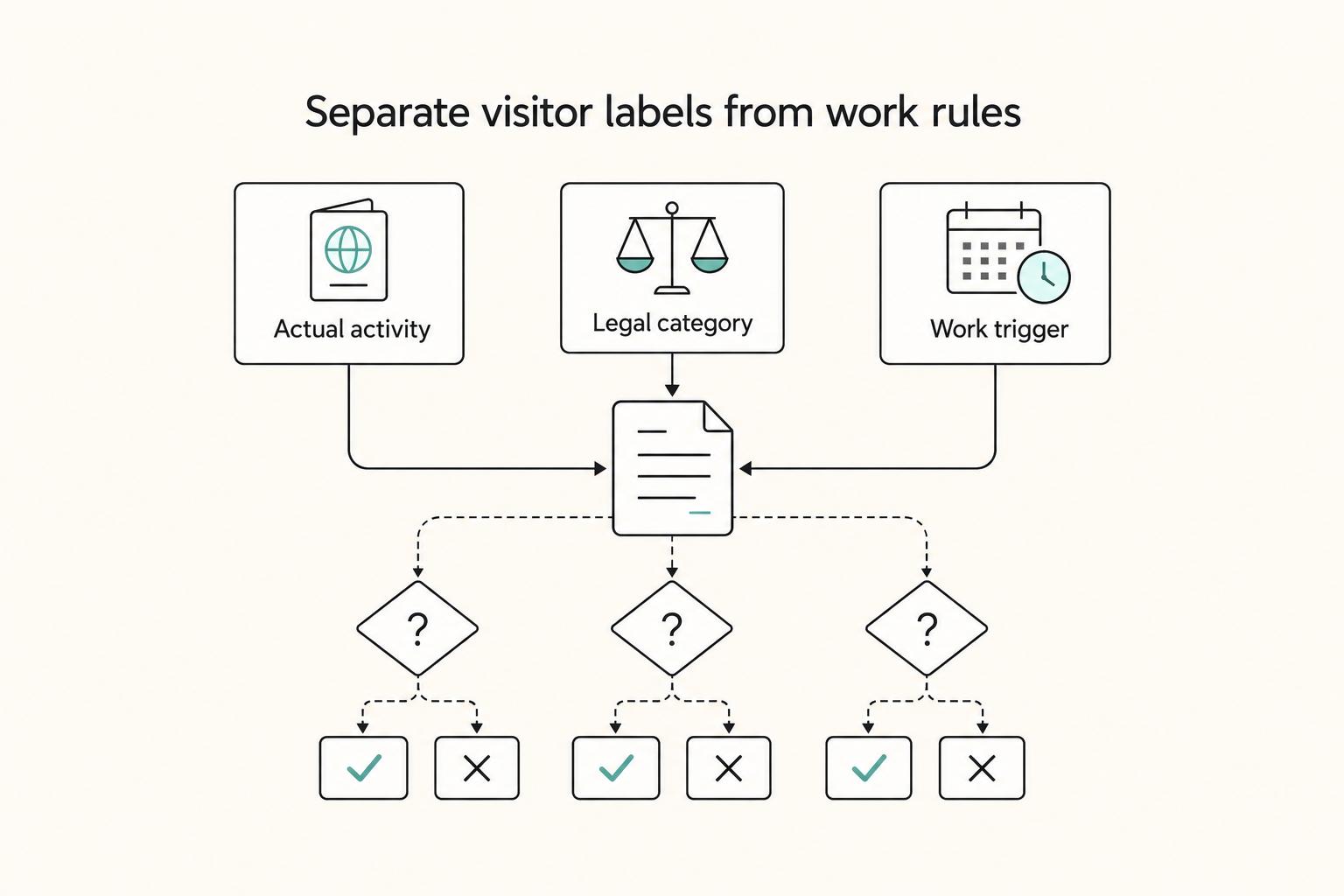
Canada Digital Nomad Visa Planning for Visitor Status and Work Permits
The phrase `canada digital nomad visa` is useful for search, but misleading if you treat it like a legal category. It is shorthand for existing Canadian status options, mainly visitor status and work permit rules, not a standalone visa stream with its own fixed process. That difference is not just technical. It changes how you should plan the trip, describe your purpose at entry, and organize your records before you leave.

Vancouver Digital Nomad Guide 2026 for Long-Stay Remote Work
If you are planning a longer stay in Vancouver, make the go or no-go call before you commit to non-refundable flights, deposits, or a long lease. This guide is about remote work planning in Canada, not short-trip sightseeing. The goal is to help you validate route, documents, and budget in the right order so one weak assumption does not force a rushed decision later.

How Freelancers Can Legally Avoid Double Taxation With Tax Treaties
Classify the tax problem before you touch a return. If your income is mostly personal service fees across borders, this guide fits. If your issue is C corporation profits and shareholder dividends, you are solving a different problem.