
Quick Answer
Yes. To build freelance business with ai in a durable way, start with one narrow package and make it contract-ready before scaling. Set cost-to-serve and contribution margin first, then choose fixed-fee, retainer, or performance-linked terms only if measurement is reliable. Require a defined handoff format, acceptance criteria, and revision policy so completion is testable. Keep AI on repeatable production tasks, while final prioritization, client communication, and QA sign-off stay human.
You can start a freelance business with AI quickly#
You can start a freelance business with AI quickly. Building one that stays profitable, reviewable, and credible with clients is harder. This guide is about that second part.
A lot of AI freelancer advice is useful, but it often stays focused on launch mechanics and productivity: how to start quickly, take on more projects, or use AI to draft work. That matters, but it is only half the decision. AI can support expert work, not replace expert judgment, so speed alone is not a business model. If your only pitch is faster output, you can still run into pricing pressure and client concerns about quality.
The bar here is stricter. We are not treating an AI-assisted service as ready to sell until it can hold up on unit economics, human review, and explicit completion rules. Unit economics means understanding profitability on a per-package or per-client basis, not just looking at revenue in the abstract. Acceptance criteria matter because they turn "good work" into verifiable conditions a client can actually review. If you plan to offer ongoing service, you also need SLA-level clarity about what is delivered, when, and under what expectations.
For this guide, success means you can answer four questions clearly before you scale anything:
- What is the single offer you can deliver repeatedly without quality drift?
- How is it priced against cost-to-serve and margin, not hype?
- Which parts can AI handle well, and which parts must stay human?
- What checkpoints prove the work is complete, acceptable, and worth renewing?
That last point is where AI-assisted services can break down. A draft can be fast and still unusable. A client handoff can look polished and still fail when acceptance criteria, review ownership, or an escalation path are not defined. A simple verification check helps here. If you cannot describe what "done" looks like in plain, testable terms, do not sell the offer yet.
The rest of the guide follows the order an operator actually needs to work in. Start with prerequisites, including evidence, baseline costs, and intake requirements. Then choose one narrow offer, price it with margin in mind, build the delivery sequence with human control points, and turn that into a contracted operating model with reviewable standards.
Later, we will cover weekly checkpoints, common failure modes, and a practical checklist you can use to move from idea to client-ready service without pretending that faster output equals a durable business. Related: How to Build a Freelance Business That's Platform-Independent.
What to Prepare Before You Build Anything#
Before you choose tools, put evidence first. Your prep should answer four questions early: is there real demand, is the market large enough to matter, what will delivery cost, and what is most likely to block execution.
| Prep area | What to gather or define | Checkpoint |
|---|---|---|
| Evidence pack | Demand signals in your niche, a rough total addressable market, practical market-size inputs, and at least three comparable productized services | If you cannot name the buyer, segment, and price band for alternatives, you are not ready to design the offer |
| Cost-to-serve model | Likely delivery steps, expected delivery time, and estimated cost-to-serve per client | Buying software first often hides effort that later shows up in QA and revisions |
| Client intake checklist | Business goals, customer journey context, dependencies, and data-access limits; request only the minimum systems and data needed | If intake does not show who owns approvals and what data is off-limits, expect timeline drift |
| Quality boundaries | QA gate ownership, revision policy, and an escalation rule for blocked delivery | Be explicit about who takes over, when, and what triggers handoff when access is missing or feedback stalls |
-
Assemble an evidence pack. Start with demand signals in your niche, not assumptions. Build a rough total addressable market, then pressure-test it with practical market-size inputs: how many buyers fit, what they already pay, and which service line or segment they currently choose. For this guide, gather at least three comparable productized services so you can compare scope, positioning, and pricing. Checkpoint: if you cannot name the buyer, segment, and price band for alternatives, you are not ready to design the offer.
-
Model cost-to-serve before tooling decisions. Map likely delivery steps, expected delivery time, and estimated cost-to-serve per client. Then decide where an AI agent can reduce manual work. Better estimates improve decision quality earlier; buying software first often hides effort that later shows up in QA and revisions.
-
Draft a client intake checklist. Use a standardized intake form so requests capture business goals, customer journey context, dependencies, and data-access limits from the start. Apply least-privilege access and request only the minimum systems and data needed. Checkpoint: if intake does not show who owns approvals and what data is off-limits, expect timeline drift.
-
Set quality boundaries up front. Define QA gate ownership, revision policy, and an escalation rule for blocked delivery. Your escalation policy should be explicit about who takes over, when, and what triggers handoff when access is missing or feedback stalls.
If you want a deeper dive, read How to Build Credit as a Freelancer.
Pick One Offer You Can Deliver Repeatedly and Profitably#
Choose one offer you can deliver the same way each time, with a clear outcome and clear boundaries. If you cannot define the handoff format and acceptance criteria before selling, it is not ready to sell as a productized service.
Score your offer options first#
Use a simple weighted scoring table before you commit so you compare options on the same criteria, not on enthusiasm. Score each option from 1 to 5 across repeatability, QA burden, margin potential, and sales clarity.
| Offer option | Repeatability | QA burden | Margin potential | Sales clarity | Notes |
|---|---|---|---|---|---|
| CRO audit | 5 | 3 | 4 | 5 | Clear deliverable, easier to package, handoff can be a fixed report |
| AI marketing strategy package | 2 | 2 | 3 | 2 | Broad promise, harder to define success, high revision risk |
| Conversion analytics setup review | 4 | 4 | 3 | 4 | Repeatable if tools and access are standardized |
You do not need a perfect weighting formula. You need one offer that stays strong across all four criteria and can be delivered repeatedly.
Checkpoint: if your top offer scores 2 or lower on sales clarity, rewrite the promise until a buyer can tell what they get, in what format, and by when.
Start with one narrow deliverable#
Start with one narrow deliverable, not a broad promise. Broad offers are harder to scope, QA, and price; a tighter package is easier to explain and sell.
Specialization can help here. As one freelance operator put it, it is "easier to close deals," and "you're able to charge more." You do not need to niche forever, but your first offer should be specific enough that a buyer understands it quickly.
A practical test: if the offer title needs a full paragraph to explain, it is probably too wide for your first package.
Define the handoff and acceptance criteria before selling#
Write the handoff format and acceptance criteria before you publish or pitch the offer. Stable delivery requires explicit service components, performance expectations, ownership, and what happens if expectations are not met.
State what counts as done in concrete terms: what is included, what is excluded, and how revisions work. If you cannot write those terms yet, do not sell the offer.
Failure mode to watch: vague offers invite scope creep, which expands work beyond approved scope and can damage schedule and budget. PMI reported that 52 percent of projects in its 2018 sample experienced scope creep.
Decide whether to package the work or scope it custom#
Use custom scoping when the work genuinely needs custom discovery each time. Use a packaged offer when the same intake, handoff format, and acceptance criteria can be reused.
Custom work can support higher pricing in some cases, but variation usually increases delivery and SLA risk. Packaged work does not guarantee high margin, but it makes pricing, QA, and delivery consistency easier to manage.
This pairs well with our guide on How to Build an Email List for Your Freelance Business.
Price for Margin, Not for Hype#
Set price from unit economics first, then choose the pricing model. Start by confirming cost-to-serve and variable-cost coverage, then pick fixed-fee, retainer, or performance-linked terms based on how measurable the work actually is. If attribution is weak, do not rely on pure performance-linked pricing.
Calculate the floor before you set the sticker price#
Use contribution margin logic first: revenue minus variable costs shows what is left to cover fixed costs and profit. Then pressure-test with break-even math: fixed costs ÷ (price - variable costs). You do not need a complex model, but you do need a clear minimum price where delivery is not subsidizing itself.
Use a quick stress test before you sell: if one extra revision cycle or review pass can erase most of the margin, either the scope is too loose or the price is too low.
Match the pricing structure to measurement quality#
| Structure | Best fit | Main risk | Verify before selling |
|---|---|---|---|
| Fixed-fee package | Scope, deliverables, and timelines are stable | Underpricing hidden review effort | Acceptance criteria, exclusions, handoff format |
| Retainer | Ongoing access to defined professional service capacity | Vague "always on" expectations | Monthly scope boundary, response terms, escalation path |
| Performance-linked pricing | Outcomes are measurable and tracking is reliable | Attribution disputes and noisy results | Tracking method, baseline, event ownership, reporting cadence |
Fixed-fee works best when scope is stable. Retainers fit ongoing access to your capacity. Performance-linked pricing is strongest when attribution is strong and tracking is reliable.
Use delivery controls to protect margin#
Acceptance criteria define when work is complete, which helps align QA and reduce ambiguity. Pair them with a clear revision policy and exclusions list in your proposal or SOW. Tighter delivery controls support higher pricing by reducing margin leakage from uncontrolled scope expansion.
Build a packaging ladder instead of forcing one deal type#
Use a sequence: diagnostic offer, implementation offer, then ongoing retainer. Add optional digital products later for buyers who want your method without buying your time. This gives you a cleaner path to non-service revenue than jumping straight into complex outcome-only pricing.
For a step-by-step walkthrough, see How to Build a Sales Pipeline for Your Freelance Business.
Build the AI Delivery System with Human Control Points#
Start narrow: use one AI agent for one defined job, and keep human sign-off where judgment affects client trust and delivery quality.
Configure one agent with a clear role, goal, and constraints#
Make instructions explicit. Instead of asking for "a CRO audit," assign a role (for example, CRO analyst), a goal (find likely conversion friction), and clear constraints (use only intake materials, name assumptions, avoid unsupported claims).
Before you sell, test and refine the setup on client-like inputs until output structure, evidence quality, and recommendations are consistently usable. If the agent ignores constraints or produces unstable outputs, keep iterating.
Test on client-like inputs before selling#
Use realistic inputs such as past landing pages, anonymized screenshots, analytics exports, or a mock funnel. Focus on whether the system handles incomplete context, conflicting signals, and messy inputs without inventing certainty.
If a polished draft still requires heavy cleanup or rework, your cost-to-serve is likely rising rather than falling.
Tie CRO output to conversion analytics and a testing framework#
For CRO work, each recommendation should map to a tracked action you can evaluate later. In GA4, map recommendations to a relevant key event so you can measure whether users complete that business-critical action.
Then put recommendations into a testable A/B structure: what changes, what stays constant, and which conversion goal decides the winner. If it cannot be tied to a tracked action or a testable variant, it is persuasive copy, not audit-grade guidance.
Keep human controls where risk and trust sit#
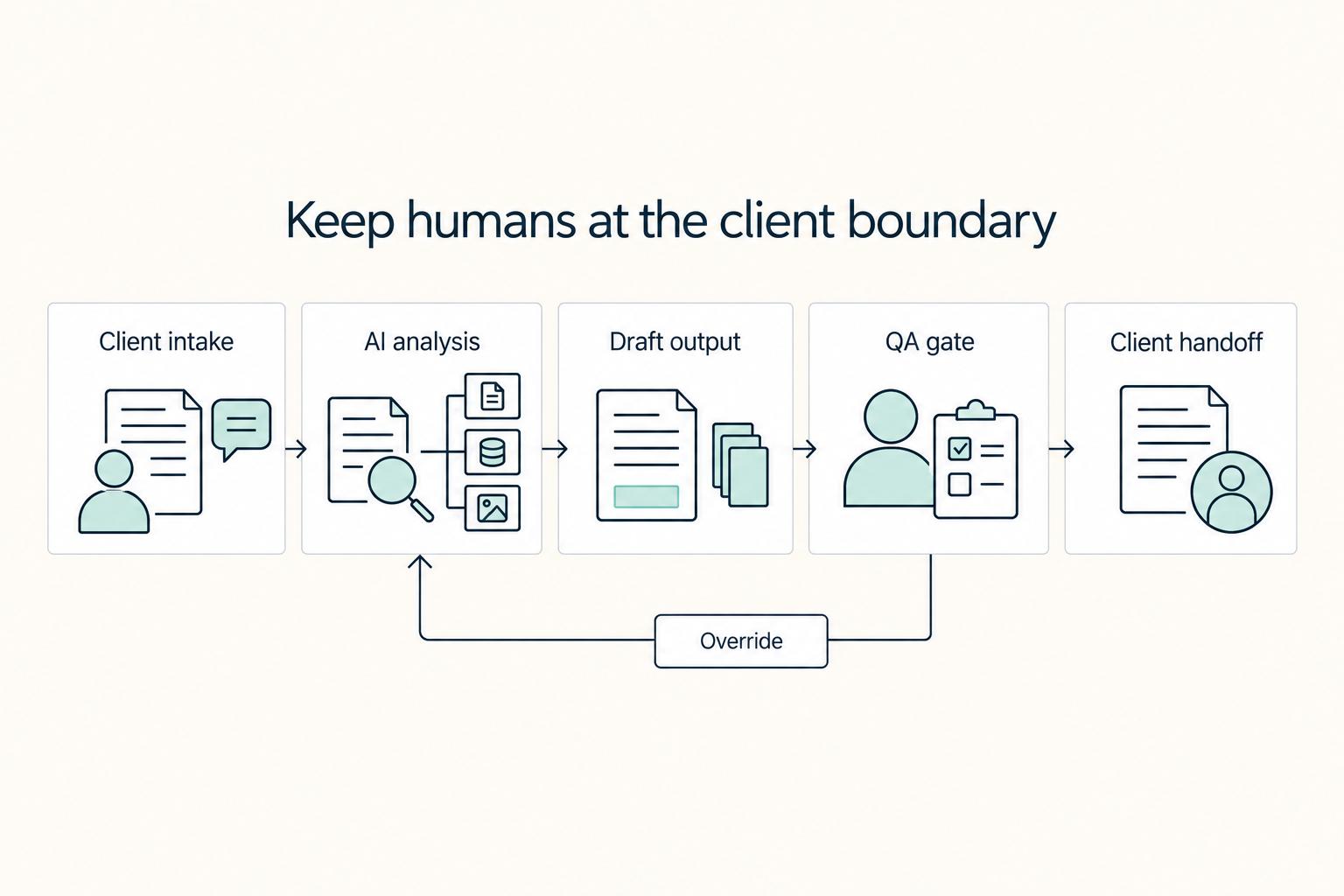
Keep final prioritization, client communication, and QA sign-off human, with an explicit override point when model behavior is weak, risky, or unsupported. A practical QA check is whether each recommendation is tied to the observed issue, expected conversion effect, and mapped key event or test.
A strong default sequence is intake -> analysis -> draft output -> QA gate -> client-ready handoff. It is not universal, but it separates raw model output from what the client sees and keeps handoff quality consistent.
We covered this in detail in How to Build a Second Brain for Your Freelance Business.
Turn Work into a Contracted Operating Model#
Once your delivery path is stable, convert it into contract language before you sell more of it. If you cannot state the service as an SLA, acceptance criteria, a revision policy, and an escalation rule, it is not a repeatable operating model yet.
| Component | What to specify | Review point |
|---|---|---|
| SLA and scope of work | Service definition, expected performance level, tasks, deliverables, timeline, input dependencies, and tracking signals or KPIs | Another reviewer should be able to decide pass or fail from the file alone |
| Client responsibilities | Required data access, the decision owner, and the expected response pattern for open questions and review cycles | If access is incomplete or ownership is unclear, route it through your escalation rule |
| Handoff format | Scope summary, findings, supporting evidence, recommendations, owners, and next actions | Use one consistent client-ready document so quality can be reviewed, not inferred |
| Delivery-cycle checkpoint | Did scope expand, did QA fail, and did margin drop versus target | Treat added requests as change-control events; if QA fails, route through escalation before handoff |
Convert the service into contract terms#
Define the service and expected performance level in the service-level agreement (SLA), then lock the tasks, deliverables, and timeline in scope-of-work language before execution starts. For each deliverable, state what you will produce, when it is due, what inputs it depends on, and which tracking signals or KPIs you will use to review performance.
Make acceptance criteria explicit and verifiable. The practical check is simple: can another reviewer decide pass or fail from the file alone, without asking what you meant?
Put client responsibilities in the intake checklist#
Name client-side requirements up front to reduce timeline drift. Your intake checklist should specify required data access, the decision owner, and the expected response pattern for open questions and review cycles.
If access is incomplete or ownership is unclear, route it through your escalation rule instead of absorbing delay as unpaid rework.
Standardize the handoff format#
Use one consistent handoff structure so quality can be reviewed rather than inferred. A single client-ready document should clearly show scope summary, findings, supporting evidence, recommendations, owners, and next actions.
When multiple stakeholders are involved, a standardized file also makes it easier to check delivery against scope, implementation clarity, and task ownership/status.
Add a delivery-cycle checkpoint#
Run the same three checks at the end of every cycle: did scope expand, did QA fail, and did margin drop versus target? Treat added requests as change-control events to contain scope creep risk.
If QA fails, route through escalation before handoff. If margin slips, check contract and process controls first: access assumptions, acceptance criteria clarity, and revision handling.
Execute the First 90 Days with Weekly Checkpoints#
Run the first 90 days with a narrow operating plan: one offer, one weekly review rhythm, and no expansion until delivery is consistently meeting your contract terms. If SLA and acceptance criteria are not holding, scaling usually increases rework instead of results.
| Period | Focus | Gate or review |
|---|---|---|
| Weeks 1 to 2 | Sell one predefined package and complete one full contract-driven cycle | Track estimated hours, actual hours, AI agent contribution, and QA issues found before handoff |
| Weeks 3 to 6 | Tighten the customer journey diagnosis and testing framework | Ask whether the step improved the client outcome, whether recommendations are auditable with evidence, and whether access, ownership, or approvals created delays |
| Weeks 7 to 10 | Add one controlled upsell | Only after recent work is on time, in scope, and accepted without revision sprawl; if attribution is weak, avoid pure performance-based pricing |
| Weeks 11 to 13 | Review unit economics by offer and cut weak offers fast | Keep offers that are repeatedly accepted with predictable effort and delivery; stop offers that repeatedly miss acceptance criteria, trigger escalations, or require more human correction than the price can support |
Sell one productized service and deliver it end to end in weeks 1 to 2#
Start with one predefined package with fixed scope, price, and handoff. A tightly scoped offer is easier to sell and validate quickly because the buyer is evaluating something concrete.
In these first two weeks, complete one full contract-driven cycle: scope, timeline, budget, SLA, revision policy, and escalation rule. Track each job in a simple log:
- Estimated hours
- Actual hours
- AI agent contribution
- QA issues found before handoff
If drafting is fast but correction is still heavy, treat that as a delivery constraint, not a tooling win.
Tighten the customer journey diagnosis and testing framework in weeks 3 to 6#
After one full delivery, tighten quality where the client feels it. For CRO work, that means your diagnosis should map to the real customer journey, and recommendations should connect to conversion analytics rather than generic advice.
Use weekly checkpoints to ask:
- Did this step improve the client outcome, or just add activity?
- Did the testing framework produce auditable recommendations with evidence?
- Did access, ownership, or approvals create delays?
Remove steps that fail those checks.
Add one controlled upsell in weeks 7 to 10 only after consistent SLA adherence#
Introduce a retainer or second fixed-fee package only after customer success is visible in recent deliveries. Gate upsells on delivered value, not pipeline optimism.
Use a simple gate: recent work is on time, in scope, and accepted without revision sprawl. If attribution is weak, avoid pure performance-based pricing and keep the upsell contract-driven.
Review unit economics by offer in weeks 11 to 13 and cut weak offers fast#
Review unit economics per offer, not as one blended average. Roll weekly notes into monthly and quarterly views of revenue, actual delivery time, revision load, QA failures, and acceptance pass/fail.
Keep offers that are repeatedly accepted with predictable effort and delivery. Stop offers that repeatedly miss acceptance criteria, trigger escalations, or require more human correction than the price can support.
Related reading: How to Create a Business Email Address for Your Freelance Business.
Fix the Failure Modes Most AI Freelancers Hit#
Most AI-assisted freelance work fails in three predictable places: generic output, revision sprawl, and over-automation in client-facing judgment. Fix these before you try to scale volume.
Reject generic output at the QA gate#
Generic output is not deliverable. For CRO work, require each recommendation to map to the customer journey, connect to conversion analytics, and show the testing logic behind priority order. Use one QA question before handoff: can you show clear evidence for each recommendation, or only plausible wording? If evidence is weak, rework before the client sees it.
Lock revision boundaries before work starts#
Revision sprawl is usually a contract-definition problem, not a client-personality problem. Define revision policy and acceptance criteria up front: how many revisions are included, what counts as scope change, and what qualifies as accepted. This is your primary scope-creep control. If a third party cannot read your criteria and decide pass or fail, margin will likely leak through extra rounds.
Keep human ownership where trust actually sits#
Keep human-in-the-loop review for decisions that affect spend, timing, or stakeholder risk. Upwork's Human+Agent Productivity Index reported up to a 70% completion lift for human-and-agent collaboration on simple projects, but those projects were mostly under $500 and represented less than 6% of marketplace volume. Use that as support for human review, not full automation of judgment. Final prioritization, client communication, and escalation decisions should stay with you.
Need the full breakdown? Read How to Build an Antifragile Freelance Business: Financial Core, Compliance Firewall, and Shock Absorbers.
Conclusion#
If you want a freelance business with AI that lasts, treat speed as a byproduct, not the offer. The durable part comes from unit economics, controlled delivery, and a service definition a client can actually approve against. AI can help you draft and accelerate, but your margin still depends on variable costs, rework rates, and whether final quality gets a human sign-off.
The next move is smaller than most people think. Do not design three offers, buy six tools, and promise broad transformation. Pick one service, price it from cost-to-serve, and run one complete delivery cycle with QA checkpoints before you scale anything.
Take the next step#
- Choose one narrow productized service tied to a real buyer problem.
A focused offer is easier to sell, scope, and review than a vague "AI support" package. Your verification point is simple: can you describe the deliverable, handoff format, and buyer outcome in one short paragraph? If not, the offer is still too broad.
- Price it using unit economics and a clear pricing model.
Start with revenue per job, subtract the variable costs, and check whether the remaining contribution margin can absorb your review time and revisions. If a package only works when everything goes perfectly, it is underpriced. The common failure mode here is ignoring hidden cost-to-serve, especially QA time and extra revision cycles.
- Set the SLA, acceptance criteria, revision policy, and escalation rule before selling.
Those are not admin extras. They are the controls that define service scope, performance metrics, responsibilities, and what happens if the work misses the standard. A good checkpoint is whether both sides could independently answer, "What counts as complete, how many revisions are included, and who decides if delivery is blocked?"
- Build one AI agent workflow with defined human QA gates.
Keep the order simple: intake, analysis, draft, QA review, client-ready handoff. Let the AI agent handle repetition, but keep final prioritization, client communication, and sign-off with you. If recommendations affect budget, risk, or timing, do not let them ship without human review.
- Run a regular checkpoint cadence (for example, every 90 days) and cut low-margin offers quickly.
Use each checkpoint to review actual delivery time, SLA misses, scope creep, and margin by offer. The test is not whether the work felt efficient, but whether the economics held up job after job. If an offer repeatedly misses acceptance criteria or burns margin through revisions, remove or redesign it quickly.
That is the practical checklist. With 75% of small businesses already using or exploring AI, the opening is real, but execution discipline is still what separates a usable service from a cheap draft factory.
For downturn planning, use How to Build a Resilient Freelance Business in an Economic Downturn. If you want to talk through your next step, Talk to Gruv.
Frequently Asked Questions
Can you realistically build an AI-assisted freelance business in 2026 without racing to the bottom on price?
Yes, but not by selling "AI help" as the offer. Demand is real, with 75% of small businesses already using or exploring AI, but Brookings also cites a 2% decline in contracts and a 5% drop in earnings for more AI-exposed freelance work. A safer path is tighter scope, clear acceptance criteria, and human judgment clients can see.
What services are easiest to turn into productized services with an AI agent?
Start with repeatable tasks that have stable inputs and a consistent handoff, such as product description writing, social content drafting, and basic customer-data analysis. Those are easier to package because you can standardize intake, output format, and QA. If every project needs a fresh strategy before a draft is even possible, it is probably too custom to productize yet.
How do you choose between a fixed-fee package, a retainer, and performance-linked pricing?
Use a fixed-fee package when scope is bounded and the acceptance criteria are easy to verify. Use a retainer when the client needs recurring work and you can define service levels, responsibilities, and remedies in an SLA. Use performance-linked pricing carefully, usually with a base fee, and only when success metrics are clear enough to verify.
What should be automated in the delivery process and what should stay human?
Automate repetitive production steps like description writing, social draft creation, and basic analysis. Keep final prioritization, client communication, QA gate sign-off, and escalation decisions human, because for many tasks AI is not reliable enough to replace expert ownership. If a recommendation changes budget, timing, or risk, require your review before it ships.
What should happen in week one versus the first 90 days?
Treat this as a practical sequence, not a guarantee. In week one, sell one narrow offer and deliver it end to end so you can see where AI saves time and where it creates rework. In the first 90 days, tighten your intake checklist, remove steps that do not improve outcomes, and document failure points. Add a retainer or second package only after you can meet the same acceptance criteria and service levels consistently.
How do you prevent quality drift when using AI for client work?
Set a standing QA gate and use the same checks every time: claims tied to client context and acceptance criteria met before handoff. Keep a simple job record for each engagement, including the brief, source inputs, key assumptions, and review changes, so human review stays consistent.
What proof should a client ask for before buying an AI-assisted service?
They should ask for the SLA, acceptance criteria, and who owns final review. They should also ask what parts are AI-assisted, what performance metrics define success, and what remedies apply if the work misses the agreed standard. If a provider cannot show roles, responsibilities, and remedies clearly, the real risk is not the tool but the operating discipline.
Try a related tool
Researched and edited by the Gruv editorial team. Gruv builds cross-border billing, payouts, and finance-operations software for global businesses.
Sources
Includes 3 external sources outside the trusted-domain allowlist.
- brookings.edu/articles/is-generative-ai-a-job-killer-evide...trusted
- csrc.nist.gov/glossary/term/least_privilegetrusted
- one.oecd.org/document/C/MIN%282024%2916/FINAL/en/pdftrusted
- sba.gov/business-guide/plan-your-business/market-res...trusted
- sba.gov/business-guide/plan-your-business/calculate-...trusted
- ama.org/multitouch-attribution-in-the-customer-purch...external
- atlassian.com/work-management/project-management/acceptanc...external
- atlassian.com/itsm/service-request-management/slasexternal
Educational content only. Not legal, tax, or financial advice.
Related Posts

How to Build Credit as a Freelancer
To build credit as a freelancer, stop relying on motivation and start running a simple, repeatable system that still works when income is uneven. You run a business-of-one, and credit is part of your operating model, not a personality test. If you've ever blamed your "money habits," you probably just lacked a workflow that turns irregular cashflow into consistent credit behavior. Start thinking like an operator: controls first, then tools.

Build a Platform-Independent Freelance Business in 90 Days
Real independence is easy to describe and harder to build: if one account on Upwork, Fiverr, or another marketplace gets limited, your business should keep moving. Marketplaces can stay in the mix, but they should not control your pipeline, onboarding, or payment.
How to Build a Resilient Freelance Business in an Economic Downturn
Treat the next month as a cash-protection sprint first, then a controlled growth restart. That order helps you avoid rushed decisions when invoices slip and buyers hesitate.