
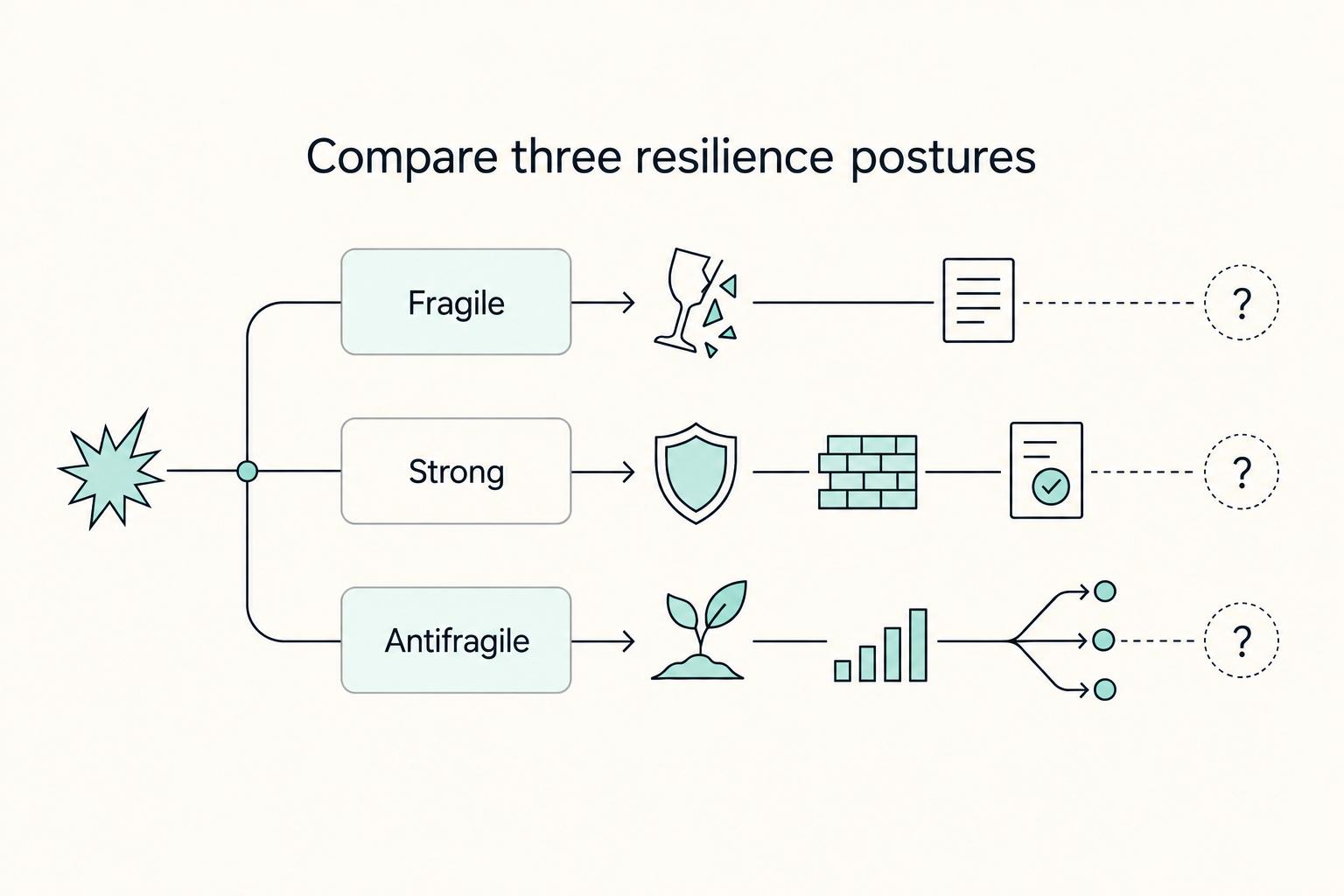
Quick Answer
Build an antifragile freelance business by creating a Financial Core, a Compliance Firewall, and operational shock absorbers that protect downside while preserving options. Cover baseline costs with reliable work and accessible cash, set contract and invoice terms before delivery, track cross-border compliance in real time, and reduce dependency on any one client, platform, or pipeline source.
Design Your Operations to Benefit From Disruption#
If you want an antifragile freelance business, design your operations to benefit from disruption, not just survive it. Resilience means you absorb a shock and recover. Antifragility, in Taleb's framing, means you improve because of volatility rather than merely endure it.
This matters because volatility is common in solo work. In the Federal Reserve's 2025 report on 2024 household finances, 59% of self-employed adults reported month-to-month income variability, versus 28% of people working for someone else. The practical question is not, "How do I avoid every shock?" It is, "How do I avoid getting forced into bad decisions when shocks happen?"
| Operating mode | What you do before disruption | Your posture when disruption hits | Business consequence |
|---|---|---|---|
| Fragile | Depend on a narrow client mix, one offer, and weak fallback options | Protect short-term revenue at any cost | You are more likely to accept underpriced, rushed, or poor-fit work |
| Resilient | Maintain risk controls, contingency plans, and continuity basics | Absorb the hit and return to baseline | You stay operational, but often aim to restore the old setup |
| Antifragile | Build diversified demand paths, reusable systems, and strong outside alternatives | Treat disruption as a trigger to upgrade clients, offers, or terms | You increase room to choose, renegotiate, or pivot |
The payoff is optionality: more real choices, with less pressure to accept bad terms. In practice, that means more room to choose clients and terms, and to pivot when needed, because you are negotiating with alternatives. This also lines up with BATNA logic: stronger outside options make it easier to walk away from weak deals.
Use this checkpoint: if losing one project would force you to cut rates or accept work you already know is a bad fit, your setup is still fragile. Optionality can feel inefficient at first. Slack capacity, multiple lead sources, and stronger operating hygiene all take effort.
Here's how that plays out. First, build a financial core that buys you time. Then put a compliance firewall in place so routine mistakes do not become expensive problems. Finally, add operational buffers so one issue does not spread across the whole business.
You might also find this useful: How to Build a Resilient Freelance Business in an Economic Downturn.
The Antifragile Financial Core: Structuring Your Economic Engine#
If you want optionality, structure your finances so downside is limited and upside stays available. In antifragile terms, fragility loses from volatility, robustness absorbs it, and antifragility can benefit from it. A known small loss can be acceptable when downside is capped and upside remains open under higher uncertainty.
Build two lanes, not one blended pot#
A practical approach is to run your money in two lanes. The baseline lane protects continuity. The upside lane funds experiments without putting core obligations at risk. Review these three controls monthly:
- Baseline coverage target: Current monthly essential outflow pending budget review for non-negotiable business and personal operating needs.
- Upside allocation lane: Capped time or cash amount pending budget review for experiments with uncertain payoff.
- Minimum liquidity policy: Access threshold pending cash-flow review; keep it in cash you can use immediately, not cash tied up in receivables or slow settlement flows.
Use one rule: fund the upside lane only after the baseline lane is covered by reliable work and accessible cash. If an experiment fails and your baseline still holds, your downside is bounded. If not, it is not an experiment.
| Financial posture | Income mix | Cash posture | Payment terms | Downside protection |
|---|---|---|---|---|
| Fragile | Commitments assume stable conditions | Thin liquidity; little room for delays | Terms are mostly accepted from the client side | Volatility can create outsized downside |
| Strong | Core obligations are covered predictably | A buffer exists for disruption | Terms are documented and followed up | Shocks are absorbed and continuity is preserved |
| Antifragile | Stable baseline plus capped upside bets | Liquidity is ring-fenced from speculative spend | Terms are set before work and tied to delivery events | Volatility may improve client mix, pricing, or offer design while downside stays bounded |
Put contracts before invoices#
Set terms while you still have leverage, then make invoicing follow those terms instead of trying to fix weak assumptions after delivery. Follow this sequence:
| Step | Key details |
|---|---|
| Set pre-engagement terms first | Confirm scope, payment timing, revision boundaries, cancellation handling, late-payment language, currency, and tax handling in signed terms |
| Bill by milestone | Tie invoices to clear delivery or approval checkpoints so payment is an operating event, not a post-delivery debate |
| Choose direct billing vs. Merchant of Record intentionally | Use direct billing when you want full control of contract and invoicing flow. Use a Merchant of Record when your model benefits from outsourced checkout and cross-border payment operations. Still verify payout timing, settlement currency, fees, refund handling, and any remaining responsibilities on your side. |
Treat "revenue-positive" work carefully. Some engagements can still create dependency or drift that weakens your core.
Run a cash firewall if you work across currencies#
If you work across currencies, review currency exposure explicitly. Match holdings to near-term obligations where possible, and track invoice currency, settlement currency, and payout timing as separate fields. Review this monthly:
- receivables aging by currency
- immediately available liquidity vs. funds still in transit
- upcoming obligations by currency in the next cycle
- forced conversions, spread surprises, and payout delays
- gaps between signed payment terms and actual payment behavior
If your liquidity policy only works after chasing late payments or converting under pressure, your core is more fragile than it looks. Related: Canada's Digital Nomad Stream: How to Live and Work in Canada.
Your Ultimate Shield: Building a 'Compliance Firewall'#
Once cash controls are in place, the next priority is stopping routine compliance misses from turning into expensive problems. Run this firewall as a repeatable process across travel days, account reporting, invoicing, and contract boundaries. For every jurisdiction-specific trigger, keep a tracker field for the verified rule or threshold and fill it only after checking current official guidance.
| Area | Reactive compliance | Early compliance firewall |
|---|---|---|
| Travel tracking | You count days only when a filing or residency issue appears | You log each entry/exit in real time, apply the local counting rule, and review warning points monthly |
| Account reporting | You reconstruct balances at year end | You maintain an account register, monitor aggregate balances, and calendar filing dates early |
| Invoicing controls | You fix invoice details after disputes | You verify entity details, numbering, tax IDs, and tax-treatment wording before sending |
| Client contract boundaries | You rely on labels like "independent contractor" | You align contract language and working behavior to support independence and reduce PE risk |
Track presence before it becomes a residency problem#
Do not manage travel risk with a generic day-count assumption. Use one travel log that can support different jurisdiction rules:
| Field | Note | Cadence |
|---|---|---|
| Country or territory | Use one spreadsheet or database row per border movement | Review weekly |
| Entry date and exit date | Record both on the same row | Review weekly |
| Local arrival/departure times | Add when relevant | Review weekly |
| Evidence source | For example stamps, boarding passes, accommodation records, or calendar records | Review weekly |
| Rule applied for counting days | Record the jurisdiction-specific rule | Review weekly |
| Confirm the current day-count threshold with the relevant tax authority | Replace it only after checking current official guidance | Review weekly |
| Set your warning margin below the confirmed day-count threshold | Replace it only after checking current official guidance | Review weekly |
Review weekly. If you approach a warning margin, pause additional days in that location until you confirm the tax impact.
Rules differ by country. U.S. substantial presence uses a current-year minimum plus a weighted three-year count, and any physical presence during a day generally counts. UK SRT day counting generally treats a day as present if you are in the UK at midnight. If a U.S. trigger is hit, check whether the closer connection exception may still apply before assuming resident treatment.
Monitor reportable accounts before year end#
Treat account reporting as a monthly control, not a year-end reconstruction project. If you are a U.S. person with foreign accounts, FBAR (FinCEN Form 114) is based on aggregate value across covered accounts. Maintain a register with:
- Account institution and account identifier
- Account type and whether it may be in scope
- Currency
- Monthly highest balance
- Conversion method used
- Aggregate total across accounts
- Confirm the current aggregate reporting trigger with the relevant tax authority
- Confirm the current filing date with the relevant tax authority
- Confirm the current extension date with the relevant tax authority
Review monthly. If aggregate value approaches the verified trigger, flag it immediately and retain supporting statements.
Tighten invoice controls before the client pays#
Invoice mistakes are easier to prevent than to unwind. Use a pre-send checklist so tax treatment and payment mechanics are consistent before the invoice leaves your system. For EU VAT-sensitive work, apply EU-wide requirements and then confirm any Member-State-specific additions. Use this checklist:
- Verify client legal entity name, registered address, and tax ID from official records; save proof of the check.
- Confirm required invoice fields are present, including issue date, unique sequential number, and relevant VAT identification references.
- Use tax-treatment language only after jurisdiction review, with adviser- or source-confirmed wording for reverse-charge or other treatment.
- Match contract/SOW/invoice fields exactly: scope, currency, milestone trigger, and payee identity.
Keep contractor boundaries clear and PE risk low#
Control this through both contract wording and day-to-day behavior. OECD treaty framing ties PE risk to a fixed place of business, so avoid creating facts that look like operational integration.
| Boundary area | Article detail |
|---|---|
| Independent-contractor language | Contractor-independence clause pending legal review |
| Worker-status evidence | Review worker-status evidence across behavioral control, financial control, and relationship of the parties |
| Day-to-day practices | Keep day-to-day practices aligned with contractor status, and avoid employee-like operating patterns |
| Authority to sign or conclude contracts | Treat authority to sign or conclude contracts in the client's name as a local tax/legal review point |
| Dedicated client location | Do not work from a dedicated location that could appear to be the client's fixed place of business without tax review and written approval |
If a client asks you to function like internal headcount from one jurisdiction for an extended period, pause and get local advice before work starts.
For a step-by-step walkthrough, see How to Use AI for Market Research in Your Freelance Business. Before you lock your compliance workflow, pressure-test your travel and filing assumptions with the Tax Residency Tracker.
Systemic Shock Absorbers: Designing Operational Buffers#
After the compliance firewall, dependency risk is another common failure point for independent professionals exposed to shocks like client loss or regulatory change. Treat each buffer as an operational check that preserves optionality so no single client, channel, or capability can box you in.
A buffer only helps if you review it regularly and adjust it as conditions change.
Run dependency controls you can audit#
| Buffer area | What to review now | If this dependency is too high | Practical response options |
|---|---|---|---|
| Clients | How much revenue depends on one client (for example, scenarios where one client is a large share) | A sudden loss can force a stressful return to baseline | Keep prospecting active, build replacement pipeline early, and maintain pre-qualified leads from always-on marketing |
| Platforms | How much lead flow, visibility, or payments rely on one platform | A platform disruption can become a single point of failure | Strengthen channels you control directly and keep off-platform proof of work current |
| Pipeline sources | Where new conversations are actually coming from | If new work comes from one source, pipeline risk rises when that source slows | Reactivate dormant sources, publish fresh proof, and ask for targeted introductions |
In one illustrative scenario, losing a client that represented 40% of revenue led to a stressful 3-4 month return-to-baseline period. In the antifragile scenario, a pre-qualified waiting list from always-on marketing helps you redeploy faster into viable next offers.
Review capabilities for pivot readiness#
Diversification is not only about client count. It also depends on whether you can redirect existing expertise without starting from zero.
Use a recurring check:
- Which parts of your current specialization remain valuable if demand shifts?
- What adjacent offer can you package quickly with credible proof?
- What small test can you run now to create future upside from change?
The GDPR example shows the pattern: prior specialization can turn disruption into demand. In that illustrative case, demand increased enough for a specialist to triple rates, but that is a scenario, not a guaranteed outcome.
Keep buffers maintained on a routine#
Maintenance beats rescue here. Treat lead generation as ongoing upkeep, not something you restart only when work dries up. On a regular cadence, update lead stages and next steps, follow up on active conversations, publish proof of work, and ask for introductions while current delivery is stable.
Run the same recurring check on your dependency exposure and pivot options. These routines make it harder for one shock to trap your business and easier to pivot with control.
If you want a deeper dive, read GDPR for Freelancers: A Step-by-Step Compliance Checklist for EU Clients.
Conclusion: Run the Financial Core, Compliance Firewall, and Shock Absorbers#
You do not build an antifragile freelance business through mindset alone. You build it by running three disciplines on purpose: your Financial Core (barbell), your Compliance Firewall, and your Systemic Shock Absorbers. That is what helps you make better decisions, avoid preventable surprises, and keep real negotiating room.
| Area | Fragile operator | Antifragile operator |
|---|---|---|
| Revenue | Allows one client to grow into a dangerous dependency (for example, near the article's 40% stress case), then scrambles after a loss. | Monitors concentration and keeps replacement demand active with a steady lead flow and pre-qualified prospects. |
| Compliance | Waits for a client, bank, or authority request before organizing records. | Keeps core records and process documentation ready before requests arrive. |
| Shock response | Tries to recover to baseline after disruption, often with a long, stressful reset. | Uses buffers and prepared demand to pivot and improve choices under stress. |
Your Financial Core takeaway: structure buys decision quality under pressure. Immediate action: review your current revenue mix this week and mark any client dependency that would put you in a scramble if it disappeared.
Your Compliance Firewall takeaway: preparedness turns surprises into admin work instead of crisis work. Immediate action: verify your records are complete and current, then set a recurring review cadence instead of handling compliance ad hoc.
Your Systemic Shock Absorbers takeaway: one setback should not trigger a chain reaction. Immediate action: pressure-test your setup now. If a major client dropped today, would your buffers and active pipeline protect your options or force a reactive search cycle?
Treat this as operating discipline, not a one-time upgrade. In a changing business, static assumptions become a risk, so revisit these three pillars regularly and adjust them as your model evolves.
We covered this in detail in How to Create a Disaster Recovery Plan for Your Freelance Business.
When you are ready to operationalize this playbook, review how Gruv Merchant of Record for Freelancers can support a collection-to-payout flow where supported.
Frequently Asked Questions
What is the barbell strategy for a freelancer's finances?
Use a two-part approach: keep most income in lower-variance work and reserve a smaller share for higher-upside tests. It works best when your baseline costs are already covered by stable revenue. List your personal costs, business costs, and tax cash, then tag each revenue stream as stable or speculative.
How can you protect yourself from non-payment?
Protect yourself by setting payment terms before work begins and confirming the payment schedule, acceptance terms, dispute path, and who processes the transaction. Non-payment risk includes formal disputes, not just late invoices. Keep an evidence pack with the signed agreement, approved scope, delivery records, and client sign-off so you can respond quickly if payment is challenged.
What are the biggest hidden international risks?
The biggest hidden international risks are residency status, cross-border tax treatment, and VAT duties you did not track while moving countries or serving foreign clients. Day-count tests and treaty rules are jurisdiction-specific, so do not rely on one universal cutoff. Keep a live residency log with travel dates, evidence, and where contracts are performed and billed from, and review EU VAT treatment and EU OSS if you sell into the EU.
How do you make a freelance business legally antifragile?
Start with a Compliance Firewall that uses recurring checks to turn surprises into admin work instead of crisis response. Be ready with the right forms for the payer relationship, such as Form W-8BEN for foreign beneficial owners dealing with a U.S. withholding agent or payer, or Form W-9 for U.S. contractors so payers can handle Form 1099-NEC reporting. Set a record-retention policy that fits your jurisdictions, since some rules require at least 5 years and EU OSS records may need to be kept for up to 10 years.
Try a related tool
Researched and edited by the Gruv editorial team. Gruv builds cross-border billing, payouts, and finance-operations software for global businesses.
Sources
- academia.edu/36718710/Taleb_Antifragile_pdftrusted
- business.purdue.edu/centers/dcmme/news/publications/state-of-us-...trusted
- csrc.nist.gov/glossary/term/resiliencetrusted
- europa.eu/youreurope/business/taxation/vat/one-stop-sh...trusted
- federalreserve.gov/publications/2025-economic-well-being-of-us-...trusted
- investor.gov/introduction-investing/investing-basics/glos...trusted
- irs.gov/individuals/international-taxpayers/substant...trusted
- irs.gov/businesses/small-businesses-self-employed/re...trusted
Educational content only. Not legal, tax, or financial advice.
Related Posts

GDPR Compliance Checklist for Freelancers Working With EU Clients
Start by separating the decisions you are actually making. For a workable **GDPR setup**, run three distinct tracks and record each one in writing before the first invoice goes out: VAT treatment, GDPR scope and role, and daily privacy operations.
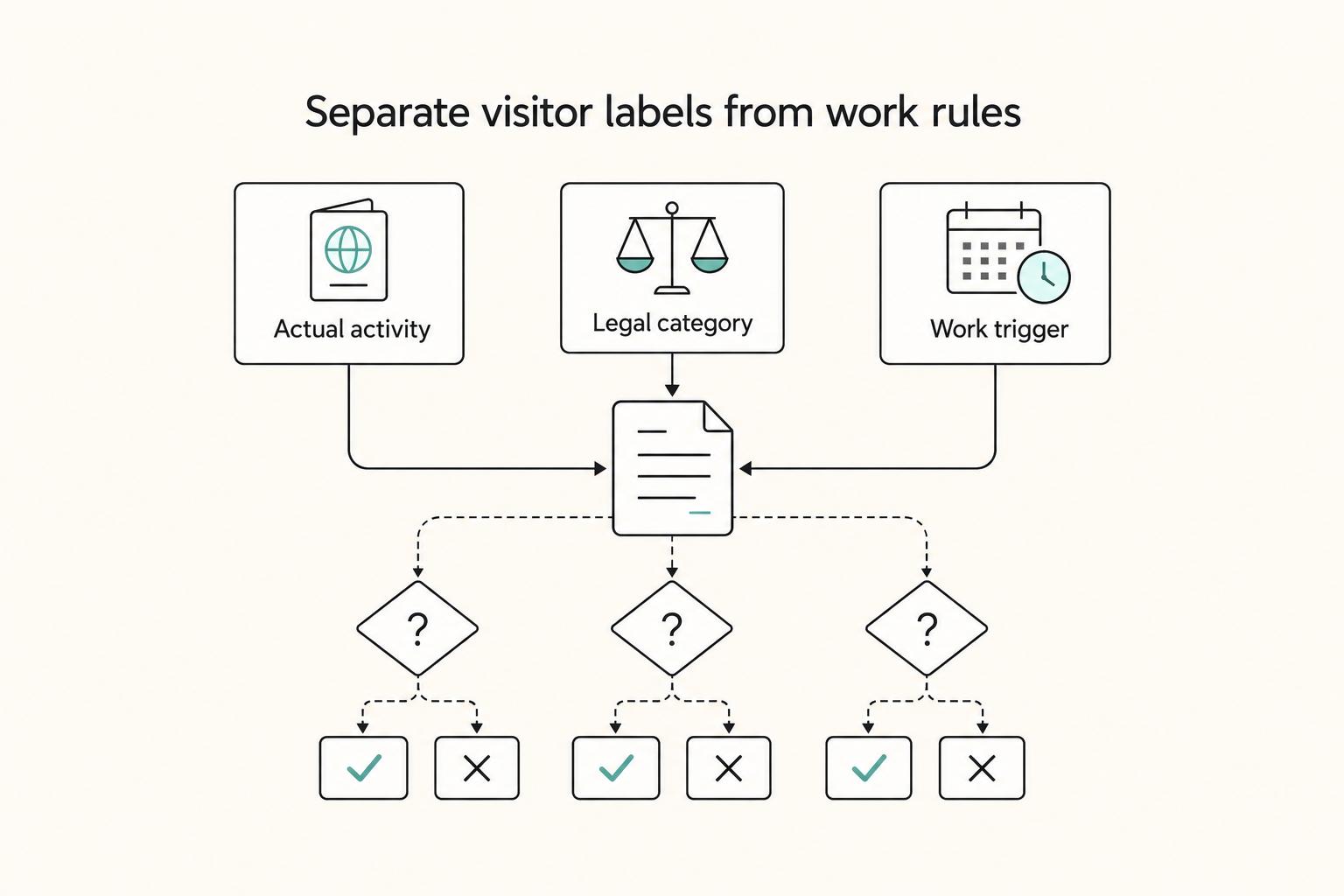
Canada Digital Nomad Visa Planning for Visitor Status and Work Permits
The phrase `canada digital nomad visa` is useful for search, but misleading if you treat it like a legal category. It is shorthand for existing Canadian status options, mainly visitor status and work permit rules, not a standalone visa stream with its own fixed process. That difference is not just technical. It changes how you should plan the trip, describe your purpose at entry, and organize your records before you leave.
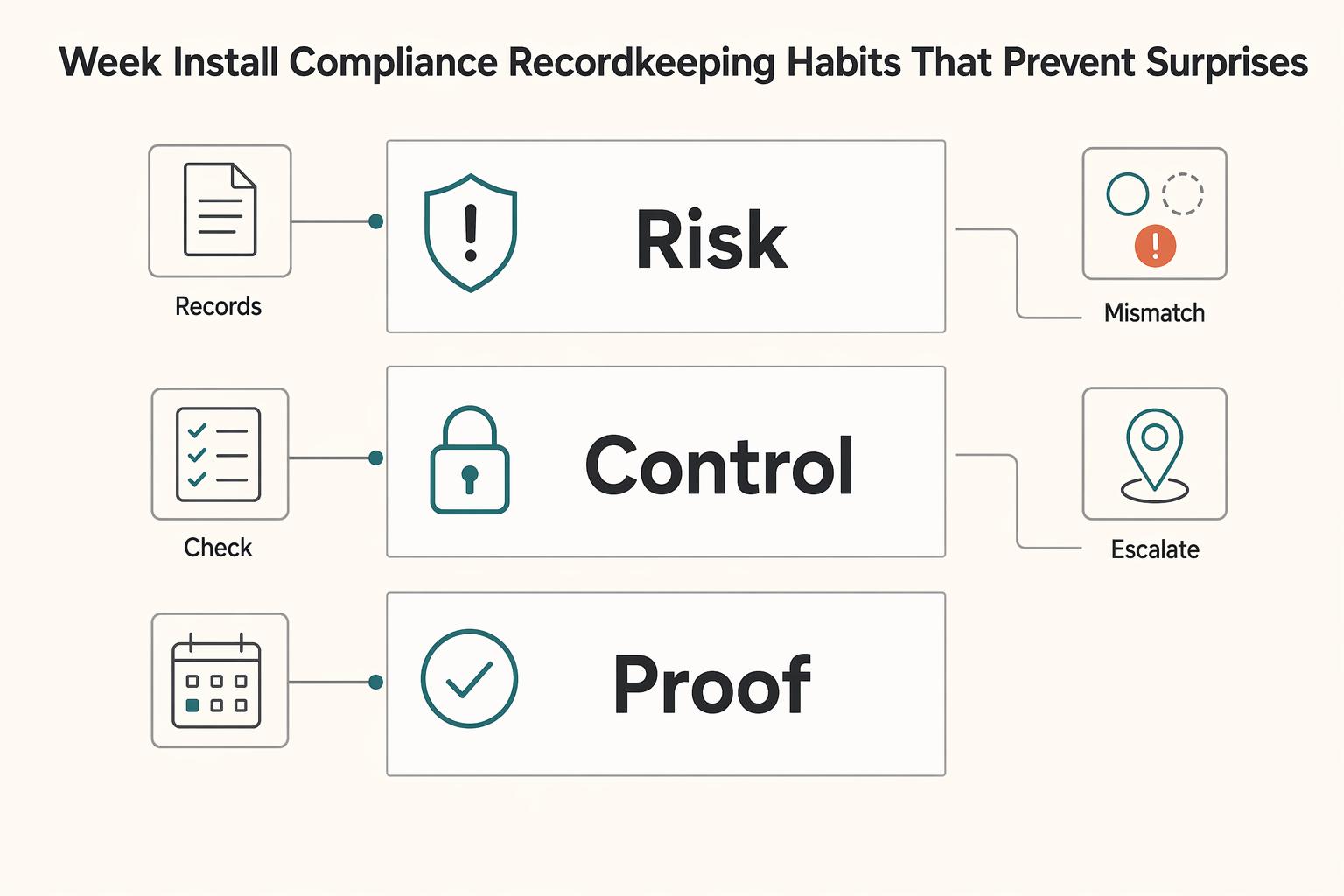
How to Build a Resilient Freelance Business in an Economic Downturn
Treat the next month as a cash-protection sprint first, then a controlled growth restart. That order helps you avoid rushed decisions when invoices slip and buyers hesitate.