
Quick Answer
For your own contractor payments, screen Chase’s documented vendor/employee ACH service, Found’s contractor tools and the plan-specific features of Bluevine, Relay, Amex and Lili. Confirm entity and funds-flow permission first: Relay excludes MSBs and escrow accounts. The U.S. account examples do not establish global availability or approval to hold customer money. Choose after a returned-payment and export test.
How to Compare Digital Banks for Freelancers and Gig Workers#
For a platform paying freelancers, start with the funding and ownership model. Paying your own contractors from company revenue is different from holding customer funds and distributing them to sellers. The named business accounts below are U.S. account examples; a global payout program also needs receiving-country and currency coverage, recipient onboarding and an approved funds flow.
A freelancer choosing an account may prioritize low fees, statements and business expense separation. A platform also needs payment approvals, returns, traceable payment IDs and exports that match its ledger. Check those capabilities against the exact account and service you will use.
A free account can still leave your team with manual work if it cannot explain a returned transfer or match bank movement to a payout record. Separate the account decision from the integration decision, and document which system owns each step.
This guide screens account capabilities and then sets operating tests for a payout program. First establish whether the provider permits your entity and funds flow. Only then compare statuses, failed or returned payouts, exports and escalation ownership. A business account does not by itself authorize money transmission or the holding of third-party customer funds.
You should come out of this article with four things:
- an at-a-glance comparison built for payout operations, not freelancer perks alone
- scenario-based recommendations for different operating models
- implementation checkpoints for finance, ops, and engineering
- a pre-launch verification checklist so your team can prove the path works before production
Choose the banking path that fits your payout volume and control needs. Keep the provider’s confirmed account features beside the tests your program still needs to pass.
At a glance comparison for platform payout use cases#
These are U.S. business-account options, not accounts available to every freelancer worldwide. The table identifies published capabilities and material limits. Ordinary vendor payments do not establish approval for a marketplace that holds or transmits customer funds.
Compare the exact service: a standard ACH transfer, a same-day ACH payment and a wire can have different fees, cutoffs and limits. For example, Chase publishes a vendor/employee ACH service with payment statuses; those documented statuses are useful starting evidence for your reconciliation test.
| Provider | Published account/payment capability | Material condition | Next operating test |
|---|---|---|---|
| Bluevine | Standard plan: no monthly fee and free standard ACH; ACH and wires from Business Checking are bank-provided services. | Qualified U.S.-registered businesses; owners in supported countries. International features differ by customer; international payments use a third-party service and its terms. | Confirm funds-flow permission, ACH return fields, approval roles and exports. |
| Relay | Starter is $0/month with accounting integrations; Grow is $30/month and includes batch vendor payments. | U.S. business entity with U.S. operating presence. MSBs, including money transmitters, are ineligible across all plans; escrow accounts are unsupported. Transaction fees apply separately. | If eligible, test batch approvals, returns and QuickBooks/Xero matching on the selected plan. |
| Chase Business Complete Banking | ACH Payment Services supports vendor/employee payees, CSV uploads up to 100 payees, repeating payments and a published status list. | Enroll through Chase Business Online. First 10 standard ACH payments/month cost $2.50 each, then $0.15 each; account fee/waiver is separate. | Map Funded, Paid, Failed and Returned to ledger states; test an actual return and approval path. |
| American Express Business Checking | ACH, wire, Bill Pay and check payments; employee access and accounting connections. No monthly maintenance fee or minimum balance. | Other service fees apply; account must be funded within 120 days to stay open. Confirm entity eligibility and intended payout program. | Test authorized users, returned payments and export fields against your payout IDs. |
| Found | Contractor payments by bank transfer or Found-to-Found can be free; W-9 collection and 1099-NEC tools. | No per-contractor fee for standard contractor payments; wires and some other methods carry fees and eligibility conditions. A contact marked as contractor is tracked as a 1099 payment. | Test tax classification, recipient delivery choice, payment evidence and returns; confirm program permission. |
| Lili | Core has no monthly fee and standard ACH is free; role-based access and QuickBooks/Xero/Gusto integrations. | Other plans/services may charge. International wires are only for LLCs, corporations and partnerships, to/from selected countries; fees apply. | Test selected-plan permissions, exports and ACH returns; do not assume sole proprietors can use international wires. |
| NBKC | Business Solutions pricing lists business checking, online banking, Bill Pay and ACH credit/debit services. | Price ACH origination and treasury services separately from the basic checking account; obtain the applicable business agreement. | Request current ACH limits, approval controls, return processing and export sample before selection. |
Primary pages: Bluevine, Relay plans and restrictions, Chase ACH, Amex Business Banking and payment methods, Found payments, Lili and NBKC business pricing. Fees are USD. For NBKC, price the applicable ACH and treasury services rather than treating the basic account as an all-inclusive payout package.
These facts support a shortlist, rather than a numeric ranking. A provider with fewer public technical details may still fit an approved program; compare the actual docs, demo and pilot against the same proof requirements.
Before comparing pricing or perks, ask each shortlisted provider for one concrete evidence pack: sample payout exports, actual status values, returned/failed ACH handling flow, and the fields finance can use to match bank movement to your internal payout ID. If that proof is missing, manual exception handling and reconciliation risk stay high.
What digital bank selection means for a platform team#
For a platform team, digital bank selection is an operations decision first: an account can hold and move funds, but payout execution still depends on controls your finance and ops teams can actually verify.
That is why "best account for freelancers" and "best banking path for paying freelancers" are different decisions. If your risk is payout scale and exceptions, you need proof that payouts are traceable, failures are manageable, and reconciliation is practical.
Check the legal provider behind the app. Bluevine uses Coastal Community Bank; Relay uses Thread Bank; Found uses Lead Bank; Lili uses Sunrise Banks. Those apps describe themselves as fintech companies, not banks. Wise’s U.S. Business agreement identifies Wise US Inc. as a licensed money transmitter and says a Wise Business Account is not a bank account. Its receiving details refer to accounts held by Wise or affiliates, not a bank account held by your business.
Use this rule for the rest of the article:
| If your main risk is... | Optimize for... | First proof to request |
|---|---|---|
| Personal-business separation | account basics | account ownership, fees, transfer limits, statement access |
| Payout scale and exceptions | operations and controls | ACH status model, return handling, exports, escalation path |
ACH is the transfer network, while a virtual account identifier helps allocate receipts in a ledger. A Merchant of Record takes responsibility for processing customer payments and associated obligations for a covered sale; confirm its sales, tax, dispute and payout obligations separately. None of these labels replaces approval for your funds flow. Obtain exact country/currency availability and account-detail issuance requirements, rather than assuming a universal setup time.
Decision criteria that actually change outcomes#
Treat this decision as payout infrastructure first, account perks second. If you overweight APY, signup offers, or UI polish and underweight traceability, exception handling, and reporting data, you raise operational risk later.
| Proof type | What to require before final selection |
|---|---|
| Docs evidence | documentation covering payout statuses, returns, exports, and relevant tax-data fields |
| Sandbox proof | a test showing a payout sent, a payout failed or returned, and the exact status/event trail |
| Operator proof | a walkthrough showing how finance or ops investigates and closes a failed payout case |
Use this discretionary worksheet, then tune its weights to your operating risk. The five core rows total 100%; if you assign up to 5% to perks, subtract the same weight from another preference row.
| Criterion | Suggested weight | Mandatory or preference | What you need to verify |
|---|---|---|---|
| Payout reliability and traceability | 30% | Mandatory | Can you trace a payout from initiation to completion or return, with usable status history? |
| Reconciliation depth | 25% | Mandatory | Are there exports, statement detail, and account-level records that let finance match movements without manual stitching? |
| Provider eligibility and compliance responsibilities | 20% | Mandatory | Does the provider allow your entity, jurisdictions and funds flow? Who performs recipient checks, handles holds and collects tax evidence? |
| API and webhooks maturity | 15% | Mandatory for product-led teams | Can engineering prove status updates, retries, and failure events in test or demo conditions? |
| Fee model | 10% | Important, but secondary | Monthly fees, transfer fees, FX costs where relevant, and any volume-linked pricing. |
| APY, bonuses, UI polish | 0 to 5% | Preference | Nice to have, but not a reason to ignore operational gaps. |
Keep a hard split between mandatory and preference checks. If a provider cannot prove payout evidence trails and operator handling for failed or returned payouts, remove it from the shortlist even if perks score well.
Tax operations are where banking choices often get expensive. If your program includes workflows like W-8, W-9, or Form 1099 handling, verify that you can collect, store, and export the needed fields and documents where enabled.
For a U.S. person with a financial interest in or signature authority over foreign financial accounts, FBAR can apply when their aggregate value exceeds $10,000 at any time in the calendar year. Keep account-level maximum values and ownership/authority records. A foreign-currency label alone does not decide whether an account is foreign: confirm the institution and account location.
The ordinary FBAR deadline is April 15 following the reported calendar year, with an automatic extension to October 15 that needs no request. Disaster relief and specific financial-professional notices may provide further relief for their defined groups; do not apply a group-specific extension to the entire program.
For each shortlisted provider, require those same three proofs before final selection.
Hidden costs and tradeoffs most comparison pages skip#
The lowest-fee-looking option can still be the highest-friction option to operate. In practice, hidden cost shows up as manual exception work, fragmented records, and slower investigation when something breaks.
A "no monthly fee" pitch is only valuable if it reduces your team's operating load. If transaction issues are hard to trace end to end, the savings often reappear as support effort and reconciliation overhead.
| Headline claim | Hidden cost that can appear | What to verify before deciding |
|---|---|---|
| No monthly fee | More manual exception handling and spreadsheet reconciliation | How a failed transaction is investigated, what status history is available, and what data is exportable |
| High APY or signup bonus | Better optics, limited help for day-to-day payout operations | Whether transaction outcomes are consistently visible and explainable in your records |
| Clean app and fast onboarding | Strong front-end experience, weaker back-office evidence | Statement/export quality and whether finance can close issues without stitching multiple tools |
| All-in-one positioning | Extra systems still needed | Clear system boundaries for events, internal ledgering, and compliance workflows |
Popularity does not show whether a provider covers your execution risk. Test whether transactions have usable records when they fail, and include the support and reconciliation time in your cost comparison.
Integration is where tradeoffs get real. A polished account can still leave you owning critical infrastructure in other tools. If that is your architecture, evaluate it as one operating stack and one risk model, not as an isolated account choice.
For earned wage access or another specialized funds flow, obtain explicit provider approval for that program before using ordinary business checking. Relay’s published restrictions include payday lenders and money transmitters; a generic contractor-payment feature does not establish eligibility for a different financial product.
Scenario-based recommendations by operating model#
Choose your operating model first. For payments to your own contractors, the published capabilities above can narrow the list; a marketplace distributing funds received for other parties needs a separate program review before those accounts enter the shortlist.
A business checking account, virtual account identifiers and Merchant of Record contracts solve different jobs. Match the added service to the specific ownership, allocation, sale or payout obligation that needs it.
| Operating model | Starting recommendation | When that path usually breaks | Evidence pack required before commit |
|---|---|---|---|
| Early-stage platform with a small freelancer base | For payments to your own contractors, consider a single business account only after provider approval, with low-frequency domestic payments and manual exception review. | Returned ACH payouts, missing status detail, or finance doing manual spreadsheet reconciliation each cycle | Compliance terms, sample payout status lifecycle, statement/CSV export, named support or escalation route |
| Scaling marketplace with high payout volume | Assume you will need added payout infrastructure, not just an account front end | Exception queues consume ops time, engineering needs event handling, or accounting needs clearer journals | Event/webhook catalog, failed payout investigation demo, reconciliation export fields, incident severity and response path |
| Cross-border program with tighter compliance needs | Keep banking and payout orchestration as separate decisions until jurisdiction, KYB, and AML behavior are verified | Country rollout stalls, withdrawal behavior changes by market, or documentation requirements vary by entity/program | Jurisdiction list, KYB requirements by entity type, AML hold/review policy, payout traceability, escalation ownership |
Early-stage platform with a small freelancer base#
For a small domestic program paying your own contractors, Chase’s documented vendor/employee ACH service or Found’s contractor-payment workflow gives you concrete features to test. First confirm the entity, service fees and intended funds flow; manual review can be workable at low volume. Holding or transmitting customer funds requires a separate approved arrangement.
Use a simple go/no-go test. Ask to see the payout status model after initiation, including failed and returned ACH behavior. If status history, return reasons, and exportable records are not clear, the "simple" setup will turn into manual exception work quickly.
Scaling marketplace with higher payout volume#
At higher payout volume, price the full operating stack, not just the account. This is where Virtual Accounts may become relevant because traceability, allocation, reconciliation, and exception handling start to dominate cost and risk.
Before you commit, require four artifacts: compliance docs, full payout status lifecycle, reconciliation export sample, and a named incident escalation path. If engineering cannot inspect events and finance cannot inspect export fields before launch, you are accepting avoidable uncertainty.
Cross-border program with tighter compliance needs#
For cross-border payouts, keep jurisdiction, KYB, AML, tax documentation, and payout delivery as separate checks. Jurisdiction coverage, KYB rollout maturity, and AML withdrawal behavior for named providers are not validated here, so each item must be verified directly.
If you need a Merchant of Record, obtain the seller-of-record contract and identify which transactions it covers. Separately confirm who owes the freelancer payment, who holds funds and which service executes it. For any cross-border path, require written country coverage, entity onboarding requirements, hold/review procedures and an escalation route for delayed withdrawals.
Include a country/currency matrix in the pilot: sender entity, recipient location, available rail, funds owner and required documents for each planned payout route.
Implementation checkpoints before go-live#
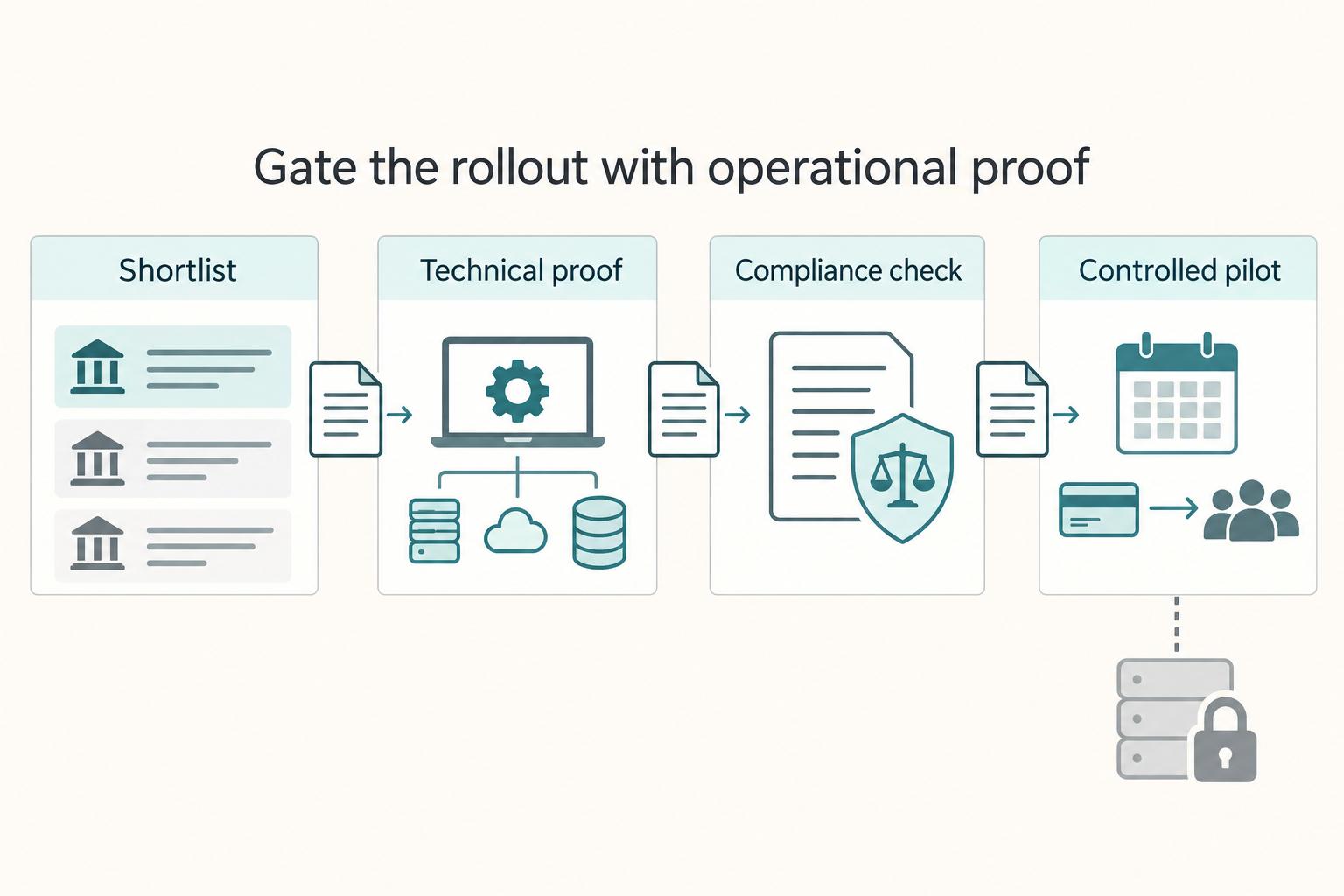
Do not move from shortlist to full migration in one jump. Use a four-step sequence: shortlist providers, run a technical proof, validate your compliance flow, then run a controlled payout pilot before any production cutover.
| Area | Launch controls to lock down |
|---|---|
| Engineering | idempotent payout-creation behavior; webhook failure/out-of-order handling; request-to-ledger traceability |
| Finance and ops | approval chain; exception queue owner; reconciliation cadence; tax-document workflow (W-8, W-9, Form 1099) where supported |
| Final gate | tested end-to-end recovery for failed payouts and investigation flow for unmatched funding/deposit entries |
Do not import a dated APY or signup offer into an operating decision. Use the current fee schedule and test service fees against your actual payment mix; a monthly fee waiver does not waive every transfer or processing fee.
| Stage | What to prove | Evidence before you advance |
|---|---|---|
| Shortlist | You have a proposed implementation plan, available sample/source data and labelled data gaps | Named owners, target use case, sample exports and proposed scope; open questions have owners for technical and compliance proof |
| Technical proof | Engineering can inspect real integration surfaces | API docs, sample payloads, and the provider's listed endpoints/webhooks |
| Compliance validation | Your onboarding flow captures required information | The provider's mandatory-information list, interruption test cases, and escalation ownership |
| Controlled pilot | Finance and ops can resolve exceptions and reconcile from pilot data | Small live batch, payout status history, failed-payout recovery steps, unmatched-entry investigation steps, and trained operators |
For engineering, set explicit internal launch controls: idempotent payout-creation behavior, webhook failure/out-of-order handling, and request-to-ledger traceability. Public onboarding docs can show which endpoints and webhooks to integrate, but they usually do not define your production recovery model.
For finance and ops, lock down the operating checklist before launch: approval chain, exception queue owner, reconciliation cadence, and tax-document workflow (W-8, W-9, Form 1099) where supported.
Final gate: no production launch until you have tested end-to-end recovery for failed payouts and investigation flow for unmatched funding/deposit entries.
Related: The Best Multi-Currency Accounts for Digital Nomads and Freelancers.
Failure modes and red flags during selection#
Treat unclear operational and compliance answers as a stop signal, not a minor documentation issue.
| Red flag | What is missing | Likely result |
|---|---|---|
| strong claims, weak operating detail | how payout failures are handled and what your team can use for investigation and reconciliation | painful exception handling later |
| "digital bank" used without a precise model | what is being offered and who owns support and compliance review when funds are delayed | ownership gaps usually show up in production |
| compliance language is generic | how KYC, AML, and CDD controls affect real operations | more holds, escalations, and unpredictability |
- Red flag 1: strong claims, weak operating detail. Require a written failure-handling flow and usable investigation and reconciliation records. Run a returned-payment case before rollout rather than estimating reliability from a marketing claim.
- Red flag 2: "digital bank" is used without a precise model. Require a plain statement of what is being offered (bank account, fintech layer, or a combined setup) and who owns support and compliance review when funds are delayed. If that remains unclear across sales, docs, and onboarding, ownership gaps usually show up in production.
- Red flag 3: compliance language is generic. Require the provider’s eligibility rules and the exact documents, review steps and escalation route for your program. A stated KYC or AML capability does not describe every hold or your team’s remaining responsibilities.
Conclusion#
The right choice is not the account with the flashiest APY, bonus, or "digital bank" label. It is the option that gives you operational fitness, compliance clarity, and reconciliation confidence when issues need to be explained to finance.
Concrete features can narrow the shortlist: free standard ACH on Bluevine Standard, Relay’s plan-based controls, Chase’s documented payment states and Found’s contractor tools. Check each account’s entity and program restrictions first, then price the exact service and test the returned-payment and export path. A low monthly fee alone does not resolve those choices.
Your next move should be simple and disciplined. Build a shortlist of the few options that match your operating model, then run the same verification pass on each one. Keep two columns throughout the process: what is publicly known, and what still needs proof from docs, sales, or a sandbox. That one habit prevents a lot of false confidence.
A practical selection flow looks like this:
- Start with your real use case, not the marketing category. If you mainly need business and personal fund separation, basic account criteria may be enough. If you need more complex payout workflows with exceptions, choose for traceability and controls first.
- Require proof before commitment. Ask for a sample event payload, written status mapping from request to final state, sandbox evidence, and a reconciliation export finance can test.
- Make the final decision scenario by scenario. One approved business account may fit a small program paying its own contractors. Higher volume, cross-border routes or holding customer funds requires additional service and program evidence.
The checkpoint that matters most is simple: can your team trace one failed payout end to end without guessing? If the provider cannot show retry behavior, duplicate protection, or how a returned payment appears in exports, you do not have enough proof yet. That is a failure mode a comparison page alone will not help you avoid.
If you are evaluating Gruv, use sales conversations for what they are good at: confirming market and program coverage, compliance scope, and whether your use case fits. Then move immediately to documents and a controlled pilot. Validate the status model, test failed payout recovery, and review reconciliation outputs before any full rollout.
Frequently Asked Questions
What counts as a digital bank for freelancers, and what is just a banking feature inside a larger platform?
Business checking and non-bank accounts can both appear in digital-bank lists. Bluevine, Relay, Found and Lili use bank partners. Under its U.S. Business agreement, Wise US Inc. provides money-transmission services and a Wise Business Account is not a bank account; receiving details refer to an account held by Wise or an affiliate. Check the legal entity and funds protection applicable to the exact product.
Do freelancers and gig workers always need a dedicated business checking account?
Use an account whose terms permit business activity and whose owner matches the business you are paying for. Personal/business separation helps records, but low payment volume does not override a provider’s use restrictions. For a platform, first distinguish paying your own contractors from handling customer money: Relay permits only eligible U.S. business entities with U.S. operating presence and excludes MSBs, including money transmitters, on every plan.
For platform teams, what should matter more than APY and signup bonuses?
Prioritize the ability to trace payments and close exceptions. APY means annual percentage yield and can change; bonuses have their own conditions. Neither replaces approved program scope, clear payment states and exports that finance can reconcile.
Which providers offer concrete business-payment features to investigate?
Bluevine offers standard ACH; Relay offers accounting integrations and paid-plan batch vendor payments; Chase documents vendor/employee ACH statuses; Amex provides several business-payment methods; Found adds contractor tools; Lili offers ACH and integrations. These are U.S. account examples with the conditions in the comparison table. Confirm program approval and test failures and exports on the selected service before launch.
How should we compare Bluevine, Relay, Chase Business, and American Express Business Checking without vendor bias?
Apply the same tests to all four: entity and funds-flow permission, exact service fees, returned-payment records and an export matched to an internal payout ID. Relay excludes MSBs and escrow accounts; Chase’s published status list is a useful starting point for payment mapping. Ordinary business-payment support does not establish approval for holding customer funds.
What minimum proof should engineering require before integrating payouts and webhooks?
Ask for a sample event payload, a written status mapping from request to final state, sandbox evidence, and a reconciliation export that finance can test. Your checkpoint is simple: can one failed payout be traced end to end without guessing? If the provider cannot show retry behavior, duplicate protection, or how a returned payment appears in exports, pause the integration.
When should a team add Merchant of Record or Virtual Accounts instead of relying on one business bank account?
Add allocation tools when one account cannot clearly separate programs, counterparties or receipt flows. A virtual account identifier may help matching without changing legal ownership. Use a Merchant of Record only when its seller-of-record contract fits the sales and tax/dispute responsibilities you need covered. Obtain separate approval for customer-fund handling and the actual payout service; neither label alone authorizes money transmission.
Try a related tool
Researched and edited by the Gruv editorial team. Gruv builds cross-border billing, payouts, and finance-operations software for global businesses.
Sources
Includes 5 external sources outside the trusted-domain allowlist.
- irs.gov/businesses/small-businesses-self-employed/re...trusted
- stripe.com/resources/more/merchant-of-recordtrusted
- wise.com/us/legal/terms-of-use-businesstrusted
- americanexpress.com/en-us/business/bankingexternal
- americanexpress.com/content/dam/amex/en-us/business/business-blu...external
- bluevine.com/business-checkingexternal
- chase.com/business/banking/checking/business-complete-...external
- chase.com/business/banking/services/achexternal
Educational content only. Not legal, tax, or financial advice.
Related Posts
Multicurrency Business Accounts for UK Freelancers and Small Companies
A multicurrency account can let a freelance business receive foreign client payments, keep the original currency and convert only the portion needed for local bills. The important choice is the exact product and market. A personal travel account, a UK business account and a US business edition can share a brand while having different eligibility, fees and protections.

The Freelance Payment Penalty: A Modeled Audit of Platform Fees, FX Spreads, and Payout Delays
The money rarely disappears through a single, easy-to-spot fee. The real loss is stacked. A marketplace takes its commission, a processor adds a charge for international cards, a bank or payment company converts the currency at a spread, a platform holds the funds before release, and a wire sheds a little to intermediaries on the way in. Each layer looks defensible on its own, but the worker feels the combined result as a smaller deposit and a later payday.

How to Respond to a Subpoena for Business Records
Move fast, but do not produce records on instinct. If you need to **respond to a subpoena for business records**, your immediate job is to control deadlines, preserve records, and make any later production defensible.