
Quick Answer
Choose the model with higher risk-adjusted return, not the lowest rate. For agency vs freelancer hiring ROI, freelancers usually win on narrow, well-owned tasks, while agencies often win when cross-functional coordination, compliance ownership, and rollout continuity drive outcomes. Compare both options with the same TCE inputs, then pressure-test each bidder on API quality, webhook failure handling, and ledger reconciliation evidence before signing.
There is no universal winner here#
There is no universal winner here. This guide helps platform founders and market operators make an agency vs freelancer hiring ROI decision based on risk-adjusted return, not the cheapest rate card or the most polished pitch.
That matters because this choice can affect more than vendor spend. It can change team structure, management load, delivery risk, and how much operational drag you absorb during execution. A lower day rate can still be the worse commercial outcome if it creates coordination gaps, rework, or fragile ownership when launch timing matters.
The scope here is narrow on purpose. We are looking at cross-border build and go-to-market work, especially where country rollout, compliance gates, and operational reliability shape payback. If your work includes country-specific rollout complexity and compliance requirements, this stops being a simple buy-rate comparison. In those cases, compliance is not a detail you sort out later. It is often a hard constraint on execution.
So the practical question is not "agency or freelancer?" in the abstract. It is: which model gives you the better return once you account for delivery probability, internal oversight, and the cost of getting blocked mid-launch. If your project is tightly scoped and well owned in-house, a specialist freelancer may produce better economics. If success depends on coordinated execution across product, operations, and compliance, paying more up front may still be the rational choice.
As you read, pressure-test each option against operator realities rather than surface claims. Ask who owns the critical path, who handles handoffs, and what happens if a country-specific requirement stalls progress. A useful checkpoint is whether a bidder can explain the actual approval points, escalation path, and evidence they would produce when something slips. If they cannot make that concrete early, the quote may be understating your real Total Cost of Engagement.
One caveat up front. Public comparisons are directionally useful, but they are not a shared benchmark base you can treat as settled truth across industries. Current guidance frames this choice as context-dependent, and that is the right stance. Neither model is always better, and available guidance does not establish a single cross-industry answer. The sections that follow are meant to give you a decision-ready way to compare tradeoffs with more operational honesty than "freelancers are cheaper" or "agencies are safer."
At-a-glance comparison table for hiring ROI decisions#
For most hiring ROI decisions, hourly rate alone is not enough. Compare total engagement cost, continuity risk, technical reliability, and compliance readiness side by side before you decide.
| Criteria | Freelancer Model | Agency Model |
|---|---|---|
| Total Cost of Engagement (TCE) | Lower sticker cost can work well when scope is narrow and your team can manage coordination directly. | Higher upfront cost can be worth it when it reduces rework, handoff loss, and launch delays across multiple functions. |
| Delivery speed | Often fast to start on tightly defined work. | Often steadier once work requires cross-functional coordination. |
| Governance overhead | Requires closer internal ownership, review discipline, and clearer acceptance criteria. | Provides more built-in coordination, but still needs one accountable internal owner. |
| Resilience against Single Point of Failure | Higher continuity risk if one person becomes unavailable. | Better continuity when contributors can be replaced without stopping delivery. |
| API integration quality | Strong fit for bounded integrations when you can validate implementation quality directly. | Stronger fit when integration depends on QA, partner coordination, and rollout support. |
| Webhooks reliability | Viable if asynchronous events, response handling, retries, and duplicate-event behavior are designed up front. | Often stronger when incident ownership and cross-team response are already structured. |
| Ledger traceability for finance and ops | Risky if implementation stops at posting data without a reconciliation process. | Better fit when reconciliation, exception handling, and audit trail ownership must stay coordinated. |
| KYC support by market | Works when requirements are already defined internally. | Better when KYC requirements vary by market and need coordinated implementation. |
| KYB and beneficial ownership readiness | Works only if legal-entity verification flows are already mapped and owned in-house. | Better when beneficial ownership collection, review, and escalation must be handled across markets. |
| AML support needs | Works for limited implementation tasks but can fragment when exceptions grow. | Better when monitoring, case routing, and compliance ownership must stay joined up. |
| VAT validation support | Works when VAT checks are straightforward and process ownership is clear. For EU flows, confirm who runs VIES checks and records valid/invalid outcomes. | Better when VAT validation sits inside broader multi-market onboarding and tax operations. |
| Best fit by stage | Best fit for pilots with narrow scope and strong internal control; can also fit focused scale optimization if continuity risk is covered. | Best fit for multi-country rollout and scale optimization where coordination load and compliance variation are high. |
Use this table as a screening tool, then verify execution detail. Ask each bidder to show an API sample, explain webhook failure handling, and describe ledger reconciliation in practice. For reliability, ask for service-specific SLOs instead of assuming a universal benchmark.
Related: Hiring a Collection Agency vs. Going to Court: A Comparison.
Calculate ROI with TCE before you pick a hiring model#
Treat ROI as a risk-adjusted outcome decision, not a day-rate comparison. Compare expected value delivered against Total Cost of Engagement (TCE), then divide by TCE; the option with the better risk-adjusted return is usually the better business decision.
Use the same five TCE inputs for both bids every time:
- Vendor spend
- Internal management time
- Cost of delay from slower value realization
- Rework cost when outputs fail acceptance
- Expected technical debt cleanup cost from short-term implementation choices
Build the comparison around expected outcomes#
Keep the target business outcome identical across bids. Then estimate each model's probability of delivering on time and at acceptable quality, and compare risk-adjusted ROI, not just invoice size.
- Expected ROI: expected business value after delivery-risk discount
- TCE: vendor spend + internal management time + delay cost + rework cost + expected technical debt cleanup
- Decision rule: pick the model with stronger risk-adjusted return, not the lower sticker price
A freelancer can cost less but require more client oversight; an agency can cost more upfront but absorb more coordination through project/account management.
Compare in the right order#
- Define scope tightly. List deliverables, acceptance criteria, dependencies, and out-of-scope items; explicitly name API, webhook, and reconciliation work when relevant.
- Estimate risk-adjusted delivery probability. Judge likelihood of on-time delivery with usable quality.
- Model downside scenarios. Price the failure cases that hurt most: launch delay, integration rework, reconciliation gaps, or handoff failure.
- Compare outcomes under risk, not averages. If one option only wins when nothing goes wrong, treat it as fragile.
Verify before you sign#
Require evidence, not generic promises:
| Evidence item | What it should show |
|---|---|
| API deliverable sample | OpenAPI spec (or equivalent) showing endpoints, auth assumptions, payloads, and error handling. |
| Webhook incident handling sample | Named incident owner, escalation path, retry/duplicate-event handling, and undelivered-event recovery procedure. |
| Ledger reconciliation sample | How they compare two record sets, identify mismatches, and resolve exceptions. |
A few details matter when you review each item:
- API deliverable sample: This makes the contract more auditable, but it does not by itself prove production reliability.
- Webhook incident handling sample: Check that recovery windows are bounded. Automatic retries can run only for a limited period, and historical event retrieval is also time-limited.
- Ledger reconciliation sample: Look for specific mismatch and exception steps, not just high-level process language.
If coordination load is higher than your team can absorb, an agency premium can still produce better ROI by reducing delay, rework, and execution fragility. If your team can tightly scope, review, and manage coordination without slipping other priorities, a freelancer model can still win.
For a step-by-step walkthrough, see Best Way for a German Agency to Pay a US-Based Freelancer.
Where the freelancer model creates better returns#
The freelancer model creates better returns when the scope is narrow, specialist, and short enough for your team to manage directly. It works best for discrete tasks with clear boundaries, a defined finish line, and one internal owner who can review, decide, and unblock quickly.
In that setup, a lower invoice can also mean lower Total Cost of Engagement, not just cheaper labor. Freelancers are typically structured to handle specific tasks or projects solo, so this model is strongest when you do not need full managed delivery. For contained integration fixes, defined API deliverables, or tightly scoped operational builds with limited cross-team orchestration, an agency layer can add cost without adding enough value.
The hard constraint is compliance ownership. Use this model only when you already control KYC, AML, VAT validation, and tax-document handling internally. You should already have clear owners for Customer Identification Program checks, ongoing AML due diligence, beneficial ownership verification for legal-entity customers where relevant, and required tax forms.
If onboarding still requires Form W-9 for a US contractor, Form W-8BEN for a foreign beneficial owner when requested by the payer or withholding agent, or Form 1099-NEC reporting logic, do not leave those steps undefined or shift them to a solo contributor.
Guardrails that make the model work#
If you choose a freelancer, put these controls in place from day one:
| Guardrail | What to put in place |
|---|---|
| Weekly acceptance criteria in writing | Define what is due, what evidence confirms it works, and what is out of scope. |
| Documented handoffs | Require updated specs, repo access, credential ownership, and short handoff notes for maintainability. |
| An explicit fallback plan | Name who steps in if the contractor becomes unavailable and what minimum artifacts are required to recover service. |
The main risk is a hidden Single Point of Failure. A solo specialist can be high value until critical knowledge, access, or unfinished work is not recoverable. If you cannot assign internal ownership, verify compliance inputs, and maintain a recovery path, the agency premium can be the lower-risk spend.
When the choice is really staffing model design, Unbundling the Agency helps separate staff augmentation from managed services.
Where the agency model earns the premium#
The agency premium is usually rational when your build depends on coordinated delivery across payments operations, compliance workflows, and multi-market rollout sequencing. In that scenario, ROI comes less from hourly rate and more from reducing rework, stalled launches, and cross-team failure points in Merchant of Record (MoR), Virtual Accounts, and batch payouts work.
A freelancer can still be the better fit for tightly bounded execution. But once scope includes legal payment responsibility, KYC/AML and tax-operational boundaries, and production reliability across teams, you are buying managed coordination as much as implementation.
MoR scope is a good example: the MoR is the legal entity responsible for processing customer payments, and that scope includes KYC, AML, and tax handling (such as sales tax, VAT, or GST). If those ownership boundaries are not designed and handed off clearly, go-live risk increases.
The same pattern appears in money movement operations. Virtual Accounts can support both receivables and payables, and batch payouts are built for high-volume execution, tracking, and reconciliation. At scale, value comes from pre-validation, exception handling, and reconciliation discipline, not just shipping an API integration.
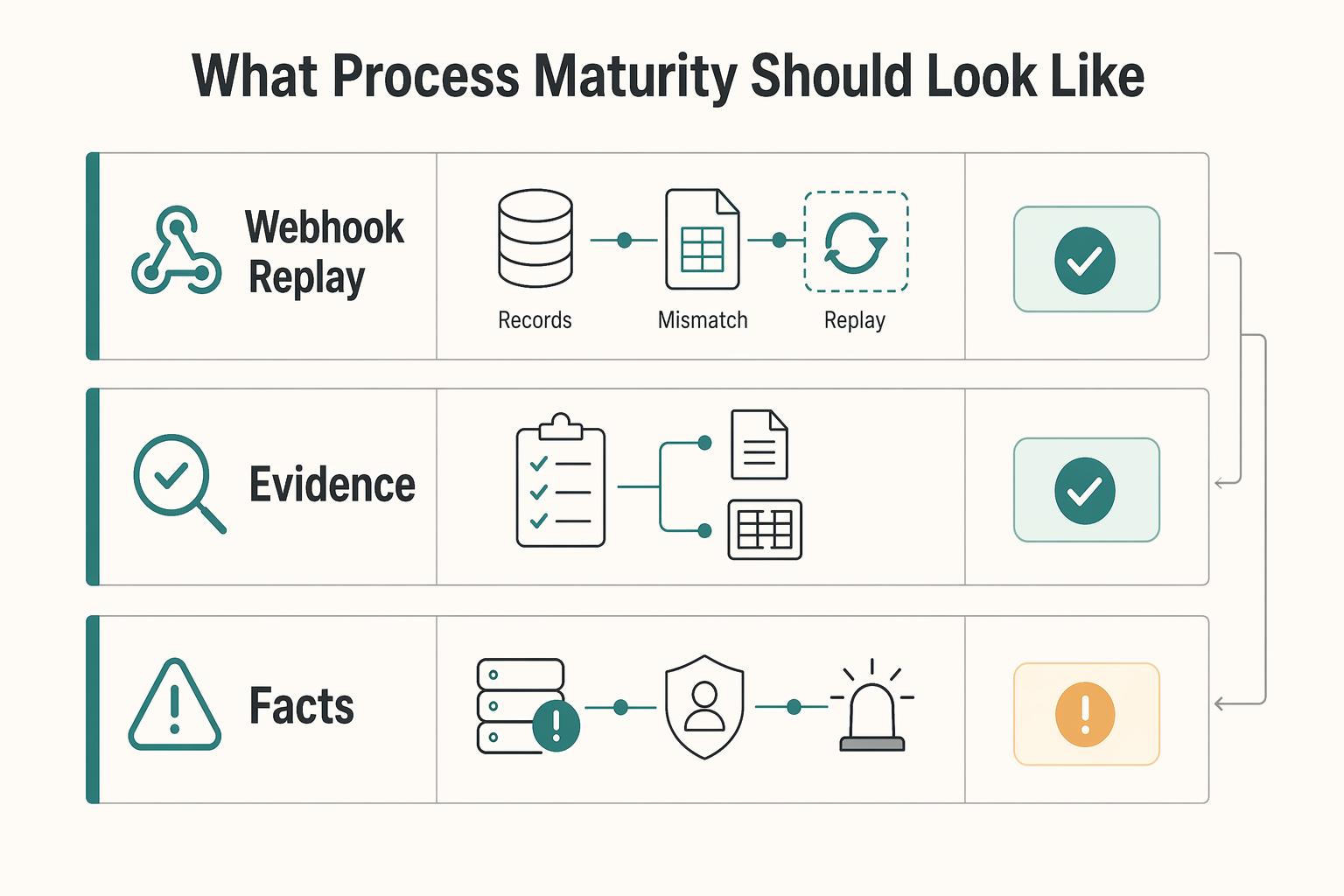
What process maturity should look like#
Do not pay a premium on brand alone. Ask for evidence that the team can absorb operational complexity:
| Process evidence | What it should show |
|---|---|
| API and webhook escalation path | Who triages, who sets severity, and who communicates status. |
| QA proof for webhook consumers | Handle duplicate delivery and out-of-order payload arrival. |
| Incident response evidence | A redacted runbook or post-incident record showing how incident impact is reduced. |
| Operational artifacts | A payout exception log and a launch checklist with compliance, finance ops, and engineering sign-off owners. |
If they cannot show how they test duplicates, manage payout exceptions, and escalate production failures, they have not earned the higher blended rate.
The tradeoff is straightforward: higher weekly cost can still deliver better ROI when the main risk is launch-window slippage and coordination failure, not isolated task execution. If your success depends on durable cross-functional execution, choose the agency model and verify process maturity before signing.
If you plan to grow from solo delivery into a team, The Agency Scaling Blueprint gives the contractor-hiring path.
Hidden costs competitors understate#
A lower quote is only cheaper if it does not shift coordination, compliance, and recovery work onto your team later. In real hiring ROI decisions, that is often where costs reverse.
The first hidden cost is fragmented ownership. A bid can look lean because the vendor only owns the build, while your team is left to connect product decisions, API integration, webhook behavior, tax-document collection, and launch signoff. Vague scope language drives change-order churn, and undocumented architecture or handoff decisions create technical debt that slows future changes.
| Hidden cost pattern | What it looks like early | What it becomes later | What to verify now |
|---|---|---|---|
| Fragmented ownership | "Client will handle coordination" | Rework, delays, invoice disputes | Named owner for API, webhooks, compliance handoffs |
| Change-order churn | Scope uses broad terms like "support as needed" | Extra fees for expected fixes and clarifications | Acceptance criteria, change approval path, written exclusions |
| Undocumented decisions | Knowledge lives in calls or one person's head | Technical debt and slower future changes | Decision log, repo documentation, handoff pack |
| Traceability gaps | No clear audit trail for money movement | Higher reconciliation effort and slower finance close | Sample ledger evidence, reconciliation report, event-to-entry trace |
Compliance drag is another quiet cost center. If cross-border payments or contractor payouts are involved, define who collects and validates tax and identity documents. Form W-8BEN is provided by a foreign beneficial owner to a withholding agent or payer, Form W-9 is used to provide a correct TIN for IRS reporting, and FBAR is filed on FinCEN Form 114 when aggregate foreign financial account value exceeds $10,000 at any point in the calendar year.
If a bidder cannot explain who owns W-8BEN or W-9 intake, who tracks potential FBAR exposure, or how beneficial ownership of legal entities is identified and verified where required under 31 CFR 1010.230, early savings can turn into manual cleanup and review delays.
Reliability risk is usually a single point of failure in practice: one person, one integration path, or one undocumented fix between you and stable money movement. When that dependency breaks, payouts and reconciliation can be disrupted. A practical check is to ask who can replay events, read the ledger trail, and resolve a payout exception without the original builder.
Red flags worth screening out before selection:
- Scope language that does not name ownership, signoff, or exclusions
- No traceability plan from webhook event to ledger entry and reconciliation output
- No sample audit-ready ledger evidence or redacted reconciliation pack
- No clear owner for beneficial ownership checks, W-8BEN, W-9, or FBAR-related handling
If a vendor says "we'll document it later," treat that as future rework in your cost model, not speed.
If the real gap is demand generation, How to Build a Client Acquisition System for Your Agency belongs before delivery-model expansion.
Decision checklist before you commit expansion resources#
Lock your operating context before you spend expansion budget. In most hiring ROI decisions, the outcome is driven more by coordination, compliance, and recovery risk than by hourly rate alone.
| Checkpoint | What to confirm | Why it changes the choice |
|---|---|---|
| Stage | Pilot vs. expansion | Narrow pilot scope can work with a Freelancer Model. Expansion increases handoffs, signoffs, and failure impact. |
| Market spread | Number of countries and level of variation | Verification requirements differ by country, so broader coverage raises operational complexity. |
| Product surface | Whether MoR, Virtual Accounts, or Payout Batches are in scope | MoR changes legal payment responsibility, and payout-batch flows change exception and reconciliation operations. |
| Recovery plan | Rollback path and termination steps | Third-party governance should cover the full lifecycle, including monitoring and termination. |
Require the same minimum evidence pack from every option: a dated delivery plan, a governance model with named owners, written compliance ownership for KYC/KYB/AML, and a rollback path. Confirm who owns country onboarding signoff, payout exception handling, and continuity if a key builder is unavailable.
Use a practical default rule, not an absolute. If market or regulatory variation is high, prioritize the Agency Model first; if scope is narrow and stable and your team already owns surrounding controls, prioritize the Freelancer Model first.
Set go/no-go on TCE plus risk, not quote alone. If the lower-cost option still leaves concentrated dependency, unclear compliance ownership, or no credible rollback path, treat it as a no-go.
For day-to-day operating cadence, Kanban vs. Scrum helps choose the workflow that matches agency risk.
First 90 days after selection#
In the first 90 days, prove two outcomes: your integration is reliable in production, and your projected ROI still holds once exceptions and rework are included. If either fails in the first production cycle, treat that as a decision point to augment or switch, not just extend the timeline.
Start with a hard scope lock at kickoff: event types, required fields, API milestones, and webhook ownership. Design for failure handling, not just happy-path demos. Undelivered live webhook events can be resent for up to three days, and missed events may need to be queried and replayed, so replay handling should be in scope from day one.
Then run integration milestones with clear operating controls. A single endpoint can handle multiple event types, but only if duplicate-event handling, logging, and response ownership are defined. Without that, one weak handler can disrupt payout or onboarding flows.
Move to controlled production only after reconciliation controls are working. Before expanding volume, confirm each payout batch ties back through payout reconciliation reporting and your ledger checks. Assign explicit owners for payout success monitoring, the exception queue, and, where available, compliance-gate pass rates such as KYC or KYB progression.
Run a three-month value review that is auditable, not activity-based. Compare actual versus forecast TCE with vendor fees, internal management time, incidents, and rework included. Then make a clean call:
- Keep the model when reliability is stable and variance is understood.
- Augment when delivery is acceptable but exception load or compliance ownership is still thin.
- Switch when missed events, reconciliation gaps, or concentrated operational risk remain unresolved.
Related reading: How to Calculate Client Lifetime Value (CLV) for Your Agency.
Conclusion#
The right answer is not the cheaper day rate. It is the option with the stronger risk-adjusted return for your actual operating context, once you count vendor spend, internal coordination time, delay risk, rework, and recovery cost. That is why this hiring ROI decision should be evaluated on total cost, not headline pricing.
If your scope is narrow, stable, and well owned internally, the freelancer model can still produce the better return. If the work crosses functions, countries, or compliance gates, the agency model can earn its premium by lowering coordination drag and reducing failure risk. A lower rate stops being a saving the moment your team is absorbing missed handoffs, unclear ownership, or a Single Point of Failure during rollout.
Your next practical step is simple: run the same total-cost checklist on both options before you sign. Ask each bidder for the evidence pack that proves they can deliver, not just the proposal that sounds cheaper.
- Delivery evidence: named owner, escalation path, backup coverage, sample handoff, and how API or webhook incidents are handled
- Compliance evidence: who owns KYC, KYB, AML, and any tax or VAT validation steps in each market
- Finance evidence: reconciliation example, ledger traceability, payout flow, and rollback path if a release fails
That verification step matters because legal and operational conditions differ by market. AML and CFT controls are built on a risk-based approach, not one universal checklist, so you should expect country-specific differences in what is required and how it is operated. VAT is also jurisdiction-dependent. In the EU, Member States set their own VAT rates within the common framework, with a standard rate no lower than 15% and, in some cases, reduced rates as low as 5%. If a bidder talks as if compliance or tax treatment is uniform across countries, treat that as a red flag.
One last operator check before implementation: confirm payment method support, payout currency support, and local payout coverage by country or region for your exact program. Do not assume a provider supports the same setup everywhere just because it works in one market. A failure mode to avoid is straightforward: the build is finished, but payouts, reconciliation, or onboarding stall because the target country or program variant is not actually supported.
The close is straightforward. Choose the model that protects business outcomes, not the one that merely looks cheaper on paper. And if you need help with payouts, compliance gates, and audit-ready money movement across markets, confirm coverage by market and program before you commit the implementation.
Use Business Process Mapping for a Small Agency That Runs Day to Day to document the handoffs that make the selected model measurable after launch.
Frequently Asked Questions
Is agency convenience worth the premium for cross-border hiring programs?
It can be, especially if your team is already thin and the work has to move across multiple workstreams at once. The premium can be rational when it cuts internal coordination time, which belongs in Total Cost of Engagement, not just vendor spend. Ask for the named delivery owner, escalation path, and backup coverage. If the agency cannot show who steps in when the lead is unavailable, you may be paying for convenience without much resilience.
Can multiple freelancers beat one agency on ROI in practice?
They can, especially when the scope is narrow and the boundaries are stable. Freelancers are generally better suited to targeted or smaller projects, while agencies are stronger when work has to scale across multiple workstreams. One common failure mode is fragmented ownership. Three lower rates can still cost more if your team is stitching together handoffs, rework, and missed dependencies.
What project scope usually tips ROI toward an agency?
When the job stops being one specialist task and becomes a coordinated delivery problem, the case for an agency often gets stronger. If you need design, build, QA, rollout sequencing, and ongoing support to happen together, the higher blended cost can still produce better return because it can reduce delay and recovery risk. If you cannot describe the work as one clear output with one clear owner, that is a sign the freelancer model may become expensive to manage.
When does a lower hourly rate stop being a lower Total Cost of Engagement (TCE)?
It stops the moment indirect costs become material. A total-cost view is useful here because it includes direct and indirect costs, which means management time, delay cost, rework, and recovery effort can count. In agency vs freelancer hiring ROI, the cheaper option is no longer cheaper if your team spends the savings on supervision, context transfer, or fixing preventable mistakes. Ask each bidder for a sample handoff, review cycle, and change-handling approach so you can price the hidden work before signing.
How should I account for Single Point of Failure risk in ROI calculations?
Treat Single Point of Failure as business-impact risk, not a vague technical concern. In practice, estimate two things: the probability of disruption and the cost of recovery, because both affect business value. If one person holds the critical context, credentials, or delivery history, add contingency cost to your model or pay for redundancy up front. A fast verification step is to ask who can take over quickly if the primary contact disappears.
What is still unknown in current agency vs freelancer ROI evidence?
There is still no universal benchmark that tells you one model always wins. ROI has no single cross-industry standard, and current evidence does not support fixed percentage advantages across every use case. The most reliable approach is to compare options inside the same scope, timeline, and risk assumptions, using the same TCE inputs for both.
Try a related tool
Researched and edited by the Gruv editorial team. Gruv builds cross-border billing, payouts, and finance-operations software for global businesses.
Sources
- cisa.gov/sites/default/files/publications/Incident-Re...trusted
- csrc.nist.gov/projects/incident-responsetrusted
- ecfr.gov/current/title-31/subtitle-B/chapter-X/part-1...trusted
- ecfr.gov/current/title-31/subtitle-B/chapter-X/part-1...trusted
- europa.eu/youreurope/business/taxation/vat/check-vat-n...trusted
- fdic.gov/news/financial-institution-letters/2023/fil2...trusted
- federalregister.gov/documents/2023/06/09/2023-12340/interagency-...trusted
- federalreserve.gov/frrs/regulations/section-1020220-customer-id...trusted
Educational content only. Not legal, tax, or financial advice.
Related Posts
Agency Scaling Blueprint for Hiring Your First Global Contractors
Scale after you harden what already works. Before you write a job description, lock down the parts of the business that usually break first under growth: contracts, cash, worker status, delivery documentation, and how work gets reviewed. This blueprint is about adding capacity without adding avoidable risk.

Collection Agency vs Small Claims for Freelancers
Do not pick the option that sounds toughest. Pick the one most likely to put money in your account with the least avoidable drag.
Choosing Between IT Staff Augmentation and Managed Services
Choosing an outsourcing model is a risk and reputation decision before it becomes a staffing decision. In [staff augmentation vs managed services](https://www.sparxitsolutions.com/blog/staff-augmentation-vs-managed-services), hourly rate often matters less than who controls delivery, who owns failures, and how disputes are settled in the contract.