
Quick Answer
Start by aligning contract terms and daily working methods around independent, project-based delivery, then send tax and compliance documents in the sequence finance actually reviews, and finish with EUR invoicing plus SEPA-capable receiving details. In this Germany-US workflow, check Scheinselbstständigkeit exposure before kickoff, keep identity data consistent across every file, and run a first-payment check on currency, remittance text, and net received. That order reduces onboarding resets and makes later invoices easier for AP to process.
Work in Three Stages: Contract, Compliance Documents, Then Payment Instructions#
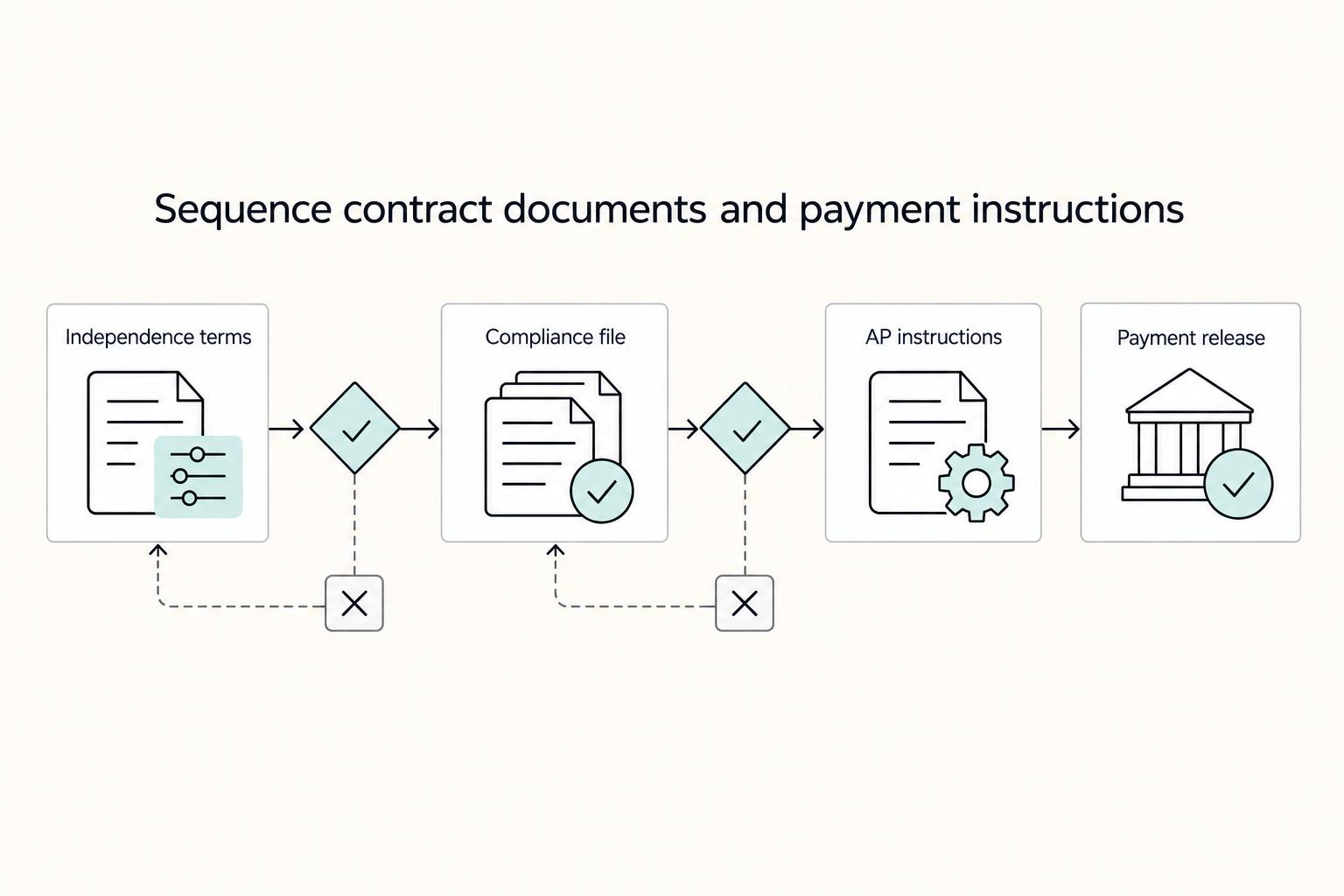
Use this order as a default: lock independence into the contract, send compliance documents in the sequence finance will actually use, then give AP payment instructions they can process without follow-up.
| Stage | Main task | Purpose |
|---|---|---|
| Stage 1 | Lock independence into the contract | Reduce Scheinselbstständigkeit risk |
| Stage 2 | Send compliance documents in the sequence finance will actually use | Prevent onboarding resets, withholding surprises, and first-invoice delays |
| Stage 3 | Give AP payment instructions they can process without follow-up | AP can process it without special interpretation and you can reconcile without guesswork |
Stage 1. Design the contract around independence risk#
Start by reducing Scheinselbstständigkeit risk in how the work will actually run, not just in how the relationship is labeled. If day-to-day practice conflicts with the contract, German status analysis can focus on the real setup.
| Contract point | What to check |
|---|---|
| Scope definition | Deliverables, milestones, acceptance criteria, and revision boundaries |
| Work control | You control methods, tools, and execution within the agreed outcomes |
| Multi-client freedom | State it clearly |
| Language to avoid | Fixed reporting-line behavior, instruction-heavy day control, or wording that makes you look like a permanent internal function |
| Liability boundaries | Errors, rework, confidentiality, and agreed responsibility limits |
That means the contract should not just sound independent on paper; it should give you a working structure you can actually follow once kickoff happens. If the written scope says you control execution, but the client then runs the engagement through employee-style supervision, fixed internal reporting behavior, or constant instruction-heavy check-ins, the file becomes harder to defend.
The cleanest setup is one where the contract, your kickoff notes, the SOW, and the later invoice line items all point to the same thing: a project-based service relationship built around outcomes. Before you sign, check the contract for these points:
- Define scope through deliverables, milestones, acceptance criteria, and revision boundaries.
- Confirm that you control how the work is performed, including methods, tools, and execution, within the agreed outcomes.
- State multi-client freedom clearly.
- Avoid employee-like language such as fixed reporting-line behavior, instruction-heavy day control, or wording that makes you look like a permanent internal function.
- Set business-to-business liability boundaries for errors, rework, confidentiality, and agreed responsibility limits.
Do not stop at the clause check. Read those points against the actual operating plan for the engagement. Ask yourself how work requests will arrive, who approves what, and how revisions are requested. Also ask whether the client expects you to behave like a temporary employee rather than an outside provider.
If the contract says the work is milestone-based, your delivery rhythm should look milestone-based. If the contract says revisions are limited, your project communication should not slide into open-ended internal support. If you preserve multi-client freedom in the agreement, avoid practical arrangements that suggest the client controls your full working availability.
Pressure-test the file before signature by comparing three items side by side:
- the contract language,
- the kickoff email or SOW summary,
- and the way the client says the work will be managed in practice.
When those three match, you reduce the chance of later cleanup. When they do not match, fix the mismatch before work starts. That is much easier than trying to explain it after invoices are already in process.
If the engagement is structurally close to employment, consider a Statusfeststellungsverfahren before kickoff, since DRV allows advance determination, and confirm current process timing before signing.
That escalation point matters most when the risk is structural rather than cosmetic. In that situation, changing a few words will not solve the problem. If exclusivity, full-time style availability, or a permanent-function setup is driving the relationship, treat it as a sign to pause. It is better to clarify the engagement path before the first deliverable than to discover later that the contract language never matched the real arrangement.
Stage 2. Send compliance in the order finance will use it#
The right documents can still create delays if they arrive out of sequence. Your goal here is to prevent onboarding resets, withholding surprises, and first-invoice delays.
Avoidable friction often starts because freelancers send a complete-looking packet in the wrong order. Finance may then have to stop and ask what the payment is for, which tax form applies, and whether treaty support exists. Only then do they revisit the invoice file. Even if every document eventually arrives, the review may restart from the top because the file was not built in the sequence the payer uses internally.
| What to send (order) | What to verify first | What this prevents |
|---|---|---|
| IRS form step, often discussed as W-8BEN | Confirm payer jurisdiction, withholding-agent role, and which IRS form matches your facts. W-8BEN is a foreign-status form, while W-9 is for U.S. persons. | Wrong-form loops and treaty-claim confusion |
| Contract + scope summary | Confirm transaction type and income characterization | Misclassification in internal review |
| Treaty-position support (if needed) | Confirm article-level applicability and required documentation | Late disputes over reduced-rate eligibility |
| German withholding-relief path (§50c EStG) where relevant to §50a exposure | Confirm whether the payment category is in scope and whether pre-payment exemption is available | First invoice being reduced and escalated after issue |
In practice, verify the logic of the file before you upload or email anything. Start with the payer's process: who is reviewing the vendor file, which tax form they expect first, and whether they want contract documents before they will discuss payment treatment. Then send the documents in that sequence, with names and identity fields aligned across everything.
A small mismatch in legal name, address formatting, or entity details can create the kind of low-level confusion that turns into a payment hold later. Keep the scope summary short and operational. It should help finance understand what the client is buying without forcing them to read the full contract line by line.
If your contract is broad, the summary should narrow the file back to the actual transaction type and the income characterization the payer is reviewing. That is often enough to prevent internal routing mistakes.
If treaty-position support is needed, do not leave it as an implied assumption. Pair it with the contract and scope summary so the reviewer can see the same story from the start. They should be able to tell who the parties are, what service is being provided, and why the supporting tax position belongs with that transaction. That does not guarantee approval, but it does reduce the chance that treaty support arrives too late, after the invoice has already been coded another way.
The same logic applies when §50a exposure might be relevant and a §50c EStG path needs to be considered. The problem is often not just the rule itself but the timing. If the first invoice is issued before the client understands whether pre-payment exemption is available, the matter may escalate after the invoice is already in circulation. That is exactly the kind of cleanup this stage is meant to avoid.
Track form expiration dates in your client record and confirm current validity windows before you sign. For example, W-8BEN generally runs from signature through the last day of the third succeeding calendar year unless circumstances change. Do not rely on memory here. Keep one client record that shows what you sent, when you sent it, what version was submitted, and what still needs renewal or confirmation.
If a form expires or a packet is updated, you want a simple trail that lets you resend the exact current file without rebuilding it from scratch. That is especially useful when the same client has different reviewers for onboarding, tax, and AP.
Stage 3. Make payment execution boring and auditable#
At this stage, aim for a setup AP can run cleanly and you can reconcile without guesswork. If the client budgets in EUR, many teams prefer invoicing in EUR and sharing SEPA-compatible receiving details so matching stays simple. SEPA standards are designed to align domestic and cross-border euro payments across SEPA countries. For VAT handling, confirm current reverse-charge applicability, wording, and required identifiers for your transaction type before the first invoice goes out.
The goal in this stage is not sophistication. It is repeatability. A payment setup works when AP can process it without special interpretation and when you can tell from the invoice and remittance alone whether it landed correctly. If the client has to ask which route to use, whether fees may be deducted, or how to reference the invoice, the setup is not finished yet.
| Payment setup | Fit | Friction risk | Fee transparency | Reconciliation clarity |
|---|---|---|---|---|
| EUR invoice + SEPA-capable receiving details | Common choice for many German B2B flows | Often lower when AP can send SEPA normally | Often clearer on transfer path | Often higher when invoice and settlement currency align |
| EUR invoice + non-SEPA international wire route | Useful fallback if SEPA details are unavailable | Can be higher due to routing and intermediary questions | Can be lower when intermediary deductions vary | Can be lower if the amount received differs from the invoice total |
| USD invoice + client-side FX conversion | Use when the client requires USD settlement | Can be higher due to FX approval and process choices | Often less transparent to you | Often lower when settlement does not map cleanly to EUR budgeting |
If you select the EUR and SEPA-capable route, make the instructions complete enough that AP can lift them directly into the payment file. That usually means beneficiary details, account details, and a remittance-reference format that matches your invoice numbering and internal reconciliation. The less translation AP has to do, the more likely you are to avoid a partial payment, a formatting error, or a remittance reference that does not map cleanly back to the invoice.
If SEPA details are not available and the client will use an international wire route, confirm the routing path and fee handling before the first invoice is approved. The issue is not just whether the payment can be sent. It is whether the amount you receive will match the invoice total closely enough for clear reconciliation. If intermediary deductions may change the net amount received, note that early and make sure the client understands how the invoice should be matched.
If the client insists on USD settlement while budgeting in EUR, expect additional review steps in many finance teams. It can still work, but it should be an intentional choice tied to the client's process rather than a default.
Once the route is clear, keep one repeatable execution pack for each new German client:
- Contract packet: deliverables, independence signals, multi-client freedom, liability boundaries, and a control or integration risk check.
- Compliance packet: verified IRS form route, treaty support where needed, and any §50a or §50c documentation tied to the income type.
- Invoice packet: EUR invoice when selected, legal entity details, service period, sequential invoice number, and verified tax wording and IDs.
- Payment instruction packet: beneficiary details, SEPA-capable account details, remittance-reference format, and invoice-matching instructions for AP.
Treat these as version-controlled working files, not one-off attachments. When the first invoice is issued, you should already know which packet was sent, whether the client confirmed receipt, and whether AP accepted the payment instructions in the exact format provided. That way, later invoices become repetition rather than rediscovery.
A simple first-payment check also saves time. After the first live invoice, verify what AP actually filed: the currency, the payment route, the remittance text, and whether the received amount matched the invoice as expected. If anything drifted, update the payment instruction packet before invoice two rather than letting the same issue repeat.
If you want a deeper dive, read Separating Business and Personal Finances: An Important Step for LLCs. Before you send your onboarding packet, prepare the tax form once with the W-8 form generator.
You're Not a Vendor; You're a Global Partner#
This is less about image than execution. After the three stages, your job is to make the client's checks easy to verify. You show partner-level execution when you own the scope, hand off compliance as a complete file, and give AP payment instructions they can use and move on from.
- Own the scope
In your kickoff note, restate deliverables, timeline, approval point, and what is out of scope. Keep that language aligned across your contract, SOW, and invoice line items so the work stays clearly project-based and easier to reconcile. If the client later asks for something outside that structure, route it back through scope and acceptance rather than letting the operating model drift.
- Hand off compliance as one complete packet
Send the tax form that matches your status before finance asks. If you are a U.S. person, use Form W-9 rather than W-8BEN, and keep your legal name and address consistent across the contract, tax form, and invoice. For VAT handling, when the customer is liable under Article 196, include a reverse-charge reference or the applicable provision on the invoice. The point is not to bury finance in paperwork. It is to give them one coherent file they can review without coming back for missing basics.
- Use payment instructions AP can execute once
If the client can pay by SEPA Credit Transfer, provide EUR instructions with the exact IBAN and the remittance reference format. SEPA credit transfers are euro-only and available for domestic and cross-border European payments, and processing may be one banking business day. Within the EEA, IBAN is sufficient, while outside the EEA a BIC is also required. Once AP confirms the route, keep the same formatting on later invoices so they do not have to reinterpret your instructions every cycle.
Keep this partner checklist in kickoff emails and invoice follow-ups:
- Confirm deliverables and the acceptance point in writing.
- Attach the correct tax form and keep identity fields identical everywhere.
- Include VAT details and a reverse-charge reference where applicable.
- Send EUR payment instructions, IBAN, and the exact remittance text.
- Ask AP to confirm the first payment format they filed.
This is the practical difference between reactive handling and early setup: fewer avoidable holds, fewer invoice disputes, and more reliable cash flow over time.
Related: The Best Way for an Australian Agency to Pay a US-Based Contractor.
Before you finalize terms with the agency, sanity-check your transfer path with the payment fee comparison to spot avoidable fee drag.
Frequently Asked Questions
How do I avoid German withholding tax as a US freelancer?
Treat this as a client-specific compliance question, not a one-size-fits-all rule. Confirm early which onboarding documents and payment-classification details the client needs before your first invoice, and provide a complete file so their review can proceed smoothly. This can reduce process delays, but it does not by itself guarantee any specific withholding outcome. If withholding treatment is material, get qualified tax advice for your exact facts before relying on assumptions.
What key clauses must be in my contract with a German client?
Make your independence explicit in both the contract language and the day-to-day working setup. Define deliverables clearly, keep control over how you execute the work, and preserve room for multiple clients and autonomous work arrangements. This helps reduce Scheinselbstständigkeit risk, which is treated as a real compliance and penalty area. Also keep scope, acceptance points, and revision boundaries clear enough to support an independent project structure in practice. Clear scope language supports commercial clarity while reinforcing the contractor relationship.
Do I need to charge VAT to a German client?
VAT treatment can depend on transaction details, so confirm invoice tax treatment with the client’s finance team (and local tax advice where needed) before sending your first live invoice. Use a consistent template with the wording and fields finance requires, and re-check format requirements as Germany moves toward mandatory B2B electronic invoicing by 2028. The practical point is consistency. Once finance confirms the expected treatment and format, reuse that template instead of rebuilding each invoice from scratch.
What is the best way to receive Euros from Germany to the US?
For EU contractor payments, SEPA credit transfers are commonly recommended to minimize costs and processing times. If the client can send a SEPA payment to EUR receiving details you control, that is often the simplest path for both AP and reconciliation. If SEPA is not available, confirm routing, fee handling, and remittance-reference format in writing before scaling up. The key test is whether funds arrive predictably and can be matched quickly to the invoice. A route that works operationally and keeps remittance details clear usually reduces follow-up with AP.
What is the purpose of the W-8BEN form for a German client?
This guide does not establish a specific German rule that a US freelancer must submit W-8BEN. Treat this as a client-onboarding requirement: ask the client’s finance team which forms they require and verify tax implications with qualified advice. If the requested form is W-8BEN, use How to Fill Out Form W-8BEN for a Foreign Freelancer as a completion guide, and keep identity details consistent across your onboarding documents.
Should I have my contract reviewed by a lawyer?
Because misclassification carries penalty risk in Germany, specialist review is prudent whenever the engagement starts to look employment-like or classification is unclear. If that risk is present, pause before signature and review What to Do If You've Been Misclassified as an Independent Contractor. A practical rule is to resolve classification and contract-structure risk before the deal goes live, rather than trying to fix it after onboarding.
Try a related tool
Researched and edited by the Gruv editorial team. Gruv builds cross-border billing, payouts, and finance-operations software for global businesses.
Sources
Includes 2 external sources outside the trusted-domain allowlist.
- ecb.europa.eu/paym/retail/sepa/html/index.en.htmltrusted
- irs.gov/individuals/international-taxpayers/claiming...trusted
- irs.gov/instructions/iw8bentrusted
- press.armywarcollege.edu/cgi/viewcontent.cgitrusted
- sec.gov/Archives/edgar/data/1619087/0001047469180047...trusted
- taxation-customs.ec.europa.eu/taxation/vat/vat-directive/persons-liable-va...trusted
- bmas.de/DE/Soziales/Sozialversicherung/Sozialversich...external
- bundesbank.de/en/tasks/payment-systems/services/sepa/conte...external
Educational content only. Not legal, tax, or financial advice.
Related Posts

How LLC Owners Separate Business and Personal Finances
For an LLC, separating business and personal money is best treated as a weekly habit, not a one-time bank setup. It keeps records cleaner, cuts month-end cleanup, and creates clearer boundaries as the company grows.

What to Do If You've Been Misclassified as an Independent Contractor
Treat this as a protection problem first, not a label debate. If your work was treated as an independent contractor arrangement even though the relationship functioned differently, your first goal is to protect pay, rights, and records while you choose the least risky escalation path. You can do that without making accusations on day one, which often keeps communication open while you document what happened.
How to Fill Out Form W-8BEN for a Foreign Freelancer
For many global professionals, Form W-8BEN is the first real point of friction in a U.S. client relationship. It often gets treated like routine paperwork. That is the wrong frame. If you run a business of one, this form is an early operating decision that affects cash flow, onboarding speed, and how much confidence a client has in your setup.