
Quick Answer
Choose IT staff augmentation when you can direct daily execution and need targeted specialist capacity; choose managed services when you want a provider to own delivery outcomes under SLA terms. Before pricing, lock four items in writing: service boundary, named owner map, escalation path, and exit criteria. Then pressure-test bids in a best-month and worst-month scenario so hidden management load, rework, and transition risk are visible.
How to Decide Between Staff Augmentation and Managed Services#
Choosing an outsourcing model is a risk and reputation decision before it becomes a staffing decision. In staff augmentation vs managed services, hourly rate often matters less than who controls delivery, who owns failures, and how disputes are settled in the contract.
By the end, you should be able to choose a model in one pass, then pressure-test it with a contract and operations checklist. If you need direct task control, augmentation can fit. If you need an MSP to own the outcome, managed services can fit better. Problems usually start when scope-change approval, work acceptance, and incident communication are not clearly assigned.
| Decision lens | IT staff augmentation | Managed services |
|---|---|---|
| Control of daily execution | Your team typically assigns tasks and priorities | Provider typically runs execution to agreed service targets |
| Accountability for outcomes | Often shared, easy to blur without named owners | Often concentrated in provider contract commitments |
| Internal oversight load | Often higher manager attention each week | Often lower daily supervision, higher vendor governance |
| Typical failure mode | Good talent, weak ownership, missed handoffs | Vague service boundary, disputes on what is included |
Success here is practical: fewer delivery surprises, clearer internal oversight, stronger client trust, and a cleaner compliance posture as you scale. Before you compare proposals, name one owner each for prioritization, acceptance, escalation, and client updates. If any line has no owner, pause the buying decision. That pause can prevent later renegotiation, because ownership gaps are usually easier to fix before legal review than after kickoff.
For EU-facing work, keep privacy and tax on separate tracks: GDPR needs its own review, while VAT operations rely on concrete mechanisms you can verify on official europa.eu pages. One Stop Shop lets a taxable person register in one Member State, and EU cross-border B2C VAT e-commerce rules include a EUR 10,000 threshold. The cross-border SME scheme includes a EUR 100,000 Union turnover cap and a process target of 35 working days after prior notification receipt. For complex cross-border VAT treatment, a VAT Cross-border Ruling request can help reduce ambiguity before launch.
Use the rest of this article as a pressure test, not a theory exercise. The next sections translate control versus accountability into SLA language, escalation design, and exit terms you can enforce before signature.
At-a-Glance Comparison Table#
Decide ownership first: who directs daily execution and who is accountable for results.
| Criteria | IT staff augmentation | Managed services |
|---|---|---|
| Delivery control | You direct day-to-day work, and external specialists report to your leads. | The provider runs delivery for the agreed scope and goals. |
| Accountability | You retain final outcome accountability, so ownership can blur unless roles are explicit. | Accountability for agreed results is concentrated with the provider under contract/SLA terms. |
| Best time horizon | Usually a fit when you want added specialists inside your existing team model. | Usually a fit when you want an outsourced function with provider-run delivery. |
| Hidden costs | Depends on ownership clarity and internal coordination discipline. | Depends on contract quality and vendor governance discipline. |
| Transition difficulty | Depends on role clarity, documentation, and handoff planning. | Depends on how clearly transition terms are defined in the agreement. |
| Service boundary clarity | Needs explicit role and responsibility boundaries to avoid ambiguity. | Needs explicit in-scope and out-of-scope boundaries. |
| Escalation path | Follows your internal management chain unless otherwise defined. | Should be defined in contract with clear response ownership. |
| SLA enforceability | Usually less central to outcome accountability because you retain final project ownership. | Central enforcement mechanism because outcomes are tied to SLA expectations. |
| Exit criteria | Should be defined, even when engagement terms are lighter. | Should be explicit because the provider owns delivery responsibility. |
If you need outcome ownership, lean toward managed services. If you need directional control and niche skills, lean toward staff augmentation. If your team is stretched and cannot support daily direction, treat that as a selection signal before you compare pricing.
Start With the Outcome You Need#
Start by naming what you are actually buying: people you direct, or an outcome a provider owns. If you need to fill a specific skill gap or add capacity to hit a deadline, staff augmentation is often a cleaner fit. If you need to hand off an entire function with defined service goals, managed services is often the better starting point.
| Outcome element | What to define |
|---|---|
| Scope | Define the exact service boundary. |
| Owner | Name one internal owner for prioritization and quality, plus one provider-side owner. |
| Success metric | Set clear targets and review cadence. |
| Failure consequence | State the business impact if targets are missed. |
That choice sets accountability immediately. With augmentation, specialists join your team under your direction, and final outcome accountability stays with you. With managed services, you hand off a function and review performance against agreed targets, typically through an SLA.
Before pricing discussions, write the outcome statement in this format:
- Scope and exact service boundary.
- One internal owner for prioritization and quality, plus one provider-side owner.
- Success metrics and review cadence.
- The business impact if targets are missed.
Practical rule: if you have strong internal leadership and need to close a specific skill or capacity gap, start with staff augmentation. If you want a partner to own delivery of an ongoing service against defined targets, evaluate managed services first.
One caveat: if you cannot name an internal owner for quality and prioritization, augmentation is harder to run well. Treat that ownership gap as an internal management issue first, then revisit vendor selection.
Build an Accountability Matrix Before Pricing#
Map accountability before you compare rates. Starting with pricing can hide the bigger risk: who owns delivery quality, who handles incidents, and who approves changes under pressure.
| Matrix row | What to define |
|---|---|
| Detection | Who identifies issues, where they are logged, and who confirms severity. |
| Triage | Who sets priority, coordinates teams, and decides escalation. |
| Remediation | Who executes the fix, approves risk tradeoffs, and signs off recovery. |
| Stakeholder communication | Who sends updates, through which channel, and on what cadence. |
| Post-incident review | Who leads the review, assigns corrective actions, and maintains the audit trail. |
Use an accountability matrix as a deal gate. Put an internal hold on signature until each high-impact activity has a clearly assigned owner, with backup coverage where appropriate.
Before commercial review, define:
- Detection and severity confirmation.
- Triage, prioritization, and escalation.
- Remediation, risk tradeoffs, and recovery sign-off.
- Stakeholder communication channels and cadence.
- Post-incident review ownership, corrective actions, and audit trail.
Failure patterns can differ by model. In staff augmentation, external specialists are managed inside your team, so unclear internal ownership can create handoff gaps. In managed services, the vendor assumes delivery responsibility, so your verification should map back to SLA commitments and agreed outcomes.
Before a second pricing round, require each bidder to return a completed matrix, escalation path, and the SLA clauses tied to delivery goals. Ask what evidence they will provide for each row, including incident records, change approvals, communication logs, and post-incident actions. If a bidder can describe outcomes but cannot map owners and records, risk is still unresolved.
Run one rehearsal check before pricing closes: take a common incident type and walk it through the matrix line by line. If two parties both think the other side approves the same decision, ownership is still unclear.
Keep contract structure aligned with the matrix so service-level commitments and failure handling stay explicit and separate.
Calculate True Cost Before You Compare Proposals#
Compare total operating cost, not just vendor line items. A lower quoted rate can look safer than it is when management time, rework, and escalation load are ignored.
| Cost area | What to include |
|---|---|
| Delivery fees | Base charges, role rates, and minimum commitments. |
| Management overhead | Internal time for planning, review, decisions, and stakeholder updates. |
| Onboarding effort | Access setup, environment readiness, and knowledge transfer. |
| Reporting cadence workload | Time to prepare for, run, and follow up on service reviews. |
| Escalation handling | Who joins incidents and how much planned work gets disrupted. |
| Rework cost | Fixes from unclear scope, handoff gaps, or acceptance misses. |
| Transition risk | Handover and continuity effort if scope or provider setup changes. |
| SLA-linked credits and breach impact | Potential credits and any remaining impact not covered by those credits. |
Before final selection, use one worksheet and capture:
- Delivery fees, including base charges, role rates, and minimum commitments.
- Management overhead for planning, review, decisions, and stakeholder updates.
- Onboarding effort for access setup, environment readiness, and knowledge transfer.
- Reporting cadence workload before, during, and after service reviews.
- Escalation handling, including who joins incidents and what planned work gets disrupted.
- Rework cost from unclear scope, handoff gaps, or acceptance misses.
- Transition risk if scope or provider setup changes.
- SLA-linked credits and any impact not covered by those credits.
Tradeoff to keep in view: augmentation preserves tighter day-to-day execution control, but it can consume more internal leadership time. Outsourcing shifts more ownership to the provider, which can lower direct supervision but raises the need for disciplined vendor management. If leadership bandwidth is tight, a higher-priced provider can still be cheaper in practice once you include the hidden costs.
Pressure-test each proposal in two scenarios before choosing:
- Best month: stable scope, normal cadence, no major incident.
- Worst month: urgent incident, change requests, escalation load, and rework.
If the economics only hold in the best month, treat the proposal as incomplete. Require each bidder to show who absorbs escalation labor and how cost changes across both scenarios.
Ask delivery and finance owners to sign off the worksheet assumptions together before final selection. This keeps cost logic tied to real staffing and response expectations.
For process discipline, add an internal reporting trigger tied to budget and risk. In one public-sector reporting context (MNIT), projects at or above $25,000 require registration and status reporting, while lower-budget projects are optional. Use that as a structure example, not a universal threshold.
Contract Terms That Prevent Expensive Surprises#
Cost assumptions matter only if the contract can enforce them under pressure. Before you sign, make sure the agreement reflects how delivery will actually run.
Use a practical four-part clause checklist:
- Service boundary: define what is in scope, what is out of scope, who owns dependencies, and how acceptance is judged.
- Service level agreement (SLA): define measurable expectations, how they are measured, and how misses are handled.
- Escalation path: define role order, decision authority, and communication expectations when delivery is at risk.
- Exit criteria: define handover duties, access and data return expectations, and continuity support during transition.
Set change-control rules before work starts. State what triggers a change request and how added work affects pricing. If out-of-scope changes are not documented, cost forecasts can lose credibility quickly.
Require evidence obligations for normal delivery and offboarding. Incident logs, delivery reports, and audit-trail artifacts should be available on request so performance and handoff can be verified with records, not memory.
The risk looks different by model. Staff augmentation agreements often center on roles and rates, while managed services agreements more often center on accountable outcomes. In both cases, weak language leaves ownership unclear.
You may see claims about potential gains, including 25 to 45 percent cost reduction and 45 to 65 percent operational efficiency improvement. Treat these as possible scenarios, not guarantees, and tie pricing, credits, and renewal decisions to your own measured results.
Plain wording matters. If both your delivery lead and business owner cannot explain a clause the same way after one read, rewrite it before you sign. Then run a walkthrough of one escalation event, one scope change, and one exit handoff.
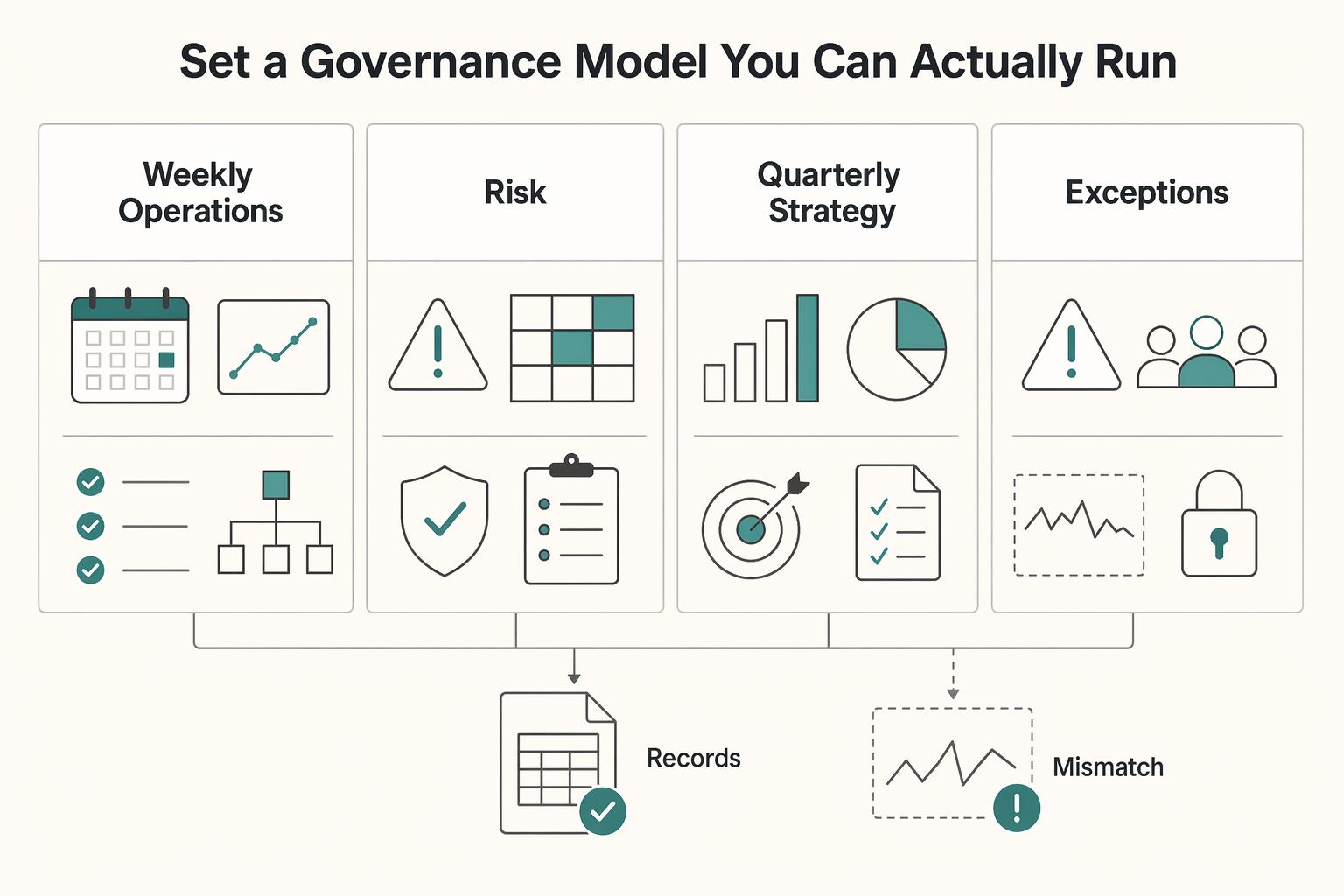
Set a Governance Model You Can Actually Run#
Governance works only when decision rights, meeting cadence, and action ownership are explicit and enforced. Set this before kickoff, and treat outputs as business records.
| Governance checkpoint | IT staff augmentation | Managed services |
|---|---|---|
| Weekly operations review | Internal delivery lead chairs; partner lead reports staffing, blockers, and replacement risk | MSP service lead reports service performance, incidents, and SLA misses |
| Monthly risk review | Your team updates risk items and accepts or escalates risk | Shared review, but your business owner approves remedies and unresolved risk |
| Quarterly strategy review | Recheck skill mix against roadmap and budget | Recheck service boundary, SLA targets, and scope drift against outcomes |
| Escalation ownership | Accountability can split unless one internal owner is named per issue | Visibility can drop unless one internal owner verifies provider evidence each cycle |
Keep one governance map across both teams with fixed meetings and named decision owners. Weekly reviews cover delivery health and blockers. Monthly reviews decide whether to accept, mitigate, or escalate material risk. Quarterly reviews test whether scope, spend, and outcomes still match the business case.
Define escalation tiers by business impact and tie each tier to SLA response expectations:
- Impact trigger: what business harm moves an issue into that tier.
- Named owners: one accountable person on your side and one on the provider side.
- Response expectation: acknowledgment and recovery targets aligned to the SLA.
- Decision authority: who can approve a workaround, scope change, or client communication.
- Closure evidence: incident summary, timestamps, and proof that actions were completed.
For European Union engagements, add recurring compliance checkpoints for tax and data handling. For VAT, confirm whether OSS is used, whether registration is handled through one Member State of identification, and who owns declaration and payment, record keeping, audits, and leaving OSS when required.
If cross-border SME treatment is used, confirm prior notification in the Member State of establishment. Monitor Union turnover against the EUR 100,000 cap, and verify EX number status before applying exemptions. The registration process is expected to complete within 35 working days, so plan onboarding with buffer.
Track data-handling responsibilities as a separate line item with named owners and monthly status checks. If meetings happen but actions are not tracked to closure, governance becomes decorative. Keep one action log with owner, due date, decision note, and completion evidence, and escalate unresolved items in the monthly risk review. Close each review by confirming which actions are complete, which are overdue, and who will communicate the decision.
Execute a 90-Day Transition With a Clear Handoff#
Treat the first 90 days as a controlled transfer with phase gates, not a loose overlap. Risk rises when ownership shifts before the incoming team can prove readiness.
| Transition stage | Handoff focus | Acceptance gate | Failure mode to watch |
|---|---|---|---|
| 1-2 weeks before Day 1 | Pre-work and ownership clarity | Transition charter, system inventory, access map, and RACI are in place | Day 1 starts with unclear ownership or missing access |
| Days 1-15 | Discovery completion and access stabilization | Incoming team can build, test, and deploy to non-production | Basic delivery still depends on the outgoing team |
| Days 16-45 | Knowledge transfer and documentation | Incoming team completes a staged incident drill | Incident handling slows because ownership or escalation paths are unclear |
| Days 46-75 | Parallel run and progressive ownership transfer | Ownership expands in stages during the parallel run | Parallel work hides unresolved defects or responsibility gaps |
| Final cutover window | Stabilize and confirm ownership at cutover | Clear ownership and a clean cutover are explicitly confirmed | Cutover proceeds while accountability is still disputed |
In one comparison, staff augmentation is positioned for shorter projects (3-6 months), while managed services are positioned for ongoing operations (12+ months). For augmentation transitions, prioritize onboarding, governance, and knowledge transfer to reduce risk.
Add internal transition check-ins during the 90-day window to review unresolved blockers before expanding ownership. If high-impact blockers remain open, pause scope expansion and keep shared ownership until those blockers are closed.
At each phase gate, store a short acceptance note, open-risk list, and named approver.
Start this work early by documenting access and ownership handoff mechanics when transition scope is agreed. Spell out access timing, transfer steps, required handoff artifacts, and sign-off owners.
Watch for Red Flags Early#
Treat early red flags as go or no-go signals. One common failure is discovering too late that what you thought you bought is not what is being delivered.
| Signal area | IT staff augmentation warning | Managed services warning | Immediate check |
|---|---|---|---|
| What you are buying | You expected outcome ownership, but the vendor is only supplying labor while you run daily tasks and priorities | Vendor promises outcomes, but cannot name who owns them | Require one named owner and one success measure per scope item |
| Accountability model | Shared ownership is implied, but no accountable person is named in the accountability matrix | Provider-owned accountability is claimed, but issues keep returning to your team | Map each recurring issue to one owner and one backup owner |
| Operating involvement | You were not prepared for high daily involvement | You expected weekly or milestone oversight, but get pulled into daily triage | Compare actual involvement to the agreed reporting cadence |
| Reliability and security proof | Claims are verbal and undocumented | Claims are polished, but evidence is incomplete or delayed | Request dated records, decision logs, and action-closure notes |
Proposal red flags can show up in the first draft. If outcomes are vague, the service boundary is undefined, or ownership is deferred, pause and force a rewrite before signature. If scope, success measures, and handoff end state are unclear, the contract is not decision-ready.
Delivery red flags show up as a pattern, not one bad week. Recurring missed commitments, unclear ownership in the accountability matrix, and reactive-only incident response mean the model is drifting. In augmentation, your side usually carries high day-to-day involvement. In managed services, provider accountability should stay with the provider; if issues keep returning to your team, that model is slipping.
Governance red flags are quieter but just as risky. Skipped reviews, inconsistent reporting cadence, and weak proof behind reliability or security claims should trigger escalation. Discovering an incident is not the same as closing it.
If you choose augmentation, assign an internal owner who can run day-to-day decisions. If you choose managed services, require provider-owned outcomes, milestone-level reporting, and clear evidence each cycle. If owners for open risks, service-boundary disputes, or exit criteria are unclear, freeze expansion until they are named.
Choose by Scenario Instead of Opinion#
Choose based on operating need, not preference: do you need more hands you direct, or a provider to own a result with clear accountability.
| Scenario | Choose IT staff augmentation when | Choose managed services when | First verification checkpoint |
|---|---|---|---|
| Custom builds and product changes | You need close control over development work and daily priorities | You can define outcomes clearly and hand day-to-day execution to a provider | Confirm who sets daily priorities and who owns the result |
| Ongoing IT operations | You need added capacity under your internal direction | You want a provider to own ongoing management and support | Confirm scope includes early monitoring, cybersecurity, data backup, and network management |
| Mixed demand: project spikes plus steady-state ops | You need direct control for build work and short bursts of extra talent | You need stable operations handled with lower day-to-day burden | Split ownership by function and document handoff rules before kickoff |
Rule 1 is control-driven: if your work requires close direction and frequent iteration, augmentation usually fits better because you direct the work. Rule 2 is operations-driven: if reliable ongoing coverage for infrastructure, backup, and cybersecurity is the priority, managed services usually fits better because the provider owns ongoing operations. Rule 3 is portfolio-driven: if demand mixes build spikes with steady-state operations, use a hybrid split with explicit ownership across functions.
Use one quick stress test before final selection:
- Name the business outcome being bought in one sentence.
- Name who makes daily execution decisions.
- Name who is accountable when results miss target.
- Name which functions stay internal and which move to the provider.
Anti-pattern to avoid: do not use augmentation when you lack capacity to direct day-to-day work, and do not use managed services without clearly defined outcomes and requirements.
Use This Decision Checklist Before You Sign#
Sign only when fit is proven in writing, not assumed in conversation. Both models can relieve overloaded teams, but the difference shows up after signature: with augmentation, you keep day-to-day control; with managed services, the provider owns delivery and outcomes.
| Checklist area | What to confirm before signing | Red flag before signature |
|---|---|---|
| Strategic fit | The model matches your management capacity and risk posture: internal oversight for augmentation, delegated delivery ownership for managed services | You chose based on rate alone, without clear ownership of results |
| Operating fit | A finalized accountability matrix, a clear escalation path, and a reporting cadence tied to business decisions | Ownership sounds shared, but no single accountable owner is named |
| Contract fit | Clear service boundaries, explicit delivery ownership, and documented handoff or exit terms | Scope is broad, obligations are vague, or exit terms are deferred |
| Compliance fit | Data handling and retention expectations, plus who is responsible for meeting them | Compliance is treated as a promise, not assigned and tracked |
| Implementation fit | A documented transition plan with named owners and checkpoint dates already scheduled | Kickoff starts before handoffs, owners, and checkpoints are finalized |
Do one quick pre-sign test: for each area above, confirm an owner, a document, and a review date. If any item is marked for later, delay signature until both sides accept it in writing.
Conclusion#
Price alone is a noisy signal. The better fit is the model that aligns ownership, risk, and your real operating capacity.
Augmentation is quick to start, simple to contract, and commonly priced as rate times hours, which can work for temporary gaps. The risk rises when it becomes permanent: higher labor costs, staff creep, weak value measurement, and loss of knowledge control.
For recurring, business-critical work, prioritize outcome ownership and clear service commitments over day rates. If a provider can only commit to available hours, you likely still carry most delivery risk. Make ownership explicit in the contract, and do not move forward with terms that leave service commitments vague.
Treat this as a final governance check, not paperwork. If ownership is unclear before signing, it will be harder to fix under pressure.
Run the checklist, make ownership explicit, and reject ambiguity. As you scale across regions, align your delivery model with compliance-ready operations and traceable financial processes. If EU client work is on your roadmap, pair this decision with GDPR for Freelancers: A Step-by-Step Compliance Checklist for EU Clients.
Frequently Asked Questions
What is the main difference between staff augmentation and managed services?
Staff augmentation adds external specialists to your existing team while you keep control of day-to-day execution. Managed services outsources an outcome to a partner that owns delivery. Both can fill IT gaps, but they differ in execution control and delivery ownership.
Which model is better for short-term projects with specialized skill gaps?
Staff augmentation is often a good fit when you need temporary specialist skills inside your current operating rhythm. It works best when your team can direct daily tasks and priorities. If you want the provider to own the outcome instead of supplementing your team, managed services is often a better match.
Which option requires less day-to-day internal oversight?
Managed services can require less task-level oversight because an outsourced outcome is delivered by the provider. Your role is typically more about defining scope and reviewing outcomes. If you still need close daily control, this model may not fit your current operating needs.
Which model gives me more control over execution details?
Staff augmentation gives you more control over execution details. You stay in charge of task direction, workflows, and reporting. That control is useful when precision matters, but it keeps management responsibility on your side.
When should I choose a managed service provider instead of augmented staff?
Choose a managed service provider when you want to outsource an outcome, not just add capacity. This model can be a better fit when delegated delivery ownership matters more than direct daily control. A practical test is to weigh your scope, scale, and management capacity.
Can managed services cost more, and when does that still make financial sense?
Costs vary, and these comparisons do not support a universal cost winner for either model. Instead of assuming one is always cheaper, evaluate which model best fits your scope, control needs, and delivery ownership goals.
What key details are usually missing from vendor comparisons and should I verify myself?
Verify who owns daily execution versus outcome ownership, because that is the core model difference. Confirm how external specialists will integrate with your team if you choose augmentation. Also check whether the model matches your real scale, scope, and control needs before you sign.
Try a related tool
Researched and edited by the Gruv editorial team. Gruv builds cross-border billing, payouts, and finance-operations software for global businesses.
Sources
Includes 4 external sources outside the trusted-domain allowlist.
- dam.assets.ohio.gov/image/upload/watchdog.ohio.gov/Investigation...trusted
- itforce.ca/blog/staff-augmentation-vs-managed-servicesexternal
- matrixsolutions.com.au/staff-augmentation-vs-managed-servicesexternal
- sparxitsolutions.com/blog/staff-augmentation-vs-managed-servicesexternal
- thirstysprout.com/post/staff-augmentation-vs-managed-servicesexternal
Educational content only. Not legal, tax, or financial advice.
Related Posts

GDPR Compliance Checklist for Freelancers Working With EU Clients
Start by separating the decisions you are actually making. For a workable **GDPR setup**, run three distinct tracks and record each one in writing before the first invoice goes out: VAT treatment, GDPR scope and role, and daily privacy operations.

The Best Digital Nomad Cities for Slow Travel in 2026
If you want a city that still works after the first exciting week, judge it like a place to live, not a place to visit. Location-independent work keeps growing in 2026, but that does not make every popular city a good base. This list is for remote professionals planning a longer stay and weighing the legal and practical choices that still matter once daily life takes over.
A Guide to Peer-to-Peer (P2P) Lending for Investors
**Build a cashflow-protection system that helps keep your business obligations current, then treat yield-seeking products as optional.** Before we talk about P2P lending, get clear on what money must stay boring, liquid, and dependable. Once that base is solid, you can evaluate alternative investments without turning your operating budget into a risk experiment.