
Quick Answer
A/B test your checkout flow by changing one monetization variable at a time, splitting traffic randomly, and judging the result against one predefined primary metric plus guardrails like AOV, abandonment, and revenue quality. Lock the hypothesis, audience, traffic weights, tracking, and stop rules before launch, then ship only if the result is credible and unit economics still work.
Plan a checkout experiment around a measurable business decision#
Run checkout A/B tests as commercial decisions, not just UX experiments. The goal is to improve conversion while keeping decisions defensible across product, payments, and finance.
A/B testing is simple: run a control (A) and a variant (B) head to head, split traffic, and judge the result against a predefined metric. Reliable reads still depend on a disciplined setup:
- Random assignment to reduce bias
- Sufficient sample for a statistically reliable call
- A clear, pre-agreed rule for what counts as better
This guide is for founders, revenue leaders, product owners, and finance operators making monetization decisions. If you change price presentation, payment options, checkout steps, or trust cues, you are testing a business choice. Those choices can affect checkout completion, cart abandonment, and average order value.
Choose tooling for your tracking, traffic and operating constraints. A large feature list does not compensate for weak randomization or an unclear business decision.
Set the primary metric, guardrails and analysis rule before launch. Confirm assignment and outcomes can be joined by the same stable experiment and variant identifiers.
What to prepare before you run your first test#
Treat the setup as a decision process, not a design exercise. Before you build a variant, align on one evidence pack, one baseline, and one way to decide.
Build a one-page evidence pack#
Start with a one-page evidence pack: your current baseline conversion funnel, the biggest visible drop-off, and your active A/B testing backlog. If the backlog is long, prioritize with ICE by scoring Impact, Confidence, and Ease from 1 to 10, then averaging: ICE Score = (Impact + Confidence + Ease) / 3. That keeps early cycles focused on higher-impact opportunities in checkout, product pages, and pricing presentation instead of low-impact tweaks.
| Prep element | Article detail |
|---|---|
| Baseline conversion funnel | Current baseline conversion funnel |
| Visible drop-off | Biggest visible drop-off |
| A/B testing backlog | Active A/B testing backlog |
Confirm the measurement path#
Confirm the measurement path before launch. Establish your baseline conversion rate, define how control and variant will be compared, and agree on what result counts as a win.
Run a pre-launch sanity check on recent data. If the baseline read is inconsistent, fix that first, then start the test.
Document segment-level splits#
Randomize eligible users within the intended audience, keeping assignment stable across repeated visits. Record planned traffic weights and segment definitions; assigning different customer segments to different variants can confound the comparison.
Lock decision rules before launch#
Lock decision rules before launch so the team is not improvising after results come in. Weak setup is how teams burn time on low-impact tests or on tests that are too weak to reach significance in a useful timeframe.
Prepare a test environment using How to Build a Sandbox Test Environment for Your Payment Platform.
Pick one monetization decision to test first#
Test one monetization decision at a time, not three ideas at once. Start with a single variable that can change what you collect, then hold the rest constant.
Choose one high-stakes variable#
Choose one high-stakes variable and leave the others unchanged, such as a single paywall or onboarding variant element.
Use a simple rule: if the hypothesis could change monetization outcomes, classify it as a monetization test. Set success criteria before launch, not after a supposed winner appears.
Set audience scope before design#
Set audience scope before you design the variant. If users can enter the flow from different contexts, pick one context for the first test and keep reporting boundaries clean.
| Implementation context | What to verify |
|---|---|
| Single placement | Randomization and stable assignment for the eligible audience |
| Multiple placements | Whether the selected product maintains assignment across all tested surfaces |
| App onboarding | Current SDK/platform support and eligibility behavior on older clients |
| Web checkout | Checkout customization permissions, assignment persistence and complete outcome events |
Do not merge traffic from different contexts into one headline result on the first pass. Keep one baseline, one audience definition, and one context tag from entry to completion so results stay separable.
For an app/paywall product such as Adapty, verify the currently supported test type, assignment persistence, audience eligibility and SDK version for every client platform. Do not assume its app-specific placement controls apply to a web checkout or that old SDK minimums remain current.
Write a falsifiable hypothesis#
Write one falsifiable hypothesis that product and finance both sign off on. Use this structure: for segment X, changing Y should improve Z versus baseline, while the commercial outcome stays acceptable. If two reviewers can read the hypothesis and disagree on what "better" means, rewrite it before building the variant.
Set and record traffic weights#
Set initial variant weights deliberately and record why. Traffic allocation is a decision, not a default.
A 70% / 30% split means roughly 700 of 1,000 users see one variant and 300 see the other. If two ideas compete, test the one with clearer commercial impact first and park the cosmetic change for later.
For the compliance-side operating context, read How to Build a Payment Compliance Training Program for Your Platform Operations Team.
Define success and guardrails before variant design#
Lock the scorecard before you design variants: one primary metric decides the test, and a short guardrail set catches business harm early. This is where you decide what counts as a win and what still blocks rollout.
Pick the primary metric#
Set one primary metric before launch and treat it as the decision-maker: your OEC.
Keep the rule strict: secondary metrics explain movement, but they do not override the primary result. If the primary metric is flat or down, the test is not a success.
Add business guardrails#
Choose a short guardrail set for business health outside the primary goal. Common guardrail categories include revenue per user, retention rate, page load time, customer satisfaction, and support ticket trends.
Define each guardrail clearly before launch so control and variant are judged with the same definition. Also verify Sample Ratio Mismatch (SRM). If control and variant traffic is not split as intended, the results are not trustworthy.
Add guardrails for authentication friction#
When a variant changes checkout friction, add explicit risk guardrails and do not read conversion in isolation.
A faster path can improve completion while economics worsen through higher fraud loss and support pressure.
Track operational outcomes explicitly#
If the flow changes critical checks, track those outcomes explicitly and keep definitions consistent across control and variant.
Use a simple rule: if conversion rises but a guardrail degrades, do not ship yet. Quantify net economic impact first, including fraud loss and support load.
See also our guide on How to Build a Developer Portal for Your Payment Platform: Docs Sandbox and SDKs.
Choose your testing stack and instrumentation depth#
Choose the stack that preserves measurement truth, not the one with the longest feature list. If you cannot tie assignment, conversion, and revenue to the same variant, your winner is harder to defend across growth, engineering, and finance.
Start with operating constraints#
Start with operating constraints, not demos. A/B testing is randomized, but in practice execution is constrained by tracking, assignment, and metric-definition realities.
Compare Convert Experiences, VWO, OmniConvert, Kameleoon and products already in your stack on implementation fit. Check where variants run, who owns code changes, how assignment is logged and what data can be exported. Confirm the team can reproduce a variant-level result before buying.
Define integrations before pricing#
Define integrations before pricing. If GA4 is your analytics system, check its variant-level event and revenue mapping; otherwise verify equivalent assignment and outcome joins in your selected pipeline.
Some integrations only send impressions, which is usually too shallow for checkout decisions. Require variant-level mapping so impressions, conversions, and revenue are captured with clear variant identifiers.
Before rollout, prove one test sends all of the following under the same experiment and variant label:
- impression
- checkout completion, or your primary conversion event
- revenue or order value event
If you use BigQuery via GA4, confirm these fields land cleanly enough to join in downstream reporting. Bi-directional flows, like reusing GA4 audiences for targeting, can help, but they do not replace clean outcome logging.
Check Shopify compatibility early#
If you are Shopify-heavy, check native compatibility early. This is an operating-risk call: reduce fragility on the surface where revenue happens.
Convert Experiences is one example in that selection conversation, and published entry pricing can serve as a rough anchor: $299/mo for 100k tested users (billed annually) or $399/mo for 100k tested users (billed monthly), plus a 15-day free trial.
Do not stop at "Shopify supported." Run live QA in staging and verify control and variant both fire the same core checkout events with complete transaction data.
Use a cross-functional handoff checklist#
Use a short cross-functional handoff checklist so winner decisions are reproducible:
| Owner | Required items |
|---|---|
| Growth | Hypothesis, primary metric, guardrails, experiment naming |
| Engineering | Assignment method, event implementation, QA evidence, rollback owner |
| Finance | Revenue definition, refund/chargeback inclusion rule, closeout report |
| All teams | Agree on conversion and revenue source of truth before launch |
| Closeout artifact | Selected analytics export or first-party event evidence, variant IDs, definitions and finance reconciliation note |
Require variant-level outcomes in your selected analytics system and reconciliation with finance reporting. GA4 is one option; a sound first-party measurement pipeline can serve the same purpose.
For a step-by-step walkthrough, see White-Label Checkout: How to Give Your Platform a Branded Payment Experience.
Prioritize experiment backlog by impact and implementation risk#
Prioritize checkout tests by expected business impact and execution risk, not by design speed. A variant is not a win if conversion goes up but revenue per visitor, average order value, or margin gets worse.
Score ideas before design starts#
Score every idea before design starts so growth, engineering, finance, and compliance review the same tradeoffs. Treat initial scores as hypotheses, then update them with baseline data before launch.
| Experiment idea | Expected revenue impact | Margin sensitivity | Engineering lift | Compliance sensitivity |
|---|---|---|---|---|
| Reorder payment methods in checkout flow | Medium to high | High if payment costs differ by method | Medium | Medium if compliance checks differ by method |
| Change pricing display or plan framing | High | High | Medium | Medium to high if disclosures or consent presentation change |
| Test cosmetic CTA copy or button color | Low to medium | Low | Low | Low |
Use one shared scale, low, medium, high, and define it once. Keep expected revenue impact tied to revenue per visitor, not conversion alone, so you do not promote false winners that lift completion but erode order value or margin.
Require one evidence note per score:
- Baseline funnel data for revenue impact
- Finance notes for margin exposure
- Engineering estimate for implementation lift
- Compliance notes for legal/compliance exposure
If a score has no evidence note, treat it as unscored.
Move high-margin tests up the queue#
When margin pressure is high, prioritize tests by expected effect on revenue per visitor, average order value, and margin, not conversion alone.
Balance impact per visitor against available traffic. Before launch, set the minimum detectable effect, calculate required sample size, and confirm expected runtime. If a test needs weeks to detect meaningful lift, plan it as a longer-cycle decision, not a quick readout.
Pause variants with legal friction#
Set a hard stop for variants that may create legal friction. If a test changes consent, disclosures, cancellation terms, or choice architecture, pause launch until legal or compliance review is complete.
Run the backlog as a portfolio#
Run the backlog as a portfolio of structural, optimization, and low-risk tests instead of one large bet. Use parallel low-risk tests only when they do not conflict with higher-impact experiments.
Before launch, define interference controls: who owns each checkout step, which tests are mutually exclusive, and the primary metric for each live test. If a test has no exclusion rule or no primary metric, do not run it.
Related: 3D Secure 2.0 for Platforms: How to Implement SCA Without Killing Checkout Conversion.
Build variants that improve trust without triggering policy issues#
Trust variants should improve clarity and confidence without changing the underlying requirements a buyer must accept or complete. If a test touches disclosures, consent language, or KYC/AML steps, keep the requirement fixed and test presentation only.
Keep approved text identical#
Keep approved legal or compliance text identical across control and variant when the goal is trust optimization. Test the surrounding presentation instead: hierarchy, reassurance copy placement, icons, spacing, and where approved text appears in the step.
Use a simple gate before launch: screenshot diffs should show the approved text block is unchanged. If that text changes, route it back through legal or compliance review, and document those boundaries in your compliance guidance.
Separate trust UX from risk controls#
Isolate trust UX tests from risk-control changes. You can test how you explain verification, but keep the underlying risk treatment the same across variants.
Randomize according to the recorded traffic weights; equal groups are common but not required. Keep risk treatment aligned for a trust-presentation test. If a branch changes risk treatment too, it tests a different combined intervention and needs its own approved hypothesis and guardrails.
Keep identity and compliance steps consistent#
For cross-border traffic, keep identity and compliance steps consistent unless those checks are the explicit hypothesis. Compliance expectations vary by jurisdiction, so flows that work in one market may not hold in another.
If users go through KYC or AML checks, keep required fields and sequence aligned across variants, then segment outcomes by market. If one branch changes exposure to those steps, hidden, delayed, or skipped, treat any lift as unreliable. Weak compliance preparation can also create downstream delays that stretch for weeks or months.
Make trust-copy changes auditable#
Make trust-copy changes fully auditable before launch. Keep exact shipped strings, control and variant screenshots, affected markets and locales, experiment ID, owner, and product, legal, and risk approval status in one record.
Do not rely on design files alone. Production text should match the record exactly. If your tooling supports deeper data collection, segmentation, and analysis, connect that audit record to experiment results and only ship a winner after consistency checks are resolved.
Plan outage handling alongside the experiment: Payment Gateway Outage Playbook: How to Keep Transactions Flowing When Your Primary Gateway Fails.
Run the test with explicit checkpoints and stop rules#
Once your variant is operationally ready, run the experiment with explicit control rules from day one. Do not launch and wait for significance alone. Use clear checkpoints and guardrail metrics so you can learn faster without compromising customer trust.
Validate tracking before the ramp#
Before you ramp traffic, verify instrumentation and assignment so control and variant readouts are comparable.
If tracking quality diverges, pause interpretation of performance results until instrumentation is corrected.
Review on a fixed cadence#
Review the test on a fixed cadence and use guardrails, not just headline conversion. At each checkpoint, review experiment-health and throughput signals in a standardized template or dashboard so teams are reading the same scorecard.
If experiment-health signals are off, treat conclusions as provisional until the cause is resolved.
Record stop rules before launch#
Define stop rules before launch and record them with the hypothesis, metrics, and ownership. Pre-agreed rules help keep decisions consistent when results are noisy.
Keep runtime expectations realistic: traditional A/B tests can need large samples and longer durations. In illustrative low-baseline/small-lift scenarios (for example, a 0.5% baseline with a 5% relative lift target), expect longer tests. Sequential testing is one adaptive alternative when long runtimes delay decisions.
Test rollback end to end#
If rollback is part of your experiment process, define it before launch and document exactly how the team will return to baseline if risk rises.
Record who can trigger rollback and what verification checks are required after rollback.
Decide winners by unit economics, not conversion alone#
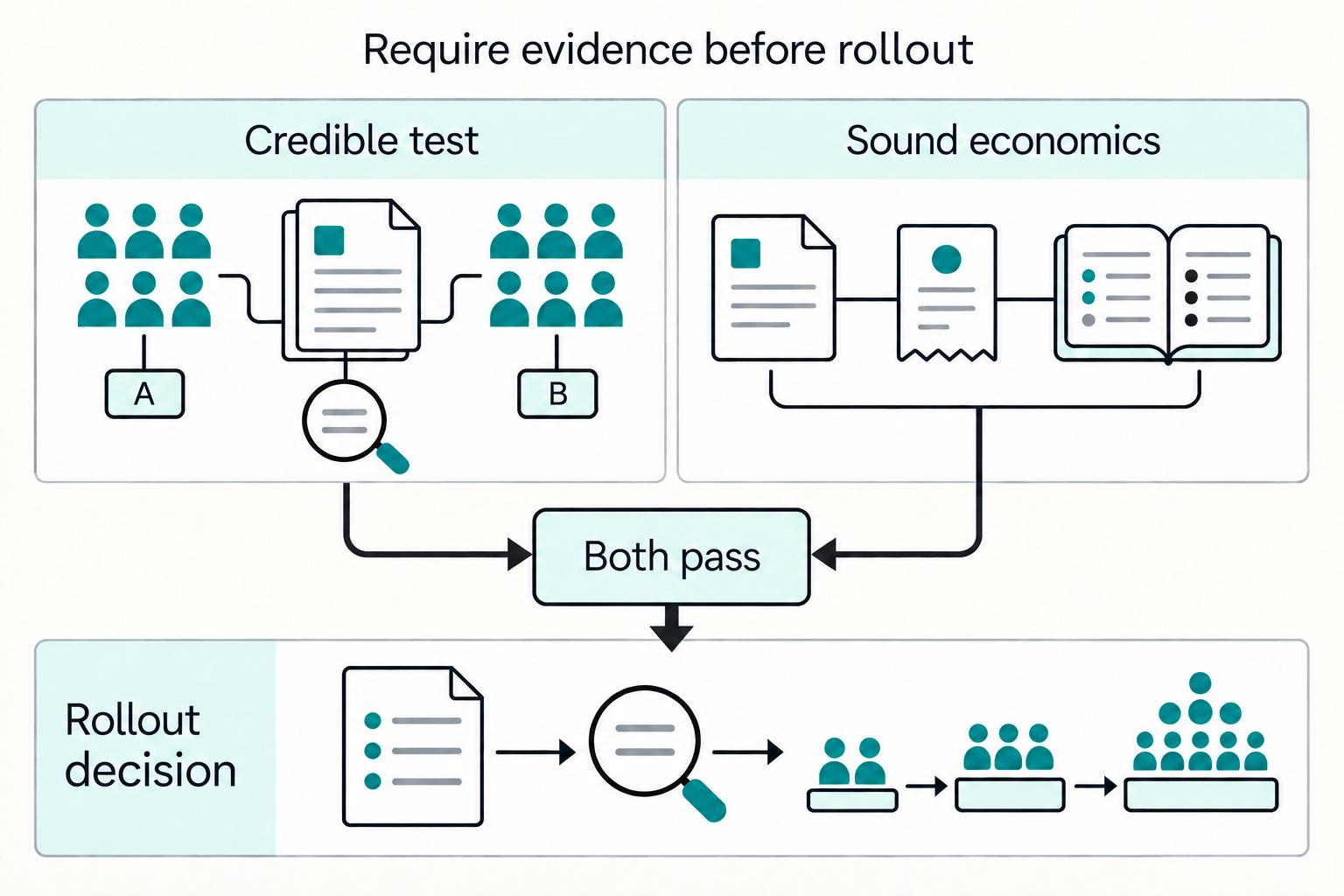
Do not pick a winner on completion rate alone. Promote only the variant that passes both a credibility check and your economics check.
Check test credibility first#
Validate randomization, assignment stability, outcome logging and the preselected statistical analysis before making a business decision. Assess effect size and uncertainty against the minimum worthwhile effect, not significance alone.
Investigate unexplained assignment or exposure imbalance against planned weights before interpreting outcomes. A planned 70/30 split or ordinary random variation is not itself confounding. Check for missing events, changing eligibility or differential delivery that could bias the comparison.
Also reconcile raw counts, not just percentages. Compare assigned sessions, checkout starts, completed orders, and the finance-side transaction count you use downstream. If analytics and finance views do not tie out, hold the decision.
Use one decision table#
Use one decision table so product, payments, and finance evaluate the same evidence.
| Decision lens | Compare vs control | Pass signal | Hold signal |
|---|---|---|---|
| Conversion outcome | Completion rate with assigned/eligible denominators and completed-order counts | Positive movement with credible test validity | Movement depends on imbalanced exposure or weak validity |
| Order economics | Internal order-value view, for example AOV or realized value | Value is stable enough for rollout | Conversion improves but value deterioration changes the business case |
| Payment-cost view | Internal processing-cost view | Cost impact is acceptable for the outcome | Cost shift is unresolved or materially worsens the economics |
| Revenue quality | Finance-side quality view, for example recognized, settled, or accepted revenue | Checkout gains translate into acceptable downstream revenue quality | Checkout gains do not translate cleanly into downstream quality |
Judge these together, not one by one. If signals conflict, do not force a winner.
Apply your business-model context#
Apply business-model context before finalizing the call. Validate against the finance view that reflects how your business records money movement, fees, and tax handling.
Add an operations check for downstream reconciliation and payout workflows. If reconciliation owners cannot confirm the variant is operationally manageable, treat the economics read as incomplete even if conversion is higher.
Run a follow-up when evidence is mixed#
If the evidence is mixed, run a holdout or a focused follow-up test. Isolate the unresolved driver instead of bundling new changes.
Promote only when the preselected analysis supports the primary outcome and economic guardrails pass. If evidence is uncertain at the planned maximum runtime, close the result as inconclusive; any extension or follow-up needs an appropriate prespecified or newly designed analysis. Before rollout, review fee and margin assumptions with the payment fee comparison tool.
Common mistakes and how to recover fast#
False confidence is the main failure mode here, so the fastest recovery is usually to tighten test design before you make a rollout call.
| Mistake | Fast recovery |
|---|---|
| Testing from a hunch instead of a defined hypothesis | Relaunch with one specific change, one clear testable hypothesis, and one primary metric. Use a pre-test checklist before launch. |
| Running without a learning framework | Define what you expect to happen and why before launch so flat or mixed results still produce usable learning. |
| Stopping early because the dashboard looks significant | For fixed-horizon tests, precommit sample size and stopping rules; repeatedly stopping at ordinary p < 0.05 can inflate false positives. For continuous monitoring, use an analysis designed for sequential decisions. Check guardrails for safety without declaring an early ordinary-significance winner. |
| Tool-first decisions when planning or analysis is weak | Pause variant iteration and fix planning/analysis requirements first. If the setup is not decision-grade, treat results as non-decision-grade. |
| Shipping changes from flawed experiments | Treat early wins as provisional until your hypothesis, stopping rule, and analysis discipline checks are in place. |
Document the measured result using Case Study Framework: How to Document Platform Payment Wins for Marketing.
Extend testing beyond checkout to capture real revenue impact#
A checkout win is provisional until you confirm the revenue outcome after payment. Post-checkout engagement can rise while business results decline, so carry the same control-versus-variation discipline into downstream analysis before broad rollout.
Test post-checkout surfaces with a revenue-first readout#
If you run experiments on thank-you or order-status surfaces, keep the design simple: one true control, one clear variation, and a clean traffic split before measuring performance with statistical rigor. Avoid stacking multiple changes at once unless you have the traffic needed for multivariate testing.
Set one primary revenue metric before you read results. Prefer a metric you can connect directly to revenue, and treat proxy metrics like clicks as supporting context, not the decision signal.
Include downstream business outcomes in the decision#
Do not stop at checkout completion. Review variant outcomes against downstream business results so your decision reflects more than front-end movement.
If you are testing payment methods, use the dedicated A/B testing workflow your payment platform provides and keep control-versus-variation definitions consistent through analysis.
Connect the result to rollout decisions#
Match your experimentation tooling to where the test runs, whether marketing pages, product flows, or both. Do not choose a winner based on feature lists alone.
Capture a compact decision record: traffic split, primary revenue metric, and the final statistically rigorous readout. That keeps rollout decisions reproducible and easier to audit later.
Conclusion#
Roll out a checkout variant only when the A/B evidence is clean and reliable, not just because early uplift looks good.
Close the test against the design you actually ran#
Before naming a winner, confirm the test basics: two versions, control and variant, random assignment, and a predefined primary metric used for the decision. If segment behavior looks inconsistent or creates new friction, treat that as a pause signal rather than a rollout signal.
Verify evidence quality before rollout#
Check that the planned analysis has enough information for the effect you need to detect, and review its uncertainty and guardrails. If the agreed maximum runtime ends without sufficient evidence, record the result as inconclusive. A staged rollout manages exposure; it does not replace a valid experiment.
Use a closeout checklist and queue the next test#
Use a short closeout checklist so the decision is easy to defend and easy to repeat:
- Primary metric documented
- Control and variant definition confirmed
- Random assignment confirmed
- Primary metric readout completed
- Decision based on the predefined primary metric
- Planned sample/observation window and analysis decision rule checked
- Smaller-segment exposure completed before wider rollout
- Follow-up test queued
If you keep one rule from this guide, keep this one. Ship when the control-versus-variant comparison is sound, the sample is strong enough to trust, and the result still holds up after a risk check.
Frequently Asked Questions
How do you A/B test a checkout flow without hurting margin?
Run a controlled test with one true control and one variant, and define the decision metric before launch. Evaluate the result with completion rate, Average Order Value (AOV), and checkout abandonment, not conversion rate alone. If completion rises but value drops enough to offset it, treat that as a non-winner.
What should platform operators test first in checkout?
There is no universal first checkout test for every platform. Start with the one change most likely to move completion or order value in your own flow, then test it in isolation. Avoid bundling multiple untested edits, because that can hurt KPIs and blur causality.
Which metrics matter most besides conversion rate?
The core checks are completion rate, AOV, and checkout abandonment. Together, they show whether a variant improves commercial outcomes or simply pushes users through in a lower-value pattern. If these signals conflict, quantify the tradeoff before rollout.
How do I choose between tools like Convert Experiences, VWO, OmniConvert, and Kameleoon?
Choose by cross-domain tracking needs, assignment stability, QA workflow, pricing model and traffic fit. Convert currently lists Growth at USD 299 per month billed annually or USD 399 billed monthly for 100,000 monthly tested users, with a 15-day trial; taxes and overage terms need separate review. Verify content flicker and complete checkout events in your actual deployment.
How long should a checkout A/B test run before calling a winner?
Plan duration from baseline rate, minimum detectable effect, desired power, error control, traffic and the outcome observation window. A few hundred conversions or a fixed two-to-six-week window does not guarantee adequate evidence. For a fixed-horizon analysis, complete its planned sample and relevant business cycles; for sequential analysis, use a valid sequential decision rule. If maximum runtime ends without sufficient evidence, record an inconclusive result rather than testing indefinitely.
Can we test thank-you and order-status offers in the same experimentation program?
Include both in the program as separate experiments with separate readouts, unless a combined intervention is deliberately designed. Keep attribution and eligibility clear. QA the actual setup before activating it through the selected tool's launch workflow; UI labels differ by product.
Researched and edited by the Gruv editorial team. Gruv builds cross-border billing, payouts, and finance-operations software for global businesses.
Sources
Includes 7 external sources outside the trusted-domain allowlist.
- abtestresult.com/articles/guardrail-metricsexternal
- adapty.io/docs/ab-test-typesexternal
- convert.com/blog/a-b-testing/ab-testing-tools-that-integ...external
- convert.com/pricingexternal
- learn.microsoft.com/en-us/xbox/playfab/live-service-management/g...external
- microsoft.com/en-us/research/wp-content/uploads/2020/08/20...external
- optimizely.com/field-notes/articles/statistics-for-the-inte...external
Educational content only. Not legal, tax, or financial advice.
Related Posts

The Freelance Payment Penalty: A Modeled Audit of Platform Fees, FX Spreads, and Payout Delays
The money rarely disappears through a single, easy-to-spot fee. The real loss is stacked. A marketplace takes its commission, a processor adds a charge for international cards, a bank or payment company converts the currency at a spread, a platform holds the funds before release, and a wire sheds a little to intermediaries on the way in. Each layer looks defensible on its own, but the worker feels the combined result as a smaller deposit and a later payday.

How to Respond to a Subpoena for Business Records
Move fast, but do not produce records on instinct. If you need to **respond to a subpoena for business records**, your immediate job is to control deadlines, preserve records, and make any later production defensible.
A US Expat's Guide to Investing in UCITS ETFs to Avoid PFIC Issues
The real problem is a two-system conflict. U.S. tax treatment can punish the wrong fund choice, while local product-access constraints can block the funds you want to buy in the first place. For **us expat ucits etfs**, the practical question is not "Which product is best?" It is "What can I access, report, and keep doing every year without guessing?" Use this four-part filter before any trade: