
Quick Answer
Use show don't tell in writing as a decision rule, not a blanket command: dramatize moments that shift trust, stakes, or motive, and state logistics or background through direct exposition. Start by tagging each paragraph as inference or instruction. Then revise only the lines that carry the key turn, using one concrete cue at a time through action, dialogue, or sensory detail. Finish with a POV check and cut repeats once the point is already clear.
Show, Don't Tell Is a Decision, Not a Rule#
Most advice about show don't tell in writing stops being useful the moment it becomes a rule. The practical version is simpler. Show when you want the reader to experience meaning through concrete evidence. Tell when a direct statement will move the piece forward faster and more clearly.
These are not rival styles. They do different jobs. Showing creates mental images through action, sensory detail, and concrete context so the reader can infer what matters. Telling gives the information outright. In creative writing and personal essay, dramatized evidence often creates a stronger connection. In passages where the goal is clarity over immersion, direct exposition can be the cleaner choice.
If you remember one revision rule, use this: when a moment carries emotional weight, reveals character, or changes how a reader should interpret what is happening, earn it with evidence. When the line only needs to deliver background, logistics, or a quick transition, tell it plainly and move on. That choice is usually more useful than trying to show every sentence.
Weak drafts often fail in one of two ways. They label experience without proving it, as in "she was nervous" or "the room was beautiful." Or they overcorrect and pile on decorative detail that slows the prose without adding meaning.
The fix is not more description by default. It is more specific language. Turning the abstract into the concrete is usually enough. A hand missing the keyhole twice tells us more than the word "nervous," and one sharp image often does more work than a string of adjectives.
you will learn how to spot flat exposition, decide when a passage needs dramatized evidence, and replace vague labels with observable cues. You will also learn when not to expand. In fiction, personal essay, and other descriptive work, control matters as much as vividness.
One quick checkpoint will keep you honest: after revising a paragraph, ask whether a reader can infer the intended emotion, motive, or tension from what is on the page. If not, add one concrete cue. If they can already infer it, do not explain it again. That is the balance this article aims for: prose that feels alive without becoming swollen, and clear without becoming flat.
What Show, Don't Tell Actually Means#
At its core, show don't tell in writing means giving readers concrete evidence in-scene so they can infer meaning, instead of being handed the conclusion through exposition.
Showing puts stimuli before interpretation: action, behavior, dialogue, and sensory cues that let readers visualize and judge for themselves. "He lied" tells. "He answered too fast, then studied the table instead of her face" shows. This is not decoration; it is inference and immersion.
Telling is still useful. It gives the conclusion directly, which is often the right move for speed, context, or transitions. Summarize low-stakes passage of time; slow down when a moment changes trust, status, or desire. Strong descriptive writing depends on that balance: dramatize what carries weight, summarize what only carries information.
Use a quick check after each passage: what can the reader infer without extra explanation? If the answer is "not much," add one concrete cue, not a block of adjectives. More detail is not automatically better, and showing is not the only path to effective writing.
Build the Mental Model Before You Edit#
Start with a simple choice for each paragraph: should the reader infer meaning from evidence, or just receive information directly? That decision should drive your edit before you touch sentences.
Use this quick checklist:
- Inference: interpretation matters, so favor observable action, dialogue, and subtext.
- Instruction: speed or clarity matters more, so direct exposition is usually cleaner.
This keeps you from making random line edits in the name of show don't tell in writing. You are deciding whether the reader should deduce or be told. A useful first pass is to label each paragraph in the margin: inference or instruction. If you cannot explain why a paragraph needs inference, do not force dramatization.
Filter detail through one mind#
When you choose to show, keep the detail consistent with a single point of view (POV). The goal is selection, not volume: two characters can enter the same kitchen and notice different evidence.
Use a quick check after rewriting: "Could these observations belong to anyone?" If yes, the passage is probably generic description. One detail tied to what this character fears, wants, or avoids usually does more work than several neutral notes.
Let behavior carry characterization#
Showing is most useful when behavior reveals character under pressure. Labels like "brave" or "selfish" state the conclusion; conduct gives the reader evidence.
Let subtext do part of that work. In conflict, people often reveal motives through hesitation, deflection, avoidance, or oddly specific actions. Concrete behavior gives readers something to interpret without narrator labels.
Use the reader workload check#
Do not ask for inference when the sentence gives no evidence. If a line feels flat, add one concrete cue before adding more description.
For example, instead of stacking adjectives, give one readable signal: she read the same text twice without replying, or set the cup down hard enough for coffee to spill. If one cue does the job, stop there. For a step-by-step walkthrough, see The Best AI Writing Assistants for Freelancers.
Decide When to Show and When to Tell#
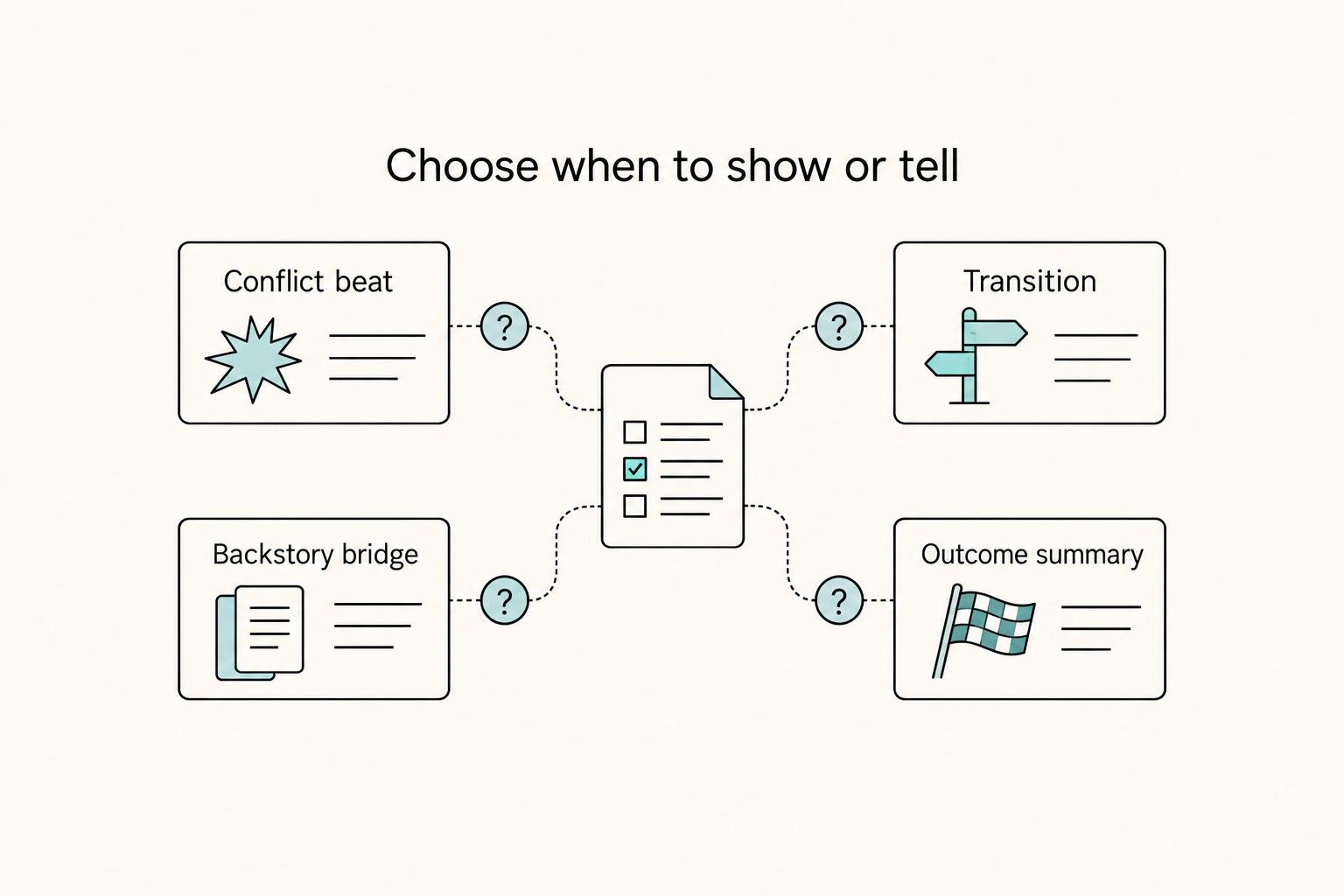
Use this rule first: if a moment changes stakes, trust, or identity in a Scene, show it; if a line only moves time or logistics, tell it with clean Exposition.
Showing is most useful when you want readers to infer meaning from evidence and feel close to the moment. Telling is most useful when you need orientation, pace, or a clear bridge.
| Moment type | Show | Tell | Why | Risk if misused |
|---|---|---|---|---|
| Conflict beat | Put the reader inside the exchange or choice that shifts trust or power | Summarize only when the exact clash is not the point | High-stakes turns usually need evidence, not labels | Over-telling flattens tension; over-showing can bloat pacing |
| Transition | Show only when movement creates real friction or discovery | Summarize travel, elapsed time, or routine setup | Most transitions reposition the story | Over-showing wastes attention; abrupt telling can skip needed context |
| Backstory bridge | Show the past only when it directly drives a present decision | Give concise context when backstory is explanatory | Backstory should support the current beat | Full flashbacks can stall momentum; blunt info-dumps can feel detached |
| Outcome summary | Show the result when emotional impact lands in real time | Summarize aftermath after the core turn is complete | Not every consequence needs equal page weight | Telling a key payoff can weaken impact; showing every aftermath detail can dilute the close |
In Fiction, over-telling can make major emotional turns feel distant. In a Marketing Video Script, over-showing can slow clarity and blur the core claim, so lead with the point and support it with one concrete example. For format-specific guidance, see How to write a 'Script' for a marketing video.
After each section, run one check: "Can a reader infer the intended emotion or motive without me naming it?" If yes, stop. If no, add one concrete cue through action, dialogue, or sensory detail, then retest. Related reading: A Freelance Designer's Guide to Presenting Work to Clients.
Revise a Flat First Draft in a Repeatable Order#
Revise in passes instead of rewriting everything. That keeps momentum and preserves what already works in the first draft as a story.
| Step | Do this | Key check |
|---|---|---|
| 1. Mark abstract labels | Highlight words like afraid, angry, and beautiful, then flag places where scene evidence is missing | Treat clusters of is, was, has, had, been as a rough telling signal worth checking, not an automatic error |
| 2. Replace highest-impact lines | Use one tool per line: action, dialogue, or sensory details | Start with lines that carry the main shift in a passage |
| 3. Tighten and keep POV consistent | Cut duplicate cues so each sentence does one job | Keep details anchored to what the POV character would realistically notice |
| 4. Run a balance pass | Keep exposition for transitions, time jumps, and context | Do not try to dramatize every line |
Step 1: Mark abstract labels before you fix anything. Highlight words like afraid, angry, and beautiful, then flag places where scene evidence is missing. Also treat clusters of passive verbs (is, was, has, had, been) as a rough telling signal worth checking, not an automatic error. Ask: can a reader infer the feeling or judgment from what is observable on the page?
Step 2: Replace only the highest-impact lines, one lever at a time. Start with lines that carry the main shift in a passage. Use one tool per line:
- Action when behavior reveals pressure or motive.
- Dialogue when tension, avoidance, or subtext should carry meaning.
- Sensory details when the moment needs presence through POV-filtered observation.
Step 3: Tighten for control and keep POV consistent. Cut duplicate cues so each sentence does one job. If one concrete cue already conveys the emotion, remove extra labels that repeat it. Keep details anchored to what the POV character would realistically notice.
Step 4: Run a final show/tell balance pass. Keep exposition for transitions, time jumps, and context. You are not trying to dramatize every line; you are deciding where showing changes meaning and where telling keeps the story moving cleanly.
Show Emotion and Motive Without Naming Them#
To show emotion and motive clearly, let readers infer them from evidence instead of naming them outright. A practical pattern is to pair one external cue with one internal cue in a single POV, then stop before you explain the meaning.
| Cue | What it looks like | Why it helps |
|---|---|---|
| External cue | A choice under pressure such as stacking plates during an argument, answering a question with a different question, or rewriting a message multiple times | Signals motive through behavior |
| Dialogue subtext | Interruption, deflection, misdirection, dodging the core question, switching topics, or over-focusing on logistics | Avoidance carries the conflict |
| Sensory detail plus internal cue | One concrete detail the viewpoint character would notice plus a thought fragment or partial bodily interpretation | Usually enough for readers to infer emotion and likely motive |
| Single POV | Keep the camera in one head and avoid head-hopping into another character's private feelings | Inference works better when some meaning stays in subtext |
The external cue should be a choice under pressure, not decorative movement. A character who keeps stacking plates during an argument, answers a question with a different question, or rewrites a message multiple times is signaling motive through behavior. Readers can often infer more from what a character avoids than from direct emotional labels.
Use dialogue for subtext by tracking interruption, deflection, and misdirection. Under strain, people often dodge the core question, switch topics, or over-focus on logistics. If one character asks, "Did you call her?" and the other says, "You left the kitchen window open," the avoidance carries the conflict.
Keep sensory detail selective and POV-true. Give one concrete detail the viewpoint character would notice, then one internal cue from that same consciousness, such as a thought fragment or partial bodily interpretation. Usually, that is enough.
Use this check while revising: can a reader infer both emotion and likely motive without your summary sentence? If yes, cut the explanation. If no, add one clearer cue, not several weaker ones. Overstating emotion can reduce impact and make the voice feel less credible.
Keep the camera in one head. Avoid head-hopping into another character's private feelings just to clarify the scene. Inference works better when some meaning stays in subtext.
Apply the Technique Across Fiction and Creator Work#
Use one rule across formats: show when you want the reader to infer and visualize, and tell when they only need the information clearly. In practice, that keeps writing immersive without slowing pace.
| Format | Primary purpose | Best "show" tools | Where concise "tell" is preferable |
|---|---|---|---|
| Fiction | Immersion, tension, characterization | Action under pressure, behavior, dialogue, selective sensory detail | Time jumps, backstory bridges, logistics, outcome summaries |
| Personal Essay | Credibility, voice, reflection | Brief scene snippets, concrete objects, remembered dialogue, bodily detail through the narrator | Context, interpretation, timeline compression, takeaway |
| Marketing Video Script | Fast clarity with enough texture to feel real | One specific use moment, one concrete pain point, one visible action, short before/after beat | Offer framing, core benefit, call to action, setup that should be explicit |
In world-building, keep decision-relevant detail inside the action. If a detail changes what a character can do, fear, or misunderstand, show it in the beat; if it is background only, move it to brief exposition and continue. For a deeper pass, see A guide to 'world-building' for fiction writers.
A useful contrast is a freelancer portfolio narrative: show one short scene to establish lived credibility, then tell the result directly so the reader does not have to decode your competence from atmosphere. use showing for proof and telling for clarity.
For an editing pass, give each paragraph one job: either build inference or deliver information. If it tries to do both, split it. For format-specific follow-through, see How to write a 'Script' for a marketing video and A creator's guide to writing a 'Media Kit'.
Avoid Overwriting and Other Common Failure Modes#
Overwriting usually reads as author performance instead of character truth, so trim until the writer feels invisible and the scene stays clear. When author presence becomes too obvious, immersion drops.
| Red flag | How it appears | Revision check |
|---|---|---|
| Stacked metaphors | Competing for attention in the same beat | Cut to one strong image and one concrete action that carries the beat |
| Repeated body-language ticks | Sighing, shrugging, or clenched jaws every few lines | Add a descriptive sentence only if it deepens subtext or sharpens POV |
| Too many sensory details | Readers notice description more than characterization | Check whether only this character would notice or phrase it this way |
| Under-explaining after trimming | Readers may feel confused or disconnected | Make sure who is acting, what they want, and what changed still land |
Common red flags on a revision pass include:
- stacked metaphors competing for attention in the same beat
- repeated body-language ticks such as sighing, shrugging, or clenched jaws every few lines
- so many sensory details that readers notice description more than characterization
If detail density slows pace, cut to one strong image and one concrete action that carries the beat. That often gives readers enough to infer emotion without getting buried under signals.
Use one hard constraint when revising: add a descriptive sentence only if it deepens subtext or sharpens POV. Then check each line: could only this character notice or phrase it this way? If not, the detail may be generic or clever for its own sake.
Do not overcorrect into under-explaining. Missing key details can force readers to fill gaps and leave them confused or disconnected. After trimming, make sure three basics still land: who is acting, what they want in the moment, and what changed by the end of the beat.
Conclusion#
Strong prose is not "all show." The real skill is control: use specific details when you want reader inference, and use direct exposition when clarity or pace matters more. That is the practical heart of this technique.
If you keep one idea from this guide, make it this: showing creates a mental picture the reader can judge for themselves, while telling informs them directly. Both are valid. The problem is not telling on its own. The problem is vague telling that gives the reader a verdict without enough specific detail to make it feel earned.
That is why the moment-level question can matter more than any rule of thumb. When a moment changes trust, stakes, motive, or identity, it can help to slow down and let action, dialogue, sensory detail, or subtext carry part of the meaning. When the paragraph is mainly moving time, logistics, or background, clean exposition can do the job. If you force every line into full descriptive writing, you may add drag instead of impact.
On revision, a simple sequence will catch most weak passages before you start polishing sentences:
- Check purpose first. Is this paragraph here to make the reader infer something, or just understand something quickly?
- If inference matters, add one concrete cue at a time through POV: a choice, a line of dialogue, or one sensory detail the character would actually notice.
- Then verify restraint. Cut duplicate signals, especially if you have already conveyed the emotion once.
That pass can improve clarity quickly. A useful checkpoint is to ask whether the reader can infer the intended feeling or motive without you naming it outright. If the answer is no, the passage may need one sharper detail. If the answer is yes, and you are still adding explanation, you are probably overwriting. Another red flag is when a paragraph gives the label and then keeps proving the same point three different ways.
A useful habit is paragraph-level honesty. In each paragraph, know whether you are asking the reader to observe or to receive information. Keep POV steady when you show. Keep exposition clean when you tell. Let specific details do the work of prompting response, and do not confuse density with power.
So the final rule is simple and sturdy: show what matters, tell what moves, and test every paragraph against its purpose. When you do that, Show, Don't Tell stops being a slogan and becomes a dependable editorial choice.
Frequently Asked Questions
What does “show, don’t tell” mean in plain language?
It means you give the reader evidence instead of a verdict. Showing presents character or story through action and sensory detail, while telling states information directly through exposition. If the reader can infer “she’s scared” from what happens on the page, you are showing.
When should I tell instead of show in a draft?
Telling is direct exposition, not a mistake by default. Do not assume there is a hard rule for when to prefer telling or showing. Treat it as a draft-level choice based on clarity and pacing.
How do I fix too much telling in a First Draft quickly?
Start by highlighting direct emotion labels like angry or nervous, since naming the feeling outright is a common telling pattern. Then replace only the highest-impact lines with one concrete cue at a time: an action, a line of dialogue with subtext, or a sensory detail. Keep the swaps selective so the draft stays clear.
How much showing is too much before prose becomes overwritten?
Too much is when added detail makes the moment harder to follow. If the reader loses track of who is acting, what they want, or what changed, pull back and simplify. Do not assume there is a fixed show-versus-tell ratio.
Can nonfiction, a Personal Essay, or a Marketing Video Script use this technique?
Showing uses concrete evidence, while telling states information directly. For other formats, treat this as a general writing choice, not a strict rule.
What are reliable ways to show emotion without naming it directly?
Use observable behavior, selective sensory detail, and subtext in dialogue. Subtext matters when the words on the page do not match what is actually happening, such as a character saying “I’m fine” while their actions suggest otherwise. The goal is to give readers cues they can interpret instead of naming the emotion directly.
Try a related tool
Researched and edited by the Gruv editorial team. Gruv builds cross-border billing, payouts, and finance-operations software for global businesses.
Sources
Includes 5 external sources outside the trusted-domain allowlist.
- jerz.setonhill.edu/writing/creative1/showing/comment-page-1trusted
- uscc.gov/sites/default/files/2025-11/2025_Annual_Repo...trusted
- vanderbilt.edu/writing/resources/handouts/show-dont-telltrusted
- helpingwritersbecomeauthors.com/common-mistakes-explainingexternal
- helpingwritersbecomeauthors.com/critique-8-quick-tips-for-show-dont-tellexternal
- hollylisle.com/one-pass-manuscript-revision-from-first-draf...external
- jamigold.com/2013/07/7-methods-for-handling-point-of-viewexternal
- jerichowriters.com/show-dont-tellexternal
Educational content only. Not legal, tax, or financial advice.
Related Posts

How to Write a Book as a Freelancer Without Scope Drift
The book needs a defined job and a defined boundary before you draft. In this cycle, give it one job: either support your client book services, or strengthen your own authority book so your niche, offer, and sales conversations become clearer.
World-Building for Fiction Writers as a Repeatable Practice
A checklist becomes a project risk when it keeps demanding more lore than your story can actually use. Checklists are not the problem on their own. A [writer's checklist](https://www.publicationcoach.com/why-writers-need-checklists) can catch avoidable mistakes before submission. An open-ended lore checklist does something else: it quietly turns drafting time into background research with no clear stop point.
How to Write a Script for a Marketing Video That Wins Client Trust
If you want a marketing video to do real business work, treat the script as a working asset first and a creative expression second. The script is the planning document for what is said and shown. The creative brief is the pre-production input that tells you what the video needs to accomplish.