
Quick Answer
Start by treating script development as pre-production planning, not a writing exercise. To write script for marketing video effectively, lock one business goal, one audience, and one buyer problem first, then build a sequence from hook to stakes to method to proof to CTA. Read lines aloud, map words to visuals in an AV format, and check that the final ask matches viewer trust level. This reduces avoidable rewrite cycles and makes next-step decisions clearer.
Your Video Script is a Business Asset, Not a Creative Exercise#
Step 1. Treat the script like pre-production#
If you want a marketing video to do real business work, treat the script as a working asset first and a creative expression second. The script is the planning document for what is said and shown. The creative brief is the pre-production input that tells you what the video needs to accomplish.
| Risk | How it shows up |
|---|---|
| Brand credibility risk | The video looks polished but says very little |
| Message fit risk | The story speaks to the wrong buyer, or to a problem your real clients do not care enough about |
| Conversion path risk | A viewer understands your service but still does not know what to do next |
For an independent professional, the risks can be concrete. Brand credibility risk can show up when the video looks polished but says very little. Message fit risk can show up when the story speaks to the wrong buyer, or to a problem your real clients do not care enough about. Conversion path risk can show up when a viewer understands your service but still does not know what to do next. One common failure mode is simple: there is no real story on paper, and visuals or music cannot rescue it later.
Before you draft, use one checkpoint. Write the core story in five sentences, then test whether it clearly covers the hook, body, and CTA. If you cannot do that, you are probably heading into rewrites because the goal is still blurry.
Step 2. Review it like an asset#
Once that five-sentence version holds together, review it with an asset-first lens: define the goal, confirm the audience, and make sure the story progression is clear from hook to body to CTA. Goals shape the story, so this checkpoint should happen before full drafting.
| Decision area | Creative-first approach | Asset-first approach |
|---|---|---|
| Objective | Make something memorable | Make your offer and fit easy to understand |
| Decision criteria | Taste, novelty, visual style | Goal clarity, audience fit, story arc, hook/body/CTA |
| Review owner | Creative peers or editor | You, or the person closest to the offer and client calls |
| Success signal | Compliments and attention | Clearer message and a clear next step for the right viewer |
This phase helps you decide the goal and audience before you draft a single line, which lowers rewrite risk when the story is unclear. For a related example, see How to Create a YouTube Channel to Showcase Your Freelance Skills.
Phase 1: De-Risking Your Message Before You Write a Single Word#
Lock your strategy before you draft. If you cannot state one goal, one audience, one pain, and one next action, your script will drift and revisions will multiply.
A common failure point is trying to make one video do everything at once. When a script tries to educate, build brand, and generate leads in the same pass, it usually weakens all three outcomes.
Step 1. Build a pre-script checklist (one page)#
Use this as a hard gate before writing:
| Checklist item | Question to answer |
|---|---|
| Business outcome | What single result should this video support? |
| Ideal buyer profile | Who is this for, in what buying context? |
| Key pain | What problem are they already trying to solve? |
| Desired next action | What should the right viewer do right after watching? |
Keep it short so vague thinking cannot hide. If your notes sound like "raise awareness," "everyone," or "reach out sometime," tighten them until the buying situation is specific and testable.
Step 2. Translate your offer into buyer impact#
Write your core message in this order: Problem -> Operational impact -> Your method -> Expected business outcome.
Use it as a practical template, not a rigid rule. Its job is to move you out of feature language and into decision language your buyer can evaluate.
Then check proof readiness early. If you cannot clearly support the outcome you promise, narrow or soften the claim before drafting. This step also helps you plan scenes, dialogue, and audio choices earlier, which can reduce production mistakes, rework, and reshoots.
Step 3. Choose channel context before script structure#
Script structure should follow purpose and context, not habit. Use this table to make decisions before you write your opening:
| Channel context | Viewer intent | Opening style decision | Proof format decision | CTA type decision |
|---|---|---|---|---|
| Social feed | Decide quickly whether to keep watching | Lead with the most relevant problem signal | Keep proof compact and easy to grasp fast | Use a low-friction next step |
| Website service page | Evaluate fit and credibility | Open with problem plus the outcome you help create | Add enough proof to show method and reliability | Use a fit-oriented next step |
| Proposal follow-up | Compare options and reduce decision risk | Start from the buyer's stated goal or concern | Use proof closest to similar work and outcomes | Use a decision-oriented next step |
If the opening, proof, and CTA are identical across every context, you have not made a real channel choice yet.
Step 4. Create a reusable message control sheet#
Use one control sheet for drafting and review so the message stays consistent:
- Voice rules: how you should sound, in plain terms.
- Approved terminology: words your buyer already uses.
- Banned phrases: generic or inflated language to avoid.
- Core analogy: one repeatable way to explain your method.
This keeps revisions aligned and prevents tone and terminology drift.
With your checklist, core message, channel choices, and control sheet complete, you are ready to move into script architecture: hook, problem, solution, proof, and call to action. If you want a deeper dive, read Thailand's Long-Term Resident (LTR) Visa for Professionals.
Phase 2: Build Trust in a Clear Order So Buyers Can Judge Fit#
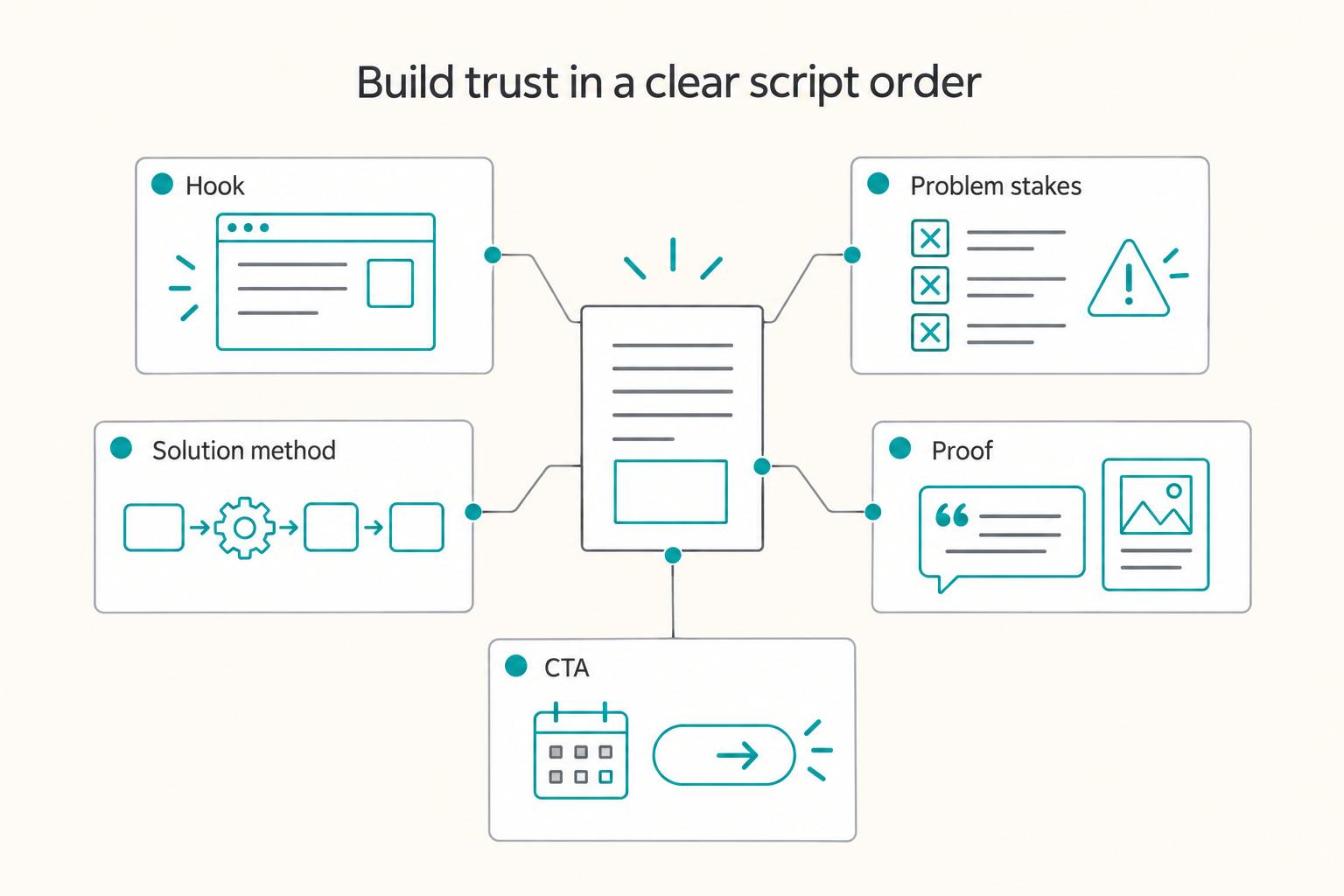
With your brief locked, build trust in a clear order so buyers can judge fit fast: Hook -> Problem stakes -> Solution method -> Proof -> CTA. Use this as a working sequence, not a rigid formula. In 2026, channels are noisier and buyers are harder to move, so your script should reduce decision friction, not add to it.
Step 1. Build the sequence around buyer judgment#
Lead with the buyer's reality, not your intro. In short social formats, your hook needs to land in the first three seconds. In longer contexts like a service page or proposal follow-up, keep the same principle: start with a problem they already recognize in day-to-day operations.
| Sequence step | What to say | What to show | Why it builds trust | Common mistake to avoid |
|---|---|---|---|---|
| Hook | Name a situation the buyer immediately recognizes | Real workflow context: board, doc, handoff, meeting moment | Shows you understand their environment quickly | Opening with your name, logo, or broad positioning claim |
| Problem stakes | Show operational consequences (rework, slow approvals, weak handoffs, missed opportunities, risky decisions with weak information) | Visible friction: stalled tasks, revision loops, dropped ownership | Makes the problem concrete and testable | Vague "this is expensive" language with no specifics |
| Solution method | Explain how you solve the issue in a repeatable way | Your process in action, not buzzwords | Helps buyers evaluate your approach, not just your promise | Overexplaining features and underexplaining decision impact |
| Proof | Add customer voice, outcomes, or a clear before/after artifact | Testimonial line, process snapshot, result evidence | Lets evidence carry the message | Generic claims that still sound persuasive with proof removed |
| CTA | Ask for one clear next step | Calendar link, contact route, service page, diagnostic offer | Lowers decision load and makes action obvious | Asking for too much commitment too early |
If the proof line is removed and the script still sounds equally convincing, tighten the claim or add better support. A polished video cannot rescue weak scripting.
Step 2. Write for the ear, not the page#
Write lines that sound natural when spoken. Keep sentences short, reduce stacked clauses, and read every line aloud before approval.
Before: "Our service delivers end-to-end strategic alignment across your go-to-market functions." After: "We help your sales and marketing teams work from the same plan."
Before: "This creates inefficiencies that negatively impact organizational performance." After: "That slows decisions, creates rework, and makes launches harder than they need to be."
Use analogies or mini transformation stories only if they pass all three checks:
- Clarifies how your method works
- Reinforces credibility with real customer voice or evidence
- Connects naturally to your CTA
If any check fails, cut it. In case-study-style sections, keep outcomes at the center; a practical balance is about 20% problem, 30% solution, 50% results.
Step 3. Review the script like a production checklist#
Before filming, convert the draft into an AV script with duration, voiceover, and shot ideas. Then review each line for alignment: claim, supporting evidence, and visual support.
| Duration | Voiceover claim | Evidence attached in review draft | Visual support |
|---|---|---|---|
| 0-5s | "Your team keeps revisiting the same launch decision." | Internal example or client pattern note | Project board with repeated status changes |
| 5-12s | "That causes delays, unclear ownership, and missed opportunities." | Process snapshot, handoff notes, or comparable case evidence | Timeline slippage, stalled approvals, long comment thread |
| 12-20s | "We run decision-focused workshops to lock priorities, owners, and next steps." | Method artifact and client corroboration | Facilitated session, decision log, action list with owners |
Attach your evidence pack to this review version, not only to the final script. If visuals and voiceover drift apart, trust drops quickly.
You might also find this useful: A Motion Designer's Guide to Licensing Music and Sound Effects.
Phase 3: Crafting the High-Value CTA That Converts Prospects to Clients#
Your CTA is where your trust architecture either becomes action or stalls. Keep it consistent with the same sequence you built in Phase 2: problem, method, proof, then one next step that fits the viewer's current trust level.
Step 1. Match the ask to the trust level#
Use cold, warm, and ready as working labels, not rigid funnel rules. Decision rule: lower trust means lower-friction help; higher trust can support a higher-commitment ask.
| Trust level | Recommended ask type | Friction level | Expected next step |
|---|---|---|---|
| Cold | Education or light discovery | Low | View a relevant resource or a focused page |
| Warm | Diagnostic or fit conversation | Medium | Book a call or request a practical walkthrough |
| Ready | Commercial next step | Higher | Start a proposal or sales conversation |
If your video is still in an awareness context, do not push for a sale. In short prospecting formats, often just under two minutes, you usually have not earned a heavy ask yet.
Step 2. Write the CTA around the outcome#
Benefit-led CTAs convert better than vague feature-led prompts. Use this formula: Action + specific benefit + scope/timeline placeholder + risk reducer.
Example pattern: "Book a [short call] to identify [specific bottleneck] in [timeframe], [low-risk condition]."
| Weak CTA wording | Stronger outcome-led wording | Best-fit context | Why it works |
|---|---|---|---|
| Contact us | Book a short call to identify your biggest handoff bottleneck | Warm visitor | Promises a concrete outcome |
| Learn more | See how we solve [problem] in a practical walkthrough | Cold to warm traffic | Extends trust without forcing commitment |
| Request a proposal | Start with a scoped conversation about your next [project] | Ready buyer | Matches higher intent with a commercial step |
Before publish, check message continuity: if the script promises one outcome, the destination page, form, or calendar copy should promise the same thing.
Step 3. Run a pre-publish QA check#
Review the CTA like an operator before you approve the script:
| QA check | What to verify |
|---|---|
| Message clarity | Can someone repeat the exact next step after one watch? |
| Value exchange | Is the viewer getting a clear benefit before giving time or details? |
| Commitment level | Does the ask match cold, warm, or ready context? |
| Follow-up path | After the click, does the next page continue the same promise? |
| Delivery readiness | Can you reliably deliver the review, walkthrough, or output you offered? |
Most CTA failures come from adding a generic ask at the end. Keep it integrated with your full script system so the final step feels earned, not bolted on. For a step-by-step walkthrough, see How to Write a Cold Email Sequence That Converts for a SaaS Product.
Your Script is Your Most Powerful Risk Management Tool#
Your script is your pre-production control document: it helps you catch avoidable delivery, brand, and conversion mistakes before filming starts. Use it to verify message clarity, visual alignment, and key legal or production risks while changes are still low-cost.
Diagnose risk before you film#
Use this table as a self-check. The difference between no script, a basic script, and a strategic script is what you can verify before production.
| Approach | Reputation self-check | Production efficiency self-check | Business outcome self-check |
|---|---|---|---|
| No script | Can you clearly state the audience, problem, and promise in one sentence? If not, your message will likely feel improvised. | Are visuals, dialogue timing, references, and crew needs still being decided on shoot day? That usually creates rework. | Is there a clear call to action, or are you expecting the viewer to decide what to do next? |
| Basic script | You have talking points, but the opening is still company-first or vague. If the main point is not clear in the first three seconds, attention usually drops. | You know the words, but scene flow and handoffs are still unclear. That often expands editing rounds. | You have a CTA, but proof is weak or disconnected from the problem, so trust stays limited. |
| Strategic script | Your opening is hook-first, problem-first, and audience-specific. One clear position is easy to hear when read aloud. | The script already supports timing, references, and crew planning, and it flags early checks like copyright clearance, safety measures, or possible stunt work. | The narrative moves from problem to implication to solution to proof, then to a CTA that matches trust level. |
Apply this today in five checks#
- Confirm one audience and one problem to frame the section.
- Check the opening: is the hook clear in the first three seconds?
- Add one proof element (result, case example, or process evidence).
- Verify CTA alignment: does the ask continue the promise you made?
- Review production notes for timing, references, crew requirements, copyright clearance, and safety flags.
This will not guarantee performance, and you still need to test. What it gives you is a more consistent message, fewer avoidable production mistakes, and more fit-qualified inquiries from people who understand your offer.
We covered this in detail in How to Write a Newsletter That Your Subscribers Actually Read.
Frequently Asked Questions
What is the best video script structure for B2B services?
Use a clear, problem-first structure so viewers quickly understand the issue, your answer, and why it matters. Before approval, read the opening aloud and revise if the value is not immediately clear.
How do you write a script for a high-value consulting or service offer?
Make the abstract concrete. Start with the problem you solve, then show the consequence of leaving it unaddressed, explain your method in plain language, and end with a clear next step. Read it aloud before approval. If it feels off-brand, trust can weaken, and if benefits are buried in long explanations, engagement can drop.
What should you include in a LinkedIn script template?
Keep it tight, problem-first, and easy to understand quickly. One useful benchmark is to test whether the main message is clear in under 30 seconds, even if that is not a universal rule. | Element | What to include | Common mistake | |---|---|---| | Hook | A specific problem your target audience recognizes immediately | Opening too broadly so relevance is weak | | Core message | One clear idea that states the problem and your answer | Trying to address everyone at once | | Opening clarity | Early language that makes the value obvious quickly | Burying the benefit in long explanations | | CTA | A clear next step that matches the script’s promise | A CTA that jumps beyond what the message supports |
How do you write a strong CTA for a professional services video?
Make the ask clear and consistent with the promise in the script. Before approval, check whether the CTA follows naturally from the message or jumps to a bigger ask.
How long should a marketing video script be?
Let the channel, audience, and job of the video decide the length. Do not start with word count. Start by asking how much context the viewer needs to understand the problem, the implication, your answer, and the next step. If the benefit is buried in long explanation, engagement usually drops.
What is the first step if you want to write script for marketing video that actually works?
Define the audience before you draft anything. Broad targeting weakens relevance, and when you try to speak to everyone, you usually connect with no one. Build a short approval brief with your target audience, single message, desired next step, and proof points, then review it before production spend.
How many drafts should you expect?
More than one. Good scripts often take multiple drafts because message clarity, tone, pacing, and proof usually get sharper through review. If you are approving a final version, use a checklist. An 18-question approval approach is one practical way to catch weak messaging before production.
Try a related tool
Researched and edited by the Gruv editorial team. Gruv builds cross-border billing, payouts, and finance-operations software for global businesses.
Sources
Includes 8 external sources outside the trusted-domain allowlist.
- bamf.com/video-script-templateexternal
- blog.hubspot.com/marketing/how-to-write-a-video-script-htexternal
- blog.vmgstudios.com/how-to-write-video-scriptexternal
- brafton.com/blog/video-marketing/video-script-templateexternal
- btlj.org/data/articles2015/vol28/28_AR/28-berkeley-te...external
- columnfivemedia.com/how-to-write-a-video-script-like-video-agencyexternal
- contentmarketinginstitute.com/video-visual-content/3-scriptwriting-secrets...external
- copyposse.com/blog/how-to-write-a-high-converting-video-sa...external
Educational content only. Not legal, tax, or financial advice.
Related Posts

Thailand's Long-Term Resident (LTR) Visa for Professionals
For a long stay in Thailand, the biggest avoidable risk is doing the right steps in the wrong order. Pick the LTR track first, build the evidence pack that matches it second, and verify live official checkpoints right before every submission or payment. That extra day of discipline usually saves far more time than it costs.
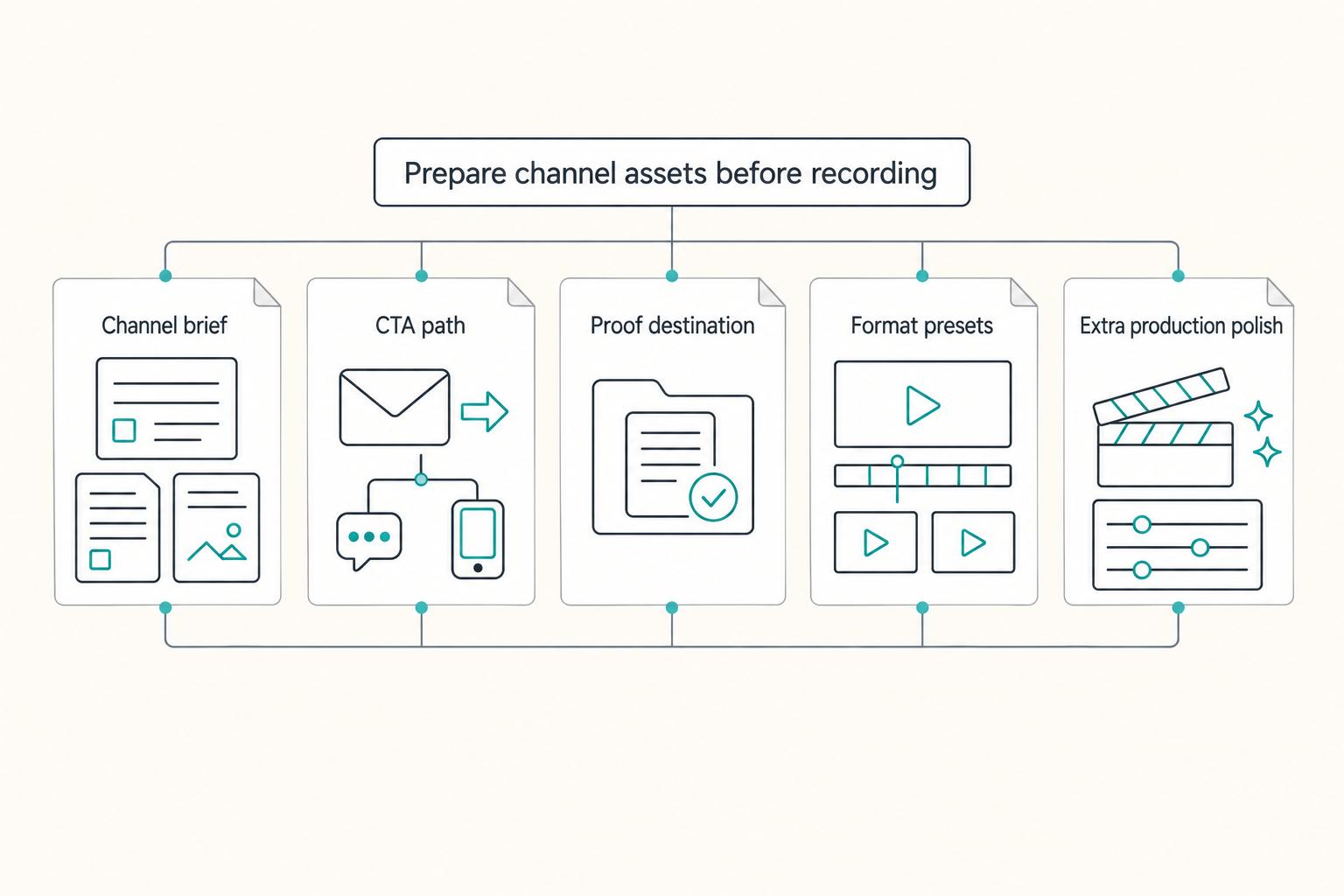
How to Create a YouTube Channel to Showcase Your Freelance Skills
Treat this like a business decision, not a creator identity project. Your goal is to publish videos that attract qualified inquiries instead of random attention.
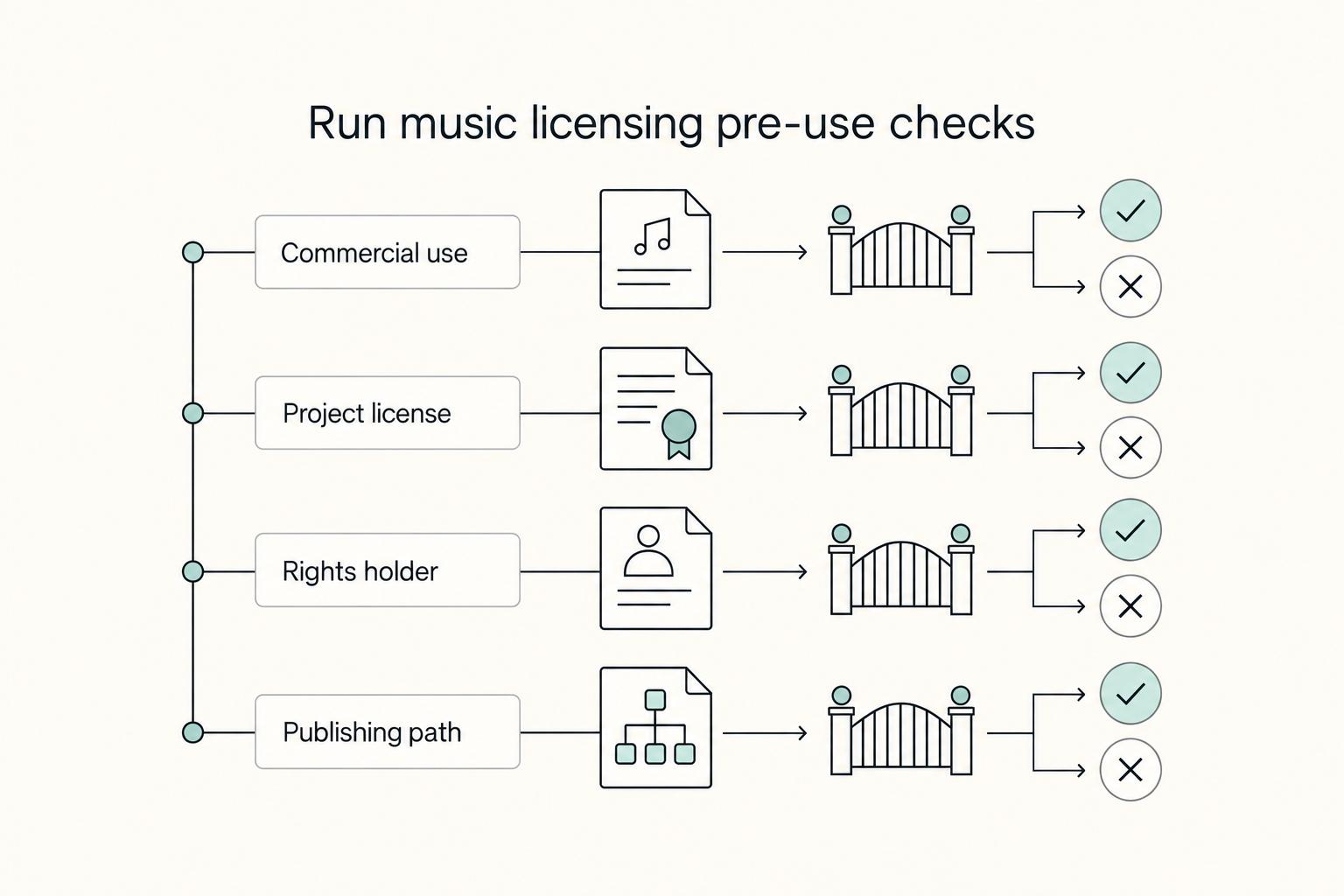
A Motion Designer's Guide to Licensing Music and Sound Effects
When you pick music or SFX for client work, you are making a rights and delivery decision as much as a creative one. In motion design, a strong track is unusable if you cannot show permission for that exact asset in that exact project.