
Quick Answer
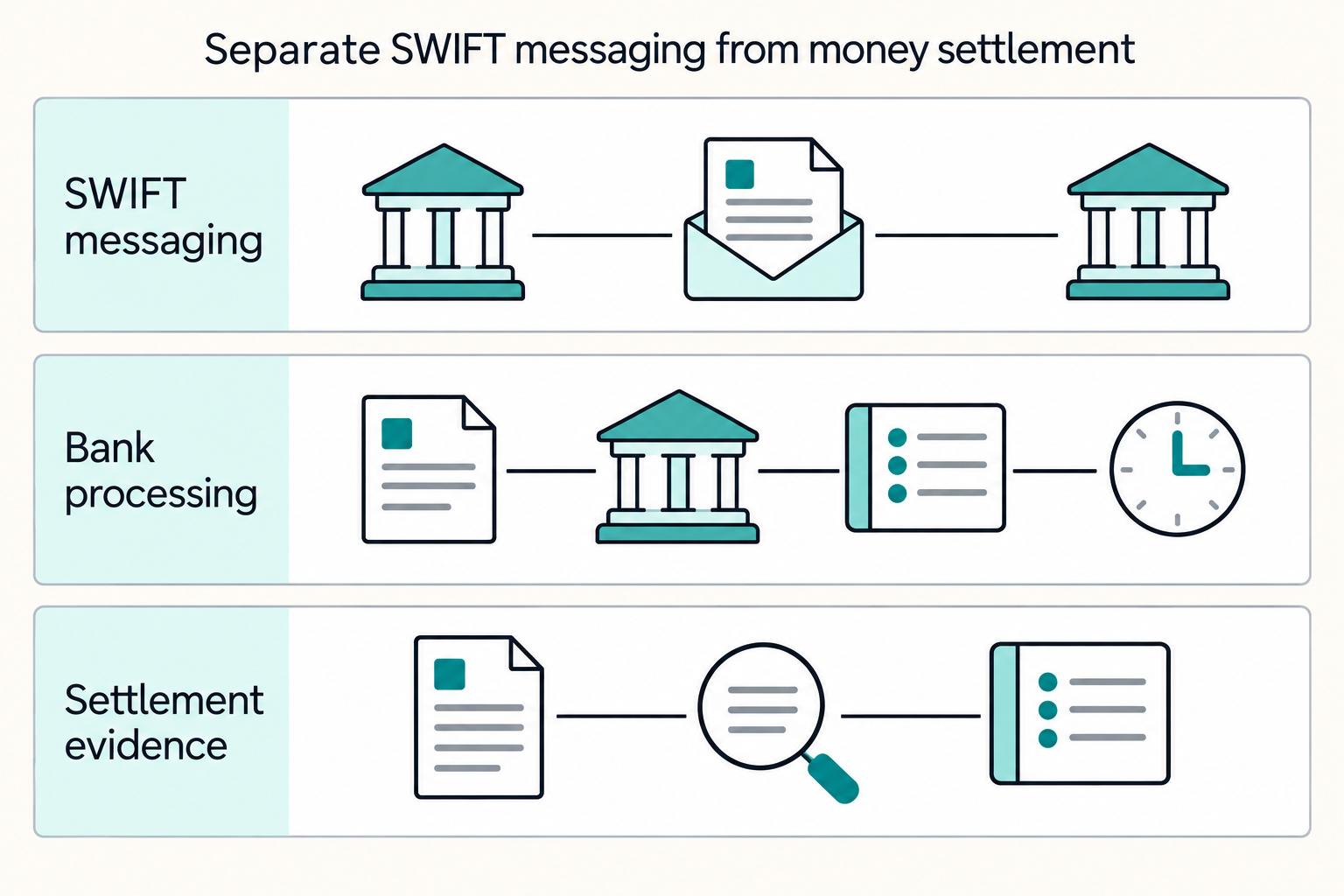
SWIFT is a bank messaging network used to transmit payment instructions between financial institutions; it is not the mechanism that settles funds. For operators, that means a SWIFT transmission record proves instruction handoff, not recipient receipt. In production, keep separate states for message acceptance and final credit, and retain supporting artifacts such as provider references and SWIFT MT103 details when available.
How SWIFT works in cross-border payouts#
Here, SWIFT means the financial network. If you came here asking what is SWIFT, the first practical step is to separate it from the other meaning of the same word. Apple describes Swift as "a powerful and intuitive programming language for all Apple platforms," and its language guide labels that documentation "The Swift Programming Language (6.3)." This article is about the financial context, not Apple development tools.
That naming collision is more than a search-result nuisance. It creates real confusion across product, finance, ops, and engineering when a spec, support note, or vendor thread says only "Swift." A simple rule helps. Write "SWIFT (financial context)" when you mean banking, and "Swift programming language" when you mean Apple. If you leave the term unqualified, the wrong team can end up answering the right problem, or worse, no one is sure which dependency is actually being discussed.
In the finance context, SWIFT publishes documentation for users of "Swift services and products." The glossary excerpt dated 10 February 2026 is enough to anchor the term without turning the introduction into a terminology dump. For an operator, the important point is clarity: teams move faster when the term is qualified and slower when everyone assumes a different meaning.
That is why this article stays practical. It defines the financial meaning in operator terms, then introduces related terms in context. The goal is not to overload you with terminology. It is to help different teams read the same issue the same way.
A useful early check is to review your own documentation and UI labels. If internal tickets, payout exports, or customer-facing help text still say just "Swift," fix that first. That small wording change removes a common failure mode: mixed assumptions about whether you are talking about SWIFT in banking or Apple code. From there, the rest of the article gives you a decision-ready view for teams scaling contractor, creator, and marketplace payouts.
This pairs well with our guide on What Is an IBAN Number? How Platforms Use IBANs to Send Error-Free European Payouts.
SWIFT is a messaging network not a settlement rail#
SWIFT is the interbank messaging layer, not the settlement mechanism. Banks use SWIFT to send secure payment instructions, but SWIFT itself does not hold customer funds or perform final settlement.
For operators, the practical rule is: SWIFT sent does not mean payment completed. Treat instruction transmission and downstream bank processing and settlement as separate states, and make sure your provider exposes evidence for both before you rely on SWIFT-linked payouts at scale.
SWIFT stands for the Society for Worldwide Interbank Financial Telecommunication. SWIFT describes itself as a member-owned cooperative headquartered in Belgium and as infrastructure financial institutions use to send and receive transactions, which is why it functions as banking communications infrastructure rather than a consumer wallet or app.
One more disambiguation prevents internal confusion: financial SWIFT is unrelated to Apple Swift, the programming language. In specs, UI copy, and support macros, write "SWIFT payment messaging" on first mention so teams do not misread dependencies.
If you need the operator version, this is it: a bank-to-bank messaging network that tells institutions how to handle a payment, not proof that funds have arrived.
We covered this in detail in What Is ACH? The Automated Clearing House Explained for Platform Operators.
Where SWIFT fits in a cross-border payout architecture#
In a cross-border payout architecture, SWIFT is the messaging layer between your payout request and downstream bank processing, not the step that proves money arrived.
The sequence should stay explicit:
- Your platform creates a payout request.
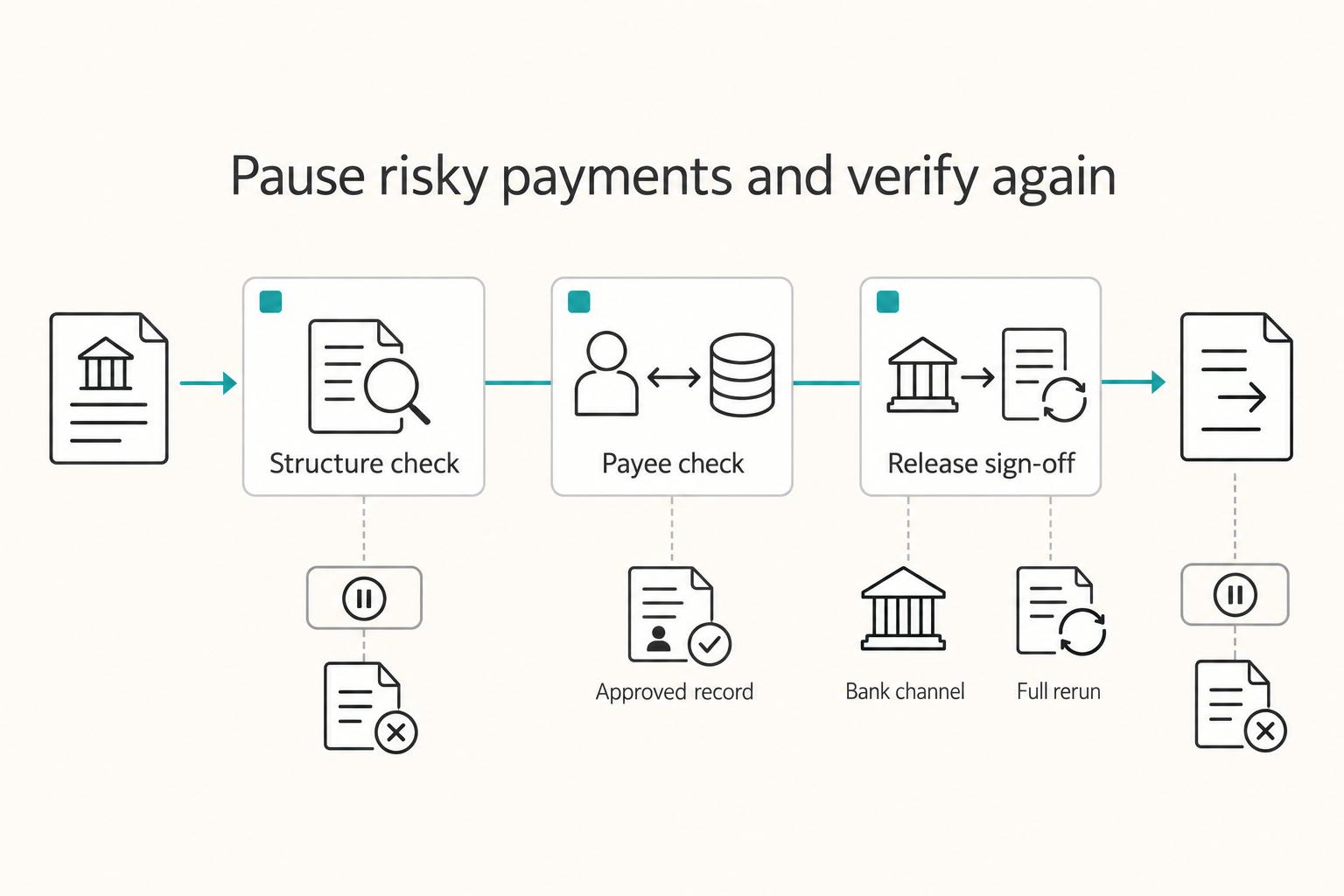
- Routing and beneficiary details are validated before release.
- The bank or provider sends the interbank instruction over SWIFTNet.
- Sending, intermediary, and receiving banks process that instruction.
- Settlement and beneficiary credit happen downstream.
Treat step 3 as transmission evidence, not completion evidence. A SWIFTNet message means the instruction entered the bank chain; it does not confirm beneficiary credit or final settlement. In many cross-border paths, one or more intermediary or correspondent banks can add processing time or fees.
Design statuses to match that reality. Keep separate states for message sent/accepted and funds settled/beneficiary credited so support does not overstate completion.
For reconciliation, tie each state to the right proof:
- Message sent/accepted: provider reference, transmission timestamp, and message artifact.
- Funds settled/credited: downstream bank outcome confirmation.
If you run high-volume payouts, reconcile across both joins:
- internal payout ID -> provider reference
- provider reference -> message artifact -> downstream outcome
That extra join prevents false positives from balance movements alone. A wallet debit can show funds moved out of your side, while recipient-side processing is still in progress. SWIFT's end-to-end traceability is useful, but your own records still need to answer "was it sent?" and "was it received?" as separate questions.
One final caution: some linked cross-border setups can run around the clock and may reach beneficiaries within seconds, but that is corridor-specific and not a default SWIFT outcome.
The identifiers and standards that decide whether payment instructions are usable#
A payment instruction is only operationally usable when your team can submit the required identifier fields for that corridor and retrieve the message evidence needed for support and reconciliation.
In practice, teams usually work across three artifacts: institution identifiers, often labeled BIC/SWIFT code; account identifiers, often labeled IBAN in some corridors; and a traceable message record such as SWIFT MT103. This section does not establish universal BIC or IBAN field rules, so treat provider- and corridor-level validation as the release gate.
| Artifact | What to use it for in ops | What is grounded here |
|---|---|---|
| BIC / SWIFT code | Institution-identifier field in payout setup and routing workflows | Naming appears in operations, but structure and mandatory-use rules are corridor-specific and not documented here |
| IBAN | Account-identifier field in corridors where your provider requires it | Requirement and format rules are corridor-specific and not documented here |
| SWIFT MT103 | Message artifact used in investigations and bank-message handling workflows | Explicitly referenced in SWIFT usage guidance, including cancellation flows with separate MT 202 COV |
For trace handling, the grounded point is clear: SWIFT usage guidance exists to clarify message-standard use, and it explicitly documents a cancellation scenario for an MT 103 Payment Instruction with separate MT 202 COV cover. So keep the transfer artifact your bank or provider exposes instead of relying on a single "wire sent" status. If you need more depth, see What is a SWIFT MT103 and How to Use It to Trace a Wire Transfer.
On standards migration, ISO 20022 is maintained by ISO/TC 68, and operators should plan for mixed-message reality rather than assuming a one-step conversion. J.P. Morgan states that:
- from November 2025, Swift supervised and non-supervised entities migrated to FINPlus ISO 20022 MX messages after coexistence ended,
- non-MX-enabled institutions may still use Swift in-flow translation if required FINPlus connection work was completed in March 2023,
- MT9xx reporting remains on MT until opt-in to MX (camt) in late 2026, with reporting coexistence noted through November 2028.
Operationally, keep your data model explicit about institution identifier, account identifier, and trace artifact, then validate each requirement against your provider's corridor rules before release. For related identifier context, see What is an IBAN and How is it Different from a SWIFT Code?.
When SWIFT is the right choice for your payout flow#
Use a SWIFT-compatible route when your main requirement is bank-to-bank international instruction coverage across many institutions. If a payout is fully domestic and a local scheme is available in that corridor through your provider, assess that route on its own terms instead of forcing every case through one bank-messaging path.
This is a coverage-versus-operations tradeoff. SWIFT is built for secure interbank messaging and broad cross-border reach, often described as over 10,000 or over 11,000 institutions across more than 200 countries. But wider reach can also mean more handoffs, so status visibility and escalation ownership need to be designed up front.
| Option | Bank reach | Message standardization | Support traceability | Operational control points |
|---|---|---|---|---|
| SWIFT-compatible bank route | Broad international bank coverage across many institutions and countries | Strong fit for standardized bank messaging, including ISO 20022 adoption for cross-border payments | Usually stronger when your provider exposes clear transfer references and message-level artifacts | Validate required beneficiary fields, store provider references and send timestamps, and define escalation ownership |
| Direct local domestic rail | Corridor-limited to where the local scheme and provider support it | Depends on the local scheme and provider implementation | Trace methods often differ from bank-wire workflows | Confirm scheme eligibility, recipient data requirements, provider support, and domestic exception handling |
| Corridor-by-corridor mix | Reach depends on how well each corridor is mapped to the right rail | Mixed standards across routes, which increases product and ops complexity | Evidence and support workflows vary by rail | Maintain explicit routing rules by corridor and keep support playbooks aligned to each rail |
Make the rule set explicit at corridor level. Document the allowed rail, required beneficiary data, expected references, and exact escalation path for delays so product, ops, and support apply the same logic.
Related: What Is a SWIFT Code? How Platforms Use BIC Codes to Route International Payouts.
Implementation checkpoints before you scale volume#
SWIFT compatibility is a baseline, not a go-live decision. In SWIFT's SWIFT Compatible Application for Corporates, Cash Management 2023 material, validation covers compatibility with standards, messaging services, and connectivity, and SWIFT explicitly says that validation is not an endorsement, warranty, or guarantee and does not assure a particular service level or outcome.
Before you scale volume, treat that compatibility result as one input in a broader launch check owned by product, engineering, finance, and ops. Your internal evidence should clearly show what your flow validates, how your tests behaved, and how support and reconciliation teams will trace issues when outcomes do not match expectations.
Use a simple rule: if your team cannot open one shared operating document and see the control checks and escalation path, the route is not ready to scale. Compatibility confirms alignment with SWIFT requirements; it does not replace your own production controls.
If your team uses MT103 artifacts for trace work, tie that process to the same internal operating runbook. For context, see What is a SWIFT MT103 and How to Use It to Trace a Wire Transfer.
Failure modes teams underestimate in SWIFT-linked payouts#
The most expensive failures are usually control and visibility failures, not obvious system outages. Cases stall because teams cannot prove state, cannot trace the right artifact quickly, or route the issue to the right owner.
| Failure mode | Why it matters | Grounded response |
|---|---|---|
| Early acknowledgment misread as final outcome | A payout can be treated as fully complete even though downstream controls, including sanctions screening filters, can still affect outcome | Keep customer-facing status language tied to your actual reconciliation evidence, not the first upstream acknowledgment |
| Fragmented payout history across systems and teams | It reduces end-to-end visibility and makes anomaly or failure investigation more time and resource intensive | Treat traceability as one chain: internal request, provider reference, ledger outcome, and trace artifact in one discoverable case path |
| Generic "payment failed" queue | Different missing or conflicting artifacts get collapsed into one label, which creates handoff loops | Route by the missing or conflicting artifact, assign a clear owner, and require the resolving evidence in the case record |
Weak intake and validation still create avoidable exception work. Before release, make sure your corridor evidence pack is explicit about required fields, validation behavior, and deliberately bad test cases that fail as expected. Passing UAT alone is not enough, because controlled scenarios do not by themselves prove production readiness or operational safety under live conditions.
Early acknowledgment can be misread as final outcome#
A common design gap is treating early technical acceptance as if the payout is fully complete. Keep customer-facing status language tied to your actual reconciliation evidence, not the first upstream acknowledgment.
Downstream controls can still affect outcome, including sanctions screening filters. Those controls also need robust implementation and ongoing testing, and filter tuning is a tradeoff between effectiveness and efficiency.
Fragmented trace data slows every escalation#
Escalations get slower and riskier when payout history is fragmented across systems and teams. Fragmented data reduces end-to-end visibility and makes anomaly or failure investigation more time and resource intensive.
Treat traceability as one chain: internal request, provider reference, ledger outcome, and trace artifact in one discoverable case path. If you need a refresher on trace artifacts, see What is a SWIFT MT103 and How to Use It to Trace a Wire Transfer.
Escalate by artifact, not by generic labels#
Do not collapse everything into a single "payment failed" queue. Route by the missing or conflicting artifact, assign a clear owner, and require the resolving evidence in the case record.
That model cuts handoff loops and makes investigations faster because ownership follows the document or control that is actually broken. For a practical field-level comparison, see IBAN vs SWIFT for International Contractor Payouts on Platforms.
Ownership model and governance signals that matter#
Treat SWIFT as messaging infrastructure, not a settlement provider. A Swift service bureau provides secure, certified access to the Swift messaging network, and that role does not include moving funds, holding customer money, or deciding when settlement happens.
When a partner says they are "on SWIFT," separate the promise into parts: connectivity, bank access, payout processing, and downstream settlement handling. Confirm who owns each step and what artifact trail you will use if a payment is delayed, because vague ownership usually turns into trace and reconciliation pain.
Use network signals carefully. Sibos is useful for direction, not proof of current delivery performance in your corridor. For example, Swift announced at Sibos in Frankfurt on September 29, 2025 that it would work with more than 30 financial institutions on a shared digital ledger, with an initial focus on real-time 24/7 cross-border payments. That is roadmap context, not confirmation that your current program can run that model today.
The real control point is country and program variation. Regulatory requirements vary by jurisdiction, and implementation depends on corridor and partner setup, so document eligibility, controls, and escalation ownership at corridor level before launch. If Telex comes up, keep it as historical context for why standardized messaging replaced legacy approaches.
The takeaway for platform operators#
Treat SWIFT as critical messaging infrastructure in cross-border payouts, not the full movement-of-money stack. That distinction should shape your status model, recipient communications, and reconciliation process.
A payment instruction can be created, transmitted, and accepted while funds are still moving through downstream banks. So sent via SWIFT is not a completion state. Transfers can still involve fees and take days to resolve, so keep a hard separation between message acceptance and confirmed receipt or settlement.
Execution quality comes from concrete controls:
- Validate required routing identifiers before release, and validate each required field independently.
- Preserve trace artifacts for every payout, including provider references, key timestamps, and status changes.
- Reconcile end to end: request, provider reference, and ledger outcome, so delayed, rejected, or manually repaired transfers stay visible.
Before launch, confirm corridor-by-corridor details with your provider: where a SWIFT route is supported, which beneficiary fields are mandatory, what downstream dependencies apply, and what trace documentation is available. Then document those decision rules in product and ops so onboarding, payout creation, and support follow the same logic.
Do not treat compatibility labels as outcome guarantees. Swift states that validation is not an endorsement, warranty, or guarantee, and does not assure a specific service level or result.
That is the operator answer: SWIFT is useful infrastructure, but only one layer of payout execution. User experience depends on the controls you build around it.
You might also find this useful: Choosing SWIFT or Local Bank Transfers for Cross-Border Platform Payouts.
Frequently Asked Questions
What does SWIFT stand for in banking?
In banking context, SWIFT refers to a secure, standardized messaging network that financial institutions use to communicate transaction instructions. You will also hear people use “SWIFT” as shorthand for SWIFT messages in a bank payment flow.
Is SWIFT a payment network or a messaging network?
It is a messaging network. That matters because a message can be created, transmitted, and accepted while the actual payment still depends on downstream bank processing, correspondent accounts, or clearing systems. A bank saying “the SWIFT was sent” is not the same as saying the beneficiary has the money.
Does SWIFT actually move money?
No. SWIFT messages carry instructions, but the funds themselves move through correspondent accounts or clearing systems. If your internal status only shows “sent via SWIFT,” add a separate checkpoint for settlement or confirmed receipt so support teams do not overstate completion.
Who owns and operates SWIFT?
For operator purposes, treat SWIFT as institutional messaging infrastructure, not as your payout platform and not as the recipient. Swift says message data is stored in operating centers in the Netherlands, Switzerland, and the United States, with three operating centers across two zones for redundancy. If you need legal ownership or contracting details, verify them directly in SWIFT’s corporate and legal materials rather than relying on a generic vendor summary.
How is a SWIFT code different from an IBAN?
Do not treat them as interchangeable without checking provider and corridor requirements.
What is a SWIFT MT103 and when do ops teams need it?
An MT103 is a SWIFT payment message commonly used as proof of payment and for tracing delayed or missing cross-border transfers. Ops teams often need it during recipient disputes, bank escalations, or any case where a provider says a transfer was sent but the beneficiary has not received funds. Ask for the MT103 together with the provider reference and timestamps, and keep those artifacts in the case file. Legacy MT formats are being replaced by ISO 20022 XML-based formats, but MT103 is still a familiar trace document in support and bank investigations. For a deeper breakdown, see What is a SWIFT MT103 and How to Use It to Trace a Wire Transfer.
Is SWIFT the same thing as Apple Swift?
In this article, SWIFT refers to banking and payment-message context.
Try a related tool
Researched and edited by the Gruv editorial team. Gruv builds cross-border billing, payouts, and finance-operations software for global businesses.
Sources
Includes 5 external sources outside the trusted-domain allowlist.
- cftc.gov/sites/default/files/idc/groups/public/@newsr...trusted
- en.wikipedia.org/wiki/Swift_(programming_languagetrusted
- tile.loc.gov/storage-services/master/gdc/gdcebookspublic/...trusted
- airwallex.com/us/blog/what-is-the-swift-payment-networkexternal
- arxiv.org/html/2408.05517v3external
- computer.org/csdl/journal/td/2024/09/10601499/1YGs8fX32Ccexternal
- docs.swift.org/swift-book/LanguageGuide/TheBasics.htmlexternal
- focus.world-exchanges.org/articles/questions-fmi-technology-teams-ofte...external
Educational content only. Not legal, tax, or financial advice.
Related Posts

How to Use a SWIFT MT103 to Trace a Delayed Wire Transfer
Start with `Field 20`, then verify the core details before you contact support. That gives your bank a usable trace anchor and helps you avoid delays caused by mismatched payment data.
What is an IBAN and How is it Different from a SWIFT Code?
For people handling high-stakes international payments, uncertainty is expensive. Not knowing whether a wire will arrive on time, or at all, pulls attention away from the work and adds avoidable risk. The fix is not another generic template. It is a repeatable process that tells you which details matter, where to get them, and how to check them before money moves.
What Is a SWIFT Code? How Platforms Use BIC Codes to Route International Payouts
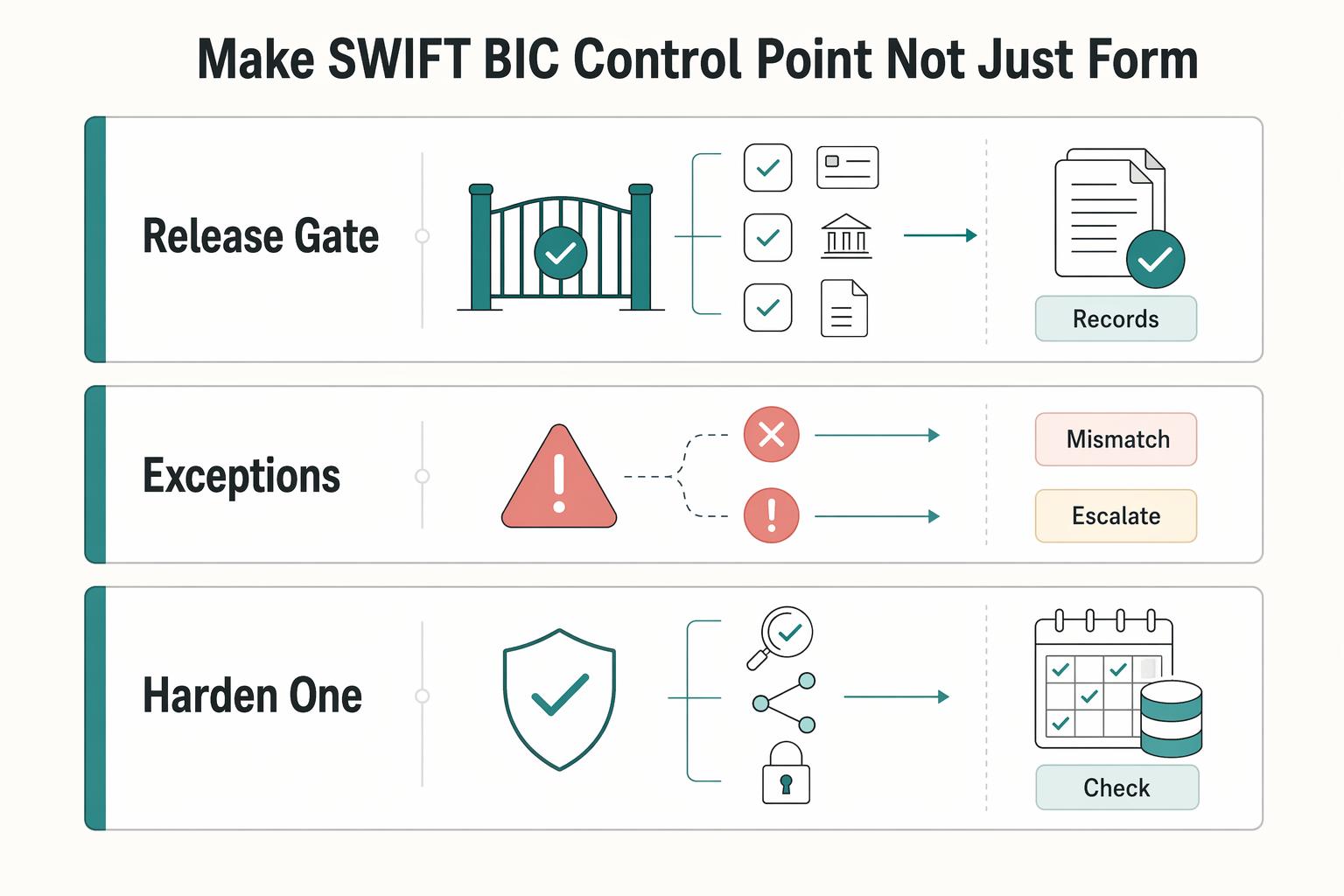
This guide exists because SWIFT and BIC data are not just banking labels. In a production cross-border payout flow, they are release-control inputs. A wrong value can stop processing, create extra fees, or trigger follow-up work your team should have prevented upstream.