
Quick Answer
Prioritize a staged launch model for virtual assistant rates by country: shortlist markets from directional rate signals, then run a narrow pilot that tests onboarding, payout handling, and compliance ownership end to end. The article’s core recommendation is to avoid committing based on blog-level comparisons alone and move forward only after auditability checks pass. In practice, that means country selection is a sequencing decision, not a pricing shortcut.
How to Compare Virtual Assistant Rates by Country#
Country-level rate comparisons can help you narrow a shortlist, but they should not decide where you launch. For a platform founder or operator, the real test is whether cost and talent fit still hold up once you move past a few hires and whether your own payment and compliance processes can support repeatable volume.
-
Rates are directional, not decisive. A virtual assistant is a remote professional who provides administrative, technical, or creative support. That wide job scope is exactly why published rate comparisons need caution. VA pay varies by specialization and the nature of the work, and country choice is not just about who is cheapest or who speaks English best. Role fit is the real differentiator. A low headline rate for general admin does not automatically translate into a good market for customer-facing support, executive assistance, or specialist task queues.
-
This guide is for operators making market-entry decisions, not one-off hires. The evidence available in search today is useful, but much of it comes from vendor and blog content rather than audited market reporting. For example, one article updated on March 31, 2025 discusses the global pool of VA talent, and another presents its analysis as a five-country comparison. That is enough to form a starting view, but not enough to skip operator checks. If you cannot clearly assign ownership for onboarding, verification, payout exceptions, and compliance signoff, a cheap market can still erode the expected rate advantage.
-
Known signals matter, but unknowns matter more when you scale. Some published claims are still worth keeping in view: offshore hiring is reported to reduce labor costs by up to 70%, and the Latin America VA market is pegged at $5.43 billion in 2023 with a projected 12.9% annual growth rate from 2024 to 2032. Those numbers can help you spot demand and cost direction. They do not, by themselves, establish payout reliability or compliance performance.
That is the lens for the rest of the guide. We stay close to what the evidence actually supports, call out where the evidence is thin, and avoid treating blog-level market claims as global truth.
If you are comparing countries for expansion, make staged decisions. Start with a narrow country hypothesis, verify that onboarding and payouts can be handled end to end, and only then commit more GTM effort. A market is not really attractive if the first pilot creates more payment and compliance noise than hiring value.
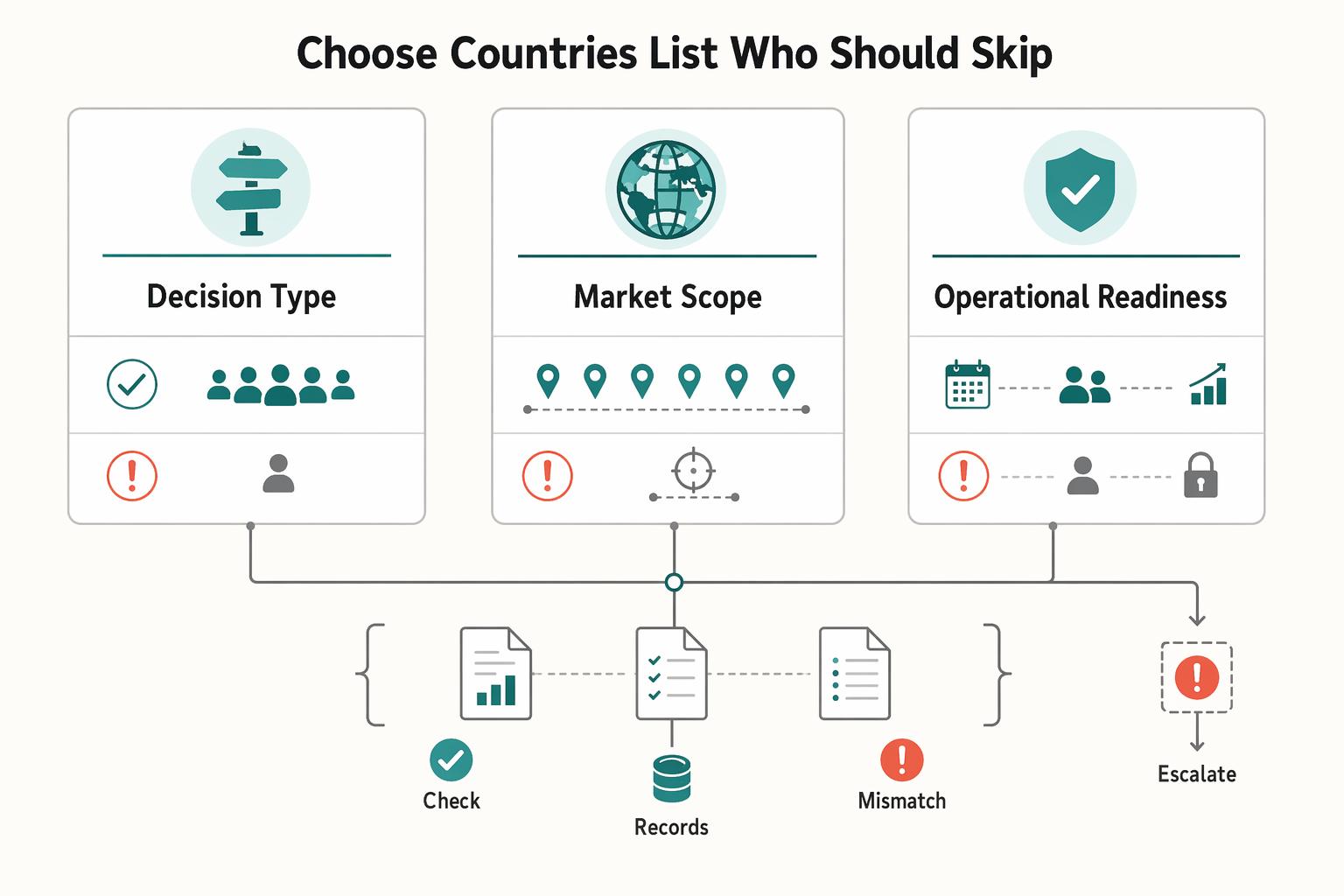
How to choose countries for this list and who should skip it#
Use this list when your decision is about repeatable, clean scale across markets, not a one-off hire.
| Decision point | Use this framework when | Pause or skip when |
|---|---|---|
| Decision type | The decision is about repeatable, clean scale across markets. | You only need one contractor for ad hoc work. |
| Market scope | You are evaluating the Philippines, India, Eastern Europe, Latin America, the United States, and Canada as launch options. | This framework is heavier than necessary for one-off hiring. |
| Operational readiness | A country stays on the shortlist only if rate upside still holds after payee verification, AML review, payout handling, and documentation workflows are tested. | Delay expansion if owners for compliance signoff, payee verification, payout exception handling, and reconciliation are unclear. |
- Use it for six market buckets, not freelancer browsing
This comparison is for operators evaluating the Philippines, India, Eastern Europe, Latin America, the United States, and Canada as launch options. It helps you compare cost depth, team overlap, and onshore context in one view. Keep commercial market stats in context: one guide claims the Philippines represents 15-20% of the global BPO market and lists an average annual salary of USD 11,000, but those are vendor claims, not audited benchmarks.
- Prioritize what survives compliance and payout operations
Keep a country on the shortlist only if rate upside still holds after payee verification, AML review, payout handling, and documentation workflows are tested. Regulatory context changes, so your screen should be current: the DOJ rule was published on 01/08/2025, the linked correcting amendment is dated 04/18/2025, and the eCFR view for 28 CFR Part 202 shows Title 28 up to date as of 3/27/2026 and last amended 3/16/2026. In practice, confirm ownership for onboarding review, document checks, payout holds, and exception visibility before launch.
- Skip this method for one-off hiring, and pause if ownership is unclear
If you only need one contractor for ad hoc work, this framework is heavier than necessary. It is built for platform operations where the same country flow must work across many payees and payouts. If you cannot name owners for compliance signoff, payee verification, payout exception handling, and reconciliation up front, delay expansion even if nominal rates look attractive.
What the market data currently supports and where it is incomplete#
The current evidence supports caution more than country-rate benchmarking.
| Region/country | Observed rate signal | Role maturity signal | Confidence level of evidence |
|---|---|---|---|
| Philippines | No decision-grade country-rate evidence is provided in the excerpts used for this section. | No method-backed maturity signal for role mix is confirmed here. | Low |
| India | No decision-grade country-rate evidence is provided in the excerpts used for this section. | No method-backed maturity signal for role mix is confirmed here. | Low |
| United States | No decision-grade country-rate evidence is provided in the excerpts used for this section. | No method-backed maturity signal for role mix is confirmed here. | Low |
| Canada | No decision-grade country-rate evidence is provided in the excerpts used for this section. | No method-backed maturity signal for role mix is confirmed here. | Low |
The operating judgment is straightforward: treat these rows as placeholders for validation work, not as budget inputs. Until you have method-matched, country-specific pay evidence, confidence should remain low.
How to read the named sources#
For GlobalTeam, Virtual Done Well, HireOverseas, and LinkedIn mirrors, keep confidence low here. The sources named in this section do not provide enough comparable, country-rate methodology detail to validate them as pricing evidence.
What should not count as rate evidence#
The Metastat Insight Virtual Assistant Market page is a commercial listing, not a validated country-pay dataset in the excerpt. It shows Buy Now - $2,950, 257 Pages, February 8, 2026, and Forecasts 2025-2032, while also showing placeholder fields such as Market Size 2026 XX.X% and segmentation by type/deployment rather than country labor-rate tables.
| Source | Cited detail | Why it does not count |
|---|---|---|
| Metastat Insight Virtual Assistant Market page | Buy Now - $2,950; 257 Pages; February 8, 2026; Forecasts 2025-2032; Market Size 2026 XX.X% | Commercial listing, not a validated country-pay dataset; segmentation is by type and deployment rather than country labor-rate tables. |
| GlobeNewswire headline | $1.92 Trillion AI in healthcare; 2026-2040 | Not country-by-country VA pay evidence. |
| ScienceDirect article | Empathic voice assistants: Enhancing consumer responses in voice commerce | About voice-commerce outcomes, not hiring-rate benchmarks. |
A GlobeNewswire headline about $1.92 Trillion AI in healthcare for 2026-2040 is not country-by-country VA pay evidence, and a ScienceDirect article on Empathic voice assistants: Enhancing consumer responses in voice commerce is about voice-commerce outcomes, not hiring-rate benchmarks.
This section does not include a payments-ops source, so none should be inferred.
For platform and channel selection by country, see Where to Hire a Virtual Assistant Without Creating Compliance Risk.
Philippines as the best first offshore market for English-heavy support#
For English-heavy support queues, the Philippines is a strong first offshore pilot, not a universal best choice. One source is explicit that there is no single best country for virtual assistants, so this should be a fit-based decision.
The practical case is the overlap of vendor-level signals: cost efficiency, talent depth, and stronger positioning for voice-heavy support with native-English fluency. Cherry Assistant describes the Philippines as often best for cost efficiency and talent depth, and Wishup positions it as the stronger choice for voice-heavy support.
Use rate snippets as directional, not as final budget inputs. Wishup lists median VA pay in the Philippines at ₱116.94/hr (~$2.0/hr), but that is a vendor-stated comparison point, not a market-wide benchmark.
Before you expand scope, keep the tradeoff visible: the same Wishup comparison says India has attrition rates 15 to 20 percentage points lower than the Philippines. Start with the queues where English-heavy communication matters most, then expand only after the pilot proves operational fit. For payment operations context, see paying Filipino virtual assistants from the US. Related: The Philippines as a Freelance Hub: A Market Analysis.
India as the best depth market for process-heavy and scalable queues#
If your bottleneck is staffing depth for SOP-led queues, India is a strong expansion choice in the available evidence. The case is process coverage and continuity for ops-heavy work, not a universal ranking.
- Depth for ops-heavy staffing
One excerpt describes India as a "deeper pool for ops-heavy + tech-adjacent support," with "lower costs for tech-heavy and ops-driven work, and a larger specialist talent pool." That supports India when you need to staff multiple process-heavy queue types at once.
- Use rate data as directional, not absolute
The same comparison lists median VA pay at ₹243/hr (~$2.7/hr) for India. Treat that as directional input, not a fixed budget assumption, because this is single-source, vendor-authored evidence.
- Continuity is a key operating signal in this source
The excerpted table cites 23-35% attrition for India and claims India is 15 to 20 percentage points lower than the Philippines. It also links lower churn to more stable QA baselines and fewer escalations, which matters when rehire, retraining, and QA reset work are slowing output.
- Keep queue fit explicit
This same source also says the Philippines remains stronger for voice-heavy support that depends on native English fluency. A practical rule is to scale India first for structured, process-led operations, then widen by queue type after performance is stable.
Eastern Europe and Latin America as the best overlap-driven options#
Treat Eastern Europe and Latin America as validation-first options: decide from pilot results and tax setup, not from assumed rate or overlap advantages.
-
Latin America: Use a narrow pilot before scale. The current evidence set does not provide verified regional rate levels or schedule-overlap benchmarks, so keep early scope focused and require hard checks on response times, replacement speed, and payout success before expanding coordination-heavy roles.
-
Eastern Europe: If your provider or contractor is in the EU, VAT handling is often the real operational gate. Ask for proof of VAT setup up front and confirm who owns cross-border tax treatment.
For EU VAT operations in Eastern Europe, validate these mechanisms directly with the supplier:
| Mechanism | What to confirm |
|---|---|
| One Stop Shop (OSS) | Whether they register in one Member State for VAT declaration/payment on covered cross-border supplies. |
| VAT Cross-border Rulings (CBR) | Whether they requested an advance ruling in the EU country where they are VAT-registered for complex cross-border VAT cases. |
| Cross-border SME scheme | Whether they filed one prior notification in their Member State of establishment, remain under the EUR 100,000 Union turnover cap, and track the stated process target of 35 working days. |
Use a split-by-risk approach: scale coordination-heavy scope only after pilot evidence is clear, and pause expansion if a provider cannot document VAT registration status, OSS use (if relevant), and ownership of cross-border tax treatment.
Related reading: Is a No-Tax Country Really Tax-Free for a US Citizen?.
Onshore markets as the best option for high-stakes specialist work#
For sensitive, high-failure-cost work, onshore is usually the safer choice: you pay more for local context, native fluency, and same-timezone coordination in the United States, Canada, Australia, or Britain. In the cited editorial ranges, onshore support is $35 to $75+ per hour versus $8 to $25 per hour offshore, so this is a targeted tradeoff, not a default staffing model.
- Best for: high-risk client accounts, executive support, and specialist tasks where communication or timing errors are expensive.
- Key pros: stronger local communication fit, cultural familiarity, and faster live handoffs during local business hours.
- Key cons: materially higher cost than offshore options.
- Practical split: keep high-risk and specialist workflows onshore, then route documented, repeatable tasks offshore to protect margin.
The operator checklist that should change your country ranking#
Country rankings should change when operations are auditable, not when hourly rates look better. If you cannot trace compliance artifacts and payout exceptions end to end, that market is not ready.
| Checkpoint | What to verify | Limit noted in the article |
|---|---|---|
| Compliance path | Confirm the required onboarding documents, the exact actions blocked when verification is incomplete, and which status or reason codes your team can actually see. | Confirm country-specific KYC, KYB, AML, and VAT rules with the relevant authority. |
| Tax-document scope | Define W-8, W-9, and Form 1099 handling by payer/payee profile. | Verify filing thresholds and country-specific rules with the relevant authority. |
| FEIE review trigger | Physical presence test: 330 full days during any period of 12 consecutive months; days do not have to be consecutive; for tax year 2026, the maximum FEIE is $132,900 per person; excluded income is still reported on a U.S. return. | IRS international FAQs are not citable as legal authority. |
| Money movement design | Compare Virtual Accounts, Merchant of Record, and payout batching based on traceability from source balance or invoice through payout instruction, beneficiary, and settlement outcome. | Confirm with a qualified adviser when each model is correct for your situation. |
| Launch checkpoints | Define pilot pass/fail criteria for activation completion, payout-failure handling, reconciliation completeness, and rollback triggers. | Verify benchmark payout-failure thresholds with your payment provider. |
| Go/no-go rule | If payout exceptions and compliance artifacts are not auditable end to end, do not treat the country as ready. | This holds regardless of nominal rate advantage. |
- Verify the compliance path before you score the market.
The sources used here do not establish country-specific KYC, KYB, AML, or VAT rules, so treat them as verification items, not assumptions. Confirm the required onboarding documents, the exact actions blocked when verification is incomplete, and which status or reason codes your team can actually see.
- Define tax-document scope early, and separate it from tax advice.
W-8, W-9, and Form 1099 handling should be defined by payer/payee profile, but do not assume filing thresholds or country-specific rules are established for those forms. FEIE is also conditional: IRS guidance says someone may qualify only if requirements are met, including foreign earned income and a foreign-country tax home. One path uses the physical presence test: 330 full days during any period of 12 consecutive months, and those days do not have to be consecutive. For tax year 2026, the maximum FEIE is $132,900 per person, and excluded income is still reported on a U.S. return. If FEIE or FBAR appears in a workflow, treat it as a review trigger, and remember IRS international FAQs are not citable as legal authority.
- Map money movement design before comparing rate bands.
Virtual Accounts, Merchant of Record, and payout batching can change operating load. Rank markets based on what you can verify in product and finance: traceability from source balance or invoice through payout instruction, beneficiary, and settlement outcome.
- Set launch checkpoints before expansion.
Define pilot pass/fail criteria up front for activation completion, payout-failure handling, reconciliation completeness, and rollback triggers. Since benchmark payout-failure thresholds are not established, make your own thresholds explicit and conservative rather than implied.
- Use one final go/no-go rule: auditability.
If payout exceptions and compliance artifacts are not auditable end to end, do not treat the country as ready, regardless of nominal rate advantage.
If payout reliability is part of the sourcing decision, use the Payout Failure Benchmark Report: Success Rates by Rail, Country, and Error Code alongside rate comparisons.
Conclusion#
The right move is not chasing the cheapest market. It is choosing the country where cost, talent supply, and payout and compliance execution still hold together as volume goes up.
- Score the evidence before you score the country.
Use published rate signals to build a shortlist, then mark how much you trust each source. A post can be current, including one published on November 26, 2025, and still leave important context unclear. If a market looks attractive because one site says the Philippines accounts for 15-20% of the global BPO market or cites an average annual salary of USD 11,000, treat that as a directional signal, not a commitment trigger. What makes this step useful is comparing confidence and operating fit, not just price.
- Run a controlled pilot that tests operations, not just hiring.
A country is not validated because you found candidates quickly. It is validated when your team can run initial payout cycles and handle exceptions without ad hoc workarounds. Bulk payment solutions can help global VA teams, and Virtual Accounts can support financial operations, but those only help if your team can monitor outcomes and resolve issues quickly. The real differentiator is visibility. If you cannot verify what happened at each step, you should not scale that market.
- Expand only after coverage and ownership are explicit.
Once a pilot passes, confirm that your provider and payout setup support the market you want to roll out. Then align product, payments ops, and compliance on a shared go or no-go decision, with clear owners for blocked actions and payout exceptions. This matters even in markets that look promising on paper. For example, one source points to Malaysia's BPO sector growing at 8% annually, which may justify watching the market, but growth alone is not a launch case if your execution path is unclear. What separates a scalable market from an attractive idea is clear ownership.
Used that way, virtual assistant rates by country become a screening input rather than a costly shortcut. Shortlist carefully, pilot narrowly, and only widen the rollout after the operational checkpoints pass.
For a step-by-step walkthrough, see How to Onboard a Virtual Assistant With Safer Access Controls.
Frequently Asked Questions
What are virtual assistant rates by country?
The figures here show a very wide price spread, not a clean benchmark set. One source puts global VA pricing at $3 to $75 per hour in 2026, with Philippines offshore VAs at $5 to $17 per hour and U.S.-based VAs at $20 to $55 per hour. Treat those figures as directional vendor or blog signals, not audited market averages.
Which countries appear cheapest and which appear most expensive for VA hiring?
In the excerpts we have, Philippines and India tend to show up on the lower-cost offshore side, while the United States sits on the higher-cost onshore side. Another source frames the broader range as $3 per hour offshore task managers to $60 per hour highly skilled onshore professionals. The red flag is false precision: there is no reliable universal cheapest-to-most-expensive ranking across every country.
Is the cheapest VA market usually the best choice for a platform?
No. Buyers now weigh reliability, skill, and scalability over lowest cost, and no single country is best. Lowest hourly rate alone is usually an incomplete decision rule.
What should a platform evaluate before expanding into a new VA sourcing country?
Start with operating fit, not just headline price. One source says country choice depends on priorities like pricing, communication quality, nearshore overlap, bilingual support, and outsourcing scale, while another emphasizes reliability, skill, and scalability. If you compare freelance and managed models, treat turnover claims as directional rather than guaranteed outcomes.
How reliable are published VA rate comparisons when methodology is unclear?
Useful for screening, weak for commitment. A guide can be freshly published, such as January 9, 2026, and still represent vendor/blog-side estimates rather than independently verified market benchmarks. When methodology is thin, use the numbers to shortlist markets, then validate with your own pilot economics.
Should we prioritize time-zone overlap or lower hourly rates first?
Pick the constraint that is hardest to fix later. If the work depends on same-day collaboration, handoffs, or bilingual client contact, nearshore overlap may matter more than the lowest rate; one source explicitly says country choice depends on whether you care most about pricing, communication quality, nearshore overlap, bilingual support, or outsourcing scale. If the work is queue-based and asynchronous, lower-cost offshore markets can make more sense.
What is the minimum compliance and payout checklist before scaling one country?
Treat compliance readiness as a separate evaluation track. For pricing and country-fit comparisons, use the rate data in this guide; for compliance and payout checklists, confirm requirements with the relevant authority before scaling.
Try a related tool
Researched and edited by the Gruv editorial team. Gruv builds cross-border billing, payouts, and finance-operations software for global businesses.
Sources
- congress.gov/112/plaws/publ81/PLAW-112publ81.htmtrusted
- congress.gov/119/bills/s1071/BILLS-119s1071enr.htmtrusted
- ecfr.gov/current/title-28/chapter-I/part-202trusted
- federalregister.gov/documents/2025/01/08/2024-31486/preventing-a...trusted
- files.consumerfinance.gov/f/documents/cfpb_final-rule_general-use-digi...trusted
- florenceaz.gov/wp-content/uploads/2021/07/August-2-2021-Age...trusted
- irs.gov/individuals/international-taxpayers/figuring...trusted
- irs.gov/individuals/international-taxpayers/foreign-...trusted
Educational content only. Not legal, tax, or financial advice.
Related Posts

The Best Way to Pay Filipino Virtual Assistants from the US
There is no single best way to **pay Filipino virtual assistants**. The right choice keeps payments on time, secure, and easy to verify, not just cheap on paper.

Payout Failure Benchmark Report for Platform Teams
A useful **payout failure benchmark report** is not a prettier exception export. It is the operating document that tells your platform team which payout failures are real rail problems, which ones are recipient-data problems, which ones were held before release, and which ones were later recovered.

Philippines Freelance Market Analysis for Cross-Border Teams
This is a decision memo, not a marketplace pitch. If you are looking at the Philippines freelance market as a freelancer or a small cross-border team, the useful question is not just whether demand exists. It is whether the channel, margin, screening burden, and payment path make sense for the kind of work you actually sell.